Burj Battles Wind High Above Dubai

Event: “Supertallest: Designing Structure.” World’s Tallest Building: Burj Dubai Lecture Series
Location: New York Academy of Sciences, 05.23.2007
Speakers: William F. Baker, PE, CE, SE, FASCE — partner, Skidmore, Owings & Merrill, Chicago, and chief structural engineer, Burj Dubai
Introduction: Carol Willis — Director, Skyscraper Museum
Organizers: Skyscraper Museum; New York Academy of Sciences
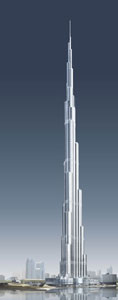
Burj Dubai

Burj Dubai, designed by Skidmore, Owings & Merrill

©Skidmore, Owings & Merrill LLP

The tallest skyscrapers of the 21st century are likely to face obstacles beyond what we can now imagine. Principally residential, concrete-framed, and Middle Eastern or Asian — as opposed to commercial, steel-framed, and North American like their 20th-century predecessors — Carol Willis observed one challenge that’s certain to remain in effect is wind. The higher a tower extends, the stronger the wind, and the more unpredictable. How do you strengthen a structure against wind forces in a place where no one has ever ventured up to measure them?

The portfolio of engineer William Baker, PE, CE, SE, FASCE, already includes one building temporarily considered the world’s tallest, the Petronas Towers in Kuala Lumpur, Malaysia. The Burj Dubai recently passed Petronas, reaching the 128th floor, and in September it will pass Taipei 101 assuming world leadership in height, at least among freestanding land-based structures (offshore oil rigs excluded). Going where no architect or engineer has gone before, Baker recognizes, means confronting unprecedented torsion stresses, wind vortices, stack effects, and other demands. Aeroelastic studies with models and wind tunnels allowed for extrapolation to actual conditions and ultimately to “tuning” of the building, like a musical instrument. Skidmore, Owings & Merrill’s design for the Burj uses spiraling sequenced setbacks, turbulence-enhancing textured cladding, an orientation that reduces the site’s most problematic airflow, and numerous other strategies to “confuse the wind,” manage the periodic rhythms of oscillating vortices, and maintain stability amid the forces encountered above 2,000 feet.

The Burj does not compete with bulky buildings like the Sears Tower in area, measuring roughly 3 million square feet (the Sears has 4.4 million), since its largely residential program calls for a smaller leafspan than a predominantly commercial building requires. (The extremely wealthy tenants who will occupy the Burj’s boutique office spaces also tend to have relatively small staffs.) Express and local elevators are stacked to minimize the proportion of floor space devoted to shafts. The Y-shaped triangular floorplates create greater torsional stability than a square or rectangular design would allow; a buttressed hexagonal core with webs of interior concrete walls throughout the three wings functions as a concrete axle. “Every piece of vertical concrete,” Baker explained, “is part of this giant beam” enlisting gravity for stability. “Gravity is amazingly reliable. If you’re resisting a load with rebar, that’s pretty reliable, but resisting with gravity is about as good as you’re gonna get.”

The exact height of the Burj remains a carefully guarded secret; all published figures Baker has seen are wrong. He pointed out that measuring building height is far from an exact science, citing debate within the Council on Tall Buildings and Urban Habitat over four types of measurement (a new standard may emerge from the International Height Meeting in Chicago, under way at this writing). Regardless of whether spires, antennas, occupied floors, or other factors determine official height, the Burj will stand well beyond its projected competitors for years, at least 2,300 feet — nearly halfway to matching Frank Lloyd Wright’s hypothetical, once-fanciful Mile-High Tower.

The unusually close focus afforded by a three-lecture series on a single building promises to reveal many fascinating aspects of the Burj. If the controversies it has already generated in the socioeconomic realm inspire analyses anywhere near as sophisticated as Baker’s technical presentation, look for some spectacular debates as the discussion moves from how it’s being built to why, and for whom.

Cass Gilbert: A Copycat for All Seasons

Event: Downtown Third Thursday Lecture: Cass Gilbert and History: The Past as Present
Location: New York County Lawyers’ Association, 05.17.07
Speaker: Barbara S. Christen — author, historian, Cass Gilbert scholar
Organizer: Downtown Alliance

Woolworth Building

The neo-gothic style of the Woolworth Building is just one of many of Cass Gilbert’s appropriated modes.

Jessica Sheridan

Architect Cass Gilbert was a style chameleon, varying his design aesthetic based on location and client. According to author and historian Barbara Christen, Gilbert’s ideas were mined from both his European travels and from his extensive library. “On one level he wasn’t that imaginative,” said Christen, showing a photo of the Mausoleum at Halicarnassus next to the similar crown of the U.S. Courthouse at Foley Square, one of many Gilbert appropriations.

New Yorkers might associate Gilbert’s style with the Foley Courthouse, or with the sugary, neo-gothic ornamentation he employed on the Woolworth Building and 90 West Street. But residents of Waterbury, CT, would have a completely different impression of Gilbert’s work, as evidenced by the colonial-inspired brick-and-stone civic and commercial buildings he designed for the town. Oberlin College students might have yet another view of the architect’s work, with several Florentine-influenced building springing from Gilbert’s master plan for the campus. Perhaps it is in the buildings that belong to Gilbert’s partially realized master plans (like those for Waterbury and Oberlin) that his mass style realignments become most evident.

In addition to these wholesale shifts in his design approach, Gilbert managed to interpose seemingly unrelated architectural elements, like a Scandinavian dormer he transposed almost directly from his travel notebooks onto a shingle-style sanatorium building in Connecticut. “He comfortably grafted styles,” said Christen. Proving that perhaps Gilbert’s true talent was for graceful assimilation, a lesson architects today can certainly appreciate.

Young Firms Take Risks for Architecture

Event: Young Architects Forum: Proof
Location: The Urban Center, 05.31.07
Speakers: Benjamin Aranda & Chris Lasch — Aranda/Lasch, NYC; Chaewon Kim & Beat Schenk, — uni, Cambridge, MA
Introduction: David Benjamin — Young Architects Committee
Organizers: The Architectural League of New York

Young Architects Forum

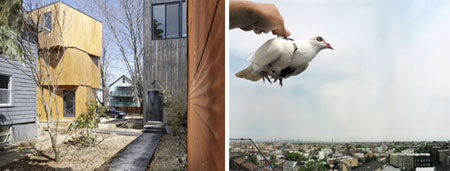
(left): uni’s XS, S, M, and L prototype houses; (right): Brooklyn Pigeon Project by Aranda/Lasch.

uni; Aranda/Lasch

“Risk is the territory of proof,” according to David Benjamin of the Young Architects Committee. Aranda/Lasch takes risks on a conceptual level through an engagement with open-ended explorations of pattern, while design/build firm uni engages risk on a pragmatic level balancing design with construction and development.

From explorations of “forbidden symmetries” found in molecular structure, woven baskets, and infrastructural proposals, Aranda/Lasch argues for an architecture situated within the patterns of natural and urban phenomena — to “get into the dynamic” is their goal, stated Benjamin Aranda. In the Brooklyn Pigeon Project, for example, the patterns of flocking pigeons are recorded through tracking devices and cameras to reframe our understanding of the city. In the Baskets Project, a collaboration with Native American basket weaver Terrol Dew Johnson, systems of pattern making (cultural and mathematical) are again taken as a starting point in an exploration of form. The study of pattern in their work is primarily about “looking at the world around us and breaking it down into phenomena,” claimed Chris Lasch, thus revealing new relationships, and perhaps new means of practicing architecture.

The risks taken by uni, on the other hand, deal with the realization of architecture as building. Taking command of their own destiny, Chaewon Kim and Beat Schenk did not simply open an office; they bought and renovated property until they completed the equivalent of a showroom of residential architecture. Four houses — categorized by size as XS, S, M, and L — function as a laboratory for exploration of domestic functions and materials. Through their design/build efforts they have made a compelling argument for the compatibility of design, real estate development, and straightforward construction.

We Are the Enemy: 2008 WMF 100 Most Endangered Sites

Event: World Monuments Watch: 2008 List of 100 Most Endangered Sites
Organizer: World Monuments Fund

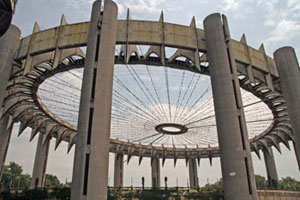
New York State Pavilion

The neglected New York State Pavilion is endangered according to the WMF.

Courtesy World Monuments Fund

This year’s official announcement of the 2008 World Monuments Fund’s (WMF) Watch List begins with cartoonist/environmentalist Walt Kelly’s well-worn quotation — “We have met the enemy and he is us,” underscoring the list’s heightened focus on recognizing man-made threats to the natural and built environment.

The list is the WMF’s call to attention and action for the survival of cultural heritage sites across the globe and is assembled by an international panel of experts in the fields of architecture, archaeology, art history, and preservation, culled from nominations from governments, conservators, site caretakers, NGOs, and individuals. Sites run the gamut and are listed by country and category — global climate change, conflict, economic and development pressures, historic cities, modern architecture, geographical regions of note.

Seven U.S. sites are on the list: Frank Lloyd Wright’s Florida Southern University in Lakeland, FL, due to deterioration and the lack of funds to make repairs; Philip Johnson’s iconic New York State Pavilion built for the 1964 World’s Fair, now a modern ruin; Route 66, the fabled two-lane highway and its deteriorating roadside architecture; Louis Kahn’s Salk Institute in La Jolla, CA, because new construction threatens to ruin the expansive view of the Pacific from the central courtyard; the Tutuveni Petroglyph Site on the Hopi Tribal Land in Arizona, described as the “Rosetta Stone” of Hopi civilization, which has been vandalized; New Orleans, while it struggles to recover its historic sites, faces continued and possibly more severe natural forces; and finally, Main Street, USA, and its body of post-war civic buildings designed in the modern style, now perceived as out-of-date and at risk of being demolished.

On this list, says WMF president Bonnie Burnham, “man is indeed the real enemy, but, just as we caused the damage in the first place, we have the power to repair it.”

Every picture tells a story — and for all of us armchair tourists, there are 100 stories, from Afghanistan to Zimbabwe, of endangered sites to learn about on the WMF website.

Arts & Letters Attendees
John Morris Dixon, FAIA, may be correct in noting that architects are underrepresented in the membership of The American Academy of Arts and Letters (See Architect Numbers Dwindle at American Academy Honors, 05.30.07), and further concerned that fewer attend Academy events, but he missed one — John M. Johansen, FAIA, who was there that evening.
– Christen Johansen, AIA

Notes from the Blogosphere

Postopolis!

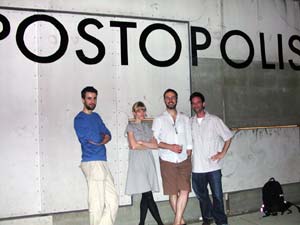
Postopolis! (l-r): Joseph Grima, Director of Storefront for Art and Architecture; Jill Fehrenbacher from Inhabitat; Dan Hill from City of Sound; and Bryan Finoki of Subtopia.

Kristen Richards

Postopolis! — an international exposition about architecture, urbanism, landscape, and design in the blogosphere — was held at the Storefront for Art and Architecture at the end of May. For five days straight this ad hoc convention featured architects, critics, and educators discussing current design-oriented issues relevant to technology and the Internet. The backbone of the event, however, spotlighted the numerous blogs that “expand the bounds of architectural discussion.” While I am an avid reader of design blogs, coming face to face with the web personalities I have encountered over recent years was bittersweet.

Orchestrated by four blogs — Inhabitat (New York), BLDGBLOG (Los Angeles), Subtopia (San Francisco), and City of Sound (London) — many other bloggers were either in attendance or asked to speak throughout the week as well. What surprised me was that most of the individuals behind the blogs are either recent graduates from architecture schools or writers whose backgrounds have nothing to do with architecture. To some extent this makes sense as blogging is a relatively young medium, and I do not believe that critics need to be professionals in the fields they critique. Also, blogging is an outlet for emerging architects whose ideas are not always considered in the firms for which they work.

The description of Postopolis! on Storefront’s website states that blogging’s “influence now spreads far beyond the Internet to affect museums, institutions, and even higher education.” While this statement doesn’t go as far to say blogs are changing the built world, there is an implication.

I think blogging has the potential to affect architecture and urbanism on a larger scale, but this can only occur with more participation from practitioners actively involved in the profession. Maybe there are more professionals who blog out there but were not included in the convention. I did notice a lack of presence from NY-based institutions (no one from AIANY was asked to speak), and there were a couple of professionals who presented their blogs (Tropolism is one, for example). Maybe the word “blog” has a bad reputation for professionals as there can be an assumption that they are snarky and sarcastic without substance.

Blogging is new enough that this reputation can change. If professionals led an ongoing commentary about their experiences designing, constructing, and developing architecture, landscape, and urbanism, the design field, as well as the public, would be more informed. There is certainly room enough online for a more diverse array of opinions.

If you want to read more about what you missed, City of Sound and BLDGBLOG have extensive coverage of Postopolis! Many of the events are also available on You Tube. Finally, Architect magazine is conducting a survey about what blogs/websites you read. If you want to enter, click here, and don’t forget to vote for e-Oculus!

In this issue:
·New Residences Pay Homage to SoHo’s Past
·NYPD Blue’s Station House is in the Pink
·Richard Meier Designs Second Museum in Germany
·NYC Real Estate Brokers Raise $1 Million for Habitat


New Residences Pay Homage to SoHo’s Past

Soho Mews

Gwathmey Siegel’s meticulously detailed façade and floor-to-ceiling windows pay tribute to Soho’s historic cast iron architecture, capturing and reflecting light and shadow as the day progresses.

Gwathmey Siegel & Associates Architects

Construction has begun on SoHo Mews, two independent residential buildings designed by Gwathmey Siegel & Associates Architects linked by a private garden designed by landscape architect Peter Walker, FASLA. Upon completion, the 175,000-square-foot development will contain 68 luxury units — lofts, townhouses, and four penthouses — 4,500 square feet of ground floor commercial space on West Broadway, and underground parking spanning the entire site. With a nod to the neighborhood’s cast iron heritage, the buildings will have a stone base and a curtain wall of metal panels. Recessed, clear, frosted, and fritted glass with horizontal and vertical channels will express the floor slabs and columns. The Art Production Fund (APF), which will occupy a ground floor office and gallery space gratis of developer United American Land, will commission custom works for the public spaces.


NYPD Blue’s Station House is in the Pink

NYPD

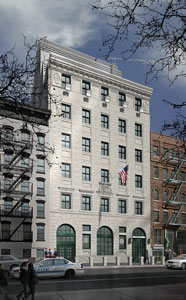
The NYPD’s 9th Precinct Station House.

Courtesy STV Inc.

The NYPD’s 9th Precinct station house on the Lower East Side, which was used as the backdrop for the television show “NYPD Blue,” has been completely modernized by STV Inc. for the Department of Design and Construction (DDC). The cast stone façade of the 1912 building was disassembled and refurbished, block-by-block. The first floor was given new openings and graphics sympathetic with the original design, and a new contemporary interior with two setback floors were added on the top of the building. The interior of the 8 1/2-story, 39,000-square-foot building now has a double height lobby and reception area with aluminum paneling, stainless steel air vents, barrel vaulted ceiling and curved surfaces, and a maple wood wall behind the reception desk. From behind a shoulder height reception desk, officers can view two large CCTV flat screens, which show changing views of the holding cells, elevators, and other areas for prisoners. Large glass panels fill the upper sections of the lobby walls on two sides offering visitors a glimpse of the staff walking along the second floor corridor.


Richard Meier Designs Second Museum in Germany

Arp Museum

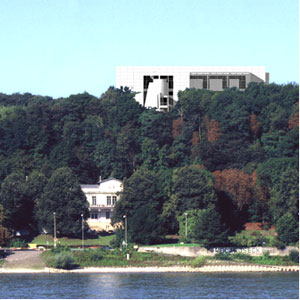
The Arp Museum.

Courtesy Arp Museum

The new Arp Museum, designed by Richard Meier Architects and scheduled to open on September 28, will house a collection of sculpture, drawings, paintings, and textiles by renowned Dada artists and their contemporaries. Situated on a heavily wooded escarpment above the Rhine River and the former Rolandseck railroad station, which now houses the Kumstler-Banhof for the Arts, the complex consists of the Arp Museum proper, a pavilion for temporary exhibitions, a subterranean corridor, and elevator tower connecting the two. Upon arrival, visitors ascend a monumental stair to the special exhibition level. The subterranean corridor leads to the 130-foot-high elevator tower leading to a two-story permanent collection. The main body of the building, clad in enameled metal panels, comprises a set of layered planes facing east, punctuated by glazed and louvered openings with a number of cantilevered balconies affording panoramic views over the Rhine.


NYC Real Estate Brokers Raise $1 Million for Habitat

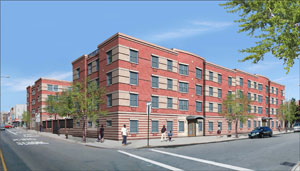
Dattner Architects

Brokers Build is raising money to fund Habitat for Humanity homes in Brooklyn.

Dattner Architects

Brokers Build, an organization consisting of New York’s top real estate brokers, has raised money to build 11 homes in Brooklyn. Designed by Dattner Architects, these homes are part of a three-building development, with 41 units ranging from one- to three-bedroom condos. The project will include energy efficient and environmental design. As per the Habitat for Humanity program, families are required to supply “sweat equity” by participating in the building of their home. Brokers Build is encouraging every broker in the city to donate at least $25.

Residents Rally for Sugar

Don’t Demo Domino

Brooklyn-based band Cheeseburger gets down on the ground to save the Domino Sugar Refinery.

Jonny Leather; Jessica Sheridan

On June 3, community leaders and local rock bands gathered on the Williamsburg waterfront in a benefit “friendraiser” concert to save the historic Domino Sugar Refinery from demolition. Don’t Demo Domino was organized by Act Local in partnership with the Waterfront Preservation Alliance. The complex is about to be rezoned for residential use, and while the organization supports development, it is fighting for a comprehensive preservation program to save the not-yet-landmarked building. The Historic District Council supports saving the complex, calling it “one of the most significant intact industrial sites on the New York waterfront, representing over 150 years of Brooklyn’s industrial past and growth.”

There is still time to sign the petition even if you missed the event. Click here to voice your support.

Van Alen Institute announced the recipients of the 2007-2008 New York Prize Fellowship, including the New York Prize Senior Fellowship winner, curator Hans Ulrich Obrist, and the 2007-2008 New York Prize Fellows: Soo-in Yang and David Benjamin, NYC; Jennifer Toy and Chelina Odbert, Cambridge, MA; Joerg Stollman and Dirk Hebel, Zurich, Switzerland; Ellen Grimes, Chicago; and John Stuart, Miami Beach…

Architects/Designers/Planners for Social Responsibility (ADPSR) honored its 2007 Lewis Mumford award winners in three categories — Peace: People’s Institute for Survival and Beyond; Environment: Coalition to Restore Coastal Louisiana; and Development: Neighborhood Partnership Network

Recipients of the 2007 Society for College and University Planning/AIA-Committee on Architecture for Education (SCUP/AIA-CAE) Excellence in Planning, Excellence in Landscape Architecture, and Excellence in Architecture Awards include Dirtworks Landscape Architecture, Honor Award for Excellence in Landscape Architecture; and Gluckman Mayner Architects, Honor Award for Excellence in Architecture for Renovation or Adaptive Reuse…

First prize winners for “Envisioning Gateway: A Public Design Competition for Gateway National Park” are Brooklyn-based Ashley Scott Kelly and Rikako Wakabayashi. NY-based honorable mention winners include Archipelago Architecture and Landscape Architecture; Christopher Marcinkoski and Andrew Moddrell of loop|8; and Frank Gesualdi and Hayley Eber

The Board of Directors of Perkins Eastman announced that architecture and design students from Carnegie Mellon University and Cornell University have been selected as the recipients of the firm’s first Shanghai Scholarship Program…

Madelyn Wils has joined New York City Economic Development Corporation (NYCEDC) as an Executive Vice President, leading its Development and Planning division… The Historic Districts Council elected Queens preservationist Paul Graziano as the organization’s sixth president…Cosentini Associates announced the appointment of K. Brett Malak as Director of Cosentini Lighting Design… Edith Robles has joined BBG-BBGM as Public Relations Director…

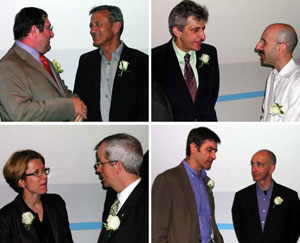
2007 AIA Fellows Reception (05.29.07): white roses for all

Fellows Fete

Clockwise: Mustafa Abadan, FAIA, and Henry K. Stolzman, FAIA; Paul Katz, FAIA, and Adam Yarinsky, FAIA; D.B. Blake Middleton, FAIA, and Roger F. Duffy, Jr., FAIA; Margaret Sobieski Rietveld, FAIA, and Frank James Greene, FAIA. Absent: Calvin Tsao, FAIA.

Kristen Richards

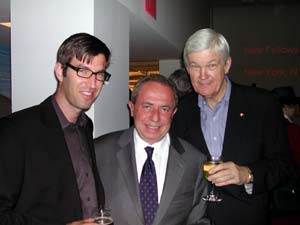
Arad, Frankl, McCullar

(l-r): Michael Arad, AIA, Andy Frankl, Ibex, and James McCullar, FAIA.

Kristen Richards

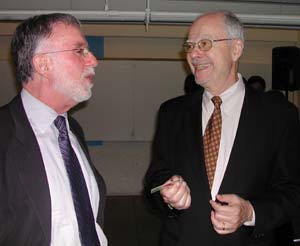
Tomasetti, Dixon

Richard Tomasetti, Hon. AIA, and John Morris Dixon, FAIA.

Kristen Richards

Tomasetti, Nadel

Richard Tomasetti, Hon. AIA, and Barbara Nadel, FAIA.

Kristen Richards