Oculus 2007 Editorial Calendar
If you have ideas, projects, opinions — or perhaps a burning desire to write about a topic below — we’d like to hear from you! Deadlines for submitting suggestions are indicated; projects/topics may be anywhere, but architects must be New York-based. Send suggestions to Kristen Richards.
09.07.07 Winter 2007-08: Power & Patronage

06.15.07 Tour Proposals: 2008 AIA Convention Tours
The 2008 AIA Convention will be held in Boston, MA, May 15-17, 2008, and Community Design Resource Center of Boston (CDRC-Boston) is working with host chapter, Boston Society of Architects/AIA (BSA), among other planners and organizations, to develop tours that will engage design professionals and community members. To submit tour ideas click the link.

07.01.07 Session Proposals: 2008 AIA Convention Continuing Education Sessions
CDRC-Boston and BSA are also developing events and sessions for continuing education credits for the 2008 AIA Convention. If you would like to develop an event or session proposal with CDRC-Boston as a co-sponsor, e-mail Brandy or call 617-585-0198.

07.31.07 Submission: LEAF Awards
Now in their fourth year, the LEAF Awards 2007 honors architects who are designing buildings and solutions that set benchmarks for the international architectural community. This year the LEAF Awards will recognize the strategic importance, impact, innovation, and practical developments in 11 award categories that both challenge and change the way we consider and evaluate buildings. Projects both new and yet to be completed are eligible, and all companies, individuals, and technologies may enter.

02.29.08 Submission: Holcim Foundation Awards
The Holcim Foundation has launched its second awards competition for sustainable construction projects. The $2 million competition celebrates innovative, future-oriented, and tangible sustainable construction projects internationally. Construction projects must be in an advanced stage of design by the competition deadline; construction may not have started before June 1, 2007. A commemorative book on the first Holcim Awards competition and a booklet on the target issues for sustainable construction are available. More details about the competition will be announced later in the year, and sent directly to you as a subscriber to the Holcim Foundation e-mail newsletter.

Architect Numbers Dwindle at American Academy Honors

Event: American Academy of Arts and Letters 2007 Awards Ceremony
Location: American Academy of Arts and Letters, 05.15.07
Organizers: American Academy of Arts and Letters

American Academy of Arts and Letters

Courtesy American Academy of Arts and Letters

While sparsely represented in the American Academy of Arts and Letters’ membership and awards in general, architects were even further under-represented at this year’s awards ceremony. Every year, architectural achievement is celebrated at the Academy along with figures in literature, fine arts, and musical composition.

Among the nine inductees to the Academy membership this year (a number determined by those of the fixed membership who are no longer with us), the sole architect was Billie Tsien, AIA, who has been producing remarkable buildings with her partner-husband Tod Williams, FAIA. We all know their American Folk Art Museum on West 53rd Street, and some of us have had the pleasure of experiencing their Neurosciences Institute in La Jolla and Phoenix Art Museum. All their work has been joint, but Academy memberships can only be held by individuals, and Tsien is certainly a deserving individual.

Receiving the Academy’s annual Arnold W. Brunner Memorial Prize for Architecture was Eric Owen Moss, FAIA, known mainly for his idiosyncratic adaptations of old industrial buildings in the L.A. suburb of Culver City for the use of high-tech and otherwise hip companies. His adventurous scheme for renovating the Queens Museum of Art was dropped two years ago, and Grimshaw/Ammann and Whitney commissioned for a more modest redo.

Among this year’s 20 winners of Academy Awards (any academy has a right to this phrase) were three architects. Wes Jones of L.A. was cited for works that “celebrate the materials and methods of industrialized production while transforming them into performative instruments that illuminate and give meaning to the human condition.” (How’s that for archi-speak?) Thomas Kundig, FAIA, of Seattle was honored for elegant reinterpretation of Northwest materials, details, and forms (to freely interpret the official jargon). Lebbeus Woods, “an architect-visionary” (says his citation) has long been producing images that are essentially art works on architectural themes.

Among visual artists recognized this year by the Academy was one who has carried out remarkably successful collaborations with architects, Martin Puryear. Recipient of this year’s Gold Medal for Sculpture, Puryear has worked beautifully with Mitchell/Giurgola Architects and Michael Van Valkenburgh on the lobby and courtyard of the New School for Social Research and on the lighting pylons for the Battery Park City waterfront. His work in the current Academy show is in itself worth the trip to 156 Street.

While the membership roster includes such names as Pei, Cobb, Meier, Eisenman, Gwathmey, Gehry, Pelli, and Polshek among its 16 architects, the only ones visible were the new inductee Tsien, the ever-energized Hugh Hardy, FAIA, and Steven Holl, AIA, the Academy member who very effectively presented this year’s architectural honors. If architects want to maintain their standing in this “arts and letters” organization, more of them ought to be visibly involved.

All architects recognized this year have mounted exhibitions at the Academy’s annual show, on view at 633 West 155 Street through June 10 (Thu-Sun, 1-4pm).

Foster Locks Lips with Modern History

Event: Building with History: How the Old and the New Can Co-exist in the Modern World
Location: The Metropolitan Museum of Art, 04.24.07
Speaker: Lord Norman Foster, Hon. FAIA
Organizer: World Monument’s Fund

Hearst Tower

The Hearst Tower represents two eras embracing each other, says Lord Foster.

Kristen Richards

“Once upon a time there was a beautiful courtyard park,” said Sir Norman Foster, Hon. FAIA, referring to the Great Court at the British Museum, one of London’s long lost public spaces. After the museum was completed in the mid 19th century, the space was filled in with a reading room, and later was used for storage. In 2000, Foster + Partners “reinvented” the space, restoring the reading room and adding a glazed canopy, making it the largest enclosed public space in Europe.

Not quite a year ago, the World Monuments Fund (WMF) launched Modernism at Risk program to address the fact that less than a century after their design and construction, Modern buildings are routinely abandoned, disfigured, or demolished, in many instances because of public indifference. This series of lectures is part of the advocacy program for the initiative and Lord Foster, a champion for preservation and reuse of historic buildings, was the first speaker.

Foster + Partners has designed many projects that illustrate how to extend the life of significant historic buildings, monuments, and public spaces. Speaking of the Reichstag, completed in 1999, he spoke of peeling back every historic layer to uncover the building’s intention and preserve time’s imprint, such as mason’s marks, graffiti left by the conquering Russians, and other war scars. The building has since become a living museum of German history as well as a realization of a modern parliament.

Recalling when he began designing the Hearst Tower, Foster’s idea to hollow out its historic shell was met with opposition. He was not only told it was impossible, but accused of “façadism.” The result, as seen the following night at a reception in Hearst Tower lobby for architects and designers in support of the WMF Modernism at Risk initiative and with Lord Foster in attendance, was an example of his belief that each age makes its own mark. There can be a dialogue between the old and the new — and in the words of Lord Foster speaking about the Hearst Tower’s era-jumping components, “one kisses the other.”

Energy Neutrality Proves to be Sponge-Worthy

Event: Mixed Greens lecture:”Zero-Energy Tower, Guangzhou”
Location: New York Academy of Sciences, 05.08.07
Speakers: Roger Frechette, PE, LEED-AP — Director of MEP Engineering, & Russell Gilchrist, RIBA, — Director of Technical Architecture, Skidmore, Owings & Merrill; Carol Willis — Director, Skyscraper Museum (introduction)
Organizer: Skyscraper Museum

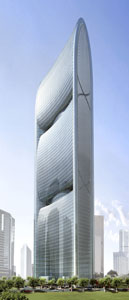
Pearl River Tower

The Pearl River Tower aims for energy neutrality by taking cue from sponges.

Skidmore, Owings & Merrill

The two complementary professions of engineering and architecture gain immeasurably from hearing each other’s languages and concerns. Anatomizing a single building (the Pearl River Tower in Guangzhou, China, scheduled for completion in mid-2009) allows a view into the interlinked processes behind high-performance design. The Skyscraper Museum’s Mixed Greens series concluded with a Skidmore, Owings & Merrill engineer/architect tag-team presentation.

Roger Frechette, PE, LEED AP, began by walking through some of the facts that make sustainable design a priority, particularly the shares of total energy and electricity that buildings consume nationally (40% of the former and 71% of the latter). Overall, because buildings generate as much carbon as transportation and industry combined, Frechette says, “form for the sake of form is no longer good enough.” Borrowing biomimicry principles from Janine Benyus’s work and applying them to new designs, Frechette described four levels of energy processing developed by SOM’s engineers: reduction in consumption; reclamation of lost energy for reuse; passive absorption of natural energy flows such as wind, sun, and water; and generation of power. Sponges, which conduct moisture efficiently, provide habitats for thousands of other species, and channel light through fiber-optic-like microfilaments in their external spicula, offer natural models of structures that can help a building meet the environmental challenges of hot, muggy, heavily-polluted Guangzhou.

To reduce dependency on external power, the Pearl River Tower uses many tricks in the book: 32 different conservation systems, including underfloor air, German-style chilled ceilings, double walls to create ventilation cavities, and non-symmetrically arrayed photovoltaics — a feature that the engineers preferred but the architects had to warm up to (“To achieve optimum performance,” Frechette commented, “you don’t often end up with a symmetric answer”). The building’s orientation defies aerodynamic orthodoxy, turning its wide side to the prevailing southern wind and channeling air into turbines. Since turbine power is a cube function of air velocity, the high winds that typically surround a skyscraper become an energy asset instead of a problem. Placing the turbines on mechanical floors also frees up rentable square footage, as does a compressed floor-to-floor height, allowing five extra stories without sacrificing floor-to-ceiling space.

The Pearl River Tower is a proof-of-concept project for a true energy-neutral building. It’s easily the world’s most efficient tall building, cutting power consumption by 58% over the baseline case and reducing carbon dioxide generation from 20 billion pounds to less than 9 billion. But it only suggests the potential for a building to attain that fourth step and return more power to the city grid than it consumes. In a different site with a less harsh climate (and perhaps more cooperative local utilities), Frechette conjectured, results would be even better. Because the tower is classified as commercial rather than industrial, regulators disallowed a set of highly efficient microturbines that could generate power from either natural gas or methane, along with heat for water — cleanly, more reliably, and more efficiently than Guangzhou’s grid. (The design preserved space for the microturbines anyway, in case the officials change their minds.)

Russell Gilchrist, RIBA, breaking down the various performance benchmarks economically, pointed out that the tower’s multiple economies allow recovery of the up-front sustainable-technology premium in 4.8 years, becoming a net revenue generator for at least 20 years beyond that point. With a financial incentive like that, the challenge to achieve a zero-energy skyscraper is squarely on the table.

Young Architects Test Their Boundaries

Event: Young Architects Forum: Proof
Location: The Urban Center, New York City, 05.17.07, 6:30
Speakers: Ivan Hernadez Quintela — ludens productions, Mexico City; Carlos Bedoya & Wonne Ickx & Victor Jaime & Abel Perles — PRODUCTORA, Mexico City
Introduction: Lisa Hseih — Young Architects Committee
Organizers: The Architectural League of New York

Museum of Contemporary Art in Lima

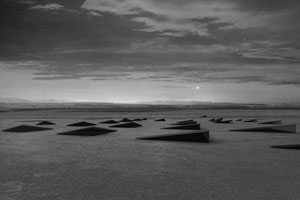
PRODUCTORA’s Museum of Contemporary Art in Lima, Peru, is buried under the desert sand.

PRODUCTORA

“Architectural practice is a process of persistently testing and reworking hypotheses continually moving toward ‘proof’,” posits Lisa Hsieh of The Architectural League of NY’s Young Architects Committee. Ludens and PRODUCTORA, two of this year’s selected architectural practices for the Young Architects Forum, both from Mexico City, embody this notion of testing through the exploration of boundary and representation in architecture.

Architecture is an “excuse for interaction” for Ivan Hernadez Quintela of ludens productions. Locating this interaction in a “space of friction,” Quintlela attempts to define the boundary between intimate space and the public realm and spur interaction among individuals. Demonstrating that architecture is incomplete without participation, the See-Saw Table alternates the positions of two participants between eating (lower and closer to the table) and talking (higher and away). Likewise, in some of his public furniture, such as a bench shaped like a spinning top, the interaction of multiple users is required to balance the shifts as each additional person gets involved. The result is equilibrium that is constantly recalibrated through a social and physical negotiation of space.

Boundary is more a question of representation than of social interaction in the work of PRODUCTORA. As inhabited and gradated thresholds, boundaries are experiential. In their proposal for the Tsunami Memorial Site in Oslo, Norway, a simple, abstract pathway that cuts into the land and hovers above the water represents the fragile relationship between culture and nature. In a proposal for the Museum of Contemporary Art in Lima, Peru, PRODUCTORA buries the project in its desert site. By organizing the museum as a hypostyle hall of various-sized columns that scale diagonally from one corner to the other — as thin columns to a series of “inhabitable columns,” their proposal re-presents the history of museums as dialogue of spatial typologies.

The testing of boundaries found in the work of both ludens and PRODUCTORA highlights the boundary as a fundamental condition for architecture while simultaneously questioning its very authority. The resultant “Proof” in the work of these practices then, is never final or determinant.

Leslie Koch, President, Governors Island Preservation and Education Corporation (GIPEC)

The Park at the Center of the World: Five Visions for Governors Island opens Thursday, May 31, at the Center for Architecture (See On View At the Center for Architecture). e-Oculus had the opportunity to sit down with Leslie Koch, President of (GIPEC) to talk about the five finalist entries, the exhibition, and future development on the island.

There will be a panel discussion about the exhibition at the Center on June 11, 6:00pm; a public forum at the Fashion Institute of Technology June 20, 6:30pm; park tours organized by the Governors Island Alliance take place June 21 and June 27, 5:00pm; and a walking tour and scavenger hunt with the Center for Architecture Foundation will happen August 11, 9:45am. Go the AIANY website for more information on all of these programs.

e-Oculus: How do you see the parks on Governors Island being unique and unlike other city parks? What activities do you see happening on the island? What will attract New Yorkers as well as tourists to the island?
Leslie Koch: The experience of traveling to the island by boat and enjoying its views and green spaces offer a unique “holiday” for New Yorkers and visitors. The parks will be designed for the unique island location at the heart of New York Harbor. We envision many activities for children and families (water play, picnicking, exploring), active recreation (biking, walking, lawn sports) and programming such as water-based and ecological activities, music, performance and public art, and festivals.

e-O: There are three main features to the GIPEC master plan — the Great Promenade, Summer Park, and the restoration of the Historic District. Please describe these aspects.
LK: The 2.2 mile Great Promenade around Governors Island will feature unsurpassed views of Lower Manhattan, Brooklyn, New York Harbor, and the Statue of Liberty. The new park on the South Island will be a “Summer Park” oasis in the city full of active recreation choices and activities that appeal to families and children. The northern Historic District is a green, civic space surrounded by historic homes and buildings dating from 1810 shaded by a verdant mature tree canopy. Design teams will rejuvenate these spaces while respecting their historic character.

e-O: What types of infrastructure will be developed to help facilitate getting people to and around the island?
LK: The passenger ferry access to and from the island will be augmented with frequent service from Lower Manhattan and other embarkation points in the harbor. We are exploring the feasibility of an aerial gondola connecting Governors Island, Brooklyn, and Manhattan.

On the island, there will be a fleet of green vehicles providing public shuttle service. GIPEC is considering a special “free” or low-cost bicycle program for transportation and recreation on the Island.

e-O: How does the GIPEC master plan fit in with Mayor Bloomberg’s plaNYC 2030? Were the teams that responded to the RFP and RFQ required to incorporate plaNYC into their proposals?
LK: GIPEC is committed to sustainable development and green design meeting the policies advanced by both the City and the State. Many of GIPEC’s sustainability goals were laid out in the design guidelines given to the competition teams. Sustainable site planning, reduced energy usage, landscape and habitat enhancement, reduction of wastewater treatment, use of environmentally appropriate materials, and solid waste management are all areas GIPEC will develop with the winning design teams. The teams were required to offer innovative, sustainable, and practical park design proposals, and they responded with a wide variety of ideas including ones addressing energy use, carbon emissions, and storm water management.

e-O: What distinguished the five final teams from other entrants?
LK: The five finalist teams exhibited a nuanced understanding of the island’s special circumstances and its design and programming opportunities. Each of these teams has worked on important public projects and done excellent design work in the past.

e-O: Discuss the selection process.
LK: A jury of design professionals, government officials, and citizens will review the design proposals and make a recommendation to GIPEC. GIPEC will select a team, not a scheme, and will work with public input to design the open spaces. The selection criteria were outlined in the RFP and include: Vision, Design Approach, and Quality of Work Product; Methodology; Relevant Past Experience and Expertise; Feasibility and Cost Effectiveness; Fee; Staff/Team; and Compliance.

e-O: What do you want exhibition-viewers to take away from the exhibition?
LK: GIPEC wants them to understand the exciting possibilities of the island coming back to life through a series of great design and programming visions. We’d like the viewers to visit the island to see for themselves what an extraordinary site this is for a once-in-a-lifetime project. And we’d like to hear reactions from viewers on the website.

e-O: Describe the timeline of development. When will a team be selected, when will construction start, when will the master plan be complete?
LK: GIPEC intends to select a park design team this summer and to begin the design process in the fall. The start of construction will be dependant on many factors including public funding and public review of the project. The public open space designs will be incorporated into the overall master planning for the island, which is ongoing.

Conventional Wisdom: Architects Grow Beyond Green

The AIA 2007 National Convention and Design Expo in San Antonio, which drew over 21,000 attendees, was packed with many exciting events and activities. Aside from the chronic humidity and heat that is native to San Antonio, the convention was a great success.

Gore: Architects Are Leaders
Former Vice President Al Gore
‘s sustainability-themed keynote speech on Saturday afternoon was an inspirational call to architects to solve the global climate crisis. He urged us to “find the power to affect the world around us,” and be aware of “the new alignment of forces emerging in our civilization.”

Gore told the crowd of about 5,000: “Society perceives value in the marketplace. Don’t get tired; you’re needed more than ever. We’ve been operating Planet Earth like a business in liquidation; that’s about to come to a stop. Architects will solve this, especially where communities take a more forceful and visible role through affecting change in advocacy. Architects are leaders,” the Oscar-winning ex-pol declared.

Gore hit his stride at the end of his speech. “The next generation will ask, ‘Were they paying attention? Didn’t they care? What were they thinking?’ or they will ask another question: ‘How did they find the uncommon moral prerogative and rise to meet that challenge?’ The choice is ours. Civilization is asking you to play a leading role in solving this crisis. The Greatest Generation won World War II, and was transformed by that crisis. They gained the moral authority to take the long view… Darfur, HIV, AIDS, the pillaging of our fisheries and rainforests, these are moral imperatives disguised as problems. We will find our moral authority and vision to get our act together and not to turn a deaf ear, to become the next greatest generation, except for the political will, but that too is a renewable resource,” Gore concluded, to thunderous applause and a standing ovation.

Designing the Sustainable Workplace in the Civic Environment
I moderated a panel (SA13 on the AIA website) featuring Pritzker Prize Laureate Thom Mayne, FAIA, former GSA Chief Architect, Skidmore, Owings & Merrill (SOM) Washington D.C. Director Ed Feiner, FAIA, and SOM NY office Senior Design Partner, Gary Haney, AIA, discussing the impact of sustainability and design for federal and public projects. Mayne’s dramatic images of the San Francisco Federal Building and other current work worldwide captivated the audience. Feiner provided context of the goals and constraints faced by a federal client seeking to implement design excellence. Haney presented the U.S. Census Building, with a series of spectacular images (See Architectural Record, March 2007).

Sins of Omission: Unfortunately, Mayne’s presence on this panel was not well publicized, which was a disservice to the membership. I attribute this to the fact that panelist names were not noted with the session descriptions in the convention catalogue or on the session website pages, which also made selecting sessions more challenging. I have indicated to AIA that this should be corrected next year, but received a noncommittal response. I encourage everyone who would like to see speakers included with session descriptions in next year’s catalogue to add this to your online session evaluation comments. Additionally, contact AIA Continuing Education, the 2008 Convention Committee, and our AIANY Regional Directors Leevi Kiil, FAIA, Peter Arsenault, AIA, and Dennis Andrejko, AIA. Perhaps if there is enough member feedback, this will be fixed.

Working the Rooms
Wednesday night, Communities by Design hosted an event at a sprawling private home with the Mayor of San Antonio, 2007 AIA National President RK Stewart, FAIA, and other AIA leaders past and present. Many attendees had been to the Citizen Architect program earlier, highlighting the role of architects in civic organizations and politics. The Architect’s Newspaper party attracted many New York Chapter members, who celebrated the installation of the “New Practices New York” showcase exhibition. Thursday, the AIA New York State party, held at an historic theater downtown, attracted many New Yorkers, as well as all the national AIA candidates.

Friday morning’s Architectural Record breakfast, announcing the best ads of the year, featured a panel that once again included Frederic Schwartz, FAIA. Later, Jeremy Edmunds, Assoc. AIA, PE, LEED AP, moderated an informative session with former congressman and Ambassador Richard N. Swett, FAIA; and President and CEO of the Congress for New Urbanism, former Milwaukee mayor, and AIA National Public Director John Norquist, Hon. AIA. The Fellows Investiture was held outdoors at the Alamo. The backdrop was architecturally significant, and the heat barely put a damper on a very special event for all the new Fellows.

Saturday’s Fellow’s Luncheon was held at a stately former train station not far from the Convention Center. We welcomed 1995 AIA National President Chet Widom, FAIA, of Los Angeles, as the new 2008 College of Fellows Secretary on the COF Executive Committee. There was just enough time to return for Al Gore’s speech, and then get ready for the Fellows Dinner. Aside from being elevated to Fellowship, few experiences are more gratifying than seeing your friends, colleagues, and those you helped, receive their Fellowships, and celebrating their personal milestones at this special event. I had that privilege in San Antonio.

ICFF Cuts Edge of Design

Usually when the International Contemporary Furniture Fair (ICFF) is in town I look forward to the more progressive expositions off-site from the Jacob K. Javits Convention Center. This year, for example, I was looking forward to Haute Green, an exhibition of “the best in sustainable design for the contemporary home” in Chelsea. Unfortunately, Haute Green fell short of my expectations. With 58 featured designers, I was expecting cutting-edge design that fully considered what it means to be green. Yes, there were a lot of recycled materials and compact fluorescent light bulbs. But overall I felt as if many of the pieces did not thoroughly explore all aspects of sustainability — every part was not necessarily made of green materials, manufacturing processes were not always taken into account, the recyclability of the pieces was seldom investigated.

If organizers are going to arrange for a separate “cutting-edge” exposition, they should be extra selective with the designers they choose. In general, Haute Green included designers who were taking their first stab at green design, and their amateurism showed.

The ICFF, on the other hand, surprised me with its range of designs. Instead of just showcasing high-end “yuppie” furniture, which has been my impression previous years, there was variety in furniture types and designers. There were booths for children and pet furniture; emerging designers were featured in addition to the usual celebrity bigwigs. Designboom, an organization for emerging designers, allowed designers to sell products. Green design was featured at many booths, including the Next Generation award winners’ Metropolis booth. Overall ICFF was a success, and hopefully next year the trend will continue incorporating more diversity in price range and design.

In this issue:
·Library Dusts the Old and Shines the New
·SVA to offer a Master of Fine Arts in Design Criticism
·The Scent of Performance
·Be@Williams — a New Kind of Downtown Address
·A More Inviting Entrance for a Hospital


Library Dusts the Old and Shines the New

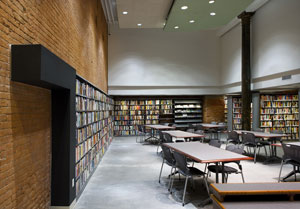
NYPL’s new SoHo branch.

NYPL’s new SoHo branch.

Rogers Marvel, courtesy NYPL

The New York Public Library opened its first SoHo branch in an 1886 building (originally a chocolate factory). The $6.1 million renovation, designed by Rogers Marvel Architects, made use of the building’s existing cast iron columns, underground vaults, and brick archways, and added new elements of wood and metal to create a dynamic contrast of old and new. The 12,000-square-foot, three-level library accommodates a wide range of library resources, including extensive collections and an advanced infrastructure for library technology. Design features include a dramatic stair that connects the spaces and brings natural light downstairs. The vaulted area outside the lower level windows is also lit, providing a subterranean view.


SVA to offer a Master of Fine Arts in Design Criticism
Beginning in the fall of 2008, the School of Visual Arts (SVA), will offer the country’s first graduate-level degree program dedicated to critical writing about design. The two-year, 64-credit curriculum will provide tools for researching, analyzing, evaluating, and chronicling all aspects of design. The program is for students who wish to write about design on a full-time, professional basis, or pursue alternative critical practices, such as curating, publishing, or teaching. Writer, critic, and educator Alice Twemlow, will chair the new department, and faculty will include writers and designers including Kurt Andersen, Paola Antonelli, Michael Bierut, Ralph Caplan, Peter Hall, Jessica Helfand, Karrie Jacobs, Julie Lasky, Cathy Leff, Phil Patton, and Steven Heller. For more information, see the SVA website.


The Scent of Performance

Fully Manicured Raw Spots

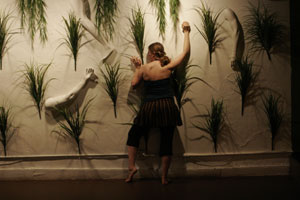
Fully Manicured Raw Spots, set design by Illya Azaroff, Assoc. AIA, Design Collective Studio.

Maribel/Liquid Video Artistry, Dixon Place 2007

The Design Collective Studio has designed the set for Fully Manicured Raw Spots, a performance choreographed by Wendy Blum of blum dance theatre, composed by Justin Mullens. Evolved from an investigation of the architecture of interruptions, according to Director of Design at the Design Collective Studio Illya Azaroff, Assoc. AIA, an interplay of crassness, vulnerability, and begrudging interdependence plays out in a quartet and two back-to-back duets. “Individual idiosyncrasies transform into aggressive buffoonery. The sounds and scents of popcorn, garlic, and onions being cooked onstage infuse the living room theater to rouse the link between smell and memory in this evening-length event. Among other things, the powerful aromas address one way of recalling dance by olfactory association.” Performances at Danspace will occur in March 2008.


Be@Williams — a New Kind of Downtown Address

Be@Williams

Be@Williams.

Perkins Eastman

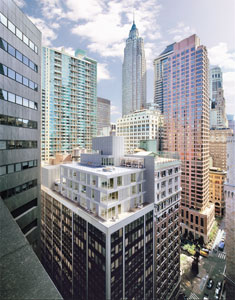
The latest addition to SDS Procida’s line of residential properties branded as “be@,” and geared for young, social, urban professionals has been completed at 90 Williams in the Financial District. The circa 1960s, 16-story office building was transformed by Perkins Eastman into a 113-unit boutique condominium residence. Throughout the 112,000-square-foot building, interior partitions were cleared for new apartment layouts, maximizing the building’s deep volume to create generous new spaces for loft-style studios, one-, and two-bedroom units. A new steel and glass penthouse rooftop addition houses a gym, recreation lounge, outdoor terrace, and outdoor bar. In addition to designing the interiors of the public amenity spaces and ground floor entrance lobby, the firm created the interiors of the model apartments.


A More Inviting Entrance for a Hospital

Columbia Memorial Hospital

Columbia Memorial Hospital entrance.

Donald Blair & Partners Architects

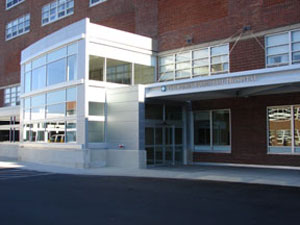
As part of their investment in new facilities and equipment, Columbia Memorial has completed its new front entrance addition, lobby, and central sterile/supply expansion, designed by Donald Blair & Partners Architects. The hospital, located in Hudson, NY, serves more than 100,000 residents in Columbia, Greene, and Dutchess counties. The previous hospital entry afforded visitors no protection from inclement weather, nor was it handicap-accessible. The new light-filled double-height entry space and lobby designed with aluminum, glass, and wood complements the hospital’s 1998 Emergency Department wing. Below the covered canopy area, the basement level was expanded providing space required for the central sterile/supply. The project was timed in conjunction with the construction of a new Medical Office Building, which is connected to the existing hospital and new entry way by a two level pedestrian link. The firm has been working with the hospital since 1999 and is responsible for the design of a patient wing, radiology renovation, and hospice renovation.

It’s Open Season at Governors Island

Governors Island has published its Summer 2007 schedule. Opening June 2, visitors will be able to visit both Saturdays and Sundays through September 2. The Governors Island Preservation and Education Corporation (GIPEC), along with the National Park Service (NPS), will provide a variety of public activities that will showcase the Island’s historic past and future. Summer programming will kick-off with a Family Festival on June 2, and includes a Saturday concert series in July and August, a cultural festival, musical and theatrical performances, among other activities. For the first time, the entire 92-acre National Historic District will be open for visitors with tours provided by NPS. For more information, click the link.