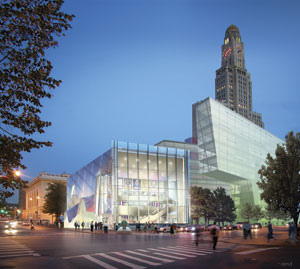
Cooper-Hewitt National Design Museum announced the winners and finalists of the 2007 National Design Awards. NY-based firms and designers: in Interior Design, the winner was Lewis.Tsurumaki.Lewis, with finalists David Rockwell, AIA, and Tsao & McKown Architects. Enrique Norten, Hon. FAIA, was a finalist in Architecture Design. In Communications Design, finalists were C&G Partners and Paula Scher. In Landscape Design, finalists were Field Operations and Ken Smith, ASLA. And the Design Patron winner was Maharam

The NYC Department of Buildings received the 2007 Sheldon Oliensis Ethics in City Government Award, an annual award given by the New York City Conflicts of Interest Board (COIB) to a New York City agency that demonstrates a commitment to the promotion of ethics and integrity…

NYU has selected a team to partner with in its strategic planning initiative, NYU 200, including SMWM, Grimshaw Architects, Toshiko Mori Architect, and The Olin Partnership.

The Cincinnati Art Museum announced the short list for its campus enhancement
and expansion project including NY firms Diller Scofidio + Renfro and
Smith-Miller & Hawkinson

NELSON, an international architecture, interior design, strategies, workplace services, engineering and information services firm, has reached an agreement in principle to merge with two NY-based firms, A/R Environetics Group and Furnstahl & Simon Architects… Swanke Hayden Connell Architects (SHCA) has named John Jappen a Principal of the firm…

James Estrin/The New York Times/Redux

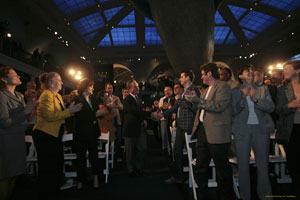
Mayor Bloomberg shakes hands with Chris Garvin, AIA, COTE co-chair at his Earth Day presentation of plaNYC 2030.

James Estrin/The New York Times/Redux

ICFFscape

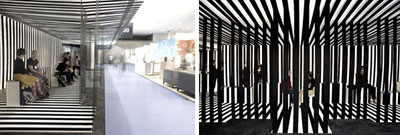
This year’s International Contemporary Furniture Fair included a bar and lounge, ICFFscape, designed by Parsons the New School for Design students.

Courtesy Parsons the New School for Design

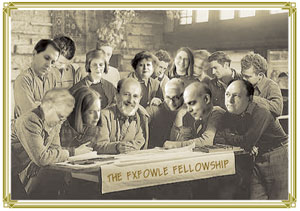
FXFelowship

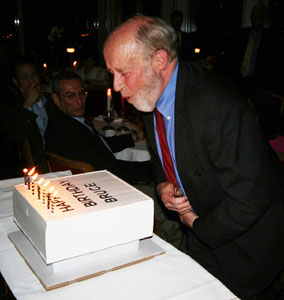
On the 70th birthday of Bruce Fowle, FAIA, FXFowle held a party. In his honor, a poem was presented. Here is a snippet: We owe Bruce Fowle much thanks tonight. / Bringing us together seems so Wright. / Let’s raise our glass with a cheering howl. / And acknowledge the “Fellowship of Fowle.”

Courtesy FXFowle Architects

Bruce Fowle, FAIA

Bruce Fowle, FAIA, blows out the candles on his birthday.

Courtesy FXFowle Architects

Oculus 2007 Editorial Calendar
If you have ideas, projects, opinions — or perhaps a burning desire to write about a topic below — we’d like to hear from you! Deadlines for submitting suggestions are indicated; projects/topics may be anywhere, but architects must be New York-based. Send suggestions to Kristen Richards.
09.07.07 Winter 2007-08: Power & Patronage

08.17.07 Registration Extension: Columbus Re-wired: Visions for Intersections
AIA Columbus, in partnership with AIA National, is sponsoring three community charrettes which will culminate in an international competition focusing on the current and future state of public transportation in Columbus, OH. Generating dialogue about public transportation, special emphasis is on illustrating how multiple transportation modes can work together to provide a complete network connecting citizens with their community and sparking economic development.

Bloomberg Bets Prosperous Future

James Estrin/The New York Times/Redux

Mayor Bloomberg shakes hands with Chris Garvin, AIA, LEED AP, COTE co-chair at his Earth Day presentation of plaNYC 2030.

James Estrin/The New York Times/Redux

With a record population, a booming economy, and an aging infrastructure, Mayor Bloomberg’s PlaNYC 2030 proposals unveiled on Earth Day constitute a comprehensive, ambitious vision for the city’s future. On par with earlier civic investments that built New York’s parks, subways, bridges, and waterworks, the Mayor’s plan represents the kind of long-range planning the city needs to prosper in the 21st century.

New York’s existing buildings are the source of 79% of our carbon dioxide emissions, and account for more than half of our energy demands, according to the Inventory of NYC Greenhouse Gas Emissions recently completed by the Mayor’s office. For the building community, the plan’s most far-reaching proposal is to upgrade the energy efficiency of large existing buildings — most of which would not meet today’s energy code — with mandates and incentives. This may include upgrades for lighting and mechanical retrofits, improvements to wall and roof insulation, and replacement of old components with high performance windows and high-efficiency condensing boilers.

As we upgrade our existing buildings, it is also critical to address new construction. The new building code that will take effect this summer includes many green improvements, but the Mayor’s plan identifies even more impressive targets for the next update. The proposals include financial incentives for buildings that exceed state energy codes and water efficiency requirements by 30% to 40%, making them some of the greenest buildings in the country. Through pilot programs, the city can play a vital role in introducing such leading-edge technologies.

By taking a comprehensive, integrated approach to intertwined issues — affordable housing, environmental justice, mass transit, environmental quality, green job creation, and climate change — Mayor Bloomberg’s plan is a bold step toward sustainable prosperity. AIA members should encourage their local and state leaders to support PlaNYC as a vision for a greener future. As important as its specific goals are, the overall benefit of the Mayor’s plan is that it creates a critical mechanism to protect the environmental and economic engine of our city for future generations.

Beauty Pushes de Botton

Event: The Architecture of Happiness: How Our Surroundings Affect Our Emotional Well-being
Location: Grace Rainey Rogers Auditorium, Metropolitan Museum of Art, 05.01.07
Speaker: Alain de Botton — author, The Architecture of Happiness (Pantheon, 2006)
Organizers: World Monuments Fund; Metropolitan Museum of Art

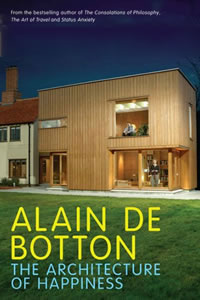
The Architecture of Happiness

Courtesy alaindebotton.com

Author, philosopher, and television personality Alain de Botton has turned to architectural commentary after popular discourses on love, Proust, status anxiety, among others; his wit and erudition are unmistakable. He brings a degree of common sense to many of the buildings he discusses. If his project to reintroduce beauty unapologetically into architectural discourse were not as laudable as I believe it is, it would not be so painful to note how often his observations recall clichés. He informed us, for example, that good buildings demonstrate a sense of place and respect the natural features that they are replacing. This is not a news flash.

The goal that de Botton strives to help his listeners realize is admirable: connecting one’s attraction to visual beauty (something everyone senses but few articulate) with the more explainable aspects of one’s life. Much of his theory expands on a quotation from Stendhal (“Beauty is the promise of happiness”), and he recognizes a broad variety of definitions of happiness to provide a range of beauties, tailored to the elements people find missing from their lives. His appreciation of a placid minimalist kitchen by John Pawson, for example, expresses his own need for calm; the alarming Deconstructivist planes of a French government building, he says, imply that the bureaucrats within live in mortal terror of becoming any more boring than they already are. These observations ring true but rarely explore fresh territory.

De Botton takes seriously a question that he admits risks naïveté: just how important architecture is at all. He does not automatically assume an answer that will flatter architects. Offering a polarity between “Catholic” and “Protestant” views of architecture — the belief that ordered environs can bring people closer to the deity and a good life vs. the belief that divinity renders physical settings irrelevant — he says, “From an entirely secular point of view, I’m a ‘Catholic,'” and proceeds to anatomize ways that buildings can elevate, debase, defend, or confuse the psyche. Given the limited choice, who wouldn’t line up behind de Botton for communion wafers? The problem is that using this particular binary schism as an organizing metaphor omits most of the range and nuance of architectural debates (not to mention questions of functionality, ecology, and scale).

He also indulges a tendency to use negative examples that are absurd, scoring easy points off a mogul’s effort to mimic Amsterdam near Nagasaki, and a dreary mirror-glass box from one of New Jersey’s most soul-sapping corporate parks. Decoding the more challenging messages of today’s architectural provocateurs would have tested de Botton’s subjectivism in vital ways: what would he make of the atonalities, asymmetries, improvisations, and provocations of love-it-or-hate-it works by, say, Robert Venturi, FAIA, Zaha Hadid, Hon. FAIA, or Frank Gehry, FAIA? He offers many observations that are worth engaging, if he’s willing to push himself past the elementary.

Gopnik Calls New York “Mono-Cultural Desert of Sameness”

Event: Gothamitis: Malcom Gladwell & Adam Gopnik in Conversation — The Inaugural Event of the Design Trust Council
Location: Museum of Modern Art, 05.02.07
Speakers: Adam Gopnik — author, Through the Children’s Gate, Paris to the Moon (Random House, 2000); Malcolm Gladwell — author, The Tipping Point, Blink; Deborah Berke, AIA — Co–Chair, Design Trust Council (Introduction)
Organizers: Design Trust for Public Space

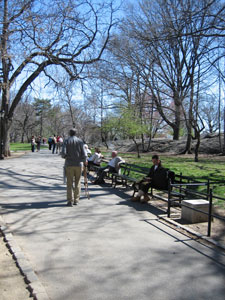
Central Park

Central Park is necessary to preserve a unique sense of place in NYC, according to Adam Gopnik.

Jessica Sheridan

New York City has lost “a part of its identity,” bemoans Adam Gopnik in his article entitled “Gothamitis” (The New Yorker, 01.08.07). Although the city has drastically reduced crime, lowered unemployment, and cleaned up its streets since the 1970s, he describes the NYC of today as “an old lover who has gone for a facelift and come out looking like no one in particular.” Author Malcom Gladwell agrees that the city has changed drastically, but he believes the city has more subtle diversity than ever.

What NYC has maintained in density, it has lost in variety, according to Gopnik. The result is a “mono-cultural desert of sameness.” Gladwell, in contrast, posits that this loss of “physical diversity” has made way for “a more profound human diversity.” Conjuring an image of a coffee shop populated with young people working on laptops, he points out that these people are engaged in “highly varied pursuits, but the outward appearance of their production is the same.” Likewise, many of the city’s loft buildings that once housed the garment industry now support a variety of uses, from housing to commercial businesses. They may be “similar people with similar salaries,” Gladwell admits, but “they are doing very different things.”

While global economic trends have resulted in economic variety, Gopnik worries that, for the first time, Manhattan has no “Bohemian frontier.” While acknowledging the transfer of this activity to locations such a Williamsburg and Red Hook, NYC’s nature has changed from a compact and cosmopolitan place where varied socio-economic groups are in constant interface to a model of a city more akin to London, with far-flung and largely isolated neighborhoods of cultural generation.

Dismissing accusations of nostalgia, Gopnik sees the vernacular form of memory as defining “cultural values.” If global economic shifts affect NY, they cannot be left unquestioned. Looking to zoning codes, Central Park, and landmark preservation, Gopnik believes that similar interventions within the free market are necessary to maintain a desirable and valued city.

Combating the Cultural Energy Hog

Event: “Green Design: We’re All in This Together” (Sally Henderson Memorial Lecture)
Location: Arthur King Satz Hall, New York School of Interior Design, 04.18.07
Speaker: Hugh Hardy, FAIA — H3 Hardy Collaboration Architecture
Organizer: New York School of Interior Design

Theater for a New Audience

The Theater for a New Audience in Brooklyn incorporates solar power and wind heating based on its siting.

Studioamd courtesy H3 Hardy Collaboration Architecture

Building with ecological values in mind begins with local knowledge, a detailed sense of specific places, and their climates, flora, and other features. In Hugh Hardy, FAIA, and colleagues’ experience with arts infrastructure, resorts, courthouses, and even parking lots, the local applications of these principles prove their resilience. Hardy included data about buildings accounting for 48% of national energy use (cf. 27% for transportation and 25% for industry); the urgency of reducing this burden is hard to dispute. He proceeded to describe an array of projects where sensitivity to site and program afforded a range of sustainable strategies.

Sometimes a useful discovery begins with knowing when to say no: when to foreclose an expected option and replace it with something humble, unorthodox, or both. The Glimmerglass Opera’s Alice Busch Opera Theater in Cooperstown, NY, with its rustic references and dramatic sliding panels, is a case in point. Mechanical ventilation would have been too expensive, as Hardy says, to serve a rarely-needed function: “moving large volumes of air v-e-r-y s-l-o-w-l-y to avoid acoustical problems… to control temperatures for just a few days out of the 365.” With no winter opera season, conventional heating and cooling weren’t worth the expense; instead, financial necessity gave Glimmerglass audiences a literal breath of fresh air. The theater inspired later projects employing passive green strategies, such as the renovated Bear Mountain Inn’s highly cost-effective geothermal system.

The new LEED Gold-rated headquarters of the Botanical Research Institute of Texas recycles pulverized material from existing buildings and employs a tilt-up construction technique. Concrete walls are poured on-site and then lifted 90 degrees into place (standard for local warehouses), making the site itself a factory of sorts and minimizing costly transportation of finished panels. Plantings on the concrete walls and roof provide shade and thermal control as well as visual variety. In the parking lot permeable paving contributes to water management and returns rainwater to the soil. “Any institution devoted to the natural world,” asserted Hardy, “should be a leader in sustainable design.”

Cultural facilities pose particular challenges. Hardy recognizes that any theater is “an inherent energy hog” because it requires acoustic isolation, artificial light, and other obstacles to sustainability. The new headquarters for the Theater for a New Audience in the Brooklyn Academy of Music Cultural District will use the new site’s western orientation of a four-story curtain wall for solar power and winter heating. A new master plan for the Santa Fe Opera adapts a former dude ranch’s open-air pavilions as rehearsal spaces, with rammed-earth walls and subterranean passages maximizing airflow through the complex.

“It would be naïve to think we’re now all suddenly going to pledge allegiance to an eco-friendly existence,” concedes Hardy. Each site-specific choice, however, can help break down a national belief that he finds dangerously counterproductive: the assumption that every building must present an internal environment of identical, constant temperature and humidity. He envisions, instead, a future where people realistically allow for “nature’s variety and fecundity.”

No Impact Man Has Quite an Impact On Me

Finally there’s someone trying to practice what’s been preached at us. I’ve been following the blog of Colin Beavan, aka No Impact Man, over the last couple of months, and while I continue to be inundated with new rules for a more sustainable life, his proactive approach touches on what the many government initiatives, Powerpoint presentations, guidelines, and new incentives lack: solutions put into action.

Beaven, along with his wife, 2-year-old daughter, and dog are attempting to live without making a net impact on the environment for one year. According to his website, “When we’re done, we can reenter the world of normal consumerdom equipped to decide which parts of our no impact lifestyle we’re willing to keep and which ones we’re not.” As he attempts to phase out all impactful aspects of his life — he consumes only locally-grown food, bikes or walks everywhere, and now borrows solar power from SolarOne to power his laptop as he eliminates the use of electricity — he approaches his experiment without pretense. He is simply searching for a better way of living and, through his blog, he shares his findings. The blog also serves as a means for readers to respond and write in with their own ideas about living a greener life.

At this point Beaven is half way through his year. While I become more aware of my daily impact, I am also becoming aware of how easy and rewarding it can be to make simple lifestyle changes. As Beaven’s wife, Michelle, wrote on the blog, “No Impact is a great ritual imploder. It’s about a lifestyle redesign, giving up what I think I can’t to see if something different, something better, emerges.”

Beaven seems to be making an impact beyond his blog as well. He has been on television several times, from “The Colbert Report” to “Good Morning America”; he makes guest appearances at environmental events (he moderated a mediabistro course and appeared at the LVHRD Bi-Fold Green celebration); he is on the radio (the “Brian Lehrer Show” and “Talk of the Nation” have featured his experiment). Ultimately, a book will be published and a movie will be produced. By providing suggestions and solutions, Beaven enables everyone with the knowledge of how they personally can make a difference. I look forward to the next six months and beyond.

In this issue:
·HPD Transforms Prison to Mixed-Use Development
·Audubon LEEDs in Design Again
·Mural Spans One and a Half Block at JFK
·Harlem’s Schomburg Center Enters New Phase; Bronx Library Wins LEED Silver
·Korea’s New Songdo City: Asia’s NYC?


HPD Transforms Prison to Mixed-Use Development
Brooklyn’s Navy Brig

Brooklyn’s Navy Brig.

Courtesy NYC HPD

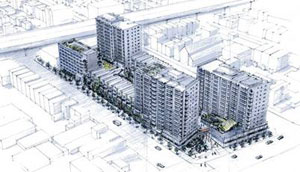
The NYC Department of Housing Preservation and Development (HPD) has selected Navy Green Joint Venture, a partnership of Dunn Development Corporation and L&M Equity Participants, which in turn has chosen the architectural team of FXFOWLE Architects, Curtis + Ginsberg Architects, and Architecture in Formation for the redevelopment of the Navy Brig site in Wallabout, Brooklyn. The redevelopment of this 103,000-square-foot former prison site will create a mixed-use, mixed income community consisting of 434 residential units, commercial space, open space, and a community facility. The Brig was built in the early 1940s and served as a naval prison. After the Brooklyn Navy Yard closed in 1966, the U.S. Immigration and Naturalization Service and later the city used the site as a minimum-security prison until it closed in 1994. Construction is anticipated to begin in the late spring or early summer of 2008.


Audubon LEEDs in Design Again
FXFOWLE Architects has been selected to design the 28,000-square-foot interiors of the National Audubon Society’s new national home office in a space formerly occupied by a printing plant. Located in Hudson Square, the new office is designed to be a certified LEED building with an integrated approach to sustainable design. A raised floor system will provide flexibility of electrical wiring while distributing under-floor air to workspaces. The National Audubon Society has long been a leader in green design, and its current office, renovated in the early 1990s, has served as a model for green office design.


Mural Spans One and a Half Block at JFK
“Skyline of the World”

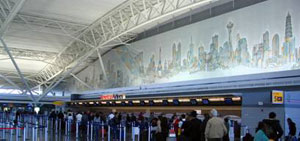
“Skyline of the World” mural at JFK.

Courtesy Think Tank New York

People can now see a panoramic depiction of 415 buildings from more than 70 international cities while waiting to check in at the new American Airlines Terminal 9 at JFK. Architect and artist Matteo Pericoli’s drawing spans the entire entry hall; running 397 feet long with a height varying from 30 to 52 feet, the monumental graphic is the world’s largest mural in an airline terminal. The mural was produced after photo-enlarging the original 12-foot-long “Skyline of the World” 32 times. International landmarks are juxtaposed not necessarily according to geography — the Hagia Sophia in Istanbul is shown next to the Burj Al Arab hotel in Abu Dhabi, and the Foshay Tower in Minneapolis is adjacent to a Venetian canal.


Harlem’s Schomburg Center Enters New Phase; Bronx Library Wins LEED Silver
At a recent open house, the internationally renowned Schomburg Center for Research in Black Culture unveiled its two-year, $11 million renovation. The New York Public Library selected Dattner Architects to update the library to give users more effective access to research resources on- and off-site. The renovation includes a new glass façade complete with a video wall viewable from Malcolm X Boulevard, and a new Scholars-in-Residence Center. Simultaneously, the library opened two new exhibitions, Stereotypes vs. Humantypes: Images of Blacks in the 19th and 20th Centuries and Black Art: Treasures from the Schomburg, selected from the Center’s Art and Artifacts Division with over 20,000 holdings.

And in the Bronx, the NYPL was awarded a LEED Silver certification for the Bronx Library Center, also designed by Dattner Architects. The center, which marks its first anniversary, is NYC’s first LEED certified municipal building.


Korea’s New Songdo City: Asia’s NYC?
New Songdo City

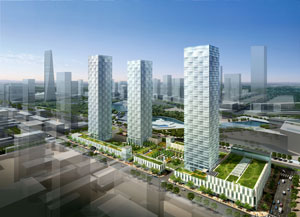
New Songdo City, Incheon, South Korea.

Hellmuth, Obata + Kassabaum

The NYC office of Hellmuth, Obata + Kassabaum (HOK) is designing seven new buildings in New Songdo City, Incheon, South Korea. New Songdo City, being built on 1,500 acres of reclaimed land along the Yellow Sea, is positioned to become the hub of Northeast Asia. The mixed-use towers and hotel will be part of the $25 billion international business district master planned by Kohn Pederson Fox Architects (KPF). The towers, built along south side of the city’s main public park on what is billed as the “5th Avenue of New Songdo City,” will accommodate housing, live-in work amenities, and retail space. Located on the south side of the park, and already under construction, is the HOK-designed 322-guestroom, 25-story hotel tower for the city’s convention center, and is hoping to be the first LEED certified hotel in Korea. The residential towers and the hotel are expected to be completed in 2009.
2 Boats Teach about Solar Power — and More

Arriving in NY’s North Cove Marina on May 8, the Swiss vessel sun21 has completed the first solar-powered transatlantic voyage. The solar-powered catamaran left continental Europe on December 3, 2006 from Chipiona, Spain. It arrived in Martinique on February 2, completing its journey on the open seas and traveled along the U.S. East Coast through March and April. The transatlantic21 Association set out to prove the feasibility of clean energy vessels on open seas, as well as to showcase the wide spread applications of solar technology to transform the shipping and boating industry. Click the link to read the blog, learn more about the boat, and see pictures of the voyage.


Also on the shores of Manhattan is the Science Barge, a sustainable urban farm designed by New York Sun Works, an environmental nonprofit organization. Offering educational tours, the barge is a sustainable urban farm powered by solar, wind, and biofuels, and irrigated by rainwater and purified river water. Using recirculated greenhouse hydroponics (water collected from rain and the river), tomatoes, lettuce, cucumbers, and peppers are grown in a greenhouse. According to the website, “In a world of climate change, rapid urbanization, and endless pollution, sustainable urban agriculture can help.” Currently the barge is moored at Pier 84 in Hudson River Park. Click the link for more information and for schedules and directions.