Winners of the 2007 Building Brooklyn Design Awards include, in the categories of Arts & Culture: StudioSUMO (The Museum of Contemporary African Diasporan Art); Community Facility: Donald Blair & Partners Architects (New Bedford-Stuyvesant YMCA); Higher Education: Gruzen Samton and Davis Brody Bond (Academic Village — Kingsborough Community College); Dormitory: Robert A.M. Stern Architects, Laurence Tamaccio Design Destinations, and SLCE Architects (Feil Hall); Primary Education: Gran Associates Architects & Planners (P.S./I.S. 395); Office: Coburn Architecture (West Elm Corporate Offices); Civic Works: Perkins Eastman (Brooklyn Supreme & Family Courthouse); Residential-Affordable: Feder & Stia Architects (277 Gates Avenue); Residential-1 to 5 Dwellings: Coggan + Crawford Architecture + Design (South Slope Condominiums); Residential-Multi-Family: Office 606 Design + Construction (L3 Condominiums); Retail: MADE (One Girl Cookies)…

Winners of the 2007 MASterwork Awards of the Municipal Art Society include: Best New Building: Hearst Tower by Foster + Partners; Best Neighborhood Catalyst: Fairway Market in Red Hook by Susan Doban Architect; and Best Commercial Restoration: Battery Maritime Building by Jan Hird Pokorny Associates.

Economic Impact Award winners include the Expansion of NY Marriott Hotel at Brooklyn Bridge by William B. Tabler Architects, SB Architects, and Moss Gilday Group; and Twin Marquis, Inc. by Luis P. Wong. Design & Economic Impact award winners include, in the categories of Mixed-Use: Red Hook Stores by Susan Doban Architect and Energy Concepts Engineering

Chris Calori, Affil. AIA, and David Vanden-Eynden of Calori & Vanden-Eynden/Design Consultants were named Fellows of the Society for Environmental Graphic Design (SEGD)… The American Society of Landscape Architects (ASLA) has named 13 new honorary members including Susan S. Szenasy, Editor-in-Chief, Metropolis magazine… Peter A. Gross, AIA, has been named Principal of Swanke Hayden Connell Architects… Meltzer/Mandl Architects has appointed Evan L. Schwartz, AIA, NCARB, Director of Design… Mayor Bloomberg appointed Janette Sadik-Khan as Commissioner of the New York City Department of Transportation (DOT)… Kimberly Szinger, P.Eng., PE, LEED AP (Stantec Consulting, Ltd.) assumes the position of President (2007-2008) of the Illuminating Engineering Society of North America (IESNA) on July 1, 2007…

New York Institute of Technology‘s (NYIT) 2007 Solar Decathlon team has re-launched its interactive websiteSolar One, BIG!NYC’s sibling organization, was just awarded $3 million in Mayor Bloomberg’s new budget…
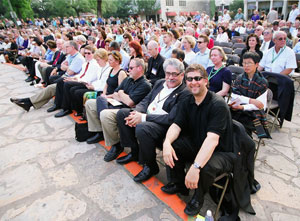
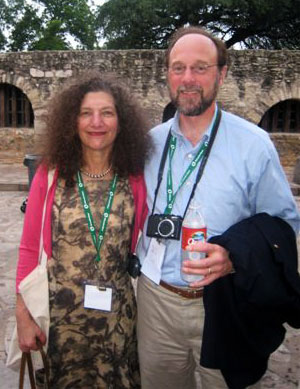
Highlights from the AIA 2007 National Convention

FELLOWS’ INVESTITURE

FELLOWS’ INVESTITURE

Among a sea of architects, AIA Vice President George Miller, FAIA, and 2009 AIA Vice President Clark Manus, FAIA, at the Alamo. Both will serve on the national ExCom together next year.

Jeremy Edmunds

FELLOWS’ INVESTITURE

Joan Blumenfeld, FAIA, IIDA, LEED AP, AIANY President with Ben Fisher, FAIA.

Rick Bell

FELLOWS’ INVESTITURE

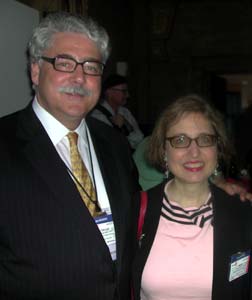
Tracey Hummer, Calvin Tsao, FAIA, and Fred Schwartz, FAIA.

Rick Bell

FELLOWS’ INVESTITURE

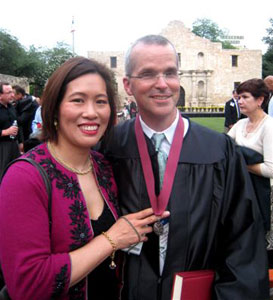
Sally Chin Greene, Assoc. AIA, with Frank Greene, FAIA.

Rick Bell

AIANYS PARTY

AIANYS PARTY

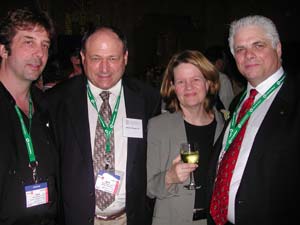
Mark Ginsberg, FAIA; Mark Strauss, FAIA, Jane Smith, AIA, and Tony Schirripa, AIA.

Kristen Richards

AIANYS PARTY

George Miller, FAIA, and Abby Suckle, FAIA.

Kristen Richards

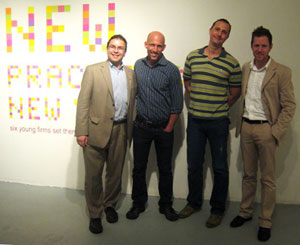
“NEW PRACTICES NEW YORK” EXHIBITION OPENING

NEW PRACTICES NEW YORK EXHIBITION

Rick Bell, FAIA; Tom Zook and Matthew Bremer, AIA, of Architecture In Formation (one of the six firms featured in the exhibition); and William Tims, AIA.

Karen Plunkett, AIA

AIA SAN ANTONIO HOST CHAPTER PARTY

AIA SAN ANTONIO HOST CHAPTER PARTY

Susan Chin, FAIA, and Jim McCullar, FAIA.

Kristen Richards

AIA SAN ANTONIO HOST CHAPTER PARTY

Mark Strauss, FAIA, Hubert Murray, AIA, RIBA, Frank Mruk, AIA, and Lance Jay Brown, FAIA.

Kristen Richards

AIA SAN ANTONIO HOST CHAPTER PARTY

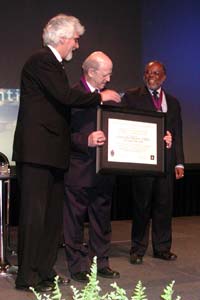
The 2007 Topaz Award was presented to Lance Jay Brown, FAIA (center) by AIA President RK Stewart, FAIA (left), and Ted Landsmark, Assoc. AIA, NOMA, President of both Boston Architectural College and ACSA (Association of Collegiate Schools ofArchitecture), and 2006 AIA Whitney Young Award (right).

Kristen Richards

AIA SAN ANTONIO HOST CHAPTER PARTY

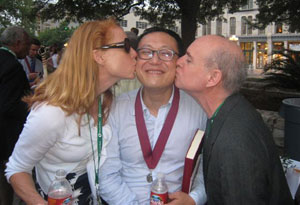
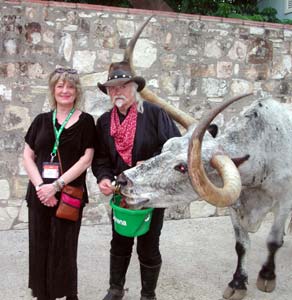
Kristen Richards, editor of OCULUS, warms up to the locals.

Courtesy Kristen Richards

Oculus 2007 Editorial Calendar
If you have ideas, projects, opinions — or perhaps a burning desire to write about a topic below — we’d like to hear from you! Deadlines for submitting suggestions are indicated; projects/topics may be anywhere, but architects must be New York-based. Send suggestions to Kristen Richards.
09.07.07 Winter 2007-08: Power & Patronage

05.21.07 Submission: Higher Education Facilities Design Awards 2007
The Boston Society of Architects is looking for design excellence in Higher Education Facilities. Facilities can be public or private and built anywhere in the world after January 1, 1999 and may be new construction or rehabilitations. Firms entering must either submit projects built in or reside in New England. Questions should be directed to Richard Fitzgerald.

05.24.07 Submission: A|L Light & Architecture Design Awards
Architectural Lighting (A|L) magazine seeks to honor outstanding and innovative projects in the field of architectural lighting design. Acknowledging notable issues in lighting design and design techniques particular to lighting, A|L also presents the A|L Virtuous Achievement Awards (ALVA), which recognizes projects that achieve the Best Use of Color; the Best Incorporation of Daylight; and the Best Lighting Design on a Budget. All winning projects will be published in the July/August 2007 issue of A|L and be featured on the website.

05.30.07 Statement of Qualifications: City of Lake Elsinore Design Competition
This design competition solicits ideas for the development of a new civic center in California — which could include a new city hall, council chambers, post office, public library, business incubator, and other government offices or mixed uses in a campus setting. Two sites have been selected for development that differ in size and surrounding environment, but both are relevant to Lake Elsinore’s historic roots and can catalyze downtown development.

06.22.07 Submission: AIA New England’s People’s Choice Awards 2007
Firms submitting project(s) to the AIA New England Design Awards Program may submit an additional display board of a project to the People’s Choice Awards program that will be exhibited at the Ring’s End Showroom prior to the AIA New England Annual Conference October 5-7, 2007 in New Canaan, CT. Visitors to the showroom and library can vote for their favorite projects. The project submission may or may not be the same as that submitted to the Design Awards program. For more information, click the link or contact Joanne Reese at AIA Connecticut.

06.29.07 Submission: Waterfront Awards Program
This awards program will honor waterfront projects, plans, citizen’s efforts (“The Clearwater Award”) and, new in 2007, student awards. Entries are judged by an interdisciplinary jury, and selected entries will be on display on the Waterfront Center’s website. The awards ceremony will take place during the Center’s annual conference November 2, 2007 in Boston.

07.05.07 Submission: Sinocities Awards 2007
FAR Architecture Center Shanghai is holding an international open ideas architecture design competition on new public space. Designers choose a site on Sinocity, a fictional growing city in the heart of China, and apply their innovative designs. All interested architects and related professionals such as architects, urban planners, landscape architects, and students may enter. All projects will be exhibited in Shanghai in August 2007. Winners will receive 35,000 RMB (EUR 3,500) in total, and the award winner will be invited to Shanghai to the Award Ceremony.

07.27.07 Proposal: The Design Trust: Healthy NYC
The Design Trust for Public Space is issuing an RFP focusing on the need to plan for NYC’s healthy future. Mayor Bloomberg’s plaNYC 2030 states that our city will soon be home to over 9 million city residents, older infrastructure, and a less predictable environment. A healthy NYC 2030 — i.e., a city that we all still want to live in — depends on our ability to act now, directing the city’s growth to achieve our goals for the future. Each project proposed should explicitly address this issue.

09.17.07 Registration: Self Sufficient Housing
The Institute for Advanced Architecture of Catalonia is issuing an international summons to architects, designers, and students. This competition encourages the design of a “SELF-FAB HOUSE,” self-sufficient dwellings that anyone can build. Using industrial or traditional craft-based techniques generated by digital processes, software-driven manufacturing, with a focus on sustainability, the prize (total value: 39.500,00 EUR) will be distributed at the discretion of the jury.

Front Line Frays Home Front

Event: Book Launch/Beatriz Colomina
Location: Labyrinth Books, 04.05.07
Speaker: Beatriz Colomina — professor of history and theory, Director of Graduate Studies, Ph.D. Program, Founding Director, Program in Media and Modernity, Princeton University, & author, Domesticity at War (MIT Press)
Moderator: Rachel Schauer — contributor, e-OCULUS
Organizer: Labyrinth Books

Domesticity at War

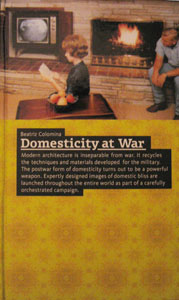
Domesticity at War, by Beatriz Colomina.

Holding up her recently published book, Domesticity at War, professor and theorist Beatriz Colomina explained that the cover image of a quaint, 1950s suburban living room, complete with fireplace and television, is actually a fallout shelter. This is exemplary of the impact of war on domesticity. From the Eameses’ use of plywood military products to the “dial-a-view” window scenes for underground shelters, Colomina’s new work explores the relationship between American architecture and war culture during and following World War II.

War propaganda encouraged Americans to celebrate their country by saving face in the public realm. A key symbol of patriotism was the suburban lawn, whose maintenance became a civic duty for those on the home front. Featured in advertisements at the time as a green paradise, the lawn was a form of therapy promoting hygiene, happiness, and health. However, lurking below its surface was a battlefield — a site of full-fledged attack on moles, worms, and other insects potentially devastating perfectly manicured blades of grass. Homeowners, in an effort to protect the lawn from infection or invasion, were told to use weaponry more common to war than the household. How do you get rid of that pesky mole? Knock it out with your spade, or better yet, gas it!

As warfare tactics transformed from WWII to the Cold War, so too did the obsession with health. The home’s interior came to reflect a new focus on the psychological, rather than physical, well-being of the family, offering refuge from hostile tensions on the outside. Where once it was a sanitary problem, the kitchen now served as a prime laboratory to cure mental woes. An ad in House Beautiful magazine exclaimed: “It wasn’t a psychiatrist Mother wanted — it was a new kitchen!”

While the changing definitions of public and private space are nothing new, Domesticity at War takes this relationship to the next level by tracing how it has been and will be influenced directly by war. As Colomina says in the closing of her book, “War does not end. It evolves, and architecture with it.”

Carpenter’s Thousand Points of Light

Event: Environmental Refractions
Location: The Cooper Union, 04.10.07
Speaker: James Carpenter — principal & founder, James Carpenter Design Associates
Organizer: The Irwin S. Chanin School of Architecture of The Cooper Union

7WTC

Glass panels with blue reflectors create the effect that 7WTC is merging with the sky.

Jessica Sheridan

Light conveys information and defines our surroundings. The work of James Carpenter, principal and founder of James Carpenter Design Associates, explores perceptions of light in transmission, reflection, and refraction, often abstracting images brought in from outside (sun, sky, water, trees). Carpenter discussed a few of his early projects as part of the Feltman Lectures, a series dedicated to advancing lighting design through the exploration of practical, philosophical, and aesthetic attributes of light and illumination.

The Luminous Glass Bridge was designed to enrich and awaken users’ perception of nature. A chapel in Indianapolis is a meditative environment created through structural glass prisms that split the visible spectrum into the blue to yellow range. A glass screen for the Rachofsky Residence, designed by Richard Meier, FAIA, is virtually structure-free. The edge of the glass is revealed, and privacy is created on one side constructed of glass with heightened reflectivity.

Carpenter’s interests predominantly focus on daylight rather than artificial light, but he has begun to integrate LED technology in his projects since it reacts similarly to natural light. He explored both realms in the enclosure, lobby, and podium light wall in 7 World Trade Center. The façade enclosure celebrates the incredible quality of light in Manhattan, according to Carpenter. The 8-inch-deep skin is composed of glass panels with blue stainless steel reflectors at the sill, creating an effect that the building is merging with sky. The base of the building enclosure is constructed of two permeable layers that conceal a Consolidated Edison sub-station. The first layer blocks views during the day, and at night a stainless steel scrim reflects light from LED sources — proving that our perception is easily altered through the abstraction of light.

A Systems Approach to the Green Skyscraper

Event: Designing the Green Skyscraper: A Mixed Greens Lecture
Location: The New York Academy of Sciences, 7WTC, 04.05.07
Speaker: Kenneth Yeang — principal, Llewelyn Davies Yeang, professor, Sheffield University, & author, Ecodesign (Hoboken: Academy Press, 2006)
Moderator: Carol Willis — founder, director, curator, The Skyscraper Museum
Organizers: The Skyscraper Museum; New York Academy of Sciences

The EDITT Tower.

The EDITT (Ecological Design In The Tropics) Tower is a fuzzy combination of organic and inorganic material.

Llewelyn Davies Yeang

A stack of kitchen plates is the basic model for today’s tall building: a series of modular concrete floors in succession, conducive to “instant compartmentalization” and the dreariness of the white-collar office, according to Malaysian principal, professor, and author Ken Yeang. The area in a typical medium-sized building (a 12-story tower on a 20,000-square-foot site) would be equivalent to six acres distributed horizontally. He conceives of skyscrapers as “no longer building design, but urban design.” They pose an opportunity to create a fluid, mixed-use community that meshes with the biological world instead of a solitary structure standing apart from it. “Everything in nature is a combination of the biotic and the abiotic,” he observes. “Look at what we build as human beings… everything [in a typical building] is inorganic except you and me and the bugs!”

Concentrating a multi-acre community on a small footprint, Yeang says, calls for architects “to make the design as humane as possible.” Aesthetically as well as functionally, his work favors fuzziness and irregularities over the “pristine edge” of most corporate towers. His buildings invite in the foliage and sunlight. One of his favorites, the bougainvillea-covered Menara Boustead building in Kuala Lumpur, he terms “the hairiest building in Southeast Asia.” With spiraling and intertwining spaces blending built structures with vegetation, his eco-cells, sky parks, multi-story voids, and sunny-side placement of service cores are all designed to optimize passive energy conservation — an important approach in the tropical climates where he usually works.

Many of Yeang’s designs remain unrealized; he acknowledges the cost premiums involved, giving figures on the high side of recent estimates for LEED-rated buildings, and recommends that anyone building a vertical garden be prepared, like any gardener, to invest resources in tending it. (For greening NYC buildings, he recommends hardy non-flowering species and operable external skins to protect plantings from high wind.) He views the current LEED system as valuable for public awareness of green design, but seriously incomplete as a means of analyzing the full set of interdependencies that constitute a bio-integrative system.

Yeang’s practical design decisions derive from a set of interlocking analyses, using mathematical partition matrices to organize the inputs and outputs of biological and built systems. His commitment to green design runs well beyond a generalized intention to conserve resources; he interprets the principle of biomimicry in organized and consistent ways, comparing buildings within a wider ecologic system to prosthetic limbs attached to a living organism. Even the most sophisticated artificial arms or hearts still require external energy sources, and the ideal prosthesis would run on bodily energy alone. Similarly, what he calls the “truly green building,” one taking all its operational energy inputs passively from nature, does not yet exist, but Yeang’s ideas are bringing that organic/inorganic balancing act closer to realization.

Post-Modernism: R.I.P.

Event: Critical Modernism — Is It Possible?
Location: Columbia University Graduate School of Architecture, Planning & Preservation (GSAPP), 04.09.07
Speaker: Charles Jencks — author, Critical Modernism: Where is Post-Modernism Going? What is Post-Modernism? (Wiley)
Introduction: Mark Wigley — Dean, Columbia GSAPP
Organizer: Columbia University GSAPP

Critical Modernism: Where is Post-Modernism Going? What is Post-Modernism?

Courtesy Columbia University GSAPP

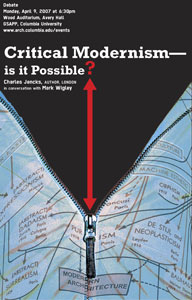
On the cover of Charles Jencks’s new edition of What is Post-Modernism? (the first new edition in 11 years), the first director of the Museum of Modern Art Alfred Barr’s chart of modern artistic movements comes apart, literally, in the image of a windbreaker emblazoned with Barr’s interconnected bubbles being unzipped. Revealed beneath is the work’s new title, Critical Modernism: Where Is Post-Modernism Going? The book’s title change reflects Jencks’s new attitude toward the movement: “Post-Modernism, like old soldiers, died slowly.” And he mourns its passing.

Author, critic, and landscape designer, Jencks was one of the earliest exponents of Post-Modernism. Critical Modernism surveys the culture and politics of the movement, and chronicles its demise. The beginning of the end was the appropriation of Post-Modern architecture by the entertainment industry in the mid-1980s. “For a moment at least it was an interesting avant-garde,” Jencks remarked.

Critical Modernism, on the other hand, attempts to “face reality” when “most Modernism is uncritical.” Art and architecture is grounded in the actuality that: arctic ice is retreating; the earth is warming, modern economics is globalizing; political culture is breeding skepticism; and fear of terrorism is growing.

It is a movement of personal posturing (think Rem Koolhaas’s tough-guy persona), pluralism (James Stirling’s Neue Staatsgalerie), black humor (Damien Hirst), and noble though feeble gestures (green architecture), in Jencks’s view. Ultimately, Jencks praises the iconographic and iconologic possibilities of forms drawn from science and mathematics — the square deformations in the Pavilion at the Serpentine Gallery designed by Toyo Ito, FAIA, the images of DNA Jencks has incorporated in his own work, and the natural fractals in everything from pine cones to pineapples.

Challenging the Glass Box

Event: Daylight and the City: Day Lighting in New York City Part 2, 1961 to Present
Location: Center for Architecture, 04.18.07
Speakers: Margaret Maile — design historian and Matthew Tanteri — daylighting consultant, Tanteri+Associates
Panelists: John An — principal daylighting, shading design, and lighting energy analyst, Atelier Ten; Florian Idenburg — project architect for the New Museum of Contemporary Art, NYC, SANAA
Moderator: Margaret Maile
Organizer: New York Section of the IESNA

As a follow up to last fall’s Part 1 of Daylight and the City, Tanteri+Associates’ Margaret Maile, design historian, and Matthew Tanteri, daylighting consultant, reconvened with a group of panelists to discuss daylighting in modern NYC. Starting where they left off (the Seagram’s Building and the 1961 Zoning Ordinance), panelists discussed where we’ve come since then and how history has influenced daylighting strategies today. Though the “glass box” is still an icon of contemporary architecture, designers no longer treat it as a sealed, artificially lit, interior environment. Modern technology and trends towards sustainable design have changed the way we articulate building façades and address daylighting. Panelists debated about whether daylighting is an art of a science and whether occupants should be entitled to “daylight rights” in the same way that air rights are regulated. It was agreed that sun charts are essential tools to evaluate the sun, despite more advanced technology available.

To illustrate a modern approach to daylighting in NYC, Florian Idenburg explained his strategies in the design of the New Museum of Contemporary Art on the Bowery. Early in the design process, his team conducted a zoning analysis of surrounding buildings to predict future sunlight patterns. The eight-story massing and expansive program occupies the entire zoning envelope. Three large galleries read as boxes that shift within the envelope in order to “let light in and people and art out.” Further strategies to admit daylight include the building’s permeable skin and integrated skylights that are grated to allow firefighter access. The grating itself was carefully selected and tested with a full size mock-up in order to allow the maximum penetration of daylight.

The modern condition and our love affair with the glass box continue to present challenges for daylighting, as designers grapple with issues of glare and thermal performance. Daylight is a major measure of success in a lighting strategy.

Hidden Splendor South of Chambers Street

Event: Downtown Third Thursdays Lecture: Forgotten Splendor: Restoring Downtown’s Historic Architecture
Location: Federal Hall, 04.19.07
Speaker: Mary Dierickx — preservationist & Principal, Mary B. Dierickx
Organizer: Downtown Alliance

Claremont Prep

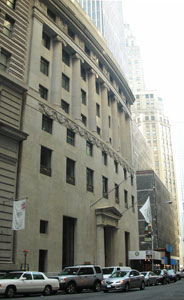
Claremont Prep is one example of the recent wave of downtown buildings that have transformed their uses after renovation.

Carolyn Sponza

While new towers and planned transit hubs for downtown Manhattan have dominated the media over the past few years, a number of daring downtown restoration projects have been slipping quietly under the radar. According to preservationist Mary Dierickx, that may be intentional. At the Historic Front Street residential lofts, located at South Street Seaport, architects Cook+Fox purposely retained the distressed look of street elevations of 11 historic buildings, while inserting three new structures. In reference to the restoration of the retained façades, Dierickx said, “This is not an incredible ‘after’ project. The whole point was to keep [the buildings] looking old.”

Historic Front Street was subsidized in part by a combination of Liberty Bonds and historic preservation tax credits. Utilizing resources such as these, and post-9/11 support like the Lower Manhattan Emergency Preservation Fund, “helped kick off the preservation movement downtown,” said Dierickx. While Historic Front Street retained and updated its original use (with retail on street level and residential above), many current downtown restoration projects are undertaking wholesale use changes, such as the conversion of a former bank building on Broad Street into Claremont Prep private academy. The banking hall (with its murals) was restored to serve as a multi-purpose room for the K-8 school, while the original vaults were converted into annex space for the cafeteria. Expect to see more creative downtown conversions like this one under construction in the next few years, proving that while banking may become virtual, living cannot.

Mayor Proposed PlaNYC is Short-Sighted

A lot of money is being raised to fund Mayor Bloomberg’s plaNYC 2030. Included in the plan is a Sustainable Mobility and Regional Transportation (SMART) organization to raise funds and issue revenue bonds to improve transportation. A NYC Energy Planning Board will centralize planning for the city’s energy supply and demand initiatives. However, nowhere in the plan does it mention raising funds to maintain the open spaces the Mayor is planning to create or rehabilitate.

The Mayor wants every person to live within a 10-minute (or 1/2 mile) walk from a park. Schoolyards will become accessible as public playgrounds. Asphalted areas will be converted into multi-use turf fields, and lights will be installed for evening use. High-quality competition fields will be made available to athletic teams across the city, as well. A new public plaza will be enhanced or created in every community. Underutilized destination parks (there are several throughout the five boroughs) will be completed. He plans on expanding the Greenstreets program, created in 1986 to replace paved traffic triangles and medians with shrubs and flowers, by planting 250,000 trees citywide.

Simply providing parks does not mean that people will use them. Often parks deteriorate from lack of use. What will make people visit parks, if they are not already in use? I’m sure in some cases, cleaning up a park and providing better lighting at night will help. But in many cases, improved surveillance and police presence is needed. For example, High Bridge Park is on the Mayor’s list of destinations to be improved. I recently helped clean that park as part of NY Cares’ Hands On New York Day. After so many rolling paper packages, plastic cocaine bags, and a number of syringes, I certainly would not feel safe spending a day wandering through the meandering pathways without extra safety measures in place.

Part of the problem with the Mayor’s plan for open space is that the list of initiatives does little to spur the city’s inhabitants. After a park is cleaned up or constructed, will there be any community outreach? Better yet, why aren’t community members being involved in the clean-up/construction? If locals are involved in improving their own communities, there will be a better chance that they will embrace and inhabit the parks. The Mayor has proposed many good ideas, but a follow-through plan is critical.