Bloomberg & Obama in Concert (Continued)

Mayor Bloomberg recalled those years in his State of the City speech: “Until recently, the New Deal and the 1930s seemed like a distant memory — something we read about in history books. But last year, when the sub-prime mortgage write-down became a global financial meltdown, the bank panics returned and today, more people are worried about losing their jobs, their savings, and their homes than at any time since the Great Depression… Time and again, the future of our city has been in doubt. Time and again, we have faced moments of truth. And each time, we have pulled together as New Yorkers and come out stronger, together.” He continued: “Our job is to help all those who are struggling — help improve their chances for a job, for keeping their homes, for making ends meet, and to do it all without new funding — because the city just doesn’t have the money. Instead, rather than spending new dollars, we have to redeploy resources and repurpose budgets — and we will.”

The reference to the Great Depression continued near the conclusion of Mayor Bloomberg’s speech: “Over the history of our city — no matter how severe the blow we’ve been dealt, no matter how uncertain the future — we have always found the strength and optimism to rise to new heights, as New Yorkers, together. No one better exemplifies that than the man who is responsible for building the college where we sit today: Franklin Delano Roosevelt. We all know how in his first speech as President, FDR reminded us that the only thing we had to fear was fear itself. But you may not know that on the last full day of his life, he wrote this: ‘The only limit to our realization of tomorrow will be our doubts of today.'”

In the first speech as President given by Barack Obama, the echo of the Entente cordiale between LaGuardia’s NYC-resilience and Roosevelt’s New Deal will-power came across loud and clear: “For everywhere we look, there is work to be done. The state of our economy calls for action, bold and swift, and we will act not only to create new jobs, but to lay a new foundation for growth. We will build the roads and bridges, the electric grids, and digital lines that feed our commerce and bind us together. We will restore science to its rightful place and wield technology’s wonders to raise health care’s quality and lower its cost. We will harness the sun and the winds and the soil to fuel our cars and run our factories. And we will transform our schools and colleges and universities to meet the demands of a new age. All this we can do. All this we will do.”

It seemed to many in the audience of billions, as well as to commentators and bloggers that President Obama’s Inaugural Address was restrained rhetoric, not reaching for unrealizable goals nor raising unachievable expectations. In this regard it was a building program, not a rendering. It was detailed enough to serve as blueprint and specifications for the near future, for a fast-track start, a shovel in the ground.

In the first week of February, architects from around the nation will converge on Washington, DC, for the annual AIA Grassroots legislative and leadership conference at which issues are raised with Members of Congress and others in government. AIA President-elect George Miller, FAIA, an AIANY past-president, is leading this national conjunction under the banner of the acronym “VIA! AIA” for Vision, Influence, and Action. The AIA’s Rebuild and Renew policy statement is a call to action. We expect that it will find, this year, friendly ears.

One of the zingers about halfway through President Obama’s Inaugural Address last week was: “Know that your people will judge you on what you can build….” Let’s not be wanting.
Component News Flash: Philadelphia’s Architecture Center

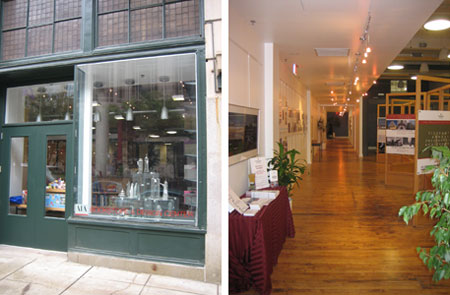
Philadelphia’s new Center for Architecture.

Courtesy AIA Philadelphia

AIA Philadelphia celebrated the ribbon-cutting ceremonial opening of its Center for Architecture on May 28, located at 1218 Arch Street — across from the Pennsylvania Convention Center by Thompson, Ventulett, Stainback and Associates, the winner of a National AIA Award for Regional and Urban Design in 2000. The spiffy, well-lit, and well-ventilated storefront Center opened to the public June 2, setting a new benchmark for architecture centers where design professionals interact with students, visitors, enthusiasts, and civic activists, along with elected, appointed officials. The ceremony and festivities were led by AIA Philadelphia President James Bogrette, AIA, and featured congratulatory remarks by recently appointed Deputy Mayor Andrew Altman, an urban planner who is also the city’s Commerce Director. Altman described how his young son had participated in the educational programs at another AIA Chapter’s Center for Architecture before moving to Philadelphia this year.

The Center’s design was developed by 30 individuals during a two-day charrette open to any Chapter member who wanted to participate. Four schemes were developed, and after consultation with existing tenants a winner was selected. The final design is faithful to the winning scheme. The architect of record, including engineering, was Philadelphia-based KlingStubbins, who donated their services as a charitable contribution to the Center. Certain installation details were then contributed by various volunteers and coordinated by a building committee of board members and the executive director.

The design itself makes the singularly successful AIA Bookstore part of an active streetscape, where it can have the greatest impact — and profitability. Glass windows front and back allow for passers-by to see through the shop into meeting and gallery spaces, able to accommodate large public gatherings and freestanding exhibitions, including the opening show of design award-winning projects. Back-of-the-house office space accommodates both Chapter staff and the Community Design Collaborative, a related organization that provides pre-development services to non-profit and community organizations using volunteer architects and related professionals.

The much-heralded Charter High School for Architecture + Design (CHAD) is also supported by the Center, and CHAD programs will find their way to the Center, according to Component Executive John P. Claypool, AIA, AICP, and Courtnay Tyus, Executive Director of CHAD’s Designing Futures Foundation. Such initiatives are already visible in the new bookstore through the competition-winning bookshelf systems designed and constructed in cooperative teams with contractors, architects, carpenter apprentices, and CHAD students.

Similar to recently opened Centers for Architecture created by AIA Austin, AIA Houston, AIA San Francisco, and the Virginia Society for Architects, AIA Philadelphia will utilize its public gallery and meeting facility to provide partners, public agencies, community organizations, media, individual citizens, and visitors an opportunity to participate and learn about the importance of their physical environment. The Center’s mission declares: “It will raise expectations about the region’s built environment and contribute to improved public policies and advocacy for a high quality living environment in Greater Philadelphia.” Other design centers are in various stages of planning nationwide, including AIA storefronts in Dallas and Raleigh.

Founded in 1869, AIA Philadelphia serves more than 1,700 AIA member registered architects and related professionals, making it one of the largest AIA components in the nation. In addition to providing professional and education support to its members, AIA Philadelphia serves as a resource for the general public, and with its fine new center, will be a public face for the City of Sibling Affection through its programs and exhibitions.

To read more about Philadelphia Center for Architecture, here is an article from The Philadelphia Inquirer‘s architecture critic Inga Saffron published June 6 and titled, “Changing Skyline: Architecture institute finally adds gallery.”

Government Oops

On May 6, the Governmental Operations Committee of the New York City Council tacitly agreed with the architects and engineers packing the City Hall committee hearing room that we were right — a registered architect or professional engineer should continue to head the NYC Department of Buildings. This was done not by a vote, but by avoidance of a vote, or, in fact, by lack of any visible support for Intro 755, which, if passed, would eliminate this requirement about the experiential and training requirements for the Buildings Department head. By cogent and probing questions, the Government Ops members present, including Councilmembers Joseph P. Addabbo, Inez E. Dickens, Erik Martin Dilan, Dominic M. Recchia, Jr., and Larry B. Seabrook, put the Administration’s representative, Anthony Crowell, in the position of defending the indefensible. Crowell, in essence, said that it didn’t matter whether or not a Commissioner who knew anything about buildings could head the Buildings Department so long as the nominee was a good manager and good communicator.

Other council members not on the committee holding the hearing, including Jessica Lapin, John Liu, Rosie Mendez, James Oddo, and David Yassky, sat at the hearing table to aggressively challenge Crowell’s arguments. Liu, for one, stated that the proposed legislation was “absurd” on the face of it. In times of heightened concern about building safety, the idea that the Buildings Commissioner did not need to be trained and tested on how buildings are made safe seemed wrong to all of the council members speaking — and to 100% of those members of the public who came to testify.

Many industry leaders, including Michael Macaluso, RA, President of the Architects Council of New York, and Anthony Schirripa, AIA, AIANY Vice-President for Public Outreach, were joined inside and outside the room by other chapter leaders from all five NYC borough components. The American Council of Engineering Companies New York Chapter was represented at the meeting by its national chair, John F. Hennessey, III, PE, and its local chapter head, Hannah O’Grady. A letter from Christine McEntee, Executive Vice President and Chief Executive Officer of the AIA national component was read into the record by AIANY Policy Coordinator Laura Manville.

The Chapter’s position statement also became part of the testimony and is attached to this summary. It was accompanied — think Miracle on 34th Street — by petitions signed by more than 3,000 individuals saying the same thing, “No PE’s, No Justice.” More signatures are needed. Click the link, add your name and e-mail it to the AIANY.

The fight is not over. A compromise bill, asking to temporarily put aside the needed experiential requirements, is within the realm of possibility, and could come back to the City Council’s Committee within the next two weeks. Please write or e-mail your Councilmember now, whether she or he is on the Governmental Operations Committee or not. It makes no sense for the City’s Health Commissioner to not be a doctor, whether for four years, four months, or four weeks. It makes less sense, given the professional needs for code and zoning interpretation, action, and decision-making, for the Buildings Commissioner not to be a licensed design professional. New York needs a Buildings Commissioner who knows how buildings stand up.

Grassroots Sound Greener

Frances Hesselbein

Frances Hesselbein speaks at Grassroots about breaking down hierarchies.

Karen Plunkett, AIA

“I don’t know what to say, I have no speech,” were the opening words of Renzo Piano, Hon. FAIA’s short remarks at Accent on Architecture. Perhaps Piano had heard earlier remarks by Frances Hesselbein, who called for architects to “throw out the dead hierarchical language of the past.” During a Grassroots keynote speech, Hesselbein, the Chairman of the Leader to Leader Institute that helps social sector organizations achieve excellence in performance and community building, said, “There is no time to negotiate with nostalgia.” Her speech, punctuated by personal stories about collaborations that had changed people’s lives, moved several sitting in the back rows of the thousand-seat auditorium to tears. She spoke of diversity, inclusiveness, and non-hierarchic organizational structures in ways that made people listen.

Grassroots is the annual leadership and legislative conference of the AIA, which takes place over four days every February in D.C. With Congress recessed, this year there were no Capitol Hill visits, so the risk of hot air was diminished as a dusting of snow confined the speechifying largely to the Grand Hyatt. Awards were conferred, including a Component Excellence award to the AIA New York Chapter for the Model Code collaborative effort that resulted in the adoption of the International Building Code.

The biggest change this year was the greening of the conference: hard copy press releases were nowhere to be found. But there were many speeches. One of the best was the workshop given by author Gary Rifkin on how to “Speak like a Pro.” His 90 minutes of cogent advice included the importance of a dramatic start — don’t bother with “Good Morning!” or immediately thanking the introducer. Rifkin said that practicing your remarks is important, preferably 20 times, and at least once with someone other than your pet listening. He also counseled against relying on a teleprompter, stressing the importance of connecting with the audience more directly, with just key word notes left where they can jog memory when needed. Having just used a teleprompter for the first time — yes, there is someone behind the curtain — I heartily agree.

Continues…

Grassroots Sound Greener (continued)

We all learned from some top word-warriors, including General Henry Shelton, the retired Chairman of the Joint Chiefs of Staff, who defined leadership in no uncertain terms. Giving the concluding keynote speech to a standing ovation on Saturday, February 23, the General used humor and cowboy analogies to make points about the qualities of decisiveness, loyalty, courage, and ethics that characterize great leaders. His one-liners were grabbers: “The higher you climb on the flagpole, the more your butt shows,” for example. But the overarching theme, of “riding for the brand” reinforced the sense of the AIA’s coherent vision. It was especially poignant that the AIA was founded on February 23, 1857, a fact that was noted in exactly none of the speeches that I heard.

Candidates for AIA office — including our own George Miller, FAIA, running for 2010 AIA President — gave forth with the most affecting and effective oratory. Often those voting at the AIA Convention know the candidates only from these small snippets. The hotel’s basement bar allowed late night discussion of the merits of their speeches, while the back-bar television showed Senators Hillary Clinton and Barack Obama trying to make words count in real time. At other watering holes, from the Hotel Monaco’s Poste Bar to Zahtinya, the AIA candidate speeches were sliced and diced as to content and passion. Hesselbein’s concept of dispersed leadership (“leadership of the future, taking people out of the boxes of the organizational chart and relating them to each other in a structure that is circular”) was discussed all over town, including the round Nest Bar at the Willard during the lunar eclipse.

The shortest major speech was that of Piano, accepting the AIA’s Gold Medal from David Thurm, AIA Public Board Member and Senior VP of the New York Times. After his dramatic start, Piano defined architecture: “Architecture is adventure spent at the frontier between art and science, a kind of contaminated art, happily contaminated by life, which makes it more real. It is also a dangerous art because if you do something wrong it is dangerous for people.” During his speech, the projected images of the New York Times building (done in collaboration with FXFOWLE Architects and Gensler) and the Morgan Library (with Beyer Blinder Belle Architects & Planners), spoke for the big picture collaborative AIA theme, “We, The People.”

This collective “We” was, at last, correctly attributed not to Thomas Jefferson but to James Madison. The collaborative aspect of the entire Grassroots conference resonated through every speech. Hesselbein said, “We must challenge the gospel of the status quo, keeping only those strategies and policies that are relevant to the future, to this new world that architects and their partners will build. We must get our house in order, and I can say house, because you are familiar with the term.” She continued: “The day of the Lone Ranger is gone. We require alliances, partnerships, and collaboration.”

President-elect Marvin J. Malecha, FAIA, who organized the Grassroots conference with Component Partnerships Director Pat Harris called Hesselbein’s remarks “a call to action.” AIA President Marshall E. Purnell, FAIA, quoted Ralph Bunche to thank Hesselbein, saying “Hearts are strongest when they beat in response to noble ideas.” Hesselbein, who had last addressed the AIA in 1998, suggested that 10 years hence the Institute call her back to the podium.

Order of Merit Conferred Upon Daniel Libeskind, AIA

Libeskind

(l-r): Consul General Dr. Hans-Jürgen Heimsoeth, Daniel Libeskind, AIA, Nina Libeskind, and Governing Mayor Klaus Wowereit.

Courtesy www.germany.info

At a ceremony on November 16, Daniel Libeskind, AIA, was presented with the Commander’s Cross of the Order of Merit of the Federal Republic of Germany, one of that country’s highest civilian honors. Dr. Hans-Jürgen Heimsoeth, the Consul General of Germany, spoke of the work of Libeskind, describing the role of the Jewish Museum of Berlin which “honors the past, celebrates the present, and looks to the future,” and of the Felix Nussbaum Museum in Osnabrück, where the artist who died at Auschwitz is celebrated by a building that “is a monument to his life and death, but which transcends his biography.” An historian and political scientist, Heimsoeth, in conferring the Order of Merit, praised Libeskind, saying that his work in Germany “greatly benefits the country, which has a collective longing to understand the past and to move into the future.”

The Governing Mayor of Berlin, Klaus Wowereit, co-officiated at the ceremony, stating that “We, the people of Berlin, are proud to be able to call the global citizen and architect Daniel Libeskind one of our city’s master builders, and we are happy that Jewish life is blossoming again in today’s Berlin.” He said, “The Jewish Museum has become ours, an essential part of Berlin. The people of Berlin have taken it to their hearts and have found new access to Jewish history.” The mayor hoped that Libeskind “will have the opportunity to create many new projects in New York, in Berlin, and throughout the world.” Mayor Wowereit subsequently visited the Berlin-New York Dialogues exhibition, on view through January at the Center for Architecture. The exhibition will travel to Berlin, re-opening at the German Architecture Center (DAZ) in early March 2008.

Heimsoeth commended Libeskind, who, he said, has “the ability to reconcile Germany’s difficult and exacerbating history with its future by means of architecture,” adding that “it is reasonable to say that Mr. Libeskind’s experiences in Berlin served him well in New York. He also knows New York’s politics very well now, and it is to his great credit that he remains a guiding voice of optimism regarding the reconstruction of the World Trade Center site.” He concluded by noting “the common themes in this work on both sides of the Atlantic are urbanism and memorial, expressed through profound positive challenges to our understanding of architecture and its potential to change our lives.”

Three Draws a Crowd

Coutdown

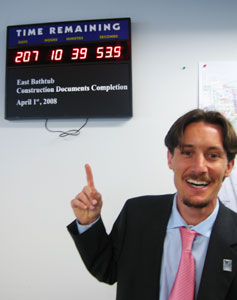
Dara McQuillan of Silverstein Properties counts down until CD sets for the east bathtub are complete.

Rick Bell

Larry Silverstein’s remarks were on target. He spoke of how much is happening at the World Trade Center site, and how the three teams hired by Silverstein Properties to design Towers 2, 3, and 4 have been working side-by-side in the super-sized studio at 7WTC. But the point of the September 6 convocation was the buildings themselves. Among other common features, including their projected LEED ratings, all focused on integrating commercial space on the ground floor thus animating the eastern façades along Church Street and enlivening the streetscape.

For Tower 2, to be known as 200 Greenwich Street and designed by Foster and Partners with Adamson Associates, retail space lines both the north and south sides of the building’s base. The 78-story structure respects the major aspects of the WTC Master Plan by Studio Daniel Libeskind, including integration with the “Wedge of Light” plaza and inflective roof planes. Tower 2 contains 138,000 square feet of retail and some 2.3 million square feet of office space. According to Foster and Partners’ project architect Michael Jelliffe, “the glazed crystalline form and diamond shaped summit of the building will be visible throughout the city and situate the Memorial Park when viewed from any location.”

Tower 3, designed by Rogers Stirk Harbour + Partners (RSHP) has 2.1 million square feet of office space and 193,000 square feet of retail. Richard Paul, partner at RSHP, noted that the 175 Greenwich Street structure, “stands centrally across Greenwich Street from the main axis formed by the two reflecting pools of the memorial.” Renderings show Dey and Cortlandt Streets as pedestrian streets unencumbered by stairways within the paved area. The verticality of the rectilinear tower is accentuated by antennae that stretch the building height to 1,240 feet above grade.

The fourth tower at 150 Greenwich Street is 64 stories tall. At 975 feet above grade it contains 1.8 million square feet of office space and five floors of retail, four located at or above sidewalk level. Project architect Gary Kamemoto of Maki and Associates said that “the above-grade retail takes the form of a podium that becomes a catalyst in activating and enlivening the immediate urban environment at pedestrian street level,” as does the Transit Hall that connects public space to the Cortlandt Street IRT stop. The angular, trapezoidal and parallelogram-shaped floor plans will create a distinctive profile on the Lower Manhattan skyline.

A countdown clock on the wall in the 7WTC super-studio indicates how many days remain until completion of construction documents for the east bathtub area of the site. Six years after the destruction of the World Trade Center, there was a sense of urgency in the room overlooking the site, and confidence the new towers would be realized regardless of the demolition schedule of Deutsche Bank or related construction schedules of the underground service concourse.

The presentation of the towers was put into perspective, as well, by an update on the National September 11 Memorial & Museum by its president/CEO Joe Daniels. The memorial project, now under construction, integrates the “Reflecting Absence” design by Michael Arad, AIA, and Peter Walker, FASLA, with the underground Memorial Museum by Davis Brody Bond Aedas (including a portion of the Vesey Street “Survivors Stair”) and the “Memorial Pavillion” visitors’ arrival center by Snohetta.

Beyond Barriers in Chicago

Access Living Headquarters

Access Living’s new headquarters in Chicago.

Courtesy www.accessliving.org

In describing the building he designed in Chicago for Access Living, a national accessibility rights public interest group, architect John H. Catlin, FAIA, of LCM Architects noted: “Accessible design is good for everyone, not just the people who use Access Living’s building everyday.” The occasion of his remarks was the presentation of the 2007 Barrier-Free America Design Award of the Paralyzed Veterans of America to Catlin and his client, Marca Bristo, President and CEO of Access Living of Metropolitan Chicago. Catlin continued: “Through this new building, and through the Barrier-Free America Award, we will deliver the message that accessibility benefits everyone from wheelchair users, to parents with strollers, to shoppers returning home with groceries.” Bristo spoke of how the LEED Silver headquarters will enable Access Living “to build our services and activities as we continue working to create an inclusive, integrated, and independent disability community.”

Access Living’s Headquarters, described as “a model of Universal and Green Design,” is located at 115 West Chicago Avenue. Less than a mile north of AIA Chicago’s new space at 35 East Wacker Drive, it was the setting for a celebration in August attended by previous Barrier-Free America Award winners including Edward K. Uhlir, FAIA, responsible for the creation of Chicago’s Millennium Park. During a tour, Access Living staff members pointed out some of the Universal Design features that make the building distinct. Those that especially impressed this visitor included:

· Easily adjustable desk counter heights to accommodate users with varying seating needs, including different wheelchair heights
· Oversized elevators with doors both front and back on all floors to enhance wheelchair maneuverability in crowded cabs
· Hallway carpeting with darker-colored borders to help those with visual impairment
· Computer screens linked to telephone and video cameras to enable telephonic signing
· Areas of rescue assistance on each floor also usable as lounge space

Access Living is a cross-disability organization governed and staffed by a majority of people with disabilities. Through its programs, services, and now its Chicago headquarters, it fosters dignity and self-esteem of people with disabilities and enhances their options so they may choose and maintain individualized and satisfying lifestyles. The 115 West Chicago Avenue building exemplifies the seven principles of Universal Design developed in 1997 by the Center for Universal Design at North Carolina State University: Equitable Use, Flexibility in Use, Simple and Intuitive, Perceptible Information, Tolerance for Errors, Low Physical Effort, and Space for Approach & Use. The implementation of these principles makes for good design accessible to all.

Other attendees at the award ceremony included AIA Chicago’s Executive Vice President, Zurich Esposito, and AIA Milwaukee President-elect Karen Plunkett, AIA. The Paralyzed Veterans of America, represented by National Vice President Gregory A. Joyce, National Director Gary E. McDermott, and Director of Architecture Carol Peredo Lopez, AIA, also has a design project underway in Milwaukee.

Shorris Launches New Port

Speaking at the New York Building Congress breakfast at the Mandarin Oriental on June 19, The Port Authority of NY & NJ Executive Director Anthony E. Shorris led off his remarks by quoting Mies van der Rohe: “Architecture is the will of an epoch translated into space.” True enough, but the remarkable thing is that we now have a Harvard and Princeton-educated Port chief executive who not only knows that Mies is more, but knows how to use him to talk with construction industry and labor leaders about a new spirit of openness at the Port Authority. The remarks, paralleled by pronouncements by Governors Spitzer and Corzine, is indicative of changes in Port Authority Board rules and procedures that will allow for greater public participation (see also “Port Authority Tentatively Approves Changes Aimed at Increasing Public Scrutiny,” by Ken Belson, The NY Times, N.Y./Region, 06.22.07).

Shorris previously served as Deputy Chancellor for Operations and Policy at the New York City Board of Education, and was a faculty member at the Woodrow Wilson School of Public and International Affairs at Princeton University. For the June 19 audience of building execs he spoke of the Port Authority’s goals in the following words: “The Port Authority should be marked by the audacity of the past without the arrogance. The Port Authority is fundamentally a BUILDING agency. Quality of design, excellence of design, is one of the criteria by which we judge projects. We will see what can be applicable from the Federal GSA model. Buildings like the transit hub by Calatrava are more than functional, they are grand.”

He noted that, “We are making the agency operate more transparently, doing things that other governmental agencies have been doing for a long time. The Port Authority should meet or exceed the standards of both states and institutionalize those changes so that these improvements survive the tenure of any Director. Ultimately, the agency should not do anything that it is afraid to talk to everyone about. The Port has been moving in this direction for months. We are proud of what we do, and showing people what we do. Openness and transparency do not conflict with the excellence of our staff and our ability to deliver projects.” After the attack on the World Trade Center, where many Port Authority employees perished, there was a renewed sense of purpose and a glimmering of openness in an agency previously known for its secretive behavior. With Board meetings now to be open to the public and press, more information about project planning and design consultant procurement will be accessible.

During the Q&A period, Shorris elaborated upon the Port Authority’s role in several major upcoming projects or plans, starting with the long-planned transformation of the Farley Post Office Building into a major rail hub. He noted, “At Moynahan Station the Port Authority’s role is predominantly in collaboration with New Jersey Transit on Access to the Region’s Core. We are also looking at a new baggage-checking facility. That grand transit hub needs to be fully integrated, linking as well to the PATH system at 34th Street.”

In response to a question about Representative Jerrold Nadler’s quest for a rail freight tunnel, he said: “Freight capacity needs to be expanded and we need to get some trucks off the road to reduce air pollution. The movement of freight in the region is something that the Port is best able to manage. It is a central question environmentally…. The Trans-Hudson Express Tunnel general plan is to be a joint effort with New Jersey Transit — we need to do this together, and we’re committed to a robust partnership to make sure that we get this implemented since it is so important to the two states.”

His conclusion about collaboration was optimistic: “The identification of enormous infrastructure projects in the region is an important thing — it has to be something that over the long term generates more revenue. Both governors are interested in moving big infrastructure projects. But the Feds are not great partners on this, so we have to find some locally generated revenue. We are fortunate now to have two governors and a mayor who are desirous of getting things built. They are so much of a mind that it is great to watch them work together. The public has not seen its government look to execute great public works the way we have the possibility to achieve now. The public needs to see that this can happen. People see a connection between resources and the quality of their lives. If we can show people that investments in infrastructure can lead to better quality of life, there will be support.”

We look forward to ongoing opportunities to see the palpable results of these process changes and project planning overtures.

Nouvel Vogue

Jean Nouvel, Hon. FAIA

Jean Nouvel, Hon. FAIA, gives a tour of 40 Mercer Street, under construction.

Rick Bell, FAIA

Architect Jean Nouvel, Hon. FAIA, was honored April 9, on the 50th anniversary of the founding of NYU’s Maison Française. The celebration, at NYU’s Kimmel Center, also started the weeklong celebration of the AIA New York Chapter’s Architecture Week, marking the sesquicentennial of the American Institute of Architects. After a brief introduction by Francine Goldenhar, director of the Maison Française, Nouvel spoke of architecture in general and of his recent work.

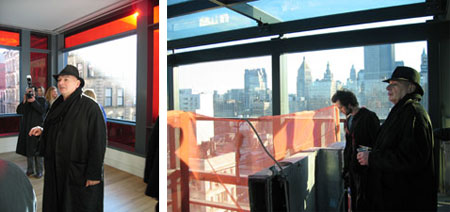
Earlier in the day he conducted a walk-through of the 40 Mercer Street residential tower, nearing completion on Grand Street. During the tour he spoke of the importance of the Manhattan light, of the city view, and of integrating the new structure into SoHo’s streetscape. The 40 Mercer Street tower, and the anticipated project next to Gehry Partner’s IAC on Eleventh Avenue, articulately speak for themselves. The Mercer Street project reflects an urbane dialogue about nature re-inserted in urban architecture, not unlike his Musée du Quai Branly. Its arcade and lobby respond to Mayor Bloomberg’s call for a million new city trees. The residential tower façade refracts light, engaging the colors of the city and the adjacent roofscapes. Nouvel, clad in black, spoke eloquently about the urban context, and of helping create a new wave of environmentally appropriate structures and a new vogue for glass housing. I, for one, was ready to move in.

His subsequent remarks at NYU, based on notes taken hastily by this writer, are excerpted below and in the word document link:

“Architecture is an expansion of our world at a time when our world is getting smaller. The global economy is expanding the promulgation of an architecture without context. We must resist the urbanization of zones and grids. We must establish sensitive poetic relics, an analysis of the art of creation that is specific to rain, sea and mountain.”

“Architecture means transformation, organizing the retention of what is already here. How does one create a vibration that evokes the hidden dimension of the past? This is surely a task for poetry, since only poetry can produce the metaphysic of the instant.”

“Architecture is a vehicle for permanence changed by life, to be impressionable and impress, to absorb and emit. Explanation is the duty; questioning is a necessity of evolution. I will conclude this introduction to my projects with a paradox by Paul Valéry: ‘contradictions generate spirit.’ ”

Click here [jeannouvel.doc]to download the full text of Nouvel’s remarks.