Meta Cheer: Remarks by Dr. Richard Farson at Grassroots, 02.05.10

Dr. Richard Farson is a psychologist, author, and president of the Western Behavioral Sciences Institute. He psyched out the architects in the Grassroots plenary, saying, “Something is beginning to stir in the design professions, dramatically changing the role of architects in the world.” He gave as the three most important AIA initiatives: the redirecting of the public identity and image of architects; the use of design to deal with the most pressing issues of the time; and that design should serve all the people. Saying that social responsibility goes “way beyond sustainability,” Farson noted that “architecture, as the leading design profession, is, potentially, the most powerful profession on earth. You can meet society’s most pressing needs.”

Long interested in the field of design, Farson was the founding dean of the School of Design at the California Institute of the Arts, and a 30-year member of the Board of Directors of the International Design Conference in Aspen, of which he was president for seven years. In 1999, he was elected as a public director and served on the AIA’s national Board of Directors. He is a Senior Fellow of the Design Futures Council. With these credentials and background, he spoke of having to think beyond the scale of individual buildings: “You have to design a new approach to architecture, not only in the private sector but also in the public sector. To tackle these questions of infrastructure we need to become meta-designers.”

In the course of his remarks, he threw out a few glib one-liners, including, “Anyone working at what they were trained to do, is probably obsolete,” and Marshall McLuhan’s aphorism, “If it’s working it’s obsolete.” He noted that architecture is “one of the few professions that is dominated by its clientele, or rather, which has come to be dominated by its clientele. This was not always the case.” He referenced the book Leadership by Design by Ambassador Richard N. Swett, FAIA, “which is about the standing of architects, and how that has changed over time.”

“The public has to learn what designers can do,” he suggested “You’ll need collaboration with social scientists, political leaders, and all sorts of people you don’t deal with now.” And he appended three friendly warnings:

· The higher you go with leadership, the less you deal with problems and the more you deal with predicaments.
· Architects strive for perfection; as we tackle these complex problems, we need to take a lot more risks, and that must allow for failure.
· Meta-design is a higher calling; the money needed for meta-design is an investment — we’ll get it all back as you architects reduce discrimination and divorce, and as you build community and democracy.

Farson concluded with a reference to the movie “Its Complicated,” in which Steve Martin plays an architect. He reminded those present that architects have a secret weapon: mystique. He said, “You have created moments of power and strength and excitement and spirituality and earthiness and beauty.” During the lively question and answer session that followed, he was asked about ways in which the social responsibility of the profession can be enhanced. His answer was telling: “We have to increase our numbers. We have to increase what we are doing. We’re not mobilized as an architectural profession to deal with the great issues of our time. We need to work more effectively with the media. Commoditization is the danger, and the trouble.” Also, answering a direct question, he was able to plug his award-winning documentary film, “Journey into Self,” available online through Psychological Films in Laguna, CA.

Cheering Charleston: Remarks by Charleston Mayor Joe Riley at the Accent on Architecture Gala

As the Grassroots blizzard blanketed DC, Charleston Mayor Joe Riley said, “I’ll talk about the art that we must all be committed to, the art of creating and maintaining beautiful and livable cities. Cities must be places where everyone’s heart can sing.”

Mayor Riley, who has worked long and hard with the American Architecture Foundation to educate elected municipal leaders about the importance of design said, “In the art of city building we must first seek not to make any mistakes. In Charleston we had made some mistakes, but we were determined to build beautiful and affordable housing. There is no excuse for building anything in our city that isn’t beautiful.”

Based on his experience in Charleston he was able to say, “One of the great challenges of city building is the restoration of downtown. The fact of the matter is that downtown is the public realm. It is where your citizenship is reinforced and where the rich and the poor can come together. Those are the reasons why the restoration of downtown Charleston was so important.”

Perhaps it was obvious to everyone in the audience, but in the context of the transformation of Charleston, his comment that “in an urban setting people don’t like to walk past vacant lots” took on new meaning: “In Charleston we got new shops downtown. It was great for our city. We got good design, good storefronts, at a human scale.”

Riley continued: “Saving buildings makes a difference on the street, even if you are saving a three-story building just to make sure that the ground floor is active.” He quoted Louis Sullivan as having said that form follows function — in Riley’s estimation that doesn’t mean that a parking garage has to make a big deal about showing off the cars parked there. He suggested the use of louvers, saying, “You don’t have to see the cars to have parking downtown.”

His speech was full of anecdotes and stories, including case studies of specific buildings in Charleston. But one of his tales that particularly resonated with the issues of downtown’s special places had Vincent Scully and Louis Kahn walking around Red Square and, as he put it, “One said about St. Basil’s, ‘Isn’t it lovely how it hits the sky?’ and the other said, ‘Yeah, but isn’t it so lovely how it hits the ground?'” From this Mayor Riley deduced that, “This is what great cities do. They have rules. We study what the city needs to be.”

A lot of his remarks at Accent concentrated on specific public spaces, including parks. For example, “When people say why build parks, that parks take property off the tax roll, they don’t understand what makes cities great. We’ve created the most lovely places. Every park design is different. Parks can be reposeful places for busy people in the center of a city. When you build a beautiful public realm, the private investment follows.”

“Charleston is a city you can walk,” he said. “Not having to drive downtown, and not having to find a parking place has saved a lot of marriages. The trams go where people want them to go.” He continued, “Let’s say that all of us here agree with all this, but what about political support?” His case studies described public engagement in the process and the outcome of decisions about public projects and spaces. He quoted a gun-toting security guard at a downtown liquor store as thanking him (during a purchase) for creating a park “that was the prettiest thing he ever saw.”

We Gonna Run This Town Tonight

Bloomberg-Inaugural

(Left): Mayor Bloomberg taking the oath of office; (Right): 2010 AIANY President Tony Schirripa, AIA, IIDA (left), and AIANY Executive Director Rick Bell, FAIA, at the inaugural.

Rick Bell (left); Olsen Tartufo

The third inaugural of Mayor Michael R. Bloomberg took place on Friday, January 1 at City Hall Park. Remarks were brief, perhaps because of the biting cold and the lack of the stars whose presence had lengthened the event four years before. The Mayor started with a reference to the people’s party that took place on New Year’s Eve at Times Square: “Last night the final moments of 2009 passed into history, and as they did, Americans from across the country looked to New York to ring in a new year, a new decade, and a new beginning. And that is only right, because our city has always led the nation, not just in celebrating holidays, but in pioneering the most innovative and ambitious new ideas.” He noted the historic achievements and leadership of New Yorkers, saying, “We have built the country’s largest affordable housing program and adopted its most sweeping public health agenda. We have pursued the boldest sustainability agenda on the planet. And we have made the greatest city in the world even greater.”

A central theme of the inauguration was the importance of immigration reform to New York and its economy. Mayor Bloomberg called our city “the world capital of opportunity and entrepreneurism,” and a place where “innovation occurs when people look with fresh ideas at old problems, and then work together to solve them.” Rhetorical flourishes in the speech gave hope to the environmentalists, builders, and architects present, including newly inaugurated AIA New York Chapter President Tony Schirripa, AIA, IIDA, whose theme this year addresses architects as leaders. The Mayor said: “We will find innovative new ways to create jobs in the industries of the future, from bioscience and arts and culture, to green technology that fights global warming and local asthma at the same time,” and “the future starts here, it starts now, and it starts with us.”

While the city’s Active Design Guidelines, a successful collaboration between several mayoral agencies, was not specifically called out in the short speech, its upcoming launch the evening of January 27 at the Center for Architecture, was anticipated. The Mayor said, “Conventional wisdom holds that by a third term, mayors run out of energy and ideas — but we have proved the conventional wisdom wrong time and again, and, I promise you, we will do it once more.”

From my perspective, the best embellishment in the inaugural speech was the Mayor’s concluding quote of the analogy from E.B. White’s Here is New York: “New York is to the nation what the white church spire is to the village — the visible symbol of aspiration and faith, the white plume saying the way is up.” Before the Staten Island P.S. 22 chorus broke into a G-rated rendition of the Jay-Z song “Run This Town” (from Blueprint 3), the Mayor ended, “On this first day of the year, the first day of the decade, and the first day of the future of this great city — the way is still up.”

Beekman Rises

Beekman-COMBO

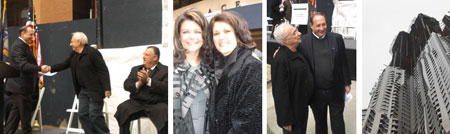
(L-R): Bruce Ratner, Frank Gehry, FAIA, and Gary LaBarbera; Joanne M. Minieri and MaryAnne Gilmartin; Frank Gehry, FAIA, and Bruce Ratner; and the Beekman Tower.

Rick Bell

“I’ve paid attention to the body language of NYC skyscrapers — this is a building that could only be built in New York,” said Frank Gehry, FAIA, at last Thursday’s topping-off ceremony for the 76-story Beekman Tower, located between Spruce, William, Beekman, and Nassau Streets in Lower Manhattan. The new building is the first residential tower designed in NYC by Gehry, who especially thanked “the workmen and the many hands that worked together to make this happen,” adding that “when I design a building, I think of all of the thousands of people who are involved” in its construction.

In construction, “topping off” refers to the ceremony held when the last beam, or in this case a 10-ton bucket of concrete, is placed at the building’s top. Since the dark days of the Great Depression, there has never been as much attention paid to issues of skyscraper form, design excellence, and the need for jobs in the construction and design industries.

As master of ceremonies and the project’s developer, Bruce Ratner, Chairman & CEO of Forest City Ratner Companies, proudly proclaimed that “Beekman has 2,500 union jobs — we build through recessions,” and that the design “is something else.” The stainless-steel residential tower has 1.1 million square feet and rises almost 900 feet above a six-story brick podium that will house the first NYC public school ever built on private land. The 100,000-square-foot school, designed by Swanke Hayden Connell Architects, will accommodate 630 students. The fact that a good part of the equity for the project came from union pension funds was not lost on the crowd of more than 200 civic and labor leaders, including NYC Buildings Commissioner Robert LiMandri, Forest City Ratner’s President & COO Joanne M. Minieri, and Executive Vice President MaryAnne Gilmartin. Gary LaBarbera, president of the Building and Construction Trades Council spoke of how the project team was “committed to success, even under the most difficult economic circumstances in decades.” He exclaimed, “The spirit of NYC made this happen — this is the greatest city in the world!”

Dallas Architecture District

OMA-Foster-RPBW

(L-R): Wyly Theater by REX/OMA; Winspear Opera House by Foster + Partners; Nasher Sculpture Center by Renzo Piano Building Workshop.

Rick Bell

The year-old Dallas Center for Architecture, located on the edge of the Dallas Arts District, hosted the 2009 convocation of the leaders of the largest AIA components, the so-called “Big Sibs.” The remarkable ground-level Center, directly across the soon-to-be-decked Woodall Rodgers Freeway from the Dallas Art Museum by Edward Larrabee Barnes, FAIA, has superb meeting and exhibition space. The two-day large-chapter meeting, led by AIA Dallas President Todd Howard, AIA, and Executive Director Paula Clements, Hon. TSA, held 10.01-02.09, allowed the exchange of best practices and ideas for how the AIA can best serve its members during the current recession. Present were presidents, presidents-elect, and executive directors from 14 cities: Atlanta, Boston, Chicago, Dallas, Denver, Houston, Los Angeles, Minneapolis, New York, Orange County (CA), Philadelphia, San Francisco, Seattle, and Washington, DC. While in Dallas, the AIA leaders were able to see the construction sites for the Winspear Opera House by Foster + Partners and AT&T Performing Arts Center Dee and Charles Wyly Theater by REX/OMA, along with the Dallas Art Museum and the Nasher Sculpture Center by Renzo Piano Building Workshop. Many also visited the still-sparkling Morton H. Myerson Symphony Center by Pei Cobb Freed & Partners, and saw Eric Breitbart’s film “Visual Acoustics: The Modernism of Julius Shulman” at The Magnolia.

Common themes emerging from the Big Sibs discussion included the importance of:
· Emerging architects / young architects
· Continuing education and volunteer opportunities during the economic downturn
· Membership retention and development; keeping in touch with members and others whose primary e-mail has changed because of layoffs
· Budgetary projections given non-dues revenue diminishment
· Collaboration with other professional and civic groups
· Strategic planning, both local and national
· Enhancing communications and advocacy
· Centers for Architecture (6 chapters have them, three are planning a center)

For AIANY, Chapter President Sherida Paulsen, FAIA, described five initiatives growing out of our six-year-old Center for Architecture, including the Not Business as Usual response to the economy; the One AIA/One NYC effort to have the five AIA chapters in our city work more closely together; exhibitions as outreach and education, including the just-opened “ContextContrast” show on new buildings in historic districts; our municipal advocacy efforts with the Department of Buildings and other city agencies, including the urbanSHED competition; and the Open to the Public effort, using exhibitions such as “New York Now” to leverage the visibility of the Center. Also representing our Chapter was president-elect Tony Schirripa, AIA, and 2011 president-to-be Margaret Castillo, AIA.

Perhaps the most compelling part of the open discussion was a presentation by Ann Schopf, AIA, President of AIA Seattle, about the need to unite behind 2030 carbon reduction goals. In particular, the educational programs being offered by AIA Seattle, which address the measurement of carbon reduction for new and existing buildings, was seen as a model. All component leaders registered support for making this program available nationwide, with financial support from the large chapters, and possibly AIA National.

George Miller, FAIA, president-elect of AIA National was present, as was Christine McEntee, executive vice president. Miller led a discussion of the AIA’s strategic planning effort and also announced a new program for next year, possibly to be called “Architecture Now” (other ideas welcome) patterned after the AIANY’s “New York Now” exhibition, currently on view at the West 4th Street subway station. All AIA members could submit the best of their work in a non-juried nationwide exhibition that would emphasize and dramatize the importance of architecture and urban design in the creation of livable and sustainable communities. The proposal was seen as consistent with the proposed and much-discussed AIA vision statement, Design Matters!

Awards of the State

“I don’t deserve this award, but I have arthritis, and I don’t deserve that either,” once quipped comedian Jack Benny. At the recent Rochester convocation of AIA New York State, 41 design awards, four student awards, and 12 service and achievement awards were conferred at two gala ceremonies. The acceptance speeches sounded like silent movies. To keep things moving, there were no opportunities for award winners at either event to thank clients, colleagues, collaborators, co-workers, co-habitators or, even, architectural photographers.

The 2009 Design Awards evening on Thursday, 09.24.09, was opened by AIA New York State President Burton Roslyn, AIA, who said that the purpose of the awards was “to celebrate design achievement and generate greater public interest…. That 41 were selected from a record number of 310 design submissions,” he declared, “is a tribute to the diligent work of the design jury, headed by Design Award Jury Chair Charles Matta, FAIA, the Director of Federal Buildings and Modernizations in the Office of the Chief Architect at GSA.” Sounding a sour note, AIA Rochester 2009 President Robert A. Healy, AIA, complained from the lectern that all 41 awards were won, this year, by NYC-based firms. Roslyn engaged in the debate by replying that the competition was anonymous, entries were unmarked, and the jurors were not aware of the location of the office of the project authors.

Matta, taking the stage, also complimented the hard work and difficult decisions of his jury colleagues, Alan H. Cobb, FAIA, VP, Director of Design, Architecture and Sustainability, Albert Kahn Associates; Tom S. Howorth, FAIA, President, Howorth & Associates Architects; Mark Robbins, Dean, Syracuse University School of Architecture; and Judith E. Bergtraum, Vice Chancellor for Facilities Planning, Construction and Management, City University of New York. But he observed that “the number of projects is indicative of the economic boom in place until 2008” implicitly raising the question of what we will see next year.

For attendees there was no Emmy or Tony suspense — award-winners had been notified in advance, and programs nicely printed. Nonetheless, a few award winners were surprisingly absent from the proceedings, which many in the room found to be unfortunate and disrespectful. Happily, many distinguished practitioners including Rick Cook, AIA, stepped up to the lectern; Cook + Fox garnered three design awards for projects as diverse as 401 West 14th Street, 11 Christopher Street, and the Center for Friends Without a Border in Siem Reap, Cambodia. Sylvia Smith, FAIA, of FXFOWLE Architects, was there to receive design awards for the Lion House Reconstruction at the Bronx Zoo and the lean reconstruction of Alice Tully Hall in Manhattan, achieved in concert with Diller Scofidio + Renfro. The Best in New York State Award was given to the four firms who together made possible the TKTS Booth and Revitalization of Father Duffy Square; Choi Ropiha (concept architects), Perkins Eastman (design architects), William Fellows Architects/PKSB (plaza architects), and Bresnan Architects (preservation architects) admirably shared the acclaim for this transformational project. One Perkins Eastman rep, standing on the podium next to PKSB’s (and AIANY 2009 President) Sherida Paulsen, FAIA, even decked out in a kilt for the occasion.

Many younger and emerging architects were present to accept their awards and the accolades of their peers. These included Philip Wu, who received an award of excellence for a project at 39 East 13th Street, and Jolie Kerns of Toshiko Mori Architect, who designed a Newspaper Café in Jinhua City, China, which also received an excellence award.

What we missed in speeches, we regained in the beauty of the winning project images, projected through Powerpoint, the 21st century equivalent of a camera obscura — a darkened chamber in which the real image of an object is received through a small opening or lens.

The Honor Awards ceremony, held at George Eastman House and sponsored by Zetlin & DeChiara, took place on Friday, 09.25.09, and was equally short and sweet. The quick pace allowed those in the audience to subsequently mingle with the honorees while touring the National Register house and the generous reception in the adjacent International Museum of Photography. AIANY Chapter members also won the lion’s share of these awards. The downstate prevalence was, again, the elephant in the room. AIANY Chapter members honored included Venesa Alicea, Assoc. AIA, LEED AP (Intern/Associate Award), Abby Suckle, FAIA (Fellows Award), Leevi Kiil, FAIA (President’s Award), and Anthony Vidler (Educator’s Award). The Firm of the Year was conferred upon Pei Cobb Freed & Partners, and one of the Student Awards went to Jackie Delsandro of Parsons, The New School of Design, School of Constructed Environments. A complete list of AIANYS Design, Honor, and Student Awards, will be posted on AIANYS’s website soon. Design matters and service was honored.

Security Talk at One Police Plaza

Police Commissioner Raymond W. Kelly formally presented the NYPD’s cogent book of design guidelines, Engineering Security: Protective Design for High Risk Buildings, at a well-attended conference at One Police Plaza on July 1. Calling the document “a major step forward to prevent an attack or mitigate the impact of an attack,” he delineated the principles of protective design and the specific recommendations necessary for “New York City’s high density environment.” The result of a process of intensive consultations and peer review, Commissioner Kelly said the final document was both informative and practical.

The details of the book’s organization and contents were outlined by Dr. Richard A. Falkenrath, NYPD Deputy Commissioner of Counterterrorism. Falkenrath described the sessions that led to the development of tools to calculate risk, with particular attention to risk mitigation and avoidance through site layout, building orientation, façade design, window placement, material selection, interior partition composition, and the prevention of progressive collapse.

Several members of the AIA New York Chapter Board, including 2009 Chapter President Sherida Paulsen, FAIA, President-elect Tony Schirripa, AIA, IIDA, and Director of Industry Affairs Carl Galioto, FAIA, reviewed advance copies of the preliminary document. The Chapter’s remarks, sent to Falkenrath on June 12, stated that the book puts forth a rational and reasonable approach to understanding the particular challenges of building high-risk buildings and offers potential solutions to address specific conditions. We agreed with the fundamental premise of the book that only a small number of high-risk buildings merit significant security design attention, but that many buildings could benefit from its suggestions. That the document requires little or no expense for low-risk buildings is noteworthy given the current economic downturn and financial crunch.

The strategies presented for medium- and high-risk buildings are consistent with recommendations made on a project-by-project basis by security consultants including Robert Ducibella (Ducibella Venter & Santore), one of the peer review technical experts whose comments educated the development of the book. The accessibility of the document, available online, makes this strategic approach available to many more architects, engineers, builders, and building owners.

The only other post-9/11 publication available that addresses how building security analysis can determine the most appropriate methods of protecting people, buildings, assets, and ongoing operations, is the tome called Building Security: Handbook for Architectural Planning & Design (2004, McGraw-Hill Professional), by Barbara Nadel, FAIA, a collection of 31 essays by architects and engineers, including Galioto. Nadel acknowledges Commissioner Kelly and many others at the NYPD in her introduction.

But the books are very different. Reading the NYPD’s Engineering Security: Protective Design for High Risk Buildings is comparable to entering into a conversation with the counter-terrorism experts at the NYPD, learning what has worked and not worked, hearing what is logical and what is not logical, determining clear and concrete steps for design and construction of buildings made iconic by location, use, and prominence.

The publication announcement at NYPD Headquarters, a 1973 structure designed by Kelly & Gruzen (now Gruzen Samton Architects, Planners & Interior Designers), included a panel discussion by NYC Department of Buildings Commissioner Robert Limandri, Ducibella, Marolyn Davenport of the Real Estate Board of New York, and yours truly representing AIANY. Other speakers included Rep. Peter King and Rep. Yvette Clarke, both members of Congress who serve on the Homeland Security Committee.

AIANY looks forward to assisting the NYPD in making the book’s contents and recommendations available to its members and to others in the design and construction communities.

Governor Patterson at ABNY

Rick Bell, FAIA, with Governor Patterson.

Marissa Shorenstein

On Thursday, 04.02.09, New York State Governor David A. Patterson came to a breakfast meeting of the Association for a Better New York to discuss his efforts to close the largest budget gap in state history and stabilize New York’s long-term finances. Governor Paterson started his remarks by noting that a large number of the projects in the Federal Stimulus Package are located in NYC. The funding coming with these projects may camouflage the fact that the state’s budget, and the city’s budget as well, have been overwhelmed by what Governor Paterson called “the tsunami of revenue downturn.” He spoke of the compromises that had to be made by all parties in Albany and called for ongoing fiscal restraint, noting that the state’s budget “has more cuts and more recurring cuts than would have occurred if I jumped up and down and called the Legislators names.”

His budgetary outline was presented succinctly: “This is where we are now in the Empire State,” he said. “We are making decisions that are unpopular, and no one knows that better than me — the solace is that these decisions are necessary.” In an even tone he continued: “This budget is about broad sweeping reforms and change; it is the road to economic recovery.” Tonal change crept in with rhetorical challenge: “To those who are criticizing it, I say you do not understand the dire circumstances of this economy, and you do not understand the need for shared sacrifice. I am the Governor of this state and I do.”

The remarks spoke to specific numbers, including the $6 billion expected from the Stimulus Package and the $4.7 billion anticipated from the personal income tax, which Gov. Patterson had previously opposed. He suggested that there was a great need to eliminate waste and redundancy in state agencies by concentrating government operations, and he cited health care and prison reforms as areas currently receiving critical attention. The Rockefeller-era drug laws, in particular, were cited as causing expensive and unnecessary mandatory incarceration for first-time offenders who, he said, need treatment more than prison.

In addressing deficits, which he said were occurring in 43 of the 50 states, and totaling almost $190 billion, Gov. Patterson said that “we shouldn’t be myopic — this problem is occurring in other states. We’ve been an equal opportunity offender in this budget process.” He concluded by saying that the proposed MTA transit fare increases are “a total encumbrance” that should not proceed.

Challenged about keeping the “Governor” in “Governors Island” he spoke of ongoing negotiations with the city, promising that “there was something being worked out” that would help fund the Governors Island Preservation & Education Corporation and its programs providing public access. Revenue tsunami or no, Governors Island needs to be kept afloat.

Sen. Kirsten Gillibrand Debuts at ABNY

Senator Kirsten Gillibrand at ABNY.

Rick Bell

Senator Kirsten Gillibrand opened by thanking the Association for a Better New York (ABNY) and its chair, William Rudin, for the opportunity to address a large crowd of civic leaders, elected officials, NYC commissioners, health care professionals, labor leaders, and builders. She pointed out that many in the room did not know her well, since her political ascent as an upstart and upstate member of Congress dates back only to 2006. Her speech, however, showed her political skills, referencing not only her grandmother (well-known in NYS Democratic circles), but former Senator Hillary Clinton’s speech in Beijing. Sen. Gillibrand said that it inspired her to ask herself, “What am I doing to impact this world, what am I doing to make a difference?” She added that to follow in the footsteps of the Secretary of State is an enormous honor, while attributing her job preparation at Davis & Polk as a securities lawyer and at HUD as special counsel to former HUD Secretary Andrew Cuomo.

She quickly got to the heart of the matter: the economic stimulus package, and the differences between the Senate and House versions of the Recovery Act. Saying that solutions must come out of Washington, but also from the private sector, the newest Senator spoke of the need for short-term relief for the communities that need it the most. She added that long-term investment in early childhood education and for college tuition relief through expansion of Pell grants and tax credits was also needed and part of the package.

Among the other topics that the AIA brought to Capitol Hill last week during the Grassroots lobbying effort, Sen. Gillibrand addressed the stimulus package’s Senate-version sums for alternative energy ($42 billion), mass transit ($8.4 billion), and public housing ($5 billion). She said that the planned expansion of AmeriCorps aided “long-term programs that make a difference, that represent who we are.”

Echoing concerns expressed by architects last week at the VIA AIA! Leadership and Legislative Conference in DC, she noted that “the real problem is that the banks don’t want to lend,” and added, “The world is watching America right now — we need to bring ideas to the table that have a short-term and a long-term impact.” As founder of the high-tech caucus in the House, Sen. Gillibrand was cogent about the job creation possibilities in the high-tech and energy sectors, and spoke of green jobs and manufacturing opportunities for New York.

In the press conference afterwards she was open to questions about her evolving positions on guns and same-sex marriage, noting the difference between representing an upstate Congressional District where hunting is a tradition, and now being the Junior Senator for the entire state. She quoted Eleanor Roosevelt about the travails and scrutiny occasioned by her appointment: “A woman is like a teabag, you don’t know how strong she is until she’s in hot water.” From the back rows of the Hilton, she seemed strong enough to represent New York.

Bloomberg & Obama in Concert

In his 2009 State of the City Address, delivered at Brooklyn College on January 15th, Mayor Michael R. Bloomberg spoke of creating jobs, strengthening the quality of life in every NYC neighborhood, and stretching every dollar further. Job creation, he said, starts with investing in new infrastructure. And in this fiscal year, the mayor reported that there will be an all-time high of more than $10 billion in capital projects, creating more than 25,000 construction-related jobs. He gave as examples not only the #7 Flushing line extension, but also the new Police Academy in Queens, a new police precinct in Staten Island, libraries in every borough, the Queens Museum expansion, and the High Line build-out.

Relating construction to federal funding, Bloomberg had this to say: “For the past year, we’ve been pushing Washington to focus the Federal Stimulus on ready-to-build infrastructure. In all fairness, they’ve finally come around — and thanks to all the work we’ve done over the past several years, we’re ready to build. We look forward to working with Congress and President-elect Obama — not just on the stimulus package, but on re-thinking the entire way we fund infrastructure projects in this country.”

Those old enough remember the special relationship that existed between NYC and the federal government during the heyday of the Works Progress Administration and its funding of municipal projects. Mayor LaGuardia had a direct line to President Roosevelt, and many NYC Department of Health District Health Centers, among many other federally funded projects, came about as a function of that lifeline.

Continues…