In this issue:
· Tishman-Speyer Wins Big West Side Prize
· South Bronx Bank Note Building to House Artists, Food Market
· Brooklyn Goes Residential/Commercial Green
· A Cohousing Project to Grow in Brooklyn
· Toronto Gears Up for an Alternatively Fueled Future
· New Center Simulates for Med Students


Tishman-Speyer Wins Big West Side Prize

West Side Rail Yards

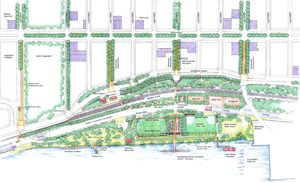
The Tishman-Speyer West Side Rail Yard proposal.

Courtesy tishmanspeyer.com

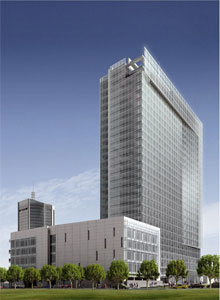
Mayor Michael Bloomberg, Governor David Paterson, Metropolitan Transportation Authority (MTA) Executive Director and CEO Elliot Sander, and MTA Chairman H. Dale Hemmerdinger announced the conditional selection of Tishman Speyer to develop the air space over the two development sites that compose the MTA’s John D. Caemmerer Rail Yard — the Western Rail Yard (WRY) and the Eastern Rail Yard (ERY). The design team for the project includes Murphy/Jahn Architects, master plan architect; Cooper-Robertson, master planner; and PWP Landscape Architecture. This decision ends a six-month bid process, which originally involved five competing developers. Tishman Speyer outbid a joint venture between the Durst Organization and Vornado Realty Trust — by $112 million, offering to pay $1.004 billion for the rights to develop the 26-acre site.

The Tishman Speyer proposal would construct more than 12 million square feet of commercial, residential, retail, cultural, and community space while preserving and rehabilitating the High Line’s linear open space. The complex includes 13 acres of open public space, 3,000 residential units of which 379 units will be affordable housing, 550,000 square feet of retail space, a public school, and a 200,000-square-foot cultural venue overlooking the “Forum.” The project is pursuing LEED Gold certification. The majority of the High Line on-site will be maintained as a linear park, but the plan will demolish the spur over Tenth Avenue and part of the section along 30th Street.


South Bronx Bank Note Building to House Artists, Food Market
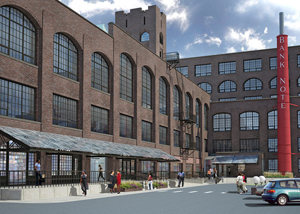
Bank Note Building

The Bank Note Building.

Beyer Blinder Belle Architects & Planners

The redevelopment of the newly designated NYC landmark — the former American Bank Note Building in Hunts Point, has begun. Beyer Blinder Belle Architects & Planners is redesigning the 420,000-square-foot, circa 1911 classical revival building. Taconic Investment Partners and Denham Wolf Real Estate Services purchased the building earlier this year for $32 million hoping to attract a tenant mix including visual and performing artists, architects, film production/studios, and a food market. When the building reopens in 2011 for its centennial celebration, it will be known as The BankNote.


Brooklyn Goes Residential/Commercial Green
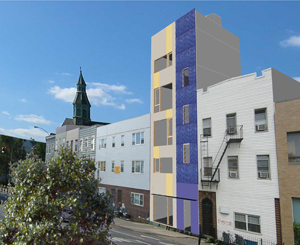
439 Metropolitan

439 Metropolitan Avenue.

Helder Design

Helder Design is aiming for LEED Platinum for a residential project on Metropolitan Avenue in Williamsburg, Brooklyn. The three-unit condo building will have two duplex residential units and one commercial unit. Green features include radiant floor heating in conjunction with continuous filtered ventilation with heat recovery, which will bring air quality to near High Efficiency Particulate Air (HEPA) standards, and private photovoltaic solar panel arrays for each unit. Since the building faces south, it also uses passive solar heating. An art gallery will occupy a portion of the ground floor, and the ground floor and cellar will be Helder Design’s architecture studio.


A Cohousing Project to Grow in Brooklyn
Cohousing communities are managed by residents and combine the advantages of private homes with the benefits of more sustainable living, including shared common facilities — such as a common dining hall and kitchen, children’s spaces, outdoor areas, and tool rooms. There are more than 100 cohousing communities in North America, the largest percentage being in California and Colorado. New York State currently has two such built communities — one in Ithaca, the other in Saugerties — with several more in various stages of formation. The new Brooklyn Cohousing Group is looking for a site within walking distance of Prospect Park that they can build from scratch or renovate to accommodate 30 families who will own their private apartments. Alex Marshall, senior editor of the Regional Plan Association’s newsletter, Spotlight on the Region, and his wife, Kristi Barlow founded the group a year ago. Now incorporated, they are working with Chris Scott Hanson, who has developed cohousing communities throughout the country.


Toronto Gears Up for an Alternatively Fueled Future
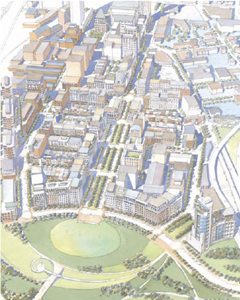
West Don Lands

West Don Lands on the Toronto Waterfront.

Courtesy waterfronttoronoto.ca

Waterfront Toronto, which oversees a 2,000-acre tract of largely publicly owned land, has selected Steven Holl Architects (SHA) to design the 3,500-square-meter District Energy Centre (DEC) in the West Don Lands, which will provide centralized heating and cooling to the first new waterfront neighborhoods of Toronto. A network of underground pipes will extend to every development parcel in the precincts, and all new buildings must rely on this system. Initially the plants will be natural gas-fired, but will be designed for conversion to alternative fuels when they become approved for urban use. Toronto-based Bortolotto Design Architect (BDA) will be collaborating with SHA. The DEC is slated to begin construction by the end of 2008 and is expected to deliver heating and cooling by the beginning of 2010.


New Center Simulates for Med Students
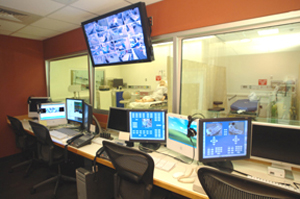
CELA

CELA control room.

Donald Blair & Partners Architects

The Center for Experiential Learning and Assessment (CELA), a two-floor fit-out of shell space within a larger medical research building has recently opened at Vanderbilt University Medical Center in Nashville, TN. Designed by NYC-based Donald Blair & Partners Architects, CELA is a state-of-the-art clinical educational facility designed to train medical students and medical staff with two distinct programs — the Simulation Technologies Program, and the Program in Human Simulation. In the former, robots are programmed to simulate medical conditions, and in the latter, actors are trained to “perform” as patients for students to evaluate and review.

Wired for audio and video recording and observed from control rooms, the simulation rooms are designed for flexibility and can adjust to different scenarios — operating rooms, intensive care rooms, and/or emergency room settings. A Virtual Reality Room contains procedural computer training machines. CELA’s overall design incorporates the need for a realistic healthcare environment — supported by the choice of finishes, materials, healthcare standards, and equipment — combined with a comfortable learning, conference, pre-encounter briefing and post-encounter de-briefing facility.
In this issue:
· Residence Hovers Along High Line
· The Team Grows in Brooklyn Arts Tower
· First Indoor Public Pool Makes a Splash in Queens
· Towers Live on the Edge — of the L Train
· Norfolk Street Turns On to Art
· A Fishy Ferry Experience from Staten Island
· Artist’s Work Cantilevers Over Denver
· Natural Elements Inspire New Residences in Anguilla


Residence Hovers Along High Line

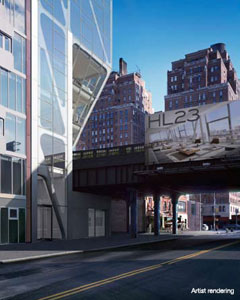
HL23

Artist’s rendering of HL23.

Neil M. Denari Architects

LA-based Neil M. Denari Architects will make its mark in NYC on a 40-foot-wide site along the High Line. Construction has begun on HL23, a 14-story concrete-and-steel-framed building with diagonal perimeter bracing that will increase in size as it cantilevers over the raised railbed. HL23 is to have façade window panels that are over 11-feet-high by six-feet-wide. The building will include 11 residences, nine full-floor homes, a duplex penthouse with terraces, and a two-floor maisonette with a private garden at the building’s base. NY-based The Spector Group is the consulting architect for construction administration, and NY-based Thomas Juul-Hansen is designing the interiors. HL23 will be a subject in the upcoming exhibition Fast Forward: Neil Denari Builds On The Highline, opening in June 2008 at the Museum of the City of New York.


The Team Grows in Brooklyn Arts Tower

Brooklyn Arts Tower

The Brooklyn Arts Tower.

Arup

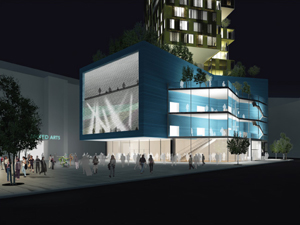
Arup will lead the programming and planning process for the fit-out of the Ashland Center at the Brooklyn Arts Tower in the BAM Cultural District. With Snøhetta as the interior architect, Arup will provide theater consulting and acoustic design services for the new center that will contain a main flexible performance space with facilities for dance and movement, large studios for rehearsals, workshops, and production development. The center is part of a commercial development designed by Studio MDA in collaboration with Behnisch Architects, providing street-level retail space with a high-rise residential tower.


First Indoor Public Pool Makes a Splash in Queens

FMCP Aquatic Center

FMCP Aquatic Center.

Daniel Avila / NYC Parks & Recreation

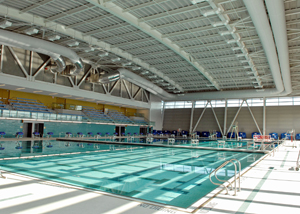
An Olympic-size swimming pool housed in the new Flushing Meadows Corona Park Natatorium and Ice Rink building is to be the first indoor public pool built by the city in 40 years. And when the NHL-regulation ice rink opens later this year, the public will enjoy what will reportedly be the largest recreation complex ever built in a city park. Designed by Handel Architects in association with Hom & Goldman Architects, the pool features 10 lanes. Movable bulkheads can configure the pool into three 25-meter swimming areas, allowing for different programming to take place at one time. One-third of the pool has a movable floor that can adjust the depth from just a few inches to over seven feet deep. A mezzanine bleacher section seats some 414 spectators, with additional seating on an adjacent outdoor terrace.

Inspired by 1939 and 1964 World’s Fair pavilions, the project was designed as part of the City’s 2012 Olympic bid, and features a three-story atrium lobby that separates the pool and ice arena under a cable-supported canopy roof.


Towers Live on the Edge — of the L Train

The Edge

The Edge.

The Stephen B. Jacobs Group

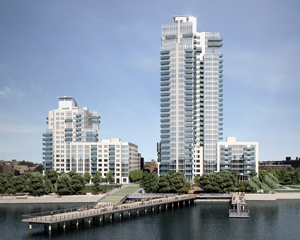
Phase One of The Edge, a new residential development on a 7.5-acre site in Williamsburg, Brooklyn, is underway. Designed by The Stephen B. Jacobs Group with interiors by Andi Pepper Interior Design, construction on the first two condo towers — one 30 stories with 370 residences and the other 15 stories with 205 units — is expected to be ready for occupancy by summer, 2009. A third tower is also planned to include more than 60,000 square feet of retail space, below grade parking for 700 cars, and approximately 1.75 acres of open space for a waterfront public park with a water taxi landing. Also proposed for the neighborhood is 54 acres of parkland, complete with an aquatic center, esplanade, and piers.


Norfolk Street Turns On to Art

Switch Building

The Switch Building.

nARCHITECTS

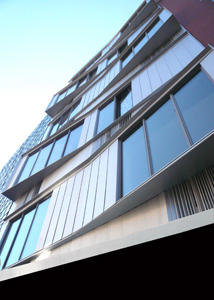
In addition to four full-floor apartments, and a duplex penthouse, the 14,000-square-foot Switch Building, designed by nARCHITECTS, contains a 2,000-square-foot nonprofit art gallery, appropriately titled the Switch Gallery. The art space expands its boundaries via a black hot-rolled steel and glass storefront that opens to the sidewalk. At the rear of the gallery, visitors descend into a double-height volume illuminated by a large skylight. The gallery’s plan maximizes wall space in a fluid spatial continuity while working around the obstacles of the residential core and lobby with which it shares its footprint. The “switching” concept can be seen in the bay windows that angle from the front façade, switching to maximize light and views.


A Fishy Ferry Experience from Staten Island

St. George Ferry Terminal

New fish tanks at the St. George Ferry Terminal.

Skanska USA

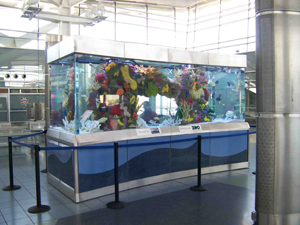
Commuters at the St. George Ferry Terminal on Staten Island may now pass waiting time viewing saltwater fish from the Indo-Pacific and Caribbean regions inhabiting two tanks built by Skanska USA. Each eight-foot-tall tank weighs 10 tons when filled with water. Three-inch thick acrylic walls contain 200 fish and 2,200 gallons of water. A back-up system for the tanks is situated downstairs in the life support room, which houses filters, heaters, sterilizers, control systems and 14 pumps to keep the fish healthy.


Natural Elements Inspire New Residences in Anguilla

Kamique

Kamique in Anguilla.

Lee H. Skolnick Architecture + Design Partnership

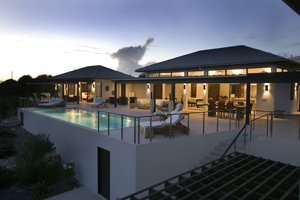
The first of four residential projects on the Caribbean island of Anguilla, designed by Lee H. Skolnick Architecture + Design Partnership, is complete. Kamique, a luxury rental property, has villas ranging from four to six bedrooms focusing on experiencing water, sand, sky, and wind. The three projects still in the works include villas and condos, or a combination of the two. The design for Shoal Bay was inspired by cultures of the indigenous Arawak Indians and African traditions blended with natural elements; Willow Run is said to re-interpret a traditional open-air Caribbean structure composed of two adjoining parcels each with a residential building with three connected pavilions.

In this issue:
· A QTiP Addition to Open in May
· Breakfast at the Old Tiffany’s
· Renaissance Advances in Downtown Brooklyn
· Going Wild Over Earning LEED Silver
· An American Hospital Out of Africa
· Bridging New York and Dubai
· Keeping Up in the West Village


A QTiP Addition to Open in May

QTiP

Queens Theatre-in-the-Park.

Caples Jefferson Architects

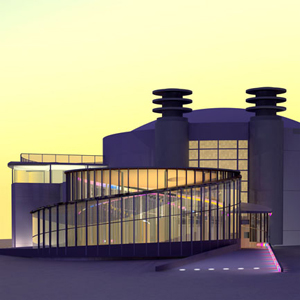
Caples Jefferson Architects recently announced that after three years of construction, the new addition to the Queens Theatre-in-the-Park (QTiP) in Flushing Meadows Corona Park is scheduled to open in May. The expansion adds a 75-seat cabaret and a 540-person lobby/reception center to the existing theater which itself is a 1972 conversion and 1993 renovation of Philip Johnson’s Theaterama. Johnson’s design was a cycloramic tribute to NY and part of the New York State Pavilion built for the 1964/1965 World’s Fair. The circular geometry of the original cylinder and the subsequent tower additions are complemented with the new rectilinear form of the cabaret and the oval plan of the reception center. The curving ceiling in the reception center creates a dramatic point of entry to the performance space.


Breakfast at the Old Tiffany’s

15 Union Square West

15 Union Square West.

Perkins Eastman

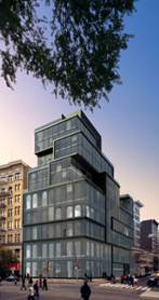
The former Tiffany & Co. building, once referred to as “the Palace of Jewels” located at 15 Union Square West, has been wrapped in a layered glass skin and made into residential condominiums by Perkins Eastman, with interiors by Vicente Wolf Associates. The cast iron arches of the original five-story structure, designed by John Kellum in 1870, were preserved and seven new floors — a series of glass cubes set at different angles — were added. Residences on the first six floors retain the original 16-foot-high ceilings, and the additional floors boast large outdoor terraces. Anticipated occupancy is Fall 2008.


Renaissance Advances in Downtown Brooklyn

State Renaissance Court

State Renaissance Court.

James McCullar & Associates

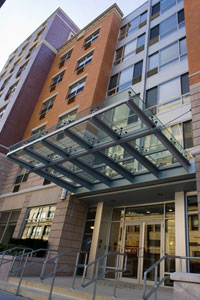
State Renaissance Court, an eight-story mixed-use building in the Hoyt-Schermerhorn Urban Renewal Area in Brooklyn that forms a transition between neighborhood high-rises and National Register row houses, is finally complete. The building, designed by James McCullar & Associates, contains 158 mixed-income apartments (50% market rate, and 50% affordable), 17,000 square feet of retail space, and an indoor garage.

Because the project sits atop a subway station, the NYC Transit Authority required that the building meet International Building Code (IBC) seismic requirements. Thus, the design consists of a first-floor rigid steel frame covering the entire site supported on station roof load points with spring isolators. In a seismic event, deep battered piles at the rear of the site will allow the building to move independently from the subway structure. The superstructure is a rigid steel frame with pre-cast floors that act in unison with the first-floor frame and the façade incorporates a pre-cast panel system. The 447-foot frontage is treated as one building, with a central glass double-height lobby leading to three elevator cores.


Going Wild Over Earning LEED Silver

The Wild Center

Main building at The Wild Center viewed from Blue Pond.

HOK NY

The Wild Center/Natural History Museum of the Adirondacks, a new 54,000-square-foot museum, is the first LEED certified museum in NY State. Located in Tupper Lake and designed by HOK NY in an indigenous Adirondack style using local materials, the museum shows how humans and nature may coexist. A three-acre pond not only provides a backdrop to the building and creates an indigenous wetland that attracts wildlife that can be viewed at close range, but also manages the site’s stormwater and exhibition water discharge. Other sustainable features include: a photovoltaic array on the roof of the Bio Building providing 10% of the museum’s power; electricity generated by Niagara Falls; a well-insulated building envelope; low VOC materials; efficient air filtration; and a digitally controlled building management system.


An American Hospital Out of Africa

ANIH

American Hospital in Abuja.

RKT&B

RKT&B is the prime architect for a $30 million, 273,000-square-foot hospital complex for the American Hospital in Abuja, the capital of Nigeria. The first phase, scheduled for completion in 2009, includes a 70-bed facility and support functions. Specific features of the design include sun screening, a large entrance canopy, a skylit atrium lobby, and lush landscaping, according to RKT&B. The hospital constitutes only one part of a 200-acre plot of farmland the Nigerian government paid for the hospital, future research buildings, a medical school, a hotel and convention center, and associated housing.


Bridging New York and Dubai

Dubai Creek bridge

Dubai Creek bridge.

FXFowle Architects

Dubai’s Roads & Transport Authority selected FXFowle Architect’s design for the longest and tallest multi-modal spanning arch bridge in the world. The winning design in an international competition is based on an “acoustic wave” and will join five existing Dubai Creek crossings. The one-mile-long, 673-foot-tall bridge will carry 20,000 vehicles per hour over 12 lanes of traffic, and 23,000 passengers per hour on two railway lines for Dubai Metro trains, and pedestrian walkways. The bridge will join four bridges and a tunnel that span the natural sea-water inlet that cuts through the center of the city. Construction will begin in March and is scheduled to be completed in four years.


Keeping Up in the West Village

385 West 12th Street

385 West 12th Street.

FLAnk

Designer/developer FLAnk is working on a new seven-story high-income condo building composed of four town homes, six full-floor flats, and two duplex penthouses in the West Village. Each residence is to have an eat-in kitchen, formal dining room, family room or den, formal living room with a gas fireplace, and a master bedroom suite with private outdoor space, according to the developer. The building is also to have a 2,700-square-foot two-tier rooftop — the upper tier will sport a 50-foot lap pool, tub/spa, and outdoor shower, while the lower tier will include a built-in dining area for entertaining, and a separate exercise and meditation deck. The building will be clad in untreated copper, which will acquire a patina over the years.

In this issue:
· Battery Park Takes Action to End World Hunger
· Not Just Books for DUMBO Warehouse
· Winged Victory for a Historic Preservation Project
· Williamsburg Builds Green with an Agenda
· Former Home of AMEX Faces Repairs
· Theater and Dance Plans at Princeton are in Motion


Battery Park Takes Action to End World Hunger

Training Towers

Training towers in The Action Center to End World Hunger.

ESI Design

Mercy Corps, an organization with an entrepreneurial approach to international relief and development work, announced that its new 4,000-square-foot center, designed ESI Design, will be called The Action Center to End World Hunger. Post 9/11, the organization, which was nominated for a 2007 Nobel peace prize, was chosen by the Battery Park City Authority (BPCA) to create a public space that will complement the nearby Irish Hunger Memorial. Included in the plans are interactive training towers with in-depth features on key areas in the world; a news bureau to enable visitors to view live feeds from various countries in which Mercy Corps is offering assistance; a flexible film screening space; presentations that will highlight people and countries in need; and action stations that provide immediate and long-term opportunities to make a difference. The $5.4 million center is aiming for LEED Platinum rating and is expected to open in the fall of 2008.


Not Just Books for DUMBO Warehouse

Melville House

Melville House.

Jeri Coppola

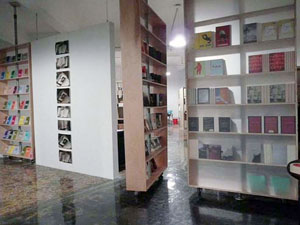
Melville House, a small, independent publishing company has opened a new multi-use space in a warehouse building in DUMBO, Brooklyn, that is part office, bookstore, art gallery, and event space. Artist Jeri Coppola designed the space featuring a wall of revolving bookcases that cordon off the company’s offices. The spare, industrial design includes furnishings made of raw wood, unpainted and exposed conduits, and epoxy-coated stone and concrete floors. Display tables constructed of unfinished plywood tops with unfinished two-by-fours as legs are on wheels to add to the space’s flexibility.

Winged Victory for a Historic Preservation Project

48 Wall Street

Restored cupola at 48 Wall Street.

Courtesy Swig Equities

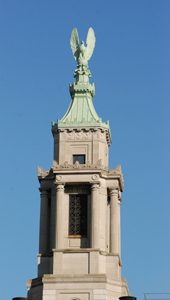
Repair and restoration work on the 11-foot-high gilded copper eagle atop the 36th floor of 48 Wall Street, formerly the Bank of New York building, has been completed. Built in 1927 and designed by Benjamin Wistar Morris, the NYC landmark-designated office tower features a multi-leveled crown, ornamented with classical detail, Doric columns, bronze grilles, and topped by the eagle. The restoration process was overseen by Swig Equities, Hoffman Architects performed the work — using both historic and modern architectural and construction practices, advanced technologies, conservation science, restoration draftsmanship, and architectural history.


Williamsburg Builds Green with an Agenda

Greenbelt

Greenbelt.

Courtesy Greenbelt

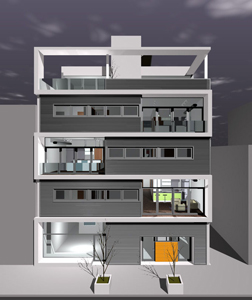
Greenbelt, a new eight-unit condo in Williamsburg, Brooklyn, designed and co-developed (with Derek Denckla of Propeller Group) by Gregory Merryweather is expected to receive a LEED Gold rating. In addition to incorporating sustainable features into the building’s design, each resident is promised a one-time green lifestyle consultation from Deep Green Living, a welcome kit explaining the benefits of green living, plus an array of other goodies. Beginning this month, Greenbelt will host a series of free public events focused on green living. And, to sustain local arts and artists, Contemporary Performance Research, a not-for-profit arts organization, purchased the ground-floor space to provide low-cost rehearsal spaces and host performances featuring local artists.


Former Home of AMEX Faces Repairs

65 Broadway

Rendering of lobby at 65 Broadway.

Lester Evan Tour

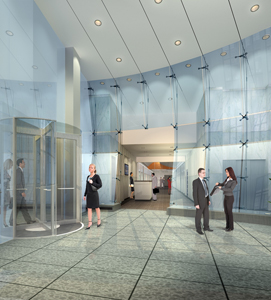
As part of a multi-million dollar capital improvement program, 65 Broadway, a 21-story, historically significant property built in 1917 as the world headquarters for American Express, is undergoing a massive renovation of its lobby, common areas, and a façade restoration, designed by Lester Evan Tour. To reflect the lobby’s original grandeur, a 40-year-old stone wall at the entrance will be removed to open up the space, and a two-story faceted glass wall will be added. The Landmark Preservation Commission approved the façade restorations that include a new masonry stairway and separate entrance for the retail portion of the building. In addition, solid granite stairs at the building’s entrance will be restored and several bronze entry doors replaced. The work constitutes the second phase of the building-wide improvements for the 351,000-square-foot office tower, including a chiller system with a built-in, environmentally-friendly co-generation facility and complete replacement of the elevator motors and cabs.


Theater and Dance Plans at Princeton are in Motion
Steven Holl Architects has been selected to design the first academic buildings for the new arts and transit neighborhood at Princeton University. The neighborhood is included in the University’s Campus Plan, a comprehensive effort to guide development through 2016 and beyond that was produced over the last two years by Beyer Blinder Belle Architects and Planners. The firm will be responsible for designing several buildings to house the Program in Theater and Dance, components of the Department of Music, the Lewis Center for the Arts, and the Society of Fellows in the Creative and Performing Arts. Encompassing an estimated 135,000 gross square feet, the preliminary plans include a black box theater, large dance studio, orchestral rehearsal space, smaller studios, music practice rooms, classrooms, support spaces, café, and offices. Other arts facilities proposed, for which different architects will be named, are an experimental media studio and a satellite for the Princeton University Art Museum.

In this issue:
· Team Wins Job to Take Upper Manhattan to River
· Luxury Pad Wins LEED Platinum Certification
· Housing Designed for Art Collectors Includes Spa for Pets
· Designs to Make Motown a Global Architectural Destination
· Meier Completes Tallest Building in Czech Republic Despite Controversy
· The Journey is in the Airport


Team Wins Job to Take Upper Manhattan to River

Take Me To The River

Take Me To The River master plan.

Courtesy Nautilus International Development Consulting

The “Take Me to the River” plan will improve pedestrian access to the Hudson River from West Harlem to Washington Heights, including the Broadway corridor from 135th to 157th Streets and extending west to Riverside Park. The winning team, led by Nautilus International Development Consulting in association with Donna Walcavage Landscape Architecture + Urban Design, was recently announced by Manhattan Borough President Scott M. Stringer, the West Harlem Art Fund, and the NY State Department of State’s Division of Coastal Resources. The team will develop a set of recommendations to improve the look and maintenance of paths and sidewalks. It will also create a plan to strengthen the cultural and economic resources of West Harlem and southern Washington Heights. Members of the team also include Eng-Wong, Taub & Associates; H3 Hardy Collaboration Architecture; Ernst & Young; Creative Cities; Studio L’Image; Warren Antonio James Architects; Kendal Henry Public Art & Urban Design; and VJ Associates.


Luxury Pad Wins LEED Platinum Certification

The Verdesian

The LEED Platinum Verdesian.

Courtesy The Albanese Organization

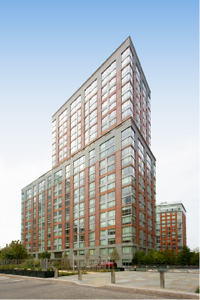
U.S. Green Building Council (USGBC) has awarded The Verdesian, a luxury rental tower located at the northern end of Battery Park City, LEED Platinum certification. Completed in 2006, the 27-story building with 252 studio to three-bedroom residences was designed by Pelli Clark Pelli Architects, with SLCE Architects as project architect and Stedila Design for interiors. The building is said to be 40% more energy efficient than required by standard building code. Sustainable elements include continuous internal IAQ monitoring; Merv 12 filters endorsed by the American Lung Association in HVAC units; a high-performance exterior wall system with a vapor and air barrier; and a natural gas-fired micro-turbine and cooling system. The project was developed by The Albanese Organization, which completed the LEED Gold Solaire in 2003, and is currently constructing The Visionaire, a luxury condo also aiming for LEED Platinum (both Pelli Clark Pelli designs).


Housing Designed for Art Collectors Includes Spa for Pets

34 Leonard

34 Leonard.

Courtesy R Squared Real Estate Partners

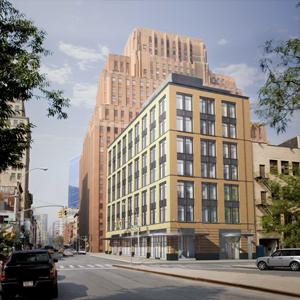
Marketed as “limited edition” residences, TriBeCa’s 34 Leonard boasts that what sets it apart from other luxury housing is that its layouts were specifically designed to accommodate art collections. Designed by Beyer Blinder Belle Architects & Planners, the building has a red masonry façade, industrial-scale windows, exposed materials, and flexible spaces. The building contains 16 one- to three-bedroom residences, and a 3,086-square-foot penthouse with a wrap-around terrace. Amenities include a grill and bar/prep area on the roof deck; sunbathing area; and private spa for pets. The lobby features a three-dimensional visual illusion of trees by artist Jennifer Steinkamp.


Designs to Make Motown a Global Architectural Destination

Cadillac Centre

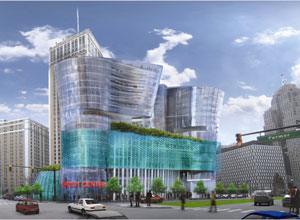
Cadillac Centre.

Anthony Caradonna, OPUS Architecture and Design Studio

New York and Rome-based OPUS Architecture and Design Studio has been selected to design the $150 million Cadillac Centre in Detroit composed of two 24-story towers of sculpted metal and glass rising from a 12-story base. The complex will include 84 apartments, a 30,000-square-foot market, a cinema, more than 100,000 square feet of major retail space, a 14,400-square-foot health club and spa, a 40,000-square-foot public park with water features, more than 25,000 square feet of boutiques and specialty shops, 800 parking spaces, and a 22,000-square-foot “living roof,” which will collect and filter rain water and help control energy consumption. The complex will occupy an entire block and connect to the landmarked 1927 Beaux Arts Cadillac Tower.


Meier Completes Tallest Building in Czech Republic Despite Controversy

CITY Tower

CITY Tower.

Richard Meier & Partners

A celebration is scheduled for the March 2008 opening of the Richard Meier & Partners-designed CITY Tower on the Pankrác plain close Prague’s city center. This winds up a saga that began in the 1980s when Czechoslovak Radio was slated to move in. In 1983 the building was abandoned, leaving behind an unfinished steel structure. Prague-based ECM Real Estate Investments acquired the property in 2000, and in 2006 major construction work began — including installation of a new external shell.

At 358 feet, the 530,000-square-foot structure has 27 above-ground and three underground floors, floor-to-ceiling glass, and a VIP restaurant and conference facility in the penthouse. The tower is part of ECM City, an ongoing urban regeneration project master planned by Richard Meier & Partners, which is to include a mixed-use complex and luxury apartment building. The developers have been locked in a battle with local groups over the project: two of the buildings included in the original master plan are now abandoned due to conflict over the buildings’ height, and one group filed a lawsuit claiming the buildings would violate the city’s status as a UNESCO World Heritage site.


The Journey is in the Airport

Carrasco International Airport

Carrasco International Airport.

Rafael Viñoly Architects

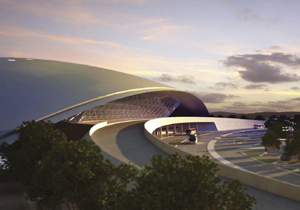
Rafael Viñoly Architects is working on Carrasco International Airport’s new terminal in Montevideo, Uruguay. The design highlights public zones and amenities, providing these areas with open space and natural light. Arriving travelers pass through a fully glazed mezzanine level that helps orient them to the terminal space before they descend to baggage claim and other services. A public, landscaped terrace and a restaurant occupy the second floor, offering views of the runway and the main concourse. Independent access roads service departures on the first floor and arrivals on the ground level. An open atrium adjacent to the street entrance opens the ground floor to the monumental main hall, visually and spatially linking the first and last stages of a traveler’s journey. The project is scheduled for completion in early 2009.

In this issue:
· DUMBO Preserves Brick and Concrete Past
· SUNY New Paltz’s Old Main Gets Smart
· New Beacon and Transitional Residence Welcomes Kids in Need
· Topping Out is Divine
· Hotel Decks Halls in Deco
· Staking Mixed-Use Claims in Williamsburg
· Native Son’s First Edificio Underway in Uruguay


DUMBO Preserves Brick and Concrete Past
The Landmarks Preservation Commission (LPC) has designated the DUMBO (Down Under the Manhattan Bridge Overpass) section of Brooklyn as NYC’s 90th Historic District. Now a residential, commercial, and retail neighborhood, with views and vistas framed by the bridge’s support piers and anchorage, the LPC cites 91 historically and architecturally distinctive buildings from the 19th and early 20th century, when Brooklyn was America’s fourth largest industrial city, and a major manufacturing center. DUMBO’s earlier buildings were built with brick façades, and massive wooden columns and beams, while those constructed later were built of reinforced concrete, offering easy maintenance, resistance to vibration, increased floor loads, and the ability to install large expanses of windows for light and ventilation. It is expected that the City Council, which must vote on this designation, will approve the new district in coming weeks.


SUNY New Paltz’s Old Main Gets Smart

Old Main

Old Main at SUNY New Paltz.

Hall Partnership Architects

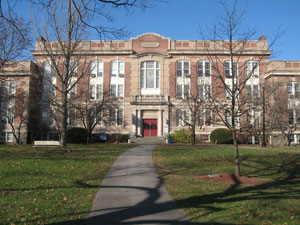
Hall Partnership Architects is currently in the design phase for the $27.5 million renovation of Old Main, built in 1907 and the oldest building on the SUNY New Paltz campus. The existing 79,153-square-foot brick and masonry structure, which serves as academic and administrative space for primarily the School of Education as well as housing the campus’ Studley Theatre, will be built out with infill floors to 87,254 square feet adding office and instructional spaces. The project involves upgrading classroom and administrative spaces while restoring historic details in the common areas.

Sustainable design initiatives include the use of low VOC materials and finishes, and recycled content. At least 10% of the total value of building materials used in the construction will be extracted, processed, and manufactured within a 500-mile radius of campus. A minimum of 50% of all wood-based materials will be certified by the Forest Stewardship Council. High albedo or reflective materials will be specified for a minimum of 75% of new roof surfaces. Full cut-off luminaires, low-reflective surfaces, and low-angle spotlights will eliminate or reduce exterior light pollution. The building is on track to earn a LEED 2.2 New Construction and Major Renovations certification. Completion is scheduled for late fall of 2010.


New Beacon and Transitional Residence Welcomes Kids in Need

Covenant House New York

Covenant House New York reconstruction.

Terrence O’Neal Architect

Building A, the completed first phase of Covenant House New York’s (CHNY) 125,000-square-foot reconstruction, recently held its first Rights of Passage graduation ceremony. The building houses the center’s new residential quarters and administrative offices. Led by Terrence O’Neal Architect (TONA), the eight-story building was gutted and rooms were regrouped and improved to provide longer term 200-bed transitional living plus education/career guidance center, with a 100-bed crisis center on the lower floors. Two more buildings on the campus, also designed by TONA, are under construction. Building B will include a childcare center and redesigned chapel on the first floor with a full recreation complex and gymnasium on the upper floors. Building C will house administrative offices, health care suites, and a renovated cafeteria. In addition, the firm will create a courtyard at the main entrance with greenery and a brightly lit canopy identifying CHNY.


Topping Out is Divine

Avalon Morningside Park

Avalon Morningside Park.

R.M. Kliment & Frances Halsband Architects

Avalon Morningside Park, designed by R.M. Kliment & Frances Halsband Architects, recently topped out at 20 stories on the southeast corner of the Cathedral Close of St. John the Divine, at Morningside Drive and Cathedral Parkway. The 300-unit building is composed of poured concrete with a warm grey brick façade shifting to mainly glass facing east to Morningside Park. The entrance has a two-story lobby and lounge that opens onto a landscaped garden, creating a dialogue with the park across the street. The building aligns with the adjacent cathedral buildings, fanning open at the corner to views of the park and the city beyond. Along Cathedral Parkway, a.k.a. 110th Street, the 150-car garage is hidden behind a stone retaining wall that surrounds the Cathedral Close. Completion is expected this year, and revenue generated by the building is slated to support the restoration and mission of the Cathedral.


Hotel Decks Halls in Deco

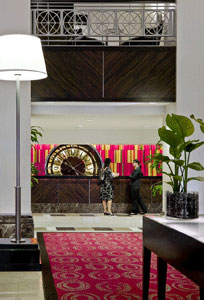
Radisson Lexington Hotel

Radisson Lexington Hotel.

Stonehill & Taylor Architects and Planners

Stonehill & Taylor Architects and Planners has completed a nearly $20 million renovation on the 27-story Radisson Lexington Hotel. The two-year project included a complete redesign of public and private spaces. In the lobby and bar, the design team honored the hotel’s original Art Deco style, but revved things up with red area rugs and red, black, and silver mohair and leather seating. Behind the original wood reception desk, the firm commissioned glass artist Paul Housberg to create backlit red and amber glass tiles that surround an existing oversized chrome clock. The hotel’s 600 guestrooms and suites — including the Centerfield Suite, a penthouse suite that was once the residence of Yankee Hall of Famer Joe DiMaggio — also received a major facelift.


Staking Mixed-Use Claims in Williamsburg

Meltzer/Mandl Architects

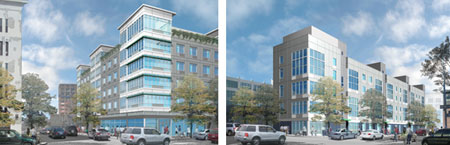
175 Kent Avenue Apartments (left); 224 Wythe Street (right).

Meltzer/Mandl Architects

Meltzer/Mandl Architects has been retained by The Chetrit Group to design two mixed-use projects in Williamsburg, Brooklyn. 175 Kent Avenue Apartments is a 118,000-square-foot, seven-story glass and masonry building with 113 residential units and space for retail and parking. 224 Wythe Street is a loft-style, four-story glass and masonry building with 16,000 square feet of studio and one-bedroom rental units, a duplex recreation room, 2,700 square feet of landscaped roof decks, plus 1,000 square feet of ground floor retail space. Although not LEED-certified, both buildings integrate sustainable design elements that include renewable and recycled materials, low-e glass, and Energy Star appliances. Each will be clad with a highly efficient panelized wall system with rain screen technology and a narrow profile, intended to allow for more livable space within. Both projects are scheduled for an early 2008 construction start.


Native Son’s First Edificio Underway in Uruguay

Edificio Acqua

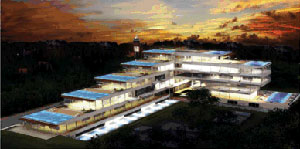
Edificio Acqua, Punta del Este, Uruguay.

Rafael Viñoly Architects

Edificio Acqua, a six-story, L-shaped luxury residential complex is currently under construction in the upscale beachfront resort of Punta Del Este, Uruguay, and will be Rafael Viñoly, FAIA’s first completed project in his home country. The 34-unit building contains four single-floor “manors” and two penthouse apartments, five double-height lofts, and 24 single-floor apartment units with living and dining areas typically facing the ocean. Bedrooms, bathrooms, and other private spaces are situated along the glass exterior wall toward the rear and sides of the building with views of surrounding gardens and forests. The building’s setbacks obscure views of other apartments to create a sense of separate residences, and terraces and infinity pools intend to visually extend the ocean into the apartments. Expected to be completed this year, the project has garnered the 2007 Real Estate Excellence Award from the Federación Internacional de Profesiones Inmobiliarias-Uruguay (FIABCI-Uruguay) in the category of Project Ideas in Process-Residential Area.

Preservation: Protecting Modern Buildings Can be a Hard Sell

Event: Changing Perspectives on Preservation: A Panel Discussion
Location: The Municipal Art Society, 11.29.07
Speakers: Hilary Ballon, Ph.D. — Professor, Department of Art History and Archaeology, Columbia University & Associate Vice Chancellor, NYU Abu Dhabi; Thomas Mellins — Curator of Special Projects, Museum of the City of New York; Anthony Wood — Executive Director, Ittleson Foundation, Professor of Historic Preservation, Columbia University, and Founder/Chair, New York Preservation Archive Project
Moderator: Frank E. Sanchis — Senior Vice President, Municipal Art Society
Organizer: Municipal Art Society

Grand Central

Grand Central Station is one of the Municipal Art Society’s successful campaigns.

Courtesy Municipal Art Society

“I can’t think of any building we’re sorry we’ve saved, but I can say that about the ones we didn’t,” said Anthony Wood, founder and chair of the New York Preservation Archive Project. This is an apt statement to make in the gallery of the Urban Center, housed in McKim, Mead & White’s 1884 Henry Villard House, saved by the fledgling Landmarks Preservation Commission (LPC) in the early 1970s. In a discussion exploring the theme of changing perspectives on preservation, new challenges and arguments are arising with contemporary times, especially when it comes to preserving Modern icons.

The Municipal Art Society (MAS), which has offices in the Henry Villard House, champions the preservation of the earliest city buildings through the Modernist era. In general, it urges the LPC to protect buildings prior to major rezoning and redevelopment projects, and advocates for the City Council to increase the LPC’s budget to allow an increase in the landmark designation rate and efficiency with which permits are processed.

Protecting Modern buildings can be a “hard sell,” even for preservationists. “We’re destroying Paul Rudolph’s across the country,” said Hilary Ballon, Ph.D., professor in the Department of Art History and Archaeology at Columbia University, underscoring the concern for protecting Modern buildings. The fate of Edward Durell Stone’s 2 Columbus Circle, for example, remains a sore point for many preservationists because the issue never went through a public hearing. Some buildings are fraught with outdated technical problems. Sustainability issues emerge, as some preservationists believe “the best green building is one that already exists,” according to Frank Sanchis, MAS’s senior vice president.

Traditional preservationists carry baggage against Modern buildings, according to Thomas Mellins, curator of special projects at the Museum of the City of New York, and it will be up to the next generation to provide the impetus to save them. “The price of preservation is constant vigilance,” said Mellins.

In this issue:
· Pennies for Kids’ Thoughts
· Ready to Bow: Bronx County Hall of Justice
· Juvenile Justice Facilities: Environment Cues Behavior
· Luxury Hotel/Condo to Connect Lower Manhattan and Battery Park
· 20th Century Village Hall Gets 21st Century Update
· Renovation of Rudolph Building is Key to Yale’s New Arts Complex
· Natick Collection Redefines Shopping Mall Experience
· South Korea Goes LEED Platinum


Pennies for Kids’ Thoughts

Penny Harvest

Penny Harvest Field at Rockefeller Center.

(left) Courtesy Common Cents; (right) photo by Peter Barton courtesy Levien & Company

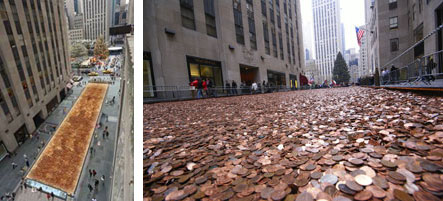
Common Cents, a non-profit that teaches children about their value as contributors to society, has launched the 17th annual Penny Harvest. Students from more than 800 schools collected over 100 million pennies to be given away to organizations of their choice, and Polshek Partnership Architects designed a 165-foot-long by 30-foot-wide steel channel to contain them. The sides are mirrored, giving the impression that the field of pennies goes on ad infinitum. Polshek Partnership recruited Peter DiMaggio from Weidlinger Associates and project manager Ken Levien, AIA, of Levien and Co. to help with the design and construction. And the cost to Common Cents? Not one penny. Professional services were pro bono. Hosted by Tishman Speyer, the installation will be on view at Rockefeller Center through December 31.


Ready to Bow: Bronx County Hall of Justice

Bronx County Hall of Justice

Bronx County Hall of Justice.

Rafael Viñoly Architects

Almost 15 years after Rafael Viñoly Architects completed the design for the Bronx County Hall of Justice, the building is finally reaching completion. Sited along two blocks of East 161st Street near the Grand Concourse, the L-shaped structure houses 47 courtrooms, seven grand jury rooms, offices, and underground parking. The building’s public courtyard and translucent accordion-shaped curtain wall were designed to signify the openness of the judicial system. The jury assembly room is adjacent to the building in a separate, private mass.

The courtrooms, with 18-foot slab-to-slab heights, house 60 spectators and 16 jurors, and many are equipped with the latest audio-visual and computer technology. The grand jury rooms allow jurors to view evidence from individual flat screens, and custom-designed benches, cabinetry, and paneling recall historic court spaces. Energy conservation is employed with extensive use of daylight, high-performance low-e glass, energy-efficient lighting, and heating and air conditioning systems that incorporate displacement ventilation.


Juvenile Justice Facilities: Environment Cues Behavior

Union County Juvenile Justice Center

Union County Juvenile Justice Center.

Ricci Greene Associates

Ricci Greene Associates, a justice design and planning firm, has completed three juvenile justice facilities in the Northeast. The $28 million Union County Juvenile Justice Center in Linden, NJ, is a 70,000-square-foot building housing 80 children. A courtyard encloses almost an acre of outdoor recreation space and allows natural daylight to penetrate the building. The $43 million Rhode Island Training School for Youth in Cranston is composed of a 52-bed detention facility and a 96-bed adjudicated facility providing an optimal physical and operational environment to house troubled youth, boasting two gymnasiums, a regulation-size soccer field, exercise rooms, library, and computer and culinary arts amenities. The $34.6 million, 100,000-square-foot Superior Court and Center for Juvenile Matters in Bridgeport, CT, built on a remediated brownfield site, consists of two separate buildings containing a courthouse with three courtrooms and a detention facility with 44 sleeping rooms. The facility is framed by a lawn in the front and a waterfront park along the river that is open to the public.


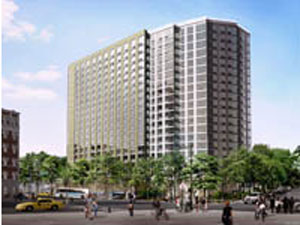
Luxury Hotel/Condo to Connect Lower Manhattan and Battery Park

50 West Street

50 West Street.

Murphy/Jahn Architects

Time Equities has gotten the green light from the NYC Council to build a 63-story, 580,000-square-foot hotel and residential building at 50 West Street, in an area known as Greenwich South, just below the World Trade Center site. Helmut Jahn, FAIA, of Murphy/Jahn Architects is the design architect, Gruzen Samton is serving as executive architect and architect-of-record, and interiors are by Piero Lissoni. The 14 lower floors will contain a 155-room, four-star luxury hotel with ground floor retail and a restaurant, and about 290 residential condominiums will occupy floors 15 through 63. The building will also feature an enclosed roof garden and lounge, spa, fitness center, screening room, and library. A public plaza along the southern boundary of the project will provide a new landscaped circulation path between West and Washington Streets and facilitate pedestrian passage from Battery Park City to Lower Manhattan. The project is expected to garner a LEED Gold certification when completed in 2010.


20th Century Village Hall Gets 21st Century Update

Bronxville Village Hall

Bronxville Village Hall.

Peter Gisolfi Associates

The circa 1942 Bronxville Village Hall in Westchester County has undergone a $5 million renovation making it cleaner, greener, and larger. Peter Gisolfi Associates had old asbestos and other hazardous materials removed — including significant quantities of lead from a police firing range in the basement. In its place are new low-e paints and carpeting, recycled and natural materials, and a zoned geo-thermal system. All old windows were replaced with energy-efficient double-glass windows; new, weatherproof doors were fitted throughout; and the attic of the two-story building has been insulated, sharply reducing heat loss through the roof. Lighting was redesigned to make greater use of natural light and to zone the building for lighting depending upon use and occupancy. The design also adds 5,000 square feet of assignable space.


Renovation of Rudolph Building is Key to Yale’s New Arts Complex

Yale arts complex

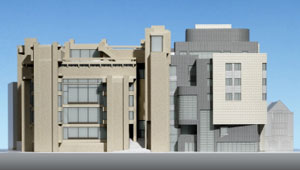
Model of Yale arts complex showing York Street elevation.

Gwathmey Siegel & Associates Architects, photograph by Jock Pottell, courtesy Yale University

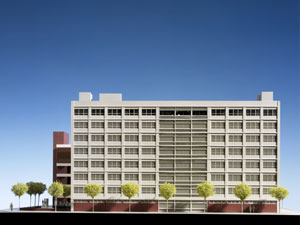
Yale University is restoring and renovating Paul Rudolph’s historic Art & Architecture Building. Per the wishes of the project’s benefactor, Sid Bass, the building will be renamed “The Rudolph Building.” This project is a key step in the creation of the university’s new arts complex, designed by Charles Gwathmey, FAIA, of Gwathmey Siegel & Associates Architects (who received his Master of Architecture from Yale in 1962, while Paul Rudolph was chairman of the Department of Architecture), that will include, in addition to The Rudolph Building, a new facility for the Department of the History of Art, and an expanded arts and architecture library.

In creating the arts complex, Gwathmey Siegel is charged with several tasks: above all restoration of Rudolph’s building; to introduce state-of-the-art technology, air-conditioning, and LEED standards; to design a new facility for the art history department; to create an expanded arts and architecture library with a street-level presence and entry; and to maintain a harmonious relationship among the complex’s elements, the multifaceted structure, and surrounding streetscape.


Natick Collection Redefines Shopping Mall Experience

Natick Mall

Natick Mall.

Beyer Blinder Belle Architects & Planners

Natick, an American Indian name loosely translated as “Place of Rolling Hills,” provided the inspiration for Beyer Blinder Belle Architects & Planners’ design for the restoration and expansion of the Natick Mall, originally built in 1966 in Natick, MA. Renamed the Natick Collection to reflect its new look, an undulating arcade ceiling, curved clerestories, and expansive skylights that filter in natural light are in direct response to the site’s topography. 550,000 square feet of retail space will be added to the renovation of the existing 150,000-square-foot mall, fitting within a 3 million-square-foot master plan — including over 100 new shops and two new anchor stores, as well as luxury condominiums and below-grade parking.


South Korea Goes LEED Platinum

U-Life

Gale International/U-Life Northeast Asia Headquarters.

HOK

The NY office of HOK has unveiled a new 55,000-square-foot Gale International/U-Life Northeast Asia Headquarters building in the Songdo International Business District in Incheon, South Korea. The building is expected to achieve a LEED Platinum rating — the first of its kind in Korea. It is part of the Kohn Pedersen Fox Associates master-plan comprised of residential, cultural, leisure, educational, healthcare, government, and institutional facilities.

Composed of a high-performance curtain wall, the five-story steel structure features photovoltaic panels integrated into the site canopy and rooftop structures, entry canopy, and south façade shade devices. A narrow floor plate and interior daylight atrium shaped by the sun’s passage will ensure daylight to over 90% of the workstations. The design also includes rain gardens, native landscaping, solar electric automobile charging stations, full daylight office space, optimized natural ventilation, fuel cells, rooftop wind turbines, a greywater recovery system, green roofs, and material life-cycle analysis.

Berlin, NYC Cultivate the Arts

Event: Berlin-New York Dialogues: Cultural Kapital/Capital Kultur: Exhibition Symposium
Location: Center for Architecture, 11.10.07
Speakers: Illya Azaroff, Assoc. AIA — Director of Design, the design collective studio (NY); Markus Bader — Principal, raumlabor_berlin (Berlin); Susan Chin, FAIA — Assistant Commissioner of Capital Projects, NYC Department of Cultural Affairs (NY); Matthew Griffin, AA Dipl. Architekt — deadline > office for architectural services (Berlin); Regula Lüscher — State Department for Urban Development (Berlin); Kristien Ring — Director, German Center for Architecture (DAZ) (Berlin); Jochen Sandig — Producer & Cultural Administrator, Radialsystem V (Berlin); Ronald Shiffman, FAICP, Hon. AIA — Professor of Urban Planning, Graduate Center for Planning and Environment, Pratt Institute (NY); Claire Weisz, AIA — weisz + yoes architecture (NY); Lynnette Widder — Department of Architecture, Rhode Island School of Design; Peter Zlonicky — architect & planner (Munich)
Organizers: AIANY in collaboration with Deutsches Haus at New York University & Pratt Graduate Center for Planning and the Environment
Sponsors: Berlin-New York Dialogues presented in partnership with Carnegie Hall as part of Berlin in Lights festival; Underwriters: Digital Plus, RFR Holding; Patrons: Eurohypo, IULA-International Urban Landscape Award; Lead Sponsors: Carnegie Corporation of New York, Tishman Speyer Properties; Supporter: The German Consulate General New York; Friends: Aucapina Cabinetry, bartco Lighting, Getmapping, Osram Sylvania. This program is supported, in part, by public funds from the NYC Department of Cultural Affairs

Berlin-New York Dialogues

At the Berlin-New York Dialogues Exhibition symposium, Consul General Dr. Hans-Jürgen Heimsoeth, with Rick Bell, FAIA, AIANY Executive Director.

Photograph by Sam Lahoz

The Mayor of Berlin, Klaus Wowereit, has said, “Berlin is a poor but sexy city.” It’s a city with a lot of space for people with little money. In fact, Berlin is as economically bankrupt as NYC was in the 1970s. This is the result of the building boom that the city experienced after reunification in 1990, as well as the unresolved issues arising from the shift of capital back to Berlin from Bonn in 1999.

NYC has recovered since the 1970s so much so that it supports 850 of the 1,400 public/private cultural institutions. Susan Chin, FAIA, assistant commissioner for capital projects at the NYC Department of Cultural Affairs (and former AIANY Chapter president) cited that city support has grown to $1.3 billion leveraging over $1 billion in private sector support to create arts and cultural facilities including the Bronx Museum of the Arts expansion by Arquitectonica, Metropolitan Museum of Art Leon Levy and Shelby White Court designed by Kevin Roche, FAIA, and the Queens Botanical Garden by BKSK Architects. The Department of City Planning is also rezoning 125th Street, river to river, for more cultural institutions to neighbor the Studio Museum of Harlem and Apollo Theater. In Long Island City, a cultural district is in formation with P.S. 1, the Noguchi Museum, and the Thalia Spanish Theatre.

The government in Berlin is not in a position to help private initiatives, but Berliners, with their “can-do” attitude have taken matters into their own hands. For example, a community turned the Post Bahnhof, a former postage distribution center, into a party and events space, transformed numerous abandoned storefronts into retail spaces, and courtyards into cafés and places to display art installations. Collective buildings are being developed that band together people with similar lifestyles. Inhabitants invest in and work with an architect to create a communal live/work space. Currently, there are more than 25 such projects in Berlin.

Berlin-based artists also are finding unlikely sites for temporary art. Jochen Sandig, co-founder of arts space Radialsystem V, created a place where contemporary and classical dance and music, and visual and electronic arts meet along the River Spree, taking advantage of the underutilized waterfront. During the demolition of the Palast der Republik, when the building was reduced to its core, architect Markus Bader of raumlabor_Berlin turned it into the Gasthof Bergkristall, a short-term hotel comprised of just four rooms.

Perhaps most comparable to new development in Berlin is the area of Red Hook, Brooklyn. Red Hook is a neighborhood with promise that could be on the road to gentrification, but still maintains a rich artistic culture. Both Berliners and New Yorkers express the need to put safeguards in place to keep rents down for the burgeoning artistic communities on both sides of the Atlantic in order to retain the cities’ vitality.
The Berlin-New York Dialogues is on view at the Center for Architecture through 01.26.07. See On View for more information.

In this issue:
·A Tour de Verre for Midtown
·New Alliance Invests in Brooklyn Playgrounds
·National Arts Club Gets a Face Lift
·Shaker Past Gets New Urbanist Makeover
·Beijing Building Acts as 3-D Billboard
·New Wing and Exhibition Space Conducts Musical Collection


A Tour de Verre for Midtown

Tour de Verre

Tour de Verre.

©Ateliers Jean Nouvel

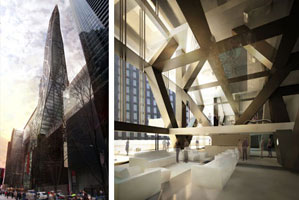
Just west of the Museum of Modern Art, a 75-story Ateliers Jean Nouvel-designed building will soon be on the rise on a 17,000-square-foot parcel of land between West 53rd and 54th Streets. The glass and steel façade, with a diagrid structural design, will taper into a spire. A mix of uses is contemplated for the building, including: a 50,000-square-foot expansion of MoMA’s galleries, a 100-room, seven-star hotel, and 120 highest-end residential condominiums on the upper floors. Hines, the international real estate firm, collaborated with Ateliers Jean Nouvel on 40 Mercer Street in SoHo as well.


New Alliance Invests in Brooklyn Playgrounds
Barclays, Forest City Ratner Companies (FCRC), and the Nets basketball team have created the Barclays/Nets Community Alliance, a new organization committed to the physical and educational development of youth in Brooklyn and surrounding communities. The Alliance will invest $1 million annually in local non-profits to improve the lives of young people in the borough through sports and other activities, including education and health care. Out2Play, a non-profit dedicated to building and refurbishing playgrounds throughout the NYC public school system will receive the first grant: $150,000 for the rehabilitation and rebuilding of playgrounds in Brooklyn. The alliance has been in the works since the announcement that the Gehry Partners-designed arena at Atlantic Yards would be called the Barclays Center.


National Arts Club Gets a Face Lift
The National Arts Club has selected FZAD Architecture + Design to renovate its 1906 home in the Tilden Mansion at 15 Gramercy Park South. Built in 1884, it is a designated NYC Landmark and a National Historic Landmark. Originally, the house had a flat-front, iron-grilled appearance that matched its neighbors, but in the 1870s, Samuel Tilden hired Calvert Vaux to “Victorianize” the faççhe process of restoring the stoops and the steps to the pediment of the building, including the restoration of the Michelangelo bust in the pediment of the western stoop.


Shaker Past Gets New Urbanist Makeover

Village of New Loudon

The Village of New Loudon.

Cooper Carry

After competing against four other firms, the NY office of Cooper Carry has been awarded the design contract for The Village of New Loudon, a 45-acre proposed mixed-use development located in Colonie, NY, one of the oldest suburban communities in the Albany region. The firm will provide master planning and architectural design services for the project. Plans call for integrating a mix of retail space and residential units, a hotel and spa, and offices sited around public space. Honoring previous community opposition to big-box retailers, the retail component will be a mix of boutique national chains and local retailers, entertainment, dining, and amenity spaces. Residential design will provide multi-family units in varied building types. The design vision draws on a combination of the area’s Shaker history and regional character, and key components of the New Urbanist movement, such as regional planning for open space and appropriate architecture and planning.


Beijing Building Acts as 3-D Billboard

SanLiTun

SanLiTun.

LOT-EK

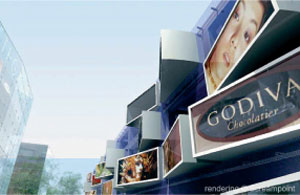
SanLiTun, a 105,000-square-foot commercial/retail building designed by LOT-EK in the Embassy District of central Beijing has been completed. The building is part of master plan, designed by Tokyo-based Kengo Kuma and Associates (KKAA), for a large commercial development with pedestrian piazza surrounded by four large buildings — SHoP Architects, Beijing Matsubara & Architect, and KKAA designed the other buildings. Abiding by the district’s four-story height restriction, the building is conceived as a three-dimensional billboard to be filled with the graphics and logos of the future retail tenants. The articulation of the façade relates to the trajectories of pedestrian movement and views through the landscape of the piazza and its surrounding buildings.

Referencing a building under construction, a layer of blue metal mesh, supported by a cantilevered scaffold-like structure, wraps the building. Offset three meters from the building, the mesh acts as a second skin buffering the city noise level and filtering direct sunlight for energy efficiency. Protruding out of the building mass are large stainless steel extrusions with glazed fronts piercing the mesh layer and bending in varying angles. At night, the extrusions become light boxes with white LED frames floating over the glowing blue mesh.
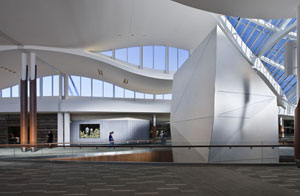

New Wing and Exhibition Space Conducts Musical Collection

Mechanical Musical Instruments

Musical Machines & Living Dolls: Mechanical Musical Instruments and Automata from the Murtogh D. Guinness Collection.

Lee H. Skolnick Architecture + Design Partnership

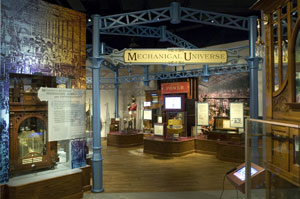
More than 150 artifacts comprise the permanent installation of the exhibition Musical Machines & Living Dolls: Mechanical Musical Instruments and Automata from the Murtogh D. Guinness Collection of historic musical instruments and mechanical figures, with over 5,000 examples of programmed media at the Morris Museum, one of NJ’s largest cultural institutions. The exhibition, designed by Lee H. Skolnick Architecture + Design Partnership, begins with an abstracted Victorian drawing room, and guides visitors through rooms highlighting scientific and technological aspects, cultural and social historical context, and craftsmanship and movement.

The collection is housed in a 4,300-square-foot gallery in the new Guinness Wing, designed by RMJM Hillier. A new Grand Entrance Pavilion, with a slatted redwood screen wall outside and modern glass panels and steel accents inside, welcomes visitors to the museum while also serving as an open event space and museum shop.