In this issue:
· Brooklyn Sets Standard for NYC Firehouses
· Something Old, Something New: 2 Residential Projects in Brooklyn
· Tribeca Condo to Feature Public Sculpture by Kapoor
· Hotel Summons Ghosts of Rat Pack Past


Brooklyn Sets Standard for NYC Firehouses

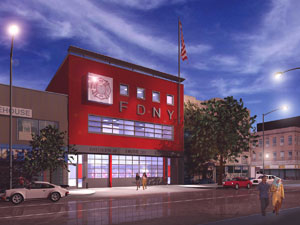
Engine Company 201 firehouse.

RKT&B

Construction has begun on a three-story firehouse designed by RKT&B for Engine Company 201 in Sunset Park, Brooklyn. The $6.8 million, 17,000-square-foot facility, which replaces a recently demolished firehouse, is one of the first to be built under the Design Excellence Program of the NYC Department of Design and Construction (DDC). The design had to address the needs of three different stakeholders: FDNY’s operational efficiencies; DDC’s requirement to set high design standards; and the community’s request for a building with a bold presence. Symbolic elements are integrated in the front façade, including the use of glazed red brick. A Maltese Cross — a symbol of protection and a firefighter’s badge of honor — is suspended in an illuminated glass lantern. In addition, part of the floor is transparent aimed to connect firefighters to the community.


Something Old, Something New: 2 Residential Projects in Brooklyn

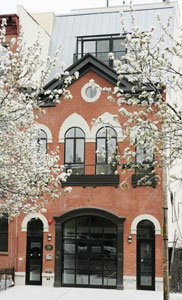
An old firehouse-turned-condo on Dean Street.

Mark Gould Architect

Mark Gould Architect (MGA) has unveiled an adaptive re-use of an old firehouse on Dean Street in Brooklyn. Two stories were added to the building, transforming the firehouse into a seven-story condominium. Split-level floors from front to rear create private entries to each unit. MGA attempted to integrate with the existing environment by creating terraces at setbacks, yards, and roofs, and by designing cutout floors that allow light to fully penetrate the interiors. On Kingsland Avenue, MGA has designed a 16-unit asymmetrical building that integrates a rain screen façade system underneath a Mansard metal roof. The building incorporates open plan loft-like apartments, duplex penthouse units with roof terraces, and duplex cellar units.


Tribeca Condo to Feature Public Sculpture by Kapoor
Alexico Group has commissioned Turner Prize recipient Anish Kapoor to create a monumental public sculpture for the ground level of the new Herzog & de Meuron-designed, 57-story residential tower at 56 Leonard in Tribeca. The London-based sculptor’s work often manipulates form and the perception of space. He is best known in the U.S. for Cloud Gate, a 110-ton, highly polished stainless steel sculpture in Chicago’s Millennium Park, and Sky Mirror, a 35-foot-diameter concave mirror temporarily installed at Rockefeller Center in 2006. Herzog & de Meuron’s design will be revealed this fall. The project is expected to be complete in 2010.


Hotel Summons Ghosts of Rat Pack Past

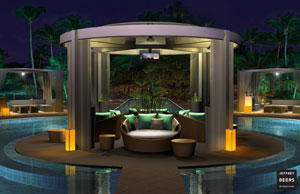
The new central cabana at Fontainebleau Miami Beach.

Jeffrey Beers International

The Fontainebleau Miami Beach, designed by Morris Lapidus, was prominent on Collins Avenue in the 1950s, sometimes cited as the Rat Pack’s playground. The hotel is currently undergoing a $1 billion renovation/expansion under the architectural and design direction of NY-based Jeffrey Beers International. The hotel will incorporate 1,504 luxury guest rooms, a 40,000-square-foot spa, 11 restaurants and lounges, 58 meeting rooms, and a pool complex. The design team is also renovating the historic 45,000-square-foot lobby, with its bow-tie marble floor designs and grand “staircase to nowhere.” Updates include an infusion of color, customized chandeliers, blue-tinted mirrored walls, and a gold tile wall on the staircase.

NY Firms Design Urban Thresholds

Event: New York Designs
Location: The Urban Center, 06.05.08
Speakers: Lyn Rice, AIA — Principal, Astrid Lipka, AIA — Associate Principal, Lyn Rice Architects; Eric Bunge, AIA, Mimi Hoang — Partners, nARCHITECTS; Robert Rogers, FAIA, Jonathan Marvel, AIA — Partners, Rogers Marvel Architects; Henry Smith-Miller, Laurie Hawkinson — Partners, & Luben Dimcheff — Project Architect, Smith-Miller + Hawkinson Architects; Douglas Korves, AIA — Partner, Douglas Korves Architect
Organizers: The Architectural League of New York

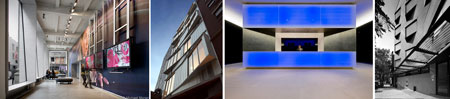
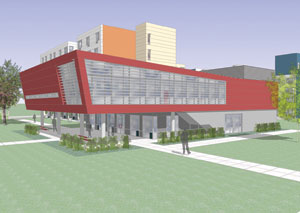
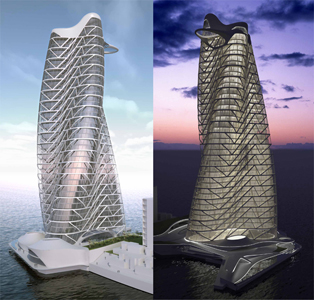
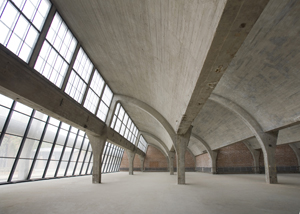
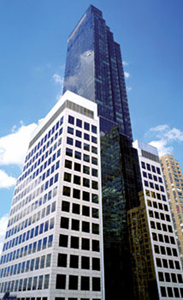
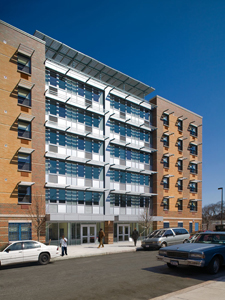
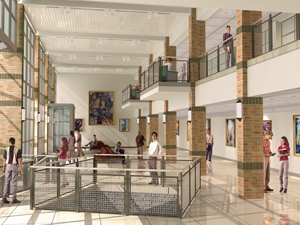
(L-R): Sheila C. Johnson Design Center by Lyn Rice Architects; Switch Building by nARCHITECTS; Luminaire Celebrates Public Space by Rogers Marvel Architects; 322 Hicks Street by Smith-Miller + Hawkinson Architects.

(L-R): Michael Moran; Frank Ouderman; Paul Warchol; Michael Moran, courtesy The Architectural League of New York

“Threshold,” said Henry Smith-Miller, “is the point that must be reached for a psychological or physiological effect to begin or be noticeable.” That definition of the word seems to be open to interpretation, as evidenced at second in the Architectural League of New York’s 2008 New York Designs juried lecture series. The 2008 New York Designs committee, comprised of Sunil Bald, Markus Dochantschi, Lynn Gaffney, AIA, Victoria Meyers, AIA, and Adam Yarinsky, FAIA, asked entrants to consider what limits, opportunities, and compromises shape thresholds in the city. A threshold, as outlined in the call for entries, might be literally a transitional space or overlap among materials, disciplines, cultures, and more.

Lyn Rice, AIA, and Astrid Lipka, AIA, of Lyn Rice Architects presented their Sheila C. Johnson Design Center at Parsons The New School for Design. The firm reinterpreted the campus to create an urban quad in the Village. Using architecture as interface, they united existing street-level lobbies of four adjacent buildings with found spaces such as a trash alley to create a new 20,000-square-foot common space. The new center contains a critique space, auditorium, design store, and an expanded gallery/exhibition area that is visually open to the street, allowing interactions between the students and public.

Eric Bunge, AIA, and Mimi Hoang of nARCHITECTS presented their Switch Building on the Lower East Side. The design interprets constraints imposed by the developer’s needs and zoning laws to create the completed seven-story building with four floor-through apartments, a duplex penthouse, and a double-height art gallery. The building’s bay windows are angled and switch back and forth, providing deep window seats on the inside. At the rear of each apartment, the living space extends out to balconies, blurring the boundary between indoors and out. The Switch Gallery has a black, hot-rolled steel-and-glass storefront and canopy that opens completely allowing art openings to extend onto the sidewalk.

Robert Rogers, FAIA, and Jonathan Marvel, AIA, surveyed their firm’s history of designing public spaces such as 55 Water Street, Streetscapes in Battery Park and on Wall Street, and the redesign, with West 8, of Governors Island. The lobby and passageway in the 78-story, black-glass Metropolitan Tower on West 57th Street is a privately owned public space. For the Luminaire Celebrates Public Space project, an illuminated feature forms the lobby desk. Its color-changing light and sculptural form animate and engage the building’s entrance; the glowing five-foot-high desk broadcasts to the street, connecting the boundary between interior and exterior.

Henry Smith-Miller’s residential project at 322 Hicks Street in Brooklyn Heights mediates the threshold between historical context and new building. Situated in a historic residential neighborhood of diverse brick building types, the angled and inflected brick façade breaks its mass to remain constant with the neighborhood’s scale. The building stretches from lot line to lot line, and Oriel windows — “innies and outies” — punctuate the façade recalling brownstone bay windows. The rear of the building opens up in a more traditionally Modern glass-and-steel façade.

In this issue:
· New FABulous Off-Broadway District Planned for East Village
· House Built for Lions is Now Home for Lemurs
· NYC School Passes the LEED Test
· Mixed-Use, Mid-Rise Completed in Central Harlem
· Two Park Avenue (1926) to Get Art Deco Update
· Yale: Gwathmey Traces Rudolph’s Footsteps
· Regeneration Building Prods Researchers to Work Together
· New-Build on Shanghai’s Bund


New FABulous Off-Broadway District Planned for East Village
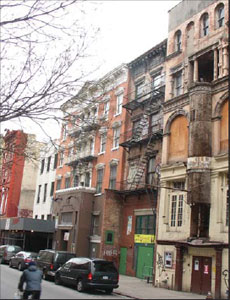
The Fourth Arts Block.

Artefactory

A new cultural destination with seven different capital projects is in the works. The Fourth Arts Block (FAB) a non-profit organization founded in 2001, recently held a ceremonial ground breaking for projects including renovation work ranging from moderate to gut rehabilitation on East 4th Street, between Second Avenue and the Bowery. The space for cultural activity on the block will increase over 90% to 99,000 square feet with the addition of three theaters, two dance studios, and three rehearsal spaces.

Starr Whitehouse Landscape Architects and Planners is leading the landscape design for the overall streetscape, which will include new tree plantings, historic-looking lampposts, and improved lighting on building façades and from buildings onto the sidewalk. Superstructures Engineers & Architects has led design on several exterior renovations and stabilizations. Mitchell Kurtz Architect, Duke Beeson Architect, Charles Rose Architects, and Robert Biviano are leading the renovations and design for the New York Theatre Workshop and La MaMa’s buildings, a multi-arts building, a youth arts center, and Teatro Circulo, respectively. In addition, WORKac is designing new office space for CreativeTime, a non-profit organization that commissions and presents public arts projects.


House Built for Lions is Now Home for Lemurs
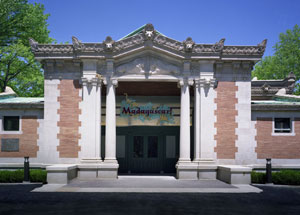
The Lion House.

Photo by Bob Zucker, courtesy FXFOWLE Architects

Exotic plant life, birds, crocodiles, hissing cockroaches, and different species of lemurs from Madagascar have a new home in the Bronx Zoo’s recently restored Lion House. The Wildlife Conservation Society (WCS), which manages the zoo, and the NYC Department of Design and Construction selected FXFOWLE Architects to integrate the new “Madagascar!” exhibition and convert the Lion House to a set piece for the zoo. Heins & LaFarge designed the 20,000-square-foot Beaux Arts building in 1903 as part of the original campus at Astor Court. As the first project to come out of the zoo’s 2001 master plan, the Lion House needed to represent the next generation of the zoo experience, function as a publicly accessible building, and exemplify the WCS’s conservation mission. Programmatically, the project integrates varying degrees of public and private access within the constrained footprint. The Lion House is the first designated landmark building in NYC to be certified “green” by the USGBC, and is projected to receive a LEED Gold certification.


NYC School Passes the LEED Test
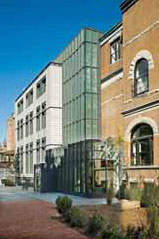
Poly Prep Country Day School.

Photo by Jonathan Wallen

Poly Prep Lower School, located Park Slope, Brooklyn, is the first NYC school to be awarded a LEED Silver plaque — for Platt Byard Dovell White’s new addition to the school. The project, which received approval from the Landmarks Preservation Commission, incorporated characteristics of the 1892 Hulbert Mansion into the design featuring eight new classrooms, a multi-purpose gymnasium, and a sky-lit dance studio. The mansion was reconfigured to include larger homerooms, a new dining room, central library, double-height music room, and additional art studios. An entrance lobby off a newly landscaped playground leads to a glass-enclosed stair linking the addition to the mansion. Green features include: a 30% reduction in potable water consumption; 70% of the school’s energy is being provided from renewable sources for at least two years; demand control ventilation in high activity spaces; and landscape materials were selected to minimize heat island effect.


Mixed-Use, Mid-Rise Completed in Central Harlem

Salem House.

Photo by John Bartlestone

Construction of Salem House, a $9.5 million, 60,000-square-foot, mixed-use facility designed by RKT&B Architects is complete. Located in Central Harlem, the seven-story structure combines affordable housing with commercial and community facilities. The primary façade is an aluminum-and-glass window wall system, and alternates with red brick panels with punched window openings. The segmented façade treatment is intended to bring the scale of the 130-foot-wide building down to that of the narrow adjacent structures along Adam Clayton Powell Jr. Boulevard. The Salem United Methodist City Society in partnership with the Phipps Houses Group commissioned the project.


Two Park Avenue (1926) to Get Art Deco Update
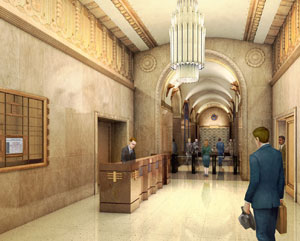
The lobby of Two Park Avenue.

Fifield Piaker Elman Architects

The American Art Deco building at Two Park Avenue, designed by Ely Jacques Kahn and built in 1926, is getting a new lobby designed by Fifield Piaker Elman Architects (FPE). The building’s new owners, Morgan Stanley and L&L Holdings, commissioned FPE to reverse a series of earlier renovations to the building, which is a designated landmark. Inspired by Kahn’s existing ornamental detailing, FPE is introducing elements such as new light fixtures with custom bronze sconces to illuminate the original ceiling mosaic and vaulted alcoves, and accent the marble walls. A new concierge desk, bronze-clad doors, and decorative bronze grilles have been designed to match Kahn’s aesthetic while functioning for contemporary use.


Yale: Gwathmey Traces Rudolph’s Footsteps
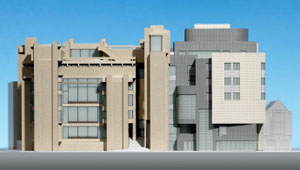
Model of Yale arts complex showing York Street Elevation.

Photograph by Jock Potel, courtesy Gwathmey Siegel & Associates Architects

Yale University’s major new building comprising the renovated Art & Architecture building (to be renamed Paul Rudolph Hall), the Jeffrey Loria Center for the History of Art, and the Robert B. Haas Family Arts Library, will open this August. Designed by Charles Gwathmey, FAIA, of Gwathmey Siegel & Associates Architects, who received his MArch from Yale in 1962 while Rudolph was chairman of the Department of Architecture, will enable continuous links between the Department of the History of Art and the School of Architecture.

As part of the master plan for the Yale Arts Area, Gwathmey Siegel & Associates restored Rudolph’s historic building, and introduced state-of-the-art technology, air conditioning, and LEED standards into a new facility serving Yale’s art history department. The firm intended the building to have its own identity, create an expanded art, drama, and architecture library with a street-level presence, and respect the surrounding streetscape. The Jeffrey Loria Center for the History of Art is added to the north side of Paul Rudolph Hall, reflecting Rudolph’s original plan to expand the building to the north.


Regeneration Building Prods Researchers to Work Together
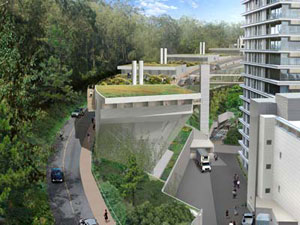
Institute for Regeneration Medicine.

Rafael Viñoly Architects

Rafael Viñoly Architects’ design for the Institute for Regeneration Medicine (IRM) building on the University of California at San Francisco Parnassus campus has been approved. The curved, terraced building follows the slope of a narrow hillside. Its horizontal form allows the building to operate as a continuous lab across its four split-levels, encouraging physical and visual connectivity among its users. Exterior ramps along the north façade connect the lab floors in continuous circulation. Landscaped green roofs offer garden amenities for the offices, and break rooms serve as social hubs. IRM reaches out to three nearby research and medical buildings via a pedestrian bridge, connecting it to the center of the campus research community. Walkways anticipate future pedestrian route improvements. The building is expected to be completed in 2010, and expects LEED Silver in line with university policy. It will also follow Labs21 environmental performance criteria.


New-Build on Shanghai’s Bund
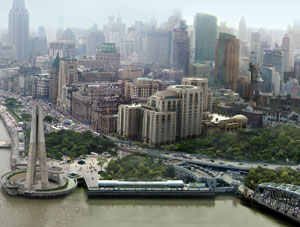
Peninsula Shanghai Hotel & Apartments.

BBG-BBGM

A recent ceremony marked the topping out of the new Peninsula Shanghai Hotel & Apartments designed by BBG-BBGM. The project consists of a hotel with approximately 235 guestrooms and suites, high-end retail space, 39 luxury residential units, and amenities that include a grand ballroom and meeting complex, jazz lounge, and rooftop restaurant. Located in the newly redeveloped Waitanyuan neighborhood on Shanghai’s historic Bund, the design combines traditional art-deco detailing and contextual scale with materials such as bronze and granite that reflect the neighborhood’s historic architecture. The hotel, the only new development on the Bund, is expected to be complete in the fall of 2009.
Interiors Awards Win Unanimously

Event: Design Awards Winners’ Symposium
Location: Center for Architecture, 05.19.08
Speakers: Farnaz Manusuri, Assoc. AIA — Lead Designer, De-Spec; Stephen Cassell, AIA — Principal, Architecture Research Office; Joel Sanders, AIA — Principal, Joel Sanders Architect; Sam Dufaux — Worker, Work architecture company; Peter Bentel, AIA — Partner, Bentel & Bentel Architects and Planners AIA; Stephan Jaklitsch, AIA — Principal, Stephan Jaklitsch Architects; John Lee, AIA — Principal, Workshop for Architecture; Taryn Christoff — Principal, Christoff:Finio Architecture; Lee Mindel, FAIA — Principal, Shelton, Mindel & Associates
Moderator: Paul Zajfen, FAIA, RIBA — Juror, Design Principal, CO Architects
Organizer: AIANY Design Awards Committee
Sponsors: Benefactors: Skidmore, Owings & Merrill; Syska Hennessy Group; Patrons: F.J. Sciame Construction Co.; HDR; HOK; Langan Engineering & Environmental Services; O’Connor Capital Partners; Richter + Ratner; Thornton Tomasetti; Lead Sponsors: Arup; Consulting for Architects; Gensler; KI; Lutron Electronics; Mancini Duffy; RMJM Hillier; Robert A.M. Stern Architects; STUDIOS architecture; Turner Construction Company; Sponsors: Armstrong World Industries; Atkinson Koven Feinberg; Building Contractors Association; Cosentini Associates; Costas Kondylis and Partners; Flack+Kurtz; Forest City Ratner Companies; FXFOWLE Architects; Ingram Yuzek Gainen Carroll & Bertolotti; James G. Kennedy & Co.; Jaros, Baum & Bolles; JCJ Architecture; John Gallin & Son; MechoShade Systems; Microsol Resources; New York University; Pei Cobb Freed & Partners; Perkins+Will; Peter Marino Architect; Polshek Partnership Architects; Ricci Greene Associates; Rogers Marvel Architects; Swanke Hayden Connell Architects; Toshiko Mori Architect; Weidlinger Associates

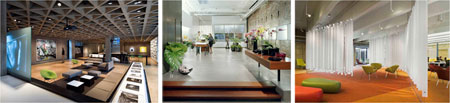
2008 AIANY Design Honor Awards in Interiors (l-r): Yale University Art Gallery Media Lounge by Joel Sanders Architect; Banchet Flower Bar by De-Spec; Friedman Study Center at Brown University by Architecture Research Office.

Courtesy AIANY

There were over 140 entries in the AIANY Design Awards Interiors category this year. “It was a daunting thing looking for a reason to get rid of a project,” said jury member Paul Zajfen, FAIA, RIBA, design principal at LA-based CO Architects. “Projects were submitted that were really good, and with another set of jurors someone else might have won.” Proving this point, John Lee, AIA, principal at Workshop for Architecture, admitted his 2008 merit award-winning project, the Maritime Intelligence Group Offices, was twice previously submitted. The difference between an honor and a merit, according to Zajfen, was unanimity and, to that end, the jury selected four honors and seven merit awards.

Honor Award Winners
The Banchet Flower Bar is a shop in the meat packing district designed by De-Spec. The two-phased project transformed a warehouse space into a flower design studio at a time when the district was still a mix of meat-packing and trendy stores and restaurants. The design team spread out flowers along the shop turning it into a performance space for passers-by, according to lead designer Farnaz Mansuri, Assoc. AIA. Once open, Mansuri was pleased to hear photographers wanted to use the space for shoots and people wanted to rent it for weddings.

Brown University’s mission of interdisciplinary education was integral to the programming, and thus the architecture, of the Friedman Study Center, stated Architecture Research Office (ARO) principal Stephen Cassell, AIA. With a large floor plate, they could design several micro-environments, each furnished differently. The interiors accommodate quiet, individual study zones, interactive areas, as well as collaborative activities.

Yale University Art Gallery Media Lounge, designed by Joel Sanders Architect, was an exercise in working with many different parties — the director and curators of the museum, bookstore employees, and students. The space serves reading, film screenings, and even banquets. Custom-designed, flexible furniture is demountable quickly and easily. Since it is located in the first floor of the Louis Kahn-designed gallery, the firm incorporated four-foot floating modular display panels to divide and create.

Merit Award Winners
Anthropologie, a retailer that sells items ranging from door knobs to clothing, called upon Work architecture company to design a new store in southern California. This involved revamping the brand and creating a template for future stores. Workshop For Architecture’s design for the Maritime Intelligence Group Offices is stylistically estranged from its neighbors despite its site in a typical 1980s brick office building. The suspended ceilings are painted black and are backlit, window walls are screened with parachute fabric, and floors are concrete.

Bentel & Bentel Architects and Planners AIA’s design for Craftsteak in an old building near Chelsea Market echoed the chef/owner’s idea that cooking is a craft, not an art. Thus, the restaurant has a refined, simple palette, to echo the process of simple food preparation. The Marc Jacobs Collection in the Palais Royal in Paris occupies seven bays in the 1739 arcade, rather than one. Stephan Jaklitsch Architects gutted the space and worked with the Ministry of Culture to develop a model for future stores in the Palais.

STUDIOS Architecture mimicked Gehry Partners’ undulating exterior skin within the IAC Headquarters to create distinct areas for the company’s Internet properties. Christoff:Finio Architecture’s “untech” scheme won the New Museum of Contemporary Art’s competition for its interiors. Ten small tables rearrange into one large one, and six mesh curtains are on ceiling tracks for maximum flexibility in the space. Shelton, Mindel & Associates’ pool house on Long Island is a simple cube with a wall opened up to the outdoors. Furniture acts as indoor “pool toys” to neighborhood children’s delight.

In this issue:
· Downtown: Gehry Makes a New Impression
· Foundation Grants $25 Million to Improve 2 NYC Parks
· Upper East Side Patterns New Condo Design
· Action at Pier 94: NYC Expands Trade Show Capacity
· Melrose Commons Builds First Sustainable Building
· Crafting a Center for Kids
· Calais Border Station is Flexible, Secure, Pollution-Free
· 1815 WV Mansion Gets New Lease on Life


Downtown: Gehry Makes a New Impression

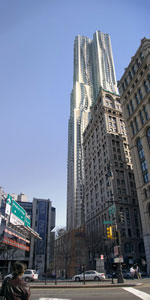
Beekman Tower looking up from Park Row.

Artefactory

The 76-story Beekman Tower will be Gehry Partners’ first residential high-rise/mixed-use commission in NYC, and at 867 feet tall it will be the tallest residential building in Manhattan. The Forest City Ratner Companies’ development will feature a 1.1-million-square-foot structure sheathed in glass and stainless steel cladding atop a six-story masonry podium. In addition to 903 market-rate rental apartments, the development will include a four-story, 100,000-square-foot pre-K through eighth-grade public school in the podium — the first public school built in NYC on private land — with a 5,000-square-foot rooftop play area. A 21,000-square-foot ambulatory care center for New York Downtown Hospital will be used as doctors’ offices, 1,300 square feet will be dedicated to neighborhood-oriented ground-floor retail space, and there will be 26,000 square feet of below-grade parking.

Due to the design of the curtain wall, each floor will have a different configuration. The folds of the façade create bay windows inside. The complex surface geometry of the curtain wall will be mapped by computer software developed by Gehry Technologies called Digital Project. There will also be a wide range of amenities including a gym, spa with swimming pool and sundeck, business conference-center, residents’ recreational lounge with golf-simulator, demonstration kitchen, and children’s playroom and television lounge. The site will feature two 15,000-square-foot landscaped public plazas designed by Field Operations.


Foundation Grants $25 Million to Improve 2 NYC Parks

Rendering of Prospect Park’s future Concert Grove.

Rendering by Peter DePasquale, courtesy NYC Department of Parks and Recreation

The Leon Levy Foundation is awarding $15 million to The New York Botanical Garden for the creation of a new Native Plant Garden on 3.5 acres adjacent to the Native Forest and Rock Garden. It will serve as a center for the study and display of plants native to northeastern United States. The garden will be one of the first projects in the Botanical Garden’s Master Plan, being developed by the Philadelphia-based landscape architecture firm Olin Partnership.

The foundation has also awarded $10 million to Prospect Park to fund renovation of the park’s 26-acre Lakeside Center, and help to restore the park to its original design as envisioned by Frederick Law Olmsted and Calvert Vaux. The grant will fund the demolition of Wollman Rink, the first step toward bringing back the area’s native trees, shrubs, and aquatics; new rinks will be built nearby. In addition, Music Island will be rebuilt as a natural habitat sanctuary where pedestrian viewing paths will be restored along the lake edge, and invasive aquatic reeds will be removed. Tod Williams Billie Tsien Architects will design the new building and ice rinks, with Christian Zimmerman of the Prospect Park Alliance as landscape architect.


Upper East Side Patterns New Condo Design

Isis Condominium.

Courtesy Alchemy Properties

FXFOWLE Architects has designed an 18-story luxury residential condo on Manhattan’s Upper East Side for Alchemy Properties. Billed as a “family-friendly” building, Isis Condominium will contain 31 two-, two-plus den, and three-bedroom residences — two units per floor and four penthouses. Resting on a six-story base, the façade features a greenish-gray mosaic made by Trespa. The project is currently under construction with an expected completion date in July 2009.


Action at Pier 94: NYC Expands Trade Show

Piers 92 and 94 — future home of a new trade show facility.

Courtesy Dattner Architects

New York City Economic Development Corporation (NYCEDC) has designated the team of Vornado Realty Trust and its subsidiary Merchandise Mart Properties Inc. to redevelop and expand the trade show facility on Manhattan’s far west side. The design team includes Dattner Architects and SMWM, with Philip Habib and Associates acting as traffic consultants. The project will expand the trade show facility on Pier 94 to include Pier 92 and will contain approximately 355,000 square feet of trade show and conference space. The project will also feature a 9,300-square-foot winter garden and accessible open space around the perimeter. A 60,000-square-foot logistics center will accommodate loading/unloading, storage, and other back-of-the-house functions to relieve traffic congestion. Developers hope the $100 million renovation will help NYC capture a larger share of the tradeshow market.


Melrose Commons Builds First Sustainable Building

El Jardin de Seline.

Magnusson Architecture and Planning

Construction is underway on El Jardin de Seline, a new, sustainable affordable housing project in the Melrose Commons section of the Bronx. The mixed-use, mixed-income rental building was designed by Magnusson Architecture and Planning (MAP) and developed by a joint venture of Nos Quedamos, MJM Construction Services, and Melrose Associates. At 12 stories, the project will be the tallest building in the neighborhood and will reference “old Bronx style” with its use of art deco motifs and materials consistent with local buildings. Funded by the NYC Housing Development Corporation, the NYC Department of Housing Preservation and Development, Richman Housing Resources, and NYSERDA, El Jardin will contain 84 units from studio to 2-bedroom apartments and will be available to residents making up to 60% and 80% of AMI. The project will contain over 2,000 square feet of community space including a laundry room and outdoor courtyard, as well as 6,000 square feet of retail space and 12,000 square feet of parking. It is expected to receive a LEED Silver rating upon completion.


Crafting a Center for Kids

The Queens Child Guidance Center.

CetraRuddy

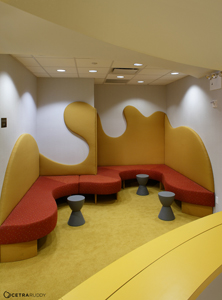
CetraRuddy has redesigned the Queens Child Guidance Center in Woodside. The organization is a family-focused non-profit that annually serves more than 12,000 children, ranging from newborns to 20-year-olds. Programming and design combined four separate facilities into one central location. The space includes two large conference rooms for group sessions — one specifically for young children with play spaces, and another for older children and adults adjacent to a two-way observation room for staff — and 40 brightly-colored soundproof counseling rooms. The Child Center is now moving into a second design phase and is adding 5,000 square feet to the existing space.


Calais Border Station is Flexible, Secure, Pollution-Free

U.S. Land Port of Entry.

Robert Siegel Architects

Ground was recently broken on the U.S. Land Port of Entry in Calais, ME. The 100,000-square-foot building, designed by NY-based Robert Siegel Architects for the Department of Homeland Security and Customs and Border Protection, is part of the General Services Administration’s Design Excellence Program. The design is intended to create a welcoming yet secure, flexible yet permanent gateway between the U.S. and Canada. The facility will be wrapped with a textured aluminum façade that acts as a protective barrier for surveillance and reflects sun and shadows. A concealed courtyard protects staff from pollution and vehicle traffic but manages to offer unobstructed views of the rugged landscape. The station, which has an overall budget of $48 million, is slated for completion in November 2009. The firm garnered a Merit Award in the Projects category of the 2007 AIANY Design Awards.


1815 WV Mansion Gets New Lease on Life

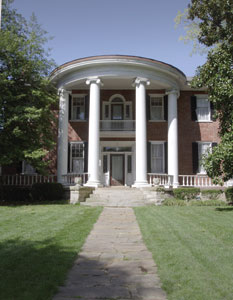
Holly Grove Mansion.

Swanke Hayden Connell Architects

Swanke Hayden Connell Architects (SHCA) has been selected by the state of West Virginia to design a comprehensive rehabilitation plan for Holly Grove Mansion, a 5,300-square-foot mansion listed on the National Historic Register of Historic Places. The circa 1815 Classic Revival mansion is on the State Capitol grounds in Charleston, next to the Governor’s Mansion. SHCA performed a due diligence evaluation and researched adaptive new uses, such as offices, event space, guesthouse, and museum. The scope of services entailed a full building assessment, including code-compliant analysis for stabilization and repair of deteriorated structural components. In addition to restoration and replication of period elements, new mechanical, electrical, plumbing, and fire suppression systems will be concealed, and period appropriate architectural finishes and features will be selected to support the building’s historic character.

In this issue:
· It’s a Wrap in Tribeca
· Nobu Brand to Consume Financial District
· New Police Precinct Will Bask in (LEED) Silver
· SUNY Stony Brook Goes Green
· BIM Helps Design Desert Tower
· Pace Gallery to Launch Beijing Branch During Olympics
· Random House Could Write a Book on Achieving LEED-EB


It’s a Wrap in Tribeca

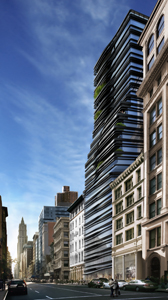
Five Franklin Place.

UNStudio

UNStudio’s design for Five Franklin Place, a residential condo, bows to the tradition of applied metal façades of Tribeca’s 19th-century cast iron buildings. The exterior will be wrapped in a shifting pattern of horizontal black metal reflective bands sewn onto the building’s form, alternating in thickness as they turn corners and envelop the 20-story tower. The banding continues inside shifting into horizontal spatial arrangements. Strategically placed curved walls echo the façade’s corners, and shift for maximum flexibility in the use of rooms. The building contains 55 residences, a combination of one- to four-bedroom apartments configured as duplex lofts or single-level units, as well as three duplex penthouses with rooftop terraces.


Nobu Brand to Consume Financial District

45 Broad Street.

Rockwell Group

Swig Equities plans to construct a new, 62-story luxury mixed-use development across from the New York Stock Exchange. Designed by the Rockwell Group, a Nobu partner of nearly 15 years, 45 Broad Street will include approximately 13,000 square feet of retail space, a Nobu restaurant, a five-star Nobu Hotel, condo residences, and private wine and saki cellars. Chef Nobu Matsuhisa wanted to emulate a traditional Japanese inn, or ryokan. The tower will be clad in glass and white metal with floor-to-ceiling windows and fritted, white, opaque panels intended to emphasize the building’s verticality, according to the architects. The project’s exterior design architect is Moed deArmas and Shannon, and SLCE serves as the project’s executive architect. The team is designing the building to win LEED certification.


New Police Precinct Will Bask in (LEED) Silver

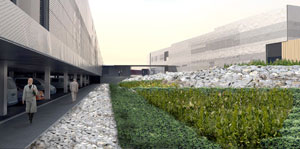
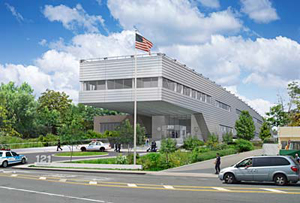
121st Police Precinct Stationhouse.

Rafael Viñoly Architects

The NYC Art Commission has approved Rafael Viñoly Architects’ design for 121st Police Precinct Stationhouse in Staten Island. The nearly 49,000-square-foot building, commissioned by the NYC Police Department and Department of Design and Construction, has been designed for an irregular site. The linear structure is intended to connect nearby residential neighborhoods to commercial corridors. Its 90-foot-long, cantilevered second floor extends over the entrance. The project consists of new work areas, holding cells, on-site outdoor parking for 108 cars, and its own vehicle fueling station. The precinct hopes to garner LEED Silver certification, which will make it the first police facility in the city to do so. Construction is slated to start in March 2009.


SUNY Stony Brook Goes Green

Residence hall and activity center at SUNY Stony Brook.

Goshow Architects

Construction has begun on the Goshow Architects-designed residence hall and activity center at the State University of New York (SUNY) at Stony Brook. The 172,000-square-foot facility is designed to increase circulation between two adjacent quads and create a transparent connection between students and the academic institution. The 600-bed residence contains six-bed suites centered around living rooms. Sustainable features include optimal natural lighting, a highly insulated building exterior, and the use of recycled materials, according to the architects. New building technologies, such as pre-fabricated walls and locally sourced materials, will cut construction time and make for early occupancy. The residence and activity center are applying for LEED Gold certification, and occupancy is expected in Fall 2009.


BIM Helps Design Desert Tower

Strata Tower.

Asymptote Architecture

The 160-meter-tall Strata Tower, a 40-story luxury residential building designed by Asymptote Architecture, is under construction at Al Raha Beach in Abu Dhabi. The tower’s form was created using parametric Building Information Modeling (BIM) tools from design development through the production phase. The design emerged from various economies of production and fabrication with special concern for sustainability. Computer modeling helped produce the building’s intelligent, environmentally responsive louver system held in a cantilevered exoskeleton veiling the entire tower in a curvilinear form. Arup is structural and MEP engineer, Front Inc. is the façade consultant, Gehry Technologies is the BIM consultant, and Atelier Ten is consulting on the environmental design.


Pace Gallery to Launch Beijing Branch During Olympics

Pace Beijing.

Gluckman Mayner Architects

Pace Wildenstein is set to open Pace Beijing this August during the Olympic Games. In a 22,000-square-foot gallery space located in the Factory 798 Arts District, NY-based Gluckman Mayner Architects will renovate the building that was formerly a 1960s munitions factory. The inaugural exhibition, Encounters, will feature Western and Asian works by artists such as Chuck Close and Alex Katz, as well as Zhang Huan and Zhang Xiaogang.


Random House Could Write a Book on Achieving LEED-EB

Random House’s North American Headquarters.

AKF Engineers

The North American Headquarters of Random House — reportedly the first major U.S. trade book publisher to adopt an environmentally proper paper policy — has achieved a LEED-EB certification. Located at 1745 Broadway near Columbus Circle, LiRo Architects + Planners designed a framework to optimize their building management corporate services to earn LEED points. During the LEED documentation process, AKF Engineers acted as Random House’s liaison to the U.S. Green Building Council.

In this issue:
· Whitney Heads Downtown
· Ad Agency Fosters Creativity Through Design
· A Contemporary Take on Bond Street
· LEED Gold Restoration Preserves Texas Treasure
· R&D Goes Green in China
· A New Great Wall for China


Whitney Heads Downtown

The entrance to the proposed downtown Whitney Museum of American Art designed by Renzo Piano Building Workshop.

Courtesy Whitney Museum of American Art

The Whitney Museum of American Art recently unveiled Renzo Piano Building Workshop’s design for a second 185,000-square-foot museum in the Meatpacking District. The six-story downtown museum will include 50,000 square feet of galleries, affording the Whitney to show more of its 20th- and 21st- century American art. The third-floor special exhibition gallery will be approximately 17,500 square feet, one of the largest free-span exhibition spaces in NYC.

Approximately 15,000 square feet of rooftop galleries will be situated on various levels of the building for dynamic outdoor exhibitions. The building also will contain an education facility, research library, conservation area, multi-use space for film and performing arts, 175-seat theater, study center, restaurant, café, bookstore, and a ground-floor exhibition gallery. The upper stories will spread beyond the building’s base, stretching toward the Hudson River to the west and stepping back from the elevated High Line park on the east. A cantilevered entrance along Gansevoort Street will shelter a public plaza steps away from the southern entrance to the High Line. Cooper, Robertson & Partners is collaborating on the project, slated to begin construction in Spring 2009 with an anticipated opening in late 2012.


Ad Agency Fosters Creativity Through Design

Dentsu America.

Chuck Choi

The New York office of TPG Architecture has completed the renovations to the global advertising agency Dentsu America’s NYC flagship office in Tribeca. The office, at 32 Avenue of Americas, is a landmarked 27-story art deco building designed by Voorhees, Gmelin & Walker in 1933, and built as the world headquarters for AT&T. The 40,000-square-foot office has an industrial loft-like aesthetic and features an open plan and glass-front offices. The client wanted a workspace that fosters creativity, so TPG developed solutions such as two brainstorming rooms, or think tanks, constructed on 30-inch platforms that appear to be suspended above the sunken staff area. LED lights are installed at the base of each structure to further enhance the floating effect. A raised café, compete with a 10-foot, 800-gallon Koi fish tank, offers uptown views.


A Contemporary Take on Bond Street

48 Bond Street.

Deborah Berke & Partners Architects

The Deborah Berke & Partners Architects-designed 48 Bond is about to be completed. Working with GF55 Partners acting as Executive Architect, the 11-story building in NoHo shares a cobblestone street with Herzog & deMeuron’s 40 Bond. Interpreting the neighborhood’s 19th century architecture, the building has zinc and glass at street level, segueing into a flamed charcoal grey granite and sheet glass. A contemporary take on the bay window, the building has narrow panes tilting out from the façade allowing for a play of shadows throughout the day. The building has 17 units.


LEED Gold Restoration Preserves Texas Treasure

The Nix House, before and after renovation.

Portico Residential LLC

New York-based Portico Residential, a real estate advisory and development firm, has been awarded the “Treasure of Texas” by Preservation Texas, a partner of the National Trust for Historic Preservation. The award was for its work on the Nix House, a circa 1899 Victorian mansion designed by Texas architect Atlee B. Ayers located in the heart of San Antonio’s King William Historic District.

The restoration incorporated over 20 green design principles for greater energy efficiency and minimal environmental impact, most notably solar chimneys, non-vented roof/attic, rainwater harvesting system, and an upgraded utility grid. The project is expected to be certified LEED Gold for a historic home. Portico Residential’s president, architect and attorney and AIANY member Roy R. Pachecano, AIA, spearheaded the project with his father, both of whom are San Antonio natives. The house is currently for sale.


R&D Goes Green in China

Genzyme.

RMJM Hillier

RMJM Hillier, the North American division of U.K.-based RMJM Group, has been selected as design architect and laboratory planner for a 200,000-square-foot, $90 million Beijing research and development center for Genzyme Corp., one of the world’s leading biotech companies. Located in Zhongguancun (ZGC) Life Science Park, an area dedicated to academic and government research centers as well as pharmaceutical and biotechnology companies, the new facility will be used for research and development activities.

Green features include a narrow foot print and four-story atrium to maximize natural ventilation; a living roof to reduce pollution from storm water runoff; a solar thermal system to provide a significant portion of the building’s hot water and reduce its energy consumption; low-flow fixtures; a high-performance exterior glass system to enhance natural light; and a sensored motorized blind system to control light and heat gain. The research and administrative portions of the building are connected via the atrium in which a series of horizontal bridges and staircases of varying heights and dimensions aim to promote productive and playful movement of people, light, and air.


A New Great Wall for China

GreenPix – Zero Energy Media Wall.

Simone Giostra & Partners Architects

New York-based Simone Giostra & Partners Architects has designed the GreenPix – Zero Energy Media Wall at Xicui Entertainment Complex in Beijing, near the site of the 2008 Olympics. The project applies sustainable and digital media technology to a curtain wall and features the largest color LED display in the world, composed of 2,292 color (RGB) LED’s, comparable to a 24,000-square-foot monitor screen. The technology transforms the building envelope into a self-sufficient organic system, harvesting solar energy by day and using it to illuminate the screen after dark, mirroring the day’s climatic cycle. Giostra, along with Arup, developed a new technology for laminating photovoltaic cells in a glass curtain wall and oversaw the production of the first glass solar panels by Chinese manufacturer SunTech. The wall will have its premiere performance in June showcasing videos, installations, and performances, organized by a team of independent curators, art institutions, and benefactors, lead by curator/producer Luisa Gui.

In this issue:
· Brooklyn Youth Center is Dynamite
· Church Converts, Adds Affordable Housing
· Seoul’s “Soul Flora” Buds
· Mixed-Use Takes Over Concrete Plant
· Public School Grows Wing


Brooklyn Youth Center is Dynamite

Dynamite Youth Center

Dynamite Youth Center.

© Jennifer Calais Smith

The Dynamite Youth Center (DYC) in Broolyn recently completed construction of its new community residence — a renovation/addition by Rafael Viñoly Architects. The center, now open 24/7, aids adolescents who face substance and alcohol abuse problems. Aided by a New York State grant, DYC is adding on to the building’s third floor and constructing a new fourth floor. A truss system was added to the second-floor auditorium to support the additions above. Supplementing the facilities, the new residential center includes four bedrooms to house 16 residents, along with a kitchen, pantry, laundry facility, and common area. Lit by skylights and a fully glazed wall, the space is adjacent to a terrace that affords neighborhood views. The building’s façade also underwent extensive restoration, including the installation of translucent street-level windows that ensure privacy yet allow natural light to enter.


Church Converts, Adds Affordable Housing

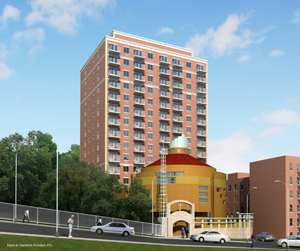
Rocky Mount Baptist Church

Rocky Mount Baptist Church.

North Manhattan Construction Corp.

This fall, the existing building housing the Rocky Mount Baptist Church in Manhattan’s Washington Heights will be razed to make way for a new 15,000-square-foot church, a 16-story apartment complex, and an 11,000-square-foot community space. Of the 75 rental units, 20% will be reserved for affordable housing. Newark-based Johnson Jones Architects Planners is designing the church, and New Rochelle-based Mario A. Canteros Architect will design the residential portion. North Manhattan Construction purchased the 20,000-square-foot site, and is developing the project.


Seoul’s “Soul Flora” Buds

Soul Flora

Soul Flora.

H Associates

NYC-based H Associates (founded by Seoul-based Haeahn Architecture) has been named winner of the Seoul Metropolitan Government’s competition for its Han River Renaissance project. The submission, “Soul Flora,” is a series of three floating islands depicting the lifecycle of a flower — from seed, to bud, to blossom. The islands, joined together by pedestrian bridges, are designed to create the appearance of flowers during the day, and lamps when illuminated at night. The “seed” island has a grass beach, marina, clubhouse, and floating pods of flora created to look like flickering candles at night. The “bud” island houses an urban entertainment center with cafés, theaters, interactive games, and exhibition space. “Blossom” will have restaurants and performance venues. The islands are scheduled to open in the fall of 2009.

Mixed-Use Takes Over Concrete Plant

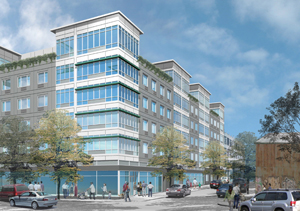
173 Kent Avenue

173 Kent Avenue.

Meltzer/Mandl Architects

Construction on 173 Kent Avenue, designed by Meltzer/Mandl Architects is slated to begin this month. The seven-story, 118,000-square-foot, mixed-use glass-and-masonry building in the Williamsburg section of Brooklyn is to include 113 condominiums, 5,000 square feet of ground-level retail space with an additional 18,000 square feet of retail space in the cellar, and parking for 140 vehicles. The design establishes a new street wall in the site of a former concrete plant. Parking for both residential and retail tenants will be behind the building. The top-floor residences will sport roof terraces providing Manhattan views. Sustainable design elements include an exterior panelized wall system with rain screen technology and low-emission glass.


Public School Grows Wing

Quaker Ridge Elementary School

Quaker Ridge Elementary School.

Peter Gisolfi Associates

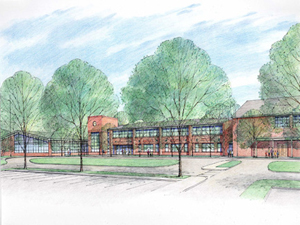
Scarsdale’s Quaker Ridge Elementary School completed construction on a new 27,000-square-foot, two-story wing that replaced a deteriorating one-story wing built in 1947. The project, designed by Peter Gisolfi Associates, houses new administration offices, teachers’ workroom, multipurpose activities room, renovated gymnasium, and 10 new classrooms. The new wing, library, and classrooms face a central courtyard.

In this issue:
· Affordable Green Housing Comes to Harlem
· New School Building Wins Gold
· A Barfly Lands in the East Village
· New Office Thinks It’s a Bar
· Office Expansion for a Private Jet Business


Affordable Green Housing Comes to Harlem

David and Joyce Dinkins Gardens

David and Joyce Dinkins Gardens.

Dattner Architects

Doors opened on the new David and Joyce Dinkins Gardens housing development in Harlem, designed by Dattner Architects. Built on city-owned property, the project is designed to meet the community’s social and environmental needs. The building includes 85 studio to two-bedroom apartments for low-income families and youths aging out of foster care, a first floor community center, and a landscaped community garden. The masonry bearing wall and pre-cast concrete plank building is organized into bays of contrasting brick colors. Two recessed, glazed window wall bays are inserted into the brick façade intended to mark the residence and community center entries and open the façade to the community.

Sustainable features include: a green roof with a solarium, rainwater harvesting system to irrigate the garden, sunshades, low-flow plumbing fixtures, recycled materials, and enhancement of indoor air quality through insulation and ventilation. The project was co-developed by Jonathan Rose Companies and Harlem Congregations for Community Improvement (HCCI).


New School Building Wins Gold

Manhattanville College

Student Center at Manhattanville College.

Peter Gisolfi Associates

A new 24/7 student center at Manhattanville College in Purchase, NY, designed by Peter Gisolfi Associates, recently opened. Sited near Reid Hall, a McKim Mead & White building, and adjacent to the existing dining hall, student post office, and college store, the new three-story, 31,000-square-foot building acts as a gateway to the campus, defining a new quadrangle that is part of the entry sequence to the center of the campus. New spaces include the student radio station, a multipurpose performance space, student lounge, campus art gallery, dance studio, graphic arts labs, and a recreational fitness center on most of the top level. The building has won LEED Gold certification.


A Barfly Lands in the East Village

Bar Solex

Bar Solex.

OPUS Interdisciplinary Design Studio

The design for Bar Solex, a French wine bar in the East Village, was inspired by the fuselage of the Concorde, the caves of Lascaux, and a lightweight French moped that is its namesake. The entry to the 15-foot-wide storefront space, designed NY- and Rome-based OPUS Interdisciplinary Design Studio, is via an existing aluminum and glass façade. The transition to the inside is facilitated by an extension of the exterior storefront’s bronze brown color and exposed cast iron column and brick walls. Patrons are greeted by an engineered lightweight, vaulted, illuminated wing ceiling that forms the 55-foot-deep space. Travel themes abound — a stainless steel counter with solid birch bull nose adds to the wing metaphor, columns evoke the repetition of milestones along a highway, and the pattern of 60 tire treads are laser cut into masonite tiles, creating a high-tech mural.


New Office Thinks It’s a Bar

Northeast Regional Office of Heineken

Northeast Regional Office for Heineken USA.

MKDA

NYC and Stamford, CT-based MKDA has completed work on an 11,000-square-foot office for the Northeast Regional Office of Heineken in downtown Stamford. The new space for the light beer importer has a light green hue and is highlighted with Maplewood and brushed chrome accents. A curved and canted white glass partition divides the back office from the 1,500-square-foot bar and reception area, outfitted with wood flooring, high-top tables, banquettes, pendant lighting fixtures, sheetrock ceilings, and an illuminated glass bar. The office also includes a “think” room designed with amber-colored accents, soft illumination, and upholstered chairs with tablet arms to enhance creativity and camaraderie among employees.


Office Expansion for a Private Jet Business

CitationShares Offices

CitationShares Offices.

Photo by Adrian Wilson

The construction of new office space for CitationShares, a division of Cessna Aircraft Company specializing in fractional jet ownership and jet card membership, is underway. Gerner, Kronick + Valcarcel, Architects (GKV Architects), is responsible for space evaluation, programming, and full architectural services. The project expands existing office space, and incorporates open plan workspaces, and flexible training rooms. Construction is scheduled for completion this May.

Mannahatta Project Surveys NYC Past in 3-D

Event: The Mannahatta Project
Location: Center for Architecture, 02.15.08
Speakers: Eric Sanderson, Ph.D. — Associate Director, Living Landscape Program; Tom Jost — Director of Planning, Arup; Glenn Phillips — Executive Director, NYC Audubon; James Karl Fischer, AIA, RIBA, Ph.D. — Co-Chair, AIANY International Committee
Moderator: Ernie Hutton, FAICP, Assoc. AIA — Co-Chair, AIANY Planning & Urban Design Committee
Organizers: AIANY Planning & Urban Design Committee

UWS 1609

The Upper West Side in 1609.

Courtesy Wildlife Conservation Society

It’s hard to imagine that 54 distinct ecosystems once existed on the island of Mannahatta — the land of many hills in the Lenape Indian dialect. Some traces of what once was has been commemorated by their names — Murray Hill and Canal Street, for example — but the marshes, beaches, and forests that once dotted the landscape are long gone and mostly forgotten. Did you know that there once was a beach on 125th Street and the Hudson River? An orchard on the Bowery? A Red Maple Swamp in Times Square?
Eric Sanderson, an ecologist with the Wildlife Conservation Society who is in charge of its “human footprint” project has been studying military maps from the American Revolution, early 19th century topographic surveys, and bird-watching and plant surveys to build a digital model of primeval Manhattan. Sanderson’s Mannahatta Project will compile the data and map the history of the island with GPS precision to show us what Manhattan looked like when Henry Hudson sailed the western shore in 1609, from the landscape to Native Americans and the wolves, mountain lion, and elk. He is planning to publish a book, website, and possibly curate an exhibition in time for the quadricentennial celebration of Hudson’s discovery. The highlight of the project will be virtual 3-D mapping of places like Times Square, complete with images from 400 years ago and projections 400 years from now. Eventually, he would like to recreate views on bus shelters or install plaques around the city pointing to landscape features that no longer exist.

Sanderson talked about a system he calls the Muir Web, named after naturalist John Muir, that shows how each species of plant, animal, and habitat forms a web of dependency. Panelist James Karl Fischer, AIA, RIBA, PhD, commented that it would be better if conservationists started with Charles Darwin and proceeded on to Muir. This “would allow one to produce better strategies to confront contemporary wildlife issues. Darwin speaks of ubiquitous impacts, not a static balance.”

Sanderson’s presentation included a split-view map of Manhattan — the left side was untouched and forested, and the right was filled with today’s skyscrapers. “The Mannahatta Project,” says Sanderson, “is not only a look into our past, but also a look forward to our future. It is the decisions we make now… that shape our planet and will endure as our legacy into the future.”