In this issue:
· Something Old, New, Reclaimed for New Condo
· South Park Slope Breaks Ground for Supportive Housing
· Goethe-Institut Opens Two New Downtown Spaces
· Contemporary Library Blends New and Old
· Digital Medium is Message at Public Communications School


Something Old, New, Reclaimed for New Condo

Steelworks House.

AvroKO

A 130,000-square-foot building, originally home to the Lewis Steel Products factory in the 1930s, is being converted to high-end loft condominiums containing 88 studio- to three-bedroom lofts. NY-based AvroKO was signed on by Fifth Square Partners to complete the concept and the creative marketing and branding. The design team decided to repurpose original site materials. Reclaimed lumber from the building was used to create shelving, interior details, and a rough-hewn wood reception desk for the lobby. The steel sash industrial window frames will be preserved and new energy-efficient windows installed. Each of the residences will feature custom-designed, handmade elements by local craftspeople, including Synchro, a contracting and architectural fabrication company.

New elements, such as steel mesh wall-coverings and polished concrete floors, aim to complement the reclaimed materials. Greener By Design will landscape the building’s 8,500-square-foot roof deck using organic fertilizers and non-chemical weed control, and incorporate low-voltage lighting and water-conserving irrigation systems. Other rooftop features include a skyline cinema, open air bungalows, communal kitchen, private rooftop cabanas, and stone fire pits. Gene Kaufman, Architect, is serving as project architect.


South Park Slope Breaks Ground for Supportive Housing

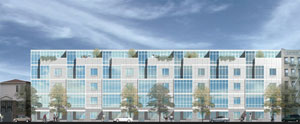
575 Fifth Avenue.

Amie Gross Architects

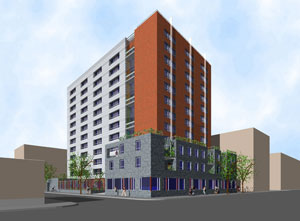
Amie Gross Architects recently broke ground on a new 30,000-square-foot, five-story supportive housing project in South Park Slope, Brooklyn. The mixed-use development will provide studio apartments and social services for 48 individuals in need, including the elderly, formerly homeless, and young adults coming out of foster care, as well as street level retail, and office and community space for supportive services. The building has been designed to achieve a LEED Gold rating and will be one of the first LEED-rated publicly-funded buildings in Brooklyn. The Fifth Avenue Committee (FAC), a not-for-profit that creates affordable housing in South Brooklyn, is developing the project.


Goethe-Institut Opens Two New Downtown Spaces

Goethe-Institut New York.

Courtesy Goethe-Institut

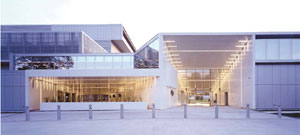
The Goethe-Institut New York, which organizes and hosts German cultural events and promotes international cultural exchange, has opened a second satellite space called the Goethe-Institut Wyoming Building in the Bowery Arts District. The space will formally open in March 2009 after a renovation by Berlin-based architects ifau (Institut für angewandte Urbanistik/Institute for Applied Urbanism) + Jesko Fezer, a firm focused on interrelated, interdisciplinary projects — including architectural and urban design, research, installations, and events in the urban context. The Institut recently opened another downtown satellite space, Ludlow 38, designed by artists Ethan Breckenridge and Liam Gillick. The space, programmed by Kunstverein München, will exhibit contemporary art.


Contemporary Library Blends New and Old

Mamaroneck Library.

BKSK Architects.

Ground was recently broken on the 13,000-square-foot addition to the Mamaroneck Public Library in Westchester County. BKSK Architects designed the addition to the existing 21,000-square-foot library, a portion of which dates back to 1927. Façade materials, column design, and box patterns are meant to blend old with new. The library’s original 1927 reading room was also restored, and a new children’s wing, dedicated teen area, expanded public computer space, enlarged community meeting facilities, a coffee bar, and outdoor terrace will meet current and anticipated future needs of library patrons. The new facility incorporates energy-efficient building systems, a green roof, sustainable materials, and natural light — elements that will enable the library to qualify for LEED Silver. Completion is slated for spring 2010.


Digital Medium is Message at Public Communications School

Newhouse III.

Poulin+Morris

Poulin + Morris, a multidisciplinary design consultancy, has completed work on Newhouse III, the latest addition to the Newhouse School of Public Communications at Syracuse University. Completed in 2008, the glass-wrapped building, designed by Polshek Partnership, supports the integration of students and specialties by housing community spaces including dining facilities, student lounges, an auditorium, a conference center, classrooms, offices, editing suites, media labs, and research centers (see OCULUS, Winter 2007/08). Poulin + Morris was responsible for the design of a comprehensive donor recognition and environmental graphics program. The solutions rely on visual metaphor and technology to communicate the foundation and future mission the journalism school. A donor wall in the entrance lobby uses more than 100 staggered, horizontal LED digital panels. In addition, two typographic wall murals are located in the atrium; one identifies school programs spanning three stories, and another celebrates the First Amendment.

In this issue:
· Metal Shutter Houses Bi-Fold Their Way to West Chelsea
· USS Intrepid Completes Two-Year Makeover
· The Chapin School Grows
· The Show Goes On at SVA
· All Are Welcome at Freak Bar
· Concert Hall Sets Sail at Rensselaer
· Two Towers, Two Bridges, Two Orientations


Metal Shutter Houses Bi-Fold Their Way to West Chelsea

Metal Shutter Houses.

Montroy Andersen DeMarco

NY-based Montroy Andersen DeMarco was named architect-of-record for the Metal Shutter Houses now under construction in West Chelsea, designed by Shigeru Ban Architects in collaboration with NY-based Dean Maltz Architect. The 33,000-square-foot, 11-story building contains floor-through duplexes ranging from 1,950 to more than 3,300 square feet. Natural light enters the first floor, two-story art gallery via a skylight that spans the rear property line through the concrete superstructure. Each residence has a double-height loggia with electronically controlled, perforated metal shutters. When the shutters are retracted, 20-foot-high by 15-foot-wide bi-fold windows — a hybrid of one manufacture’s industrial bi-fold system and another company’s residential window product, are revealed. When opened, they create a continuous floor plan from the interior to the deck. Commissioned by HEEA Development, the project is slated for completion this coming spring.


USS Intrepid Completes Two-Year Makeover

USS Intrepid Sea, Air & Space Museum.

Skanska USA

The USS Intrepid Sea, Air & Space Museum reopened in time for Veteran’s Day after a two-year renovation project with a new paint job, new exhibitions, restored aircrafts, and a new public pier. As part of the final phase of construction, Skanska USA Building installed gangways to transport an estimated one million visitors onto the ship annually, and to permanently secure the USS Intrepid in the newly reconstructed berth at Pier 86 in Hudson River Park. The five gangways provide access from a 64-foot-high glass elevator tower and three stair towers, and contain galvanized aluminum panels and canopies that match the towers. The decommissioned carrier is plugged into utility “umbilicals” on the pier to connect it to the landside visitor’s center for utility sources. A series of flexible hoses transport water and waste, while a chiller plant supplies the ship with heat and air conditioning.

Skanska first removed the original deteriorated pier and built its replacement on 360 steel-pipe piles driven to bedrock. The pier structure is a “sandwich” of drainage mat, high-density traffic-bearing foam fill, gravel, soil, and finished concrete paving. The 782-foot by 150-foot deck surface pattern resembles the stripes on a waving flag. The Concorde aircraft has also been permanently installed on the pier.


The Chapin School Grows

The Chapin School.

Marner Architecture

Marner Architecture has completed the expansion of The Chapin School on the Upper East Side. The additions provide advanced technological developments in classroom design for urban independent schools. Built in 1928, the six-story American Georgian-style building has had various additions over the years. This latest glass-and-metal addition includes new faculty offices, a student resources learning center, and three additional classrooms. The materials used in the façade maximize building insulation while allowing ample natural light to enter the building. Sunlight is controlled by external sunshades and translucent glass panels above interior sightlines to optimize light penetration without glare while preserving thermal insulation.


The Show Goes On at SVA

School of Visual Arts new cultural center.

Courtesy School of Visual Arts

School of Visual Arts (SVA) will soon have a new cultural center for film screenings, lectures, and other cultural programs that support its educational mission. Laurence G. Jones Architects and Aragon Construction have begun renovation on a 25,000-square-foot site, formerly the two-screen Clearview Chelsea West Cinemas. Upon completion, one renovated theater will seat 480, and the other 280. Both auditoriums will feature new screens and draperies, expanded stages, and new lighting and sound system. Other improvements include renovating the existing basement and upgrading all of the theater’s mechanical systems, fire alarms, and electrical services. The lobby will be replaced with a design by SVA acting chairman, Milton Glaser. The venue’s façade, also designed by Glaser, will display a changing set of graphic and sculpture art related to the school’s arts curriculum and will serve as the theater’s signature element.

All Are Welcome at Freak Bar

Coney Island USA Freak Bar.

Photo by Paul Warchol, courtesy Philip Tusa, Architect (www.philiptusa.com/new.cfm)

Astroland may be closing, but the new Coney Island USA’s Freak Bar and Museum Gift Shop, designed by Bensonhurst-born architect Philip Tusa, AIA, has opened for year-round business. The bar is in the circa 1917 Child’s Surf Avenue Restaurant building, home to Coney Island USA (CIUSA), a not-for-profit arts organization that presents the Mermaid Parade and Sideshows by the Seashore, the only remaining “ten-in-one” live sideshow in Coney Island. The greatest design challenge was to incorporate the new spaces with the existing, achieved by “perforating” the existing dividing partitions with large-scale oculus and archway openings to form an interconnected whole that functions as CIUSA’s “Front Door on Coney’s Surf Avenue.” The renovation also revealed the façade’s arches, long hidden by plywood signs. Now one can belly up to the bar and have a cold Coney Island Lager with a fire-eater — in the middle of winter, no less.


Concert Hall Sets Sail at Rensselaer

Experimental Media and Performing Arts Center.

Courtesy Davis Brody Bond Aedas

Doors opened at Rensselaer Polytechnic Institute’s new Experimental Media and Performing Arts Center (EMPAC) in Troy, NY. Grimshaw Architects in collaboration with Davis Brody Bond Aedas and Buro Happold designed the 220,000-square-foot building that occupies a steep hillside. The $200 million facility houses a 1,200-seat concert hall, a 400-seat theater, two adaptive environment studios, an audio and video production suite, artists-in-residence studios, and a dance studio. To accommodate the steep hillside, the design team located entrances at both the highest and lowest elevations. From the entrance, patrons descend through the seven-level central atrium serving as the building’s social hub.

The concert hall is wrapped inside a “hull” of curved cedar planks hovering inside a glass exterior, and provides a practical enclosure for the extensive mechanical duct spaces and surrounding circulation corridors, and serves as a structural component that supports the roof. The concert hall’s shoebox form is optimized for Romantic-era symphonic music, but adaptive acoustics accommodate jazz, amplified music, films, and spoken-word events. The 400-seat theater is a hybrid of a traditional fly tower/audience chamber configuration with an adaptable studio/theater-in-the-round design.


Two Towers, Two Bridges, Two Orientations

The LM Project.

Steven Holl Architects

Steven Holl Architects unanimously won the international design competition for “the LM Project” in Copenhagen. With a program that connects office towers and civic spaces with a public walkway 65 meters above the harbor, the concept is based on two towers carrying two bridges at two orientations, all intended to connect with the unique aspects of the site’s history. Due to the site geometry, the bridges meet at an angle to appear as if they are shaking hands over the harbor. A prow-like public deck contains public amenities such as cafés and galleries. Each tower carries its own cable-stay bridge that is a public passageway between the two piers. The façades have high-performance glass curtain walls with a solar screen made of photovoltaics. They are connected to a seawater heating/cooling system with radiant heating in the floor slabs and radiant cooling in the ceiling. Natural ventilation is provided on every floor with windows opening at floor and ceiling level for maximum air circulation. Optimum natural light is provided to all offices due to the reflective light performance of the screens. Wind turbines line the roof of the pedestrian bridge providing all electricity for lighting the public spaces.

In this issue:
· Living Classrooms Educate Future Scientists
· The Lights are Now Brighter on Broadway
· Blue Men Cultivate Young Kids
· Museum Connects Town to Ex-Architect-Turned-Painter
· Portugal Explores New Era of Science
· Korea Opens for Business with New Convention Center


Living Classrooms Educate Future Scientists

Lehman College.

Perkins + Will

Lehman College in the Bronx, part of the City University of New York (CUNY), recently broke ground on its new Science Building. The first of a three-phase project designed by Perkins + Will to create a science-oriented “campus within a campus,” the 69,000-square-foot building will feature state-of-the-art laboratories for research and learning along with a conference center and office space.

The building is intended to be used as a teaching tool. The central courtyard will enclose a wetland of native grasses hosting microbes capable of cleaning stormwater that can be recycled within. Faculty and students will be able to collect samples, understand how contaminants in the water impact the ecosystem, and study how natural processes can remove contaminants from the environment. In addition, displays will provide real-time information on building operations, such as the energy saved by solar hot water panels and the amount of water cleansed and re-circulated over the building’s lifespan. Additional sustainable features include preservation of the existing trees and reuse of the college’s 1950s rock garden; radiant floor heating; rooftop greenhouse; aggressive storm and greywater management systems; and provisions for future blackwater treatment. The project is CUNY’s first to go for LEED and is expected to receive LEED Gold.

The Lights are Now Brighter on Broadway

TKTS Booth.

Photo by Emile Wamsteker, courtesy Times Square Alliance

Theater goers are now saying, “Meet me under the red steps in Father Duffy Square.” The new TKTS Booth, the winner of a 2000 international ideas competition sponsored by the Theatre Development Fund and directed by the Van Alen Institute, was designed by Perkins Eastman based on Australia-based Choi Ropiha’s winning concept. The custom-fabricated fiberglass booth is enclosed in an amphitheatre-style red glass staircase, 27 steps high, boasting seating room for more than 500 people. The state-of-the-art slip-resistant glass steps are lit from below with LEDs and incorporate geothermal-based heating and cooling technology.
The new Duffy Square also doubles the amount of pedestrian space previously available and allows visitors to experience the Times Square “bowtie” on the staircase or sitting at street-level café tables. NY-based architecture and interior design firm Williams Fellows Architects, designed the plaza. This $19 million project was overseen by the Times Square Alliance, the Theatre Development Fund, and the Coalition for Father Duffy in a public-private partnership that included $11.5 million in city funding from the NYC Department of Cultural Affairs.


Blue Men Cultivate Young Kids

Blue Man Group Creativity Center.

Pentastudio Architecture

Pentastudio Architecture has been commissioned by the Blue Man Group, known for its elaborate theatrical shows, to design its newest venture — the Blue Man Creativity Center, scheduled to open in fall 2009. The school’s founders believe that a child’s physical environment has a great impact on his or her creative development, and spaces are designed to awaken the senses and inspire imagination via diverse materials, luminescent colors, tactile elements, and resonant sounds. The center, geared for children aged two through six, is located in NoHo. The circa 1830s buildings, became a designated landmark in 1965, and the architects’ plans have been approved by the Landmarks Preservation Commission. Renovations include a new wheelchair-accessible entry at sidewalk level. Future plans are for a detailed design of the school space itself, including specialized furniture, millwork, lighting, and media. The firm previously designed the group’s rehearsal, casting, and training studio.


Museum Connects Town to Ex-Architect-Turned-Painter

Centro de Artes Nadir Afonso.

Louise Braverman, Architect

Louise Braverman, FAIA, has designed the new Centro de Artes Nadir Afonso, slated to be built in 2010 with the goal of being a cultural and economic engine for Boticas, Portugal. The museum will exhibit approximately 80 artworks by Portuguese artist Nadir Afonso (born 1920), known for his abstract geometric paintings. The artist was formerly a practicing architect who worked for both Le Corbusier and Oscar Niemeyer. The museum is divided into two distinct yet connected parts — a cultural structure and a below-grade exhibition space covered by a park. A double-height entry hall featuring a ceramic mural by the artist with a second story balcony provides entrance to an auditorium. A black-and-white floor pattern, typical of Portuguese design, runs throughout and merges the outdoor café with the indoor entry, café, multipurpose space, and gift shop. The below-grade exhibition space, carved out of a granite hillside and covered with a planted green roof park, connects to the pastoral section of town. The excavated granite also functions as a retaining wall for the galleries, and a glass roof will provide indirect light for the art displays.


Portugal Explores New Era of Science

Gouverneur Healthcare Services.

RMJM Hillier

A groundbreaking ceremony was recently held for Portugal’s first major medical research center for cancer and the neurosciences: the 300,000-square-foot Champalimaud Foundation Centre. The centre is the first building in a major redevelopment plan for Belem, along the Tagus River in Lisbon. Three buildings have been designed by a team that includes Bombay-based Charles Correa Associates as design architect, NY-based RMJM Hillier as laboratory and clinical design architect, and Consiste of Portugal as the architect-of-record. The main building houses the diagnostic, treatment and wellness centers, research labs, and administrative offices. One building hosts a rainforest garden that is accessible to patients and staff, an auditorium, restaurant, exhibition area, and conference center. The third building has an open-air amphitheater facing the river for public performances and community events. The three buildings are arranged to create a 125-meter-long pathway leading across the site toward open seas; the plaza is open to the public and suited for events. As a symbolic gesture in ushering in a new era of scientific exploration and discovery for Portugal, the Foundation arranged for a small robot to place the first stone in the building’s foundation, expected to be completed in October of 2010.


Korea Opens for Business with New Convention Center

ConvensiA Convention Center.

Kohn Pedersen Fox Associates

Songdo ConvensiA Convention Center was officially handed over to the city of Incheon, by NY-based developer Gale International. The $155 million convention center, designed by Kohn Pedersen Fox Associates, is the first building completed in the Songdo International Business District, a 1,500-acre master planned financial district. The ConvensiA offers one of the world’s longest column-free spans for exhibition space (145 meters). A sculptured roof resembles overturned boat hulls, and the center contains two boat-shaped exhibition halls and two-and-a-half gabled entrance spaces. Eventually, the facility will more than triple in size to eight halls and 10 entrance spaces. The “expandable” building will grow to 1.3 million square feet when complete. Songdo IBD will officially open in August 2009, as the first new city in the world designed and planned as an international business district.

In this issue:
· Princeton Sets Stage for Arts Center
· Artists Fence in Construction Sites
· Health Care Center Heals Body and Soul
· New Academic Center Looks to Ellis Island for Inspiration


Princeton Sets Stage for Arts Center

Lewis Center for the Arts.

Princeton University

Steven Holl Architects unveiled Princeton University’s new Lewis Center for the Arts, and performance and teaching spaces for the Program in Theater and Dance in the Department of Music, and the Society of Fellows in the Creative and Performing Arts. Encompassing 130,000 square feet, the proposed complex will contain three buildings sharing a common reception area. It will house several public spaces including an art gallery, black box theater, dance studio, music rehearsal room, box office, café, and offices. The plans also call for a courtyard built around a pool filled with recycled and filtered stormwater. The shallow water will be translucent in all seasons and is intended to be a piece of art itself. Skylights under the pool will provide natural light to the reception space below. In addition to stormwater collection, other sustainable features include graywater treatment and reuse, green roofs, and geothermal wells. Beyer Blinder Belle Architects & Planners are updating traffic circulation, parking, retail space, and other neighborhood plans near the site.


Artists Fence in Construction Sites

Green Gate, Summer, by Raina Accardi.

Downtown Alliance

Two new public art projects have been installed at downtown construction sites as part of Re:Construction, the ongoing initiative of the Alliance for Downtown New York to bring color, movement, nature vistas, and “green” technology to Lower Manhattan streetscapes. Sidewalk shed scaffolding and construction fencing act as canvasses for temporary art and architecture. The Houston Fence installation, designed by Carolina Cisneros, Mateo Pinto, and Carlos J. Gomez de Llarena, is located at the intersection of Broadway and Houston. Inspired by QR-code patterns (a type of barcode), the installation identifies each segment with color codes that relate to the site, traffic, and city. Green Gate, Summer, located at the base of the AIG building at 175 Water Street was designed by artist Raina Accardi and wraps a sidewalk shed in a vinyl banner depicting trees and sky. Actual foliage emerges from the structure itself, also. Re:Construction is made possible by a $1.5 million Community Enhancement Fund grant awarded by the Lower Manhattan Development Corporation, and is sponsored by the AIG and supported by the NYC Department of Design and Construction (DDC).


Health Care Center Heals Body and Soul

Harlem Hospital.

HOK

A ground-breaking ceremony marked the start of construction of the Harlem Hospital modernization project. Designed by HOK NY in association Studio /JTA, the concept integrates innovative health care planning and design excellence with an expression of Harlem’s history and culture. The plan includes a new patient pavilion and the renovation of key nursing and clinical units in the Martin Luther King Jr. Pavilion. With 180,000 square feet of new construction and 120,000 square feet of renovated space, all major clinical elements — specifically the emergency department, surgery, invasive procedures, imaging, and critical care beds — are organized to provide state-of-the-art care and treatment.

The new design will preserve and highlight the WPA murals from existing buildings slated to be demolished. The murals, initially commissioned in 1936, were the first major U.S.-government commissions awarded to African-American artists. The architects will incorporate restored mural images into the building’s architecture at the scale of the 80-foot-high façade by using transparent images integrated within a sustainable, high-performance curtain wall. The design for the new pavilion received an AIANY 2005 Design Award.


New Academic Center Looks to Ellis Island for Inspiration

University Center/Academic Center.

Gensler

St. John’s recently celebrated the topping off of its new University Center/Academic Center (UC/AC) on the school’s Queens campus, attended by the project’s design and construction team from Gensler, FJ Sciame Construction Company, and AFK Engineers. The 127,000-square-foot, five-story brick-and-stone building was designed to complement the existing campus buildings. Fourteen “flexible” classrooms will allow faculty to configure a classroom according to type of class taught, and to quickly rearrange the room from a row setting to a circular, cluster, or other arrangement. The building will also provide ample student recreation and entertainment spaces, student organization offices and meeting/conference rooms, new board room, and banquet room. The design for the estimated $77 million building is said to be inspired by The Great Hall of Ellis Island and is symbolic of the Vincentian Mission of the University which opened its doors to the children of immigrants.

In this issue:
· Here Come the Jets
· Towers Stack in Tribeca
· A Kahn at Last? Four Freedoms Will Be Engraved on Roosevelt Island
· Common Ground Finds Silver Lining in Supportive Housing
· Bed-Stuy Boom Begins


Here Come the Jets

The New York Jets Atlantic Health Training Center.

© Florian Holzherr

The New York Jets usher in a new football season and a new athletic training center and corporate HQ in Florham Park, NJ. Designed by Skidmore, Owings & Merrill (SOM), the Atlantic Health Training Center is the largest training facility in the National Football League. The architects’ vision was to create a focused learning and working environment that would enable the Jets to train with more efficiency and with a total focus on football. The facility is organized around the football fields so views of the fields are always present throughout the 600-foot-long building. The new building will include health and fitness facilities, locker rooms, classrooms, media/editing rooms, food service, medical training facilities, a 161-seat auditorium, and office and hospitality space. In addition, there will be four outdoor football fields — three natural grass and one artificial turf — and one indoor artificial turf field enclosed in a 100-foot-high field house.


Towers Stack in Tribeca

56 Leonard Street.

Herzog & de Meuron

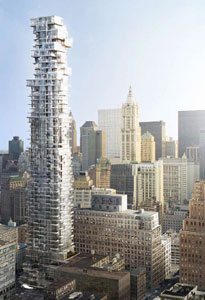
Construction has begun at Herzog & de Meuron’s 56 Leonard Street, the firm’s first high-rise residential tower. Located in the Tribeca Historic District, the 57-story residential condo will contain 145 residences — each with its own unique floor plan and private outdoor space. Described by the firm as “houses stacked in the sky,” the building is composed of an 18-foot-high black granite-walled lobby, several floors of residences, a 75-foot infinity pool, fitness center with yoga studio, wet and dry spa, a library lounge, screening room, private dining/conference room, and center for kids and family activities. Balconies and terraces are arranged in varied schemes that provide uninterrupted views of the city. Residences will range in size from two- to five-bedroom units. The project’s developer, the Alexico Group, has commissioned artist Anish Kapoor to create a balloon-like reflective stainless steel form that will be integrated into the architecture at street level.


A Kahn at Last? Four Freedoms Will Be Engraved on Roosevelt Island

Four Freedoms Park.

Courtesy Franklin and Eleanor Roosevelt Institute

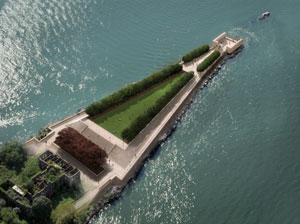
The Franklin D. Roosevelt Four Freedoms Park, as designed specifically for the site south of the Renwick Smallpox Hospital Ruin on Roosevelt Island by Louis I. Kahn, has been given a conditional green light. The “Room” as Kahn called it, is an open-air plaza defined on three sides by closely-spaced granite columns upon which will be carved Roosevelt’s Four Freedoms. The park is intended for passive recreation such as picnicking, sunbathing, and public events. Open along its south side, the “Room” frames a view of the United Nations headquarters. The conditional designation will be formalized in a future agreement between the Franklin and Eleanor Roosevelt Institute (FERI) and the Roosevelt Island Operating Corporation (RIOC). Once construction is complete, New York State Parks has agreed to operate and maintain the park.


Common Ground Finds Silver Lining in Supportive Housing

The Lee.

Kiss + Cathcart Architects

The NYC Department of Housing Preservation and Development (HPD), and Common Ground, a non-profit organization that develops supportive housing to help end homelessness, recently broke ground on The Lee on the Lower East Side of Manhattan. Designed by Kiss + Cathcart Architects, The Lee will provide affordable housing linked to on-site social services for 263 residences and will be NYC’s first LEED Silver supportive housing project. Key green design features in the 12-story glass-and-masonry tower include: a high-performance condensing boiler; drought-resistant landscaping; individual temperature control; water-saving fixtures; high-efficiency lighting; and a green roof. The $59 million project, which was a winner in the NYC Department of Environmental Protection’s 2005 Green Building Design Competition, is expected to be complete in spring 2009.


Bed-Stuy Boom Begins

781-791 DeKalb.

Meltzer/Mandl Architects

Meltzer/Mandl Architects has completed the design for seven four-story townhome-style buildings, each offering seven residences, in the Bedford-Stuyvesant section of Brooklyn. The buildings, which total 41,400 square feet, contain studios, as well as one- and two-bedroom homes and duplexes. The design was inspired by the concept of the pre-war walk-up, where each building has its own interior stairwell and lobby — and no elevator. Construction on the project is slated to begin in early 2009.

In this issue:
· 9/11 Memorial Museum Pavilion Plans Unveiled
· MCNY Overhauls for First Time in 76 Years
· Brooklyn Courthouse Gets a New Life — as Two Schools
· Affordable “Smart Housing” Grows in Brooklyn
· New Retail Center Completes Triangle Junction
· Reading Room Serves Radiology, 21st Century Style
· In the Heights — Shanghai Style


9/11 Memorial Museum Pavilion Plans Unveiled

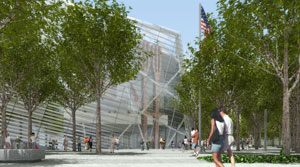
The National September 11 Memorial & Museum.

Created by Squared Design Lab, provided by National September 11 Memorial & Museum

The National September 11 Memorial & Museum held a design briefing for the Memorial Museum Pavilion, designed by Snøhetta and located between the two memorial pools on the northeast quadrant of Memorial Plaza, designed by Michael Arad, AIA, and Peter Walker, FASLA. Modest in size compared to previous iterations, the building’s footprint is approximately 15,000 square feet and has a total area of approximately 40,000 square feet. Surrounded by a grove of oak trees, the glass and steel structure is intended to link the surrounding urban infrastructure with the Memorial Plaza park, and to bring natural light into the below-grade exhibition areas. One of the main features will be two saved “tridents” from the base of the original World Trade Center towers on display in the entry. In addition, it will provide visitors with information, general site orientation, ticketing services, security screening, 160-person auditorium space, café , rest areas, and a private room for use by 9/11 family members.


MCNY Overhauls for First Time in 76 Years

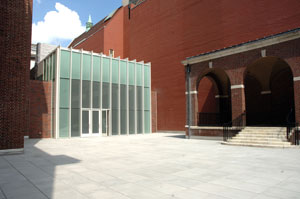
The Museum of the City of New York.

Polshek Partnership Architects

A ribbon cutting and open house marked the completion of the $28 million Phase I modernization project of the Museum of the City of New York, and the launch of Phase II and III. The museum’s circa 1929 Georgian Revival building has been largely unaltered since 1932, and the lifespan of its collections has been seriously compromised by the lack of appropriate environmental systems. Designed by Polshek Partnership Architects, the three-level addition includes: a new 3,000-square-foot gallery with translucent sunlight-diffusing glass; 6,000 square feet of terraces; restored vestibule and rotunda at the main entrance; redesigned and re-landscaped 4,700-square-foot Fifth Avenue terrace; and a below-grade curatorial center featuring cold rooms for the preservation of the museum’s extensive photo collection. The project is expected to be fully complete in 2011 at a cost of $ 97 million, $19.5 million of which came from the NYC Department of Cultural Affairs.


Brooklyn Courthouse Gets a New Life — as Two Schools

Transformed Brooklyn courthouse.

Gran Kriegel Associates

A project to convert a former 1951 courthouse in downtown Brooklyn into two high schools has been completed. Designed by Gran Kriegel Associates on behalf of the NYC School Construction Authority, the 140,000-square-foot space was gutted and reconfigured. To respect the surrounding character of Brooklyn’s civic center yet create a distinct identity for the schools, design solutions included re-cladding the building with lightweight limestone panels and adding a new double-height glass entry. The lobby features re-installed bas-relief stone panels salvaged from the original courthouse. The steel framed, long-span joist structure was separated from the existing roof by an interstitial space, which allows for efficient MEP distribution and optimum noise isolation. The building is now home to the Urban Assembly School for Law and Justice, and Urban Assembly School of Math and Science for Young Women.


Affordable “Smart Housing” Grows in Brooklyn

Smart Housing prototype.

RKT&B Architects

RKT&B Architects’ “Smart Housing” urban infill program is expanding with four new projects. Developed in conjunction with CPC Resources to address the need for affordable housing while making use of vacant space, the new designs are modeled on a prototype four-story, eight-family walk-up built by the firm in Park Slope, Brooklyn in 2003. At four stories, only one means of egress is required; other cost-efficient strategies include two-way visual access from the street and through ventilation. The projects are located in Bedford Stuyvesant, Brownsville, and Crown Heights on sites that are multiples of 20 to 25 feet and in neighborhoods with R6 zoning, which allow for medium-density housing of approximately 100 apartments per acre.


New Retail Center Completes Triangle Junction

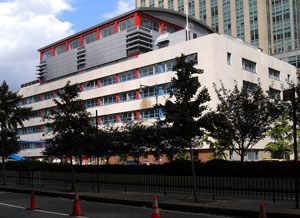
Triangle Junction.

Cooper Carry

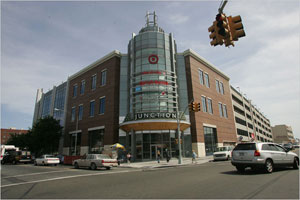
Triangle Junction, the trapezoid-shaped new retail center in the Flatbush section of Brooklyn, officially opened in April. Currently, the building is undergoing interior fit-outs for seven retailers and restaurants that will occupy the 65,000-square-foot first floor. Developed by Triangle Equities and designed by Cooper Carry, the $150 million center was completed after six years of planning, design, and construction. The three-story building is designed to blend in with the neighborhood’s retail stores and walk-up residences. Textured faç ades — red brick, terra cotta, and glass — are separated by pre-cast cement piers with two cylindrical glass towers that serve as atria at the corners. Engineers had to develop a special platform over the Long Island Rail Road on top of which the retail center was constructed.


Reading Room Serves Radiology, 21st Century Style

UVA Radiology Reading Room.

Perkins Eastman/Photo: © Boris Feldblyum

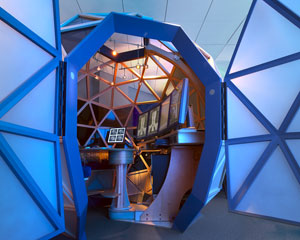
Perkins Eastman recently completed a prototypical radiology reading area as the first step in a phased master plan for the University of Virginia Health System’s Radiology Department in Charlottesville, VA. The long-term vision for the plan efficiently organizes circulation, improves patient privacy, and provides increased flexible support areas for the department’s clinical activities. Due to digital imaging technology, the main reading area is now a concierge receptionist-served private space with ergonomically designed workstations, replacing the typical dark room with illuminated films. The three-year renovation frees up nearly 5,000 square feet of existing space while organizing operations around clusters of each clinical imaging type. Key elements of the project include a centralized waiting/reception area, a 15-bed patient preparation and recovery suite, and a new rounds room. There is also a multimedia conference space fitted with the latest display technology, a concierge station, flexible physician offices, and a new residents’ work area with staff support and educational components.


In the Heights — Shanghai Style

Sky Walk at the Shanghai World Financial Center.

Kohn Pedersen Fox Associates

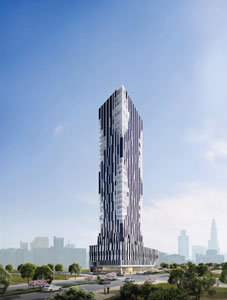
Perched at 1,555 feet in the air, the Sky Walk recently opened on the 101st story of the Shanghai World Financial Center (SWFC), and has been declared the highest publicly accessible built space in the world. Designed by Kohn Pedersen Fox Associates, the Sky Walk is the pinnacle of the SWFC’s seven-level public observatory occupying the building’s 94th through 100th floors; a second Sky Walk on the 97th floor features a roof that opens when weather permits; and a Sky Arena on the 94th floor houses exhibition and event spaces. The Sky Walk extends 180 feet across a portal at the top of the tower and is designed with canted glass walls and a glass floor, affording city and river views. Shaped by the intersection of two sweeping arcs and a square prism — representing ancient Chinese symbols of heaven and earth, respectively — the tower’s tapering form optimizes programmatic efficiencies, from large floor plates at its base for offices, conference facilities, high-end retail, and dining establishments to rectilinear floors for the 174-room Park Hyatt Shanghai above.

In this issue:
· Work on Brooklyn Bridge Park Progresses
· Brooklyn Goes 80/20 on Housing
· Institute for the Study of the Ancient World Modernizes
· New School Goes Green by the Book
· Admiral’s Row In Jeopardy
· Long Island City Celebrates Industry
· Clinton Library Receives Conditions Report
· New Med School Breaks Ground in Scranton


Work on Brooklyn Bridge Park Progresses

Brooklyn Bridge Park.

Courtesy brooklynbridgepark.org

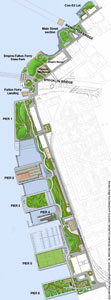
The new park, designed by landscape architect Michael Van Valkenburgh Associates, will run 1.3 miles along the East River and will tie together the neighborhoods of DUMBO and Brooklyn Heights. The 85-acre park will be built on land now covered with asphalt, concrete, abandoned sheds, and rubble along the water’s edge. The NY office of Skanska is charged with turning the industrial remains into lawns, beaches, coves, restored habitats, playgrounds, sports facilities, and landscaped gardens. Structural steel and aluminum cladding from the old sheds, as well as concrete and asphalt, will be recycled. In addition, the waterfront will be reshaped with 180,000 cubic yards of material dredged by the Army Corps of Engineers from Fresh Kills channels in the harbor. Approximately 85% of the park will be complete by 2010, and the park is expected to be fully complete in 2012.


Brooklyn Goes 80/20 on Housing

80 DeKalb Avenue.

Costas Kondylis Partners

Forest City Ratner Companies (FCRC) has closed on financing for a 335,000-square-foot building designed by Costas Kondylis at 80 DeKalb Avenue in Downtown Brooklyn. The project is a 34-story tower that contains 73 affordable and 292 market rate rental units — making it the first 80/20 development in the borough to be financed with New York State Housing Finance Agency funds. The project consists of 123 studios, 188 one-bedroom, and 54 two-bedroom units, and aims for LEED certification. Green features include: the use of low- or no VOC-emitting materials; low-flow fixtures; recycling over 75% of construction waste; and using recycled materials with recycled content. As part of its ongoing commitment to strengthen minority- and women-owned businesses, FCRC has awarded 19% of the project’s contracts to such firms. In addition, FCRC projects that 30% of the construction workforce will be made up of minority workers and 10% of women workers. Major construction on the building began in July, which is expected to open during the summer of 2009.


Institute for the Study of the Ancient World Modernizes

NYU Institute for the Study of the Ancient World.

Levien & Company

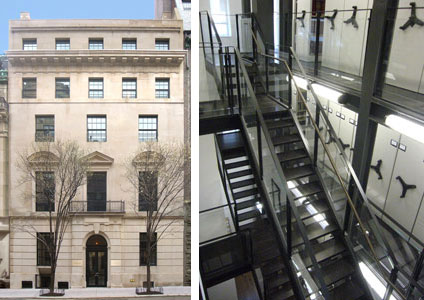
New York University’s Institute for the Study of the Ancient World, housed in an early 20th century mansion on the Upper East Side, has been completed. The 27,000-square-foot cultural and academic facility contains conference rooms, offices, and exhibition galleries. Major elements of the project included the restoration of the building’s grand staircase, installation of new elevators and interior and exterior staircases, and a four-story glass-and-metal library embedded in three stories of the grand building. Levien & Company managed the project team including Selldorf Architects and was funded by the Leon Levy Foundation.


New School Goes Green by the Book

P.S. 59.

Ehrenkrantz Eckstut & Kuhn Architects

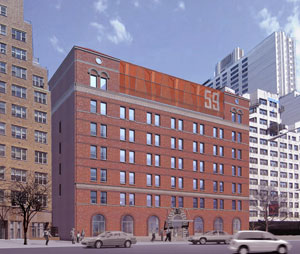
Through a public-private partnership between the Educational Construction Fund, an arm of the NYC Department of Education, and real estate developer The World-Wide Group, Manhattan’s first School Construction Authority (SCA)-certified green school located on 57th and 2nd Avenue opens this month. Designed by Ehrenkrantz Eckstut & Kuhn Architects, the school is the new temporary home for Public School 59 — also known as The Beekman Hill International School — for pre-kindergarten through fifth grade students. The project is the first school to comply with the Department of Education’s NYC Green Schools Rating system based on LEED certification requirements, which was adopted in 2008. With SCA standards calling for higher levels of fresh air, the project includes an ultra-efficient HVAC system, all of the windows were replaced with low-e-coated glass to help keep heat out and allow light in, and the building uses steam for heat, which emits no greenhouse gases. The new school includes a rooftop play area, a full-sized gymnasium, common learning areas, science laboratories, and classrooms.


Admiral’s Row In Jeopardy

Admiral’s Row rendering by Andrew Burdick.

Courtesy Municipal Art Society

The Municipal Art Society (MAS) recently presented alternative plans to retain the 11 historic buildings on Admiral’s Row on the edge of the Brooklyn Navy Yard to the U.S. Army National Guard Bureau. Since the National Guard is in the process of selling the site to the City of New York, which intends to lease it to the Brooklyn Navy Yard Development Corporation (BNYDC), MAS instead proposes the development of a 65,000-square-foot grocery store, a large parking lot, and additional retail and industrial space on the site. The collection is composed of 10 houses for naval officers that were built between the mid-19th century and 1901, and a timber shed from the 1830s that is believed to be a rare survivor. Although the deteriorated buildings have been abandoned since the 1970s, MAS believes they are of architectural interest and most are structurally sound.

MAS held a public visioning session where participants developed several principles to guide the preparation of the alternatives, ranging from saving all of the buildings to losing only three or four of them; retaining green space; reducing substantially the number of surface parking spaces; and provide public access, serve the needs of the community, and help foster small businesses and new employment opportunities. Renderings produced by Andrew Burdick of the studio collaborative and Architecture for Humanity New York were created to illustrate the differences between the concept behind one of the MAS alternatives and the BNYDC’s proposal.


Long Island City Celebrates Industry

L haus.

Cetra/Ruddy

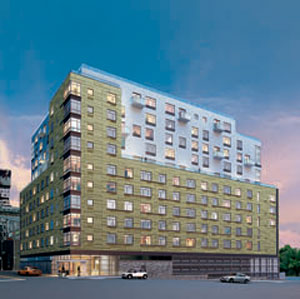
Cetra/Ruddy’s new residential condo project in Long Island City is starting to reveal its faç ade composed of a mix of green-hued cement fiber and corrugated metal panels, in deference to the neighborhood’s industrial character. Named the L haus because of its shape, the 11-story building will contain 122 one-, two-, and three-bedroom residences with 17,000 square feet of amenities. Outdoor spaces include a lawn with a water feature, and a roof terrace with both public areas and private cabanas with views of Manhattan. There will also be a club room, a relaxation space, catering pantry, fitness center, yoga space, and media room. L haus is expected to be completed in early 2009.


Clinton Library Receives Conditions Report

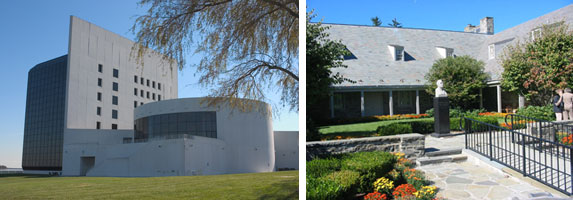
John F. Kennedy Presidential Library & Museum (left), and Franklin Delano Roosevelt Library.

Einhorn Yaffee Prescott Architecture & Engineering

The National Archives and Records Administration recently selected Einhorn Yaffee Prescott Architecture & Engineering (EYP) to conduct a building conditions report at the William J. Clinton Presidential Library in Little Rock, designed by Polshek Partnership in 2005. Its archival and museum holdings are the largest within the Presidential Library system with approximately 76.8 million pages of paper documents, 1.85 million photographs, and over 84,600 artifacts. EYP has worked on all 12 presidential libraries in the country; work ranges from thorough building envelope studies and recommendations, to replacing roofs and systems, to renovation and addition of archival storage spaces.


New Med School Breaks Ground in Scranton

The Commonwealth Medical College.

HOK

The Commonwealth Medical College recently broke ground on its Medical Sciences Building in Scranton, PA. The NY office of HOK, in association with Highland Associates, shaped the physical planning of the educational program by pairing biomedical laboratories with other highly technical components, such as a gross anatomy lab, simulation rooms, and standardized patients’ rooms to achieve operational and mechanical efficiency. The west research wing and east educational wing will surround a shared courtyard to create a campus setting. The linkage between the two buildings will act as a gathering space with a porch, courtyard, and café. To the east, public ground-floor spaces include additional common areas, a bookstore, and lobby. Rainwater collection that will be used for the gardens and indigenous plantings, heat recovery, CO2 sensing, occupancy sensors, high-performance glazing, integrated daylight control through honeycombed transom glazing, and the use of local stone will contribute to the overall sustainability. The project is slated for completion by 2011.

In this issue:
· Newsweek Moves to Hudson Square
· Friends Seminary Expands, Modernizes
· Flatiron Condos Caters to Animal Instincts
· Plaza District Tower Undergoes Renovation
· Eco-Tower Rises in Downtown Brooklyn
· Community Saves Congregation While Razing a Church
· Aycock Auditorium Upgrades Performance
· New Cruise Terminal Welcomes Tourists to Shanghai
· U.S. Promotes Greening Abroad


Newsweek Moves to Hudson Square

Newsweek.

Ted Moudis Associates

Newsweek will soon occupy approximately 155,000 square feet on the third and partial fourth floors of 395 Hudson Street, a 10-story building owned by the NYC District Council of Carpenter’s Pension Fund. Ted Moudis Associates is designing the interiors to suit Newsweek’s 450 employees, and will include private and executive offices, workstations, two interconnecting staircases, a conference center, and “huddle spaces” for impromptu meetings. The new design is intended to reflect Newsweek’s commitment to innovation, collaboration, style, and the incorporation of “green-friendly” products as the project hopes to earn LEED certification.


Friends Seminary Expands, Modernizes

Friends Seminary.

©Paul Warchol

The first phase of the multi-million-dollar comprehensive renovation and expansion of Friends Seminary has been completed. The 220-year-old Quaker school is located within the Stuyvesant Square Historic District. The project encompasses about 27,000 square feet and incorporates four of the eight historically significant buildings within the complex. Renovations include the addition of a new library, classrooms, science lab, bathrooms, and vertical circulation core. Due to the assemblage of buildings, an elevator serves six floors in three separate buildings. With three doors, each of which opens into a different building, and since each structure has a different floor height, some elevator stops are only six inches apart. Levien & Company, the project management firm representing the owners, lead a team that includes Helfand Architecture, now known as Tinmouth Chang Architects.


Flatiron Condos Caters to Animal Instincts

Alma.

Karl Fischer Architects

Karl Fischer Architects and interior design firm Roman & Williams have teamed to convert the Alma, a 1907 Neo-Renaissance landmark building, into a luxury, full-floor loft-style condominium building in the Flatiron District. When complete, the building will contain 11 three-bedroom floor-through residences, a triplex penthouse, and an adjacent six-story, 4,586-square-foot townhouse. Common areas include a lobby featuring custom furniture and a “glowing” concierge stand by Roman & Williams, Bocci pendant chandeliers, and floor-to-ceiling marble with accenting mirrors, a fitness center, and a pet spa in the lower level. The Alma is being developed by Beck Street Capital and scheduled for completion in summer 2009.


Plaza District Tower Undergoes Renovation

655 Madison Avenue.

Montroy Andersen DeMarco

Interior construction at 655 Madison Avenue, a 193,000-square-foot, 25-story office building at 60th Street, owned by GVA Williams, includes a new high-efficiency glass-and-granite exterior, new lobby, glass-walled elevator cabs, new HVAC systems, and improved pre-built office space. A total of 75,000 square feet will be renovated and designed by Montroy Andersen DeMarco. Construction is due to start at the end of this summer and is scheduled to be complete in the fall.


Eco-Tower Rises in Downtown Brooklyn

Toren.

Skidmore, Owings & Merrill

The Toren (Dutch for “tower”), designed by Skidmore, Owings & Merrill, is on the rise in downtown Brooklyn. The 38-story condo, with its silver-blue aluminum-and-glass façade, contains 240 units ranging from studios to three-bedroom apartments. The top eight floors will offer one-bedroom penthouse units, and 24 duplex penthouses of two- and three- bedrooms featuring two-story living rooms. The building features a multi-level roof garden, outdoor screening area, 2,000-square-foot fitness center, library/lounge, parking garage, and retail space. The project is aiming for LEED Gold, and developer BFC Partners says it will be equipped with its own cogeneration plant. Occupancy is slated for April 2009.


Community Saves Congregation While Razing a Church

Senior Residences at the First Presbyterian Church in Astoria, photo before and rendering after expansion.

Goshow Architects

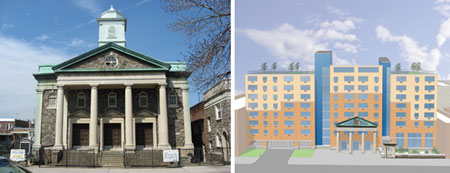
The First Presbyterian Church of Astoria in Queens needed repairs and upgrades that would cost millions, a sum prohibitive for a dwindling congregation to afford. Instead, the congregation partnered with the Hellenic American Neighborhood Action Committee (HANAC), a group that will raze the circa 1922 Colonial Revival church, and build and operate three new buildings that will house 94 one-bedroom and efficiency units of senior housing with a sanctuary/community space, and an exhibition space to document the history of the church and its building. Plans by Goshow Architects call for saving the granite columns and Greek pediment on the church’s façade, which will be used as freestanding elements at the entrance. Financing for the $21 million building is being completed by HANAC through HUD and the Enterprise Foundation. Groundbreaking is scheduled for early 2009.


Aycock Auditorium Upgrades Performance

Aycock Auditorium.

Photo by Tom Kessler

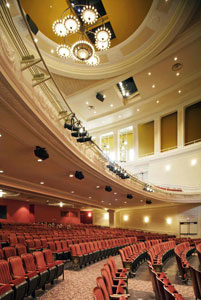
The $19 million renovation and modernization of The University of North Carolina at Greensboro’s 55,000-square-foot Aycock Auditorium by Charlotte-based Gantt Huberman Architects with NY-based Holzman Moss Architecture has been completed. The Aycock Auditorium serves as the university’s primary performance space, and serves as the cultural hub for the region. The renovation addresses artistic and programmatic requirements including improved sight lines at the orchestra level, a double-platform orchestra pit lift, new elevator, an expansion of the back-of-the-house dressing rooms and production shops, wider seating, and a complete upgrade of HVAC, electrical, plumbing, lighting, and sound systems.


New Cruise Terminal Welcomes Tourists to Shanghai

Shanghai Port International Cruise Terminal.

Frank Repas Architecture

The one kilometer-long Shanghai Port International Cruise Terminal, located adjacent to the city’s historic Bund district and designed by NY-based Frank Repas Architecture, was recently completed. Shanghai is one of the largest international ports in the Far East and is the shipping center of China. The 675,000-square-foot underground facility lies beneath a new public waterfront park and is the first phase of the city’s new waterfront park system. The terminal meets the needs of imports and exports, and can also serve up to three 2,500-passenger ships simultaneously — as well as regular shipping liners. The architects designed the structure to express a bridge extruded from the landscape — a skylight, gateway, amphitheater, and viewing bridge linked together. A glass “bubble” acts as a 45,000-square-foot observation building floating above the park as an extension to the three-level subterranean building. Other NY-based firms involved in the project are Weidlinger Associates for structural work, and Eti Katoni Design and Terrain for outdoor spaces.


U.S. Promotes Greening Abroad

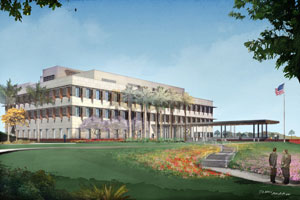
U.S. Embassy Compound in Panama City.

Einhorn Yaffee Prescott, Architecture & Engineering

The U.S Embassy Compound in Panama City, Panama, has earned LEED certification, making it only one of two embassies to have done so (the first was in Sofia, Bulgaria). Designed by Einhorn Yaffee Prescott, Architecture & Engineering, the embassy compound incorporates a range of technologies and strategies including an erosion and sedimentation control plan. Water consumption for irrigation is reduced by 50% and potable water use is reduced by 32% through the use of innovative bathroom fixtures. Energy efficiency measures are incorporated throughout, including improved roof insulation, lighting controls, and HVAC standards. More than 32% of the building materials were produced within 500 miles of the project site, and efficient waste collection and dedicated recycling facilities were integral to the building design. In addition, the project promotes the use of mass transit and cycling.

In this issue:
· Visitors Will Experience Chanel Handbag… from the Inside
· Light Reflects From Tribeca Rooftop
· Canadians Renovate The Garden
· Health Department Breathes New Life into Landmark Quality Buildings
· West Point Salutes New Library and Learning Center
· NJ Students Given Room for their Robots to Compete
· A “Rocky” Start to New Natural History Museum


Visitors Will Experience Chanel Handbag… from the Inside

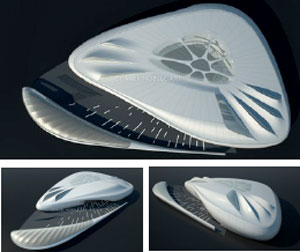
Zaha Hadid’s rendering of the Mobile Art pavilion to be installed in Central Park’s Rumsey Playfield this fall.

Courtesy CHANEL

Central Park will serve as the sole American venue for Mobile Art, a traveling international exhibition housed in a pavilion designed by London-based Zaha Hadid, Hon. FAIA. Commissioned by CHANEL, and conceived by the company’s designer, Karl Lagerfeld, Mobile Art presents changing installations by contemporary artists from around the world, each of whom has designed a unique piece for the project exploring the convergence of fashion and art. Marking the 50th anniversary of the iconic CHANEL “2.55” stitched-leather handbag designed by Coco Chanel, the handbag was presented to participating artists as jumping off points. Assembled from 700 components, Hadid’s pavilion is designed to appear as an abstracted handbag. According to Hadid, the 20-foot-tall, 95-foot-wide organic form of the building is a torus, a donut-like circular geometry found in nautilus shells. The pavilion’s 2,300 square feet of interior exhibition space wrap a central court illuminated by a translucent plastic skylight. The pavilion will be open and free to the public from 10.20-11.09.08.


Light Reflects From Tribeca Rooftop

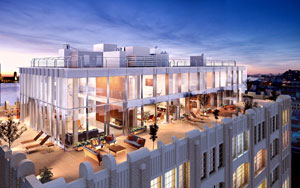
Skyloft Penthouse.

Courtesy Stribling & Associates

The Skyloft Penthouse at 145 Hudson Street, crowning a 14-story Art Deco building in Tribeca, is on the market. The circa 1920s former printing factory was redeveloped into a mixed-use commercial and residential condo. The 7,500-square-foot rectilinear duplex is sheathed in glass within a metal framework designed by James Carpenter Design Associates. The northern and southern exposures are composed of vertical glass modules with glass “fins” that redirect and refract light, while the eastern wall has two rows of 10-foot-high high-performance glass panels interspersed with operable windows. In addition, the windows are equipped with a sensor system to automatically close in inclement weather. The four-bedroom residence, with interiors and finishes designed by Rogers Marvel Architects, includes a double-height library/observatory that cantilevers over the spa area with a hot tub and shower.


Canadians Renovate The Garden
Madison Square Garden has selected Ottawa-based Brisbin Brook Beynon as the project architect and Skanska as construction manager for the arena’s $500 million renovation. Using existing space, the project will include: a redesigned Seventh Avenue entrance; more seating with better sightlines; wider and more spacious public concourses; new lighting, sound, and LED video systems in HDTV; 68 new mid-level suites; and 20 new floor-level suites. Construction is slated to begin in Spring 2009. The Garden will continue to operate during the renovation, with no impact on the New York Knicks’ or New York Rangers’ schedules, and should be complete in time for the 2011-2012 sports seasons.


Health Department Breathes New Life into Landmark Quality Buildings
The NYC Department of Design and Construction (DDC) has contracted Swanke Hayden Connell Architects (SHCA) to design the rehabilitation of three health centers located in “landmark quality” buildings run by the NYC Department of Health. The facilities include: the Astoria District Health Center (circa 1935), a Classical Revival building in Queens; Bedford District Health Center (1950), a Modern/Art Deco building in the Bedford-Stuyvesant neighborhood of Brooklyn; and the Fort Green Health Clinic (1938), an Art Deco style building, also in Brooklyn. The scope of the work primarily involves exterior building envelope rehabilitation and ADA-accessibility upgrades. The NYC Public Design Commission (formerly the Art Commission) approved the proposed changes. Construction is under way, with completion slated for October 2008.


West Point Salutes New Library and Learning Center

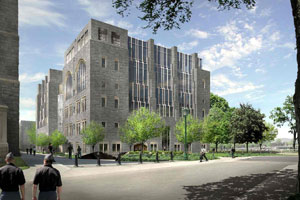
Jefferson Hall-USMA Library and Learning Center.

Holzman Moss Architecture

This September, West Point will open the new Jefferson Hall-U.S. Military Academy Library and Learning Center, planned and designed by NY-based STV in collaboration with Holzman Moss Architecture for the U.S. Army Corps of Engineers. Sited on the edge of academy’s 70-acre training field and athletic space known as the “Plain” (a historical landmark), the $62-million, 141,000-square-foot building will serve the institution’s 4,400 cadets and faculty. Divided into three masses with step-backs echoing the form of surrounding structures, the six-story granite and glass building keeps with West Point’s Gothic tradition. Two granite-block end towers bookend a full-height curtain wall comprised of blast-resistant glass and pre-cast concrete mullions, framing views of the campus and Hudson River. Additional design elements include amber-colored glass brick to filter light into an archival area, and exposed structural clay tile walls in the entry lobby and collection areas. The building has achieved a bronze rating under the Army’s SPiRiT program — the equivalent of LEED certification.


NJ Students Given Room for their Robots to Compete

Robotics Center.

Terrence O’Neal Architect

Construction is underway on the 6,500-square-foot Robotics Center in the Central Ward in Newark. Designed by Terrence O’Neal Architect and commissioned by Newark Public Schools, the facility will provide a dedicated space for high school students who excel in math and science to design and build robots able to compete in robotics tournaments. The building, which can accommodate 65 students, will include a robotics practice and competition field, computer lab, and machine shops. Completion is slated by September 2009.


A “Rocky” Start to New Natural History Museum

The Utah Museum of Natural History.

© Red Square, inc. for Polshek Partnership Architects, LLP, and GSBS Architects

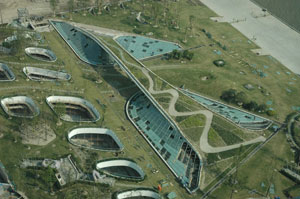
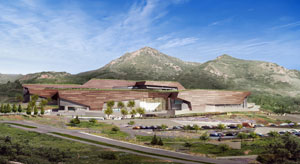
Ground was broken for the Utah Museum of Natural History at The Rio Tinto Center overlooking the Salt Lake Valley. The new 161,000-square-foot building, designed by NY-based Polshek Partnership Architects with UT-based Gillies Stransky Brems Smith Architects, and exhibitions designed by NY-based Ralph Appelbaum Associates, will double the size of its current facility and allow the display of 1.2 million objects. Conceived as an abstract extension and transformation of the land, the building rests on a series of terraces that lay along the site’s contours. The use of concrete, stone, and copper is intended to illuminate Utah’s geological and mineralogical history. The exhibitions will be organized in a series of eight thematic areas and three embedded learning labs; media is integrated throughout, from reflective sit-down experiences and multi-player interactive installations, to ambient soundscapes. The museum will open to the public in winter 2010-2011 and is anticipated to be certified LEED Gold.

In this issue:
· Lincoln Center Programs POPS
· Green Building Eases New Mothers into Parenthood
· Fort Ticonderoga: Silver on Parade
· A Lesson Plan for Designing New York City Schools
· Condo Caters to Adult and Children’s Entertainment
· New Jersey Takes Advantage of Skyline Views


Lincoln Center Programs POPS

The former Harmony Atrium will become a new visitor center for Lincoln Center.

Courtesy Lincoln Center for the Performing Arts

A privately owned public space (POPS) was unveiled at Lincoln Center for the Performing Arts in a design by Tod Williams Billie Tsien Architects for a new visitor center. Formerly known as the Harmony Atrium, it’s between Broadway and Columbus Avenue at 62nd and 63rd Streets. Plans call for transforming the space into a “theatrical garden” for performances and civic events. The redesigned 7,000-square-foot public space will feature a centralized box office, information desk, dynamic media wall, Rosa Mexicano restaurant, and public restrooms. Pentagram design consultancy and Show & Tell Productions, a creative technology company specializing in environmental communications, are also involved in the project. In addition, plans for a new micro-park designed by Diller Scofidio + Renfro in association with Beyer Blinder Belle Architects and Planners will include an urban grove at 62nd Street across from the visitor center. The park aims to create a more inviting entrance at the southeast portion of the campus and provide a shaded, quiet place to congregate.


Green Building Eases New Mothers into Parenthood

New Space for Women’s Health.

Lilker Associates Consulting Engineers

Perkins + Will and Lilker Associates Consulting Engineers are designing a new 8,000-square-foot sustainable facility for the New Space for Women’s Health, an independent, stand-alone birthing center to open in 2010. The new center, which is being retrofitted from an existing Midtown parking facility, will provide an environment where midwives, mental health professionals, family educators, among other professionals to offer women and families prenatal and postpartum care, childbirth education, gynecological services, social work, and psychological care. The three-floor building has LEED certification in mind, including high-efficiency heat pumps, sustainable heat recovery systems, low-flow plumbing fixtures, and energy-saving lighting equipped with sensors that reduce interior lighting relative to available natural light.


Fort Ticonderoga: Silver on Parade

Deborah Clarke Mars Education Center.

Tonetti Associates Architects

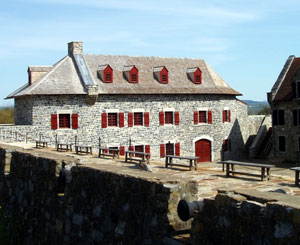
Sited on Fort Ticonderoga’s central parade ground in the Adirondacks, the Deborah Clarke Mars Education Center is a 16,000-square-foot structure with French-style masonry recreating a secure warehouse built during the French and Indian War and blown up by retreating French troops in 1759. Designed by NYC-based Tonetti Associates Architects, the project is slated to earn LEED Silver certification for a number of green features, including use of locally quarried stone, and a geothermal heating and cooling system that serves the entire building using heat pumps from three deep wells. The education center contains classrooms, galleries, production spaces for mixed-media interviews, museum store, central hall, and what the museum calls “essential mingling spaces.” Research for the project spanned three countries and two continents including Canadian sources at Fortress Louisbourg in Cape Breton, Vieux-Montréal, Québec, and French sources at the coastal fortifications of Normandy and Brittany, as well as sources from the New York Public Library, the New York Historical Society library, and New York State Library in Albany.


A Lesson Plan for Designing New York City Schools

PS/IS 295.

Swanke Hayden Connell Architects

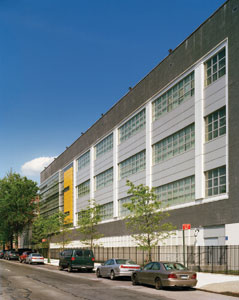
PS/IS 295, a new 88,000-square-foot Pre-K through 8th grade school in Queens Village, has been completed. Designed by Swanke Hayden Connell Architects (SHCA), on behalf of the NYC School Construction Authority, the plan strives to foster a connection between the school and the neighborhood by making major assembly spaces available for community use. Consisting of standardized rectilinear spaces on a highly irregular site, the design aims to reflect both the busy commercial strip of Jamaica Avenue and the adjoining quiet residential neighborhood. The program is organized into a long, four-story volume on Jamaica Avenue. The auditorium and gymnasium slide out from under it to relate to a smaller scale and the south-facing playground. A pre-cast concrete “frieze” of playing children animates the building’s through-lobby, accessible from Jamaica Avenue and the playground. This frieze wraps into the building’s interior and frames the auditorium entrance, where a public art mural resides.


Condo Caters to Adult and Children’s Entertainment

Georgica.

Cetra/Ruddy

Georgica, named after East Hampton Village’s Georgica Pond, is a 20-story, 58-unit, 134,000-square-foot residential tower at East 85th Street and Second Avenue. The Cetra/Ruddy-designed project incorporates a playroom and fitness center. Interior design details will include custom bamboo and glass walls, limestone fireplaces, and a limestone and marble lobby. A landscaped roof deck, by HM White Site Architects, is to accommodate adult and children’s activities with a playground, flowering trees, ornamental grasses, and a natural lawn. Construction is set to be complete in 2009.


New Jersey Takes Advantage of Skyline Views

Vela Townhouses.

Arquitectonica

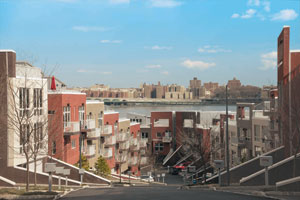
The Vela Townhouses, a luxury waterfront community in Edgewater, NJ, near the George Washington Bridge, is a 140,000-square-foot development designed by Arquitectonica to take advantage of Manhattan skyline views. Five separate buildings contain 29 townhouses, and eight units comprised of three floors, a cellar, private roof decks, and glass-enclosed solariums. By blending traditional elements, textures, and materials with a contemporary motif, the firm attempted to create a sleek aesthetic. The community also features designs by landscape architect Thomas Balsley Associates, including a waterfront infinity-edge pool. Rosen Global Partners developed the project.