In this issue:
· Water Filtration Plant Is Hole In One for NYC
· Fortune Shines on West Harlem Affordable Housing
· Get Taken to the Couture Cleaners
· Luxury Hilton Rises in Liberty City North
· The Sun Never Sets on New Marc Jacobs Store
· Welcome Center Tells a Story
· Shade Machines, Social Brackets Inspire 4 Tower in 1


Water Filtration Plant Is Hole In One for NYC

Water filtration facility at Moshulu Golf Course.

Grimshaw

The NYC Department of Environmental Protection and Department of Parks and Recreation have partnered to build the city’s first water filtration facility, currently under construction on 35.6 acres in Van Cortlandt Park in the Bronx, beneath the Mosholu Golf Course driving range. The filtration system will become an integral part of the city’s infrastructure and deliver 290 million gallons of water per day, or 30% of the city’s water supply.

The plant itself has been designed by engineering firms Hazen and Sawyer and Metcalf & Eddy in a joint venture. Grimshaw and Ken Smith Landscape Architect are creating the site and above-ground structures, which, when completed, will be a sustainable and low-impact example of storm water management and gray water systems. According to the design team, the concept for the project was influenced by the water lily, which catches rainwater as it falls, filters it for its own use, and returns the excess into the pond below. Recreational facilities include a clubhouse and driving range, tee boxes that are discreet structures fully integrated into the landscape; atop the treatment plant’s green roof is a nine-acre driving range. The project is budgeted at $95 million and is expected to open in 2012.


Fortune Shines on West Harlem Affordable Housing

Fortune Society.

Jonathan Rose Companies

The Fortune Society, whose motto is “building people, not prisons,” and Jonathan Rose Companies recently broke ground on a $42 million, 110,000-square-foot project that will bring affordable housing to the West Harlem community. It will provide supportive permanent housing and service space for formerly incarcerated homeless men and women, and generate ongoing revenue to support the services the Fortune Society offers its clients. The new complex is adjacent to the Fortune Academy, familiarly called “The Castle,” which includes transitional housing for homeless men and women just released from prison.

Designed by Curtis+Ginsberg Architects, the 114-unit development aims to complement the historic character of the Fortune Academy, and will be environmentally responsible and efficient to operate. The project is seeking LEED-NC Gold certification, and is participating in programs from Enterprise Green Communities and the New York State Energy Research and Development Authority (NYSERDA). A roof garden will feature a rainwater harvesting system and offer views of the Hudson River. Aluminum solar shades on the south faç ade are among other green features.


Get Taken to the Couture Cleaners

Madame Paulette’s flagship store.

DIA/WRKS

DIA/WRKS has put the finishing touches to the flagship store of Madame Paulette’s, a custom cleaner to the “who’s who” of fashion. The 2,000-square-foot space, located in Manhattan House, the modernist Upper East Side landmark designed by SOM’s Gordon Bunshaft in 1950, contains a 22-foot-long concierge counter, custom-made bronze tiles, Venini chandeliers, baroque furniture, and one-of-a-kind images of fashion icons. With the grand interiors nearly complete, DIA/WRKS will begin to revamp of the store’s faç ade, which may include displays of such world-renowned designers as Roberto Cavalli and Vera Wang.


Luxury Hilton Rises in Liberty City North

Conrad Hotel.

GRAD Associates

Newark-based GRAD Associates’ design for Hilton’s luxury brand Conrad Hotel in Liberty Harbor North in Jersey City, received the green light from the city’s planning board. The project will occupy a full block of this major redevelopment area, fronting a marina, with views of Lower Manhattan. The complex will contain a 300-room hotel, conference facilities, 470 luxury condominium units, fully mechanized parking for 738 cars, and two rooftop gardens (one for the hotel and one for the nine-story condominium development). Site preparation (Phase I) is scheduled to begin in April for the hotel, and the condominiums (Phase II) are anticipated to start soon after the hotel is completed early in 2011. The project is aiming to achieve LEED Platinum status.


The Sun Never Sets on New Marc Jacobs Store

Marc Jacobs store in Sao Paulo.

Stephan Jaklitsch Architects

Stephan Jaklitsch Architects has designed seven stores for Marc Jacobs that are scheduled to open in 2009 — five Marc Jacobs Collection and two Marc by Marc Jacobs stores. Since 2000, the firm has designed all the Marc Jacobs’ stores worldwide and continues to design site-specific boutiques, such as the recently completed first store in South America in the upscale Jardins neighborhood of Sao Paulo with a Collection shop on its first level and a Marc by Marc Jacobs on the second. Also recently completed are two stores in Bahrain.

In the works are a Collection shop in the ground floor of a 19th-century residential building near Grosvenor Square in London; a Collection store on the ground level of the new 60-story Elysian building in Chicago’s historic Gold Coast district; a Hong Kong flagship Marc Jacobs Collection store on the grounds of what once was the Marine Police headquarters and is now a new luxury shopping destination; and finally, a new free-standing Marc Jacobs Collection flagship store in Seoul.


Welcome Center Tells a Story

Rutgers University’s welcome center.

Murphy Burnham & Buttrick

Rutgers University has commissioned architects Murphy Burnham & Buttrick, in collaboration with exhibition designers Ralph Appelbaum Associates, to design a visitor center for its New Brunswick campus geared towards communicating the institution’s global reach and telling the Rutgers story. The new 12,000-square-foot building is strategically sited to serve as a gateway to the university, and will be used as a springboard for the 40,000 students, parents, and alumni who are anticipated to visit the campus each year. In addition to a series of exhibition spaces, the building, known as the Welcome Center, will house admissions staff and contain multipurpose spaces to accommodate large tour groups and university-wide events. The team began to imagine the center as a dynamic, people-filled “billboard” that would grab visitors as they turned off the highway and in to the campus. In addition, the building is designed to be completely “off-the-grid,” employing an array of electricity-generating solar reflectors as well as geothermal technology to heat and cool the facility. Construction is expected to be completed by fall of 2009.


Shade Machines, Social Brackets Inspire 4 Tower in 1

4 Tower in 1.

Steven Holl Architects

Steven Holl Architects has been selected as the winning firm to design the master plan of the “4 Tower in 1,” an office tower complex around the new Shenzhen Stock Exchange Headquarters in Shenzhen’s Futian commercial business district. The design is based on the concept of tropical skyscrapers as “shade machines,” with a “social bracket” connecting the towers and the street level. The design for the four towers utilizes circular building footprints to maximize the interior space and open views while minimizing the exterior envelope. The optimized office floors are connected via double- and triple-height social spaces on alternating sides of the towers. Automatic solar tracking screens made of perforated PV cells make one full rotation per day around the circumference of each building, collecting enough PV energy to cool the towers completely while allowing them to act as an urban clock.

Supporting programs for the towers, such as cafeterias and gyms, are combined with cultural programs such as art galleries, auditoriums, and a cinema. Its sculpted form allows it to negotiate between environmental restrictions and the requirements of the public programs. A continuous roof garden park collects storm water and recycles all the gray water from the four skyscrapers.

In this issue:
· The Bronx is Up With a New Mixed-Use Development
· Jewish Braille Institute Reveals NY Headquarters
· Three Becomes One for New Housing in Brooklyn Historic District
· Green Design to Revitalize New Brunswick
· The Beacon Shines Once Again


The Bronx is Up With a New Mixed-Use Development

Fordham Place.

GreenbergFarrow

The recently opened Fordham Place, designed by GreenbergFarrow, is the first new mixed-use development in the Bronx in more than 15 years and the first Class A office building to be built in the borough in over 20 years. The 276,475-square-foot retail and office complex, developed by Acadia Realty Trust and its partner PA Associates, is located opposite Fordham University. Maintaining and reusing as much of the existing structure as possible, the design adds a total of approximately 90,000 square feet to the property’s first six floors. Other upgrades include an expanded cellar, and the relocation of the loading dock, which was replaced by a two- to five-story glass structure serving as an entrance to the upper-level retailers.


Jewish Braille Institute Reveals NY Headquarters

JBI International.

Fink & Platt Architects

JBI International, established in 1931 as the non-profit Jewish Braille Institute that provides blind and visually impaired readers with literature in audio, large print, and Braille, has recently opened a 20,000-square-foot facility in midtown Manhattan. Designed by Fink & Platt Architects, the new JBI Library includes a complete renovation of the organization’s existing 17,500-square-foot, seven-story building, a two-story, 2,500-square-foot addition, and a new curtain wall and storefront to replace the failing masonry façade. The library includes a digital recording studio, post-production and circulation departments, high-efficiency archival media storage, executive offices, meeting rooms, staff lounge, roof garden, and tenant rental space. Fink & Platt established a strong visual identity for the space through color, materials, and graphics. Graphic design firm Whitehouse & Company created a Braille map for the lobby and custom wallpaper that communicate the mission of the organization. The project was partially funded by the NYC Economic Development Corporation (NYCEDC).


Three Becomes One for New Housing in Brooklyn Historic District

Old Fulton Street Apartments.

Fifield Piaker Elman Architects

Three adjoining Greek Revival commercial structures built from 1836-1839 in Brooklyn’s Fulton Ferry Historic District in Dumbo will be transformed into a 15-unit apartment building with retail on the ground floor. Designed by Fifield Piaker Elman Architects for Northside Development, the buildings’ façades will be restored. Internally, the units will be united by replacing the original structural columns and floor joists with a new steel frame allowing for clear spans between bearing walls. The new brick rear façade will feature punched window openings with double-hung windows compatible with the historic front façade. The penthouse addition, which will be set back, has a sloped upper façade so that it will be barely visible from the street, and won’t detract from the building’s architectural character. The Landmarks Preservation Commission has approved the plans for the buildings, and the project is scheduled to be completed in early 2010.


Green Design to Revitalize New Brunswick

Hiram Square Condominium.

Tarantino Architect

Lawrence and Sharon Tarantino, of NJ-based Tarantino Architect, have teamed with the owners of the Frog and The Peach Restaurant at Hiram Square in downtown New Brunswick to design and develop a multi-unit, sustainable residential condominium adjoining the restaurant. The restaurateurs, Jim Black and Betsy Alger, have a background in environmental design and horticulture, which may account for the fact that the project contains a green roof for growing herbs for the restaurant and beehives for honey production. Other green features include renewable solar energy collection, geothermal heat systems, recycled building materials, on-site wind power and a solar veil. The one- and two-bedroom units will contain private green spaces with outdoor accessibility, radiant heating, sustainable interior finishes, and renewable materials. Green amenities include Smart Car Zip Car service, and culinary amenities include a “Take Home Chef.” The project is part of the vision for revitalizing New Brunswick and the riverfront, and aspires to be the first residential project in the city to receive a LEED-Platinum certification.


The Beacon Shines Once Again
Following a seven-month, $16 million restoration, the 2,800-seat landmark Beacon Theatre on the Upper West Side reopened this month. The 1927 theater was designed by architect Walter Ahlschlager in a mix of styles including Greek, Roman, Renaissance, and Rococo. Beyer Blinder Belle Architects & Planners headed-up the comprehensive restoration project that focused on all historic interior public spaces, backstage, and back-of-house areas, and was based on extensive research and on-site examination of original, decorative painting techniques. Restoration elements range from historic finishes in the lobbies, to custom patterned carpet based on the original designs, and the original 30-foot-high Venetian-inspired chandelier. Over the course of the restoration process, more than 1,000 artisans, craftsmen, and tradesmen worked on the project.

From Cave Art to Art Cave

Event: Lascaux: “The Sistine Ceiling of Prehistory”: The Complex Story of an Ice Age Sanctuary
Location: Center for Architecture, 01.30.09
Speaker: Randall White — Professor of Anthropology, New York University
Respondents: Simon Carr — Painter; Terrence Moran — NYU Professor of Culture and Communication, NYU; James McCullar, FAIA — Immediate Past President, AIANY; David Bennett, FAIA — Representative, International Tunneling and Underground Space Association
Organizers: AIANY Architectural Dialogue Committee; American Society of Landscape Architects; Les Maison Française, NYU

Hall of Bulls, Lascaux Cave, Montignac, France.

Courtesy AIANY

The flame created by burning animal fat and juniper twigs in a small clay lamp would flicker across the contours of the cave, bringing to life about 2,100 realistic paintings animals ranging from a 16-foot-long bull to tiny 18-inch-long horses. Since the complex of prehistoric caves with 17,000-year-old paintings were accidentally discovered in 1940, anthropologists, archaeologist, and art historians have marveled at the abilities of the artists to create depth, mix unnatural colors, and build scaffolds to tell stories that are indecipherable to this day.

In the subterranean gallery of the Center for Architecture, which is about one-third the size of Lascaux, NYU Professor of Anthropology Randall White, one of the world’s leading specialists in the study of Paleolithic art, discussed the 30 years of research he has conducted in the Dordogne region of France, where the caves are located. “Lascaux is not an island,” says White, “it’s part of a collection of caves.” In his opinion, Lascaux has been out of fashion for the last 20 or so years since other discoveries as old as 33,000 years have been found in the region. They are “not quite the same, but as impressive,” he says.

So why is Lascaux continually intriguing? In addition to the paintings themselves, there are stories about overzealous archeologists, mismanagement of the site by bureaucrats, and shady dealings by the locals. But today’s headline reads that Lascaux is in crisis mode — fighting for its life, and Mother Nature seems to be against it. In brief, the caves were opened to tourists after World War II, and the influx of thousands of people disturbed the cave’s natural equilibrium. After being plagued by fungi and bacteria then by re-crystallization of the rock itself, the caves were closed to the public in 1963. That year an air recirculation system was installed to mimic the cave’s natural currents. When in 2000 it was decided that the caves needed a new air conditioning system, authorities hired a company from the region that had experience doing supermarkets, not pre-historic caves.

The last time White visited Lascaux in 2001, he studied mold instead of the paintings themselves. “We’ve created a monster,” he says. “Lascaux has been turned into a laboratory.” Today, only a few scientific experts are allowed to work inside the cave and just for a few days a month. To satisfy the public and local economy, Lascaux II, a replica of two of the cave halls — the Great Hall of the Bulls and the Painted Gallery — was opened in 1983, 200 meters from the original. In addition, reproductions of other Lascaux artwork can be seen at the Centre of Prehistoric Art at Le Thot, France.

This brings us the Art Cave, an award winning project designed by Brooklyn-based architecture firm Bade Stageberg Cox. The Art Cave was built for private art collectors to house works they owned by contemporary artists such as Donald Judd, Richard Serra, and Vito Acconci. Instead of disturbing the natural beauty of the landscape on the 17-acre site in Napa Valley, the architects reverted to the idea of the primitive cave to shelter and showcase the works of art. The cave’s presence is articulated by weathering steel entry portals incised into the hillside. This modern cave satisfies local building codes. The design takes advantage of tunneling construction techniques developed for the wine industry to create a column-free interior volume. Like the original Lascaux Caves, the Art Cave is not open to the public, but unlike Lascaux, it has ever changing exhibitions to showcase the owner’s collections.

In this issue:
· The Dutch are Coming!
· Religion Goes Green
· Kids Are Happy at the Blue School
· Coney Island Puts On the Glitz
· Performing Arts Center is Shell Shocked
· New York Designer Renews Florida Westin
· Hotel/Spa/Wine Center Flowers in Alsace


The Dutch are Coming!

New Amsterdam Plein & Pavilion.

Courtesy Handel Architects

At a recent press conference with Dutch officials, Mayor Bloomberg announced plans for the Dutch-American celebration of the 400th anniversary of Henry Hudson’s arrival in New York Harbor. Peter Minuit Plaza at The Battery will become the site of a new 5,000-square-foot New Amsterdam Plein & Pavilion, to be designed by Dutch firm UNStudio in collaboration with Handel Architects. The site will be designed as an “outdoor living room” for spontaneous and scheduled activities as well as an intermodal transportation hub, where bicycles, buses, subway, and water transportation intersect with the cultural offerings.

Walkways will feature engraved quotations from Russell Shorto’s book The Island at the Center of the World: The Epic Story of Dutch Manhattan and the Forgotten Colony that Shaped America. A carved stone map of the Castello Plan, a circa 1660 map of Lower Manhattan, will grace the entrance. The open space will draw visitors with UNStudio-designed seating and tables. The pavilion will have an undulating roofline and curving walls intended to evoke an opening flower, and the façade will be equipped with LEDs allowing for a constantly changing light show at night. The site will also feature berms and perennial gardens, designed by NYC Parks & Recreation using the color palette of Dutch garden designer Piet Oudolf, who created The Battery Bosque Gardens and the Gardens of Remembrance. The project is made possible by a major grant from the government of the Kingdom of the Netherlands to The Battery Conservancy as part of the NY400 celebration and in honor of the enduring relationship between New York and Holland.


Religion Goes Green

Convent for The Community of the Holy Spirit.

BKSK Architects

Out of 14 firms invited to submit proposals, BKSK Architects has been selected to design a new, 13,000-square-foot green convent for The Community of the Holy Spirit, a contemplative order of Episcopalian nuns in Morningside Heights. Design inspiration came from the nuns’ desire to connect more profoundly with the natural world and live in an environmentally friendly manner. Spaces are intended to inspire quiet contemplation, both individually and collectively. The presence of natural light and falling water are brought into sanctuaries as symbols of a divine presence. The convent will include dual rooftop gardens, rainwater collection, and energy-efficient heating and cooling systems. Also on the boards at BKSK is a green synagogue in Brooklyn.


Kids Are Happy at the Blue School

Double classroom at the Blue School.

Hudson Studio Architects

Hudson Studio Architects has completed a new preschool/kindergarten for the Blue Man Group on the Lower East Side of Manhattan. The brainchild of the three original partners of the successful theater, their latest production, the Blue School, takes the approach that art and creativity are central to education. The space itself is transformed through light and sound in ways that the students can control. The school features a versatile padded space called the Wonder Room. The padding lifts up to reveal a digital interactive floor system used for learning through light, color, and movement. The space also has a climbing wall, and is used for yoga/movement sessions. Similar to the stage show, the school has talk tubes that allow the kids to communicate between rooms and the students can use UV-sensitive paint to create a mural that can be seen when the hallway lights switch from full spectrum to black light.


Coney Island Puts On the Glitz

Coney Island.

Courtesy NYC Department of City Planning

City Planning Commissioner Amanda M. Burden, Hon. AIANY, announced the launch of a public review for a comprehensive rezoning plan that would re-establish Coney Island as a year-round destination and bring new economic opportunities to the area. The plan would foster a total of some 6.8 million square feet of new development, and the proposed 19-block zone would create an open and accessible 27-acre indoor and outdoor amusement and entertainment district. Under the proposed rezoning, an estimated 1.1 million square feet of amusement and entertainment-related uses — such as dark rides, virtual reality, water parks, IMAX theaters, circuses, and restaurants and catering facilities — and 800 hotel rooms could be developed in the district, creating year-round job opportunities. The rezoning would also catalyze redevelopment of vacant and underutilized land for mixed-income housing and neighborhood retail and services. The plan is the culmination of an interagency planning effort led by the Department of City Planning and the Economic Development Corporation.


Performing Arts Center is Shell Shocked

Francis Marion University Performing Arts Center.

Holzman Moss Architecture

Ground has been broken on the new Holzman Moss Architecture-designed $32.8 million, 68,000-square-foot Performing Arts Center at Francis Marion University (FMU) in Florence, SC. The 900-seat multipurpose hall features adjustable acoustics and staging options to accommodate a broad scope of music programs from solo performances to 80-person orchestra ensembles. A fly tower and orchestra pit also allow for music, dance, and theater productions. The firm designed a built-in, single-piece, automated orchestra shell enclosure that in minutes transforms the stage and fly loft from a tuned musical environment to an open and flexible stage house for theatrical events at the push of a button. The customized, patent-pending Actuated Stage Shell extends into the interior of the room, enveloping both the stage and audience in a single cohesive enclosure. A series of large roller wheels distribute the weight of the 20-ton shell to move easily along the surface of the stage floor. The complex also contains a 100-seat black box theater, and an academic wing for offices, classrooms, and support spaces. The facility is expected to be completed in the fall of 2010.


New York Designer Renews Florida Westin
New York-based hospitality design firm Therese Virserius Design recently completed the renovation of 120,000 square feet of hotel space for Westin Hotel and Resorts in Fort Lauderdale, FL. The resort-style hotel’s rejuvenation included the renovation of 300 guest rooms and suites, meeting facilities, common areas, ballrooms, five pre-function rooms, and boardrooms. The new look was achieved by using custom carpeting, crown molding, contemporary lighting, natural light, bold patterns, green foliage, and blue and brown hues throughout.


Hotel/Spa/Wine Center Flowers in Alsace

Loisium SAS.

Steven Holl Architects

Steven Holl Architects, in collaboration with Swiss firm Rüssli Architects, has been commissioned to realize a new 100-room destination hotel, spa, and wine center for Loisium SAS in a forest overlooking vineyards in Alsace, France. The concrete frame structure sheathed in blackened wood siding is designed to emulate nearby red cliffs and the forest landscape. The design uses this concept of “arborescence” to influence the order and space of the building. Exterior spaces are divided, providing privacy for the spa while inviting the public into the restaurant. The flower-like center pavilion is made with red weathered steel, similar to the cliffs, and colored glass in different shades of red, and will house a wine gallery and a gathering space with chapel-like acoustics for concerts and special events. It can also be a place for silence and reflection, connecting the site with the adjacent 11th-century Marbach Abbey, located on the Santiago de Compostela pilgrimage route.

In this issue:
· Music and Art Breathe New Life into Firehouse
· Transparency Opens Up Conference Center
· The Smith Keeps Up With the Jones’s in Boerum Hill
· Hungary Returns to the Beaux Arts
· Greater Hanoi Develops a Master Plan


Music and Art Breathe New Life into Firehouse

BP Music Center.

HOK

The NY office of HOK unveiled the redesign of former Engine Company 204 Firehouse, turning the space into the BP Music Center. Shuttered in May 2003 due to budgetary reasons, the Cobble Hill firehouse will be the permanent home for the Brooklyn Philharmonic and Create!, a non-profit organization for children’s art education and training. HOK’s pro-bono gut renovation of the 4,250-square-foot, 19th century building will incorporate a multi-purpose space for performances, meetings, lectures, and other community uses on the ground floor, as well as offices of for the two organizations and a music rehearsal room on the second floor. The brick exterior will be restored to its natural color, and a modern, all-glass entrance, complete with marquee, are in the works.


Transparency Opens Up Conference Center

Cornell University School of Industrial and Labor Relations.

Michael D. Szerbaty + Associates

NY-based Michael D. Szerbaty + Associates has completed a newly renovated conference center for Cornell University’s School of Industrial and Labor Relations (ILR). Located in midtown Manhattan, the center’s expanded public areas, conference rooms, and teaching facilities offer an upgraded learning environment and comfortable teaching and public spaces. A glass-walled resource center that contains carrels with computers and most of the center’s research books opens up what had been a closed off library. The dining area’s waist-high walls allow views to the perimeter windows, providing natural light and a visual connection with the city. By integrating these low walls and floor-to-ceiling glass, conference attendees also can have a quick take on who is there and find ample room for a quick conversations or meetings. The $1.3 million project is the latest in a series of teaching, conference, and research facilities that the firm has designed for ILR and Cornell University.


The Smith Keeps Up With the Jones’s in Boerum Hill

The Smith.

Meltzer/Mandl Architects

Meltzer/Mandl Architects has completed the design of The Smith, a new 13-story, mixed-use complex in the Boerum Hill section of Brooklyn. The 116,000-square-foot project will contain a 93-room hotel with 50 condominiums above. The condos are primarily two-bedroom homes, with the 12th floor consisting of duplexes with rooftop terraces. In addition, 1,100 square feet of medical offices and retail space will front Atlantic Avenue, and there will be below-grade parking for 64 vehicles. In keeping with the character of the brownstone and contemporary townhouse neighborhood, the building steps down to four stories along its State Street frontage.


Hungary Returns to the Beaux Arts

Exchange Palace.

Beyer Blinder Belle Architects & Planners

Tippin Corporation, a Budapest-based real estate development firm, has commissioned Beyer Blinder Belle Architects & Planners to create an adaptive re-use and restoration plan for the 500,000-square-foot Exchange Palace, a historic landmark in the center of the city. Designed by Ignacz Alpar and built in 1905 to house the Budapest Stock and Commodities Exchange, the Beaux Arts-style building is notable for its ornamental details in the Art Nouveau style of the Hungarian Secession. In 1956, it was converted into the Hungarian State Television station, and major interior modifications were made to accommodate television sound stages. The historic façades will be restored, as will the remaining, intact grand interior spaces — most notably the main entrance stair hall and the central domed rotunda. All new mechanical and vertical transportation systems will be installed to create a state-of-the-art, modernized facility. Located on Freedom Square, a variety of new uses are being considered for the building, including office and retail space, as well as space for cultural programs. The restoration of the ground floor storefronts will once again allow cafés with sidewalk seating to animate the streetscape.


Greater Hanoi Develops a Master Plan
Out of a field of 21 international competitors, Perkins Eastman was selected by the government of Vietnam to lead a team of two Korean firms — Posco E&C, and Jina Architects — that will develop a master plan for Greater Hanoi. Preserving the city’s historic core and its 1,000-year-old architectural legacy was among the main themes for the design, along with meeting the needs of a city that is expected to grow from the current six million inhabitants to more than 10 million by 2030, and channeling the population growth into several satellite cities linked by a new transit system. In addition, the team recommended a strategy for preserving more than 40% of the area for natural preserves, recreational space, and agricultural uses. In 2007, this same team completed a master plan for part of Hatoy Province, which was recently annexed into the expanded Capital District.

In this issue:
· It’s a Village Mitzvah!
· BMW Inspires Affordable Housing at Harvard
· Plans Approved for Residential Addition to Washington Hilton
· A Vacation in Prefab, West Virginia
· Century City Enters 21st Century
· Elementary, Middle School Goes Green in Germany


It’s a Village Mitzvah!

Village Temple.

Lee H. Skolnick Architecture + Design Partnership

Lee H. Skolnick Architecture + Design Partnership (LHSA+DP) recently completed the renovation of the Village Temple in Greenwich Village. Lee Skolnick, FAIA, a member of the congregation, was initially asked to assist in assessing the renovation and expansion, but ended up donating much of his own time to designing the building’s new façade. Rendered in a sandstone-colored stucco finish with a pattern of bronze reveals allude to traditional mortar joints. Bronze and stainless steel signage, new glass doors, a state-of-the-art video message board, and a glass entry canopy complete the project. Translucent graphics depicting the “Tree of Life” appear on glass doors, windows, and the adjacent storefront. Additional renovation plans include a warmer, more welcoming foyer, a more functional and attractive social hall, and a sanctuary anteroom.


BMW Inspires Affordable Housing at Harvard

GINA by BMW.

RMJM

RMJM is funding and participating in a project with designers from Munich-based BMW and the Harvard Graduate School of Design (GSD) to develop a new affordable housing prototype. Futuristic housing concepts incorporate “elastic skin” technology. The inspiration for the program came from a team at BMW Group Design Munich who created the “GINA Light Visionary Model,” a car that has a surface made of elastic fabric rather than sheet metal, which means the surface can move, weighs less, and uses less energy to fabricate. Also, GINA stands for “geometry and function in N” implying an infinite number of adaptations — a concept that will hopefully be expanded on by GSD students.


Plans Approved for Residential Addition to Washington Hilton

Washington Hilton Hotel.

Beyer Blinder Belle Architects & Planners

The Washington, DC Historic Preservation and Review Board (HPRB) approved Beyer Blinder Belle Architects & Planners’ (BBB) design for an 11-story residential addition to the Washington Hilton Hotel. The mid-century Modern Expressionist building was designated a landmark by the HPRB in July 2008. Designed by William B. Tabler, FAIA, in 1965, the 1100-room hotel occupies a five-acre site on Connecticut Avenue. Due to the oddly shaped site and building height limitations, 50% of the Hilton’s program is below grade, including a column-free ballroom, conference facilities, and service areas. The addition is part of a larger redevelopment project, including a major renovation and rehabilitation of the hotel. BBB’s design for the new residential building echoes the sculptural quality of the Hilton, respecting its height and scale. Shared elements include curved façades and a repetitive modular aesthetic. The glass façade of the addition is an intentional contrast to the grid-work of concrete that defines the existing, while its semicircular form responds to the hotel’s geometry, creating two primary open spaces — the interior hotel courtyard and south facing residential terrace.


A Vacation in Prefab, West Virginia

lostrivermodern.

Resolution: 4 Architecture

Secluded in a steeply sloped wooded site in Long River, WV, sits a 64-by-16-foot prefab cabin available for rent. NYC-based Resolution: 4 Architecture (res4), a firm specializing in maximizing light and space in urban settings and the creators of the original Dwell (magazine) Home, designed lostrivermodern. Pairing the efficiencies of modular construction with the Usonian tradition of intimate, organic design, the firm strives to prove that modern prefab can be both spectacular and affordable. The cabin features a master bedroom, bath, and living space on the upper level, with a second bedroom, bath, and media room downstairs. Lostrivermodern is the first res4 home available for guests.


Century City Enters 21st Century

Century City.

Pei Cobb Freed & Partners

It’s been nearly 50 years since Pei Cobb Freed & Partners worked on the Century City Apartments in Los Angeles, and now they are designing a $2 billion mixed-use project on the 5.75-acre site of the Century Plaza Hotel for Next Century Associates. The project will feature two 50-story towers rising from a grand plaza with a 240-room Hyatt Hotel, 163 hotel residences, 130 luxury residential condominiums, 100,000 square feet of office space, 106,000 square feet of retail shops and restaurants, a spa and fitness center, and one of the largest ballrooms in Los Angeles. The design emphasizes pedestrian connectivity and sustainable design, and was inspired by the City of Los Angeles’ greening goals. The project is consistent with the Century City Specific Plan and will be LEED-Silver certified with green roofs and building materials. Ken Smith has signed on as landscape architect.


Elementary, Middle School Goes Green in Germany

Middle school lobby in the Elementary and Middle School Complex, Bavaria, Germany.

Mitchell/Giurgola Architects

Mitchell/Giurgola Architects has completed a new American elementary and middle school located on 17 acres in Bavaria, Germany. The complex is at the core of a planned community composed of a chapel, child development center, and a youth center, and will accommodate 1,400 students in 200,000 gross square feet. The two schools essentially function as separate entities — each will have its own gymnasium, information/media center, and technology centers — but share common spaces such as a multipurpose room, which includes the auditorium and cafeteria.

The sloped site influenced the design as three classroom bars rotate and step down the landscape in one-story increments, linking the school to the child development center and the youth center at its ends. The elementary gym and multipurpose room interrupt the bars, defining the entries. The media centers are also located at the entrances to provide easy access and to showcase their cutting-edge programs. The project also features a “green” roof. The classroom wings have ribbon windows to maximize daylighting. Adjustable sunscreens with solar sensors are installed on the south, east, and west exposures. The building is naturally ventilated with operable windows and utilizes radiant heating. Baurconsult, Architekten+Ingenieure served as the architect of record.

In this issue:
· Space Used as Teaching Tool in New School
· Village Gate Opens Doors Again as Le Poisson Rouge
· W Creates Wow Factor
· Hotel Uses Small Site to Let In Light
· Stony Brook Wirelessly Paves Way for High-Tech Research
· New Smells Emanate from NJ
· Events Set Sail in Atlantic City


Space Used as Teaching Tool in New School

Green Beginnings Academy & Arts Center.

Karl Fisher Architect

Karl Fischer Architect, with interior designers and project coordinators DIA/WRKS and Wonder Works Construction and Development, have begun work on the Green Beginnings Academy & Arts Center, a pre-school located at the luxury multi-family development, Clinton Greens on West 51st Street. The school will use 8,000 square feet of space on the ground level and second floor to accommodate up to 100 students from six months to five years of age. Upon completion, the school will be one of a handful of pre-schools in the U.S. that subscribe to the Italian Reggio Emilia philosophy of teaching. Working with this educational approach, physical space is a primary element, and art is an integral part of the curriculum — many Reggio Emilia schools have dedicated art rooms staffed by full-time art teachers. The school is expected to be open for the Spring 2009 semester.


Village Gate Opens Doors Again as Le Poisson Rouge

Le Poisson Rouge.

Robert Wolsh

Architectural design and acoustic consulting firm Walters-Storyk Design Group has completed a redesign the former Village Gate, transforming it into a new club, Le Poisson Rouge. The club functions in three distinct configurations: fixed stage with table seating for 250 patrons of jazz, rock, and big band ensembles; an open dance space for 550 on a 23-foot-diameter hardwood sprung floor; and a performance-in-the-round setting, with a movable center stage, for acoustic, blues, or classical music. The club has two elevated VIP opera boxes and two private entrances as well. In addition to the flexible performance space, the club has two cinema-sized screens with surround sound. A fully soundproofed lounge adjacent to the performance space can hold approximately 130 guests.


W Creates Wow Factor

W New York.

BBG-BBGM

BBG-BBGM has completed the renovation of the W New York at 541 Lexington Avenue, the hotel’s the first renovation since it opened 10 years ago. According to the architects, guest rooms and specialty suites have been infused with what they’ve coined wow. Each room was designed as a modernized interpretation of nature using scale, transparency, and graphics. Beds wrapped in zebrawood, are the focal point of the rooms, and wow design elements include custom-designed headboards with backlit, sensual photos in silhouette. Duplex suites have a double-height ceiling, a second-story loft bedroom, dark hardwood floors, and custom-designed, backlit acrylic panels featuring abstract tree forms. The extreme suites include wraparound outdoor terraces, teak flooring, oversized daybeds, and solid raw cedar cocoon chairs.


Hotel Uses Small Site to Let In Light

Linden Hotel.

Lang Architecture

Construction recently began on the Linden Hotel, a 16,000-square-foot, 38-room hotel in East New York, Brooklyn, designed by Lang Architecture. To maximize the small site, an atrium opens the building to light and views. Stairs and bridges span the atrium, providing access to guest rooms and a breakfast area on the lower level. The building is constructed from an interlocking polycarbonate system combined with expanded metal mesh to form an intermittently transparent, translucent, and opaque curtain wall that will change character throughout the day.


Stony Brook Wirelessly Paves Way for High-Tech Research

CEWITT.

Jeff Goldberg/Esto, courtesy Mitchell/Giurgula Architects

Construction has been completed on the Mitchell/Giurgola Architects-designed Center of Excellence in Wireless and Information Technology (CEWIT) at Stony Brook University on Long Island. CEWIT is a $250 million government/industry/academic partnership leading the next wave of the wireless and info-tech industries. The 100,000-square-foot facility will operate as a research center focusing on wireless networking and traffic management, effective bandwidth utilization, pervasive and high-speed computing, radio and digital communication, 3-D visualization, ad-hoc networks, digital signal processing, cyber security, wireless reality, computer vision, networks, virtual reality, bioinformatics, expressive networks, data mining, and computational neuroscience.

The structure is a mix of flexible, open lab space and supporting offices. Incubator space for private industry initiatives has also been incorporated, in addition to a clean room, an anechoic chamber, and a large multi-purpose space. The new center is part of a statewide economic strategy to make NY — and specifically Long Island — an innovative, global hub for the high-tech industry. The center is intended to anchor the new campus and district, where private/public partnerships can aid the design and production of new industry-leading products and concepts.


New Smells Emanate from NJ

Givaudan.

Montroy Andersen DeMarco

Montroy Andersen DeMarco completed the 150,000-square-foot East Hanover, NJ, corporate campus for Givaudan, a Swiss-based flavor and fragrance company. Five years in the planning, the $28 million renovation features the company’s two-building concept — one for commercial and corporate offices and the other for fragrance development. Instead of building a new facility (the initial plan), Givaudan relocated in an office building that had been constructed with a “split plan,” which solved many of the design challenges. The two- and three-story buildings, for offices and development respectively, are connected with a centrally located lobby atrium. “Odor booths” — areas completely impermeable to external odors — were constructed of a specially designed metal-and-glass partition system. Green elements include open plans, natural lighting, energy-efficient Low-e glass and fiber-optic lighting, sustainable bamboo flooring, and an automated climate monitoring and control system.


Events Set Sail in Atlantic City

Event space in One Atlantic.

mUSE Architects

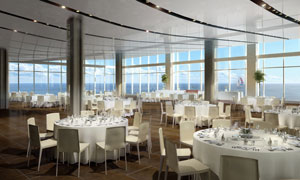
Designed by mUSE Architects, One Atlantic is an independent event venue in Atlantic City that stretches 300 feet over the Atlantic Ocean. Floor-to-ceiling windows maximize ocean views from every room. The project includes 10,000 square feet of interior event space and a 2,500-square-foot terrace. The main space offers views of the ocean and Atlantic City skyline. Reflective sail-like coffered ceilings, natural cork flooring, limed oak wood, and sheer gold drapes are intended to create a maritime feel. The venue is expected to open its doors in summer 2009.

NY, NJ Waterways Contend with Future

Event: Port Authority Speaker Series: On the Waterfront: Finding the Balance for Development and Communities
Location: The New School, 12.02.08
Speakers: Susan Bass Levin — Deputy Executive Director, Port Authority of New York and New Jersey; Carl Biers — Education Director, International Longshoremen’s Association Local 1588; Carter Craft — Former Director of Programs, Metropolitan Waterfront Alliance; Venetia Lannon — Senior Vice President, Maritime Division, NYC Economic Development Corporation; Joshua Muss — President, Muss Development Company; Elizabeth Yeampierre — Executive Director, United Puerto Rican Organization of Sunset Park
Moderator: Greg David — Editorial Director, Crain’s New York Business
Organizers: Center for NYC Affairs; Milano The New School for Management and Urban Policy

Jessica Sheridan

The East River waterfront.

During the 19th century, New York and New Jersey waged so many disputes over their shared harbor that state police exchanged shots in the middle of the Hudson River. Since its inception in 1921, the Port Authority of New York and New Jersey (PANYNJ), has administered the common waterways and waterfront interests of both states. It’s been a 50/50 partnership. For “On the Waterfront,” the program’s title derived from the classic film, Susan Bass Levin, deputy executive director of PANYNJ, did her best Brando stating, “I coulda been a contender.” She was referring to the gritty 1950s followed by the rapid decline of the city’s piers. In fact, it was the river crossings built by the PANYNJ that helped hasten their downfall as the population moved away from manufacturing, leaving an abandoned waterfront.

The longshoreman’s struggles against corrupt union bosses, which drove the plot of the movie, may be over, but longshoremen and the unions are still fighting to save their jobs. Carl Biers of the International Longshoremen’s Local 1588 in Bayonne and Jersey City is campaigning to save blue collar jobs on a former army base that has been targeted for high-end residential developments. Biers wondered why the Federal Government isn’t aiding ailing ports.

The PANYNJ’s $8.7 billion investment program is upgrading and improving the region’s infrastructure. Initiatives include the temporary and permanent PATH station at the World Trade Center; developing a WTC transportation hub; the AirTrain JFK; improvements at LaGuardia, Kennedy International, and Newark airports; expanding ferry service; redeveloping and expanding Howland Hook Marine Terminal in Staten Island; deepening river channels to accommodate deep-draft container ships; and advancing facility security.

“Nobody in this economic climate is going to be putting new projects into the ground in the near future,” said Joshua Muss of Muss Development Company. He sees the economic downturn as an opportunity for the development community to address which areas are appropriate to develop. But it takes years to get a project underway. For example, Muss has been developing Sky View Parc for Flushing on the Flushing River for 27 years. Originally a 14-acre brownfield, the mixed-use development designed by Perkins Eastman will include 800,000 square feet of retail space, six condo and rental buildings, a parking facility, and a 55-foot-wide river esplanade.

Waterfront activist Carter Craft’s hopes for the waterfront are less grand. He thinks of waterways as extensions of green spaces on land, echoing sentiments of his mentor Mike Davis, the recently deceased founder of the Floating the Apple organization. Davis fought to reclaim the Hudson, Harlem, and East Rivers for recreational use and “universal public access.” Craft noted that in addition to the Floating Pool in the summer, swimming in the rivers is a year-round activity. With decreased pollution, pilings are becoming homes for mussels, marshes and wetlands are being reclaimed, and piers are being transformed for recreational and commercial use.

Elizabeth Yeampierre, the executive director of the United Puerto Rican Organization of Sunset Park, encouraged waterfront communities to get involved with its development. The people of her community want to preserve manufacturing, maintaining their homes as well as their livelihoods. High on her wish list is to spread out green spaces, from the waterfront inland, to places that can’t immediately enjoy the waterfront.

In this issue:
· Silver Towers Obtains Landmark Status
· Children’s Aid Breaks Out Holiday Cheer with New Center
· Tapestry Weaves Mixed-Income Residential in East Harlem
· Mixed-Use Defies Rock and Hard Place
· High School Serves Athletes… on Roof
· Labs Plug and Play into the Future
· Double Skin Reveals Highest Non-Enclosed Observation Deck in Shanghai


Silver Towers Obtains Landmark Status

Silver Towers.

Greenwich Village Society for Historic Preservation

The NYC Landmarks Preservation Commission (LPC) unanimously voted to designate the I.M. Pei & Associates-designed Silver Towers complex and its central sculpture, “Portrait of Sylvette” by Picasso, NYC landmarks, ending a five-year campaign by the Greenwich Village Society for Historic Preservation (GVSHP). According to the advocacy group, while the LPC has recently payed increasing attention to Modern architecture, Silver Towers is the first post-war urban renewal “superblock” development in NYC to be landmarked. Originally known as University Village, the 1967 residential complex, set on five acres north of Houston Street between Mercer Street and LaGuardia Place, was designed by James Ingo Freed for New York University. Three identical 30-story, reinforced concrete towers built in the Brutalist style encircle a 36-foot-tall concrete sculpture. The towers cover a small percentage of the site, reflecting the influence architect Le Corbusier.


Children’s Aid Breaks Out Holiday Cheer with New Center

Children’s Aid Society Center.

BBG-BBGM

BBG-BBGM completed the renovation of three visitation rooms and a multi-functional conference room for the Children’s Aid Society Center in the South Bronx — a project they performed pro bono. The firm raised funds and pro bono donations of materials from vendors and other entities to finance the renovation. During the course of several days, the partners and staff carried out the design and construction from start to finish. Despite space limitations, lack of natural light, and small budgets, the firm tried to achieve functional and creative designs with themes from a garden to an island oasis.

Vendors that donated include: Advantage Sports Flooring, Artistic Tile, Benjamin Moore, BestArt & Mirror, County Draperies, Design Communications, Drapery by LORE, Design Tex, DFB Sales, Evan Shatz Sales Associates, Haig Lighting, Hightower Group, InterfaceFlor, Johnsonite, Kellex Corporation, Knoll Textiles, Koroseal, Liora Manne, Milliken, Myriad Fine Art, Osborne & Little, P Kaufmann, Pavarini McGovern Construction Company, Richard J. Fasenmyer Foundation, Selective Surfaces, The Erwyn Group, Ultrafabrics, Wolf Gordon, and 3-FORM.


Tapestry Weaves Mixed-Income Residential in East Harlem

Tapestry.

Jonathan Rose Companies

Jonathan Rose Companies in partnership with Lettire Construction, has broken ground on Tapestry, the first affordable and mixed-income residential rental development designed for LEED Silver certification in East Harlem. The 12-story, 185-unit apartment building will be located at the foot of the Robert F. Kennedy Bridge (formerly the Triborough Bridge), and will offer a mix of market rate, middle-income, and low-income apartments. Designed by Pei Cobb Freed & Partners Architects and MHG Architects, the project will contain studio through three-bedroom apartments, underground parking, a gym, accessible green roofs, a media/children’s playroom, bike storage, and 8,000 square feet of retail. The project is part of the 125th Street river-to-river rezoning, a multi-city agency rezoning effort to infuse the area with cultural, retail, entertainment, and affordable housing for Harlem residents. Tapestry is the first development to result from the rezoning, which was passed this past April.


Mixed-Use Defies Rock and Hard Place

Roscoe C. Brown, Jr. Apartments.

Meltzer/Mandl Architects

Despite a 30-foot-high rock outcropping covering nearly half the site, the Roscoe C. Brown, Jr. Apartments in the Bathgate section of the Bronx is currently under construction. Meltzer/Mandl Architects designed the 279 units by carving out a section of the rock for a lobby and allowing the remaining building to “float” above it onto a series of shear walls. The result will be a glass lobby that looks on a geological rock garden. The complex, which also features a latticework façade of articulated brick forms and two-story glass with metal panel accents, will offer studios through three-bedroom rental homes. There will also be 6,100 square feet of ground-level retail space, administrative offices, and on-site parking. Two outdoor recreation areas and community rooms are included in the 254,000-square-foot development. Completion is scheduled for 2010 under the sponsorship of Phipps Houses.


High School Serves Athletes… on Roof

Union City high school.

HOK New York

HOK New York and RSC Architects have designed a 366,550-square-foot high school to be sited on the former Roosevelt Stadium in Union City. The new school features an athletic stadium, complete with a grandstand area, on the roof for baseball, soccer, and football. As Union City’s only high school, the new structure will contain 66 general classrooms, small-group instruction space, cutting-edge science labs, and home economic labs. The athletic component of the high school also includes a three-station gymnasium, weight rooms, and locker rooms. The media center, located off the courtyard, creates both indoor and outdoor study areas, and will serve the general community by functioning as a public library. In addition, there will be a 980-seat auditorium, a small black box performance space, dance studio, and musical and choral studios for students.


Labs Plug and Play into the Future

RMJM Hillier

Washington University’s Bauer Hall.

Washington University in St. Louis recently broke ground on Bauer Hall, a 150,875-square-foot building for its School of Engineering & Applied Science, designed by RMJM Hillier. The new building will house the School of Engineering’s Department of Energy, Environmental & Chemical Engineering (EECE), provide space for the International Center for Advanced Renewable Energy & Sustainability (I-CARES), and expand the Department of Biomedical Engineering.

RMJM Hillier combined its expertise in state-of-the-art “plug-and-play” laboratories and historic preservation into a unified concept. Two-thirds of the space will be dedicated to research laboratories designed to maximize flexibility across the range of aquatics, aerosols, synthetic chemistry, and biomedical research activities. A plug-and-play casework system — including moveable base cabinets, removable tables, and ceiling-mounted service panels — improves ability to accommodate both bench-top and floor-mounted equipment while reducing the cost of future renovations as research priorities change. One feature will be an 85-seat distance-learning classroom available for use by all academic departments. Completion is expected in 2010.


Double Skin Reveals Highest Non-Enclosed Observation Deck in Shanghai

Shanghai Tower.

Gensler

Shanghai Tower is adjacent Jin Mao Tower and Shanghai World Financial Center in the Luijiazui Finance and Trade Zone, an area poised to be China’s first super-tall district. The 632-meter Gensler-designed tower, organized as nine stacked cylindrical buildings, will house Class-A office space, retail, a luxury hotel, cultural venues, and the world’s highest non-enclosed observation deck. The inner layer of the double-skin façade encloses the buildings, while a triangular exterior layer comprised the envelope. The spaces between the two layers create atrium sky gardens. Much like plazas and civic squares in traditional cities, the atria contain restaurants and convenience stores. The Shanghai Tower Construction & Development is the project’s developer, Thornton Tomasetti is the structural engineer, Cosentini Associates is the MEP engineer, and the Architectural Design and Research Institute of Tongji University as the Local Design Institute will support Gensler. The development is slated for completion in 2014.

How Do People Live? Ask an Architect who Does Interiors

Event: Designs For Living: New Directions in Design of the Home
Location: Trespa Showroom, 10.21.08
Speakers: Lee Mindel, FAIA — Principal, Shelton/Mindel Architects; Annabelle Selldorf, AIA — Principal, Selldorf Architects; Alan Wanzenberg, AIA — Principal, Alan Wanzenberg Architect
Moderator: Abby Suckle, FAIA, LEED AP — AIANY Interiors Committee & AIANY Secretary
Sponsors: Trespa; WB Wood NY

Neue Galerie.

Courtesy http://neuegalerie.org

Most architects in NYC do a lot of single-family residential work. Virtually all architects undertake interior design from the beginning of their practices, and for many it punctuates their careers. A panel composed of architects with expertise in all scales of residential design, from furniture to multi-family residences, were enthusiastic about designing interiors — warts and all — from the client who says he/she doesn’t know much about architecture but knows what he/she likes, to the interior designer who wants to “play architect,” to the decorator who wants to cover over the architecture.

All of the panelists expressed enjoyment in working with and getting to know their clients and their particular lifestyles — even when they themselves were the client. Alan Wanzenberg, AIA, of Alan Wanzenberg Architect, whose reputation is in designing for celebrities, has three homes on which to “experiment.” His primary residence for the past 30 years, an apartment in the city, “is not an easy space, and I’m always changing it and moving things around.” He uses his beach house on Long Island to play with furniture and his cabin upstate to work with light and color in a modest space.

Lee Mindel, FAIA, principal of Shelton/Mindel Architects, has designed a variety of interior types — an ocean liner, a Gulfstream airplane, Ralph Lauren’s headquarters with rooms that appear to be dipped in chocolate, vanilla, and caramel, as well as lighting and plumbing fixtures, textiles, and furniture. The North Sea Pool House on Long Island, which won an AIANY 2008 Design Award for Interiors, was formerly a garage/mechanical building. The two-story space is integrated with a pool, sculpture garden, and a creek. Sculptures that look like “pool toys” blur the lines between sculpture and furniture.

A 2006 AIANY Design Award project, a residence in one of Richard Meier Architect’s Perry Street towers, is an exercise in playful geometries — the street grid and the flow of the Hudson River are intended to give a feeling that the building’s core extends into space. The terrazzo floor was inspired by the Hudson when frozen.

For Annabelle Selldorf, AIA, of Selldorf Architects, working on interiors allows her to learn about the client and how they live. She usually agrees not to foist something on a client, and vice versa. “Taste,” she says, “is nothing to argue about. Either you have it, or you don’t; but there is room for discussion.” Selldorf also designs furniture, and feels that understanding its making helps her understand its usage. Selldorf completely renovated the interior of a Carrère and Hastings-designed Neue Galerie to exhibit early 20th-century German and Austrian artworks. Recently, she designed the interiors for Philip Johnson’s final residential project — the 12-story glass-and-steel Urban Glass House. What defines designing for a single client/resident, according to Selldorf, is to conjecture who might the residents be and what is it that people do nowadays.