Marketing, PR Committee Helps Jump Start Business

Event: Jump-Start Your Marketing Effort
Location: Center for Architecture, 04.28.09
Speakers: Marketing Communications: Richard Staub, FSMPS — President, Richard Staub Marketing Services; Sally Handley, FSMPS — President, Sally Handley Inc.; Business Development: Nancy Kleppel — Co-chair, AIANY Marketing & Public Relations Committee, Principal, Nancy Kleppel Consulting; Maxine Rhea Leighton, Assoc. AIA — Principal, Business Development/Director of Marketing, Beyer Blinder Belle Architects; Public Relations: David Grant — President, LVM Group; Joann Gonchar, AIA, LEED AP — Senior Editor, Architectural Record & GreenSource; Interviews/Presentations: Chris Strom, AIA — Director of Project Development, Mission Critical, Skanska USA Building, Inc.; Kathy Kleiver — Director of Business Development, H3Hardy Collaborative Architecture; At Large: Kirsten Sibilia, Assoc. AIA, LEED AP — Chief Marketing Officer, JCJ Architecture; Gretchen Bank, Assoc. AIA — Co-chair, AIANY Marketing & Public Relations Committee, Director of Marketing and Business Development, Selldorf Architects
Organizers: AIANY Marketing & Public Relations Committee
Sponsors: Skanska USA Building, Inc.; Stuart-Lynn Company

The take-away: “Advertising is what you pay for and PR is something you pray for.” David Grant, president of LVM Group, didn’t invent that line, but he imparted those words of wisdom at the first program of the AIANY’s reconstituted Marketing and PR Committee. Inspired by the work of the Not Business as Usual initiative and recognizing the issues of marketing and public relations were not being adequately addressed by other committees, the committee presented a workshop geared to provide firms of all sizes a comprehensive introduction to going about their marketing and PR efforts.

The opening session focused on marketing communications, business development, public relations, presentations, and the interview process. After a brief overview, the entire group was divided into four smaller sections, grouped by common experience or firm size. Each team of two speakers delivered their presentations separately to each group.

A post-program survey showed that attendees found the business development session most valuable, with a number of action items suggested. Active listening: put down all devices; don’t try to answer before you hear; be prepared to paraphrase what you have heard. Enhancing your relationships: pick one client or prospect to get to know better; do something social. Networking: go to an event; go out with a colleague or peer. Gathering information: add a new publication or media outlet to your regular list; read a broad-based selection of information for at least one hour per week. “Go/no go”: review or create your own questionnaire.

“Our objective,” said committee co-chair Nancy Kleppel, “was to present useful information to firm principals and technical and professional staff, and to enable them to take on some of their own marketing efforts. While we are welcoming to marketing professionals, we hope to have an ongoing dialogue with architects, offering them the tools and information they need to succeed. Going forward, we hope the professional community, the membership, will see the revived marketing committee as a resource.”

Comments by a cross-section of attendees were:

Debra Pickrel, Principal, Pickrel Communications: “I believe that there is strength in numbers — by sharing our insights with others, we develop both individual and collective vision, which benefits our profession at large.”

Ariel Wilchek, Focus Lighting: “I was able to share and absorb trade secrets to focus my efforts on getting published, gaining new clients, and making effective presentations.”

Peter C. Budeiri, AIA, Peter Budeiri + Associates: “The seminar made the point that my firm’s marketing and communications efforts should be focused on the client’s needs and interests, and that they should send a consistent message based on an accurate understanding of our strengths.”

In this issue:
· Broadway Will Be Green With Envy
· Justice — and a New Office — for All
· Westchester School Adds Classrooms, New Sports Field
· Korea Will Have a Park Dedicated to Taekwondo


Broadway Will Be Green With Envy

Henry Miller Theater.

Cook + Fox

The Henry Miller Theater will open its doors to the public in September with a revival of “Bye Bye Birdie.” The theater, which is incorporated into the Cook + Fox-designed Bank of America Tower at One Bryant Park, is the first newly built Broadway house in more than 20 years, as well as the first to be LEED certified. The approximately 50,000-square-foot, 1,055-seat theater, also designed by the firm, preserves Henry Miller’s vision for a new American theater in its intimate scale and emphasis on the direct relationship between audience and actors. The building’s landmarked 1918 Neo-Georgian façade by Allen, Ingalls & Hoffman was fully restored, and the new theater was constructed behind it. The theater now meets technical requirements of modern Broadway productions, with a fully functional fly-tower, deeper stage, and updated stage lighting. In addition, the theater is structurally separated from office tower above and below to maintain acoustic isolation. The theater was designed to achieve LEED Gold certification, and with its use of sustainable materials, water conservation measures, and energy efficiency, provide the best possible environmental quality for patrons and staff.


Justice — and a New Office — for All

New space for The Bronx Defenders.

Levien & Company

Project management firm Levien & Company has completed a 20,000-square-foot renovation project for The Bronx Defenders, a group of not-for-profit attorneys, social workers, investigators, parent advocates, and support staff. Designer Alta Indleman designed a new office space in what was once a restaurant, including the installation of a spiral staircase and the integration of glass blocks throughout to create better lighting. The lobby features murals painted by elementary school students from nearby P.S. 29, a participant in The Bronx Defenders’ Community Arts Exchange program. The artwork reflects the perspectives of neighborhood youth on the richness and diversity of their community, embodying the long-time motto of the organization’s youth programs: “In defense of justice in our community.” Jack Green & Associates, engineer, and Excel Contracting completed the team.


Westchester School Adds Classrooms, New Sports Field

Tuckahoe Middle and High School.

Peter Gisolfi Associates

Construction was recently completed on a new addition to the Tuckahoe Middle and High School in Westchester County, NY. The three-story addition, designed by Peter Gisolfi Associates, blends with the existing building to reflect the structure’s Art Deco exterior. The new interior space and renovations maintain the building’s original stylistic language. The 21,000-square-foot addition contains 10 new classrooms and a lobby entrance with an elevator, and connects to the three wings of the existing building, enclosing two new exterior courtyards. A series of changes to the existing structure aims to clarify the organization of the entire building. Also included in the project is a new sports field with bleacher seating, synthetic turf, a press box, and a sub-surface drainage system to retain storm water on the site.


Korea Will Have a Park Dedicated to Taekwondo

Taekwondo Park World Headquarters.

Samoo Architecture

NY-based Samoo Architecture with project lead Samsung C & T and Samoo Architects & Engineers in Seoul, Korea, has won the commission to construct the new Taekwondo Park World Headquarters in Muju, Korea. Located on 570 acres of mature woodlands, natural streams, and valleys, the park and associated building complexes will become a world cultural heritage site emphasizing the spirit, beauty, and sport of Taekwondo. In addition to housing the headquarters of various Taekwondo organizations, the park will contain a sports arena, visitor and exhibition centers, and training and lodging facilities.

Design Awards in Architecture Return to Early Modernism (Cont’d)

In one of the most prominent and contentious locations in Manhattan, Allied Works Architecture redesigned the Museum of Arts and Design, recipient of a Merit Award. According to Principal Kyle Lommen, their goal was to “open the building up to its context, and the primary act was one of subtraction.” They connected gallery spaces vertically, provided a connection to Central Park and beyond, and brought light in through cuts in the floors and exterior walls. What everyone can see, even those who don’t go inside, is a façade of glazed terracotta tiles that create an iridescent surface designed to play with the light.

Pelkonen noted that Honor Award-winning Thomas Phifer and Partner’s pavilion at Rice University is so ethereal that it makes you wonder whether it’s an apparition. How do you build a glass building on a neo-Byzantine campus that’s also suited for the climate in Texas? The answer, according to Partner Stephen Dayton, was with a sheltering trellis system that provides shade and perforated “sklylight scoops” to bring light and air into the building.

Situated on the fringes of Columbus, IN, a city known for its Saarinen buildings, the Merit Award-winning Irwin Union Bank branch building is in a mall with big box retail. To distinguish the building from its neighbors, Deborah Berke & Partners Architects designed a “light box” that serves as a canopy, a unifying element, and a beacon that can be seen by motorists 1/4-mile away. The light box “is the opposite of a bleak, fluorescent lit Wal-Mart,” according to Partner Marc Leff, AIA.

“The Chosen Children’s Village Chapel arrests you with its origami-skin,” Pelkonen said. There also happens to be a human-interest aspect to the project. Carlos Arnaiz, associate partner at Stan Allen Architect, had volunteered as a youth in the village that is home to kids with disabilities. When the founders of the non-profit organization needed an architect to design the chapel, they called upon him. The firm and all other professionals involved worked pro-bono on this Merit Award winning-project. The chapel has no mechanical systems and the building, according to Arnaiz, “exploits the plasticity of concrete.” It needed to be thin and compact to handle seismic challenges, and the walls were designed like a ceiling with movable beams.

Three of the winning projects are private residences uniquely integrated into theie landscapes on acres of private property. Allied Works’ Dutchess County Guest House sits on a natural shelf in the landscape and, with its articulated framing of steel tubing, binds the house to the surroundings. Thomas Phifer and Partners’ Millbrook House is at the end of a forested road that leads to a sheltered meadow. The residence was designed to appeal to the owner’s affinity towards a Japanese aesthetic and incorporates an indoor and outdoor environment. Both projects garnered Honor Awards. Joel Sanders Architect’s Merit Award-winning House on Mount Merino is embedded into a hillside with panoramic views. Inspired by the Hudson River School of painting, the house has framed, static views — like a movie camera viewfinder.

All of these projects share a certain formal semblance with early Modernism. They feature simple, geometric forms, have an abundance of light-filled, open spaces, and many have a lot of glass and steel. Pelkonen aptly summed up her remarks by saying, “When you see these buildings, you know you are in a presence of great architecture and you are moved.”

Caochangdi: Center for New Creative Development

Event: James Stirling Memorial Lecture on the City: Beijing Inside Out: Caochangdi, a lecture by Robert Mangurian and Mary-Ann Ray
Location: Center for Architecture, 04.05.09
Speakers: Robert Mangurian & Mary-Ann Ray — Principals, STUDIO WORKS
Organizer: AIANY; Canadian Centre for Architecture; London School of Economics
Sponsors: Underwriter: PKSB Architects; Sponsors: Benjamin Moore & Co.; Buro Happold Consulting Engineers; Studio Daniel Libeskind; Syska Hennessy Group; Trespa

Courtesy cca.qc.ca/

The Bird’s Nest Stadium. The Forbidden City. Tian’anmen Square. Caochangdi? Though it may not be on most tourists’ lists of sites to see in Beijing, Caochangdi, which means “grassland” in Mandarin, is one of Beijing’s approximately 500 urban villages. It is the largest revenue producing district in the country, and is the home and workplace of architects Robert Mangurian and Mary-Ann Ray, principals of STUDIO WORKS, who won the competition for the third biennial James Stirling Memorial Lecture on the City.

Their presentation, “Caochangdi Urban Rural Conundrums: Off Center People’s Space in the Early 21st Century Republic of China — A Model for the Momentous Project of the New Socialist Village,” gave an insider’s view of life in a place they called an “urban village.” Urban villages like Caochangdi were originally carved out for agriculture and peoples communes, and are now the new lexicon of Chinese urbanism. As presented from the seat of a bicycle coursing along the streets, one sees the floating populations of migrant farm workers, taxi drivers, ex-pats, and artists who find it a source of cheap, albeit “illegal,” three-story residences.

Caochangdi is also the home of artist Ai Weiwei, who after living in NYC, returned to his native China in 1993. Ai Weiwei served as the artistic consultant for design, collaborating with Herzog & de Meuron on the Beijing National Stadium for the 2008 Summer Olympics as well as Ordos 100, and is part of what the presenters call “the new DNA for creative development” in China.

The James Stirling Memorial Lectures competition was established in November 2003 by the Canadian Centre for Architecture (CCA) to create a forum for the advancement of new critical perspectives on the role of urban design and urban architecture in the development of cities worldwide. It was conceived in homage to British architect James Stirling, who believed that urban design is integral to the practice of architecture and a vital topic for public debate.

In this issue:
· Preservationists Have Something to Dance About
· Port Authority Gets Temporarily Fashionable
· Exhibition Documents Arrival of the Dutch
· New Law School Rises to Head of Its Class
· University Center Innovates With Local Materials


Preservationists Have Something to Dance About

Peridance Center.

Kohn Architecture

The future home of the Peridance Center located in the East Village and designed by Kohn Architecture is currently under construction. The circa 1903 Beaux-Arts building, designed by Jardine, Kent & Jardine, will suit the needs of the dance school’s expanding programs, featuring eight professionally equipped studios with high ceilings, column-free space , sprung floors, and a professional sound system. The ground floor will contain the Salvatore Capezio Theatre, café, a museum, and a store that sells dancewear. The two-story red brick and limestone building looks like it has an additional floor because of an exposed metal truss supporting a shed roof. Its façade is pierced by round and oval windows common to the style of townhouses built during the period. The former horse auction barn was slated for demolition, but a “standstill agreement” was reached with the New York City Landmarks Preservation Commission that paved the way for the building to be added to the Trust for Architectural Easements, guaranteeing the building will be preserved in perpetuity.


Port Authority Gets Temporarily Fashionable

Port Authority Bus Terminal’s temporary fashion retail and art exhibition space.

super-interesting!

Super-interesting! architecture.design.strategies has transformed an unused 2,500-square-foot storefront in the Port Authority Bus Terminal Building into a temporary fashion retail and art exhibition space that will provide young fashion designers and artists a visible stage to display and sell their work. Off-the-shelf fluorescent strip lights function as a chandelier, merchandise lighting and giant LCD-style signage reflect off a glossy black floor. Oversized, translucent lace super-graphics and white-painted thrift store wood chairs give the space a stripped-down-to-suit-the-economic-time look. Due to budgetary constraints, the firm decided to manage and coordinate the construction, organizing licensed trades people, and set builders from the film industry to execute the highly custom-designed details. The firm worked with the Times Square Alliance and The Fashion Center BID on the project.


Exhibition Documents Arrival of the Dutch
Urban A&O has been selected as the lead designer for the 400th Henry Hudson anniversary exhibition, “The Island at the Center of the World,” at the South Street Seaport Museum, on view 09.10-12.31.09. Working in collaboration with Thinc Design, the exhibition will be categorized into three themes — what the world was like at the time the Dutch were exploring Manhattan, the history of New Amsterdam, and the various groups of people living there at the time. Four galleries will exhibit historical maps, and books. Portrait Stations will allow visitors to sit and listen to stories of early Dutch immigrants and their diverse backgrounds while viewing portraits of contemporary Dutch New Yorkers. The approximately 4,150-square-foot show will utilize 34 transparent acrylic tables of varying sizes and will be arranged to form a dynamic relationship with the four existing gallery spaces and serve as an organizational device.


New Law School Rises to Head of Its Class

Lewis Katz Building at Penn State’s Dickinson School of Law.

Polshek Partnership Architects

Penn State’s Dickinson School of Law celebrated its 175th anniversary with the opening of its new 114,000-square-foot Lewis Katz Building, designed by Polshek Partnership Architects. The focal point of the building is its glass-enclosed law library with a 100,000 volume capacity and seating for 294 students. The design draws from the idea that the law library is the theoretical and physical heart of the legal educational experience, and was conceived as a floating element, sheltered from the rest of the school’s program beneath.

The ground plane flows unimpeded, linking interior and exterior space to foster the feeling of openness and accessibility. Within, the library’s continuous looping circulation system offers several different types of study environments. Beneath this aerial form is a series of volumes clad in local sandstone that contain the classrooms, auditorium, and courtroom. These elements surround a broad commons area that opens to the landscape and follows its stepping contours, directly connecting the school’s interior programs to the surrounding campus. The project was constructed to meet LEED certification requirements, and from its continuous planted green roof to its reintroduction of pervious surfaces on what was a massive parking lot, the building helps reduce the amount of rainwater runoff generated by the site.


University Center Innovates With Local Materials

University Center expansion.

Holzman Moss Architecture

The University of Southern Indiana in Evansville recently broke ground on its new $18.4 million University Center expansion, designed by Holzman Moss Architecture. The project will convert the university’s former 60,000-square-foot library into dining, lounging, meeting, and student organization spaces and replace the existing conference center bridge linking the old library and existing University Center. The project features a 103-foot-tall, conical stone tower at the center of campus, and incorporates local and reclaimed materials. Key design elements formed from select materials produced by leading regional manufacturers include the dome-shaped ceiling in the central atrium decorated by a geometric pattern created out of 1,200 intertwined chair legs from Jasper Chair Company, and the stone-clad tower featuring quarry-faced roughback limestone from BG Hoadley Quarries. A series of solid aluminum ingot ends will be transformed into benches for the lobby as well. Scheduled for completion in 2010, the expansion adds a total of 20,815 square feet of space.

In this issue:
· New Museum for African American History and Culture Announced
· Public Radio Takes to the Street
· New York State Theater Adjusts Its Sounds
· A Shop Pops Up in Brooklyn
· An Elevated Park Runs Through It
· Putting the Parking in Ballpark
· NYIT Heads Upstate to the Estates


New Museum for African American History and Culture Announced

National Museum of African American History and Culture.

Courtesy Davis Brody Bond Aedas

The team of Freelon Adjaye Bond/SmithGroup has been selected by The Smithsonian to design the National Museum of African American History and Culture to be located on the National Mall in Washington, D.C. The core design team consists of three firms — The Freelon Group will ensure that the design reflects the values and priorities of the museum and the Smithsonian; Adjaye Associates will focus on the formal development and refinement of the building design; and Davis Brody Bond Aedas will assure adherence of the design to the program and vision. The building design will take up to three years, with construction to begin in 2012. Set to open in 2015, the museum’s total cost is estimated to be $500 million. Freelon Adjaye Bond/SmithGroup was one of 22 teams that responded to the Request for Qualifications in the summer 2008, and six firms selected to participate in the design competition in January 2009.


Public Radio Takes to the Street

Jerome L. Greene Performance Space.

Courtesy WNYC

WNYC radio is on the air, online, and now on it’s on the street! The Jerome L. Greene Performance Space, designed by Kostow Greenwood Architects, is a state-of-the-art, multimedia performance space and broadcast studio on the ground floor of WNYC’s new home at Charlton and Varick in Hudson Square. The Greene Space was created for live performances, WNYC radio shows and video webcasts with concerts, theater, political and cultural discussions, film, and visual arts. A news ticker carves through space and out the windows, making breaking news available to passersby. The venue can seat 125, and millions more will be able to stream live audio and video events and download podcasts created in the studio. The space was registered as a relocation project with the USGBC and expects to achieve a LEED Silver rating. The use of recycled paper for printed materials, low-wattage LED theatrical lighting, a stage made of renewable bamboo, and interactive programs on environmental issues that the station broadcasts are just some of the ways Greene Space will promote being green.


New York State Theater Adjusts Its Sounds

David H. Koch Theatre.

David H. Koch Theatre

An interior renovation of the David H. Koch Theater at Lincoln Center by JCJ Architecture will update the venue, providing an enriched experience for devotees of both the New York City Opera and New York City Ballet. Phase one of the improvements includes enlarging the orchestra pit and providing operable platforms replacing the stage lighting system, building a media center to allow hi-definition recording and broadcasting of performances, and installing 2,550 custom-designed seats. In addition, the lobbies will be refinished with new carpeting and wall covering. This will be the first major facelift for the 45-year-old, Philip Johnson-designed theater, which, until recently, was known as the New York State Theater.


A Shop Pops Up in Brooklyn

Rocawear shop.

D-ASH Design

D-ASH Design has created a mobile lounge to showcase hip-hop music mogul Jay-Z’s line of apparel for Rocawear. The first location for the temporary space will be in Brooklyn, near the Atlantic Terminal. Mohair sofas, suede walls, custom zebra wood cabinetry, a 46-inch flat-screen TV, stereo system, and a custom gaming zone, transport the customer into the Jay-Z and Rocawear lifestyle. Fully stocked with merchandise, the 50-foot luxury liner will travel around the country to Jay-Z concerts and other events.


An Elevated Park Runs Through It

The High Line Building.

Morris Adjmi Architects

Designed by Morris Adjmi Architects, The High Line Building on West 14th Street in the Meatpacking District has topped out. The building, which was designed to LEED Gold standards, features 100,000 square feet of office space and 11 floors of retail space at the base of the park’s main entrance. The building has a dramatic steel-framed glass tower atop an existing five-story Art Deco masonry building that was a former meat processing facility. The offices on the upper floors have panoramic views of the Hudson River and the historic neighborhood through its floor-to-ceiling windows, while its lower floors offer direct views of the park, which also runs 103 feet through the building. The building is expected to be completed Fall 2009.


Putting the Parking in Ballpark

Ruppert Plaza Garage.

Clarke Caton Hintz

Trenton-based Clarke Caton Hintz (CCH), unveiled several parking garage facilities at the new Yankee Stadium that will provide recreational and park facilities for the surrounding community — which lost valuable park space when the new stadium was erected. The more than one-million-square-foot Ruppert Plaza Garage will accommodate 1,500 public parking spaces and features an expansive roof-deck to support the NYC Department of Parks and Recreation’s rooftop park. When completed in April 2010, it will include basketball and handball courts, a 400-meter athletic track, adult fitness equipment, an artificial turf soccer/football field, a 600-seat grandstand, site furnishings, and a comfort station that will house restrooms and changing areas.

The approximately 250,000-square-foot 164th Street Garage, a five-story garage with rooftop parking adjacent to the new stadium, will provide approximately 630 spaces. The garage’s façade, highlighted with blue lighting and stainless-steel mesh, matches the new stadium’s stone. Construction on the four-story, approximately 970-space 161st Street Garage will begin this summer. CCH and its design-build partners continue to be responsible for overseeing financing, design, building, operation, and maintenance of the garages. All aspects of the project now run through a newly created entity called Bronx Parking Development Corporation.


NYIT Heads Upstate to the Estates

Dean’s Office at NYIT.

Courtesy DIA/WRKS

DIA/WRKS has been selected to design the administrative offices for New York Institute of Technology’s School of Architecture and Design in Old Westbury, NY. With more than 100 wooded and landscaped acres, NYIT’s Long Island campus comprises several former North Shore estates, including the former C.V. Whitney estate buildings that were reconstructed for educational use. The design of the new building takes its cues from the architectural details of the estates’ former polo stables while contrasting them with clean, understated surfaces and angles. Among the distinctive elements in the design of the 2,500-square-foot space are original furniture pieces by Le Corbusier and Marcel Breuer, a rustic brick fireplace, and white marble mantles. The project is slated to begin in May and be completed by the fall.

In this issue:
· Jersey City Bridges City and Marina
· Design Dresses Clothing Store
· A New Tree Grows in Brooklyn
· Reform Temple Restructures
· Prism Links to the Past at AAAL
· This Hotel Breaks the Archetype
· Color Floods Hell’s Kitchen


Jersey City Bridges City and Marina

Jersey City’s new waterfront master plan.

Starr Whitehouse Landscape Architects + nARCHITECTS

The Jersey City Waterfront Parks Conservancy recently unveiled a new master plan called Connect the Parks that re-imagines parcels of parkland in disrepair surrounding the Little Morris Canal Basin. The plan, designed by Starr Whitehouse Landscape Architects and Planners in collaboration with nARCHITECTS, ensures the protection of waterfront parkland and Manhattan views via passive lawns, kids’ play elements, interaction with water and nature combined with natural erosion protection, and promotion of aquatic life. An “Infinity Bridge” that connects two major parcels of parkland will result in a continuous walkway from the city to the marina. Two pavilions will provide gathering areas that can be used for concerts, puppet shows, and more.


Design Dresses Clothing Store

Derek Lam store.

SANAA

Women’s ready-to-wear and accessories designer Derek Lam’s first freestanding store has opened in Soho’s Cast-Iron Historic District. Designed by SANAA, the 2,800-square-foot boutique is on the ground floor of an 1876 warehouse building. The firm designed transparent organic forms crafted of clear acrylic to create distinct rooms within the store, each one housing a different collection. Custom-fitted wood and aluminum furniture, a one-pour concrete floor, and original brick walls painted white are intended to heighten the exhibition-like feel of the store.


A New Tree Grows in Brooklyn

Castle Braid Building.

Durukan Design

It’s not the same Castle Braid Building (a.k.a. 114 Troutman) as it was in Betty Smith’s novel, A Tree Grows in Brooklyn, set in pre-World War I Brooklyn. Durukan Design is transforming the 160,000-square-foot factory building for developer Mayer Schwartz into a rental apartment building with 146 one- to three-bedroom units. Concrete floors are printed with patterns, staircases take unexpected forms, and walls are built specifically so artists can use them as canvases. Glass encloses a 5,500-square-foot courtyard, designed by Future Green Studio, and is composed of green walls, garden enclaves, a graffiti art wall, a double-sided fireplace, wood furniture made from tree trunks, and found corrugated steel. Amenities are intended to create community, including a doorman, common area, gym, movie screening room, laundry center, library, and a game room. The developer is considering adding a food co-op/café for the project as well.


Reform Temple Restructures

Temple B’nai Chaim.

PKSB Architects

PKSB Architects got the green light for the construction of a new addition to Temple B’nai Chaim in Fairfield County, CT. The expansion will provide a sanctuary and reception hall and catering kitchen in a pre-engineered steel building. The existing temple will be converted to classroom, library, and administrative spaces. A glass and stone circulation spine will link the old and the new providing a unifying façade, appropriately scaled to the woodland setting.


Prism Links to the Past at AAAL

Glass link from terrace. The former American Numismatic Society is on the left; the Academy is on the right; Trinity Cemetery is beyond.

American Academy of Arts and Letters

The American Academy of Arts and Letters (AAAL) has completed construction of Glass Link, designed by architect James Vincent Czaika, AIA, and consulting architects Henry Cobb, FAIA, and Michael Flynn, FAIA, of Pei Cobb Freed & Partners. Connecting exhibition galleries in the administration building to those in the former headquarters of the American Numismatic Society, the new link is a rectangular prism, 12 square feet wide and 16 feet high with iron-laminated glass walls, roof, and floor. The roof panels are two panes of glass with a 50% white dotted frit pattern. The panels are supported by three structural glass beams, which bear directly on the existing walls. The floor consists of 16 translucent glass panels that allow uniform lighting below.


This Hotel Breaks the Archetype

Helix Hotel.

Leeser Architecture

Leeser Architecture has won an invited competition to design a five-star luxury hotel in Abu Dhabi. Known as the Helix Hotel, due to its staggered floor plates, the building rests in the bay, partially floating in the water and adjacent to the Zaha Hadid-designed Sheik Zayed Bridge now under construction. Guest rooms and suites are arranged around a helical floor that constantly shifts in width and pitch as it rises to the top floor. As the helix winds upward, programmatic elements change from lounges and restaurants on the bay, to meeting rooms and conference facilities, to lounges and cafés, a luxury indoor-outdoor health spa, and a rooftop deck with a glass-bottom swimming pool.

The firm is working with Atelier Ten on sustainable features to maximize use of local natural resources such as the installation of GROW cladding made from 100% recyclable polyethylene that will collect energy from both the sun and the wind. An interior waterfall in the atrium will help to maintain comfortable temperature and humidity levels, and a retractable glass wall will open up to ocean air. The 208-room/suite hotel will be the centerpiece of a comprehensive new development that will contain offices buildings, condominiums, and retail along the water.


Color Floods Hell’s Kitchen

Xie-Xie.

TVD

Therese Virserius Design recently unveiled the design for a fast-food gourmet restaurant concept called Xie-Xie, which means “thank you” in Mandarin. The 400-square-foot Asian sandwich shop located in Hell’s Kitchen has a façade with horizontal ribbed panels highlighting the Xie-Xie signage. The logo is imprinted on the glass in a gradient pattern. Inside, a violet and white wall is comprised of alternating colored stripes extending up the wall and cantilever across the ceiling. The wall directly across from the counter features Xie-Xie fortune cookies cast in hues of chartreuse, violet, raspberry, and orange in high gloss porcelain.

Waterfront Zoning Revisions Rock the Boat at City Planning

Event: Dept. of City Planning’s Proposed Waterfront Zoning Revisions
Location: Center for Architecture, 02.20.09
Speaker: Claudia Herasme — Urban Designer & Program Manager for Guidelines, NYC Department of City Planning (DCP)
Panelists: Howard Slatkin — Deputy Director of Strategic Planning, DCP; Bill Woods — Director of Waterfront and Open Space, DCP; Bonnie Harken, AIA — Co-chair, Waterfront Committee, American Planning Association/NY Metro Chapter; Susannah Drake — New York Chapter President, ASLA; Lee Weintraub, FASLA — ASLA National Trustee; Michael Samuelian, AIA — Co-chair, AIANY Planning and Urban Design Committee
Organizer: AIANY Planning and Urban Design Committee; NY ASLA; APA NY Metro Chapter

New Waterfront Zoning Provisions will mandate public access to the waterfront, but could constrain and limit design.

Jessica Sheridan

Proposed by the NYC Department of City Planning (DCP) and in the process of winding its way through the public review process is a text amendment to the Waterfront Zoning Provisions of the 1993 Zoning Resolution. The DCP is pursuing a comprehensive review and revision of the current urban design regulations, which mandate public access to the waterfront. These rules have successfully produced public waterfront access areas, but it has become apparent that they impose design constraints and limitations.

Drawing upon the city’s experience with waterfront developments in recent years, the new standards are designed to address a wider variety of waterfront conditions than anticipated by the existing text. Many of the elements of the DCP’s proposal already exist at the Greenpoint and Williamsburg waterfronts, and at the Ikea site in Red Hook — all in Brooklyn. In brief, DCP’s proposal is intended to improve the quality of future waterfront space by promoting inviting spaces that “read as public,” allowing a greater diversity of experiences through design flexibility, enhancing the variety and quality of plantings, and better accommodating storm water management and other green practices.

All panelists applauded the DCP’s intentions and efforts, but had their concerns. Bonnie Harken, AIA, co-chair of the waterfront committee at the American Planning Associations (APA) NY Metro Chapter, said the APA supports the goals of the revision — to make the waterfront more open and accessible to the public and introduce more flexibility into the design standards — but added, “What we’d like to see next is for the waterfront zoning to fit more consistently with some of the broader planning issues facing NYC.” With climate change already bringing rising sea levels and more intense storms, NYC’s low-lying waterfront areas need to be designed for flood-proofing and absorption, storm water management, and shoreline protection. She believes coordination of the zoning with agencies responsible for the environment, such as the NY State Department of Environmental Conservation and NYC Department of Environmental Protection, and climate change initiatives of PlaNYC is needed to plan in a larger sense for the future sustainability of NYC’s waterfronts.

Attendee Stephen Whitehouse, RLA, AICP, spoke of Gowanus Green, one of the first sizable projects to start a review under the new regulations. His firm, Starr Whitehouse, is part of a competition-winning team composed of Rogers Marvel Architects and West 8 to create affordable housing along the Gowanus Canal in Carroll Gardens. The new waterfront zoning brings the canal under its jurisdiction; the project must comply with the new waterfront zoning’s bulk regulations and criteria for public waterfront access. Whitehouse agrees the new regulations will result in engaging spaces, but based on his experience, the regulations are “complex and require significant effort to demonstrate compliance to the satisfaction of the department. With the changing regulations, the methods of demonstrating compliance have not been standardized, so we’ve had to create them, with an eye both to the text and to feasibility.” He explained that with the large site, for example, compliance formulas are generating requirements for too many benches and tables. The standards for compliance are “far too onerous to demonstrate, and it should be dropped,” he argued.

The proposal is now undergoing review by the City Planning Commission, which is weighing the recommendations from the AIA, APA, and ASLA, along with other recommendations from the Borough Presidents and Community Boards. A vote is expected in April.

Casa Malaparte’s Enigmatic Legacy Continues

Event: The Curious Case of Casa Malaparte: Literal Deconstruction and the Surrealist Building Enclosure
Location: Center for Architecture, 03.10.09
Speaker: Michael McDonough, AIA — Author, Casa Malaparte: A House Like Me (Clarkson-Potter)

Courtesy michaelmcdonough.com

“Who is this guy riding a bike around on a roof with no railing in a cliffside dwelling in the middle of the Bay of Naples,” asked Michael McDonough, AIA, pointing to a black-and-white photograph. McDonough is equally fascinated with Curzio Malaparte (1898-1957) — an Italian who was variously a journalist in London, a collaborator with the Surrealists in Paris, and a war correspondent on the Russian front during World War II — and Casa Malaparte, the fortress-like villa he designed for himself on the Isle of Capri. After 10 years studying the house and the man, and three years writing and editing, McDonough’s book Malaparte: A House Like Me was published in 1999.

“Casa come me,” or “house like me” is what Malaparte called his deep terracotta-colored masonry villa that was realized in 1939. Located on a promontory 32 meters above the sea, the house is surrounded by natural beauty on land steeped in Roman history. The outline of the building follows the course of the cliffs and is built on three levels. A large roof terrace stretching out towards the sea can be reached solely by a reverse pyramid staircase that fits in perfectly with the shape of the rocks. The idea for the steps comes from a church in Lipari, where Malaparte worshiped during his imprisonment. Access to the property is either by foot from the town of Capri or by boat and then a hike up a staircase cut into the cliff. “It’s inaccessibility,” says McDonough, “is extraordinary.”

One question that continues to mystify architects and historians is who really designed Casa Malaparte? Italian rationalist architect Adalberto Libera designed one scheme. Malaparte, who, according to McDonough, felt “architects are basically engineers,” worked with Libera’s plan, adapting it and building it with a local stonemason. The house has no steel components — rather, it is built of limestone, concrete, and stucco, materials found onsite. Terrific storms would cause windows to be blown out and the salty wind would blow completely through the house. In addition, the salt water in the in the two-foot-thick limestone walls migrated to the outside causing the stucco to fall off. An audience member questioned the color of the house. Yes, it was originally white, which was the color of the fascists, but after Malaparte became interested in communism, he painted it red. McDonough surmised that through time, even if people couldn’t read words, they could “read” materials and color.

The house was abandoned after Malaparte’s death in 1957 and became a victim of vandalism and neglect. Malaparte had willed the house to the People’s Republic of China — it is said he admired Chairman Mao — but his wish was contested and now the Casa Malaparte Foundation is its steward, making it available to architecture students. Malaparte’s great-nephew, Nicolo Rositani, is primarily responsible for restoring the house to a livable state. However, due to the building materials and the elements, Casa Malaparte is in a state of perpetual restoration.

In this issue:
· Five New Projects for TEN Arquitectos
· Oak Room and Oak Bar at The Plaza Reopen
· A Piano Factory Changes Its Tune
· A School That Knows Its ABC’s, and Its G for Green
· First “Green” Affordable Mixed-Use Project in the Garden State
· A Passage Through India


Five New Projects for TEN Arquitectos

Clinton Park.

TEN Arquitectos

TEN Arquitectos is currently working on five new commercial and residential buildings in the city. This number includes the recently completed ONE York, an upscale, 32-unit residential condominium located at Sixth Avenue and Canal Street. The project is a sleek fusion of old and new. A crystalline shaft penetrates a pre-existing industrial loft building and rises to create a prow of glass and steel seven stories above it. Clinton Park, on 11th Avenue between 53rd and 54th Streets, is a 1.3-million-square-foot, mixed-use development with a 28-floor tower containing 900 apartments (20% inclusionary) a 25,000-square-foot health club, a Mercedes Benz showroom, market, and a 35,000-square-foot horse stable for the NY Police Department. The Habita Hotel Chelsea features a metal mesh façade and exterior glass elevator, which rises through a slender glass column. On the ground level is a brasserie and bar lounge, and the roof deck features a pool, bar, and garden terrace. Near Bryant Park, the Cassa Hotel, is a combination restaurant, bar, boutique hotel, and luxury condo that share a common triple-height lobby. The tower uses windows and a punctured rhythm to ornament the façades.

The firm is also working in Park Slope, Brooklyn, at 580 Carroll Street in Park Slope, a 30,000-square-foot condominium containing 17units. The project is set back and separated from the street by a 3,000-square-foot shared garden, introducing an element of country living to an urban site.


Oak Room and Oak Bar at The Plaza Reopen

The Oak Room at The Plaza.

Sari Goodfriend

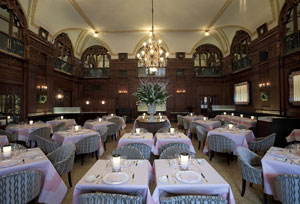
The restoration and redesign of The Oak Room and adjacent Oak Bar at The Plaza Hotel in Manhattan has been completed by Selldorf Architects. The firm conducted a detailed restoration of the designated interior landmark room, including all of the original paneling, paintings, and moulding. Built by Plaza Hotel architect Henry Hardenbergh in 1907, the room features a Renaissance Revival interior that boasts a 24-foot ceiling with Flemish and English oak paneling, carved reliefs, and original oil frescos of Bavarian castles. The architects custom-designed almost every new element of the space, including personalized furniture and modern accessories, to evoke an atmosphere of chic, elegant, and sophisticated dining. Of particular note are the walls in the newly created private dining room, which have been covered in a curtain of woven copper fabric. In addition, new lighting suffuses the restaurant, and complementary colors of copper and oak set the theme throughout.


A Piano Factory Changes Its Tune

The Sohmer Piano Factory.

Caliendo Architects

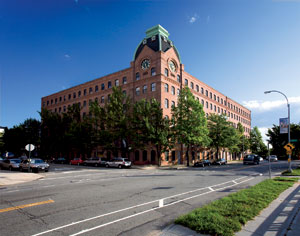
The Sohmer Piano Factory, a designated landmark on the East River in Long Island City distinguished by its prominent clock tower, has been converted into a 69-unit condominium designed by Caliendo Architects. The red brick building, designed in the German Romanesque Revival style by the architectural firm Berger & Baylies, was built in 1886. Now known as the Piano Factory, the lobby, detailed in mosaic tiles with piano key accents and an original Grand Sohmer piano, opens into a private circular driveway. The residence offers studios to three-bedroom homes designed by Penelope Kim Designs, with ceilings up to 12 feet high, many with private terraces or balconies facing Manhattan.


A School That Knows Its ABC’s, and Its G for Green

PS/IS 338.

HOK

The New York office of HOK was commissioned by the School Construction Authority to design a new $52.5 million Public School/Intermediate School in South Jamaica, Queens. The 93,400-square-foot school is one of the first in the city built under the NYC Green Schools Rating System, and will accommodate approximately 625 students from Pre-K through eighth grade in 32 classrooms. The design scheme reflects the everyday activities experienced within the facility. In addition, the courtyard entrance will feature an outdoor kinetic art installation by artist Christopher Green. The school’s U-shaped form, complete with a welcoming court facing the street, will be defined by the five-story L-shaped Learning Block, filled with classrooms and a library, and the four-story Activities Block, housing the auditorium, gymnasium, and cafeteria. The two blocks will be distinctly patterned with vertical and horizontal symbols found in musical scores, geological strata, mathematics, science, and art. The interior walls and floors will integrate colorful linear strokes throughout. The school is scheduled to open in September 2011.


First “Green” Affordable Mixed-Use Project in the Garden State

Webb Apartments.

GF55

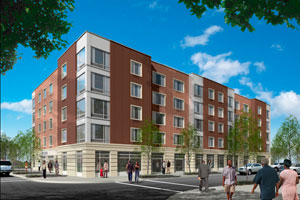
GF55 Partners has completed Webb Apartments, the first 100% affordable, “green,” mixed-use building in NJ. Located in the heart of the Martin Luther King, Jr. redevelopment zone in Jersey City, the 58,740-square-foot building is a public-private partnership between the State of New Jersey, the City of Jersey City, and developer Genesis Companies. The five-story building contains 40 housing units and 8,000 square feet of retail space, and incorporates bamboo floors, low VOC paints, and low SONE exhaust fans. Webb Apartments has received LEED-Silver certification.


A Passage Through India
Lee Harris Pomeroy Architects (LHPA) has been selected to design the new East-West Metro Railway in Kolkata (formerly Calcutta), India. The new corridor will span 13.7 kilometers and include a tunnel under the Hoogly River. LHPA will be responsible for the design of six underground stations and for developing land use plans in the station areas. The project is part of a comprehensive initiative by the governments of India and West Bengal to modernize and expand its transportation system. Once completed, it will link suburban residential areas of Salt Lake and Howrah to the central business district. The new metro will connect with major rail terminals in Howrah and Sealdah, as well as an existing North-South metro line. Ferries, buses, surface rail, and taxis will also be accessible to the line. It will accommodate an estimated 480,000 passengers daily when fully completed in 2014. The firm’s other transit projects include the Union Square, MoMA, and Lincoln Center subway stations.