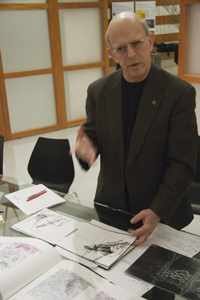
02.09.08: The Emerging NY Architects (ENYA) Committee held a jury at the Seamen’s Church Institute of New York and New Jersey for South Street Seaport: Re-envisioning the Urban Edge, the group’s third biennial international ideas competition.

Caples, Small, Sorkin

(l-r): Jurors Sara Caples, AIA, Maia Small, and Michael Sorkin.

Jessica Sheridan

Sorkin

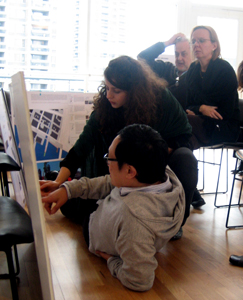
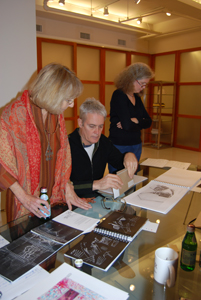
Michael Sorkin kneels to get a closer look at what Calvin Tsao, FAIA, is describing. Eeva-Liisa Pelkonen (l) and Nina Baniahmad (r) look on.

Jessica Sheridan

Tsao, Baniahmad

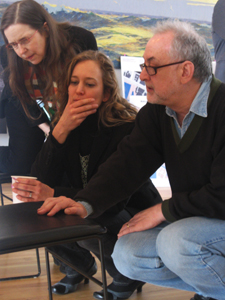
Calvin Tsao, FAIA, and Nina Baniahmad, 2006 ENYA Prize winner, debate their favorite entry. Michael Sorkin and Eeva-Liisa Pelkonen view the board from a distance.

Jessica Sheridan

Center for Architecture Gallery Hours
Monday-Friday: 9:00am-8:00pm, Saturday: 11:00am-5:00pm, Sunday: CLOSED

Join an Architalker for a Hosted Tour of Center for Architecture
Exhibitions

Join us for free Architalker-hosted tours of the Center for Architecture exhibitions Fridays at 4:00pm. To join one of these tours, meet in the Public Resource Area on the ground floor of the Center for Architecture.

CURRENT EXHIBITIONS

February 26 — May 31, 2008

Building China

Five Projects, Five Stories

Galleries: Judith and Walter Hunt Gallery, Mezzanine Gallery

The People’s Republic of China is undergoing a phenomenal transformation. Since 1978, with the adoption of an open-door policy, the country has developed a thriving market economy, out of which existing and new cities are experiencing rapid and aggressive growth. A new generation of architects is active in the vanguard of this construction, developing their own architectural identity.

Building China: Five Projects, Five Stories features five unique architectural case studies that were conceived, designed, and recently completed by Chinese architects. Located throughout China, many of these buildings, being exhibited in the U.S. for the first time, offer the public insight into China’s ever changing landscape. Through the stories of these five projects, themes emerge: Production of Contemporary Culture, Reinventing Urban Fabric, Making the Private Public, Reinterpreting Traditional Design Philosophy, and Hybrid Development Models. These case studies of contemporary architecture introduce critical voices from the People’s Republic of China, challenging the West’s stereotypical interpretation of China as a homogeneous society.

Organized by: The AIA New York Chapter and the Center for Architecture Foundation in collaboration with People’s Architecture and the AIA New York Chapter International Committee

Curator: Wei Wei Shannon, People’s Architecture

Co-Curator: Shi Jian

Exhibition Design: Popular Architecture

Graphic Design: Omnivore

Photography: Iwan Baan

Patron: Digital Plus

Supporters:
Beyer Blinder Belle: Architects & Planners

EDAW

Jerome and Kenneth Lipper Foundation

Friend: Häfele, Calvin Tsao

Related Events

Tuesday, February 26, 2008, 6:00 — 8:00pm

Opening

Friday, February 22, 2008, 6:00 — 8:30pm

Book Talk with Peter Hibbard: The Bund Shanghai: China Faces West

Saturday, March 1, 2008, 11:00 — 5:00pm

Made by China, A symposium featuring panelists:
Zhang Lei, Yan Meng, Wang Shu, Kent Martinussen, Henrik Valeur,
Pan Haixiao, Ambassador Richard Swett

Saturday, March 8, 2008, 10:00am-12:00pm, 1:00pm-3:00pm

FamilyDay@theCenter: China – Feats of Engineering

Thursday, March 20, 6:00 — 8:00pm

New York/China Dialogues

Friday, May 9, 2008, 6:30 — 8:30

Asian CineVision presents Films from Contemporary China

Friday, May 30, 2008, 6:30 &#8212 8:30pm

Film from the Da Zha Lan project, Sponsored by
the Asian/Pacific/American Institute at NYU and NYU’s China House

To register or for more information: www.aiany.org/calendar
CES credits available


February 15 — April 12, 2008

Co-Evolution:
Danish/Chinese Collaboration on Sustainable Urban Development in China

Galleries: Kohn Pedersen Fox Gallery, HLW Gallery

The exhibition confronts the environmental challenges related to rapid and extensive urbanization in China and illustrates the value of international and interdisciplinary collaboration. CO- EVOLUTION displays four visionary projects – the results of collaborations between Danish architects and professors and students from leading Chinese universities.

This exhibition at the Center for Architecture is financed by the Danish Ministry of Culture

Related Programs organized by the AIA New York Chapter, the Center for Architecture Foundation, the Danish Architecture Centre, People’s Architecture, and the AIA New York Chapter International Committee

Curator: Henrik Valeur and UiD

Sponsored by:
  

Engineering Consultancy Services:

Related Events

Friday, February 22, 2008, 6:00 — 8:30pm

Book Talk with Peter Hibbard: The Bund Shanghai: China Faces West

Saturday, March 1, 2008, 11:00 — 5:00pm

Made by China, A symposium featuring panelists: Zhang Lei, Yan Meng, Wang Shu, Kent Martinussen, Henrik Valeur, Pan Haixiao, Ambassador Richard Swett

Saturday, March 8, 2008, 10:00am-12:00pm, 1:00pm-3:00pm

FamilyDay@theCenter: China – Feats of Engineering

Thursday, March 20, 6:00 — 8:00pm

New York/China Dialogues

Friday, May 9, 2008, 6:30 — 8:30

Asian CineVision presents Films from Contemporary China

Friday, May 30, 2008, 6:30 &#8212 8:30pm

Film from the Da Zha Lan project, Sponsored by
the Asian/Pacific/American Institute at NYU and NYU’s China House

To register or for more information: www.aiany.org/calendar
CES credits available


January 28 — May 3, 2008

Project Showcase: The Bank of America Tower at One Bryant Park

Galleries: Margaret Helfand Gallery, Gerald D Hines Gallery, Public Resource Center

Under the growing pressure of the climate crisis, how we design, as well as what we design has become a critical issue. The new office tower at Bryant Park, designed by Cook+Fox Architects and developed by the Durst Organization and Bank of America, is an example of how the design of tall buildings can be fundamentally rethought, serving the client and the planet with equal efficiency and respect. This exhibition explores One Bryant Park as a living ecosystem composed of the elements Light, Air, Water, Fire and Earth. These primary forces, when thoughtfully addressed as integrated and sustainable systems, contribute to a substantial reduction in the environmental impact of tall buildings, as well as to worker health and productivity. Anticipating a LEED platinum rating (Leadership in Energy and Environmental Design), the highest level of sustainable design recognized by the USGBC (U.S. Green Building Council), the crystalline faceted 54-story tower is at once both an iconic corporate presence and an emblem for the green design movement. Project Showcase: The Bank of America Tower at One Bryant Park asks design professionals to look more deeply at how architecture can engage natural systems and infrastructure, how sustainable measures can be more user-friendly, and how we can raise awareness for the urgent need of comprehensive green building solutions.

Exhibition and related programs organized by the AIA New York Chapter and the Center for Architecture Foundation in collaboration with the Illuminating Engineering Society of New York (IESNY)

Curator: Margaret Maile Petty

Exhibition Design: Morris | Sato Studio

Graphic Design: WSDIA | WeShouldDoItAll

Lead Sponsor: A. Esteban & Company

Sponsors: Cline Bettridge Bernstein Lighting Design, Illuminating Engineering Society of New York (IESNY), Severud Associates, Tishman Construction Corporation

Supporter: Jones Lang LaSalle

Related Events

Saturday, February 23, 2008

Symposium: Sustainability and the Lighting Profession

02.05.08

02.05.08

Well the NY Giants have defeated the supposedly undefeatable New England Patriots — in the Eisenman Architects-designed Cardinals Stadium, no less! As we settle into February, rest assured spring is here, or so said Staten Island Chuck (despite rival Punxsutawney Phil’s prediction of six more weeks of winter). So emerge from your holes and check out some of the great events at the Center for Architecture.

Also, make sure you check out the new President’s Column in the Around the AIA + Center for Architecture section. Once a month, James McCullar, FAIA, 2008 AIANY President, will offer his take on events happening at the Center.

– Jessica Sheridan, Assoc. AIA, LEED AP

One Laptop Combats Large Corporations to Provide for All

Event: Design Heroix Kick-off: Mary Lou Jepsen
Location: Center for Architecture, 01.30.08
Speakers: Mary Lou Jepsen, PhD — CEO/CTO, Pixel Qi & Former Chief Technology Officer, One Laptop Per Child (OLPC); Idit Harel Caperton — President & Founder, World Wide Workshop, CEO & Founder, MaMaMedia; Allan Chochinov — Partner, CORE77, Editor-in-Chief, Core77.com, & Strategist, Coroflot.com and DesignDirectory.com; Gabriella Coleman — Anthropoloigst, Assistant Professor of Media, Culture, and Communication, Steinhardt School of Culture, Education and Human Development, NYU; (Introduction) Natalie Jeremijenko — Artist, Director of xDesign Environmental Health Clinic, NYU & Assistant Professor in Art, NYU
Organizer: Center for Architecture; NYU; Buckminster Fuller Institute
Sponsors: Center for Architecture; Environmental Health Clinic, NYU; Buckminster Fuller Institute

XO Laptop

The One Laptop Per Child XO laptop.

Courtesy laptopgiving.org

Giving children in developing countries an opportunity to learn is not easy, as Mary Lou Jepsen, PhD, CEO/CTO of Pixel Qi, can attest. As the former chief technology officer of the One Laptop Per Child (OLPC) program, she has persevered trying to bring the idea that every child should be able to be educated on an easily accessible, affordable laptop. Challenges included bringing the price of each laptop down to $100; designing an artifact that uses a minimum amount of energy; and developing a network that will work anywhere in the world, has a long lifetime, and can be easily distributed.

Called the XO laptop, this computer is the greenest laptop available. It uses a fraction of the energy consumed by a mainstream laptop because the motherboard is set up to sense when it is not in use. If someone is watching something and not using the keyboard, then only the power for the screen remains on. The XO can also last longer than five years and is made from biodegradable materials. According to Jensen, the XO is 15 times more sustainable than EnergyStar standards.

Computer screens are the most expensive, power-hungry component, and the most liable to break. Together with Quanta, the world’s largest laptop manufacturer, OLPC reduced the energy needs of the LCD screen so the computer runs on a mere two watts of power. To run the computer, communities can obtain a five-watt solar panel, use hand cranks, windmills, or even animals.

To make the XO easily accessible for novice computer users, the MaMaMedia Creative Center developed a system designed to enable students and teachers to immediately understand how to interact with the laptop through tutorials and an intuitive interface. The Internet runs via a mesh network system — one computer obtains access with far-ranging wireless technology, and then the connection is transferred among other laptops in short range. Also, portals are built into the mesh allowing students to communicate and do research together internationally.

Although the XO laptop has not been introduced to all developing countries, OLCP has received positive feedback from the communities that are participating in the testing program. Jepsen has lofty goals for the XO laptop as well, as she has started to develop a similar computer for high-end users to help fund the OLPC program. If her plans pan out, the $100 cost could be reduced to $75 or even $50.

Young Designers Emerge from Woodwork

There is a surfacing mass of architects no longer willing to isolate themselves in the office at all hours every day. They are planning social events, looking to network beyond the panel discussions and exhibition openings. In the past couple of years, emerging designers are making architecture more exciting, and considering the popularity of the events, their community will only keep growing.

The AIANY Emerging NY Architects Committee (ENYA) is a pioneer in this movement. With a 750-member database (and contacts worldwide), it holds the largest number of events — competitions, a book club, sketching program, building tours — in addition to panel discussions and presentations. Pecha Kucha organizes presentations in a fast-paced social environment (See “20/20 Hindsight on Pecha Kucha NY,” by Rachel Schauer, 10.30.07), and LVHRD holds an annual architects duel (See Architects Duel Praises ‘ikOnyk’ Tower, by B.A. Cook, in this issue). The USGBC Emerging Green Builders NY hosts fashion shows, competitions, and participates in monthly “Green Drinks” happy hour events.

Latest to join the list is Design in 5, a committee of the Architectural League of New York that focuses on designers within the five boroughs and within five years of graduation (open to graphic, industrial, and fashion designers, artists, as well as architectural designers). They have begun an annual charrette event (See “Designers Rethink Cityscape — One Scaffold at a Time,” by Bill Millard, 08.07.07), and last week held a “Drinks with a Designer” program where G TECTS principal and New Practices New York finalist, Gordon Kipping, AIA, gave a tour and presentation of Miyake Madison, followed by a social hour at the nearby Phoenix Park Bar. Farzana Gandhi, chair of Design in 5, said there were more than 80 people on the waiting list.

I hope, and suspect, these young architect groups will continue to gain momentum in the city, enhancing the already vibrant architecture community. My hope is that the next step for these groups is to join forces and begin to cross-germinate, not only among themselves but also among other emerging professional groups citywide.

Want to Make it a Green Election Year?

It being Super Tuesday, you may be interested to know where the presidential candidates stand on environmental issues. The environmental news and commentary blog, Grist, has made it easy. The site outlines the candidates’ positions and includes interviews, fact sheets, videos, audio clips, and a chart that allows for easy comparisons. The website also has information about former candidates.

01.28-29.08: Sighted & Sited: Bank of America Tower at One Bryant Park: Panel, Party, and Hard Hats

One Bryant Park Panel

Kristen Richards

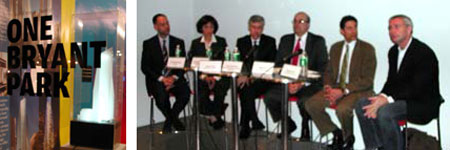
Just prior to the exhibition opening last Monday, the Center for Architecture was filled to overflowing for “Collaboration and Green Design,” a panel discussion among key players involved in the design of the 2.1 million-square-foot, 52-story Bank of America Tower at One Bryant Park. (l-r): Rocco Giannetti, AIA, Gensler; Francesca Bettridge, IALD, Cline Bettridge Bernstein Lighting Design; Scott Frank, PE, LEED AP, Jaros Bolles & Baum; Edward Depaola, PE, Severud Associates; Jody Durst, Durst Organization; Richard Cook, AIA, Cook + Fox; and Carol Willis, Skyscraper Museum (moderator, not pictured).

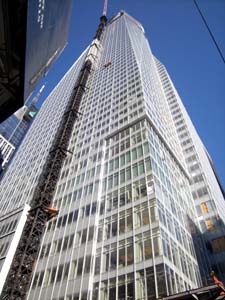
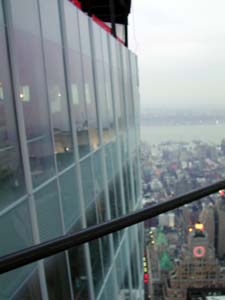
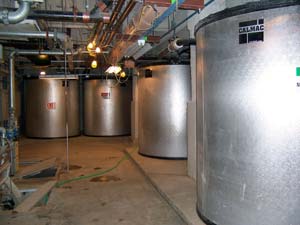
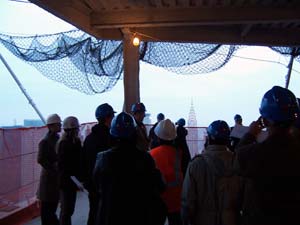
The next day, USGBC-NY hosted a hard-hat tour of the building, slated to be the first LEED Platinum skyscraper, led by Cook + Fox Associate Partner Serge Appel, AIA, LEED AP. This included walking through the thermal storage and cogeneration plants located three stories underground, a walk-through of an almost completed trading floor to review the under floor air distribution systems – and spectacular views from the 50th floor that as yet has not been glassed in.

One Bryant Park

Kristen Richards

One Bryant Park

View from the 50th floor and the high-performance glass curtain wall.

Kristen Richards

One Bryant Park

Main chiller plant.

Kristen Richards

One Bryant Park

Chilling plant system includes 40 centrifugal chiller tanks that range from 600 to 1,200 tons capacity.

Justin Stanwix

One Bryant Park

Thermal storage room.

Kristen Richards

One Bryant Park

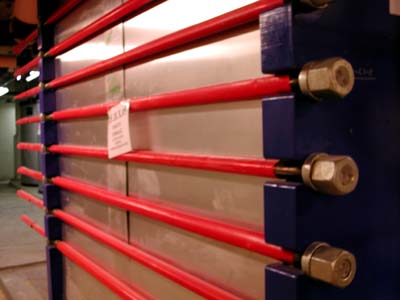
Flat plate heat exchanger (“A somewhat standard piece of equipment,” Appel said, “but I like the way they look”).

Kristen Richards

One Bryant Park

View from the top.

Justin Stanwix

12.08.07: The AIANY Emerging NY Architects Committee (ENYA) held a jury for the Schedium Call for Portfolios competition. Jurors included professor Lance Jay Brown, FAIA, artist Nancy Golding, architect Sherida Paulsen, FAIA, and The Architect’s Newspaper editor-in-chief, William Menking. Three winners — Francis Hur, Manole Voroneanu, Evangelique Zhao — and three honorable mentions — Bogdana Frunza, Alessandro Ayuso, and John Arthur Liu — were announced. Winners will take part in an evening drawing event pairing an established architect with the emerging winner, the first will be held this Spring at the Center for Architecture. The series’ sponsors are Richter+Ratner and The Architect’s Newspaper.

Schedium Jury

(l-r): Jurors Nancy Golding, William Menking, and Sherida Paulsen, FAIA.

Megan Chusid

Schedium Jury

Juror Lance Jay Brown, FAIA, discusses emerging drawing talent.

Megan Chusid

Center for Architecture Gallery Hours
Monday-Friday: 9:00am-8:00pm, Saturday: 11:00am-5:00pm, Sunday: CLOSED

Join an Architalker for a Hosted Tour of Center for Architecture
Exhibitions

Join us for free Architalker-hosted tours of the Center for Architecture exhibitions Fridays at 4:00pm. To join one of these tours, meet in the Public Resource Area on the ground floor of the Center for Architecture.

CURRENT EXHIBITIONS

January 28 — May 3, 2008

Project Showcase: The Bank of America Tower at One Bryant Park

Galleries: Margaret Helfand Gallery, Gerald D Hines Gallery, Public Resource Center

Under the growing pressure of the climate crisis, how we design, as well as what we design has become a critical issue. The new office tower at Bryant Park, designed by Cook+Fox Architects and developed by the Durst Organization and Bank of America, is an example of how the design of tall buildings can be fundamentally rethought, serving the client and the planet with equal efficiency and respect. This exhibition explores One Bryant Park as a living ecosystem composed of the elements Light, Air, Water, Fire and Earth. These primary forces, when thoughtfully addressed as integrated and sustainable systems, contribute to a substantial reduction in the environmental impact of tall buildings, as well as to worker health and productivity. Anticipating a LEED platinum rating (Leadership in Energy and Environmental Design), the highest level of sustainable design recognized by the USGBC (U.S. Green Building Council), the crystalline faceted 54-story tower is at once both an iconic corporate presence and an emblem for the green design movement. Project Showcase: The Bank of America Tower at One Bryant Park asks design professionals to look more deeply at how architecture can engage natural systems and infrastructure, how sustainable measures can be more user-friendly, and how we can raise awareness for the urgent need of comprehensive green building solutions.

Exhibition and related programs organized by the AIA New York Chapter and the Center for Architecture Foundation in collaboration with the Illuminating Engineering Society of New York (IESNY)

Curator: Margaret Maile Petty

Exhibition Design: Morris | Sato Studio

Graphic Design: WSDIA | WeShouldDoItAll

Lead Sponsor: A. Esteban & Company

Sponsors: Cline Bettridge Bernstein Lighting Design, Illuminating Engineering Society of New York (IESNY), Severud Associates, Tishman Construction Corporation

Supporter: Jones Lang LaSalle

Related Events

Saturday, February 9, 2008, 10:00 – 12:00pm & 1:00 — 4:00pm

FamilyDay@the Center: Green Light, Go!

Saturday, February 23, 2008

Symposium: Sustainability and the Lighting Profession
Will Congestion Pricing Live Up to City’s Needs?

Event: Civic Talk: Congestion Pricing
Location: Museum of the City of New York, 01.09.08
Speakers: Walter McCaffrey — Lobbyist, ex-councilmember; Michael O’Loughlin — Director, Campaign for New York’s Future; Anthony Weiner — Congressman, Bronx-Queens; Kathryn S. Wylde — President/CEO, Partnership for NYC
Moderator: Henry J. Stern — President, New York Civic
Organizers: Museum of the City of New York

Event: Congestion Pricing Public Forum
Location: Center for Architecture, 01.14.08
Speakers: Wiley Norvell — Communications Director, Transportation Alternatives; Peter Kostmayer, Hon. AIA — President, Citizens Committee for NYC; Alan J. Gerson — Manhattan District 1 Council member; Walter McCaffrey; Shirley McRae — Member, Brooklyn Community Board 2
Moderator: James Wright, AIA — Co-Chair, AIANY Transportation and Infrastructure Committee
Organizers: AIANY Transportation and Infrastructure Committee

Congestion Pricing

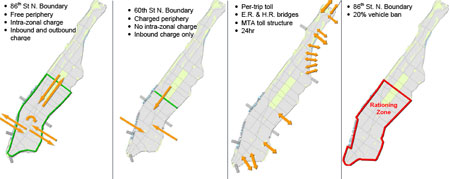
Four of the five different congestion pricing plans on the table (l-r): The Mayor’s Plan; The Alternate Congestion Pricing Plan; The East River and Harlem River Toll Plan; and The License Plate Rationing Plan.

Courtesy NYSDOT

With five plans on the table, and a $354 million federal grant at stake, the Traffic Congestion Mitigation Commission has just until January 31 to decide on the best congestion pricing proposal to recommend to the Governor, State Legislature, City Council, and Mayor for review. Recently, the commission made available its Interim Report to the Traffic Congestion Mitigation Commission outlining the strengths and weaknesses of each proposal. Over the last couple of weeks, a series of discussions, public forums, and events intended to include the public in the process have taken place around the city, and advocates both for and against congestion pricing are not making the commission’s decision easy. To make it more complicated, the commission can recommend any of the plans, a modified version of the plans, or a completely new plan.

Panelists — both for and against congestion pricing — emphasized that congestion mitigation and monetary income to improve mass transit must remain the two highest priorities throughout the decision process. Kathryn Wylde, president and CEO at Partnership for NYC, argued that since only 5% of commuters to NYC come by car, the remaining 95% mass transit riders would benefit, making congestion pricing indispensable. With one million additional inhabitants expected in coming years, something needs to be done, claimed Shirley McRae, Brooklyn Community Board 2 member. According to Michael O’Loughlin, director of the Campaign for New York’s Future, congestion pricing is one way to funnel money into the infrastructure. It’s rare to see so many government officials — from President Bush to Mayor Bloomberg — agree on an initiative, so now clearly is the time to act, urged Wiley Norvell, communications director at Transportation Alternatives.

Much of the skepticism about congestion pricing lies in trusting the government to follow through on its promises. Congressman for the Bronx and Queens Anthony Weiner doesn’t think the city will receive as much money as the government is projecting. With an influx of one million new inhabitants, the already overwhelmed subways will suffer further, stated Walter McCaffrey, lobbyist and ex-councilmember. Also, there is no guarantee that the net increase in funding will end up in mass transit as promised. Instead, congestion pricing could fail just like to the lottery — a government initiative intended to filter money into education, but built-in additional taxes drained that same money out of the system. In addition, Weiner believes congestion pricing will create a larger class divide citywide, in essence making Midtown a gated community. That the 17-person commission was selected by government officials, and the public won’t be able to vote on the issue, only reinforces his theory, he contends.

Many alternatives There are many congestion pricing alternatives to the proposed five plans. To name a few, Weiner suggested reinstating the commuter tax on vehicles commuting from outside of the city. He wants to see larger fees placed on trucks, since he believes they are the root cause of congestion, and create tax incentives for overnight deliveries to ease up truck congestion during rush hour. Also, instead of charging people in the city, he wants to see gas prices raised to “charge people at the pumps.” McCaffrey thinks the city needs to crack down on policies already in place, such as “block-the-box” violations and parking permit forgery. He also blames the construction industry for blocking streets, and would like to include construction-related blockages in the proposals, possibly by limiting hours that deliveries are made. Norvell suggested that carpooling and biking incentives be built in to the plans. As the March deadline nears for the state government to vote on the commission’s suggestions, a narrower vision of congestion pricing should emerge. Just whose interests the plan will aid is yet to be seen.