
08.31.2015: Cynthia Kracauer, AIA, Center for Architecture, Managing Director, snapped a picture of celebratory staff members James Fallarino, Events Manager, and Camila Schaulsohn, Communications Director, at the Archtober kick-off, Tweet-for-Treat. Participants received free architecturally-inspired Coolhaus ice cream sandwiches and could peer into the Center’s new space on 181 Front Street, opening officially on 09.10.15 for the exhibition opening of “Sea Level: Five Boroughs at Water’s Edge.” Continue reading “Sighted”
Author: Julia Christie
Sighted
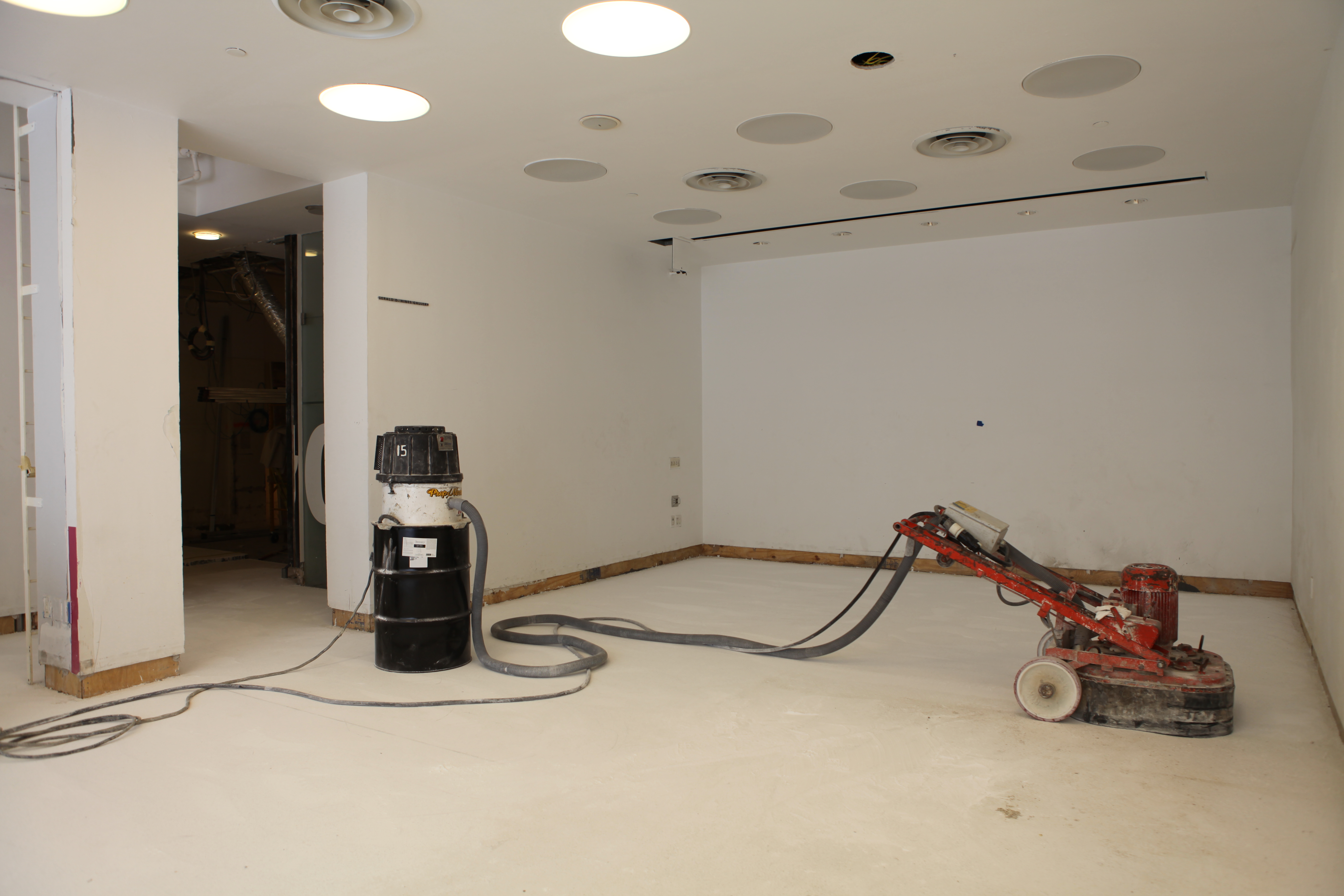
08.03.15: A work-in-progress! A snapshot of our beautiful new floor designed by Andrew Berman Architect. Come see the complete renovation at the opening of our fall exhibition “Un/Fair Use” on 09.10.2015. Continue reading “Sighted”
Representing Context as Political Strategy in Architecture
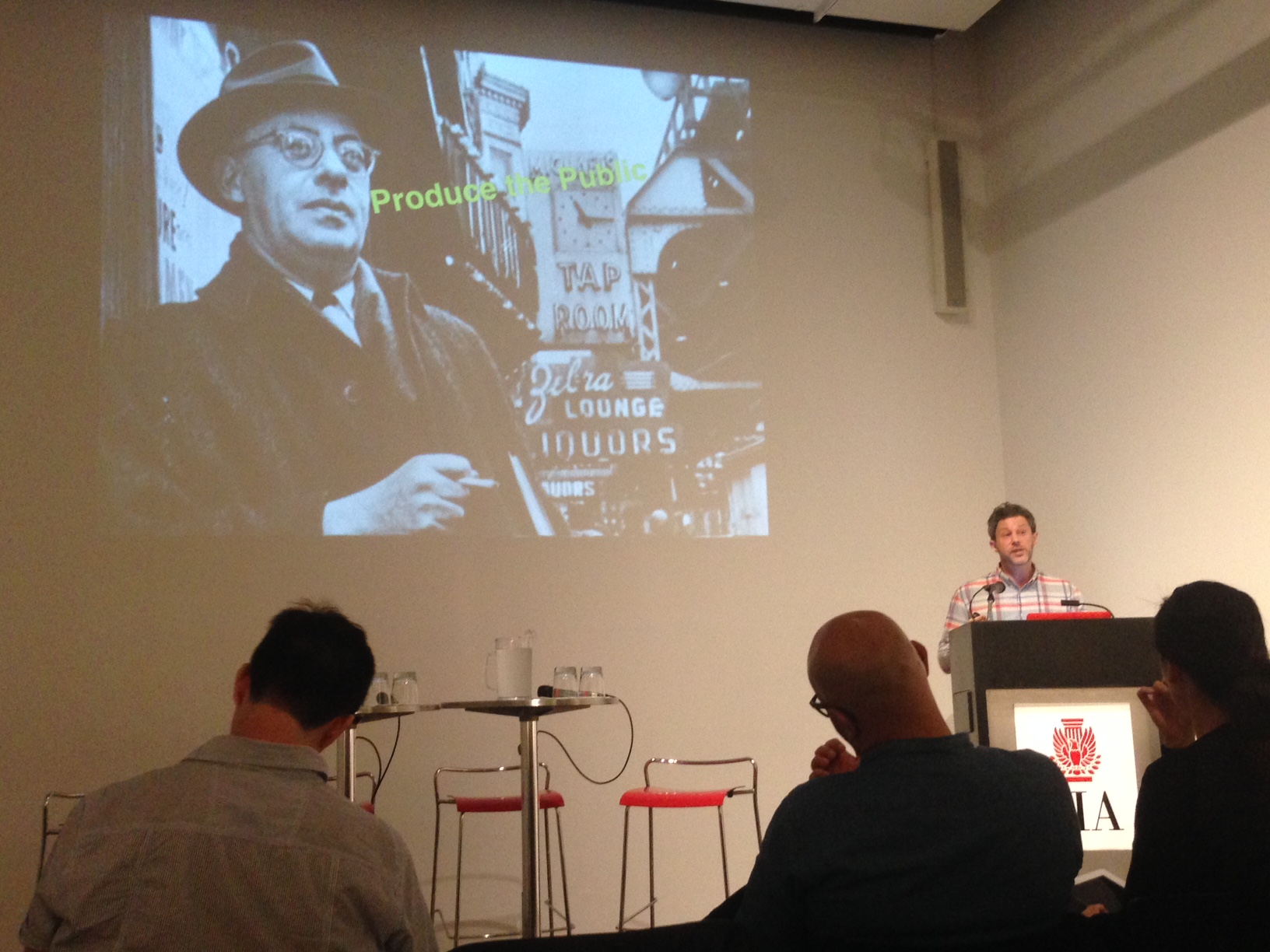
Newark Planning Office Director Damon Rich and Jae Shin, principals of Hector, Rafi Segal, principal of A+U, Quilian Riano, founder and principal of DSGN AGNC, and Alejandro de Castro Mazarro, program coordinator of the Latin American Laboratory at Columbia GSAPP, gathered at the Center for Architecture on 06.17.15 to exchange ideas about how architects can create both buildings and images that tell a full narrative, while simultaneously reflecting an urban context and communicating that context to policy makers and the public. Rich pointed out that controversies such as “poor doors” have become the site of public moral outrage, yet reflect an already existing economic disparity. Rather than answer to current social and economic inequity, how can architecture serve as a platform for resistance? Continue reading “Representing Context as Political Strategy in Architecture”
Sighted
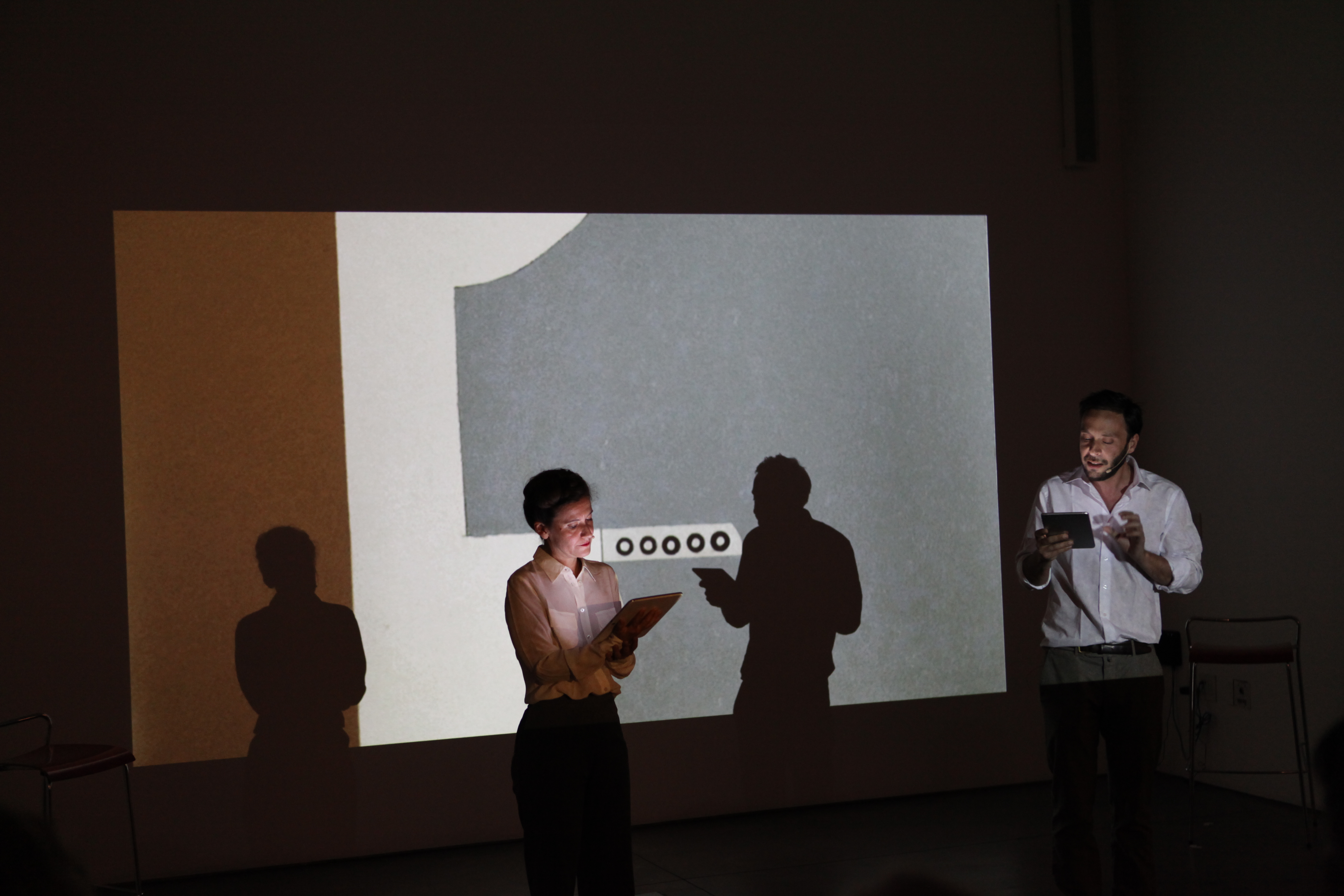
06.26.15: Anne Priol and Mica Smadja brought to life the letters between architect-designer Eileen Gray and architect-critic Mica Smadja in the performance E1027: Design for Living, directed by artist Elizabeth Lennard and organized by the Center for Architecture with support from the Graham Foundation, Trustees Brooks Adams and Lisa Liebmann of the Herman Liebmann Foundation, and the French Ministry of Culture and Communications.
06.24.15: AIANY President Tomas Rossant, AIA, spoke at the 2nd Annual Architecture Forum Perspective USA, sponsored by The Plan magazine, at the Waldorf Astoria.
06.23.15: John Cetra, AIA, Founding Principal, CetraRuddy Architecture, presented One Madison at the 2015 AIANY Housing Awards Symposium. The Symposium honored five projects, selected by jurors Philip Casey, Tom Kundig, FAIA, Nancy Ludwig, FAIA, Michael Maltzin, and Michael Sorkin, for design excellence and innovation in multifamily housing design.
06.18.15: The AIANY Oculus Committee hosted Timber in the City Editor Andy Bernheimer, AIA, NCARB, Partner, Bernheimer Architecture and co-Writer Alan Organschi, Partner, Gray Organschi Architecture. Bernheimer and Organschi presented the groundbreaking work exploring the innovative use of mass timber technologies as well as designs drawn from the Timber in the City Competition.
06.18.15: Francesca Bettridge, Michael Hennes, and Renata Gallo of Cline Bettridge Bernstein Lighting Design and Ed Pulver of ESI Design received a 2015 Lumen Award of Merit in lighting design for 330 Hudson Street Lobby at the 47th Annual IESNYC Lumen Gala.
06.18.15: Paul Marantz, Founder and Consulting Design Principal of Fisher Marantz Stone, accepted a 2015 Lumen Award of Merit in lighting design for The National September 11 Memorial Museum at the 47th Annual IESNYC Lumen Awards.
06.18.15: Charles Pavarini III and Lana Lenar of zeroLUX lighting design received a Lumen Award of Citation for Falling Sticks, a light installation in Kansas City, MO, at the 47th Annual IESNYC Lumen Gala in New York City.
06.15.15: Robert Wall, Wazir Khan, Sam Currie, Marc Gee, Peter Gluck, and Stephane Derveaux of GLUCK+ celebrated at the Opening of the Cary Leeds Center for Tennis & Learning in Crotona Park in the South Bronx. The Center, reaching an estimated 30,000 children and youth, was designed and constructed by GLUCK+ with the New York City Department of Parks & Recreation.
Building from Waste, Materializing the Invisible
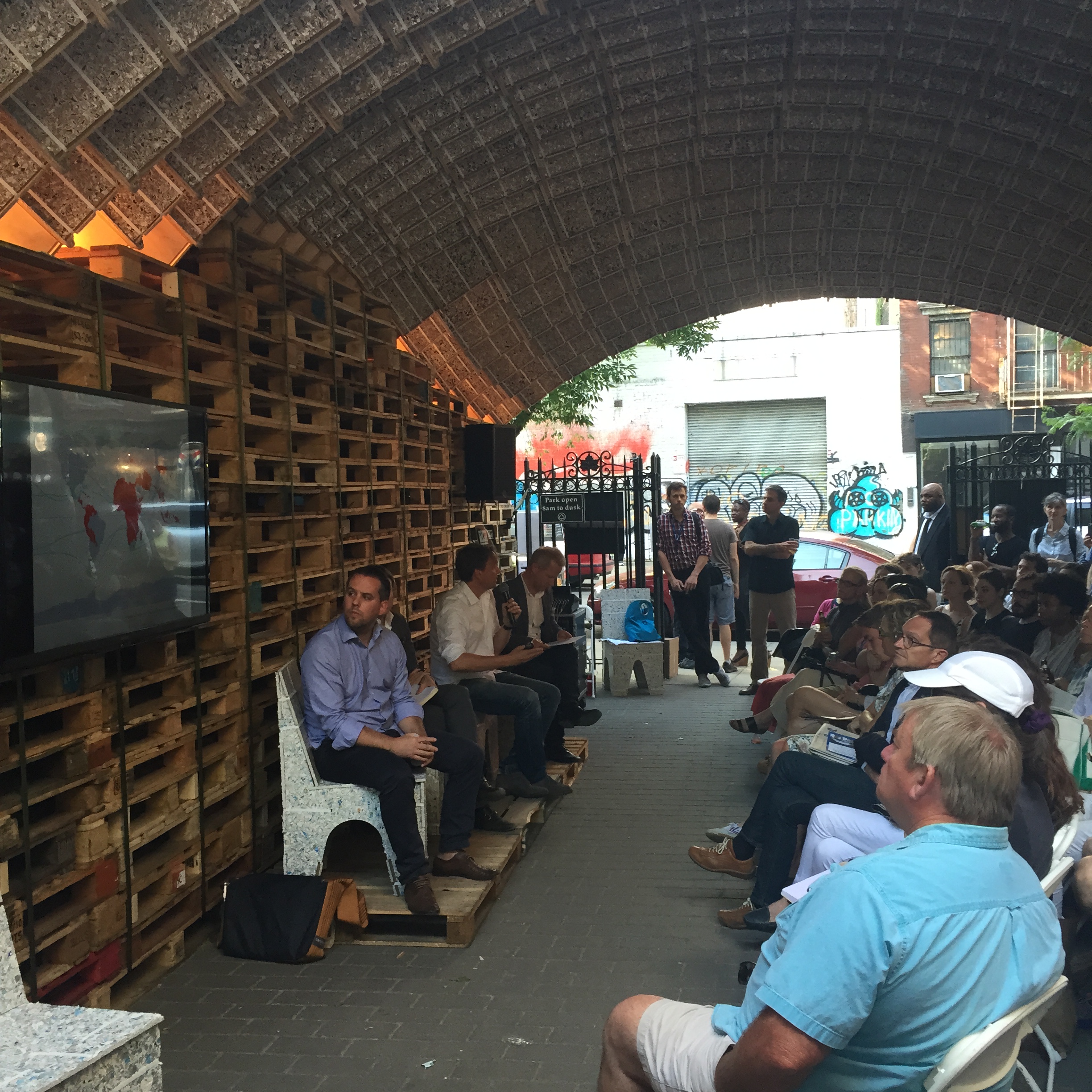
Nestled under the ETH Zurich Future Garden and Pavilion at Houston and 2nd Avenue, two panels of architects, artists, engineers, and scientists met to discuss art and design, ethical practice, and the future city. The pavilion was a temporary structure made from a variety of waste-sourced materials, from plastic-bottle blocks to tiles made from coffee grinds. The panels, organized by AIANY and ETH Zurich in partnership with the New Museum’s IDEAS CITY Festival, explored the festival’s theme “Invisible Cities,” which considered, in particular, the invisible systems, energy, and economies at work in the modern city. Looking at waste as a culturally invisible and forgotten urban product, the first panel discussed alternative building materials derived from waste as a way to build in harmony with the earth’s available resources. The second panel turned to broader ideas of how invisible spaces and systems can be made visible through art, design, and technology. Continue reading “Building from Waste, Materializing the Invisible”
Micro Units Reflect Cultural Shifts While Confronting the Housing Shortage
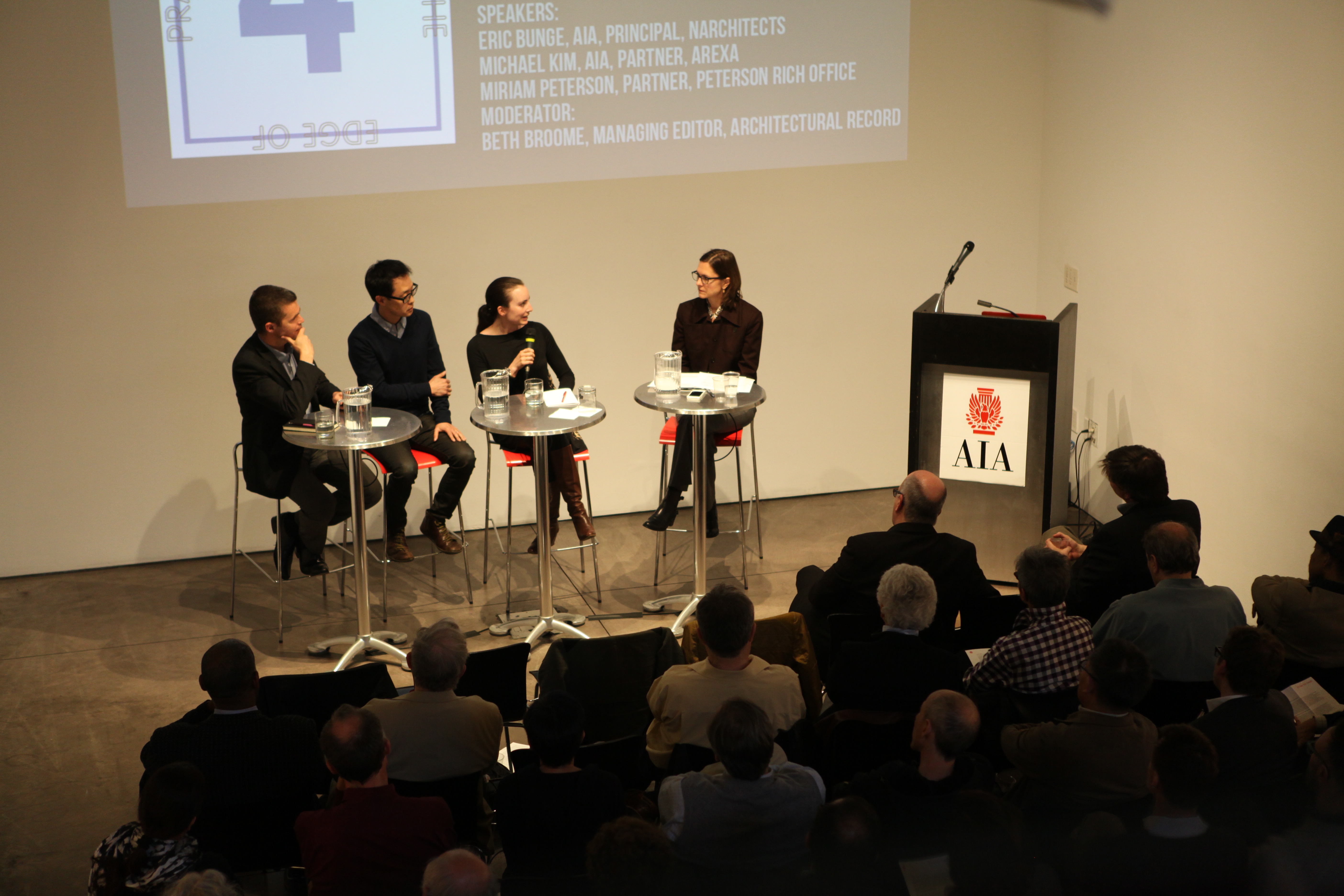
New York City’s housing stock has failed to reflect not only the demand for housing, but also the city’s changing demographics. While nuclear families comprise 18% of New York City’s population, multi-unit apartments make up 60% of the housing stock, said Eric Bunge, AIA, principal of nARCHITECTS. Micro-unit housing, a form of high-density dwelling with units for one to two people, has emerged as a means to mitigate sprawl, displacement, high rent, and other consequences of the housing crisis, while reflecting the lifestyle and culture of contemporary city residents, particularly that of the young and the elderly. In 2012, following in the footsteps of cities in Europe and East Asia that have embraced micro typologies, the city launched adAPT NYC, a competition to build a micro-unit apartment building on an empty lot at 335 East 27th Street. nARCHITECTS submitted the winning design. Bunge joined Michael Kim, AIA, partner at ARExA, Miriam Peterson, partner at Peterson Rich Office, and Beth Broome, managing editor of Architectural Record, at the Center for Architecture on 04.27.2015 for “Edge Living: Micro-Units, Live/Work Environments, and the Future of Urban Dwellings,” the fourth in the series of programs based on the presidential theme of Tomas Rossant, AIA, “Dialogues from the Edge of Practice.” Continue reading “Micro Units Reflect Cultural Shifts While Confronting the Housing Shortage”
Sighted
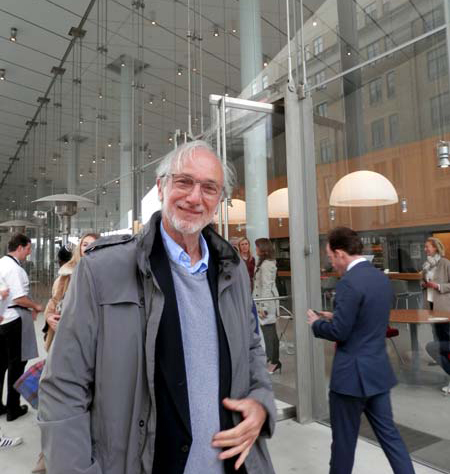
04.23.15: Renzo Piano, Hon. FAIA, taking a break from the media-zoo preview of the new Whitney Museum of American Art. Continue reading “Sighted”
The Landscape Architecture Legacy of Dan Kiley
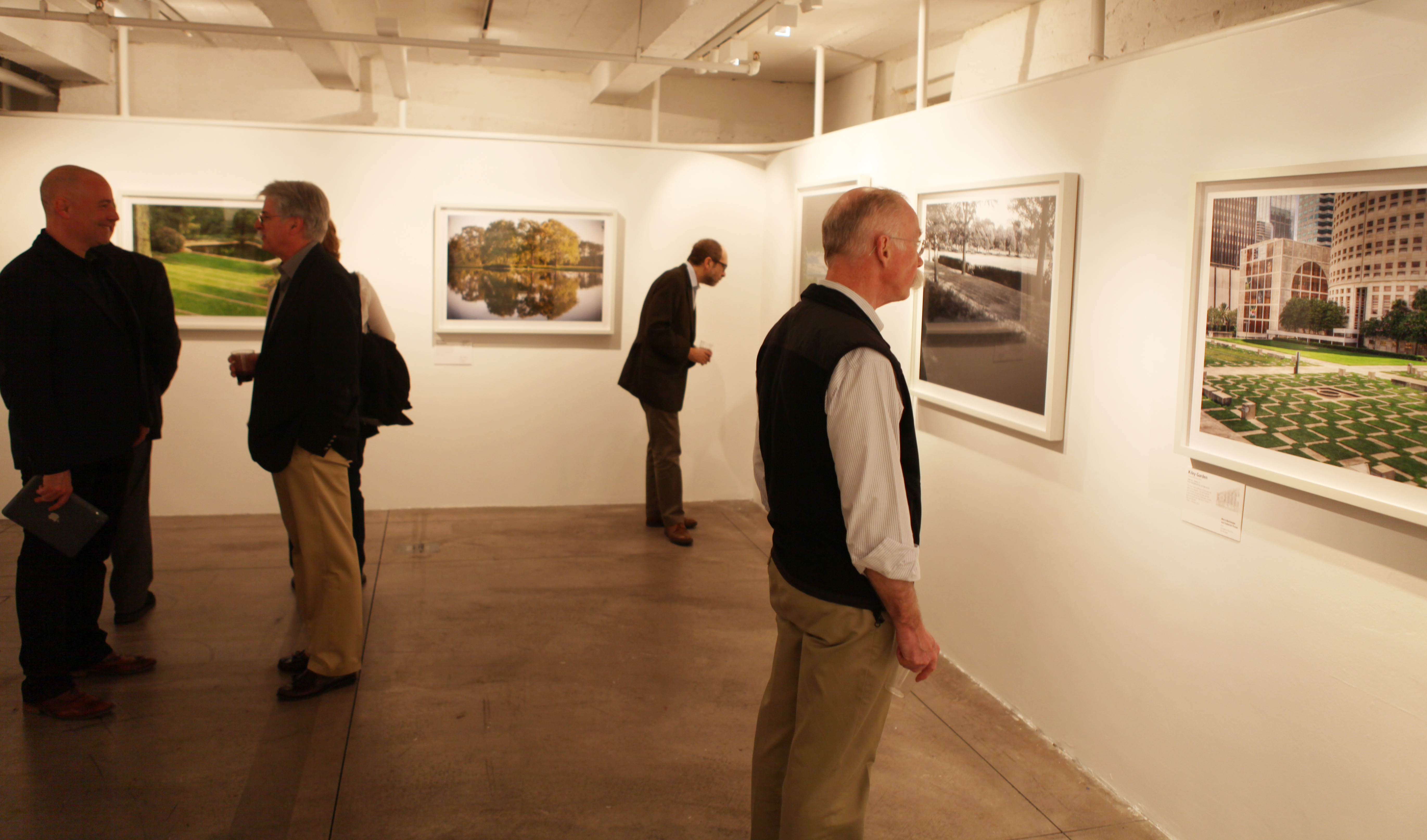
Among Dan Kiley’s designs are some of the most celebrated landscapes of the 20th century, yet many have fallen into neglect. Following his 100th birthday, The Cultural Landscape Foundation commissioned –24 artists to photograph –27 of Kiley’s more than 1,000 designs to fortify his legacy, assembling “The Landscape Architecture Legacy of Dan Kiley” exhibition. Opening in the Fall of 2013, the exhibition has traveled to five states across the country and is now on view at the Center for Architecture, in time for April, Landscape Architecture Month. The exhibition presents an introduction to Kiley’s oeuvre, showcasing his imaginative approaches to a variety of contexts, a diverse and thoughtful use of plants, and the geometric clarity of his designs. From private homes to public parks, the exhibition demonstrates how Kiley’s Modernist designs create a balance of order, lush nature, and open space, inspiring calm and awe. Continue reading “The Landscape Architecture Legacy of Dan Kiley”
The Art Under-World: the MTA Arts for Transit Program
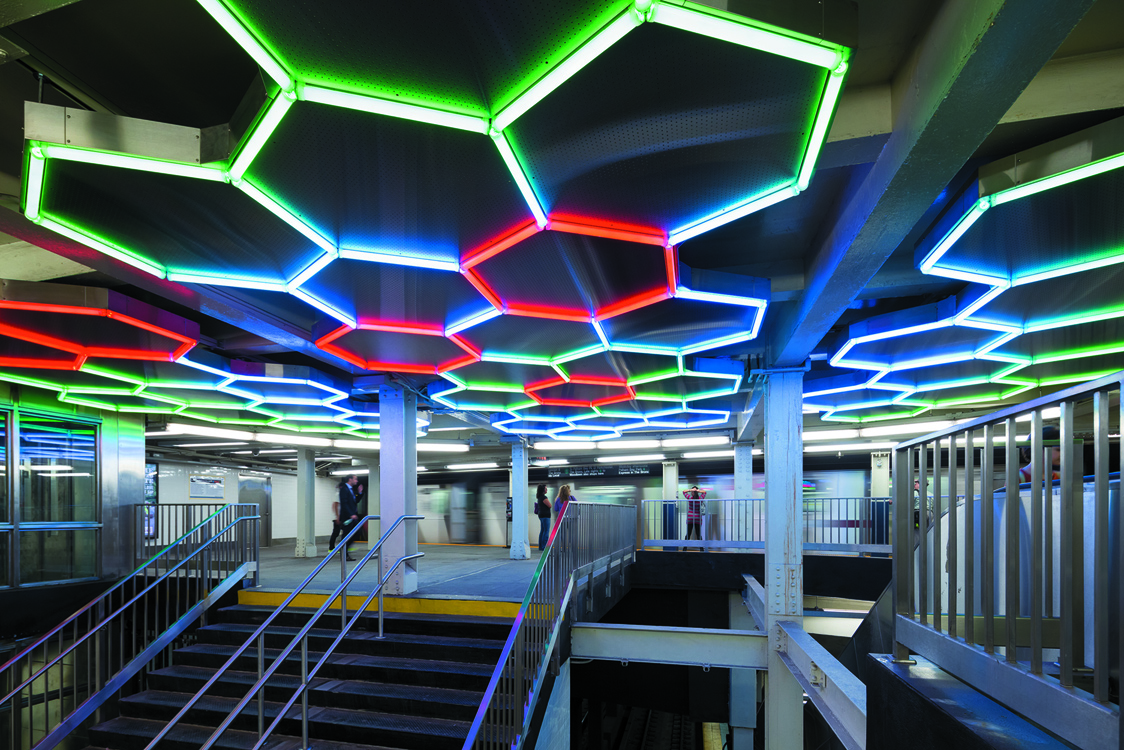
For me, it’s Nancy Spero’s Lincoln Center mosaics, Artemis, Acrobats, Divas and Dancers. I pass them nearly every day on the 1/2/3 line, and I always peer out the train window to look. Transit art is simultaneously hugely public and deeply intimate; the majority of the 4.3 million daily riders of the New York City rail system see the same works of art every day on their commute. “It’s a museum, with hundreds of miles of walls; it’s a museum that never closes; it’s a museum with a fairly modest entry fee,” praised Sam Roberts, New York Times Urban Affairs correspondent. The MTA’s Percent for Art Program, which dedicates 1% of the cost of city-funded construction projects to public art, has repurposed the many walls of our underground streets into a living museum. The program was instituted in 1982 by Mayor Edward Koch and pushed by Ronay Menschel, founder of MTA Arts & Design, at a time of a reinvestment in the city’s public transit. Since its inception, MTA Arts & Design has commissioned 260 works of public art. On 02.19. 15, director of MTA Arts & Design Sandra Bloodworth, artist Andrea Dezso, Sam Roberts, and Ronay Menschel, former MTA board member, gathered at the Museum of the City of New York to talk about the history and vision of MTA Arts and the Percent for Arts Program. Continue reading “The Art Under-World: the MTA Arts for Transit Program”
Embracing the Waterfront, from New York to Copenhagen
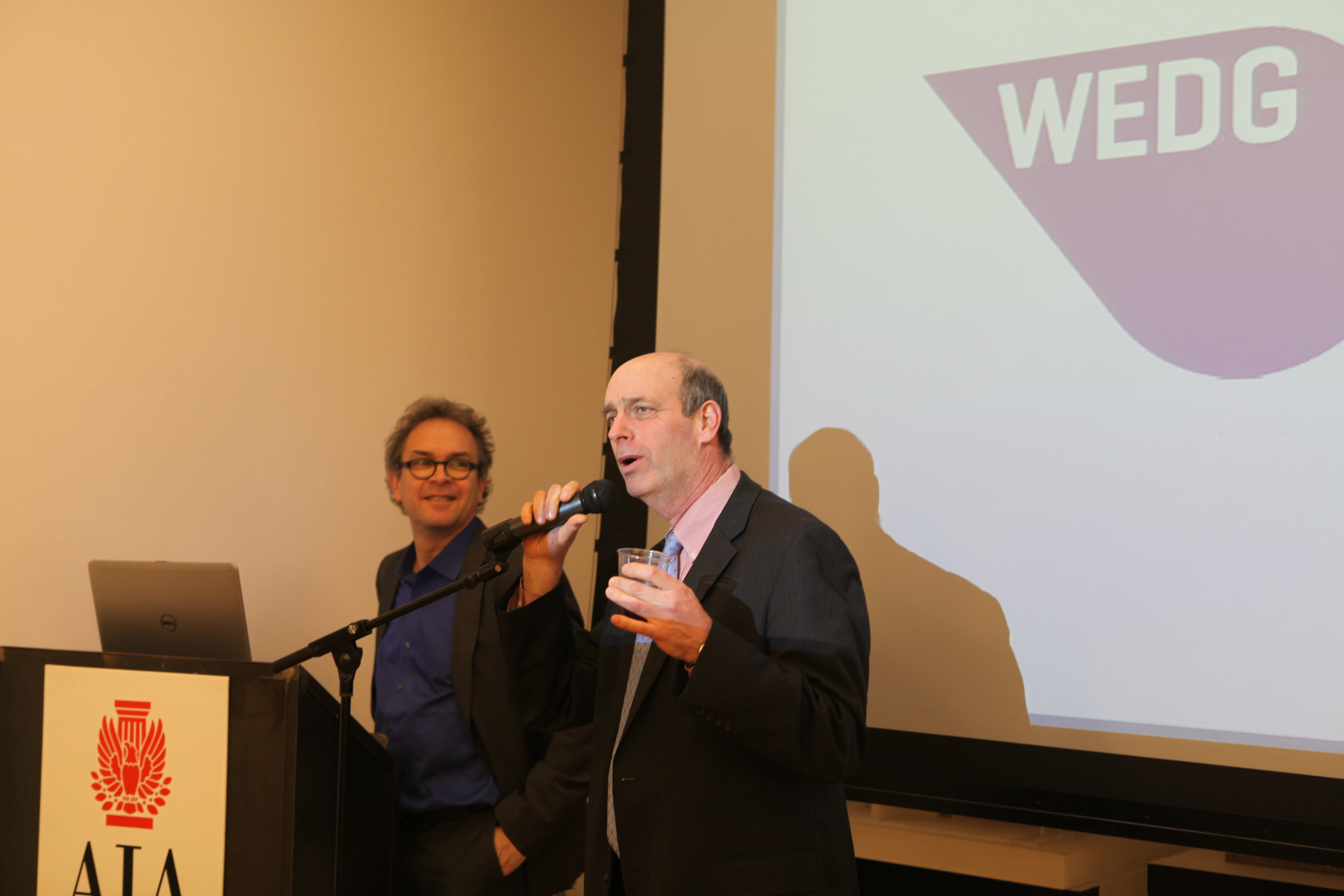
“The water keeps reminding us that the water is actually changing,” remarked Lykke Leonardsen, head of Copenhagen’s Climate Unit. Waterfronts, once hosts to the very industries contributing to pollution, are now particularly vulnerable to rising sea levels. In the last few decades, abandoned postindustrial waterfront sites have been reclaimed by municipalities and transformed into integrated social and recreational urban spaces in the form of parks, housing, beaches, and other facilities. Waterfront Edge Design Guidelines (WEDG) was created by the Metropolitan Waterfront Alliance (MWA) to ensure waterfront access is met with resilient, ecological, and equitable design. A panel on waterfront resiliency strategies in New York and Copenhagen accompanied the opening of MWA’s WEDG exhibition at the Center for Architecture. Continue reading “Embracing the Waterfront, from New York to Copenhagen”