New Glass Shatters Old Perceptions

Event: Engineered Transparency: Glass in Architecture and Structural Engineering
Keynote Speaker: Kazuyo Sejima — Founding Partner, SANAA
Location: Columbia University, 09.26-28.07
Organizers: Columbia University Graduate School of Architecture, Planning and Preservation; Columbia University Department of Civil Engineering and Engineering Mechanics; with Technische Universität Dresden’s Institute of Building Construction
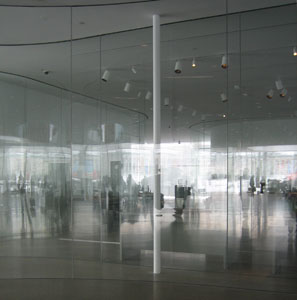
Glass Pavilion

The Glass Pavilion at the Toledo Museum of Art, designed by SANAA.

Jessica Sheridan

Offering new modes of visual pleasure and spatial experience, glass has benefited from major advances in engineering and structural innovations. The Engineered Transparency conference brought together international architects and engineers to discuss the present and future implications of glass in building design.

Considered one of the most advanced firms working in glass, founding partner of Tokyo-based SANAA, Kazuyo Sejima, kicked off the three-day conference with a keynote presentation of recent projects that push glass technologies to new limits. One of the best examples is the Glass Pavilion at the Toledo Museum of Art in Ohio, housing the museum’s extensive glass collection, with more than 5,000 works from ancient to contemporary times. Constructed of double-layered, floor-to-ceiling, curved glass panels, the undulating walls blur the boundaries between the exterior and interior spaces. The project pushes the definition of glass as a material as the curves alternate a viewer’s clarity and obscurity, reflection and distortion. In addition, the relationship between inside and outside is intensified. Visitors are constantly aware of their surroundings as the glass walls provide a dual experience of the outside environment overlapping the exhibition spaces.

The Glass Pavilion resurfaced throughout the conference as one of the best examples of cutting-edge glass design. The plan of the pavilion reveals challenges not just in aesthetics and experience, but also in structure, and heating and ventilation. Guy Nordenson, of NY-based Guy Nordenson and Associates Structural Engineers and structural engineer for the project, discussed the unique steel framing in the roof and concrete framing in the floor to enhance the thin panes of glass. Matthias Schuler, of Stuttgart-based Transsolar, talked about climate engineering challenges given the cellular structure of the galleries. The inner walls make up the galleries, and the exterior walls create cavities to insulate and provide heating and ventilation.

While glass might always have been a popular material, it is only recently that its technology has advanced structurally, aesthetically, and thermally. Engineered Transparency only scratched the surface of what is to come.
2nd Annual National Design Week, 10.14-20.07

10.16.07: Cooper-Hewitt’s 2007 National Design Awards Winners Panel

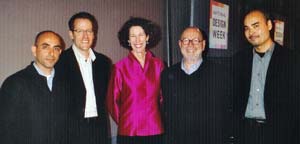
Cooper Hewitt Design Panel

Winners panel (l-r): Nader Tehrani; David J. Lewis; Cara McCarty; Peter Walker, FASLA; and Marc Tsurumaki, AIA.

Kristen Richards

Several hundred people gathered under the large, white “big-top” tent installed in Cooper-Hewitt’s garden to hear from some of this year’s National Design Award winners. The panel discussion covered a range of subjects, from collaboration, fame, tough projects, and green design, to challenges and rewards, and persuading clients. Panelists included: Marc Tsurumaki, AIA, and David J. Lewis, Lewis.Tsurumaki.Lewis (LTL); Nader Tehrani, Office dA; Peter Walker, FASLA, PWP Landscape Architecture; fashion designer Rick Owens; with Cooper-Hewitt Curatorial Director Cara McCarty as moderator.

They offered some interesting — and amusing observations…

On collaboration:
Lewis/Tsurumaki: “We get along fine and we never argue [laughter]; the best idea wins.” “It’s based on redundancy. All three of us are involved, which allows us to play off of each other, not compete.”

On fame:
Tehrani: “We thought the MoMA project [Fabrications: The Tectonic Garden, 1998] would bring us fame and jobs — it didn’t.”

On challenges:
Walker: “The World Trade Center Memorial is the toughest project. I’m still not sure how it will work out.”…”Landscape urbanism — what is it? I don’t know what it is. We’re now more involved in spaces on top, spaces in-between.”

Lewis: “Too often sustainability is talked about as something applied rather than fundamental integration. For us, it’s a source of innovation rather than obligation.”

Tehrani: “To raise the bar of green design — overcome policies, rules, and regulations — how can we, as architects, raise the standards?”

On rewards:
Lewis: “We’re too busy to step back and figure out what’s rewarding.”

On persuading clients:
Tehrani: “It’s what we do all day. We have to get people to buy in. We design with the client — they own the process.”

On role models:
Tehrani: “Those guys.” [indicating LTL] “I wish they’d stop winning competitions and give some to us.”

Owen (who was the quietest, but had the biggest/loudest crowd of fans in the audience): “I changed my mind. Now I want to be an architect.”


2007 National Design Awards After-Party

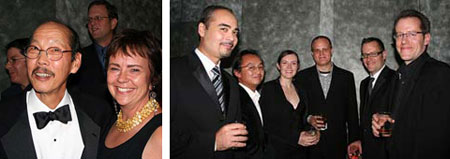
Cooper Hewitt After Party

(Left): Frank Ching with wife, Debra. (Right): LTL gang (l-r): Marc Tsurumaki, AIA; Thomas Tsang; Caroline O’Donnell; Troy Schaum (former LTL staff member, currently at OMA); Paul Lewis, AIA; David J. Lewis.

Sara Moss

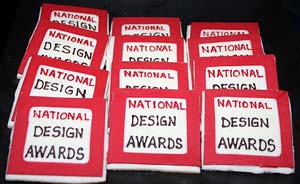
10.18.07: Award winners and guests enjoyed dancing, drinks, and even National Design Award cookies at the Cooper-Hewitt’s after party, hosted in the museum’s Target National Design Education Center. I had the pleasure of chatting with Lewis.Tsurumaki.Lewis (LTL), who won the National Design Award for Interior Design, and the honor of meeting Frank Ching, who received a Special Jury Commendation for his role in design education.

Other award winners were: Maharam (Design Patron Award); Denise Scott Brown, RIBA, and Robert Venturi, FAIA (Design Mind); Adobe Systems Incorporated (Corporate Achievement Award); Office dA (Architecture Design Award); Antoine Predock, FAIA (Lifetime Achievement); Chip Kidd (Communications Design Award); PWP Landscape Architecture (Landscape Design); Jonathan Ive, Apple (Product Design); and Rick Owens (Fashion Design). For more information on the program, including a list of this year’s finalists, and video of the awards gala, go to the National Design Awards website.

Cooper Hewitt Cookies

Sara Moss

Convention Focuses on Liability, Control, Public Policy

Event: 2007 AIANYS Convention: The Past As Prologue
Location: Grand Hyatt, NYC, 10.04-06.07
Speakers: Collaborative Design and Insurability: Frank Musica, Esq. & David Blue — Victor O. Schinnerer & Company; Design Professionals and Public Policy: Joan Blumenfeld, FAIA, IIDA, LEED AP — 2007 AIANY President & Principal, Perkins + Will; Mark Strauss, FAIA, AICP — AIANY Immediate Past President & Principal, FXFowle Architects; Sherida Paulsen, FAIA — AIANY Vice President of Public Outreach & Principal, Pasanella+Klein Stolzman+Berg Architects
Organizers: AIA New York State

It seems that architects have started to lose control over their profession. Or perhaps the profession no longer belongs to just architects. Client demands and expectations have increased, building standards have risen, the field is more specialized, and new technologies make it permanent. General contractors, subcontractors, consultants, and various other specialists are completing an increasing amount of the design and management work, leaving architects more like subcontractors than leads.

What can architects do to regain the role they traditionally held? Collaborative Design and Insurability, a panel discussion led by Frank Musica, Esq., and David Blue of Victor O. Schinnerer & Company, spoke to both sides, covering architects’ increasing roles as collaborators professionally and with clients. New technology, such as B.I.M. (Building Information Modeling), may shift the practice away from traditional drawing methods, but it saves production time better spent preparing more thorough contracts. This matters because contracts need to be adjusted with the changing times — for instance, the sustainability movement.

As green design becomes less of a commodity and more of a standard, having a written statement understood by client and architect can help avoid potential lawsuits and reduce professional liability costs. Insurance companies adjust rates for firms practicing green design on a case-by-case basis, yet liability insurance costs will soon be adjusted profession-wide.

AIANY is taking steps to help architects reposition themselves legislatively. Design Professionals and Public Policy, led by Joan Blumenfeld, FAIA, IIDA, LEED AP, 2007 AIANY president, Mark Strauss, FAIA, AICP, AIANY immediate past president, and Sherida Paulsen, FAIA, AIANY vice president of public outreach, discussed the Chapter’s policy committee. Intended for members to become more proactive in legislative issues, the committee deals with the ways architects practice and the liability involved in practicing. When it launches, the new AIANY website will also provide an interactive interface for architects to discuss policy issues, and the Public Information Exchange (PIE) will expand its capabilities to include a blog for such discussions.

As one of the attendees stated, we are “creative problem solvers” and must reach out to the public. Architects’ ideas are only relevant if they are shared.

NYC: A Soul at Stake

Event: Is New York Losing Its Soul?
Location: Donnell Library Center, 10.03.07
Speakers: Alison Tocci — President & Group Publisher, Time Out New York; Darren Walker — Vice President, Rockefeller Foundation; Tama Janowitz — novelist; Rocco Landesman — President, Jujamcyn Theaters
Moderator: Clyde Haberman — columnist, The New York Times
Organizers: The Municipal Art Society

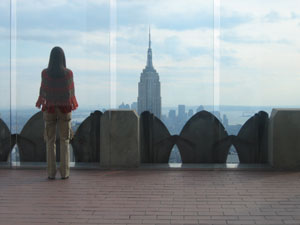
Empire State Building

The Municipal Art Society asks if Jane Jacobs would think NYC is losing its soul.

Jessica Sheridan

NYC’s ever-increasing crop of chain stores and banks is changing more than just the landscape. The city’s “soul” surfaces in many ways: artists and independent retailers; immigration and ethnic diversity; “organic messiness” and “sexiness.” The underlying theme overall, however, is uniqueness.

With the “Disneyification” of Times Square and the Atlantic Yards project as hot-button topics, panelists wondered: What would Jane Jacobs do? Her advocacy of short, tree-lined blocks, population density, and retail variety could be the answer; or maybe her 1950s approach to urban planning is irrelevant now. Panelists emphasized the importance of maintaining vital immigrant and working-class communities, and noted that the city’s African-American and young residents are on the verge of being priced out.

The onus falls on the city government to create sufficient interventions where growing economic inequality threatens the city’s uniqueness, such as through rent control or tax-break programs. According to Darren Walker, vice president of the Rockefeller Foundation, NYC has had the most aggressive subsidized housing program in the U.S. since Mayor Koch, and it is still insufficient. With significantly more demand than supply, and a million new residents projected in the next 10 years, creative solutions are needed at the leadership level.

Founded by a Dutch trading company, NYC has been shaped by money as much as it has by its penchant for evolution and reinvention. The question is how it will reinvent itself in this era of the market-based economy, when developers and “big money” seem to hold the cards. More questions than answers were raised, and there may not be a definitive solution. Jane Jacobs would turn the question to the community, and seek action at the neighborhood level.

For Once, a View from the Ground Up

Event: The World Trade Center Site: Designing the Public Realm
Location: Center for Architecture, 09.18.07
Speakers: Panel A: Program and Schedule: Steven Plate — Director, World Trade Center Construction, The Port Authority of NY and NJ; Joan Gerner, Assoc. AIA — Executive Vice President of Design Construction & Capital Planning, National September 11 Memorial & Museum; Janno Lieber — WTC Project Director, Silverstein Properties; Panel B: Planning and Design of the Public Realm: Joe Brown, FASLA — President/CEO, EDAW; Peter Walker, FASLA — Partner-in-Charge, Peter Walker and Partners Landscape Architects; Anne Lewison, AIA — Architect, Snøhetta; Respondents: Allen Swerdlowe, AIA — Chair, New York New Visions (NYNV) Site Committee; Ned McGuire — Chair, Civic Alliance, NYNV Memorial Committee
Moderators: Panel A: Rick Bell, FAIA — Executive Director, AIANY; Panel B: Ernest Hutton, Assoc. AIA, AICP — Co-Chair, NYNV
Organizer: New York New Visions

WTC Progress

Work is being done at Ground Zero.

Courtesy Joe Woolhead, www.panynj.gov

As designs crystallize at the World Trade Center site, people are wondering what Lower Manhattan will look like from the ground — not just from the bird’s-eye perspective seen in many published renderings. Speakers from city agencies and key designers recently provided a status report focusing on at-ground activity and the public realm.

Grade-level planning begins at the programming and scheduling stages. For example, to enhance a visitor’s experience of the National September 11 Memorial and Museum, pedestrian planning is being considered while the design is at its preliminary phases, according to Joan Gerner, Assoc. AIA, executive vice president of design construction and capital planning. Using computer software, the team created a visualization of the Memorial’s pedestrian traffic patterns of visitors, residents, and workers. On a larger scale, the new towers will relate to each other and the surrounding neighborhoods because of the collaboration among site architects throughout the design process, not just after the designs have been solidified, explained Janno Lieber, WTC project director at Silverstein Properties.

A key factor when designing a building or memorial is how it will relate to the public realm; and every firm designing for the WTC site is approaching this challenge differently. When planning the overall site, urban designers from EDAW are looking to “totally reform the public realm of Lower Manhattan,” stated president/CEO Joe Brown, FASLA. From details (the design of street lights) to overarching principles (promoting civic activity and interaction), EDAW is carefully considering the shaping of the sites’ public spaces. Peter Walker, FASLA, partner-in-charge of Peter Walker and Partners Landscape Architects, designing the landscape of the World Trade Center Memorial, is attempting to re-imagine the relationship between secular and sacred spaces by integrating active and contemplative elements. Planted trees are intended to arch like cathedrals over busy paths, for example. A memorial pavilion, designed by Snøhetta, will glow at all hours and act as a beacon on the site.

The public desires Ground Zero to be wonderful, and built soon.

New High Line to Open in 2008

Event: High Line Discovered
Location: Center for Architecture, 09.25.07
Speaker: Robert Hammond — Co-Founder, Friends of the High Line
Organizer: NY Chapter/American Society of Landscape Architects

High Line

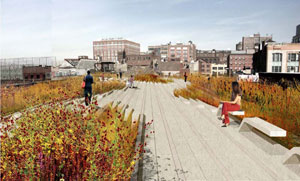
The High Line: NYC will be the world’s second city to boast a 1.5-mile linear promenade (the other is Promenade Plantée in Paris).

Courtesy Friends of the High Line

More than a year after the first grass-covered plank was removed from the abandoned High Line, the elevated rail bed is being transformed, and the first section running from Gansevoort Street to 20th Street is projected to open in 2008. Robert Hammond, co-founder of the Friends of the High Line (FHL), described the design-selection process and recounted the two international competitions that led to the final concept.

The last train ran in 1980. Since then, nature reclaimed the rail bed and the High Line faced demolition plans for much of the past two decades. The design team, led by Field Operations and Diller Scofidio + Renfro with co-opted engineering, lighting, and horticulture experts, seeks to preserve and reinterpret the industrial-meets-natural condition of the structure.

Concrete planks will meander the promenade, morphing into furniture and acting as a smooth walkway. Hundreds of plant species, selected by Dutch horticulturalist Piet Oudolf, will sprout through the seams of the curbs and create a patchwork of local perennials, shrubs, grasses, and trees. Running through the Meatpacking District, West Chelsea, and Hell’s Kitchen, the “park-in-the-sky” will be open at night, with low lighting illuminating the path allowing visitors to experience the city lights.

Hammond used a map to show the development slated to take place near the High Line in the coming years — including the Whitney Museum of American Art’s satellite museum to be located on Gansevoort Street at the gateway to the promenade. While the future of the rail bed from 30th to 34th Streets is still up in the air, Hammond said that the momentum of the FHL’s partnership with NYC and other supporters leaves room for optimism.

Architecture as Social Policy

Event: Politics, Publics and Design
Location: Graduate School of Architecture, Planning, and Preservation (GSAPP), Columbia University, 09.10.07
Speakers: Dr. Rene Spitz — Chairman, International Design Forum (IFG), Ulm; Kenneth Frampton — Ware Professor of Architecture, GSAPP, Columbia University; Adi Shamir — Executive Director, Van Alen Institute
Organizers: Kadambari Baxi — Associate Professor, Undergraduate Architecture, Barnard College & Columbia College; Irene Cheng — Doctoral Candidate, GSAPP, Columbia University

Living City

Living City was awarded a 2007 New York Prize Fellowship through the Van Alen Institute.

Courtesy David Benjamin and Soo-In Yang

In a time where globalization meets global warming, the boundaries between public and private are constantly shifting. The International Design Forum (IFG) Ulm and Van Alen Institute are two organizations examining the relationships among politics, the public realm, and design — the former with an annual design competition, and the latter with its New York Prize Fellowship.

The Designing Politics competition intends to “encourage projects to develop consequences which leave a lasting mark on our social and physical environment,” according to Dr. Rene Spitz, IFG Ulm chairman. What made the winning projects in 2006 stand apart from other submissions was the way they examined the relationship between design and politics.

The KwaThema Project: Designing Negotiations Between Planning and Violence, submitted by Hannah le Roux of Johannesburg, proposes to overcome the tension between violence and planning within derelict public spaces in a small township in South Africa by working with the local community. One aspect of the project, for example, is to transform an eroding former liquor store into a children’s playground with help and input from local school children. Uncounted Counts. Citizenship by Design and Design for Democracy is a research project investigating the relationship between the individual and the state, examining nationality within globalization. Created by Kadambari Baxi, associate professor at Barnard and Columbia Colleges, and Irene Cheng, doctoral candidate at the Graduate School of Architecture, Planning, and Preservation (GSAPP), Columbia University, research will lead to prototypes of alternatives to the standard products, including passports, naturalization tests, ballot papers, and election booths.

The Van Alen Institute’s 2007 New York Prize Fellowship “provides international emerging practitioners and scholars an opportunity for in-depth research and a platform for interventions in the public realm,” according to the online overview. Living City, one of the prizes awarded to David Benjamin and Soo-In Yang, evaluates NYC’s air quality. For three months, Benjamin and Yang will develop a full-scale architectural membrane that “breathes” reacting to the surrounding air quality. Through a responsive, kinetic surface, movement is converted into public information.

In response to the panel discussion held at GSAPP on the two programs, Kenneth Frampton, Ware Professor of Architecture at GSAPP, discussed the importance of contextualization, but voiced concern over the inherent latency some of the projects presented. Whether or not all of the projects will be implemented, the proposals are forward looking and a step in the right direction toward social responsibility.

New York’s Nine Schools Parade Own Identities

Event: arch schools: r(each)ing out
Location: Center for Architecture, through 10.19.07
Exhibition Designer: Leah Gazit
Participating Schools: The City College of New York; Columbia University; The Cooper Union for the Advancement of Science and Art; Cornell University; New Jersey Institute of Technology; New York Institute of Technology; New York School of Interior Design; Parsons The New School for Design; Pratt Institute; Princeton University; Rensselaer Polytechnic Institute; School of Visual Arts; Syracuse University; University at Buffalo (SUNY); University of Pennsylvania; Yale University
Organizers: AIANY; Center for Architecture Foundation
Sponsors: Kohn Pedersen Fox Associates; RMJM Hillier; Skidmore, Owings & Merrill; Support by: Pei Cobb Freed & Partners; Friends: Beyer Blinder Belle Architects & Planners; Butler Rogers Baskett Architects; Francois de Menil Architect; Gabellini Sheppard Associates; Mancini Duffy; Robert A.M. Stern Architects; Terrence O’Neal Architect

arch schools: r(each)ing out

Courtesy Center for Architecture

The arch schools: r(each)ing out exhibition at the Center for Architecture and its title express the unique identity of the nine participating schools while linking them back to their common focus: architecture. To whom do architecture schools r(each) out? Do they network with each other or the field at large? What do the parentheses emphasize? How shall I connect these schools conceptually and graphically? After considering these questions, I was able to focus the design of the exhibition on the connection among the schools and the communicative dialogue it inspires.

How to challenge uniformity was an obvious and inevitable issue. Each school is committed to thinking outside the box and stretching the boundaries of the given space. After the schools proposed concepts for exhibiting their new architectural ideas, I saw a need to tie them together with one consistent and bold gesture — a single, yellow line.

This line serves to visually unify the schools and emphasize the details of the exhibited designs. By giving the schools 24″x36″ model zones and 48″x96″ presentation boards, I could maximize the three-dimensional potential of every two-dimensional surface. The vivid vinyl strip of modulating width traverses the monochromatic space with one clean cut. It starts at the top of the white wall, weaves behind the school boards, folds at the edge of the unfinished concrete floor, and concludes by wrapping around the base of each model. This simple graphic intervention highlights the expression of all contributing schools, while maintaining a coherent continuity among them.

From the interactive projection screens included in the displays of both Columbia University and New Jersey Institute of Technology, to the clever model base designed by the University of Pennsylvania, and the intricately carved floating model from Princeton University, each school creatively overcomes the barriers set by the standardized requirements, and, in turn, sparks a discourse between students and professionals.

New Practices Grows Up

Event: New Practices New York Showcase Series
Location: Häfele Showroom
Speakers: Winners of the 2006 New Practices New York competition
Organizer: AIANY New Practices Committee; The Architect’s Newspaper
Sponsor: Häfele America Co.

Zakrzewski Hyde Architects

Travelogue, an installation by Zakrzewski Hyde Architects, is currently on view at the Häfele Showroom. It is the final installation of the New Practices Showcase series.

Zakrzewski Hyde Architects

This month marked the end of the 2006/7 New Practices Showcase Series and the beginning of a new series of programs organized by the AIA New York Chapter’s youngest committee, the New Practices Committee. The program germinated two years ago at a new members reception at the Center for Architecture, when Nino Hewitt, AIA approached Susan Chin, FAIA, (2005 AIANY President) and myself and asked, “What kind of support does the AIA provide for new practices? I just started an architectural firm (LEVEL Architecture), and I need some help.”

Susan and I looked at each other and quickly realized that, although the Chapter has a professional practice committee, an emerging architect committee, and offers numerous forums for young professionals, we did not provide many programs that were specifically aimed at the needs of recently-developed practices. We decided to remedy the situation by partnering with The Architect’s Newspaper and launching “The New Practices Roundtable,” a series of programs reaching out to young practices offering resources in areas of business practice, technology, and marketing. At the roundtables, new practitioners shared ideas, discussed best practices, and vented frustrations. It was “group therapy for emerging practices.” The series was a major success and attracted over 500 attendees in four sessions.

One year later, we expanded the program to showcase emerging practices entitled “New Practices New York.” To launch the program, we announced a mini-portfolio review for practices founded after January 1, 2000. More than 50 practices submitted, and six architectural firms were selected: Architecture In Formation; G Tects; Gage/Clemenceau Architects; Interboro Partners; WORK AC; and Zakrzewski Hyde Architects.

The showcase highlighted the firms’ achievements in a group exhibition at the Center for Architecture last summer. (The show was re-exhibited at a gallery during the AIA Convention in San Antonio this past May, and is traveling to London this fall.) Following the initial showing, a bimonthly exhibit and reception was held for each of the practices at the Häfele Showroom. The final showcase, featuring Zakrzewski Hyde Architects, is on display through the end of August.

A new generation of young architects is now gaining recognition and becoming leaders in the professional community, thanks to the showcase program. In fact, a number of the participants have taken the reins and are turning the roundtables into a full-fledged committee at the chapter. The new committee’s first program, “Super-Models, MEGA_100+, Large-Scale Firms Revised,” was held at the Center on July 11, and examined how large practices are redefining themselves to emulate the passion and agility of young practices (See “Large Firms Struggle to Outbid Small Firms,” by Jessica Sheridan, Assoc. AIA, LEED AP, in this issue of e-Oculus). In the next issue of e-Oculus, Matthew Bremer, AIA, principal of Architecture In Formation, and Marc Clemenceau Bailly, AIA, principal of Gage/Clemenceau, will write about the objectives of this new committee. If you are interested in joining and/or participating in the committee, please contact Amanda Jones, AIANY Program Committee Coordinator.

In closing, I want to thank Susan Chin, FAIA, Joan Blumenfeld, FAIA, IIDA, AIANY President, James McCullar, FAIA, Rick Bell, FAIA, and the staff at the AIA NY Chapter, The Architect’s Newspaper, Häfele America, and all our program sponsors and participants. It’s been a great run, and we look forward to the next generation of programs for young practices.

NYIT Students Make a Solar Difference

Event: 2007 Solar Decathlon
Location: National Mall, Washington D.C., 10.12-20.07
Organizers: U.S. Department of Energy’s Office of Energy Efficiency and Renewable Energy

OPEN House

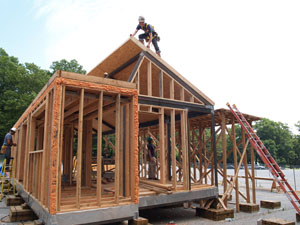
NYIT architecture students Matthew Mathosian, architecture team leader (left); Matthew Vecchione, student project manager (roof); and Ryan Knippenberg work on constructing OPEN House, NYIT’s entry in to the 2007 Solar Decathlon.

Angela Marshall, courtesy NYIT

“A majority of students participate in the Solar Decathlon because they truly want to make a difference in the world by reducing traditional energy consumption or to acquaint themselves with solar power and energy-efficient technologies,” says Daniel Rapka, an engineering graduate student and engineering team leader of the New York Institute of Technology (NYIT) Solar Decathlon 2007 team. This fall, NYIT students will transport their solar home to the National Mall in Washington, D.C., to compete against 19 international colleges and universities in the U.S. Department of Energy’s (DOE) Solar Decathlon 2007. NYIT is the only college selected from the NY metropolitan area to compete.

The international contest challenges collegiate teams to design, build, and operate the most energy-efficient solar-powered home. NYIT’s entry, OPEN House, features two main components: a 480-square-foot open space and a manifold (or core). The open floor plan creates flexible zones to accommodate multiple functions, allowing the occupant to customize their living space. The south-side glass wall visually connects inhabitants to the outside world and fills the living space with natural sunlight throughout the day. The core contains the kitchen, bathroom, and the electrical and mechanical systems.

Smart House technology will provide the dweller with additional flexibility, convenience, and comfort. The home’s automation and control system allows efficient control and the scheduling or maintenance of household functions, such as air temperature, lighting, and appliances. Since the team is unable to dig into the ground on the National Mall, a roof pond above the home’s core will serve as a model of what a geothermal source would be doing on a logistical level. The pond will be a hybrid feature of the solar house — it models a geothermal system by providing a source or sink for thermal energy and also acts as a passive collector or radiator depending on the season. If the home needs heating, energy can be pulled from the pond to heat the home and if the home needs cooling, the excess energy from the house will be stored in the pond.

NYIT’s interdisciplinary, multi-campus team is composed of more than 75 undergraduate and graduate students studying architecture, engineering, interior design, communication arts, marketing, and culinary arts. Faculty members from each department serve as project advisors. “Students participating in the Solar Decathlon have a unique opportunity to gain real-world experience through hands-on learning and interdisciplinary education,” says Matthew Vecchione, a fifth-year architecture student and student project manager of NYIT’s Solar Decathlon 2007 team.

Competition guidelines require that all homes be a maximum of 800 square feet. An overall winner is determined based on the teams’ scores in 10 categories: architecture; engineering; market viability; communications; comfort zone; appliances; hot water; lighting; energy balance; and getting around (track mileage of electric car). The DOE provides all 20 teams with an electric car to help transport the house, and $100,000 to support the project. To raise additional funds and encourage public support and sponsorship, the team has appeared at conventions and sustainable conferences, and has invited green-friendly businesses to attend team presentations.

Solar Decathlon 2007 will be on view to the public October 12-20. More information about NYIT’s Solar Decathlon entry can be found online. The entry is also included in the arch schools: r(each)ing out exhibition at the Center for Architecture through October 19 (See On View: At the Center for Architecture).