The Future of Professional Practice: DC Smorgasbord had Something for Everyone

Event: The Future of Professional Practice
Location: Capital Hilton Hotel, Washington, DC, 12.02-04.07
Organizers: American Institute of Architects; AIA Practice Management; AIA Technology in Architectural Practice; AIA DC; AIA Delaware; AIA Northern Virginia; AIA Educator/Practitioner Network; AIA Integrated Practice; AIA Design-Build; AIA Small Project Practitioners
Sponsors: Victor O. Schinnerer & Co. Inc; Adobe; Newforma; Graphisoft; Bentley.
Future of Professional Practice

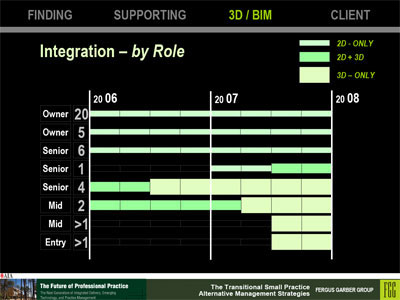
This chart shows changes from 2006 to 2007 in the readiness of staff at several levels to take on progressively more sophisticated 3-D/BIM tools (numbers at left show years of experience).

Source: The Fergus Garber Group, Palo Alto, CA

Perhaps the most telling riff played on the conference’s basic theme was that new employees know more about technology than seasoned partners, that information technology was galloping ahead at a prodigious rate, and that the conference was here to let the younger, avant garde strut their stuff on integrated delivery, leveraging emerging technology, and innovative practice management.

As it turned out, this umbrella conference drew value from every generation, from baby boomers to GenYers. James H. Timberlake, FAIA, of KieranTimberlake Associates, Philadelphia, kicked things off before a Washington, DC gathering of 260 from 39 states, the UK, and Australia with a two-hour keynote in which he gave a not-so-flattering picture of productivity changes in the construction industry. Whereas productivity in non-farm labor (including construction) rose by 215% between 1964 and 2004, construction productivity alone actually declined by 5% over the same 40-year span.

This suggestion isn’t new. What is new was Timberlake’s acknowledgment of these three factors:

1. Split in the role of the ancient master builder into a number of design and construction roles, creating dispersion of a once concentrated skill base;
2. “burgeoning materiality,” that is, the explosion of new materials in the last 25 years (aerogel, titanium, zenite) — “Novelty is [found to be] sufficient to justify use,” he and partner Stephen Kieran, FAIA, wrote in Prefabricating Architecture, but “beyond infatuation …lies a world of purposeful form yet to be explored;” and
3. lack of “refabrication” of the industry to obtain the quality, schedule, and cost control long boasted by the auto, shipping, and aircraft industries.

Five tracks. Concurrent break out sessions pursued five tracks:

A. Leading the business
B. Developing the people
C. Delivering the work
D. The range of technologies for your firm (basic)
E. Leveraging BIM and Integrated Practice (advanced)
Continues…

Critique: New Museum’s Cause for Culture

Event: The New Museum of Contemporary Art opening
Location: The New Museum of Contemporary Art
Architect: Kazuyo Sejima and Ryue Nishizawa/SANAA (Tokyo) — Architect; Gensler (NY) — Executive Architect

New Museum

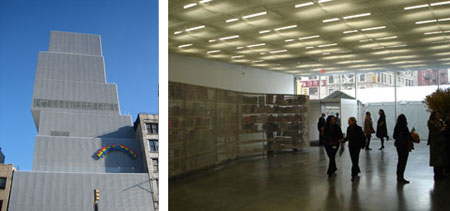
The exterior (left) and lobby (right) of the New Museum of Contemporary Art.

Jessica Sheridan (left); B.A. Cook (right)

The New Museum of Contemporary Art has been open to the public for a little more than a month, and this author believes it is one of the best new built projects. Designed by Tokyo-based Kazuyo Sejima and Ryue Nishizawa of SANAA, with Gensler (NY) serving as executive architect, this small building continues the New Museum’s role as rebel for the cause of culture.

There were challenges. Landowners on the Bowery did not want to sell their lots to yet another developer looking to make luxury apartments. The museum decided to continue building downtown post 9/11. The design team instituted artful and careful use of materials on a frugal budget ($64 million for 60,000 square feet).

Quietly strong, many feel the building works at street level by provoking passersby to peer into its glass lobby. Unobstructed views within welcome installation art. The rest of the building is composed of five almost translucent aluminum clad offset stacked blocks. The top two house the offices and education center with skyline views, while the other boxes provide three open-plan gallery levels partially lit from above by natural light. Gallery levels three and four with a connecting stairway offer choices for multi-media art. The subterranean level forms a theater, quite large for a small museum that will host film series and projection artworks.

The building has flaws, however; the circulation among the levels is bumpy, gallery spaces though open are small, and craftsmanship is not impeccable.

Time will tell if the New Museum’s impact is only of this moment or if it will be able to re-invent itself with the city’s future. The first scenario is akin to Marcel Breuer’s Whitney Museum — a building that was innovative for the post World War II period, but by the end of the 20th century became an agent for the Upper East Side elite, as the institution attracted the upper-crust creating high-end luxury residential development. The second scenario is comparable to the Pompidou Centre, by Renzo Piano, Hon. FAIA, and Richard Rogers, RIBA, Hon. FAIA. It was equally original when built and constantly re-invents the concept of the urban plaza to this day. Could the New Museum and the Bowery co-exist and follow this example? The realist would say no but for now let’s enjoy this moment.

Holocaust Memorial Defines Architecture, Architect, People, Place

Event: Screening of Michael Blackwood’s film, “Peter Eisenman: Making Architecture Move”
Location: The Paley Center for Media, 10.28.07
Speakers: Peter Eisenman, FAIA — Founder & Principal, Eisenman Architects; Michael Blackwood — Director, “Peter Eisenman: Making Architecture Move;” Ron Simon — Curator of Television, The Museum of Television & Radio
Organizers: The Paley Center for Media, The Architectural League of New York

Event: Dialogue: Jacques Herzog and Peter Eisenman
Location: Graduate School of Design (GSD), Harvard University, 12.04.07
Speakers: Peter Eisenman, FAIA — Founder & Principal, Eisenman Architects; Jacques Herzog, Hon. FAIA — Senior Partner, Herzog & de Meuron (Basel, Switzerland)
Moderator: Jeffrey Kipnis — Curator of Architecture and Design, Wexner Center for the Arts (Columbus, OH)
Organizers: GSD, Harvard University

Though both events — a screening of the documentary “Peter Eisenman: Making Architecture Move,” and a dialogue between Jacques Herzog, Hon. FAIA, and Peter Eisenman, FAIA — were intended as debates between Eisenman and a relevant players in architectural practice, they focused mainly on re-examining Eisenman’s belief in architecture based on the design of the Memorial to the Murdered Jews of Europe in Berlin, Germany. During the Herzog discussion, the memorial served to answer the question: “What is architecture?” The screening used the memorial to highlight the maze of relations, characters, and politics of Eisenman’s vision.

Directed by Michael Blackwood, the documentary aptly captures the myriad voices and opinions that influenced the course of the memorial’s creation as well as its future. The first half of the film is a collection of opinions from German politicians, filmmakers, and writers that documents the obstacles to the memorial’s creation and interprets the controversy over the abstractly minimalist “memory-scape.” The second half views visitors’ responses to the memorial and each other. Acting as a silent observer, the film shows the memorial melting into society and history. In short, the film itself becomes a part of the formative process as well as a documentation of it.

At the Herzog debate, when the fundamental question of “what is architecture” arose, the discussion turned into self-reflection. Eisenman defined himself as a conceptual stronghold — someone who revels in theory over pragmatics. He recounted that sculptor Richard Serra, one-time collaborator on the memorial, stated it was Eisenman’s best work because “it does not have plumbing.”

In the end, Eisenman, as in all his works, presents a self-evaluation adding meaning and value to the creative process. For him, the transformation from his intellectual pursuits to his physical manifestations is anti-climatic. The finished product must be experienced and continuously evolve through visitors and inhabitants.

The Future of Professional Practice (continued)

Small stone makes big waves. At the session entitled The Transitional Small Practice: Alternate management strategies, Daniel M. Garber (of the Fergus Garber Group, Palo Alto, CA) showed how small, growth-hungry firms must employ innovative often riskier, design and delivery methods to replace safer traditional methods.

Garber’s view on integrating roles in the firm when transitioning from 2-D to 3-D/BIM is shown in the chart. The chart shows changes from 2006 to 2007 in the readiness of staff at several levels to take on progressively more sophisticated design and delivery tools (numbers at left show years of experience).

When smartly done, results are:

· better coordinated production
· streamlined production documentation
· greater client participation in design phase
· shorter design cycle.

Town Hall tales. The proceedings ended with a novel device called the Town Hall. Genially presided over by Architectural Record deputy editor Charles Linn, FAIA, this town hall mushroomed fast into informal, animated, often blunt exchanges, as though the pent up listening of the previous two days finally detonated into some frank but all-in-all civil exchanges. Topics: BIM and its high technical but low design impact; the undesirable designation (by architects) of the architect as Master Builder (preferred: Team Captain; Master Coordinator); the dangers of getting lost inside the new technology; the paradox of earning HSW credits at BIM-related sessions but none on managing people; anxiety as motivator; and the risks inherent in the new technology of making decisions too fast, without enough thought.

AIA has promised to make transcripts of talks available at about this time on its website.

Power to the People

Event: Modernism and the Public Realm with Nathan Glazer
Location: The Museum of the City of New York, 11.28.07
Speakers: Kent Barwick — President, Municipal Art Society; Nathan Glazer — Sociologist, Critic, Author of From a Cause to a Style: Modernist Architecture’s Encounter with the American City; Fred Siegel — Senior Fellow, Progressive Policy Institute and Columnist, New York Post; Susan Henshaw Jones (introduction) — President/Director, The Museum of the City of New York
Moderator: Hilary Ballon, Ph.D. — Professor, Department of Art History and Archaeology, Columbia University, Associate Vice Chancellor, NYU Abu Dhabi, and Curator, Robert Moses and the Modern City
Organizer: The Museum of the City of New York

NYC

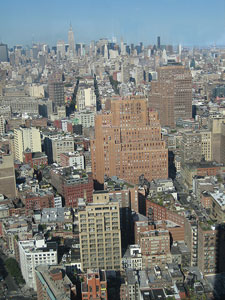
As more large buildings are built in the city, the more its vitality is lost.

Jessica Sheridan

“The difficulties in producing an attractive urbanism constitute perhaps the greatest problem for Modernism,” argues sociologist and critic Nathan Glazer in From a Cause to a Style: Modernist Architecture’s Encounter with the American City. He takes planners and architects to task for their apathy toward social consciousness. The impact of iconic and gigantic buildings has led to a lack in diversity and livability in cities. “There should be a diversity of functions (uses), and there should be an interest in neighborhoods,” continues Glazer. Successful streets depend on planners, architects, developers, politicians, and the public. The political culture and economic forces need to be examined to restore life to the streets.

Coupled with the current exhibition, Jane Jacobs and the Future of New York at the Municipal Art Society, and Glazer’s book on Modernism’s failure to cities, a recent panel debated how to salvage the city’s vitality and fabric. “Big cities are the natural economic homes of immense numbers and ranges of small enterprises.” (The Life and Death of Great American Cities). However, the contemporary urban fabric does not permit the diversity so sought by Jacobs.

To accommodate increased density, larger buildings are being constructed, and NYC is moving farther away from Jacobs’s ideal, claimed Kent Barwick, president of the Municipal Art Society. Larger buildings create empty streets. Lexington Avenue is a case study showing that certain neighborhoods are dense and full of vitality, while others consist of Modernist buildings and vacant sidewalks, an audience member pointed out.

The number of iconic buildings is now what defines modern cities. For example, the Atlantic Yards development will change a large section of Brooklyn, adding a number of new high rise buildings designed by Gehry Partners, yet it was not planned or discussed with its residents, stated New York Post columnist and senior fellow at the Progressive Policy Institute Fred Siegel. Atlantic Yards will not benefit Brooklyn residents, he argued. It will only mark the skyline — something that will feed into politicians’ egos, and not much else.

Questions remain about what should be done to preserve the city’s vitality while maintaining economic growth. The real estate industry is one source for jobs and is essential for economic growth. But we do not fully take advantage of other resources NYC can offer, contends Siegel. Civic culture is an instrument that can impact the city as well. Every voice needs to be heard when making major urban decisions, not just a powerful few.

Which Rules: Cities of Culture or the Culture of Cities?

If you visit the Sydney Opera House, you will find an international cultural repertoire such the Paris Ballet or the Mozart Festival. You will also find contemporary artists and art in the Australian bush, or in the avant-guarde Darling Harbor in Sydney. The issue of current versus established culture is a modern phenomenon worldwide, and subject of recent debate between Magdy Youssef, director and the senior planner of the Maroochy Shire Council, and this author.

Culture can stagnate within traditional institutions, and contemporary art is often found in fragments hidden within cities. Of course, prominent art institutions play a role within the contemporary city fabric — the Museum of Modern Art demonstrated a commitment to new art when it acquired PS 1 in Queens, for example — but architects and urban designers can take the lead in creating small, more modest places for new, experimental art. Renzo Piano Building Workshop designed Aurora Place, a mixed-use office and residential tower overlooking the Sydney Opera House and Sydney Harbor. The building’s plaza opens to a neglected alleyway with shops and warehouses, instead of the nearby botanical garden with access to the opera house. As a result, space is provided for contemporary art that will not be overshadowed or polarized by the institutions.

In Europe, such phenomena can also be observed. Current art can be found in Percy, the old wine port of Paris — more so than the institutionalized French outlets dedicated to the same purpose. The Berlin-NewYork Dialogues exhibition at the Center for Architecture sheds some additional light on this phenomenon.

The current dynamics of cultural generation and renewal is critical to the process of urban design and architecture. Our Australian colleagues are demonstrating meticulous efforts to observe the process of renewal by integrating art, architecture, and planning under one umbrella, and their cities are benefiting as a result.

AIANY Generates “Center Envy” Across Nation

Event: Big Sibs
Location: San Francisco, 10.11-12.07
Participants: AIA Atlanta; Boston Society of Architects; AIA Chicago; AIA Dallas; AIA Houston; AIA Los Angeles; AIA Minneapolis; AIA New York Chapter; AIA Philadelphia; AIA San Francisco; AIA Seattle; AIA Washington, D.C.

Big Sibs

Connie Wolf, Director/CEO of The Contemporary Jewish Museum in San Francisco, gives a walking tour during the Big Sibs conference.

Rick Bell

Big Sibs, a group of the largest AIA urban chapters with more than 1,000 members, brings focus on urban issues such as affordable housing, infrastructure and transportation, pollution, and urban sprawl. Every year, the Big Sibs gather for a “show-and-tell,” providing an opportunity to hear what AIA components are doing for their members and get a feel for how the construction industry is faring nationwide. Right now, business is booming everywhere, but there is an overall sense that we have reached the peak and will start heading downhill soon.

AIANY’s Center for Architecture has become a hot topic for other components. Many of them are suffering from “Center Envy,” and as a result centers are springing up like mushrooms after a rain. Richmond, VA, opened a center April 1, 2006. AIA San Francisco just built out a new headquarters, including a large exhibition/multipurpose space open to the public. The local SF Association of Collegiate Schools of Architecture (ACSA) is constructing a new building that uses LaGuardia Place as a model. Houston and Austin have recently opened centers. Dallas is also planning new centers. Even our national AIA headquarters is getting a big overhaul that will make it more open, transparent, public, and green (complete with a geothermal system similar to NYC’s Center).

Hearing that so many chapters are engaging more with the public was really inspiring. It made me appreciate individuals like Margaret Helfand, FAIA, Rolf Ohlhausen, FAIA, George Miller, FAIA, Dennis Kuhn, FAIA, and many more, who had the vision and foresight to conceptualize the Center and the guts to take the chance on actually seeing it through.

Jane Jacobs’s Spirit Still Hovers

Event: Can One Woman (Still) Make a Difference? Jane Jacobs and New York
Location: St. Mark’s Church-in-the-Bowery, 10.31.07
Speakers: Christopher Klemek — Co-Curator, Jane Jacobs and the Future of New York; Roberta Brandes Gratz — Urban Critic; Samuel Zipp — Assistant Professor of American Civilization and Urban Studies, Brown University; Julia Vitullo-Martin — Senior Fellow, Manhattan Institute’s Center for Civic Innovation; Laurie Beckelman — President, Beckelman & Capalino (Introduction)
Moderator: Joseph Giovannini — Architectural Critic & Author
Organizers: Municipal Art Society

Future of New York

Courtesy Municipal Art Society

As one who rose from ordinary citizen to celebrity, Jane Jacobs continues to fascinate readers and rouse conversation about what makes cities work. In The Death and Life of Great American Cities, she encouraged fellow citizens and readers to “look closely at real cities. While you are looking, you might as well also listen, linger and think about what you see.” At this event panelists of urban experts who have written about Jacobs’s work and/or knew her personally provided vignettes into her persona and work.

Urban critic Roberta Brandes Gratz, who knew Jacobs, described her as someone who was both interested in and cared about real people, how they lived, and what their lives were like — important things to know to resolve urban issues. Christopher Klemek, co-curator of Jane Jacobs and the Future of New York now on view at the Urban Center, called Jacobs a “Madisonian” who sought ways to prevent any one faction from obtaining tyrannical control. He noted that Mayor John Lindsay had made overtures to Jacobs to work in government. Klemek reported that later in life she had some regrets about not taking Lindsay up on the offer, but she cared more about creating coalitions and organizations. Besides, both sides of the 1960s political spectrum embraced her ideas, stated Samuel Zipp, assistant professor of American civilization and urban studies at Brown University.

Questions remain about whether current city planning actually incorporates Jacobs’s thinking. Gratz lamented that lessons of the West Village have never been fully realized. While community-oriented structures have been put in place since the 1960s, “private market imperatives dominated by corporate developers, including nonprofits, have gone largely unquestioned,” added Zipp. In some instances, nonprofits are competing for what Jacobs would have regarded as self-isolating land, argued Julia Vitullo-Martin, senior fellow at Manhattan Institute’s Center for Civic Innovation.

Still, times have changed for the better because of Jacobs, believes Vitullo-Martin, citing successful developments citywide from Brooklyn waterfronts to Frederick Douglas Boulevard between 116th and 125th Streets. Jacobs’s influence spreads beyond NYC as well. The local fishing community is taking civic planning action in New Jersey to preserve Liberty State Park. So there is still hope for a Jacobs-inspired future. Jacobs has set a precedent for citizens to get involved, coalesce, and shape development of their communities.

The Jane Jacobs and the Future of New York exhibition aims to “energize a new generation of New Yorkers to observe and recognize the best of our city and become citizen activists for possible change,” according to Laurie Beckelman, president of Beckelman & Capalino, who introduced the event. For more information about the exhibition and related events, and to read blogs and see video podcasts, click the link above.

Gauging the Shifting Global Environment

Event: This Will Kill That? presents Saskia Sassen, author of Territory, Authority, Rights: From Medieval to Global Assemblage
Location: Center for Architecture, 10.23.07
Speakers: Saskia Sassen — Sociology Professor, Columbia University
Organizers: AIANY Emerging NY Architects (ENYA) This Will Kill That? Committee
Sponsors: SoHo Reprographics

Saskia Sassen

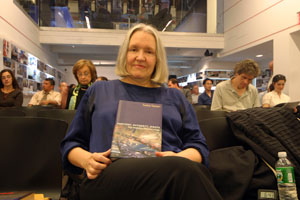
Saskia Sassen holding her book, Territory, Authority, Rights: From Medieval to Global Assemblage at the Center for Architecture.

Katerina Kampiti

Nation-states often sacrifice their national identities for globalization. But don’t ignore national identities, including their economic histories, if you want to comprehend the global environment. This is the argument made by Saskia Sassen in her latest book, Territory, Authority, Rights: From Medieval to Global Assemblage (Princeton University Press, 2006).

Sassen explains globalization by using analogies, tracing their progress through history. One example is the corporate environment. In the past, companies were small entities. They were housed in one building, and the firm’s identity was apparent in the architecture, the advertising, the owners themselves, and the location of the business. This was long ago. After years of technological advancement and evolving infrastructure, businesses have become more global and less identifiable. Satellite offices and the Internet allow for multi-national establishments, creating what Sassen terms “specialized assemblages.”

In a way, corporations parallel larger global trends. Whereas countries used to be entities within themselves, now boundaries are blurred. Countries will thrive if they can successfully make this transition.

Canstruction: It’s that time again

Event: Canstruction; 15th Annual Design/Build Competition Awards Gala
Location: New York Design Center, 11.08.07 (exhibition through 11.21.07)
Organizers: The Society for Design Administration; AIANY; The New York Design Center

Canstruction

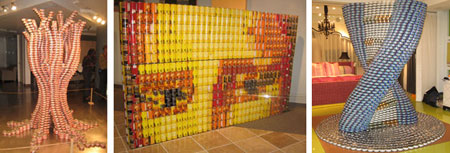
(l-r): “Best Structure”: Tree by Platt Byard Dovell White; and “Best Labels”: Decoding Hunger by JCJ Architecture; “Honorable Mention”: D-CAN-A by Gilsanz Murray Steficek.

(l-r): Matthew J. Lalli; Matthew J. Lalli; Amy Tsim

Canstruction is an annual event where teams of architects, engineers, and other design/construction-related firms disobey the axiom, “Don’t play with your food.” Challenged to conceive structures created solely out of cans and other food products, these virtuosos never cease to amaze with their gravity-defying feats of visual canplexity.

While Canstruction is first and foremost a charity donating all food proceeds to City Harvest, it is also an impassioned competition among the participants, many of whom have entered for more than 10 years. Though many of the designs are whimsical, some integrate social commentary. Gensler’s More Than Just “TwoCANS” Feeding, a team led by yours truly, exhibits a mother toucan feeding her chick. Butler Rogers Baskett Architects’ An UnBEARable Truth incorporates the world’s environmental crisis with two polar bears surviving a melting ice cap.

There are also eye-catching designs that redefine structural integrity, such as Platt Byard Dovell White’s Tree. Having won the Structural Ingenuity award for the past four years, their creations always set a high bar for other entrants. This year, the structural engineering firm Gilsanz Murray Steficek met, and nearly jumped over, that bar winning an Honorable Mention for their interpretation of a DNA Helix. When asked how GMS has grown since last year, team captain Eugene Kim said that it was pre-planning, pre-builds, three-times as many volunteers, and three-times the cost.

Whereas GMS has grown from experience, “rookie of the year” JCJ Architecture depended on passion and a fresh outlook to win Best Use of Labels for its entry Decoding Hunger, a depiction of the Mona Lisa. According to Anthony Arce, AIA, principal at JCJ, “a great team building experience and a chance to give back to the community” were the reasons his firm entered. When asked about their strategy, team member Raphael Charles said, “We wanted to do something iconic.”

The Canstruction exhibition may be seen at the New York Design Center, 200 Lexington Avenue, from November 8-21. Hours: Monday-Saturday, 9:00am-5:00pm. Admission: one can (or more) of food.