Carpenter’s Thousand Points of Light

Event: Environmental Refractions
Location: The Cooper Union, 04.10.07
Speaker: James Carpenter — principal & founder, James Carpenter Design Associates
Organizer: The Irwin S. Chanin School of Architecture of The Cooper Union

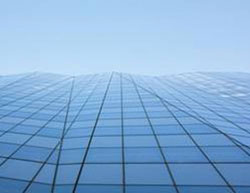
7WTC

Glass panels with blue reflectors create the effect that 7WTC is merging with the sky.

Jessica Sheridan

Light conveys information and defines our surroundings. The work of James Carpenter, principal and founder of James Carpenter Design Associates, explores perceptions of light in transmission, reflection, and refraction, often abstracting images brought in from outside (sun, sky, water, trees). Carpenter discussed a few of his early projects as part of the Feltman Lectures, a series dedicated to advancing lighting design through the exploration of practical, philosophical, and aesthetic attributes of light and illumination.

The Luminous Glass Bridge was designed to enrich and awaken users’ perception of nature. A chapel in Indianapolis is a meditative environment created through structural glass prisms that split the visible spectrum into the blue to yellow range. A glass screen for the Rachofsky Residence, designed by Richard Meier, FAIA, is virtually structure-free. The edge of the glass is revealed, and privacy is created on one side constructed of glass with heightened reflectivity.

Carpenter’s interests predominantly focus on daylight rather than artificial light, but he has begun to integrate LED technology in his projects since it reacts similarly to natural light. He explored both realms in the enclosure, lobby, and podium light wall in 7 World Trade Center. The façade enclosure celebrates the incredible quality of light in Manhattan, according to Carpenter. The 8-inch-deep skin is composed of glass panels with blue stainless steel reflectors at the sill, creating an effect that the building is merging with sky. The base of the building enclosure is constructed of two permeable layers that conceal a Consolidated Edison sub-station. The first layer blocks views during the day, and at night a stainless steel scrim reflects light from LED sources — proving that our perception is easily altered through the abstraction of light.

A Systems Approach to the Green Skyscraper

Event: Designing the Green Skyscraper: A Mixed Greens Lecture
Location: The New York Academy of Sciences, 7WTC, 04.05.07
Speaker: Kenneth Yeang — principal, Llewelyn Davies Yeang, professor, Sheffield University, & author, Ecodesign (Hoboken: Academy Press, 2006)
Moderator: Carol Willis — founder, director, curator, The Skyscraper Museum
Organizers: The Skyscraper Museum; New York Academy of Sciences

The EDITT Tower.

The EDITT (Ecological Design In The Tropics) Tower is a fuzzy combination of organic and inorganic material.

Llewelyn Davies Yeang

A stack of kitchen plates is the basic model for today’s tall building: a series of modular concrete floors in succession, conducive to “instant compartmentalization” and the dreariness of the white-collar office, according to Malaysian principal, professor, and author Ken Yeang. The area in a typical medium-sized building (a 12-story tower on a 20,000-square-foot site) would be equivalent to six acres distributed horizontally. He conceives of skyscrapers as “no longer building design, but urban design.” They pose an opportunity to create a fluid, mixed-use community that meshes with the biological world instead of a solitary structure standing apart from it. “Everything in nature is a combination of the biotic and the abiotic,” he observes. “Look at what we build as human beings… everything [in a typical building] is inorganic except you and me and the bugs!”

Concentrating a multi-acre community on a small footprint, Yeang says, calls for architects “to make the design as humane as possible.” Aesthetically as well as functionally, his work favors fuzziness and irregularities over the “pristine edge” of most corporate towers. His buildings invite in the foliage and sunlight. One of his favorites, the bougainvillea-covered Menara Boustead building in Kuala Lumpur, he terms “the hairiest building in Southeast Asia.” With spiraling and intertwining spaces blending built structures with vegetation, his eco-cells, sky parks, multi-story voids, and sunny-side placement of service cores are all designed to optimize passive energy conservation — an important approach in the tropical climates where he usually works.

Many of Yeang’s designs remain unrealized; he acknowledges the cost premiums involved, giving figures on the high side of recent estimates for LEED-rated buildings, and recommends that anyone building a vertical garden be prepared, like any gardener, to invest resources in tending it. (For greening NYC buildings, he recommends hardy non-flowering species and operable external skins to protect plantings from high wind.) He views the current LEED system as valuable for public awareness of green design, but seriously incomplete as a means of analyzing the full set of interdependencies that constitute a bio-integrative system.

Yeang’s practical design decisions derive from a set of interlocking analyses, using mathematical partition matrices to organize the inputs and outputs of biological and built systems. His commitment to green design runs well beyond a generalized intention to conserve resources; he interprets the principle of biomimicry in organized and consistent ways, comparing buildings within a wider ecologic system to prosthetic limbs attached to a living organism. Even the most sophisticated artificial arms or hearts still require external energy sources, and the ideal prosthesis would run on bodily energy alone. Similarly, what he calls the “truly green building,” one taking all its operational energy inputs passively from nature, does not yet exist, but Yeang’s ideas are bringing that organic/inorganic balancing act closer to realization.

Post-Modernism: R.I.P.

Event: Critical Modernism — Is It Possible?
Location: Columbia University Graduate School of Architecture, Planning & Preservation (GSAPP), 04.09.07
Speaker: Charles Jencks — author, Critical Modernism: Where is Post-Modernism Going? What is Post-Modernism? (Wiley)
Introduction: Mark Wigley — Dean, Columbia GSAPP
Organizer: Columbia University GSAPP

Critical Modernism: Where is Post-Modernism Going? What is Post-Modernism?

Courtesy Columbia University GSAPP

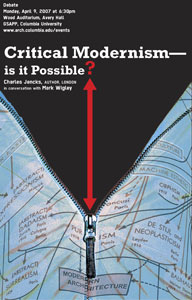
On the cover of Charles Jencks’s new edition of What is Post-Modernism? (the first new edition in 11 years), the first director of the Museum of Modern Art Alfred Barr’s chart of modern artistic movements comes apart, literally, in the image of a windbreaker emblazoned with Barr’s interconnected bubbles being unzipped. Revealed beneath is the work’s new title, Critical Modernism: Where Is Post-Modernism Going? The book’s title change reflects Jencks’s new attitude toward the movement: “Post-Modernism, like old soldiers, died slowly.” And he mourns its passing.

Author, critic, and landscape designer, Jencks was one of the earliest exponents of Post-Modernism. Critical Modernism surveys the culture and politics of the movement, and chronicles its demise. The beginning of the end was the appropriation of Post-Modern architecture by the entertainment industry in the mid-1980s. “For a moment at least it was an interesting avant-garde,” Jencks remarked.

Critical Modernism, on the other hand, attempts to “face reality” when “most Modernism is uncritical.” Art and architecture is grounded in the actuality that: arctic ice is retreating; the earth is warming, modern economics is globalizing; political culture is breeding skepticism; and fear of terrorism is growing.

It is a movement of personal posturing (think Rem Koolhaas’s tough-guy persona), pluralism (James Stirling’s Neue Staatsgalerie), black humor (Damien Hirst), and noble though feeble gestures (green architecture), in Jencks’s view. Ultimately, Jencks praises the iconographic and iconologic possibilities of forms drawn from science and mathematics — the square deformations in the Pavilion at the Serpentine Gallery designed by Toyo Ito, FAIA, the images of DNA Jencks has incorporated in his own work, and the natural fractals in everything from pine cones to pineapples.

Challenging the Glass Box

Event: Daylight and the City: Day Lighting in New York City Part 2, 1961 to Present
Location: Center for Architecture, 04.18.07
Speakers: Margaret Maile — design historian and Matthew Tanteri — daylighting consultant, Tanteri+Associates
Panelists: John An — principal daylighting, shading design, and lighting energy analyst, Atelier Ten; Florian Idenburg — project architect for the New Museum of Contemporary Art, NYC, SANAA
Moderator: Margaret Maile
Organizer: New York Section of the IESNA

As a follow up to last fall’s Part 1 of Daylight and the City, Tanteri+Associates’ Margaret Maile, design historian, and Matthew Tanteri, daylighting consultant, reconvened with a group of panelists to discuss daylighting in modern NYC. Starting where they left off (the Seagram’s Building and the 1961 Zoning Ordinance), panelists discussed where we’ve come since then and how history has influenced daylighting strategies today. Though the “glass box” is still an icon of contemporary architecture, designers no longer treat it as a sealed, artificially lit, interior environment. Modern technology and trends towards sustainable design have changed the way we articulate building façades and address daylighting. Panelists debated about whether daylighting is an art of a science and whether occupants should be entitled to “daylight rights” in the same way that air rights are regulated. It was agreed that sun charts are essential tools to evaluate the sun, despite more advanced technology available.

To illustrate a modern approach to daylighting in NYC, Florian Idenburg explained his strategies in the design of the New Museum of Contemporary Art on the Bowery. Early in the design process, his team conducted a zoning analysis of surrounding buildings to predict future sunlight patterns. The eight-story massing and expansive program occupies the entire zoning envelope. Three large galleries read as boxes that shift within the envelope in order to “let light in and people and art out.” Further strategies to admit daylight include the building’s permeable skin and integrated skylights that are grated to allow firefighter access. The grating itself was carefully selected and tested with a full size mock-up in order to allow the maximum penetration of daylight.

The modern condition and our love affair with the glass box continue to present challenges for daylighting, as designers grapple with issues of glare and thermal performance. Daylight is a major measure of success in a lighting strategy.

Hidden Splendor South of Chambers Street

Event: Downtown Third Thursdays Lecture: Forgotten Splendor: Restoring Downtown’s Historic Architecture
Location: Federal Hall, 04.19.07
Speaker: Mary Dierickx — preservationist & Principal, Mary B. Dierickx
Organizer: Downtown Alliance

Claremont Prep

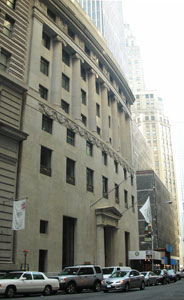
Claremont Prep is one example of the recent wave of downtown buildings that have transformed their uses after renovation.

Carolyn Sponza

While new towers and planned transit hubs for downtown Manhattan have dominated the media over the past few years, a number of daring downtown restoration projects have been slipping quietly under the radar. According to preservationist Mary Dierickx, that may be intentional. At the Historic Front Street residential lofts, located at South Street Seaport, architects Cook+Fox purposely retained the distressed look of street elevations of 11 historic buildings, while inserting three new structures. In reference to the restoration of the retained façades, Dierickx said, “This is not an incredible ‘after’ project. The whole point was to keep [the buildings] looking old.”

Historic Front Street was subsidized in part by a combination of Liberty Bonds and historic preservation tax credits. Utilizing resources such as these, and post-9/11 support like the Lower Manhattan Emergency Preservation Fund, “helped kick off the preservation movement downtown,” said Dierickx. While Historic Front Street retained and updated its original use (with retail on street level and residential above), many current downtown restoration projects are undertaking wholesale use changes, such as the conversion of a former bank building on Broad Street into Claremont Prep private academy. The banking hall (with its murals) was restored to serve as a multi-purpose room for the K-8 school, while the original vaults were converted into annex space for the cafeteria. Expect to see more creative downtown conversions like this one under construction in the next few years, proving that while banking may become virtual, living cannot.

Ability Not Disability

Event: Symposium On Inclusive Design: Accessible Residential Environments
Location: New York School of Interior Design, 03.31-04.01.07
Speakers: Patricia Moore, PhD — MooreDesign Associates & Adjunct Professor, Arizona State University; Jordana Maisel — MUP Director of Outreach and Policy Studies, Center for Inclusive Design and Environmental Access, University at Buffalo; Eleanor Smith — Director, Concrete Change, Atlanta, GA; Todd Brickhouse — Todd Brickhouse Accessibility Associates; Bruce Hannah — industrial designer and Principal, Hannah Design; Danise Levine — Assistant Director, IDEA Center; Patricia Rizzo — Lead Researcher and Residential Program Manager, Lighting Research Center, Rensselaer Polytechnic Institute; Rosemarie Rossetti, PhD — Rossetti Enterprises; Valerie Fletcher — Executive Director, Adaptive Environments; Mary Jo Peterson — Mary Jo Peterson; Linda Volpe — Compliance Specialist, Accessibility Services, United Spinal Association
Organizers: New York School of Interior Design

Designers can help enable differently-abled populations from the aging to people with physical limitations. Patricia Moore, PhD, kicked off a symposium on Inclusive Design discussing what life is like as an 85-year-old woman. After going “undercover” for three years, her experiences led to a better understanding of the needs of the elderly. Outlined in her book, Disguised: A True Story, Moore recommends that designers create simple yet flexible spaces. Low physical effort is key and independence leads to the highest quality of life for the aging.

Designers can empower the aging through straightforward design, according to Mary Jo Peterson, a leader in Universal Design for the kitchen and bath. As memory fades, visual storage can help someone keep track of where things belong. Forget touch controls, and install the old mainstay — doorknobs. Technology can be complicated, and the screens can be difficult to read with diminished sight. Task lighting, handles with openings, and continuous counters at one height are also basic yet helpful techniques.

After being bound to a wheelchair, Rosemarie Rossetti, PhD, is building a home for herself and her husband. The “Universal Design Living Laboratory.” contains ramps, an elevator, low counters in the kitchen and bathrooms, and a sprinkler system throughout the house. The house will be available for tours and shows and will display design techniques that help them maintain active lifestyles.

Universal Design is about designing for the end user. Life is unpredictable, and that is an important factor for designers to consider.

Nouvel Vogue

Jean Nouvel, Hon. FAIA

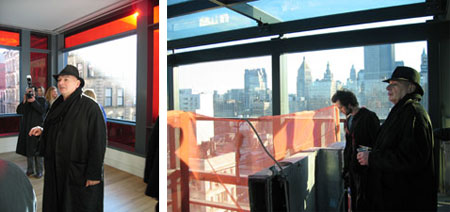
Jean Nouvel, Hon. FAIA, gives a tour of 40 Mercer Street, under construction.

Rick Bell, FAIA

Architect Jean Nouvel, Hon. FAIA, was honored April 9, on the 50th anniversary of the founding of NYU’s Maison Française. The celebration, at NYU’s Kimmel Center, also started the weeklong celebration of the AIA New York Chapter’s Architecture Week, marking the sesquicentennial of the American Institute of Architects. After a brief introduction by Francine Goldenhar, director of the Maison Française, Nouvel spoke of architecture in general and of his recent work.

Earlier in the day he conducted a walk-through of the 40 Mercer Street residential tower, nearing completion on Grand Street. During the tour he spoke of the importance of the Manhattan light, of the city view, and of integrating the new structure into SoHo’s streetscape. The 40 Mercer Street tower, and the anticipated project next to Gehry Partner’s IAC on Eleventh Avenue, articulately speak for themselves. The Mercer Street project reflects an urbane dialogue about nature re-inserted in urban architecture, not unlike his Musée du Quai Branly. Its arcade and lobby respond to Mayor Bloomberg’s call for a million new city trees. The residential tower façade refracts light, engaging the colors of the city and the adjacent roofscapes. Nouvel, clad in black, spoke eloquently about the urban context, and of helping create a new wave of environmentally appropriate structures and a new vogue for glass housing. I, for one, was ready to move in.

His subsequent remarks at NYU, based on notes taken hastily by this writer, are excerpted below and in the word document link:

“Architecture is an expansion of our world at a time when our world is getting smaller. The global economy is expanding the promulgation of an architecture without context. We must resist the urbanization of zones and grids. We must establish sensitive poetic relics, an analysis of the art of creation that is specific to rain, sea and mountain.”

“Architecture means transformation, organizing the retention of what is already here. How does one create a vibration that evokes the hidden dimension of the past? This is surely a task for poetry, since only poetry can produce the metaphysic of the instant.”

“Architecture is a vehicle for permanence changed by life, to be impressionable and impress, to absorb and emit. Explanation is the duty; questioning is a necessity of evolution. I will conclude this introduction to my projects with a paradox by Paul Valéry: ‘contradictions generate spirit.’ ”

Click here [jeannouvel.doc]to download the full text of Nouvel’s remarks.

Mayor Proposed PlaNYC is Short-Sighted

A lot of money is being raised to fund Mayor Bloomberg’s plaNYC 2030. Included in the plan is a Sustainable Mobility and Regional Transportation (SMART) organization to raise funds and issue revenue bonds to improve transportation. A NYC Energy Planning Board will centralize planning for the city’s energy supply and demand initiatives. However, nowhere in the plan does it mention raising funds to maintain the open spaces the Mayor is planning to create or rehabilitate.

The Mayor wants every person to live within a 10-minute (or 1/2 mile) walk from a park. Schoolyards will become accessible as public playgrounds. Asphalted areas will be converted into multi-use turf fields, and lights will be installed for evening use. High-quality competition fields will be made available to athletic teams across the city, as well. A new public plaza will be enhanced or created in every community. Underutilized destination parks (there are several throughout the five boroughs) will be completed. He plans on expanding the Greenstreets program, created in 1986 to replace paved traffic triangles and medians with shrubs and flowers, by planting 250,000 trees citywide.

Simply providing parks does not mean that people will use them. Often parks deteriorate from lack of use. What will make people visit parks, if they are not already in use? I’m sure in some cases, cleaning up a park and providing better lighting at night will help. But in many cases, improved surveillance and police presence is needed. For example, High Bridge Park is on the Mayor’s list of destinations to be improved. I recently helped clean that park as part of NY Cares’ Hands On New York Day. After so many rolling paper packages, plastic cocaine bags, and a number of syringes, I certainly would not feel safe spending a day wandering through the meandering pathways without extra safety measures in place.

Part of the problem with the Mayor’s plan for open space is that the list of initiatives does little to spur the city’s inhabitants. After a park is cleaned up or constructed, will there be any community outreach? Better yet, why aren’t community members being involved in the clean-up/construction? If locals are involved in improving their own communities, there will be a better chance that they will embrace and inhabit the parks. The Mayor has proposed many good ideas, but a follow-through plan is critical.

In this issue:
·Affordable Housing in Bronx Is UP
·Museum-within-a-museum: New Light Shed on Greek and Roman Art
·Cooper-Hewitt Renovates
·Randall’s Island Sports New Look
·Water Heals at Medical College
·Boris Godounov Plays Princeton
·On the Boards in Baltimore


Affordable Housing in Bronx Is UP

500 East 165 Street

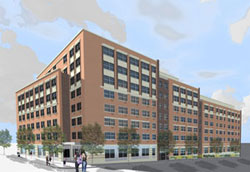
500 East 165 Street in the Bronx.

Magnusson Architecture and Planning

Ground was broken for a new affordable housing project, designed by Magnusson Architecture and Planning (MAP), in the Morrisania section of the Bronx. Developed by a joint venture of L&M Equity Participants, Nos Quedamos, and Melrose Associates, the building will rise eight stories on a corner of 165th Street and Third Avenue. Because of the site’s location on a main thoroughfare, MAP plans for a dramatic façade and an articulated corner entry with a setback to create public open space in front of the building. The steep slope of the site inspired a partially double height atrium space that allows light to move through the building and affords views from the street to a landscaped courtyard. Funded through New York State’s Division of Housing and Community Renewal, the project will create 128 units of affordable housing for residents earning up to 60% of Area Median Income (AMI), and approximately 4,500 square feet of commercial space.


Museum-within-a-museum: New Light Shed on Greek and Roman Art

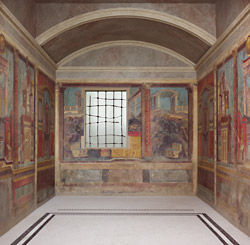
Cubiculum

Cubiculum (bedroom) from the Villa of P. Fannius Synistor.

Courtesy Metropolitan Museum of Art

After more than five years of construction, the Leon Levy and Shelby White Court at The Metropolitan Museum of Art is now open to the public. Billed as a “museum-within-the-museum,” the long-awaited opening concludes the completion of a 15-year redesign project headed by Kevin Roche, FAIA. Returning to public view are the Met’s collection of classical art and thousands of long-stored works from the museum’s collection of Hellenistic, Etruscan, South Italian, and Roman art — on display in a peristyle court with a two-story atrium evoking that of a large Roman villa. The McKim, Mead, and White atrium previously displayed Roman art for 20 years before being converted into a cafeteria. Although the new design introduces several features, it remains faithful to the architects’ original concept — classically inspired architecture — and a glass roof that allows the objects below to be viewed in natural daylight


Cooper-Hewitt Renovates
On the heels of an ambitious capital campaign, Cooper-Hewitt, National Design Museum has raised $33 million for the renovation of its home in the landmark Andrew Carnegie Mansion. The Design Architect Selection Committee, which includes the museum’s executive architect, Beyer Blinder Belle Architects & Planners, unanimously chose Richard Gluckman, FAIA, principal of Gluckman Mayner Architects, to develop the interior renovation. Through renovation and re-programming portions of the Carnegie Mansion and the adjacent Miller and Fox townhouses owned by the museum, the project expects to increase the museum’s total exhibition space from approximately 10,000 to 18,000 square feet.

Gluckman will design a new 7,000-square-foot flexible gallery and stairway to connect floors — which will be expanded with an additional 1,000 square feet of gallery space — forming a juxtaposition between 21st century design and the mansion’s Georgian style. The renovation program, which follows a two-year master planning process conducted by Beyer Blinder Belle, will advance in stages, with the design development by Gluckman to be conducted in the coming months. The renovation of the Miller and Fox townhouses will begin in spring 2008, followed by the renovation of the Carnegie Mansion, beginning in summer 2009.


Randall’s Island Sports New Look

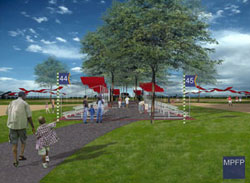
Randall’s Island quad

The main quad planned for Randall’s Island.

Courtesy Levien & Company

Levien & Company is project manager for the Randall’s Island Sports Development Project, one of the largest public works projects in recent NYC history. The $127 million project will contain 64 state-of-the-art athletic fields, attendant roadways, parking, pedestrian pathways, lighting, landscaping, and comfort stations to be built on the island’s 300 acres. In response to a growing need for quality sports and recreation facilities in the city, the non-profit Randall’s Island Sports Foundation (RISF) created a public-private partnership with the NYC Department of Parks & Recreation. Together, they commissioned a master plan prepared by M. Paul Friedberg and Partners and Ricardo Zurita Architecture & Planning for Randall’s and Ward’s Islands. Already implemented is construction of the Icahn Track & Field Stadium (designed by Hillier), and in the development stage are a new and expanded Sportime Tennis Center and 27-acre Aquatic Entertainment Complex.


Water Heals at Medical College

Weill Greenberg Center

Weill Greenberg Center.

Polshek Partnership Architects

Sited on the Upper East Side, the newly completed 330,000-square-foot, 15-story Weill Greenberg Center for ambulatory care takes its place among the college’s array of different architectural styles. Guided by the principle that the building’s design is integral to the healing process, Polshek Partnership Architects created a series of interior water features, including a 60-foot-long water wall, a 100-foot-long stream, and a reflecting pool. An interior vehicle drop-off that opens directly onto the ground floor lobby (complete with valet parking) facilitates patient arrivals and departures. A white ceramic fritted glass curtain wall cut into undulating vertical facets allows soft light to permeate the interior while assuring patient privacy. It also reflects the gothic motif of the original New York Hospital-Cornell Medical Center across York Avenue.


Boris Godounov Plays Princeton

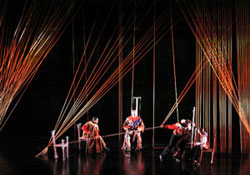
Set design for “Boris Godunov”

Set design for “Boris Godunov.”

RUR Architecture

Jesse Reiser, AIA, principal of Reiser + Umemoto RUR Architecture, led a team of graduate students at Princeton University’s School of Architecture in designing the set for the world premiere of Alexander Pushkin’s 1825 play, “Boris Godunov.” The interdisciplinary set design involved the concept, design, and production of the sets using legendary theater director Vsevolod Meyerhold’s notes and other source materials as the basis for a new interpretation. For the design of the sets, Meyerhold’s concept of the “biomechanical theatre” was extrapolated to fit a 21st century paradigm.


On the Boards in Baltimore

Market Center Urban Renewal Area

Master plan for the Market Center Urban Renewal Area.

Cooper, Robertson & Partners

Baltimore Mayor Sheila Dunn recently unveiled Cooper, Robertson & Partners’ urban design plans for Lexington Square, a mixed-use urban retail destination and residential project. The three-city-block, $250 million redevelopment project has been designed to revitalize the Market Center Urban Renewal Area of Baltimore’s Westside. Two 14-story residential towers containing 400 residential rental apartments, 300,000 square feet of retail space, and 900 enclosed parking spaces comprise the project that is slated to begin construction in Spring 2008.

In this issue:
·AIA Teams Up with Google Earth
·AIANY Members to Speak at GSD
·Big Apple Tour of San Antonio


AIA Teams Up with Google Earth
The American Institute of Architects (AIA) launched two new AIA layers in Google Earth with the software’s recent upgrade: Blueprint for America and America’s Favorite Architecture. Marking AIA’s 150th anniversary, the AIA and Google Earth partnership demonstrates architecture’s impact on the world to more than 200 million Google Earth users.
America’s Favorite Architecture layer features the American public’s favorite structures, as selected by a Harris Interactive poll announced earlier this year. Google Earth users can now see newly-created 3-D models of the ballparks, bridges, buildings, and memorials that characterize architecture and comment on the poll results.

The Blueprint for America documents community service efforts funded by the AIA, in which AIA members donate their time and expertise to collaborate with community leaders and local citizens to address issues such as homelessness, sustainable communities, and downtown revitalization. Clicking on the Blueprint for America layer enables users to explore how AIA members and local citizens are working together to resolve real issues in their communities.

To learn more, either go to the websites, or watch the AIA/Google Earth YouTube video available online here.


AIANY Members to Speak at GSD
The Summer 2007 Executive Education program held by the Harvard Graduate School of Design comprises some 40 workshops covering design, real estate, business development, management, planning, and technologies. AIA New York Chapter member speakers include Randolph Croxton, FAIA; William Pedersen, FAIA; Walter Chatham, FAIA; Stephen Kliment, FAIA; Gregory Beck; Raymond Bordwell, AIA; J David Hoglund FAIA; Robert A. Klein, AIA; and Paul Milana, AIA. For details, visit the website or telephone: 617.384.7214.


Big Apple Tour of San Antonio

While forgetting the Alamo may be forgivable, missing the array of programs your peers are serving up later this week is not. Come support your fellow New Yorkers who are presenting or moderating 25 programs at the AIA Convention. Topics range from spicing up your presentations to improving your writing skills to choosing technologies to deliver your projects. New Practices New York will be exhibited; a reception for AIANYS will celebrate new Fellows and Lance Jay Brown, FAIA, this year’s Topaz Award Winner. AIAS and Architect magazine will throw parties Thursday evening. The Council of Architectural Component Executives (CACE) will host a luncheon on Friday highlighting reasons to come to NYC in August. Friday evening the new Fellows will receive their medallions at the Alamo.

A full list of events and seminar handouts (to conserve this year’s convention is paperless!) are available online. Following is a list of all programs with NY-based speakers and significant events by day and time. Enjoy!

Wednesday, 5/2

8:00 AM-12:00 PM
· WE02 The Human Connection: Bring Your Presentations to Life!, Carol Doscher; Rich Swingle
· WE14 Tall Buildings at Work: The New High Performance Office, David White with Vidar Lerum, PhD, Assoc. AIA; Eui-Sung Yi

8:30 AM-5:30 PM
· WE25 Integrating Green Design with Historic Preservation — NWA, Roy R. Pachecano, AIA, APA, NCARB; David J. Pfeffer, Esq. with Brian Chandler; APA, Stephen Colley, AIA

1:00-5:00 PM
· WE33 Sustainable Lighting Challenges, Barbara Cianci Horton with James Benya; Gilbert Lang Mathews, Esq.
· WE35 Writing for Success in Architecture Practice: Improved Tools and Techniques for Clear Communication, Stephen A. Kliment, FAIA

6:30-9:00 PM
· New Practices New York Exhibition opening at Blue Star Arts, 101 Bowie St., San Antonio, TX

Thursday, 5/3

10:00-10:50am
· AIA Candidate Speeches and Regional Caucuses

1:30-3:00 PM
· TH04 Women in Green: Voices of Sustainable Design, Robin Guenther, FAIA, with Kira Gould, Assoc. AIA; Sandy Mendler
· TH08 Sustaining Our Elderly, Mitch Green with Jeffrey W. Anderzhon, FAIA; Ingrid Fraley, IIDA
· TH17 Creating Sustainable Psychological and Physiological Designs, Vincent Smith with Lisa Krumins; Barbara Lyons Stewart, AIA

3:00-4:30 PM
· E10 AIA Honors and Awards Ceremony

4:00-5:30 PM
· TH34 Greening Affordable Housing: New Innovations from the Field, William Stein, AIA, LEED AP with Bruce Hampton, AIA, LEED AP; Bill Roschen, AIA; Walker Wells, AICP, LEED AP
· TH48 Sustainability, Design, and Innovation, Susan Szenasy with Kira Gould, Assoc. AIA; Lance Hosey, AIA, LEED AP; Henry Siegel, FAIA
· TH49 Drivers of Change: Energy, Water, and Climate Change, Fiona Cousins, PE, LEED AP, Jessica Strauss, AIA, LEED AP
· TH51 AIA Whitney M. Young Jr. Forum

6:30-9:00 PM
· AIA New York State Reception at Aztec on the River, 201 East Commerce Street

Friday, 5/4

8:15-9:45 AM
· FR08 Lessons Learned from the ArchVoices Essay Competition, Elizabeth Donoff with Matt Ostanik, AIA, CSI
· FR09 Innovation and Sustainability in Blast — Resistant Design, Robert Smilowitz, PhD, PE, with Ken Hays; Kevin O’Connor, AIA, LEED AP; Morgan R. Williams, AIA
· FR18 Designing for Aging Baby Boomers as Opposed to Seniors: What’s the Difference?, Priscilla Wallace with Steven Wayne Goggans, AIA; Paul Morris, FASLA; Judy Schriener

10:00-11:30 AM
· Gold Medalist and Topaz Award presentations

1:30-3:00 PM
· FR30 New York New Visions: Success or Failure?, Alexander Garvin, APA; Rosalie Genevro; Mark E. Ginsberg, FAIA, APA; Mark Strauss, FAIA, AICP
· FR36 New York City Builds on Its Legacy, Laurie Kerr, LEED AP; Karen K. Lee, MD, MHSc, FRCPC; Deborah Taylor, AIA, LEED AP
· FR39 Advocacy Tactics for a Sustainable Endgame: The Politics of Sustainability, Jeremy S. Edmunds, Assoc. AIA, PE, LEED AP with Ron Faucheux, PhD, Esq.; John Norquist, Hon. AIA; Ambassador Richard N. Swett, FAIA
· FR43 Sustainable Communities in Our Nation’s Regions: AIA Honor Awards for Regional and Urban Design, J. Max Bond Jr., FAIA; Lance Jay Brown, FAIA with Constance Bodurow, Assoc. AIA, AICP
· FR47 Sustainable Design Perspectives after the Disaster, Marianne Cusato, CNU with Robert J. Berkebile, FAIA; Walker Wells, AICP, LEED AP

4:00-5:30 PM
· FR66 Making a Difference: AIA 2007 Young Architect Award Recipient’s Discussion
· FR74 Deconstructing Sustainable Interiors, Susan Szenasy with Jeff Barber, AIA, LEED AP; Carlie Bullock-Jones Thompson; Tom Paladino; Kendall P. Wilson, AIA, IIDA, LEED AP

6:00-7:00 PM
· FR80 The Viridian Loan Fund: Bringing Green Roofs to Affordable Housing, Leslie Hoffman

6:00-7:30 PM
· Fellows’ Investiture at the Alamo

6:00-8:00 PM
· New Practices at Blue Star Arts, 101 Bowie St., San Antonio, TX

7:30-11:30 PM
· E30 Fiesta! San Antonio Host Chapter Party at LaVillita

Saturday, 5/5

8:15-9:45 AM
· SA07 Resilient Green Design Teams and Processes, Kathleen Bakewell, Assoc. AIA; Gerry Lang, AIA
· SA13 Designing the Sustainable Workplace in the Civic Environment, Barbara A. Nadel, FAIA with Edward A. Feiner, FAIA; Gary Haney, AIA, NCARB; Thom Mayne, FAIA
· SA17 Design Issues and Considerations for Improving Sustainable Roofs, Douglas Stieve, AIA with Christopher W. Giffin, AIA; Richard S. Koziol, AIA, NCARB

11:30 AM-1:00 PM
· SA26 Professional Practice in the 21st Century, James Sawyer, AIA with James P. Cramer, Hon. AIA, IIDA

1:30-3:00 PM
· SA50 AIA Institute Honor Awards for Architecture