Green is in the Details

Event: Helmut Jahn: A MIXED GREENS LECTURE
Location: The New York Academy of Sciences Headquarters, 7 WTC, 03.15.07
Speaker: Helmut Jahn — President and CEO, Director of Design, Murphy/Jahn; Carol Willis — director, Skyscraper Museum (introduction)
Organizers: The Skyscraper Museum; The New York Academy of Sciences

Andreas Keller, courtesy Skyscraper Museum

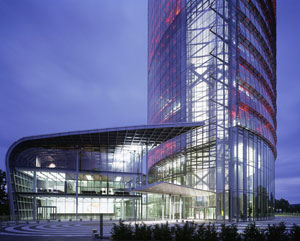
The Deutsche Post Tower in Bonn, Germany is routinely green.

Andreas Keller, courtesy Skyscraper Museum

As one might expect from a product of the Illinois Institute of Technology’s Miesian curriculum, Helmut Jahn, FAIA, offers “an attention to performance on all levels” as the key to sustainable design. He finds that “…the right answer to all problems is dealing with light, dealing with natural air, and dealing with water;” optimizing function in these areas, he believes, is the most effective way to make buildings energy-efficient and comfortable. Get the basics right, Jahn insists, and retain Mies’s farsighted attention to the properties of today’s materials, and advanced green technologies (heat recovery, greywater processing, etc.) will be largely unnecessary.

Sustainability per se, as the term is commonly understood, doesn’t appear to be a critical priority for Jahn. After walking the audience through a series of towers his firm designed, he confessed, “Maybe I don’t even care how green they are.” He regards LEED and comparable environmental accounting systems as more valuable for marketing purposes than for efficient operation; he noted that in a typical 40-point LEED Gold building, the Veer Towers in Las Vegas, 19 are directly attributable to design, and only five of the 19 involve reductions in energy use. “Building green does not necessarily mean that it’s going to be good architecture,” he says; sustainability appears as a welcome byproduct of his emphasis on functionality.

Most of the projects presented are in Europe, where energy costs are historically high, codes are rigorous, and clients need little persuasion about the virtues of efficiency. In Berlin’s Sony Center, a short 7-meter leafspan maximizes natural ventilation, and features regarded as innovative in the U.S. (raised floors, low-E fritted glass, load-bearing mullions) are routine. The twin-elliptical-shell Deutsche Post Tower in Bonn, has minimal energy requirements, needing no cooling towers or supply/return ducts; its thermal management relies on Rhine water, interior sky gardens, the heat-storing properties of concrete, the aerodynamic properties of its own envelope, and simple fans. Jahn’s ideas are also expanding to Asia and the Mideast; one tower for Pearl River New City in Guangzhou, China, will sport a vertically shingled facade that acts as an exterior sunshade and allows natural ventilation, and new forms are planned for Doha and Abu Dhabi (watch for a particularly daring structure in the latter, tentatively nicknamed the Twister). The dominant aesthetic in Murphy/Jahn’s work tends toward dematerialization, as biomorphic and modernist: buildings with skins that breathe and skeletons that put every molecule of their materials to work.

Balancing Great American Cities: Its Form AND Content

Event: Interpreting and MisInterpreting Jane Jacobs: New York and Beyond
Location: Museum of the City of New York, 03.07.07
Speakers: Ronald Shiffman, FAICP, Hon. AIA — Professor of Urban Planning, Pratt Institute; Michael Sorkin — Director, Graduate Urban Design Program, City College of New York; Margaret Zeidler — President, 401 Richmond, Toronto; Moderator Mary W. Rowe — Senior Urban Fellow, Blue Moon Fund; Roberta Brandes Gratz — Founder, The Center for the Living City at Purchase College (introduction)
Organizers: Museum of the City of New York

The Death and Life of Great American Cities

Jessica Sheridan

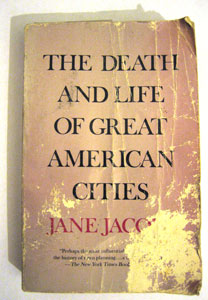
In The Death and Life of Great American Cities, Jane Jacobs praised the organized chaos of everyday urban life and articulates how a city’s aggregate form contributes to a vital life. She taught us how to listen to urban places, explains Roberta Brandes Gratz, founder of the Center for the Living City at Purchase College. In the neighborhoods she admired, Jacobs did not, however, see a model for but rather principles to guide urban development. In Greenwich Village, for example, Jacobs saw a healthy exchange between the public and private realms that should be replicated. But not all neighborhoods can or should be the Village.

According to Michael Sorkin, Director of the Urban Design Program at the City College of New York, the dual aspects of Jacobs thinking — the formal and the participatory — are interdependent. Often her ideas are misread because of the tendency to “divorce Jane Jacobs the activist from Jane Jacobs the gifted observer of urban morphologies.” Jacobs’s observations are increasingly lost as her ideas are appropriated “to sell large, top-down projects,” explained Ronald Shiffman, FAICP, Hon. AIA, Professor of Urban Planning at Pratt Institute. He cited the Atlantic Yards project in Brooklyn and Columbia University’s Manhattanville expansion as examples of this. As Sorkin summarized, “The form of the ‘good city’ and its culture are inseparable.”

How Dutch Ideals Shaped NY

Event: Russell Shorto Details Manhattan’s Dutch Origins — Downtown Third Thursdays Lecture Series
Location: National Museum of the American Indian, 03.15.07
Speaker: Russell Shorto — author & contributing writer, New York Times Magazine
Organizers: The Alliance for Downtown New York

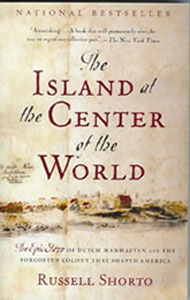
The Island of the Center of the World

Courtesy russellshorto.com

Held in a building that stands on the very site of the Dutch fort of New Amsterdam, Russell Shorto asked audience members to imagine putting time into reverse, and envision 17th-century Manhattan: poised between the civilization of Europe and the virgin continent of North America. This is what Shorto did when writing The Island at the Center of the World, an investigation into the depth of Dutch influence on Manhattan, and consequently America. Drawing on recently translated 17th-century Dutch records, Shorto discovered how the uniquely Dutch ideas of tolerance, free-market trade, and the melting pot became the foundation for American ideology.

Unlike the rest of Europe, Dutch provinces were home to settlers of many cultures who had fled their own war-torn countries. Diversity fostered religious and social tolerance that vastly exceeded the rest of Europe and flourished during their cultural Renaissance. These ideals, as well as words such as “cookies” and “boss,” were transferred to their American colonists, in a territory that swept as far south as the Delaware River. In fact, a Jesuit priest in the 1640s reported hearing 18 languages on the streets of Manhattan — when only about 500 people lived there.

Adriaen van der Donck became the champion of colonists’ rights. The only lawyer in the colony, he petitioned for fair treatment from Peter Stuyvesant, the colony’s director. After being jailed for door-to-door petitioning, van der Donck spent three years at the Hague, publicizing the potential of New Amsterdam. His actions led to a municipal charter that ensured free trade and tolerance. After the English took over in 1664, they kept this template, which formed the basis for what New York would become.

It’s great to read a favorable write-up on the pedicab regulations (See Editor’s Soapbox: Proposed Pedicab Protocol Not So Appalling). I also agree that the limited number within Manhattan may not be needed. I think the cost of the regulations will reduce the number in order to maintain profits. If the business is succeeding, then it should be allowed to grow.

Now we can only hope the licensing and insurance will limit the pedicab pot smoking breaks I regularly see along CPW.

– Nick Lawson, architectural designer

Note: Since the last issue was published, Mayor Bloomberg decided not to sign the pedicab bill, at least for now.

USGBC vs. NAHB – What Difference Does it Make?

“In an effort to bring uniformity to sustainable building practices, the International Code Council (ICC) and National Association of Home Builders (NAHB) have announced an agreement to develop and publish a residential green building standard.” This recent press release announces the upcoming launch of NAHB’s Green Home Building Guidelines. If NAHB is trying to unify sustainable practices, why is it developing these guidelines this year, the same year that the U.S. Green Building Council (USGBC) is releasing its LEED for Homes program?

NAHB’s guidelines are similar to LEED for Homes. There is a point system based in several categories: Lot Design, Preparation, and Development; Resource Efficiency; Energy Efficiency; Water Efficiency; Indoor Environmental Quality; Operation, Maintenance, and Homeowner Education; and Global Impact. A project can achieve Bronze, Silver, or Gold rating. Both the NAHB and USGBC websites even claim that their programs began in 2004. NAHB maintains that its guidelines are more geared toward local or regional jurisdictions, but after reading through the point system, I am unclear as to how its point qualifications are different from LEED.

One difference between the Green Home Building Guidelines and LEED for Homes is that NAHB is working with the ICC and the American National Standards Institute (ANSI) to develop its standards. This will make it easier on designers who comply with these building standards already, while in order to achieve LEED certification a designer has to go above and beyond the existing standards in order to achieve points.

Also, NAHB claims that its guidelines are more oriented to the economic needs of homeowners. It is difficult to convince a homeowner to apply for LEED certification because of filing costs, but nowhere does the website outline application costs for the Green Home Building Guidelines (at least that I could find).

Ultimately, this is another example of clashing organizations adding to the confusion about sustainability. At least NAHB acknowledges, “It should be noted that although many green building programs have been in existence for 10 years or more, the concept and practice of green building is not clearly defined and straightforward.” Also, NAHB’s website does include a link to the USGBC’s website (not vice versa). So maybe the USGBC is the only one who does not play well with others. I am not against multiple systems to rate sustainability, but why duplicate the efforts of other organizations? Why not deliver a clear and simple guide that anyone can understand and use?

In this issue:
·Collaboration Success Story Hits East New York
·Three New Landmarks in Far West Village; Five to Go
·Compassion & Healing: 2007 VISTA Award
·Betting a Casino Heralds Catskills Comeback
·Community is Focus in Pike County, PA
·New Center Nods to Nobel Norwegian Novelist
·7 WTC’s New Tenant Floats on 42nd Floor
·Chinatown Loft Becomes Church (and a UWS Synagogue)
·Professionals Hang-Out at Houston Biomedical Research Facility


Collaboration Success Story Hits East New York
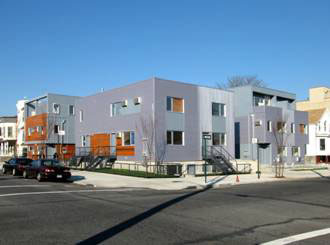
East New York Homes.

East New York Homes.

Della Valle Bernheimer

A ribbon cutting ceremony officiated by Mayor Bloomberg marked the opening of the 2,200-square-foot Glenmore Gardens, an affordable condominium housing project in East New York, Brooklyn, developed through the City of New York Department of Housing Preservation & Development (HPD) New Foundations program on land owned by HPD. New Foundations is a homeownership program established to develop sites in neighborhoods lacking ownership opportunities and to encourage small developers and contractors to create affordable housing.

Della Valle Bernheimer Architects coordinated the design, development, and construction of five similar semi-detached slab-on-grade condominiums in collaboration with Architecture Research Office (ARO), BriggsKnowles Architecture+Design, and Lewis.Tsurumaki.Lewis. The firms each selected a floor plan type and then designed a unique shell for it. Using the same materials — 90% recycled corrugated aluminum, fiber cement panels, and cedar siding for the façades — Della Valle Bernheimer designed two of the buildings while the other firms designed one each. The complete construction budget was $2.3 million.


Three New Landmarks in Far West Village; Five to Go
Keller Hotel

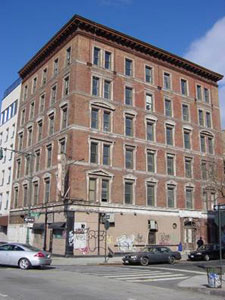
Keller Hotel at 150 Barrow Street.

Courtesy Greenwich Village Society for Historic Preservation

In response to the Greenwich Village Society for Historic Preservation’s (GVSHP) “Campaign to Save the Far West Village,” the New York City Landmarks Preservation Commission (LPC) voted unanimously to designate three more sites: the 1898 Neo-Classical Keller Hotel on Barrow Street, one of three remaining intact former sailors’ hotels in the Village that is currently being renovated into apartments; the 1839 Henry Wykoff House on Charles Street; and the 1844 Greek Revival Edwin Brooks House on West 11th Street. In 2005, the City committed to designating five additional sites in the area, but has not yet acted upon them. The GVSHP is also spearheading the protest against the 45-story Trump SoHo Condo Hotel at Spring and Varick Streets.

In related news, the LPC also granted protection for the library administration building at the Brooklyn Botanic Garden. The concrete and brick Tuscan-Revival-style building, one of a few designed by McKim, Mead & White without landmark designation, was completed in 1917.


Compassion & Healing: 2007 VISTA Award
Maimonides Cancer Center

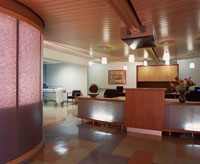
Maimonides Cancer Center.

Guenther 5 Architects

The American Society of Healthcare Engineering (ASHE) named Guenther 5 Architects recipient of a VISTA Team Award in the Renovation Category for the 60,000-square-foot Maimonides Cancer Center in Brooklyn. The design was cited for integrating best medicine practices with compassionate and healing design, as well as environmentally responsible architecture and interiors.

The architects transformed a former bank check-processing facility into an experience-focused sustainable center reconnecting the deep floor plate with natural light whenever possible. In consideration of environmental sensitivity and a strong connection between healing and nature, the Center’s program includes two linear accelerators, where patients receive radiation therapy — now a standard protocol; a spacious chemotherapy area; a pediatric oncology space featuring a play area and aquarium; family consult areas; several private meditation areas; physician’s offices; and a resource room on the ground floor open to the community.


Betting a Casino Heralds Catskills Comeback
St. Regis Mohawk Casino

St. Regis Mohawk Casino.

Brennan Beer Gorman Architects

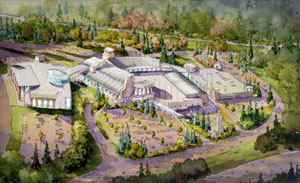
The St. Regis Mohawk Casino, just 90 miles northwest of New York City, is about to become the first casino in the Catskills, and Brennan Beer Gorman Architects (BBG) is set to design the 600,000 square foot gaming destination. Inspired by Adirondack-style lodges, the building is designed to create a relationship to nature, incorporating elements such as stone and natural wood. Glassed-in pedestrian walkways will accentuate the building’s perimeter while a stone tower will become a visible icon, according to the press release. Gaming will be focused around a double-height central atrium, with balconies overlooking from the specialty restaurant areas above. Planned restaurants, a nightclub, and an event center are programmed to offer entertainment to both gaming and non-gaming clients. The casino has won approval from Governor Eliot Spitzer and awaits final approvals from the Department of the Interior.


Community is Focus in Pike County, PA
Pike County Central Library

Pike County Central Library.

Frederic Schwartz Architects

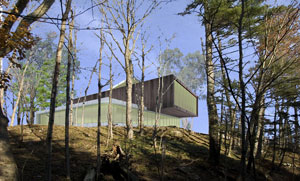
Frederic Schwartz Architects has won the design competition for the Pike County Central Library in Milford, PA. The building is sited to take advantage of the view and adjacency to wooded parkland. The focal point of the two-story, 18,000-square-foot building is a high, open, sky-lit “hub” around which all interior circulation is organized. The library will contain a community meeting room, small conference and tutoring rooms, café, and roof terrace. Green building components include high-performance, low-E double-glazing, and energy efficient mechanical systems such as radiant floor heating, operable windows for cross ventilation, and a planted roof. Joining the design team is Henry Myerberg, AIA, an award-winning library design architect (and a principal at Rockwell Group) with five projects currently in the works for the Robin Hood Foundation’s L!BRARY initiative.


New Center Nods to Nobel Norwegian Novelist
Knut Hamsun Center

The Knut Hamsun Center.

Steven Holl Architects

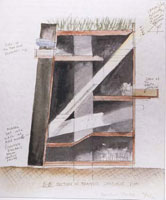
In 1994, Steven Holl Architects was commissioned to design a center for the Nobel Prize-winning turn-of-the-century Norwegian novelist Knut Hamsun. The project is back on track thanks to the support of the Norwegian Council, and will be open in time for Hamsun’s 150th birthday in August 2009. The Center, located above the Arctic Circle near Hamsun’s childhood home, will include exhibition areas, a library and reading room, and an auditorium. The concept for the project, “Building as a Body: Battleground of Invisible Forces,” is an architectural interpretation of the author’s work and controversial Nazi-sympathizing character. In the interim, the Museum of Modern Art purchased a model of the building.


7 WTC’s New Tenant Floats on 42nd Floor
Darby & Darby Office

Darby & Darby Offices at 7WTC.

Gerner Kronick + Valcarcel, Architects

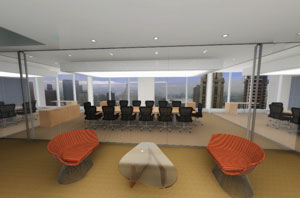
Gerner Kronick + Valcarcel, Architects (GKV) has been selected to design the law offices of Darby & Darby on the 42nd floor of 7 WTC. The 80,000-square-foot office will feature a glass staircase suspended by stainless steel tension rods joining a two-story conference center housing a boardroom and a multi-purpose room. Placed at opposite ends of the main reception area, they are designed to be individual glowing glass and sycamore “boxes.” The use of sheer stretch fabric ceilings in all conference rooms will allow for acoustical separation and privacy while maintaining a light and airy atmosphere. To take advantage of the natural light from the floor-to-ceiling windows, an open office plan was created along with private offices on the perimeter. Full-height glass sidelights connect to figured sycamore wooden doors at the perimeter offices and pull natural light into corridors and other interior spaces.


Chinatown Loft Becomes Church (and a UWS Synagogue)
Cetra/Ruddy

The new world headquarters and church for the Oversea Chinese Mission.

Cetra/Ruddy

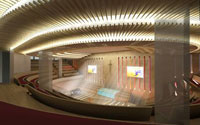
Chinatown’s Oversea Chinese Mission has commissioned Cetra/Ruddy to design its new world headquarters and church. The firm was selected as architect and interior designer to provide a creative re-adaptation of an existing 12-story commercial loft building. The reconfigured HQ will contain classrooms, community and pastoral office spaces, and a new 750-seat, two-story sanctuary. State-of-the-art acoustics and audio-visual capabilities for multi-media religious worship in Mandarin, Cantonese, and English languages will be installed. Construction is scheduled to begin this coming summer with an estimated completion date during summer 2008. Simultaneously, the firm is designing a new “ground-up” synagogue uptown.


Professionals Hang-Out at Houston Biomedical Research Facility
Methodist Hospital Houston Expansion

Methodist Hospital Houston Expansion.

Kohn Pederson Fox Architects

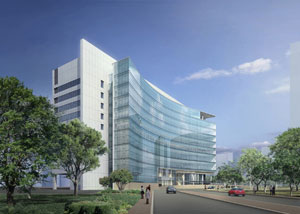
The Methodist Hospital in Houston has selected Kohn Pedersen Fox Architects to design a new 11-story biomedical research institute. The 300,000-square-foot facility is divided into two distinct volumes, one for labs and the other for offices. They are joined by an atrium that, along with its connecting bridges, provide break rooms and other informal gathering spaces on each floor. The program also includes conference facilities with a 250-seat auditorium, a vivarium, imaging suite, and current good manufacturing practice facilities. Bridge connections to the existing hospital are proposed at several floors to facilitate translational research and a sense of professional community.
2010 Imperative

During the Global Emergency Teach-in, Architecture2030 issued the 2030 Challenge and the 2010 Imperative — strategies to transform the built environment, stabilize emissions, and ultimately achieve acceptable levels over the next 10 years. The event was broadcast on the Internet on February 20, and is available on the website.

Since buildings are responsible for almost half (48%) of all annual energy consumption, immediate action within the building industry as well as a concentrated global effort are essential to avoid hazardous climate change.

The 2010 Imperative includes the following objectives:
  ·Beginning in 2007 all design studios should “engage the environment in a way that dramatically reduces or eliminates the need for fossil fuel.”
  ·By 2010 achieve complete ecological literacy in design education, including: design/studio; history/theory; materials/technology; structures/construction; professional practice/ethics.
  ·By 2010 achieve a carbon-neutral design school campus by: implementing sustainable design strategies; generating on-site renewable power; purchasing green renewable energy and/or certified renewable energy credits.

Sponsors of the event included:
Platinum: American Institute of Architects; The Home Depot Foundation; U.S. Green Building Council; New York Academy of Sciences. Gold: Rockefeller Brothers Fund; Silver: AIA Large Firm Roundtable; Supporters: AIA New York; AIA Committee on the Environment; Skidmore, Owings & Merrill; Metropolis; AIA Students; Society of Building Science Educators; Association of Collegiate Schools of Architecture; Union Internationale des Architectes; Royal Architecture Institute of Canada; American Solar Energy Society; Jonathan Rose Companies; Turner Construction; National Wildlife Federation; BuildingGreen, Inc.; D+Arquitectos.

The American Institute of Architects College of Fellows has awarded its 2007 Latrobe Prize of $100,000 for the proposal, “On the Water, A Model for the Future: A Study of New York and New Jersey Upper Bay,” which was presented to principal investigator Guy Nordenson, professor, structural engineering, Princeton University School of Architecture and founder of Guy Nordenson and Associates, NY… Other recipients of the Latrobe Prize, and participants in the project, include Stan Allen, AIA, Catherine Seavitt, AIA, and James Smith, Princeton University; Michael Tantala, Tantala Associates; and Adam Yarinsky, FAIA, and Stephen Cassell, AIA, Architecture Research Office…

The Institute of Classical Architecture & Classical America announced the winners of the 2007 Arthur Ross Awards for Excellence in the Classical Tradition. NYC-area winners are: The Rambusch Company (Artisanship); Acanthus Press LLC (Publishing); and World Monuments Fund (Stewardship). In addition, Robert A.M. Stern, FAIA, was given special recognition by the Board of Directors, prompted by the recent publication of New York 2000: Architecture and Urbanism Between the Bicentennial and the Millennium as the final volume in his five-part series…

James R. Martin, AIA, has joined the firm of daSILVA Architects, as a principal… Julia Nelson, AIA, and Todd Poisson, AIA, have been promoted to Associate Partners at BKSK Architects… Spacesmith named John Coburn, AIA, Director of Operations… Thomas J. Scialo has joined SBLM Architects as Director of Construction Administration… Stephen E. Gottlieb, AIA, has joined SUPERSTRUCTURES Engineers + Architects as Senior Preservation Architect…

Kristen Richards

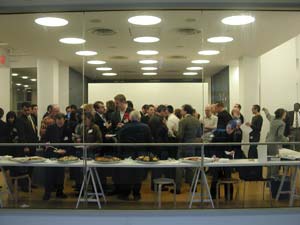
Crowds gathered at the AIA NY Chapter’s New Members Reception at the Center for Architecture 03.15.07.

Kristen Richards

Kristen Richards

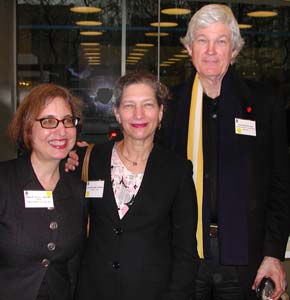
(l-r): Abby Suckle, FAIA, LEED AP, Secretary of the AIANY Chapter Board of Directors; 2007 AIANY President Joan Blumenfeld, FAIA, IIDA, LEED AP; and AIANY First Vice President/President Elect James McCullar, FAIA.

Kristen Richards

Craig Morton

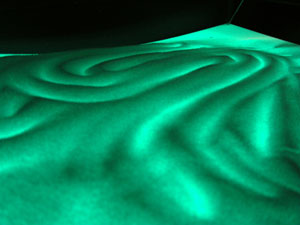
Winners of the 2007 Illuminating Engineering Society of NY (IESNY) Student Design Competition were announced at the opening of the Immersive Lightscapes exhibtion at Lotus Space. The winning entry was submitted by Chung-Jung Liao, MFA Lighting, Parsons The New School for Design.

Craig Morton

Craig Morton

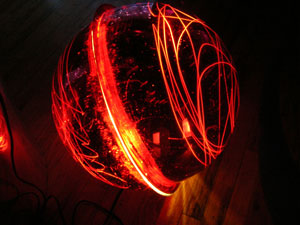
Another submission to the IESNY competition was this ball of light designed by Vincent Milner, AAS Interior Design, Parsons The New School for Design.

Craig Morton

Oculus 2007 Editorial Calendar
If you have ideas, projects, opinions — or perhaps a burning desire to write about a topic below — we’d like to hear from you! Deadlines for submitting suggestions are indicated; projects/topics may be anywhere, but architects must be New York-based. Send suggestions to Kristen Richards.
06.01.07 Fall 2007: Collaboration
09.07.07 Winter 2007-08: Power & Patronage

Submission: Open Architecture Prize
Advanced Micro Devices, Inc. (AMD) and Cameron Sinclair, winner of last year’s TED Prize and founder of Architecture for Humanity, announced the first ever Open Architecture Prize at the annual TED Conference. The $250,000 Open Architecture Prize is the largest prize in the field of architecture and is designed to be an international multi-year program. Each year, a winning design will be chosen from a field of low-cost, sustainable design projects to be built in a selected community. The first project for the Open Architecture Prize will be an “e-community center,” a centralized building equipped to enable an entire community to access the Internet. The winning designs will be built as part of the prize and in alignment with the 50×15 Initiative, a program founded by AMD to connect 50 percent of the world’s population to the Internet by 2015.

03.30.07 Submission: 2007 AIA NYS Convention: Call for Presentation Proposals
Inspired by the 150th Anniversary of the AIA, the theme of the 2007 AIA New York State Convention (10.04.07-10.06.07) will be “The Past as Prologue.” Proposals will be accepted for seminar topics that address this theme — or better yet, take it to the next level — to educate design professionals.

04.06.07 Call for Papers: Sixth International Conference on Courthouse Design
The AIA Academy of Architecture for Justice seeks contributions to a discussion among world leaders in the justice field regarding innovation in planning, design, technology, and research for courthouses. This year’s theme is Sustainable Excellence, and the conference, which will take place at the Marriot Brooklyn Bridge 09.26-09.28.07, will explore ideas surrounding sustainable communities, design excellence, green design, among others. For more information click the link; for inquiries, address all questions to Katherine Gupman, AIA project manager via e-mail or call 202-626-8051.

04.10.07 Request for Proposals: Futbol Club Barcelona Stadium Remodeling
FC Barcelona is calling for architects from around the world to remodel Camp Nou (FC Barcelona stadium) into a modern stadium. The stadium will celebrate its 50th anniversary on 09.24.07. The selection process is through an international tender that is supported by the Association of Architects of Catalunya, which will contribute the necessary expertise for selecting the architect, or team of architects, who will be commissioned for the project.

04.13.07 Call for Papers: Worship Facilities Conference
The Worship Facilities Conference & Expo (WFX) is seeking qualified presenters for the educational sessions to be offered at WFX 2007, October 24-26 in Atlanta, GA. This event, now in its third year, is designed to help decision makers in houses of worship pull together their strategies for facilities design, financing, building management, and audio-visual and IT technologies.

05.09.07 Submission: Van Alen Institute New York Prize Fellowship
The annual New York Prize Fellowship brings emerging practitioners and scholars to the Van Alen Institute headquarters in NYC and supports early- to mid-career architects, designers, planners, and individuals from other disciplines across the arts, humanities, and sciences. Fellows pursue advanced independent study to generate projects — such as exhibitions, installations, and symposia — on the most significant issues shaping the design and use of public space. The Institute seeks projects that approach architecture as a cultural practice with public consequence and that engage public audiences. The Council will select up to five Fellows for periods of three months each in 2007- 2008. Fellowships include a stipend, project support, individual office/studio space at the Institute with publishing opportunities.

05.29.07 Submission: Columbus Re-wired: Visions for Intersections
AIA Columbus, in partnership with AIA National, is sponsoring three community charrettes which will culminate in an international competition focusing on the current and future state of public transportation in Columbus, OH. Generating dialogue about public transportation, special emphasis is on illustrating how multiple transportation modes can work together to provide a complete network connecting citizens with their community and sparking economic development.

06.01.07 Submission: World Habitat Awards 2007
The Building and Social Housing Foundation seeks entries for the World Habitat Awards 2007 competition, initiated in 1985 to identify practical, innovative, and sustainable solutions to current housing issues capable of being transferred or adapted for use elsewhere. The competition is open to all individuals and organizations, including central and local governments, NGOs, community-based groups, research organizations, and the private sector. Two winners will receive £10,000, presented at the annual United Nations global celebration of World Habitat Day.