Steel at Dawn

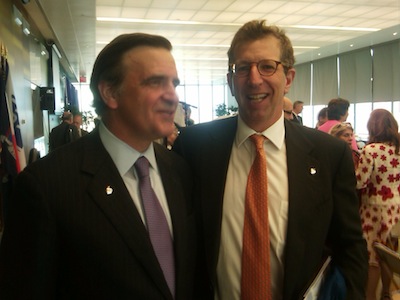
(l-r) Deputy Mayor Robert K. Steel and William C. Rudin

Rick Bell, FAIA

Robert K. Steel, Deputy Mayor for Economic Development, challenged a room full of civic leaders gathered at the new John Jay College of Criminal Justice Building to think “not about facilities, but what they facilitate” in strengthening New York City’s economic competitiveness. After a brief introduction by William C. Rudin, Chairman of the Association for a Better New York (ABNY), which hosted the June 21st breakfast, Steel outlined ways in which those coming together on the rooftop of the new City University of New York structure at 899 Tenth Avenue, designed by Skidmore, Owings & Merrill, could bolster the business climate and “encourage economic diversification, including investments in talent and in broadband infrastructure.”

He described the “four pillars of the city’s economic development” as:
* Improving the quality of life with public investments in parks, sanitation, culture, and schools;
* Creating a pro-business environment, making it clear that New York City is open for business;
* Investing in the future, with major redevelopment areas like Lower Manhattan, Downtown Brooklyn; and Long Island City;
* Fostering the idea that we have to be committed to innovation and game-changing initiatives.

The Deputy Mayor stated that “together, these four pillars provide a strong foundation for growth for the decades ahead,” and would create fertile soil for job creation by reforming the city’s bureaucracy. Of particular interest to the architects in the room was his description of ways in which processes of the Department of Buildings and the Department of City Planning were being reformed. Noting that it is now possible to apply for City permits online, rather than having to visit an office downtown, he cited the NYC Development Hub as a new mechanism to simplify operations.

The ABNY event was also billed as an opportunity to announce BluePRint, the initiative of the Department of City Planning. While the City’s ULURP process follows a predictable schedule, he noted that the much-maligned pre-certification process is being streamlined in an effort led by City Planning Chair Amanda Burden, Hon. AIANY, that will “make the process more efficient and predictable without sacrificing quality standards.” Process reform and more timely reviews have been long-time advocacy goals of the AIA New York Chapter. Deputy Mayor Steel said that “these improvements will save time and money for the developers and the City, getting projects onto the tax rolls sooner.

Steel gave as examples of upcoming change, the Bloomberg Administration’s work with the NYC Housing Authority to address long-standing operational deficits and maximize NYCHA’s real estate portfolio value. And he spoke of the transformative role of large-scale projects such as the Kingsbridge Armory and the Applied Science and Technion campuses. In describing neighborhood change across the city from Willets Point to Seward Park, he said that Mayor Bloomberg “is committed to creating the jobs of the future.”

The Deputy Mayor’s inspirational remarks concluded with a call to “keep investing in infrastructure and talent,” and, paraphrasing ABNY Founder Lew Rudin, “New York City’s best days lay ahead.” As for a question about design during the Q&A session, he said simply: “We can do more” – so keep tuned.
Steel at Dawn

(l-r) Deputy Mayor Robert K. Steel and William C. Rudin

Rick Bell, FAIA

Robert K. Steel, Deputy Mayor for Economic Development, challenged a room full of civic leaders gathered at the new John Jay College of Criminal Justice Building to think “not about facilities, but what they facilitate” in strengthening New York City’s economic competitiveness. After a brief introduction by William C. Rudin, Chairman of the Association for a Better New York (ABNY), which hosted the June 21st breakfast, Steel outlined ways in which those coming together on the rooftop of the new City University of New York structure at 899 Tenth Avenue, designed by Skidmore, Owings & Merrill, could bolster the business climate and “encourage economic diversification, including investments in talent and in broadband infrastructure.”

He described the “four pillars of the city’s economic development” as:
* Improving the quality of life with public investments in parks, sanitation, culture, and schools;
* Creating a pro-business environment, making it clear that New York City is open for business;
* Investing in the future, with major redevelopment areas like Lower Manhattan, Downtown Brooklyn; and Long Island City;
* Fostering the idea that we have to be committed to innovation and game-changing initiatives.

The Deputy Mayor stated that “together, these four pillars provide a strong foundation for growth for the decades ahead,” and would create fertile soil for job creation by reforming the city’s bureaucracy. Of particular interest to the architects in the room was his description of ways in which processes of the Department of Buildings and the Department of City Planning were being reformed. Noting that it is now possible to apply for City permits online, rather than having to visit an office downtown, he cited the NYC Development Hub as a new mechanism to simplify operations.

The ABNY event was also billed as an opportunity to announce BluePRint, the initiative of the Department of City Planning. While the City’s ULURP process follows a predictable schedule, he noted that the much-maligned pre-certification process is being streamlined in an effort led by City Planning Chair Amanda Burden, Hon. AIANY, that will “make the process more efficient and predictable without sacrificing quality standards.” Process reform and more timely reviews have been long-time advocacy goals of the AIA New York Chapter. Deputy Mayor Steel said that “these improvements will save time and money for the developers and the City, getting projects onto the tax rolls sooner.

Steel gave as examples of upcoming change, the Bloomberg Administration’s work with the NYC Housing Authority to address long-standing operational deficits and maximize NYCHA’s real estate portfolio value. And he spoke of the transformative role of large-scale projects such as the Kingsbridge Armory and the Applied Science and Technion campuses. In describing neighborhood change across the city from Willets Point to Seward Park, he said that Mayor Bloomberg “is committed to creating the jobs of the future.”

The Deputy Mayor’s inspirational remarks concluded with a call to “keep investing in infrastructure and talent,” and, paraphrasing ABNY Founder Lew Rudin, “New York City’s best days lay ahead.” As for a question about design during the Q&A session, he said simply: “We can do more” – so keep tuned.

Viva Verde!

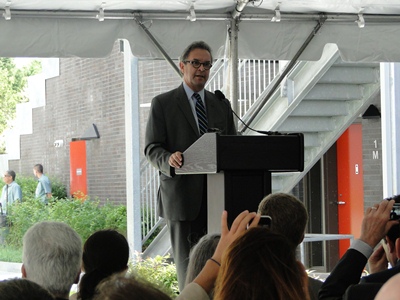
Rick Bell, FAIA, gives closing remarks.

Daniel Fox

Event: Via Verde Ribbon-Cutting Ceremony
Location: Via Verde, 700 Brook Avenue, Bronx, NY, 06.18.12
Speakers: Shaun Donovan, United States Secretary of Housing and Urban Development; Michael R. Bloomberg, Mayor, City of New York; Jonathan F.P. Rose, President, Jonathan Rose Companies; Adam Weinstein, President, Phipps Houses; Frank Bisignano, Chief Administrative Officer and Mortgage Banking CEO, JPMorgan Chase; Congressman Jose E. Serrano; Darryl C. Towns, Commissioner and CEO, NYS Homes and Community Renewal; Bronx Borough President Rubin Diaz, Jr.; Council Member Maria del Carmen Arroyo; Rick Bell, FAIA, Executive Director, AIA New York

These remarks were delivered at the closing of Via Verde’s Ribbon-Cutting Ceremony, 06.18.12.

New housing that New Yorkers can afford has often seemed to be an unrealizable dream. Today marks the opening of Via Verde, a truly remarkable and innovative mixed-income development.

The American Institute of Architects New York Chapter is happy to have had a role in initiating the project, along with the New York City Department of Housing Preservation and Development and the New Housing New York Steering Committee – led by Lance Jay Brown, FAIA, with Mark Ginsberg, FAIA, both here today – which challenged the design team to create an exemplary model that would create new and replicable standards for green affordable housing design.

Two extraordinary firms, Dattner Architects and Grimshaw Architects, represented today by Richard Dattner, FAIA, Bill Stein, FAIA, Adam Watson, AIA, and Venesa Alicea, AIA, along with Vincent Chang, AIA, Andrew Whalley, AIA, and Robert Garneau, AIA, combined to win the contest. They joined with Jonathan Rose Companies and Phipps Houses to get it built. It was important to all that the new housing create opportunities for a healthier way of life.

The complex, one of the first to follow the recently published NYC Active Design Guidelines, allows for more physical mobility. Stair use is encouraged by making the stairways attractive and easy to find. Windows in the interior stairways help, as do the bright paint colors. Stairs also head up from the courtyard to the lush terraced vegetable gardens, planted by GROW NYC – with special thanks to Gerard Lordahl. These culminate in the health club level where another design might have put a penthouse apartment. Solar panels and other common-sense environmental features, such as ceiling fans, also lower energy use and carbon footprint. Apartments benefit from cross-ventilation, so that air conditioning use will be less necessary.

For those who have seen the cycle of disinvestment and destruction in the South Bronx, the building of housing on what had been an overgrown, polluted, and seemingly unbuildable site seems almost miraculous. Turning the rubble-strewn lot into the Via Verde, shows that a “green way” exists not only when market forces align, but when there is a spirit of design creativity joined to community demand.

Today we come together to celebrate Via Verde’s opening. Let us all agree, going forward, that the creation of beautiful, healthy, and affordable housing is an absolute priority. Viva verde!

Tokyo Dispatch

Tokyo hosted the International Union of Architects’ 24th World Congress of Architecture (UIA2011) during the last week of September. Taking place at the Tokyo International Forum, designed by Rafael Viñoly, FAIA, who was present at the event, the UIA2011 meeting reportedly drew more than 5,000 design professionals and students from more than 100 countries. The focus of the long-planned international forum, Design2050, took on new urgency after the 03.11.11 earthquake and related tsunami catastrophe in north-eastern Japan. Many presentations, panels, and seminars were recalibrated to address what the international design community could do to anticipate, prevent, and respond to similar natural disasters. The major result of the Congress was the issuance of the Tokyo Declaration, which committed the world’s design community to better learn from disasters, exchange initiatives, and promote responsibility within our profession.

During the first day of the conference, a letter was presented to AIANY by Taro Ashihara, Hon. AIA, president of the Japan Institute of Architects, thanking New York’s architects for the support that came in response to the recent disaster. With the involvement of Hisaya Sugiyama, AIA, president of AIA Japan — a KPF alum — a fruitful discussion of disaster preparedness and risk assessment took place.

AIA President Clark Manus, FAIA, along with President-elect Jeff Potter, FAIA, and Executive Vice President/CEO Robert Ivy, FAIA, led the AIA National official delegation. Their blog entries, and those of other delegates, can be found on the AIA National website. Among other functions of the delegates, was voting in the election of the next UIA president to replace Louise Cox, who has served her three-year term, and selecting the venue for the 2017 Congress. Albert Dubler, an architect from Paris, was elected as UIA President; and following the 2014 UIA meeting in Durban, South Africa, the next city to host the conference will be Seoul, whose delegation included Sungjung Chough, Hon. FAIA.

AIANY was represented by Chapter President Margaret O’Donoghue Castillo, AIA, LEED AP, and Executive Director Rick Bell, FAIA, who co-presented the Chapter’s work on Buildings=Energy and Active Design at the UIA’s poster session and technical seminar. At the session, similar research was discussed with colleagues from Nigeria, Indonesia, and Malaysia. The panel discussion on the Active Design Guidelines and public health initiatives drew an enthusiastic audience of architects and others such as Robert Bell, director of the National Gallery of Australia, and Lone Sigbrand of the Danish Building Research Institute.

Keynote speakers included Tadao Ando, Hon. FAIA, Fumihiko Maki, Hon. FAIA, David Adjaye, Hon. FAIA, OBE, Christo (warm and witty with many one-liners, including “Jean-Claude always said we didn’t emigrate to the United States, we emigrated to New York City.”) Somewhat less well-known but as thrilling to hear was Vladimir Slapeta, an architect and historian from the Czech Republic, who wove a narrative of cross-continental cultural influences that linked Japanese Modernism and Metabolism back to the innovations of the Brno International Fair of 1925-28 and its New House Werkbund Exhibition.

As a corollary to the UIA events, the World Architectural Festival unveiled the shortlisted projects from Asia in its annual design competition. An exhibition of the WAF premeated work was held at the galleries in the Tokyo Headquarters of the UCHIDA-YOKO Company, a leading information technology company. WAF President Paul Finch organized evening receptions at which Castillo and recently-elected RIBA President Angela Brady, FRIBA, could renew acquaintances with World Architecture Festival and Architecture Review colleagues including Edmond Katongole, Jessica McFarlane, and Jane Connolly, who had been at the Ibex/New York celebration during the AIA Convention in New Orleans. UCHIDA’s Honorary Chairman Shinichi Mukai, and President/CEO Takashi Kashihara were extraordinarily hospitable to international guests, including AIANY and WAF sponsors from the Hong Kong, Singapore, and London offices of Rider Levett Bucknall.

Apart from the headliner talks, research papers, and design works presented, the star of the conference was the host city itself. An incredible mix of tradition and innovation, Tokyo boasts what is perhaps the most complicated, expansive, and useful public transportation system on earth. The subway made it easy to get around town, to see renowned structures and gardens, ranging from Kenzo Tange’s National Stadium in Yoyogi Park constructed for the 1964 Olympic Games, to more recent commercial structures in nearby Omotesando. The degree to which Japanese and Western cultures have intersected since the removal of trade barriers in the mid-1800s is phenomenal, with European and American branding pervasive. But it is the quintessentially Japanese stores, from Mikimoto to Uniqlo, that capture the spirit of the place.

It was in navigating the street life, urban design, and 24/7 feeling of Tokyo that those from NYC felt most at home. From the New York Grille at the Park Hyatt Hotel — scene of the late-night ponderings in Lost in Translation, to the Frank Lloyd Wright relics at the Imperial Hotel, much looked familiar. Totally different, and totally sublime, was the Supreme Delight club in Roppongi, the pecha kucha basement birthplace where Mark Dytham, architect and expat inventor of that communication art form, holds court. I felt privileged to reprise the UIA “Obesity and Architecture” talk there in the allotted six minutes and 40 seconds.

AC Dispatch

Atlantic City hosted the first-ever, metro-area, tri-state convention of the AIA, bringing together architects from New York, New Jersey, and Pennsylvania. To many it seemed a strange choice of venue for a late September convocation — poorly served by public transportation, lacking in urban design and architectural imagination, a sad place on the edge of a great sand beach.

But what Atlantic City lacked in design sensitivity, it made up in chutzpah, conviviality, risk-taking, and posing the eternal questions: Would anyone go? Would the suspense about the tri-state design awards conferred by the three state presidents keep those sitting on the edge of their chairs? Would the fog lift? Could you place bets on the Architectural Billing Index?

And yes, people went — more than 150 from New York and many from its largest AIA Chapter. Spotted in the crowd were bold-face names, like newly-appointed Design Trust Executive Director Susan Chin, FAIA; AIA National 2013 President Mickey Jacob, FAIA; AIANY President Margaret O’Donoghue Castillo, AIA, LEED AP; AIANY Past-Presidents Mark Ginsberg, FAIA, LEED AP, and Tony Schirripa, FAIA, IIDA; AIANYS Past-Presidents Terrence O’Neal, AIA, LEED AP, Burt Roslyn, FAIA, Orlando Maione, AIA, and Russ Davidson, AIA; Claire Weisz, AIA, an AIANYS board member representing Manhattan, and Venesa Alicea, AIA, LEED AP, also a board member representing Associate Members; Ennead Managing Partner Joseph Fleischer, FAIA; CACE Executive Committee Director Valerie Brown, from the Westchester-Hudson Valley Chapter; Adam Melis from AIA National Government Affairs; and Tom Schell from Naylor, publisher of OCULUS. But as Alicea noted, very few of the convention attendees were Associates — perhaps a function of the price point, location, or mid-week timing.

There was suspense — as the award program was revealed just before jury chair Larry Chan took to the lectern. Some sat, others gravitated towards the buffet. And the ABI was up — go figure.

Keynote speakers included Topaz Medallion winner Stanley Tigerman, FAIA, and our own Richard Meier, AIA, who will also be feted at this year’s Heritage Ball on 10.27.2011. A high point of Meier’s talk was his reminiscing about growing up in New Jersey, along with Jordan Gruzen, FAIA, and together heading down to the Steel Pier-era shore.

In his spirited “pecha meier” talk, the Pritzker-winning architect showed Esto-wonderful images from a score of projects, including the Neugebauer House in Naples, FL; the Rachofsky House in Dallas; the Perry Street Towers with 165 Charles Street; the Burda Collection building in Baden-Baden, and the Arp Museum in Rolandseck, Germany; the courthouse in San Jose with its dome on grade; the Weill Hall for Life Sciences labs at Cornell; the façades of two towers for Mitsubishi in Tokyo; the 8-star hotel in Tianjin; City Green Court in Prague; a proposed residential tower at the corner of Rothschild and Allenby in Tel Aviv; the Jubillee Church in Rome; and, last — though certainly not least — the Getty Center in Los Angeles, where “landscape is very much part of the experience of being there.”

Seminar panels on sustainability, codes, accessibility, and lighting animated late-night discussions at bars themed around other parts of the country, including the mildly Wild West.

AIA New York State elections — all uncontested — were held. Succeeding AIANYS President David Businelli, AIA, from Staten Island, is Buffalo’s Kelly Hayes McAlonie, AIA, confirmed as 2012 President, and joined by AIANY member Eric Goshow, AIA, LEED AP, as President-Elect. Tim Boyland, AIA, was elected as Vice President for Government Advocacy.

Much discussion took place at the AIANYS Board Meeting and elsewhere about the NYC Lobby Commission’s efforts to label and register all architects as lobbyists if they present at Community Boards or regulatory commissions (see link to AIANY Chapter testimony).

The high point for many was meeting people from (relatively) afar, or at least from outside of one’s daily or conventional experience. Perhaps that is where the Atlantic City metaphor seems most positive — bringing people together to look out at foggy skies, trying to make sense of where architecture and architects are going when the chips are down.

Note: To read more about the election results and award winners, see Names in the News.

What Have Architects Learned in 10 Years?

Ten years ago the Yankees and Red Sox were battling for first place in the American League East, and Philadelphia and Atlanta were doing likewise in the National League. New York architects were designing buildings for cities in China and the Middle East, and issues of taxation and spending loomed large on the national stage. The summer was hot, and the first Harry Potter film was about to be released. Then the airplanes hit New York, D.C., and Pennsylvania, and the world changed.

Photographs of people in the streets of Lower Manhattan show a combination of dust, anxiety, confusion, terror, and resilience. For those of us there, then, it seemed as if time stood still. And then the buildings fell. Inexplicably. Quickly. Impossibly. Rescue workers rushed to the site. Many others, as well, labored to save lives.

In the days and weeks following September 11, architects, engineers, landscape architects, urban designers, graphic artists — the entire NYC design community –came together to offer help, ideas, and expertise. New York New Visions, a group of 20 professional societies, including AIANY, produced a document with fundamental concepts for rebuilding. In the intervening years, three trends have taken root, changing the way buildings in NYC are built. While this had been initiated in the last years of the 20th century, it took the events of 9/11 to create a sense of urgency about their importance.

The first principle is safety. The NYC Building Code initially came about, just over a century ago, in response to the Triangle Shirtwaist Factory fire, where young seamstresses died because of locked and inadequate building exits. Insufficient exit capacity after the attack on the Twin Towers caused a major change in the city’s construction codes. First by Local Law, then by the acceptance of the International Building Code, exit standards were brought on par with other major cities around the world.

The second idea is sustainable design. Following the 9/11 attacks, Americans called into question our reliance on overseas sources of energy. Today, buildings across the country are increasingly energy efficient as we look more closely at ways of reducing the carbon emissions caused by the construction and use of our structures. In NYC, the Mayor’s Office for Long Term Planning & Sustainability has spelled out clear carbon reduction plans, and the Bloomberg Administration, in partnership with the City Council, is pushing for energy upgrades in existing buildings. Building owners and tenants now demand energy efficiency. Architects are responding by designing buildings that are much more energy efficient, trying to realize goals for 2030 that would have been unimaginable at the dawn of the millennium.

The third change is that we are now an integral part of a global design community. Increased global consciousness since 9/11 has changed the way buildings are designed and constructed. The world has gotten smaller through changes in technology. Architectural firms in NY, large and small, have found projects overseas in both good times and bad. NY architects have transformed the skylines of cites including Dubai, Shanghai, and Singapore. Just as important are the smaller-scale changes made by NY-based firms in cities throughout the world, from Helsinki to Seoul. New Yorkers also responded with designs for housing and social service facilities after the natural disasters in New Orleans, Thailand, and Haiti. And, in turn, NY has benefited, since 2001, from an influx of overseas design talent, with new world-class buildings, such as the Hearst Tower by London-based Foster + Partners, and The New York Times Building by Genoa-based Renzo Piano Building Workshop with FXFOWLE.

Heightened attention to building safety, sustainable design, and to the global marketplace shows that architectural practice has changed since 9/11. As creators and stewards of the built environment, architects have enlivened NYC, delivering buildings that were not feasible or constructible a decade ago. NY is a different place than it was then. When the Yankees play again, this year, in the World Series, they will win the last game.

Accent Egu

The Atelier Projet Urbain, a moveable fȇte of architects, planners, and urban designers from France, came to New York for three days of meetings with city officials, activists, and practitioners. Over a hundred French design and planning experts were here for a conference, which kicked-off 07.06.11 with a reception at the Center for Architecture. Two days of seminars and symposia took place at Cooper Union’s Great Hall. The program was formulated by Ariella Masboungi — general inspector for sustainable development of the French Ministry of Ecology, Sustainable Development, Transportation & Housing — along with Jean-Louis Cohen and Barbara Chénot Camus.

Conference topics included the major stages in the growth and transformation of New York, as well as perspectives on planning and design policies in NYC and the metropolitan region. Panels were organized around the broad topics of mobility, sustainability, zoning, and the waterfront. Speakers included City Planning Chair Amanda Burden, FAICP, Hon. AIANY, Parks Commissioner Adrian Benepe, and DEP Commissioner Cas Holloway, along with, among others, Diana Agrest, Majora Carter, Christian de Portzamparc, Elizabeth Diller, Wendy Feuer, Cecilia Kushner, Roland Lewis, Michael Sillerman, Michael Sorkin, Tom Wright, and Adam Yarinsky. Opening and closing remarks were given by Jean-Marc Michel, head of the directorate for planning, housing, and nature for the French government.

The AIA New York Chapter orchestrated four half-day-long tours of the city, getting the conference attendees out to Red Hook and up to the South Bronx, as well as to the High Line and Lower Manhattan. At each of these tour locations, organized by Laura Trimble, project architects including Michael Arad, Craig Copeland, Mary Dietz, Ricardo Scofidio, and Carla Swickerath, joined clients such as Stephanie Gelb for animated discussions. Among the many insights shared, several stood out, including Burden describing her job being “to make it happen — with exciting and dynamic architecture — and with urban design which starts with how buildings meet the street and meet the sky.” In his introductory remarks, Cohen cited Marcel Duchamp’s description of New York as “disharmonious and confrontational” at least as compared with Paris. Vive la dissonance.

Moving Images of Design Excellence in Astoria

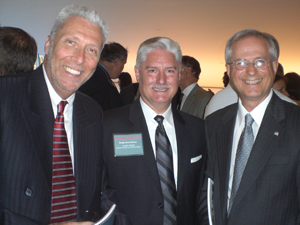
(L-R): James P. Stuckey, President, Public Design Commission; Joseph Aliotta, AIA, LEED AP, Swanke Hayden Connell Architects; and Ed Burke, Staten Island Deputy Borough President at the Public Design Commission Awards.

Rick Bell, FAIA

At the Museum of the Moving Image in Astoria, Queens, the Public Design Commission of the City of New York conferred the 29th annual Awards for Excellence in Design on 06.20.11. The architects, landscape architects, and public artists winning awards were in attendance, along with their public agency clients from, among others, the NYC Department of Design & Construction (DDC), Department of Transportation (DOT), Economic Development Corporation (EDC), Department of Cultural Affairs (DCA), and Department of Parks & Recreation. Mayor Michael R. Bloomberg unfortunately was not present, his mother having succumbed on Sunday at the age of 102. His place at the lectern was taken by First Deputy Mayor Patricia E. Harris, who cut her teeth at the Art Commission under Mayor Ed Koch. She recalled those days saying, “I was at the first Art Commission awards, 29 years ago; I was there, and we’ve come a long way.” Setting up the presentation of the awards by Public Design Commission President James P. Stuckey, the Deputy Mayor stated that “we remain a city that encourages excellence in design,” and that “we will leave a city even more dazzling than it is today — it is a great legacy for our children, too.” She called out a special appreciation for the staff of the Public Design Commission, headed by Executive Director Jackie Snyder.

Design awards were presented to the following projects and design teams:

· Construction of the Brooklyn Children’s Museum Rooftop Pavilion, by Toshiko Mori Architect with Ove Arup & Partners (DDC, DCA, and Brooklyn Children’s Museum).
· Construction of a Salt Shed, by Dattner Architects with WXY Architecture + Urban Design, Klein and Hoffman, Greeley and Hansen, and Reginald D. Hough Architect (Department of Sanitation).
· Reconstruction of Harper Street Yard, including the Construction of a Diesel Monitoring Booth by nARCHITECTS with Robert Silman Associates, URS Corporation, and Langan Engineering (DDC, and DOT).
· Renovation and Addition to the 122 Community Center, including the installation of Inhale/Exhale and Independent Lines, by Deborah Berke & Partners Architects with Monika Goetz, Buro Happold, and Serett (DDC, DDC, and The 122 Community Center).
· Installation of a Commemorative Program at the Original Yankee Stadium Site, by Doyle Partners and Cozzolino Studio with Stantec, Thomas Balsley Associates, and van Geldern Machine Company (EDC, and Department of Parks & Recreation).
· Rehabilitation of the Delancey and Essex Municipal Parking Garage, by Michielli + Wyetzner Architects with Engineering Group Associates, Tillotson Design Associations, and M-E Engineers (DDC and DOT).
· Construction of the Hunter’s Point Community Library, by Steven Holl Architects with Michael Van Valkenburgh Associates, Robert Silman & Associates, and Icor Associates (DDC, Queens Library, and Queens West Development Corporation).
· Reconstruction of the Staten Island Animal Care Facility, by Garrison Architects with Anastos Engineering, Plus Group Consulting Engineering, Cline Bettridge Bernstein Lighting Design, Judith Heintz Landscape Architecture, and Wohl & O’Mara (DDC, Department of Health & Mental Hygiene, and Animal Care & Control of NYC).
· Rehabilitation of the Sands Street Gatehouses at the Brooklyn Navy Yard Industrial Park, by Beyer Blinder Belle Architects & Planners with Robert Silman Associates, and JFK&M Consulting Group (Brooklyn Navy Yard Development Corporation).
· Renovation and Expansion of the Museum of the Moving Image, by Leeser Architecture with Karlssonwilker, Anastos Engineering Associates, ADS Engineers, R.A. Heintges & Associates, L’Observatoire International, Stantec, and Atelier Ten (EDC, DCA, and Museum of the Moving Image).

A Special Recognition Award was conferred for:

· Renovation and Addition to the Office of Emergency Management (OEM) Headquarters, by Swanke Hayden Connell Architects with Weidlinger Associates, Philip Habib and Associates, Jaros Baum and Bolles Engineers, Steven Winter Associates, Hillman DiBernardo & Associates, and Design 360 (DDC, and OEM).

Joseph Aliotta, AIA, LEED AP, principal-in-charge at Swanke Hayden Connell Architects and AIANY president-elect, accepted the award for the OEM project. At the reception, which followed in the garden of the Museum of the Moving Image, project stories were traded by agency folks and the black-clad designers who were appreciative not only of the public sector commissions, but the recognition of their efforts by an administration that cares passionately about design.

Relative Resilience and the Coefficient of Friction

(L-R): Paul Bello, PE, 2012 Chair, ACEC New York; Deputy Mayor Stephen Goldsmith; Margaret O’Donoghue Castillo, AIA, LEED AP, 2011 AIANY President.

Rick Bell

Deputy Mayor Stephen Goldsmith addressed the membership breakfast of the American Council of Engineering Companies (ACEC) of New York on 03.03.11 at the Union League Club. After a glowing introduction by ACEC New York 2012 Chair Paul A. Bello, PE, of AKF Engineers, the Deputy Mayor for Operations spelled out NYC’s economic condition, and what Mayor Bloomberg, his deputies, and commissioners are doing about it. “It is true that because of the relative resilience of the city’s economy, revenues are higher than the Office and Management & Budget had expected,” was his opening line, followed quickly with: “But the expense side is something else.”

Much of the speech reviewed the reasons that “the cost of government is going up at a higher rate than revenues” with much attention focused on the pensions of former municipal workers and the need for lay-offs beyond those leaving city employ by attrition.

Of keen interest to the many engineers and two architects (including 2011 AIANY President Margaret O’Donoghue Castillo, AIA, LEED AP) in the room were the issues of procurement reform and review of regulatory processes. The former was noted in regard to the time it takes to issue, analyze, and award contracts through Request for Proposals. With Marla Simpson, director of the Mayor’s Office of Contract Services, at the head table, the Deputy Mayor joked about the administration’s remaining time in office perhaps being shorter than some consultant hiring decisions, adding that “how we do procurements is on the table.”

One of the recent hires was a consulting firm to analyze the operations of the NYC Department of Buildings as part of the Mayor’s “Simplicity” program “to reduce the friction of working with government.” Goldsmith noted, “There is a culture clash at the Buildings Department between two missions: policing safety and building buildings,” and that “mediating between those is the major issue of process change.”

The extent of capital expenditure reductions in the city’s proposed budget was also discussed, with particular mention of the difference between an across-the-boards cut of 10% or 20% on all projects versus the elimination of a set number of projects totaling that amount of the capital budget. The Deputy Mayor said that “there is a great variation between agencies on costs.” More radical was his mention that the city incurs costs by outsourcing all risk. He noted that it might be possible to change municipal contracts and the bonding process to cut costs by allowing for more risk.

Good news for the engineers present was the Deputy Mayor’s mention of the city’s green infrastructure program, creating “new opportunities in hydroelectric and sludge.” He noted “if we can take some of the gray infrastructure and make it green infrastructure and have more permeable surfaces and save some money while we do it, everyone will be happy.”

He invited those present to get involved in the issues of regulatory reform, including the problems of sequential and conflicting reviews, and concluded by saying, “In the end, we also have to get health costs under control, but we have to first figure out how to make city government more simple, more efficient, and less full of friction.”

Amanda’s Accent

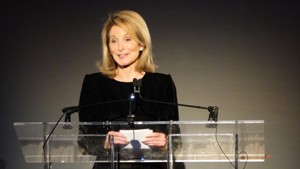
Amanda Burden, Hon. AIANY, FAICP, Chair of the NYC City Planning Commission, at the Accent on Architecture gala.

Laura Trimble

Amanda Burden, Hon. AIANY, FAICP, Chair of the NYC City Planning Commission, won the Keystone Award at the Accent on Architecture gala of the American Architectural Foundation (AAF) on 02.04.11. Mayor Richard M. Daley of Chicago was the recipient, in absentia, of the Joseph Riley Award — record snows in Chicago made it impossible for him to attend the event, held at the Paul Mellon Auditorium in Washington, D.C. The AIA New York Chapter was well-represented by 2011 President Margaret Castillo, AIA, LEED AP, President-elect Joe Aliotta, AIA, Susan Chin, FAIA, Mary Burke, AIA, Mark Behm, Assoc. AIA, Venesa Alicea, AIA, Laura Trimble, Kate Rube, and Jay Bond.

The Keystone Award was presented by AAF President & CEO Ron Bogle after remarks by HUD Secretary Shaun Donovan, Hon. AIA, NEA Chairman Rocco Landesman, and Paul Goldberger of The New Yorker. Landesman praised Burden for her “design fanaticism,” saying that “she insists that architects do not only their best work, but that they go beyond themselves and do things that are new, that haven’t been done before.” In describing her as “exacerbating but irresistible, a visionary and a wonk,” he said that “the moral here is that good design leads not just to pleasure, but to real sustainability and economic utility as well.”

Despite travel problems that recalled last year’s Accent “Snowmageddon,” Goldberger arrived to deliver an oration praising Burden as the person who “understands the enormous importance of architectural quality in the public realm, and she has done this in the most visible city in the world. She is the city’s chief advocate for architecture, and recognizes that every work of architecture in the city, public or private, has a public role to play.” Goldberger noted that Burden “has become a symbol for architectural quality worldwide” and is someone who “reminds us never to forget that all design and planning decisions should be focused on making life easier and more pleasant. Design is not a thing apart, but a thing in service of the good life.” He spoke of her ability to see the big picture but also focus in on the detail, citing the neighborhood-by-neighborhood re-writing of the zoning code. “This is not planning as a bureaucrat, not planning as a technocrat, and certainly not planning as an autocrat,” he continued. “Amanda has been down on the ground. She has changed the zoning in a hundred neighborhoods.”

Burden concluded the evening by putting aside her prepared remarks and saying, simply, “I’m the luckiest person in the world. I love cities. To see something come alive, to see the High Line come alive, inspires me. Great design is not a solitary endeavor, it requires collaboration. It requires all of you.”