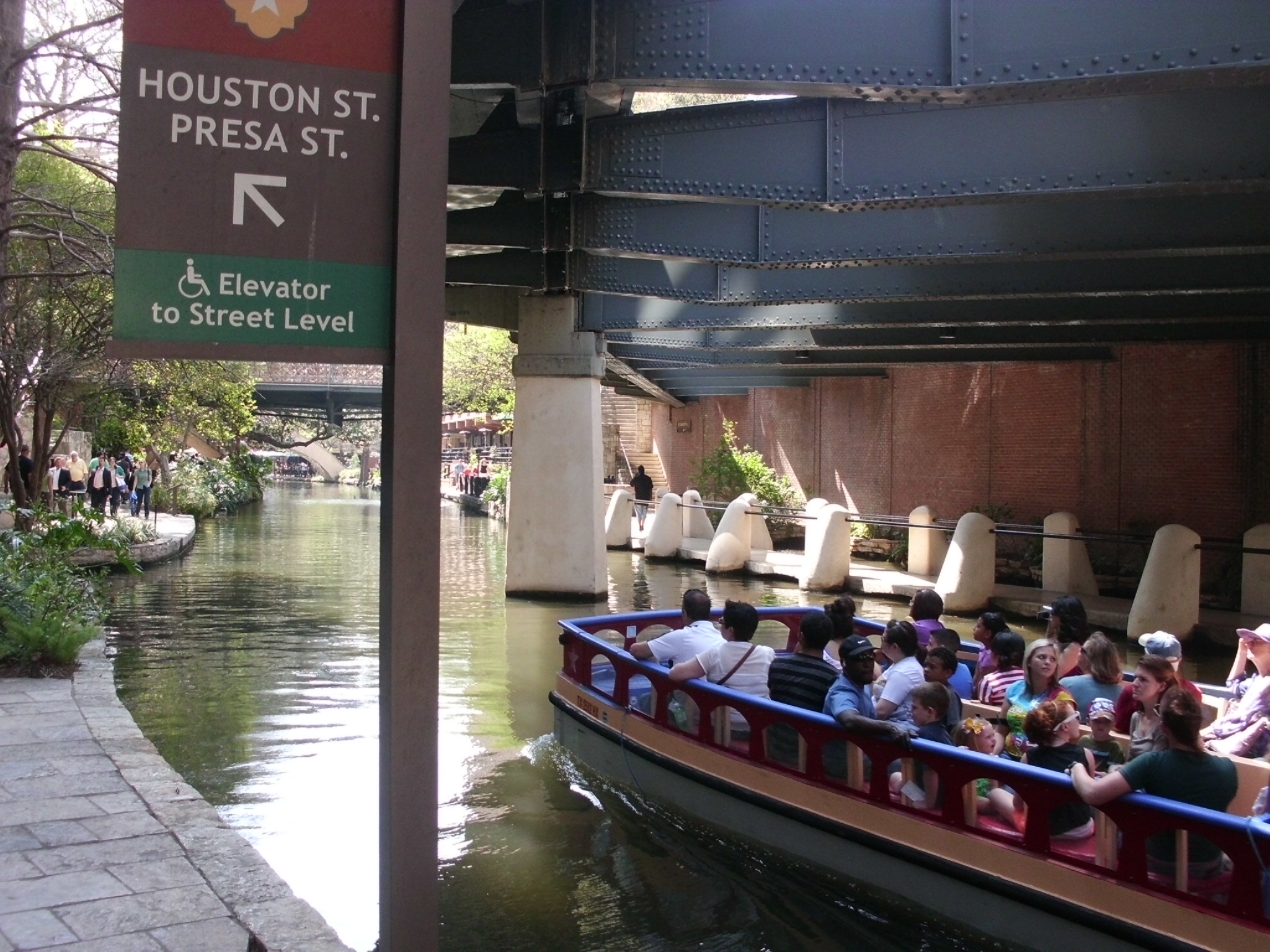
The Metropolitan Health District of the City of San Antonio, in collaboration with the San Antonio Department of Planning & Community Development, the Mayor’s Fitness Council, AIA San Antonio, and the UTSA College of Architecture convened a conference on Tuesday, 03.19.13 called “Public Health and the Built Environment.” A packed ballroom at the St. Anthony Riverwalk Wyndham Hotel brought together an equal number of architects, designers, and public health professionals, evoking comparisons to our own Fit City conferences. Continue reading “Fit City San Antonio: Something to Remember”
Category: AIANY – Message From the Executive Director
Rhetorically Speaking: State of the City on Valentine’s Day
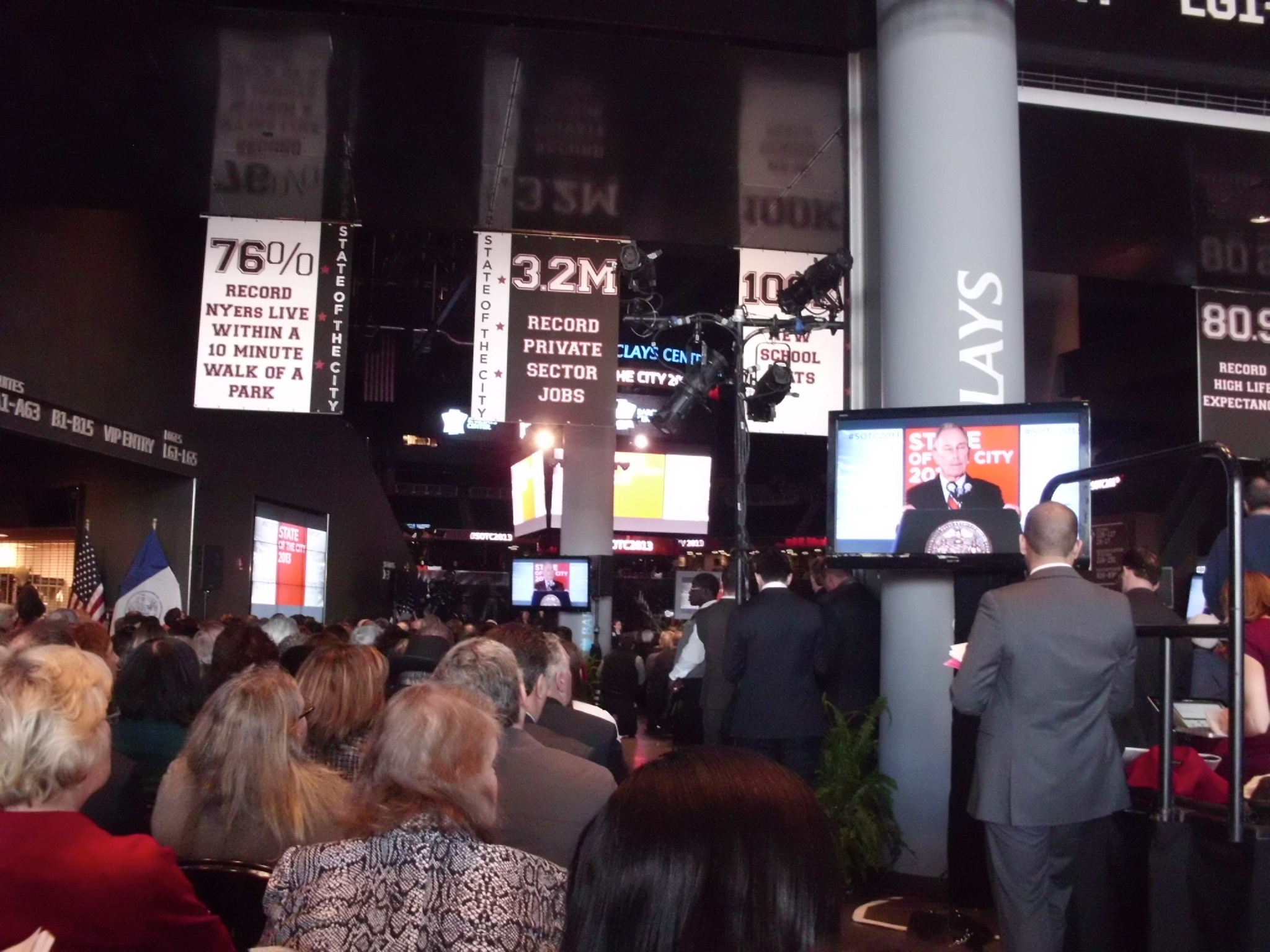
Mayor Michael R. Bloomberg and Borough President Marty “Fuggedaboutit” Markowitz were both born on Valentine’s Day. But there seemed to be no particular love lost between them at Brooklyn’s Barclays Center, where the mayor delivered his final State of the City Address on 02.14.13 after a short introduction from the BP. Marty’s gag gift to Hizzoner was a large, Styrofoam cup – useful as a prop in the mayor’s call for eliminating extruded polystyrene containers to facilitate recycling. After describing his realized dream of seeing a professional sports team come back to Brooklyn, the Beep gave the microphone to Mayor Bloomberg with “once you think you’ve heard it all, you haven’t.”
The first English language reference to Valentine’s Day was in Geoffrey Chaucer’s Parliament of Foules, written in 1382, whose introduction speaks of a political version of heaven: “First know yourself to be immortal; and always see that you labor diligently and teach for the common profit.” Chaucer wrote of a congress of birds convened that day to win the favor of the eagle, not-for-nothing the longtime symbol of the American Institute of Architects. There were many similarities between the scene at Barclays and Chaucer’s crowded convocation: “there was scarcely room for me to stand, so full was the entire place.”
The mayor’s remarks touched on the key points of the Bloomberg Administration’s achievements, many of which, in housing, the environment, urban design, and access to the waterfront, are consistent with positions taken by the AIA New York Chapter. He noted: “Each of the five boroughs is better off than ever before and the State of the City has never been stronger.” Continue reading “Rhetorically Speaking: State of the City on Valentine’s Day”
Rhetorically Speaking: Microcosm

The results of the adAPT NYC competition for innovative small-scale housing were announced at the Museum of the City of New York yesterday by Mayor Michael R. Bloomberg, accompanied by NYC Housing Preservation and Development (HPD) Commissioner Mathew M. Wambua and MCNY President Susan Henshaw Jones. Continue reading “Rhetorically Speaking: Microcosm”
Rhetorically Speaking: The West and the Brightest
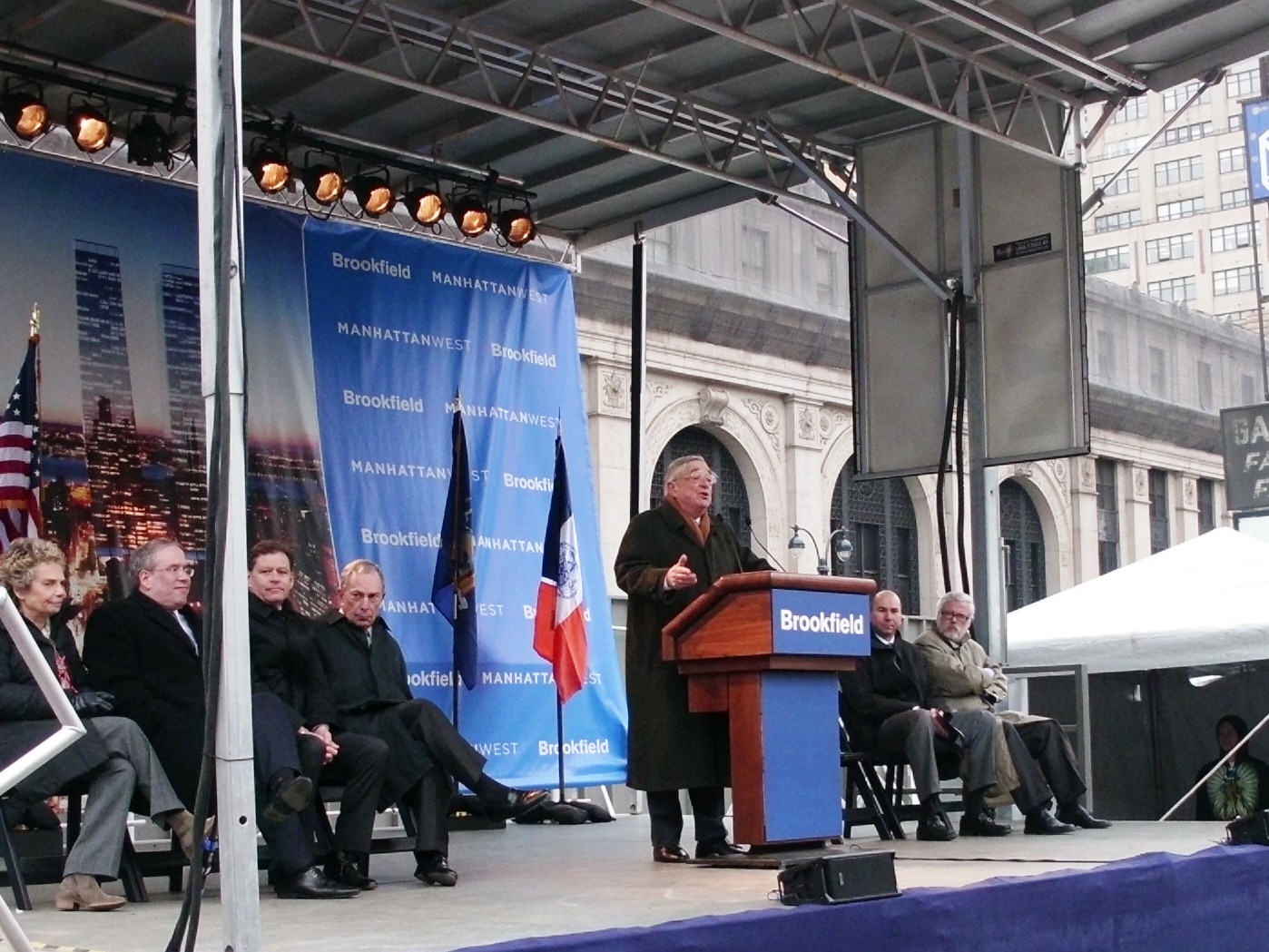
“We are literally, today, building a bridge,” said John Zuccotti, chairman of Brookfield Properties Corporation, at the start of a groundbreaking ceremony on 01.15.13 for the Manhattan West Development at Hudson Yards. The platform upon which the $4.5 billion multi-use project will take shape represents the kick-off of an important part of the Bloomberg Administration’s vision for growth. Continue reading “Rhetorically Speaking: The West and the Brightest”
Ada Louise Huxtable (1921-2013)
Tributes to Ada Louise Huxtable, Hon. AIA, have been written by those who knew her far better than I, and by those – critics and practitioners – who know best how to express their individual and our collective sense of loss. That she created a way of looking at architecture, preservation, and urbanism is clear. And we know she got people to think hard about our cities, our structures, and our design mistakes. Her words struck home, and hit hard those most needing corrective action.
Continue reading “Ada Louise Huxtable (1921-2013)”
Pier Review

Mayor Michael R. Bloomberg opens the playing fields at Brooklyn Bridge Park.
Rick Bell, FAIA

Soccer players on the field.
Rick Bell, FAIA
Mayor Michael R. Bloomberg led a team of elected and appointed officials along with members of the Red Bull professional soccer organization to open the first active recreation component of Brooklyn Bridge Park. The mayor greeted the large crowd of spectators and reporters on hand for what he called a “good news” event on Thursday, December 13. “Where were you for the 16-ounce cup announcement?” he asked those assembled. Continue reading “Pier Review”
Hudson Yards Breaks Ground

Hudson Yards rendering, looking northeast.
Courtesy MIR
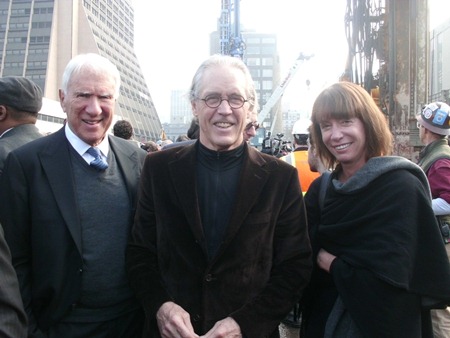
(l-r) Gene Kohn, FAIA, and Bill Pedersen, FAIA, with NYC DOT Commissioner Janette Sadik-Khan at the Hudson Yards Groundbreaking.
Rick Bell, FAIA
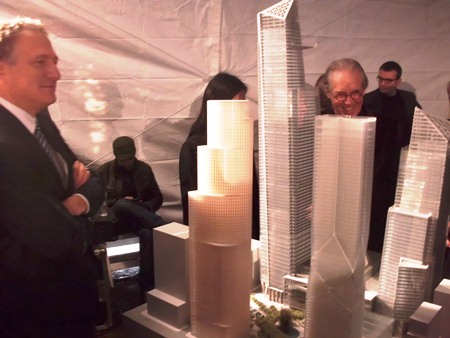
(l-r) Former Deputy Mayor Dan Doctoroff and Bill Pedersen, FAIA, examine the Hudson Yards model.
Rick Bell, FAIA
Mayor Michael R. Bloomberg and City Council Speaker Christine Quinn joined Related Companies Chairman Stephen M. Ross and architects from Kohn Pedersen Fox Associates, Diller Scofidio + Renfro, David M. Childs, FAIA and Skidmore, Owings & Merrill, along with Rockwell Group, to break ground on the 26-acre Hudson Yards development. Construction started yesterday on the KPF-designed South Tower, a 47-story tall, anticipated LEED Gold tower with 1.7 million square feet which will house the world headquarters of Coach Inc.
Steve Ross started the ceremonies with a short speech noting that the Hudson Yards “is the defining development of the 21st century.” He praised Mayor Bloomberg’s leadership in creating a legacy for New Yorkers and visitors from around the world, saying, “no mayor has done more than Mayor Bloomberg for the City of New York,” and “No other accomplishment will be more visible or more impactful than Hudson Yards.” Related is well-know in New York as the developer of the 2.8 million-square-foot Time Warner Center, and is an industry leader in green building.
The Mayor shared credit with City Council Speaker Christine Quinn, saying, “Breaking ground for the first commercial building at Hudson Yards is a wonderful thing,” and that the site was “one of the largest private developments undertaken.” He noted that the $3 billion in public infrastructure investment has unlocked even greater private funding, and praised the “dynamic architects” present for creating a place for innovation for the arts and destination for community events.” Describing the program and plans, the Mayor said that “in the race for global competitiveness, New York stands alone.” He quoted a description of New York’s skyline which embodies “grace, swagger, creativity, and hard labor.”
Speaker Quinn also shared credit with the Mayor, former Deputy Mayor Dan Doctoroff, and the Chair and Members of Community Board 4. She remembered that back in 2004 and 2005 the project was “difficult and contentious” but that those involved “kept searching for the things we could agree on.” The project was realized, she continued, because “we all stayed in the room, believing there was a better use for this space than a rail yard.” Job creation is at the heart of the project, which will also create, in her words, “affordable housing, parks, and culture.” She concluded by saying, “We yelled ’til we all agreed, and we made something happen, setting a new standard.”
KPF was represented by, among others, Gene Kohn, FAIA, Bill Pedersen, FAIA, and Jill Lerner, FAIA – whose inauguration as AIA New York 2013 President takes place on Tuesday, 12.11.12. Pedersen noted: “During my entire career, I have focused on bringing urban commercial buildings into interactive relationships with their context. No building should stand in isolation, and every building should link to the fabric of the city.” He added that “I consider Hudson Yards to be the most important test in my career of this philosophical position. The relationships between buildings are facilitated and encouraged by our desire to create structures that gesture and defer to one another.”
Before the groundbreaking ceremony the West Side was overcast and shrouded in a light drizzle. With the podium speeches and photo-op whirring of site engines, the sun came out and the future of the site seemed clear indeed.
Vive la Différence
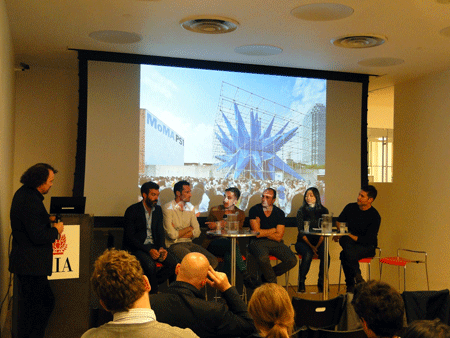
Marc Clemenceau Bailly, AIA, directs the discussion after the individual presentations, with HWKN’s “Wendy” as a backdrop.
Daniel Fox
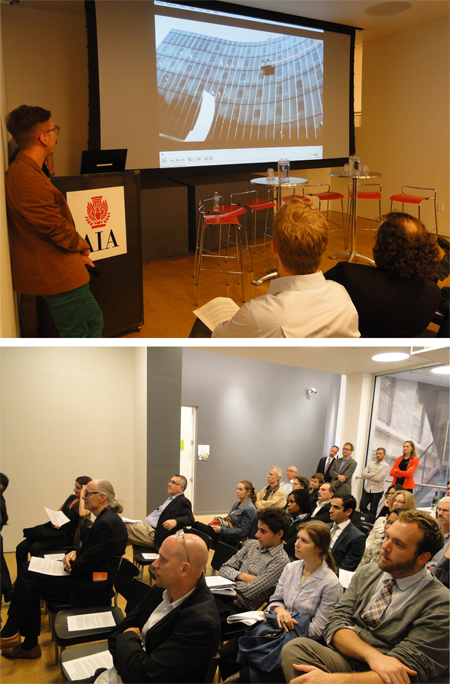
(top) Guillaume Aubry, Cyril Gauthier, and Yves Pasquet of Freaks – Freearchitects, France, present a video chronicling their “Sur Mesure” sticker installation, as (l-r) Thomas Delamarre of French Cultural Services and Marc Clemenceau Bailly, AIA, look on. (bottom) The audience was treated to a lively transnational exchange of ideas and anecdotes.
Daniel Fox
Event: France – New York: Young Architects Dialogue
Location: Center for Architecture, 09.24.12
Organizers: The Center for Architecture and the Visual Arts, Architecture, Design-Arts Department of the Cultural Services of the French Embassy
Welcome: Rick Bell, FAIA, Executive Director, American Institute of Architects New York Chapter
Moderator: Marc Clemenceau Bailly, AIA, Gage-Clemenceau Architects; Co-Chair, AIANY New Practices Committee
Speakers: Guillaume Aubry, Cyril Gauthier, and Yves Pasquet, Freaks – Freearchitects, France; Remi Salles, A+R Salles Paysagisme, France; Jing Liu, Solid Objectives – Idenburg Liu (SO-IL), New York; Marc Kushner, AIA, HWKN, New York
This Monday, the Center for Architecture hosted an evening of vivid cultural exchange and comparison, which brought two emerging French firms and young architect laureates of the Album des Jeunes Architectes et Paysagistes (AJAP) 2011, together for conversation with two award-winning emerging New York firms, both recent winners of the MoMA Young Architects Program. After brief shout-outs for some of the distinguished guests in the audience, including Thomas Delamarre of French Cultural Services and Chrissa Laporte of the French-American Foundation, the program and panelists were introduced by moderator, Marc Clemenceau Bailly, AIA. Marc, a partner at Gage-Clemenceau Architects (gageclemenceau.com/home/), is a recent New Practices winner and co-chair, and after his enthusiastic stage-setting, the invited firms started the evening with presentations of their work.
FREAKS, also known as FREEARCHITECTS, (www.archdaily.com/tag/freaks-freearchitects) is a Paris-based design firm with three partners, Guillaume Aubry, Cyril Gauthier, and Yves Pasquet, all graduates of the Ecole Nationale Supérieure d’Architecture Paris-La Villette. After having worked several years for larger architecture firms, they founded “Freaks – Freearchitects” in 2007. The three principals distinguish themselves by an uninhibited approach to architecture and urbanism, demonstrated by their ebullient presentation of a video chronicling their “Sur Mesure” sticker installation of red dimension lines on the landmark façade of Oscar Niemeyer’s Building for the French Communist Party in Paris. Their projects, in general, tackle domestic issues and favor a hands-on methodology.
A+R SALLES PAYSAGISME was represented on the panel by Rémi Salles, one of two partners, with his wife, Amélie. The couple met while studying landscape architecture at the Ecole Supérieure d’Architecture des Jardins et du Paysage. In 2003, they moved to Dublin, where they lived and worked for six years. During Ireland’s economic boom they won commissions including two city parks on the outskirts of Dublin. In 2006 they decided to join forces to create A+R Salles Paysagisme, a landscape firm based in Guitres. The Dublin work was presented in Rémi’s talk, and was characterized by what he described as a “generous” vision of the landscape – and one that was necessarily green.
Jing Liu of SO – IL was up next. She and Florian Idenburg are founders of Solid Objectives – Idenburg Liu, hence “SO – IL” (www.so-il.org/) an idea-based design office. With a global reach, it brings together extensive experience from the fields of architecture, academia, and the arts. Idenburg and Liu envisioned their New York studio in 2008 as a creative catalyst involved in all scales and stages of the architectural process. With roots in Europe, China, and Japan, they endeavor to realize their ideas globally. SO-IL is a recent winner of the MoMA/PS1 Young Architects Program, AIANY New Practices Award, and an AIA Design Award. Jing started her presentation with the MoMA/PS1 installation.
Lastly, HWKN (www.hwkn.com/) was represented by Marc Kushner, AIA, who had also been a speaker at Saturday’s Future Now Summit (see article by Julie Engh, Assoc. AIA, above). Marc is a partner – along with Matthias Hollwich – in the New York-based architecture firm HWKN and is a co-founder of Architizer, which he founded in 2009 with his partners. Architizer is a revolution in the way architects communicate their work and is the first crowd-sourced database for architecture online. Since its inception, Architizer has started a fundamental re-evaluation within the profession of how architecture is consumed, and remains the fastest growing platform for architecture online. HWKN’s “Wendy” at MoMA/PS1 was this year’s summer installation.
Bringing together architects and landscape architects from different cultural and political contexts has become a hallmark of the Center for Architecture and its well-attended seminars and symposia crafted by Laura Trimble Elbogen, the Center’s Partnership Programs Manager. With deft moderating by Marc Bailly, the dialogue with our colleagues and copains proved most fruitful. If there were difference in dialect or client-base, the similarity between the firms and their intent was, if anything, more vivid.
Boldface in Seattle
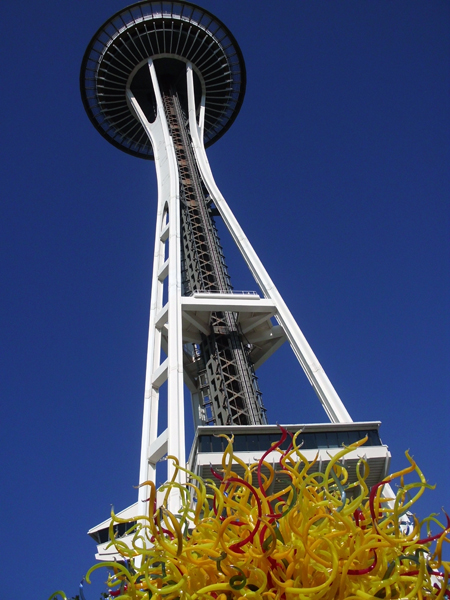
Seattle Space Needle from Chilhuly Glass Museum and Garden
Rick Bell, FAIA
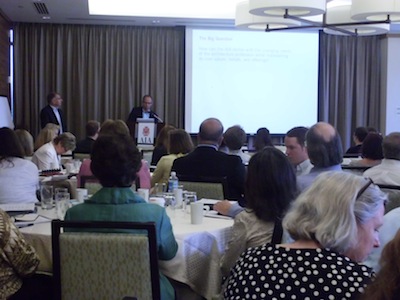
Arthur Cohen and Michael Bierut leading the CACE discussion on the AIA Repositioning. The project slide reads, “Our Premise: The nature and practice of architecture is evolving and the AIA must evolve with it in order to secure its leadership position.”
Rick Bell, FAIA
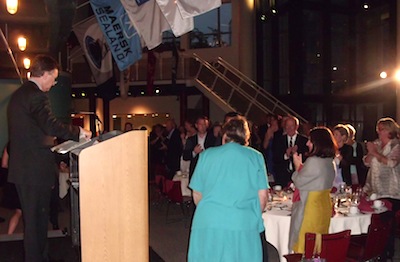
Jeff Potter, FAIA, at lectern, leads an ovation for Karen Lewand, in turquoise in foreground, back to camera.
Rick Bell, FAIA
One of the big secrets of Seattle is that it doesn’t rain there in August. That isn’t the reason that both the AIA’s Knowledge Leadership Assembly (KLA) and Council of Architectural Component Executives (CACE) met concurrently in the Starbuck City last week, but it certainly made it more pleasant. Three days of meetings took place at two well-designed hotels – the Fairmount for the committee leaders and the Pan Pacific for the association staff. The groups were able to come together for evening receptions at the Olympic Sculpture Park by Marion Weiss, FAIA, and Michael Manfredi, AIA, and at the Wooden Boat Center on Lake Union, a short trip by kayak to the boathouses starring in Nora Ephron’s Sleepless in Seattle – in which Tom Hanks plays the insomniac widower architect who leaves Chicago for the city of Jimi Hendrix.
AIA Executive Vice President Robert Ivy, FAIA, said at the kickoff : “Our members go out and change the world every day. Change is in the air. The mood is expectant.” Central to both meetings was the presentation of the working hypotheses of the AIA’s Repositioning effort, introduced by AIA President Jeff Potter, FAIA, who noted that “across our profession the sun is starting to come up,” and referenced a bumper sticker seen in Texas that read: “Give us just one more boom, and we won’t screw it up.”
The AIA’s blue-sky re-envisioning team is being led by New York-based consultants LaPlaca Cohen and Pentagram; Arthur Cohen and Michael Bierut kept a usually contentious cohort of almost 200 AIA staffers enthralled with logic and wit, outlining the nine central premises of the new institute in the making. Some of the broad ideas delineated resonate with the activities and strategic plan of AIANY, including: Going Beyond Bricks & Mortar to engage with policy; Focus on Connectivity to activate a community of peers; and Being Good for Business by bolstering efficiency and economic returns. The inclusive and transparent process can be reviewed on the Repositioning the AIA website.
Our region was represented at KLA by Mary Burke, FAIA, Chair of the Interiors Knowledge Community Advisory Group, and by David Del Vecchio, AIA, former Regional Representative from New Jersey. New York’s CACE attendees were Ed Farrell for AIANYS and CACE Executive Committee member Valerie Brown, Hon. AIANYS, from the Westchester Hudson Valley Chapter. Notable sponsors present included Laura Marlow from Reed Construction Data, Ann Casso from the AIA Trust, Ned Cramer from Hanley Wood, and Tom Schell from Naylor, which publishes Oculus along with a host of other AIA and association publications.
In a rare undisputed election, the CACE members present elected new executive committee officers. The current CACE ExCom is led by AIA Florida Executive Director Vicki Long, Hon. AIAFL, as 2012 President and by President-elect Carolyn Boyce of AIA Pennsylvania. New officers for next year will be 2013 President-elect Tina Litteral, Hon. AIA, from AIA Arizona, along with Heather Vance of AIA Utah, Kate Shelton of AIA Charlotte, and Melissa Hunt, of AIA Eastern Oklahoma.
CACE Honors were conferred at a closing dinner at the Bell Harbor International Conference Center (next door to the Edgewater where John Lennon is said to have put out a fishing line from his hotel window). Also announced was that AIA South Dakota is the recipient of the Hanley Wood grant for $10,000 this year. And Karen Leward received a standing ovation and appropriate accolades upon the announcement that she is retiring after many years of wonderful service as Component Executive of AIA Baltimore.
The heart of the CACE meeting, though, was the presentation of best practices by AIA Components, large and small. Among the notable presentations were those on membership development by AIA Seattle’s Lisa Richmond, Margot J. van Swearingen, Assoc. AIA, Sian Roberts, AIA, and Natalie Quick, and on Emerging Professionals and ARE prep by AIA San Francisco’s Michelle Railsback, AIA South Carolina’s Adrienne Montare and Kevin Fitzgerald, AIA, the director of the AIA’s Center for Emerging Professionals. A program on how to garner publicity and media for Chapter activities was led by Lindsey Ellerbach of AIA Eastern Oklahoma, Alison Pruitt of AIA Palm Beach, and Dawn Taylor of AIA Kansas City.
The meetings generally took place in conference rooms with windows, but at the outset, AIA Seattle President Rico Luis Quirindongo, AIA, and Chapter Executive Director Lisa Richmond encouraged attendees to take advantage of their limited free time to see the architectural treasures of the city, including the new headquarters building of the Bill & Melinda Gates Foundation by NBBJ.
Rico called Seattle “the last frontier,” and noted that the city was “trying to figure out how to go net zero.” Conference attendees were seen at the Chihuly Glass Museum and Garden, OMA‘s Seattle Library, and the Seattle Art Museum by Venturi, Scott Brown and Associates (now VSBA), and its addition by Allied Works Architecture. AIA Mississippi Executive Director Joe Blake was spotted at the Seattle Space Needle, celebrating the 50th anniversary of its construction as the centerpiece of the 1962 Seattle World’s Fair. And at least one CACE staff person admitted to attending the Nicki Minaj concert so as to see the interior of the landmarked Paramount Theater. Reviewed in advance in the Seattle Times, the sold-out Pink Friday concert had all of the bombast and rap eloquence of her recent Super Bowl half-time show. Minaj, a graduate of LaGuardia High School in Manhattan, sported bold-face makeup that used most – if not all – of the primary colors.
When the annual CACE meeting took place in New York in August of 2007, the AIA Sesquicentennial was celebrating America’s favorite architecture, a lot of which was to be found in our town. For those fortunate enough to go to Seattle, this Big-Sib sister city unveiled its exemplary environmental initiatives (including a 2030 Eco District), along with extraordinary waterfront planning and active recreation facilities. The Seattle Chapter was also ahead of us in that it opened the very first AIA-led storefront architecture center, some 31 years ago, led by AIA poet laureate Marga Rose Hancock.
So, if Seattle seems to be a colorful, sunny, and vibrant city that, parenthetically, never sleeps, it may have the advantage of being three hours earlier than New York. There is also something about the coffee.
Micro to the Max
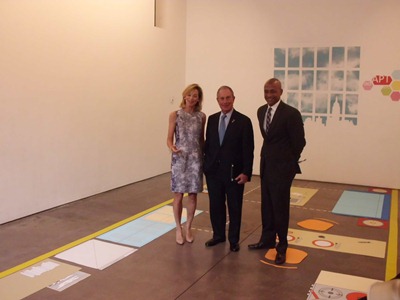
City Planning Commission Chair Amanda Burden, Hon. AIANY, NYC Mayor Michael R. Bloomberg, and Housing Preservation & Development Commissioner Mathew Wambua at the adAPT NYC press conference at the Center for Architecture.
Rick Bell
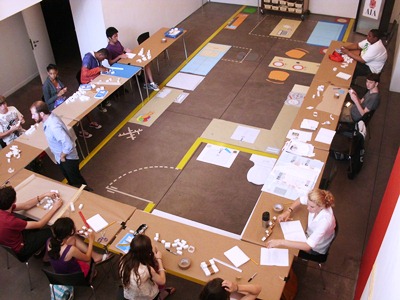
From Mayor Bloomberg to children participating in the Center for Architecture Foundation’s programming, everyone at the Center for Architecture was talking about the beauty of small spaces.
Rick Bell
The City’s new micro-unit housing competition, adapt NYC was announced at the Center for Architecture on Monday, July 9, by Mayor Michael R. Bloomberg, accompanied by City Planning Commission Chair Amanda Burden, Hon. AIANY, and Housing Preservation & Development Commissioner Mathew Wambua. (Click here to watch the video.)
To demonstrate the potential of a change in the minimum housing unit size, a 300-square-foot apartment was delineated by bright yellow tape on the floor of the Center for Architecture’s Tafel Hall. Colorful furniture, fixtures, and fittings designed in-house by municipal architects led by Alexandros Washburn, AIA, were added in to give a sense of scale to the demonstration. Coming up on July 31, HPD will host a technical session at the Center to answer questions about the new initiative and the accompanying Request for Proposals.
The discussion to date has centered, in part, on how a smaller apartment might attract and retain recent graduates and those just entering the city’s job market. The AIANY’s Committee on Design for Aging, has also suggested the value of micro-units to an aging population for which the micro-unit may be right-sized. Whether for the young or less-young, the advantages of smaller units in a growing, high-density city were reflected in the many articles and blog entries appearing after the announcement. And students attending the Center for Architecture Foundation’s summer design camp also got into the mix, pondering design interventions while sitting at tables ringing this most adaptable apartment. Come see it at the Center, and hear or read about the city’s RFP.