09.19.08 CALL FOR TRIBUTES

Stephen A. Kliment, FAIA
(1930-2008)


We are sad to inform you of the recent passing of Stephen A. Kliment, FAIA. For a special tribute to be featured in an upcoming issues of e-Oculus and Oculus, we’re seeking personal anecdotes, images, and remembrances — any and all are welcome. Please e-mail them to eoculus@aiany.org by Friday, 10.03.08.

– Rick Bell, FAIA, Kirsten Sibilia, Assoc. AIA, LEED AP, Kristen Richards, and Jessica Sheridan, Assoc. AIA, LEED AP

Stephen A. Kliment. Photo by Kristen Richards.

Passing: Stephen A. Kliment, Architect and Writer

Stephen A. Kliment, FAIA, an architect and writer whose work influenced what was built and how buildings were received, died on September 10, while traveling in Ebersberg, Bavaria. He was 78. The cause was cancer, his wife Felicia Drury Kliment said.

A distinguished architect, author, teacher, and editor, Stephen Kliment touched the lives of many, as a colleague and mentor. He was born in Prague, Czech Republic, on May 24, 1930, and was raised in England, immigrating to the United States in 1950 to study architecture. His primary and secondary education was received in Prague and in the United Kingdom. He received architectural degrees from the Massachusetts Institute of Technology (a BA in 1953), and an M.Arch. from Princeton University in 1957. He also studied architecture at l’Ecole Speciale d’Architecture in Paris and at the University of Havana, Cuba.

A long career straddled architectural practice and criticism, with notable projects undertaken as a partner with Caudill Rowlett Scott (1968-1980) and at Skidmore, Owings & Merrill. Previously, he was editor-in-chief of Architectural & Engineering News (1960-1968), a magazine dedicated to the technical aspects of architecture at a time when the subject was not covered in the major architectural journals. Subsequently, he was acquisitions editor of architecture books at John Wiley & Sons (1987-1990) before becoming editor-in-chief of Architectural Record (1990-1996), where he helped develop it in into the premier architectural magazine in the United States. Most recently he served as editor of Principal’s Report, published by Newark, NJ-based IOMA (Institute of Management and Administration).

At the New York Chapter of the American Institute of Architects, Mr. Kliment served on the Board of Directors and became the Editorial Director of Oculus and e-Oculus, helping to re-launch the print magazine in 2003 and overseeing the development of the electronic journal. In each quarterly issue of Oculus he reviewed current architectural literature, with book reviews that stood out for their eloquence and wit. In his review of Romy Wyllie’s architectural biography of Bertram Goodhue, Mr. Kliment might have been describing his own writing style, comprising a “singular synthesis of his life and work” with “broad scholarship distilled into lucid, jargon-free prose.”

As a teacher, he gave courses on writing for the design professions, including architecture, engineering, interior design, landscape architecture, and graphic design. These courses were legendary at Harvard’s Graduate School of Design, and at City College of the City University of New York where he was an adjunct professor. He was a prolific author, best known for Writing for Design Professionals (WW Norton), and as the series founder and editor of the Building Type Basics Series for John Wiley & Sons.

At the time of his death he had been working on a book on African-American architects, representing a long-time commitment to making the architectural profession more diverse and inclusive. He was an honorary member of NOMA, the National Organization of Minority Architects. NOMA President-Elect R. Steven Lewis, AIA, said, “He will certainly be missed by all who came to know him and to appreciate the support that he gave as a champion of black architects.”

He leaves his wife, Felicia Drury Kliment, a nutritional consultant and author, and daughters Pamela Drury Kliment and Jennifer Kliment Wellander, both of Seattle, two grandchildren, and a brother, architect Robert Kliment, FAIA, of New York.

To read David Dunlop’s tribute in the New York Times, see S. A. Kliment, 78, Architect and Editor, Is Dead.

To read the tribute in Architectural Record, see Stephen A. Kliment, Former RECORD Editor in Chief, Dies at 78.
Government Oops

On May 6, the Governmental Operations Committee of the New York City Council tacitly agreed with the architects and engineers packing the City Hall committee hearing room that we were right — a registered architect or professional engineer should continue to head the NYC Department of Buildings. This was done not by a vote, but by avoidance of a vote, or, in fact, by lack of any visible support for Intro 755, which, if passed, would eliminate this requirement about the experiential and training requirements for the Buildings Department head. By cogent and probing questions, the Government Ops members present, including Councilmembers Joseph P. Addabbo, Inez E. Dickens, Erik Martin Dilan, Dominic M. Recchia, Jr., and Larry B. Seabrook, put the Administration’s representative, Anthony Crowell, in the position of defending the indefensible. Crowell, in essence, said that it didn’t matter whether or not a Commissioner who knew anything about buildings could head the Buildings Department so long as the nominee was a good manager and good communicator.

Other council members not on the committee holding the hearing, including Jessica Lapin, John Liu, Rosie Mendez, James Oddo, and David Yassky, sat at the hearing table to aggressively challenge Crowell’s arguments. Liu, for one, stated that the proposed legislation was “absurd” on the face of it. In times of heightened concern about building safety, the idea that the Buildings Commissioner did not need to be trained and tested on how buildings are made safe seemed wrong to all of the council members speaking — and to 100% of those members of the public who came to testify.

Many industry leaders, including Michael Macaluso, RA, President of the Architects Council of New York, and Anthony Schirripa, AIA, AIANY Vice-President for Public Outreach, were joined inside and outside the room by other chapter leaders from all five NYC borough components. The American Council of Engineering Companies New York Chapter was represented at the meeting by its national chair, John F. Hennessey, III, PE, and its local chapter head, Hannah O’Grady. A letter from Christine McEntee, Executive Vice President and Chief Executive Officer of the AIA national component was read into the record by AIANY Policy Coordinator Laura Manville.

The Chapter’s position statement also became part of the testimony and is attached to this summary. It was accompanied — think Miracle on 34th Street — by petitions signed by more than 3,000 individuals saying the same thing, “No PE’s, No Justice.” More signatures are needed. Click the link, add your name and e-mail it to the AIANY.

The fight is not over. A compromise bill, asking to temporarily put aside the needed experiential requirements, is within the realm of possibility, and could come back to the City Council’s Committee within the next two weeks. Please write or e-mail your Councilmember now, whether she or he is on the Governmental Operations Committee or not. It makes no sense for the City’s Health Commissioner to not be a doctor, whether for four years, four months, or four weeks. It makes less sense, given the professional needs for code and zoning interpretation, action, and decision-making, for the Buildings Commissioner not to be a licensed design professional. New York needs a Buildings Commissioner who knows how buildings stand up.

2008 Advocacy Week Comes to NYC

Event: Advocacy Week
Date: 03.24-28.08
Organizers: AIA National; AIANY

Advocacy Week

Advocacy Week meeting at the District Office of Congresswoman Nydia Velàzquez included (l-r): Rick Bell, FAIA, AIANY Executive Director; Andrew Goldberg, Assoc. AIA, AIA National’s Senior Director for Federal Relations; AIANY Vice President Tony Schirripa, AIA; Don Weston, AIA Brooklyn; Rep. Velàzquez; Frank Lo Presto, AIA, AIA Brooklyn President; Marcus Marino, AIA, AIA Staten Island President; Laura Manville, AIANY Policy Coordinator; and Cynthia Kracauer, AIA, LEED AP, AIANY Managing Director.

Dan Wiley

AIA Advocacy Week 2008 was an effort to organize hundreds of meetings nationwide with members of Congress during the congressional recess, March 24-28. Since AIA members can bring expertise in the design field to the attention of elected leaders, hopefully key issues will be brought forth on a larger platform. Nearly 800 AIA volunteer leaders and executives laid the groundwork for Advocacy Week during the annual Grassroots Leadership and Legislative Conference in Washington, DC, February 20-23.

“Small businesses are the backbone of the American economy, and nowhere is that more clear than in NYC,” said Congresswoman Nydia M. Velàzquez, chairwoman of the House Committee on Small Business, who believes small businesses help make the city vibrant and diverse. A high point of 2008 Advocacy Week was a meeting on March 27 with Velàzquez during which AIA leaders exchanged ideas about the three key AIA National Legislative Priorities for 2008: Public Transportation Funding, Energy Efficient Buildings, and Eliminating Federal Contract Retainage Rules on Architects and Engineers. Representatives from three NYC AIA Components, including AIA Brooklyn President Frank Lo Presto, AIA, AIA Staten Island President Marcus Marino, AIA, and AIA New York Vice President Tony Schirripa, AIA, attended the meeting.

As NYC’s senior member on the House Subcommittee on Housing and Community Opportunity, Velàzquez was particularly interested in AIANY’s sesquicentennial blueprint initiative, Via Verde, a community-based public-private partnership that will result in the construction of over 200 units of sustainable, affordable housing in the South Bronx, designed by Phipps Rose Dattner Grimshaw. With her district spanning three boroughs and including neighborhoods as diverse as Red Hook, Bushwick, SoHo, and the Lower East Side, Velàzquez was also interested in AIANY’s dedication to cross-cultural interaction — such as the Berlin-New York Dialogues: Building in Context exhibition, currently on view at the German Architecture Center in Berlin.

Similar discussions took place throughout Advocacy Week in the 15th Congressional District, home to House Ways and Means Committee Chair Charles Rangel. AIANY President James McCullar, FAIA, shared thoughts with Michelle Sherwood, Rangel’s legislative counsel, on how to best incorporate energy saving features and incentives into affordable housing, noting that his firm designed a project nearing completion on West 123rd Street in the Congressman’s district.

Other events that highlighted the AIANY’s concerns about these three issues, as well as our 24/7 “everyday advocacy,” included programs at the Center for Architecture and testimony at City Council. Laura Manville, AIANY policy coordinator, attended a council hearing on congestion pricing, submitting the Chapter’s testimony in favor of the plan. New York New Visions and the Chapter’s Planning & Urban Design and Transportation & Infrastructure Committees hosted a presentation of the MTA’s Capital Plan, and its relation to the congestion pricing proposals. Participants included the MTA’s William Wheeler, AIA, director of special project development and planning, Gregory Kullberg, director of capital program budgets, and Nina Haiman of the Office of Planning and Sustainability of NYC Department of Transportation. McCullar introduced the panel by putting transportation-based planning in the context of Advocacy Week, PlaNYC, and AIANY “Designs for Living” annual theme.

Andrew Goldberg, Assoc. AIA, AIA National’s senior director for federal relations, joined local component leaders and staff for many of the Advocacy Week events, including the Velazquez and MTA meetings, as well as the City Council hearing on Governors Island convened by Councilmember Alan Gerson as chair of the Committee on Lower Manhattan Redevelopment.

Grassroots Sound Greener

Frances Hesselbein

Frances Hesselbein speaks at Grassroots about breaking down hierarchies.

Karen Plunkett, AIA

“I don’t know what to say, I have no speech,” were the opening words of Renzo Piano, Hon. FAIA’s short remarks at Accent on Architecture. Perhaps Piano had heard earlier remarks by Frances Hesselbein, who called for architects to “throw out the dead hierarchical language of the past.” During a Grassroots keynote speech, Hesselbein, the Chairman of the Leader to Leader Institute that helps social sector organizations achieve excellence in performance and community building, said, “There is no time to negotiate with nostalgia.” Her speech, punctuated by personal stories about collaborations that had changed people’s lives, moved several sitting in the back rows of the thousand-seat auditorium to tears. She spoke of diversity, inclusiveness, and non-hierarchic organizational structures in ways that made people listen.

Grassroots is the annual leadership and legislative conference of the AIA, which takes place over four days every February in D.C. With Congress recessed, this year there were no Capitol Hill visits, so the risk of hot air was diminished as a dusting of snow confined the speechifying largely to the Grand Hyatt. Awards were conferred, including a Component Excellence award to the AIA New York Chapter for the Model Code collaborative effort that resulted in the adoption of the International Building Code.

The biggest change this year was the greening of the conference: hard copy press releases were nowhere to be found. But there were many speeches. One of the best was the workshop given by author Gary Rifkin on how to “Speak like a Pro.” His 90 minutes of cogent advice included the importance of a dramatic start — don’t bother with “Good Morning!” or immediately thanking the introducer. Rifkin said that practicing your remarks is important, preferably 20 times, and at least once with someone other than your pet listening. He also counseled against relying on a teleprompter, stressing the importance of connecting with the audience more directly, with just key word notes left where they can jog memory when needed. Having just used a teleprompter for the first time — yes, there is someone behind the curtain — I heartily agree.

Continues…

Grassroots Sound Greener (continued)

We all learned from some top word-warriors, including General Henry Shelton, the retired Chairman of the Joint Chiefs of Staff, who defined leadership in no uncertain terms. Giving the concluding keynote speech to a standing ovation on Saturday, February 23, the General used humor and cowboy analogies to make points about the qualities of decisiveness, loyalty, courage, and ethics that characterize great leaders. His one-liners were grabbers: “The higher you climb on the flagpole, the more your butt shows,” for example. But the overarching theme, of “riding for the brand” reinforced the sense of the AIA’s coherent vision. It was especially poignant that the AIA was founded on February 23, 1857, a fact that was noted in exactly none of the speeches that I heard.

Candidates for AIA office — including our own George Miller, FAIA, running for 2010 AIA President — gave forth with the most affecting and effective oratory. Often those voting at the AIA Convention know the candidates only from these small snippets. The hotel’s basement bar allowed late night discussion of the merits of their speeches, while the back-bar television showed Senators Hillary Clinton and Barack Obama trying to make words count in real time. At other watering holes, from the Hotel Monaco’s Poste Bar to Zahtinya, the AIA candidate speeches were sliced and diced as to content and passion. Hesselbein’s concept of dispersed leadership (“leadership of the future, taking people out of the boxes of the organizational chart and relating them to each other in a structure that is circular”) was discussed all over town, including the round Nest Bar at the Willard during the lunar eclipse.

The shortest major speech was that of Piano, accepting the AIA’s Gold Medal from David Thurm, AIA Public Board Member and Senior VP of the New York Times. After his dramatic start, Piano defined architecture: “Architecture is adventure spent at the frontier between art and science, a kind of contaminated art, happily contaminated by life, which makes it more real. It is also a dangerous art because if you do something wrong it is dangerous for people.” During his speech, the projected images of the New York Times building (done in collaboration with FXFOWLE Architects and Gensler) and the Morgan Library (with Beyer Blinder Belle Architects & Planners), spoke for the big picture collaborative AIA theme, “We, The People.”

This collective “We” was, at last, correctly attributed not to Thomas Jefferson but to James Madison. The collaborative aspect of the entire Grassroots conference resonated through every speech. Hesselbein said, “We must challenge the gospel of the status quo, keeping only those strategies and policies that are relevant to the future, to this new world that architects and their partners will build. We must get our house in order, and I can say house, because you are familiar with the term.” She continued: “The day of the Lone Ranger is gone. We require alliances, partnerships, and collaboration.”

President-elect Marvin J. Malecha, FAIA, who organized the Grassroots conference with Component Partnerships Director Pat Harris called Hesselbein’s remarks “a call to action.” AIA President Marshall E. Purnell, FAIA, quoted Ralph Bunche to thank Hesselbein, saying “Hearts are strongest when they beat in response to noble ideas.” Hesselbein, who had last addressed the AIA in 1998, suggested that 10 years hence the Institute call her back to the podium.

Island Hopping

Governors Island

The future of Governors Island is more clear.

Jessica Sheridan

In June 2007, while the five landscape design proposals for Governors Island were on view at the Center for Architecture, there were public meetings at which the designs were presented. It was easy to find good things to say about four of the schemes as they all had interesting design features that would create an exciting and vibrant future for the island, as enunciated in the Governors Island Alliance analysis of the proposals. Of the four schemes, one stood out, particularly in regard to the phased construction of what might be a protracted build-out, given New York State lethargy, so far, about funding for the island. Eventually the island, we know, will achieve adequate levels of financing to create great public spaces and uses.

The winning West 8/Rogers Marvel Architects/Diller Scofidio + Renfro/Quennell Rothschild and Partners/SMWM scheme had several particularly appealing attributes, as described by the team when it was presented at the Center in June:

· “Green like broccoli.”
· “Creates an illusion with gestures and strong identities beyond 19th and 20th century repertories.”
· “Verticality as inspiration.”
· “From day one, an incredible bicycle circuit; the bikes will make the island owned by every New Yorker; six or seven iconic shelters with bike racks.”
· “North Island is already a park.”
· “A circuit of boulevards and promenades providing wind sheltering and continuous route.”
· “Planting strategy keeps view corridor to the water and the Statue of Liberty.”
· “Heart of the island is playing fields.”
· “Flowers and insects in meadows, with playing fields carved out.”
· “Meadows as placeholders for future development.”
· “Positive archaeology to create piles of debris, beautiful sculptural features that can be inhabited and create beautiful view corridors.”
· “100 years evolution of program.”
· “Needs a progressive succession; in the future, new buildings will occur, but buildings shouldn’t swallow the island – the pattern absorbs the buildings.”
· “Canal is a 40-foot-wide, one-way passage, but is not affordable in Phase 1. It would create clarity about the boundaries of the original geological island.”

The advantages of this scheme include experience on many other similar projects, and the design excitement generated by the component firms. The team’s proposal, “World Park,” has a strong identity and addresses the five distinct destinations on Governors Island, the North Island & National Monuments, a Great Lawn, the Promenade, a new vertical landscape, and a marsh. World Park also addresses phasing particularly well.

As analyzed after the presentation, the five most significant features of the proposal included:
Verticality: The use of demolition debris creates a vertical landscape, framing views of the Statue of Liberty, but more importantly creating a significant terrain that rivals in scale the grand structures of the North Island.
Bicycles: The project is described as a bicyclist’s paradise; the provision of identifiable free bicycles that would not migrate off-island a strong feature.
Marsh: It is intriguing to imagine a significant portion of the South Island as a salt-water marsh.
Sustainability: This team presents a clear concept of a “sustainable urban landscape” where natural elements are integrated with the harbor setting.
Separation: The southern end of the island remains significantly wilder; this is accentuated by the possible creation of a 40-foot-wide channel along the original southern edge of the 18th-century island.

Possible disadvantages in this team’s proposal include the difficulty of creating vertical landscape elements that can become occupied interior space. There is also very little mention of recreational areas for team sports such as soccer and softball. At this writing after the selection of the team, it seems that the advantages of the proposal clearly outweigh the disadvantages. Congratulations to the Governors Island Preservation and Education Corporation (GIPEC), its jury, and the winning team.

Order of Merit Conferred Upon Daniel Libeskind, AIA

Libeskind

(l-r): Consul General Dr. Hans-Jürgen Heimsoeth, Daniel Libeskind, AIA, Nina Libeskind, and Governing Mayor Klaus Wowereit.

Courtesy www.germany.info

At a ceremony on November 16, Daniel Libeskind, AIA, was presented with the Commander’s Cross of the Order of Merit of the Federal Republic of Germany, one of that country’s highest civilian honors. Dr. Hans-Jürgen Heimsoeth, the Consul General of Germany, spoke of the work of Libeskind, describing the role of the Jewish Museum of Berlin which “honors the past, celebrates the present, and looks to the future,” and of the Felix Nussbaum Museum in Osnabrück, where the artist who died at Auschwitz is celebrated by a building that “is a monument to his life and death, but which transcends his biography.” An historian and political scientist, Heimsoeth, in conferring the Order of Merit, praised Libeskind, saying that his work in Germany “greatly benefits the country, which has a collective longing to understand the past and to move into the future.”

The Governing Mayor of Berlin, Klaus Wowereit, co-officiated at the ceremony, stating that “We, the people of Berlin, are proud to be able to call the global citizen and architect Daniel Libeskind one of our city’s master builders, and we are happy that Jewish life is blossoming again in today’s Berlin.” He said, “The Jewish Museum has become ours, an essential part of Berlin. The people of Berlin have taken it to their hearts and have found new access to Jewish history.” The mayor hoped that Libeskind “will have the opportunity to create many new projects in New York, in Berlin, and throughout the world.” Mayor Wowereit subsequently visited the Berlin-New York Dialogues exhibition, on view through January at the Center for Architecture. The exhibition will travel to Berlin, re-opening at the German Architecture Center (DAZ) in early March 2008.

Heimsoeth commended Libeskind, who, he said, has “the ability to reconcile Germany’s difficult and exacerbating history with its future by means of architecture,” adding that “it is reasonable to say that Mr. Libeskind’s experiences in Berlin served him well in New York. He also knows New York’s politics very well now, and it is to his great credit that he remains a guiding voice of optimism regarding the reconstruction of the World Trade Center site.” He concluded by noting “the common themes in this work on both sides of the Atlantic are urbanism and memorial, expressed through profound positive challenges to our understanding of architecture and its potential to change our lives.”

Three Draws a Crowd

Coutdown

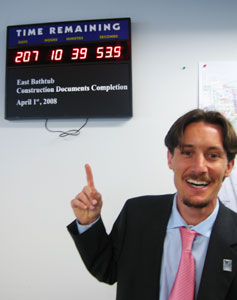
Dara McQuillan of Silverstein Properties counts down until CD sets for the east bathtub are complete.

Rick Bell

Larry Silverstein’s remarks were on target. He spoke of how much is happening at the World Trade Center site, and how the three teams hired by Silverstein Properties to design Towers 2, 3, and 4 have been working side-by-side in the super-sized studio at 7WTC. But the point of the September 6 convocation was the buildings themselves. Among other common features, including their projected LEED ratings, all focused on integrating commercial space on the ground floor thus animating the eastern façades along Church Street and enlivening the streetscape.

For Tower 2, to be known as 200 Greenwich Street and designed by Foster and Partners with Adamson Associates, retail space lines both the north and south sides of the building’s base. The 78-story structure respects the major aspects of the WTC Master Plan by Studio Daniel Libeskind, including integration with the “Wedge of Light” plaza and inflective roof planes. Tower 2 contains 138,000 square feet of retail and some 2.3 million square feet of office space. According to Foster and Partners’ project architect Michael Jelliffe, “the glazed crystalline form and diamond shaped summit of the building will be visible throughout the city and situate the Memorial Park when viewed from any location.”

Tower 3, designed by Rogers Stirk Harbour + Partners (RSHP) has 2.1 million square feet of office space and 193,000 square feet of retail. Richard Paul, partner at RSHP, noted that the 175 Greenwich Street structure, “stands centrally across Greenwich Street from the main axis formed by the two reflecting pools of the memorial.” Renderings show Dey and Cortlandt Streets as pedestrian streets unencumbered by stairways within the paved area. The verticality of the rectilinear tower is accentuated by antennae that stretch the building height to 1,240 feet above grade.

The fourth tower at 150 Greenwich Street is 64 stories tall. At 975 feet above grade it contains 1.8 million square feet of office space and five floors of retail, four located at or above sidewalk level. Project architect Gary Kamemoto of Maki and Associates said that “the above-grade retail takes the form of a podium that becomes a catalyst in activating and enlivening the immediate urban environment at pedestrian street level,” as does the Transit Hall that connects public space to the Cortlandt Street IRT stop. The angular, trapezoidal and parallelogram-shaped floor plans will create a distinctive profile on the Lower Manhattan skyline.

A countdown clock on the wall in the 7WTC super-studio indicates how many days remain until completion of construction documents for the east bathtub area of the site. Six years after the destruction of the World Trade Center, there was a sense of urgency in the room overlooking the site, and confidence the new towers would be realized regardless of the demolition schedule of Deutsche Bank or related construction schedules of the underground service concourse.

The presentation of the towers was put into perspective, as well, by an update on the National September 11 Memorial & Museum by its president/CEO Joe Daniels. The memorial project, now under construction, integrates the “Reflecting Absence” design by Michael Arad, AIA, and Peter Walker, FASLA, with the underground Memorial Museum by Davis Brody Bond Aedas (including a portion of the Vesey Street “Survivors Stair”) and the “Memorial Pavillion” visitors’ arrival center by Snohetta.

Beyond Barriers in Chicago

Access Living Headquarters

Access Living’s new headquarters in Chicago.

Courtesy www.accessliving.org

In describing the building he designed in Chicago for Access Living, a national accessibility rights public interest group, architect John H. Catlin, FAIA, of LCM Architects noted: “Accessible design is good for everyone, not just the people who use Access Living’s building everyday.” The occasion of his remarks was the presentation of the 2007 Barrier-Free America Design Award of the Paralyzed Veterans of America to Catlin and his client, Marca Bristo, President and CEO of Access Living of Metropolitan Chicago. Catlin continued: “Through this new building, and through the Barrier-Free America Award, we will deliver the message that accessibility benefits everyone from wheelchair users, to parents with strollers, to shoppers returning home with groceries.” Bristo spoke of how the LEED Silver headquarters will enable Access Living “to build our services and activities as we continue working to create an inclusive, integrated, and independent disability community.”

Access Living’s Headquarters, described as “a model of Universal and Green Design,” is located at 115 West Chicago Avenue. Less than a mile north of AIA Chicago’s new space at 35 East Wacker Drive, it was the setting for a celebration in August attended by previous Barrier-Free America Award winners including Edward K. Uhlir, FAIA, responsible for the creation of Chicago’s Millennium Park. During a tour, Access Living staff members pointed out some of the Universal Design features that make the building distinct. Those that especially impressed this visitor included:

· Easily adjustable desk counter heights to accommodate users with varying seating needs, including different wheelchair heights
· Oversized elevators with doors both front and back on all floors to enhance wheelchair maneuverability in crowded cabs
· Hallway carpeting with darker-colored borders to help those with visual impairment
· Computer screens linked to telephone and video cameras to enable telephonic signing
· Areas of rescue assistance on each floor also usable as lounge space

Access Living is a cross-disability organization governed and staffed by a majority of people with disabilities. Through its programs, services, and now its Chicago headquarters, it fosters dignity and self-esteem of people with disabilities and enhances their options so they may choose and maintain individualized and satisfying lifestyles. The 115 West Chicago Avenue building exemplifies the seven principles of Universal Design developed in 1997 by the Center for Universal Design at North Carolina State University: Equitable Use, Flexibility in Use, Simple and Intuitive, Perceptible Information, Tolerance for Errors, Low Physical Effort, and Space for Approach & Use. The implementation of these principles makes for good design accessible to all.

Other attendees at the award ceremony included AIA Chicago’s Executive Vice President, Zurich Esposito, and AIA Milwaukee President-elect Karen Plunkett, AIA. The Paralyzed Veterans of America, represented by National Vice President Gregory A. Joyce, National Director Gary E. McDermott, and Director of Architecture Carol Peredo Lopez, AIA, also has a design project underway in Milwaukee.

Shorris Launches New Port

Speaking at the New York Building Congress breakfast at the Mandarin Oriental on June 19, The Port Authority of NY & NJ Executive Director Anthony E. Shorris led off his remarks by quoting Mies van der Rohe: “Architecture is the will of an epoch translated into space.” True enough, but the remarkable thing is that we now have a Harvard and Princeton-educated Port chief executive who not only knows that Mies is more, but knows how to use him to talk with construction industry and labor leaders about a new spirit of openness at the Port Authority. The remarks, paralleled by pronouncements by Governors Spitzer and Corzine, is indicative of changes in Port Authority Board rules and procedures that will allow for greater public participation (see also “Port Authority Tentatively Approves Changes Aimed at Increasing Public Scrutiny,” by Ken Belson, The NY Times, N.Y./Region, 06.22.07).

Shorris previously served as Deputy Chancellor for Operations and Policy at the New York City Board of Education, and was a faculty member at the Woodrow Wilson School of Public and International Affairs at Princeton University. For the June 19 audience of building execs he spoke of the Port Authority’s goals in the following words: “The Port Authority should be marked by the audacity of the past without the arrogance. The Port Authority is fundamentally a BUILDING agency. Quality of design, excellence of design, is one of the criteria by which we judge projects. We will see what can be applicable from the Federal GSA model. Buildings like the transit hub by Calatrava are more than functional, they are grand.”

He noted that, “We are making the agency operate more transparently, doing things that other governmental agencies have been doing for a long time. The Port Authority should meet or exceed the standards of both states and institutionalize those changes so that these improvements survive the tenure of any Director. Ultimately, the agency should not do anything that it is afraid to talk to everyone about. The Port has been moving in this direction for months. We are proud of what we do, and showing people what we do. Openness and transparency do not conflict with the excellence of our staff and our ability to deliver projects.” After the attack on the World Trade Center, where many Port Authority employees perished, there was a renewed sense of purpose and a glimmering of openness in an agency previously known for its secretive behavior. With Board meetings now to be open to the public and press, more information about project planning and design consultant procurement will be accessible.

During the Q&A period, Shorris elaborated upon the Port Authority’s role in several major upcoming projects or plans, starting with the long-planned transformation of the Farley Post Office Building into a major rail hub. He noted, “At Moynahan Station the Port Authority’s role is predominantly in collaboration with New Jersey Transit on Access to the Region’s Core. We are also looking at a new baggage-checking facility. That grand transit hub needs to be fully integrated, linking as well to the PATH system at 34th Street.”

In response to a question about Representative Jerrold Nadler’s quest for a rail freight tunnel, he said: “Freight capacity needs to be expanded and we need to get some trucks off the road to reduce air pollution. The movement of freight in the region is something that the Port is best able to manage. It is a central question environmentally…. The Trans-Hudson Express Tunnel general plan is to be a joint effort with New Jersey Transit — we need to do this together, and we’re committed to a robust partnership to make sure that we get this implemented since it is so important to the two states.”

His conclusion about collaboration was optimistic: “The identification of enormous infrastructure projects in the region is an important thing — it has to be something that over the long term generates more revenue. Both governors are interested in moving big infrastructure projects. But the Feds are not great partners on this, so we have to find some locally generated revenue. We are fortunate now to have two governors and a mayor who are desirous of getting things built. They are so much of a mind that it is great to watch them work together. The public has not seen its government look to execute great public works the way we have the possibility to achieve now. The public needs to see that this can happen. People see a connection between resources and the quality of their lives. If we can show people that investments in infrastructure can lead to better quality of life, there will be support.”

We look forward to ongoing opportunities to see the palpable results of these process changes and project planning overtures.