Beekman Rises

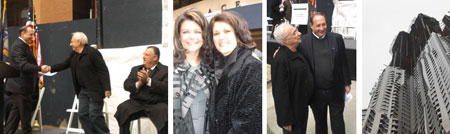
Beekman-COMBO

(L-R): Bruce Ratner, Frank Gehry, FAIA, and Gary LaBarbera; Joanne M. Minieri and MaryAnne Gilmartin; Frank Gehry, FAIA, and Bruce Ratner; and the Beekman Tower.

Rick Bell

“I’ve paid attention to the body language of NYC skyscrapers — this is a building that could only be built in New York,” said Frank Gehry, FAIA, at last Thursday’s topping-off ceremony for the 76-story Beekman Tower, located between Spruce, William, Beekman, and Nassau Streets in Lower Manhattan. The new building is the first residential tower designed in NYC by Gehry, who especially thanked “the workmen and the many hands that worked together to make this happen,” adding that “when I design a building, I think of all of the thousands of people who are involved” in its construction.

In construction, “topping off” refers to the ceremony held when the last beam, or in this case a 10-ton bucket of concrete, is placed at the building’s top. Since the dark days of the Great Depression, there has never been as much attention paid to issues of skyscraper form, design excellence, and the need for jobs in the construction and design industries.

As master of ceremonies and the project’s developer, Bruce Ratner, Chairman & CEO of Forest City Ratner Companies, proudly proclaimed that “Beekman has 2,500 union jobs — we build through recessions,” and that the design “is something else.” The stainless-steel residential tower has 1.1 million square feet and rises almost 900 feet above a six-story brick podium that will house the first NYC public school ever built on private land. The 100,000-square-foot school, designed by Swanke Hayden Connell Architects, will accommodate 630 students. The fact that a good part of the equity for the project came from union pension funds was not lost on the crowd of more than 200 civic and labor leaders, including NYC Buildings Commissioner Robert LiMandri, Forest City Ratner’s President & COO Joanne M. Minieri, and Executive Vice President MaryAnne Gilmartin. Gary LaBarbera, president of the Building and Construction Trades Council spoke of how the project team was “committed to success, even under the most difficult economic circumstances in decades.” He exclaimed, “The spirit of NYC made this happen — this is the greatest city in the world!”

Dallas Architecture District

OMA-Foster-RPBW

(L-R): Wyly Theater by REX/OMA; Winspear Opera House by Foster + Partners; Nasher Sculpture Center by Renzo Piano Building Workshop.

Rick Bell

The year-old Dallas Center for Architecture, located on the edge of the Dallas Arts District, hosted the 2009 convocation of the leaders of the largest AIA components, the so-called “Big Sibs.” The remarkable ground-level Center, directly across the soon-to-be-decked Woodall Rodgers Freeway from the Dallas Art Museum by Edward Larrabee Barnes, FAIA, has superb meeting and exhibition space. The two-day large-chapter meeting, led by AIA Dallas President Todd Howard, AIA, and Executive Director Paula Clements, Hon. TSA, held 10.01-02.09, allowed the exchange of best practices and ideas for how the AIA can best serve its members during the current recession. Present were presidents, presidents-elect, and executive directors from 14 cities: Atlanta, Boston, Chicago, Dallas, Denver, Houston, Los Angeles, Minneapolis, New York, Orange County (CA), Philadelphia, San Francisco, Seattle, and Washington, DC. While in Dallas, the AIA leaders were able to see the construction sites for the Winspear Opera House by Foster + Partners and AT&T Performing Arts Center Dee and Charles Wyly Theater by REX/OMA, along with the Dallas Art Museum and the Nasher Sculpture Center by Renzo Piano Building Workshop. Many also visited the still-sparkling Morton H. Myerson Symphony Center by Pei Cobb Freed & Partners, and saw Eric Breitbart’s film “Visual Acoustics: The Modernism of Julius Shulman” at The Magnolia.

Common themes emerging from the Big Sibs discussion included the importance of:
· Emerging architects / young architects
· Continuing education and volunteer opportunities during the economic downturn
· Membership retention and development; keeping in touch with members and others whose primary e-mail has changed because of layoffs
· Budgetary projections given non-dues revenue diminishment
· Collaboration with other professional and civic groups
· Strategic planning, both local and national
· Enhancing communications and advocacy
· Centers for Architecture (6 chapters have them, three are planning a center)

For AIANY, Chapter President Sherida Paulsen, FAIA, described five initiatives growing out of our six-year-old Center for Architecture, including the Not Business as Usual response to the economy; the One AIA/One NYC effort to have the five AIA chapters in our city work more closely together; exhibitions as outreach and education, including the just-opened “ContextContrast” show on new buildings in historic districts; our municipal advocacy efforts with the Department of Buildings and other city agencies, including the urbanSHED competition; and the Open to the Public effort, using exhibitions such as “New York Now” to leverage the visibility of the Center. Also representing our Chapter was president-elect Tony Schirripa, AIA, and 2011 president-to-be Margaret Castillo, AIA.

Perhaps the most compelling part of the open discussion was a presentation by Ann Schopf, AIA, President of AIA Seattle, about the need to unite behind 2030 carbon reduction goals. In particular, the educational programs being offered by AIA Seattle, which address the measurement of carbon reduction for new and existing buildings, was seen as a model. All component leaders registered support for making this program available nationwide, with financial support from the large chapters, and possibly AIA National.

George Miller, FAIA, president-elect of AIA National was present, as was Christine McEntee, executive vice president. Miller led a discussion of the AIA’s strategic planning effort and also announced a new program for next year, possibly to be called “Architecture Now” (other ideas welcome) patterned after the AIANY’s “New York Now” exhibition, currently on view at the West 4th Street subway station. All AIA members could submit the best of their work in a non-juried nationwide exhibition that would emphasize and dramatize the importance of architecture and urban design in the creation of livable and sustainable communities. The proposal was seen as consistent with the proposed and much-discussed AIA vision statement, Design Matters!

Awards of the State

“I don’t deserve this award, but I have arthritis, and I don’t deserve that either,” once quipped comedian Jack Benny. At the recent Rochester convocation of AIA New York State, 41 design awards, four student awards, and 12 service and achievement awards were conferred at two gala ceremonies. The acceptance speeches sounded like silent movies. To keep things moving, there were no opportunities for award winners at either event to thank clients, colleagues, collaborators, co-workers, co-habitators or, even, architectural photographers.

The 2009 Design Awards evening on Thursday, 09.24.09, was opened by AIA New York State President Burton Roslyn, AIA, who said that the purpose of the awards was “to celebrate design achievement and generate greater public interest…. That 41 were selected from a record number of 310 design submissions,” he declared, “is a tribute to the diligent work of the design jury, headed by Design Award Jury Chair Charles Matta, FAIA, the Director of Federal Buildings and Modernizations in the Office of the Chief Architect at GSA.” Sounding a sour note, AIA Rochester 2009 President Robert A. Healy, AIA, complained from the lectern that all 41 awards were won, this year, by NYC-based firms. Roslyn engaged in the debate by replying that the competition was anonymous, entries were unmarked, and the jurors were not aware of the location of the office of the project authors.

Matta, taking the stage, also complimented the hard work and difficult decisions of his jury colleagues, Alan H. Cobb, FAIA, VP, Director of Design, Architecture and Sustainability, Albert Kahn Associates; Tom S. Howorth, FAIA, President, Howorth & Associates Architects; Mark Robbins, Dean, Syracuse University School of Architecture; and Judith E. Bergtraum, Vice Chancellor for Facilities Planning, Construction and Management, City University of New York. But he observed that “the number of projects is indicative of the economic boom in place until 2008” implicitly raising the question of what we will see next year.

For attendees there was no Emmy or Tony suspense — award-winners had been notified in advance, and programs nicely printed. Nonetheless, a few award winners were surprisingly absent from the proceedings, which many in the room found to be unfortunate and disrespectful. Happily, many distinguished practitioners including Rick Cook, AIA, stepped up to the lectern; Cook + Fox garnered three design awards for projects as diverse as 401 West 14th Street, 11 Christopher Street, and the Center for Friends Without a Border in Siem Reap, Cambodia. Sylvia Smith, FAIA, of FXFOWLE Architects, was there to receive design awards for the Lion House Reconstruction at the Bronx Zoo and the lean reconstruction of Alice Tully Hall in Manhattan, achieved in concert with Diller Scofidio + Renfro. The Best in New York State Award was given to the four firms who together made possible the TKTS Booth and Revitalization of Father Duffy Square; Choi Ropiha (concept architects), Perkins Eastman (design architects), William Fellows Architects/PKSB (plaza architects), and Bresnan Architects (preservation architects) admirably shared the acclaim for this transformational project. One Perkins Eastman rep, standing on the podium next to PKSB’s (and AIANY 2009 President) Sherida Paulsen, FAIA, even decked out in a kilt for the occasion.

Many younger and emerging architects were present to accept their awards and the accolades of their peers. These included Philip Wu, who received an award of excellence for a project at 39 East 13th Street, and Jolie Kerns of Toshiko Mori Architect, who designed a Newspaper Café in Jinhua City, China, which also received an excellence award.

What we missed in speeches, we regained in the beauty of the winning project images, projected through Powerpoint, the 21st century equivalent of a camera obscura — a darkened chamber in which the real image of an object is received through a small opening or lens.

The Honor Awards ceremony, held at George Eastman House and sponsored by Zetlin & DeChiara, took place on Friday, 09.25.09, and was equally short and sweet. The quick pace allowed those in the audience to subsequently mingle with the honorees while touring the National Register house and the generous reception in the adjacent International Museum of Photography. AIANY Chapter members also won the lion’s share of these awards. The downstate prevalence was, again, the elephant in the room. AIANY Chapter members honored included Venesa Alicea, Assoc. AIA, LEED AP (Intern/Associate Award), Abby Suckle, FAIA (Fellows Award), Leevi Kiil, FAIA (President’s Award), and Anthony Vidler (Educator’s Award). The Firm of the Year was conferred upon Pei Cobb Freed & Partners, and one of the Student Awards went to Jackie Delsandro of Parsons, The New School of Design, School of Constructed Environments. A complete list of AIANYS Design, Honor, and Student Awards, will be posted on AIANYS’s website soon. Design matters and service was honored.

Security Talk at One Police Plaza

Police Commissioner Raymond W. Kelly formally presented the NYPD’s cogent book of design guidelines, Engineering Security: Protective Design for High Risk Buildings, at a well-attended conference at One Police Plaza on July 1. Calling the document “a major step forward to prevent an attack or mitigate the impact of an attack,” he delineated the principles of protective design and the specific recommendations necessary for “New York City’s high density environment.” The result of a process of intensive consultations and peer review, Commissioner Kelly said the final document was both informative and practical.

The details of the book’s organization and contents were outlined by Dr. Richard A. Falkenrath, NYPD Deputy Commissioner of Counterterrorism. Falkenrath described the sessions that led to the development of tools to calculate risk, with particular attention to risk mitigation and avoidance through site layout, building orientation, façade design, window placement, material selection, interior partition composition, and the prevention of progressive collapse.

Several members of the AIA New York Chapter Board, including 2009 Chapter President Sherida Paulsen, FAIA, President-elect Tony Schirripa, AIA, IIDA, and Director of Industry Affairs Carl Galioto, FAIA, reviewed advance copies of the preliminary document. The Chapter’s remarks, sent to Falkenrath on June 12, stated that the book puts forth a rational and reasonable approach to understanding the particular challenges of building high-risk buildings and offers potential solutions to address specific conditions. We agreed with the fundamental premise of the book that only a small number of high-risk buildings merit significant security design attention, but that many buildings could benefit from its suggestions. That the document requires little or no expense for low-risk buildings is noteworthy given the current economic downturn and financial crunch.

The strategies presented for medium- and high-risk buildings are consistent with recommendations made on a project-by-project basis by security consultants including Robert Ducibella (Ducibella Venter & Santore), one of the peer review technical experts whose comments educated the development of the book. The accessibility of the document, available online, makes this strategic approach available to many more architects, engineers, builders, and building owners.

The only other post-9/11 publication available that addresses how building security analysis can determine the most appropriate methods of protecting people, buildings, assets, and ongoing operations, is the tome called Building Security: Handbook for Architectural Planning & Design (2004, McGraw-Hill Professional), by Barbara Nadel, FAIA, a collection of 31 essays by architects and engineers, including Galioto. Nadel acknowledges Commissioner Kelly and many others at the NYPD in her introduction.

But the books are very different. Reading the NYPD’s Engineering Security: Protective Design for High Risk Buildings is comparable to entering into a conversation with the counter-terrorism experts at the NYPD, learning what has worked and not worked, hearing what is logical and what is not logical, determining clear and concrete steps for design and construction of buildings made iconic by location, use, and prominence.

The publication announcement at NYPD Headquarters, a 1973 structure designed by Kelly & Gruzen (now Gruzen Samton Architects, Planners & Interior Designers), included a panel discussion by NYC Department of Buildings Commissioner Robert Limandri, Ducibella, Marolyn Davenport of the Real Estate Board of New York, and yours truly representing AIANY. Other speakers included Rep. Peter King and Rep. Yvette Clarke, both members of Congress who serve on the Homeland Security Committee.

AIANY looks forward to assisting the NYPD in making the book’s contents and recommendations available to its members and to others in the design and construction communities.

Convention Convened

Approximately 22,500 architects convened in San Francisco for the 2009 AIA Convention.

Jessica Sheridan

PLENARY & PENURY
The most remarkable aspect of the 2009 AIA Convention in San Francisco was that despite near-record attendance, many AIA members were able to participate in the plenary sessions and continuing education seminars from home. From the podium at the Moscone Center, AIA President Marvin Malecha, FAIA, spoke of a symposium where 14 people were in the room, while over 14,000 participated electronically. Questions were asked online and through Twitter, and the Tweet sounds of pluralist participation, at 140 characters max, kept the grandstanding and pontificating to the minimum, except at Saturday’s Business Session. While overall attendance surpassed 20,000 people, and the product exhibition space was sold out, revenue was down, and many who were in Boston could not afford to attend because of the state of the economy and the liquidity of their firms.

HONORS & AWARDS
The almost-full plenary sessions belied the fall-off since last year’s convention, and spirits were high as many New Yorkers were honored for design awards and distinguished service. Honor awards were won by NY-based firms including FXFOWLE Architects, Thomas Phifer & Partners, Lyn Rice Architect, Diller Scofidio + Renfro, Cristoff:Finio, TEN Arquitectos, and STUDIOS Architecture.

Matthew Bremer, AIA, notably, won one of the eight Young Architect Awards. Bremer was recognized as co-chair of the AIANY New Practices Committee and as a “young architect who combines recognized and celebrated talent with a willingness to support the profession and provide mentorship for others.” His design talent and attention to detail were also noted in the AIA National commendation. Bremer, along with co-chair Marc Clemenceau Bailly, AIA, curated and installed the New Practices New York exhibition at AIA San Francisco’s Center for Architecture + Design; the exhibition opened with the concurrent announcement of the New Practices San Francisco winning firms.

Venesa Alicea, Assoc. AIA, LEED AP, received the AIA Associates Award. First presented in 2008, it is the highest honor given to individual Associate AIA members based on their demonstrated and unparalleled commitment to their component or region’s membership, in the community, in professional organizations, and in the design and construction industries. Alicea was commended for her unwavering commitment, her abilities in practice, and her outreach encouraging others to pursue IDP and licensure.

Marcy Stanley, Hon. AIA, received her Honorary Membership in the AIA, where she was applauded for her service to the Institute, AIANY, and the Washington DC Metro Chapter.

One of the highest AIA honors, the Edward C. Kemper Award for Service to the Profession, was bestowed on Barbara Nadel, FAIA. Nadel’s commendation by President Malecha noted the worldwide impact of her security design work. Her remarks credited the many collaborators and colleagues, both in her writings and consultations. She was described by AIA President-elect George Miller, FAIA, as “a proven leader, a dedicated mentor to emerging professionals, and an advocate for the AIA and the issues that are critical for the future of the profession.”

PORTER & BOND
The Whitney Young award, a very moving ceremony in which Clyde Porter, FAIA, a Dallas-based architect and facilities administrator, was honored, also included a tribute to J. Max Bond, Jr., FAIA. Bond had been scheduled to speak at the convention, and his untimely death leaves an immeasurable gap in the architectural fabric of our city and the world. The tribute, organized by AIA National’s historian and poet Ray Rhinehart, used interview footage seen at the 2005 Heritage Ball when Bond was honored with the AIANY President’s Award. A memorial will take place Tuesday, 05.12.09, at 3:00pm at the Great Hall of Cooper Union, followed by the opening at 6:00pm that evening of “The Life and Work of Max Bond, 1935-2009,” an exhibition at the Center for Architecture.

INVEST & CONVOKE
This year the Fellowship investiture took place at Grace Cathedral, a grand space atop Nob Hill where the invocation of distinguished achievement was spiritual, and the architecture itself awe-inspiring. Among the 112 architects elevated to Fellow were nine AIANY members, including Ken Drucker, FAIA; Belmont Freeman, FAIA; Christopher Grabé, FAIA; John Grady, FAIA; Robert Heintges, FAIA; Frank Lupo, FAIA; Joanna Pestka, FAIA; Annabelle Selldorf, FAIA; and Sylvia Smith, FAIA. Among the nine Honorary FAIA awards conferred, one name in particular stands out — that of Manfredi Nicoletti, Hon. FAIA. Nicoletti visited the Center for Architecture on 05.04.09 and delivered an impassioned oration on technology and growth after an introduction by his friend and sponsor, John Johansen, FAIA. The celebratory dinner included many others from NY, there to honor friends and colleagues. The new Fellows were honored, as well, at the social highlight of the Convention, the AIA New York State party organized and sponsored by Ibex Construction and its president, Andy Frankl. It was held at the City Club, the city’s best Art Deco interior graced by a Diego Rivera mural.

ELECTIONS & BUSINESS MEETING
The election results for AIA National office have been announced through various other communications. Our Chapter’s congratulations go out to 2010 President-elect Clark Manus, FAIA, of San Francisco, Vice Presidents Peter Kuttner, FAIA, of Boston, and Mickey Jacob, FAIA, of Tampa, along with John Rogers, AIA, of Ohio, elected as Treasurer. The merits of these and the other eminently qualified candidates were discussed at an AIA New York State caucus marked by candor and passionate debate.

Speaking of impassioned debate, the business session of the convention was held on Saturday, 05.02.09. Three reasonable and necessary amendments to the AIA National Bylaws were defeated. Our Chapter voted in favor of all of them:
1. Changing the term International Associate to AIA International,
2. Allowing Associate members to serve as Regional Directors, and,
3. Creating a new category of “Public Membership” in the AIA.

The fact they did not receive the necessary 2/3-delegate vote was seen by many as an abnegation of the future — a slap in the face to the associate membership, a denial of international outreach, and a reinforcement of the traditional insularity of many of the voting delegates. The various AIA list serves have been hot and heavy with statements of principle on both sides of all three issues. Over the next weeks and months strategies for compromise and consensus will emerge. In the aftermath of these three nay votes, however, one thing is certain: better communications and better outreach is needed to reaffirm the core principles of the AIA of the future: inclusiveness, participation, and growth. On these topics, I clearly left my heart, and say hey votes, in San Francisco.
Governor Patterson at ABNY

Rick Bell, FAIA, with Governor Patterson.

Marissa Shorenstein

On Thursday, 04.02.09, New York State Governor David A. Patterson came to a breakfast meeting of the Association for a Better New York to discuss his efforts to close the largest budget gap in state history and stabilize New York’s long-term finances. Governor Paterson started his remarks by noting that a large number of the projects in the Federal Stimulus Package are located in NYC. The funding coming with these projects may camouflage the fact that the state’s budget, and the city’s budget as well, have been overwhelmed by what Governor Paterson called “the tsunami of revenue downturn.” He spoke of the compromises that had to be made by all parties in Albany and called for ongoing fiscal restraint, noting that the state’s budget “has more cuts and more recurring cuts than would have occurred if I jumped up and down and called the Legislators names.”

His budgetary outline was presented succinctly: “This is where we are now in the Empire State,” he said. “We are making decisions that are unpopular, and no one knows that better than me — the solace is that these decisions are necessary.” In an even tone he continued: “This budget is about broad sweeping reforms and change; it is the road to economic recovery.” Tonal change crept in with rhetorical challenge: “To those who are criticizing it, I say you do not understand the dire circumstances of this economy, and you do not understand the need for shared sacrifice. I am the Governor of this state and I do.”

The remarks spoke to specific numbers, including the $6 billion expected from the Stimulus Package and the $4.7 billion anticipated from the personal income tax, which Gov. Patterson had previously opposed. He suggested that there was a great need to eliminate waste and redundancy in state agencies by concentrating government operations, and he cited health care and prison reforms as areas currently receiving critical attention. The Rockefeller-era drug laws, in particular, were cited as causing expensive and unnecessary mandatory incarceration for first-time offenders who, he said, need treatment more than prison.

In addressing deficits, which he said were occurring in 43 of the 50 states, and totaling almost $190 billion, Gov. Patterson said that “we shouldn’t be myopic — this problem is occurring in other states. We’ve been an equal opportunity offender in this budget process.” He concluded by saying that the proposed MTA transit fare increases are “a total encumbrance” that should not proceed.

Challenged about keeping the “Governor” in “Governors Island” he spoke of ongoing negotiations with the city, promising that “there was something being worked out” that would help fund the Governors Island Preservation & Education Corporation and its programs providing public access. Revenue tsunami or no, Governors Island needs to be kept afloat.

VIA AIA!

(L-R): Laura Manville; Rick Bell, FAIA; Tony Schirripa, AIA, IIDA; Sherida Paulsen, FAIA; Michael Cosentino, AIA (President-elect, AIA Queens); Congresswoman Carolyn Maloney; Mary Burke, AIA; Margery Perlmutter, AIA; Margaret Castillo, AIA, LEED AP; Venesa Alicea, Assoc. AIA, LEED AP: Terrence O’Neal, AIA; Burt Roslyn, AIA.

Orly Isaacson

The Grassroots Leadership and Legislative Conference of the American Institute of Architects brought more than 800 architects to Capitol Hill last week. Our Rebuild & Renew message called on Congress to prioritize economic recovery funding for projects that will stimulate the design and construction industries, creating jobs and assuring design quality. The AIA’s plan will enable architects and builders to create safe and modern infrastructure, energy efficient buildings, and sustainable communities.

The AIA New York delegation was led by Chapter President Sherida Paulsen, FAIA, and included President-elect Tony Schirripa, AIA, IIDA, Vice President for Public Outreach Margaret Castillo, AIA, LEED AP, Public Director Margery Perlmutter, AIA, Associate Director Venesa Alicea, Assoc. AIA, LEED AP, along with Policy Coordinator Laura Manville.

AIA National issued briefs that we discussed with NYC legislators calling for the promotion of healthy and safe communities through transportation funding, the elimination of federal fee retainage rules, and health care reform.

We also had conversations on the Hill about the impact of the economic crisis on the architecture and design community in New York, and how project funding and credit is needed to keep offices going. The Chapter’s Not Business as Usual advocacy efforts resonated with members of Congress and others present. Of particular interest to many was the idea of energy surveys of public buildings as a generator of work, and the expansion of AmeriCorps to include a DesignCorps component.

The VIA AIA theme of vision/influence/action was organized and led by AIA National President-elect George Miller, FAIA, a past-president of AIA New York.

A highlight was the Best Practice session spotlighting the AIA New York Chapter’s New Housing New York Legacy Project. Many affordable housing enthusiasts and housing specialists came to hear the presentation by Holly Leicht, Deputy Commissioner for Development of the NYC Department of Housing Preservation & Development, and Mark Ginsberg, FAIA, LEED AP, the Chapter’s AIA150 Champion.

With a spirit of change in DC, and a sense of urgency imparted by global economic conditions, this Grassroots conference was considered by those attending as the most important lobbying effort by the AIA in history.

Sen. Kirsten Gillibrand Debuts at ABNY

Senator Kirsten Gillibrand at ABNY.

Rick Bell

Senator Kirsten Gillibrand opened by thanking the Association for a Better New York (ABNY) and its chair, William Rudin, for the opportunity to address a large crowd of civic leaders, elected officials, NYC commissioners, health care professionals, labor leaders, and builders. She pointed out that many in the room did not know her well, since her political ascent as an upstart and upstate member of Congress dates back only to 2006. Her speech, however, showed her political skills, referencing not only her grandmother (well-known in NYS Democratic circles), but former Senator Hillary Clinton’s speech in Beijing. Sen. Gillibrand said that it inspired her to ask herself, “What am I doing to impact this world, what am I doing to make a difference?” She added that to follow in the footsteps of the Secretary of State is an enormous honor, while attributing her job preparation at Davis & Polk as a securities lawyer and at HUD as special counsel to former HUD Secretary Andrew Cuomo.

She quickly got to the heart of the matter: the economic stimulus package, and the differences between the Senate and House versions of the Recovery Act. Saying that solutions must come out of Washington, but also from the private sector, the newest Senator spoke of the need for short-term relief for the communities that need it the most. She added that long-term investment in early childhood education and for college tuition relief through expansion of Pell grants and tax credits was also needed and part of the package.

Among the other topics that the AIA brought to Capitol Hill last week during the Grassroots lobbying effort, Sen. Gillibrand addressed the stimulus package’s Senate-version sums for alternative energy ($42 billion), mass transit ($8.4 billion), and public housing ($5 billion). She said that the planned expansion of AmeriCorps aided “long-term programs that make a difference, that represent who we are.”

Echoing concerns expressed by architects last week at the VIA AIA! Leadership and Legislative Conference in DC, she noted that “the real problem is that the banks don’t want to lend,” and added, “The world is watching America right now — we need to bring ideas to the table that have a short-term and a long-term impact.” As founder of the high-tech caucus in the House, Sen. Gillibrand was cogent about the job creation possibilities in the high-tech and energy sectors, and spoke of green jobs and manufacturing opportunities for New York.

In the press conference afterwards she was open to questions about her evolving positions on guns and same-sex marriage, noting the difference between representing an upstate Congressional District where hunting is a tradition, and now being the Junior Senator for the entire state. She quoted Eleanor Roosevelt about the travails and scrutiny occasioned by her appointment: “A woman is like a teabag, you don’t know how strong she is until she’s in hot water.” From the back rows of the Hilton, she seemed strong enough to represent New York.

Bloomberg & Obama in Concert

In his 2009 State of the City Address, delivered at Brooklyn College on January 15th, Mayor Michael R. Bloomberg spoke of creating jobs, strengthening the quality of life in every NYC neighborhood, and stretching every dollar further. Job creation, he said, starts with investing in new infrastructure. And in this fiscal year, the mayor reported that there will be an all-time high of more than $10 billion in capital projects, creating more than 25,000 construction-related jobs. He gave as examples not only the #7 Flushing line extension, but also the new Police Academy in Queens, a new police precinct in Staten Island, libraries in every borough, the Queens Museum expansion, and the High Line build-out.

Relating construction to federal funding, Bloomberg had this to say: “For the past year, we’ve been pushing Washington to focus the Federal Stimulus on ready-to-build infrastructure. In all fairness, they’ve finally come around — and thanks to all the work we’ve done over the past several years, we’re ready to build. We look forward to working with Congress and President-elect Obama — not just on the stimulus package, but on re-thinking the entire way we fund infrastructure projects in this country.”

Those old enough remember the special relationship that existed between NYC and the federal government during the heyday of the Works Progress Administration and its funding of municipal projects. Mayor LaGuardia had a direct line to President Roosevelt, and many NYC Department of Health District Health Centers, among many other federally funded projects, came about as a function of that lifeline.

Continues…

Bloomberg & Obama in Concert (Continued)

Mayor Bloomberg recalled those years in his State of the City speech: “Until recently, the New Deal and the 1930s seemed like a distant memory — something we read about in history books. But last year, when the sub-prime mortgage write-down became a global financial meltdown, the bank panics returned and today, more people are worried about losing their jobs, their savings, and their homes than at any time since the Great Depression… Time and again, the future of our city has been in doubt. Time and again, we have faced moments of truth. And each time, we have pulled together as New Yorkers and come out stronger, together.” He continued: “Our job is to help all those who are struggling — help improve their chances for a job, for keeping their homes, for making ends meet, and to do it all without new funding — because the city just doesn’t have the money. Instead, rather than spending new dollars, we have to redeploy resources and repurpose budgets — and we will.”

The reference to the Great Depression continued near the conclusion of Mayor Bloomberg’s speech: “Over the history of our city — no matter how severe the blow we’ve been dealt, no matter how uncertain the future — we have always found the strength and optimism to rise to new heights, as New Yorkers, together. No one better exemplifies that than the man who is responsible for building the college where we sit today: Franklin Delano Roosevelt. We all know how in his first speech as President, FDR reminded us that the only thing we had to fear was fear itself. But you may not know that on the last full day of his life, he wrote this: ‘The only limit to our realization of tomorrow will be our doubts of today.'”

In the first speech as President given by Barack Obama, the echo of the Entente cordiale between LaGuardia’s NYC-resilience and Roosevelt’s New Deal will-power came across loud and clear: “For everywhere we look, there is work to be done. The state of our economy calls for action, bold and swift, and we will act not only to create new jobs, but to lay a new foundation for growth. We will build the roads and bridges, the electric grids, and digital lines that feed our commerce and bind us together. We will restore science to its rightful place and wield technology’s wonders to raise health care’s quality and lower its cost. We will harness the sun and the winds and the soil to fuel our cars and run our factories. And we will transform our schools and colleges and universities to meet the demands of a new age. All this we can do. All this we will do.”

It seemed to many in the audience of billions, as well as to commentators and bloggers that President Obama’s Inaugural Address was restrained rhetoric, not reaching for unrealizable goals nor raising unachievable expectations. In this regard it was a building program, not a rendering. It was detailed enough to serve as blueprint and specifications for the near future, for a fast-track start, a shovel in the ground.

In the first week of February, architects from around the nation will converge on Washington, DC, for the annual AIA Grassroots legislative and leadership conference at which issues are raised with Members of Congress and others in government. AIA President-elect George Miller, FAIA, an AIANY past-president, is leading this national conjunction under the banner of the acronym “VIA! AIA” for Vision, Influence, and Action. The AIA’s Rebuild and Renew policy statement is a call to action. We expect that it will find, this year, friendly ears.

One of the zingers about halfway through President Obama’s Inaugural Address last week was: “Know that your people will judge you on what you can build….” Let’s not be wanting.