Sleepless in Saratoga

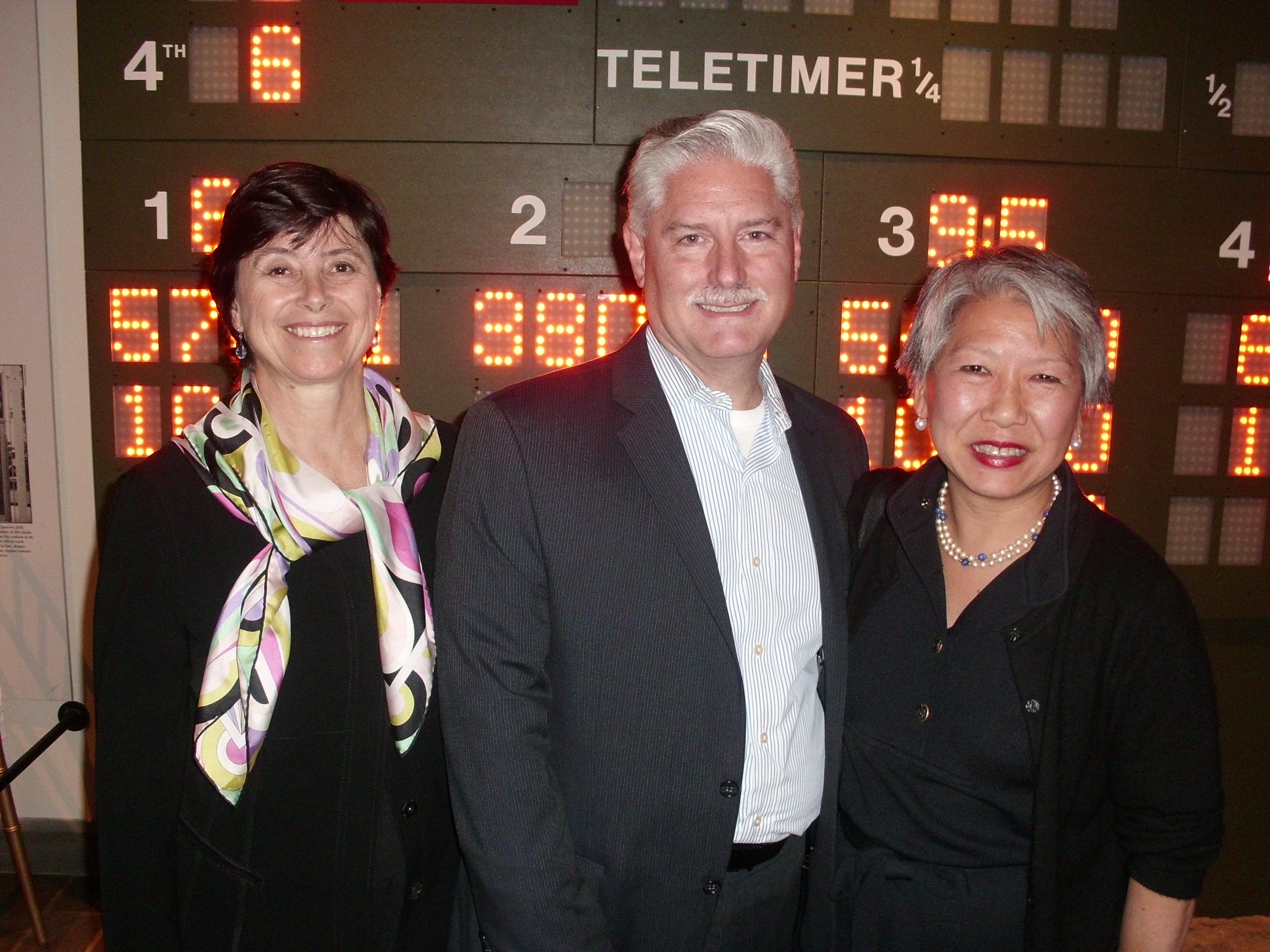
Jill Lerner, FAIA, Joseph J. Aliotta, AIA, LEED AP, and Susan Chin, FAIA, at the Racing Museum

Rick Bell, FAIA
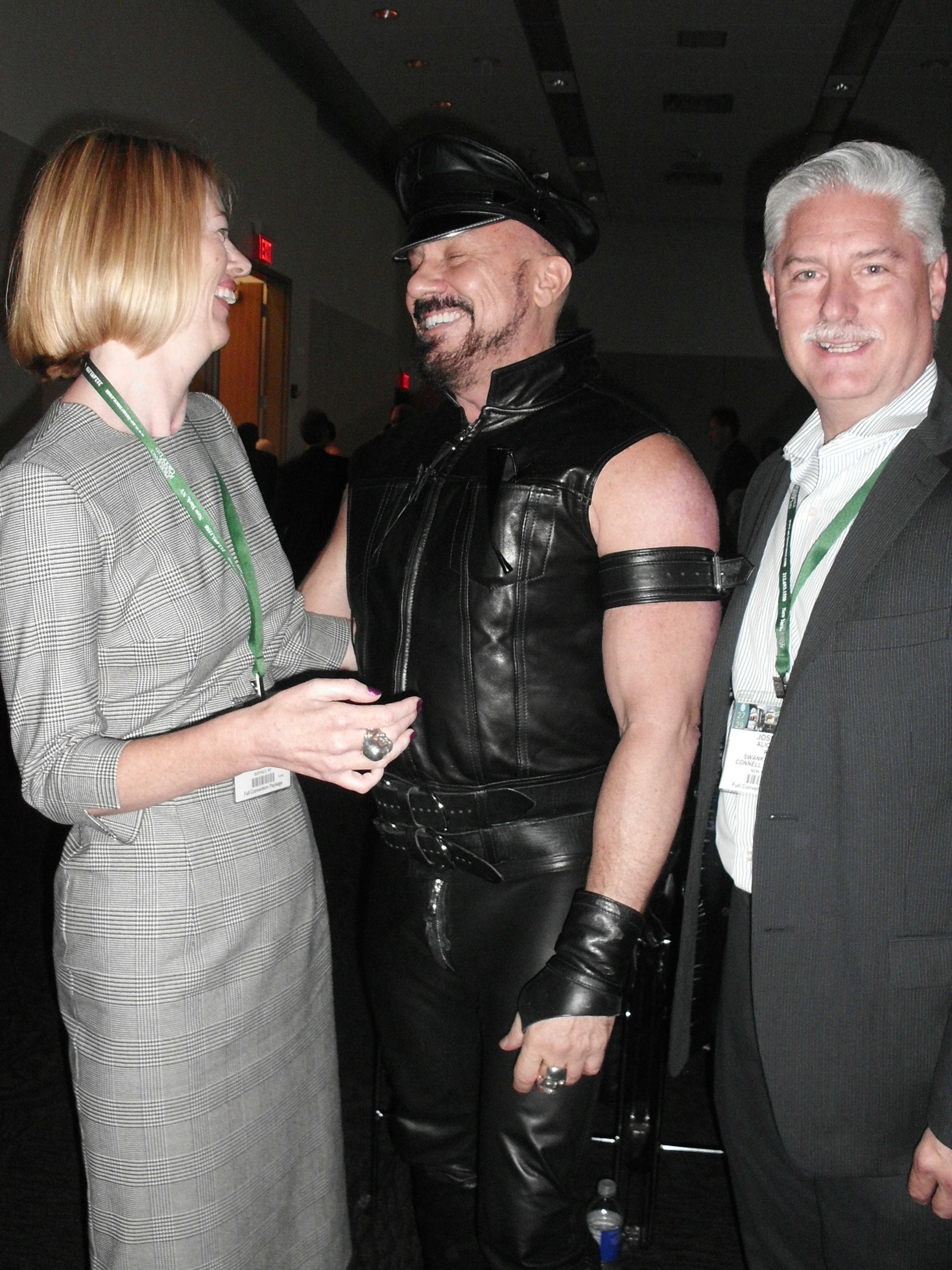
Kelly Hayes McAlonie, AIA, Peter Marino, FAIA, and Joseph Aliotta, AIA, LEED AP

Rick Bell, FAIA

People generally go to Saratoga for the waters, the racing, or for Skidmore College. Last month there was another reason: the AIA New York State Convention, held at the Hilton downtown near Caroline Street. We’ll come back to Caroline Street – and return to Saratoga, especially since it is possible to go up and back on one of the best trains in the country. Amtrak – who knew? – has a “superliner” or “VistaDome” car north of Albany on the route to Montreal. A glazed-roof train car provided Mary Burke, FAIA, Margaret Castillo, AIA, Abby Suckle, FAIA, and this correspondent an utterly new and different vantage point of the fall foliage, the bucolic landscape, and the upper Hudson. Starting a trip to a congregation of AIA stalwarts in this unconventional manner put the sojourn in an entirely different perspective. The AIA New York Chapter delegation was spearheaded by 2012 President Joseph J. Aliotta, AIA, and President-elect Jill Lerner, FAIA.

The opening reception took place at the extraordinary National Museum of Racing. With a collection of racing memorabilia, artifacts, and artwork, the museum also had everything from a real starting gate to a skeleton of a horse in motion.

The 30th AIANYS Annual Convention was organized by AIANYS Past President David Businelli, AIA, along with Dan Wilson, AIA, David Pacheco, AIA, and Jeffrey Morris, AIA, from AIA Eastern New York. It was animated by the robust presence of Kelly Hayes McAlonie, AIA, and the communication skills of President-elect Eric Goshow, AIA. Three extraordinary keynote speakers punctuated the three days. The first of the lectures, “Building an International Practice,” was given by Peter Marino, FAIA, looking hip and hungry in black leather. He shared war stories, anecdotes, and tips, such as “speak the language,” while describing how his practice has succeeded in countries all over the world. When one’s clients are the major fashion houses of the world – think Chanel – hanging with celebrities doesn’t hurt, nor does being on the cover of L’Uomo Vogue back in December 2009. Peter’s advice, however, was relevant to firms small and large, no matter what their client base. It dealt with empathy, outreach, and flair – distinguishing characteristics of his career and that of others who would wish to succeed in the global economy.
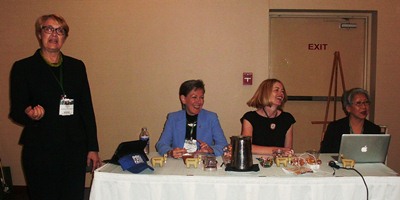
(l-r) Nancy Goshow, AIA, Helene Dreiling, FAIA, Kelly Hayes McAlonie, AIA, and Susan Chin, FAIA

Rick Bell, FAIA
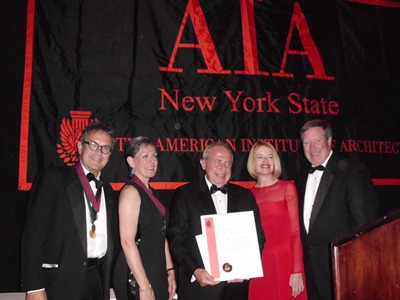
Andy Frankl (center) receiving award with (r-l) Ed Farrell, Kelly Hayes McAlone, AIA, Helene Combs Dreiling, FAIA, and Rick Bell, FAIA.

Rick Bell, FAIA

Bracketing the opener was the closing keynote by Eric Cesal, who studied architecture at Washington University in St. Louis and has worked in Haiti with Architecture for Humanity. The author of Down Detour Road, Eric spelled out the steps by which architects and designers can engage their communities to make a difference. The third impressive keynote was by Billy Procida, president of Procida Advisors LLC, who suggested that architects “crossover to the other side” and test their skills at development.

Of the 44 programs, two that particularly stood out were on areas of practice. One, by Robert Lopez, RA, head of the State Board of Architecture in the Office of the Professions of the New York State Education Department, was called “Understanding Permissible Corporate Entities and the New Design Professional Corporation Laws in NYS.” It packed the room with those eager to learn more about the implications of recent changes in State regulations pertaining to firm ownership, and the basic tenets of the corporate practice prohibitions in New York.

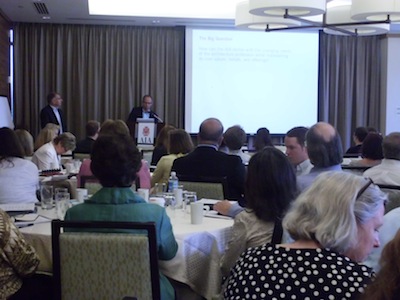
Nancy Goshow, AIA, longtime co-chair of the AIANY Women in Architecture Committee, organized a panel discussion that brought together Helene Combs Dreiling, FAIA, Kelly Hayes McAlonie, AIA, and Susan Chin, FAIA. Helene is newly elected as AIA’s national president for 2014; Kelly, apart from her AIANYS leadership, is interim assistant vice president in the Capital Planning Group of the University of Buffalo; and Susan heads the Design Trust for Public Space, and was recently elected an AIA National Vice President. Issues discussed included gender and generational perspectives, and the change in the nature of architectural employment in private sector firms, academia, and public agencies. Despite the fact that currently women comprise 40% of enrollees in schools of architecture, only 25% of architects in this country are women, and 17% are AIA members. This panel of accomplished architects discussed the challenges of being women in practice, at home and in the AIA. The first questions came from some of the men in the room, including former AIANY Presidents Walter Hunt, FAIA, and Tony Schirripa, FAIA. The most important concluding remarks, however, came from Nicolette Feldser, Assoc. AIA, the associate director on the AIANYS Board, who noted that the Convention was poorly attended by younger members. Costly and largely mid-week, many Associates who might have benefited from the discussions and debates were effectively locked out. Maybe this can change in Syracuse next year – so save the dates of September 25-27, 2013.

The Convention’s trade show brought 89 vendors and distributors to Saratoga whose products or services were new to many architects attending. Many of those taking booths from upstate companies were relatively unfamiliar, but very accessible – for example Hubbell Galvanizing. Familiar faces with new technologies to offer included folks from Marvin Windows, Oldcastle, and Schindler, among many others. It was gratifying to see downstate companies, such as B&B Sheet Metal from Long Island City, represented by Gretchen Cobb, engaging with those specializing in preservation practice in New York City. The most sought-after giveaway of the show, apart from product information necessary for our designs, was the elegant umbrella from Belgium-based Buzon Pedestal International; with its canvas case and “brelli” logo, it came in handy during the misty weekend.

Business of a different order was conducted at both the AIANYS Board Meeting and subsequent Annual Meeting. At the former, the State Component’s Strategic Plan was formally adopted. Described as a “living document,” it will undoubtedly be seen in conjunction with the developing “repositioning” endeavor of AIA National.

At the Annual Meeting, Raymond Beeler, AIA, was elected to be 2014 AIANYS President in an uncontested election that testified to the respect he has garnered as the Board’s Vice President of Public Advocacy. The replacement for Ray Beeler as VP will be Mary Burke, FAIA, whose campaign speech and thoughtful reflections on priorities of engagement helped assure her election despite the qualifications and service of Randolph Collins, AIA, who promises to stay involved with outreach efforts. Mary and Randy worked together on the design of the new office space for AIA New York State in downtown Albany.
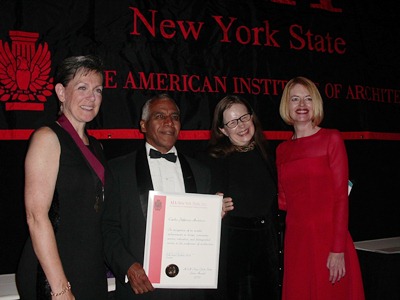
Sarah Caples, AIA, and Everardo Jefferson, AIA, receiving award from Kelly Hayes McAlonie, AIA, and Helene Combs Dreiling, FAIA.

Rick Bell, FAIA
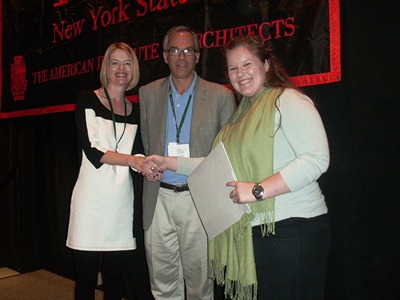
(r) Julie Ann Engh, Assoc. AIA, receiving award from (l) Kelly Hayes McAlonie, AIA, and (c) Raymond Beeler, AIA.

Rick Bell, FAIA

(l) Karen Kubey, Assoc. AIA, receiving award from (r) Kelly Hayes McAlonie, AIA.

Rick Bell, FAIA

Service awards were conferred to many AIANY Chapter members throughout the three day convention. These included Caples Jefferson (Firm of the Year); Julie Ann Engh, Assoc. AIA (Intern – Associate Award); Andy Frankl of Ibex Construction (Honorary AIANYS); Walter A. Hunt, Jr., FAIA (Jame William Kideney Gold Medal Award); Paul Segal, FAIA (Fellows Award); and Abby Suckle, FAIA (President’s Award). Friends of the High Line, represented at the ceremony by Erycka Montoya Pérez, won the Community Development Award. Michael Sorkin, who won the Educator Award, was not able to attend, having fractured his ankle on a slippery New York City sidewalk; his prepared remarks were abbreviated for delivery, but his regret communicated. Kate Spata also received the Student Award in absentia, as she is currently studying in Barcelona.

Student awards – and small scholarship checks augmented by an AIA National matching grant – were received by many attending NYC architectural schools, including Mia Zinni (Columbia University); Jeremy Jacinth (The Cooper Union); Robert Conway & Greg Thomas (NYIT); and Charlotte Ensign & Samuel Weston (Parsons The New School for Design). Karen Kubey, Assoc. AIA, was the first-ever recipient of the AIANYS ARE Scholarship, created to recognize Associate AIA members who have made significant contributions at an early stage in their career.

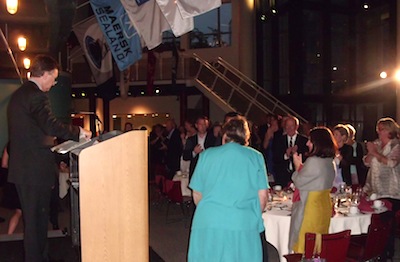
The annual black-tie gala provided the opportunity to celebrate design excellence, with many prize-winning projects designed by AIANY Chapter members, including: Adamson; Morris Adjimi; ARO; Bentel & Bentel; Cook+Fox; Cooper Joseph; CUH2A; Debra Berke; daSilva; Davis Brody Bond; François de Menil; Diller Scofidio + Renfro; Ennead Architects; Fielder Marciano; FXFOWLE; GF55; Gruzen Samton IBI Group; Handel Architects; Hanrahan Meyers; HLWInternational; Jaklitsch/Gardner; Kohn Pedersen Fox; LTL; Peter Marino; Audrey Matlock; NBBJ; Pei Cobb Freed; Port Authority of NY & NJ; Rice+Lipka; Rockwell Group; Frederic Schwartz; SHoP Architects; Smith-Miller Hawkinson; Snøhetta; Skidmore, Owings & Merrill; Studio Garneau; Tsao+McKown; and Unitedlab.

For me, the closing highlight of the trip was the first tour I have ever taken during an AIA Convention. It was of the Saratoga Race Course, which dates back to 1847. The tour was led by Samantha Bosshart of the Saratoga Springs Preservation Foundation, Charles Wheeler, Jr., manager of Planning and Community Relations for the New York Racing Association, and Michael Phinney, AIA, of the Phinney Design Group. We had access from grandstand to stable, from the Woodford Reserve Lounge to the muddy practice course, where those horses not yet en route to southern fields ran for a group of architects mesmerized by the motion, standing in the rain, thinking of the Travers and the history of connection between species.

And yes, at the train station going home, it was possible to buy a bottle of Saratoga Spring Water, available since 1872.
Vive la Différence

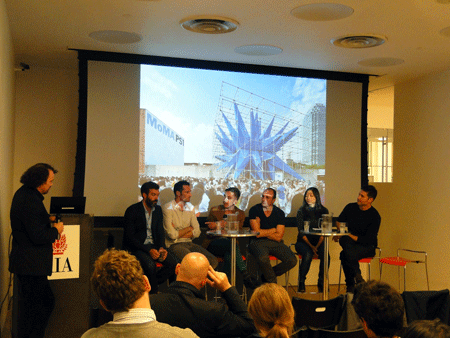
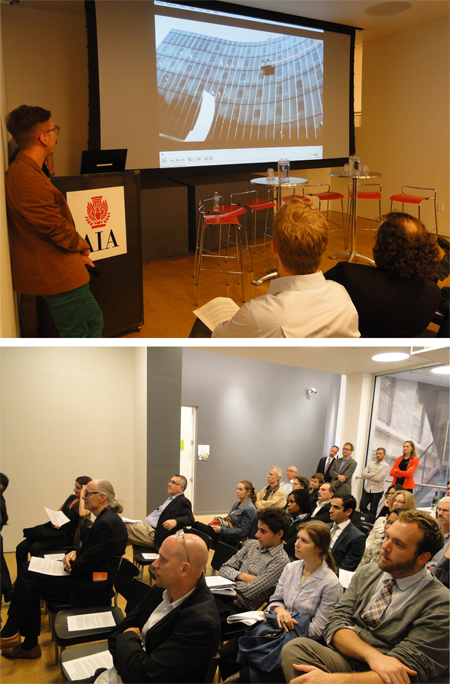
Marc Clemenceau Bailly, AIA, directs the discussion after the individual presentations, with HWKN’s “Wendy” as a backdrop.

Daniel Fox

(top) Guillaume Aubry, Cyril Gauthier, and Yves Pasquet of Freaks – Freearchitects, France, present a video chronicling their “Sur Mesure” sticker installation, as (l-r) Thomas Delamarre of French Cultural Services and Marc Clemenceau Bailly, AIA, look on. (bottom) The audience was treated to a lively transnational exchange of ideas and anecdotes.

Daniel Fox

Event: France – New York: Young Architects Dialogue
Location: Center for Architecture, 09.24.12
Organizers: The Center for Architecture and the Visual Arts, Architecture, Design-Arts Department of the Cultural Services of the French Embassy
Welcome: Rick Bell, FAIA, Executive Director, American Institute of Architects New York Chapter
Moderator: Marc Clemenceau Bailly, AIA, Gage-Clemenceau Architects; Co-Chair, AIANY New Practices Committee
Speakers: Guillaume Aubry, Cyril Gauthier, and Yves Pasquet, Freaks – Freearchitects, France; Remi Salles, A+R Salles Paysagisme, France; Jing Liu, Solid Objectives – Idenburg Liu (SO-IL), New York; Marc Kushner, AIA, HWKN, New York

This Monday, the Center for Architecture hosted an evening of vivid cultural exchange and comparison, which brought two emerging French firms and young architect laureates of the Album des Jeunes Architectes et Paysagistes (AJAP) 2011, together for conversation with two award-winning emerging New York firms, both recent winners of the MoMA Young Architects Program. After brief shout-outs for some of the distinguished guests in the audience, including Thomas Delamarre of French Cultural Services and Chrissa Laporte of the French-American Foundation, the program and panelists were introduced by moderator, Marc Clemenceau Bailly, AIA. Marc, a partner at Gage-Clemenceau Architects (gageclemenceau.com/home/), is a recent New Practices winner and co-chair, and after his enthusiastic stage-setting, the invited firms started the evening with presentations of their work.

FREAKS, also known as FREEARCHITECTS, (www.archdaily.com/tag/freaks-freearchitects) is a Paris-based design firm with three partners, Guillaume Aubry, Cyril Gauthier, and Yves Pasquet, all graduates of the Ecole Nationale Supérieure d’Architecture Paris-La Villette. After having worked several years for larger architecture firms, they founded “Freaks – Freearchitects” in 2007. The three principals distinguish themselves by an uninhibited approach to architecture and urbanism, demonstrated by their ebullient presentation of a video chronicling their “Sur Mesure” sticker installation of red dimension lines on the landmark façade of Oscar Niemeyer’s Building for the French Communist Party in Paris. Their projects, in general, tackle domestic issues and favor a hands-on methodology.

A+R SALLES PAYSAGISME was represented on the panel by Rémi Salles, one of two partners, with his wife, Amélie. The couple met while studying landscape architecture at the Ecole Supérieure d’Architecture des Jardins et du Paysage. In 2003, they moved to Dublin, where they lived and worked for six years. During Ireland’s economic boom they won commissions including two city parks on the outskirts of Dublin. In 2006 they decided to join forces to create A+R Salles Paysagisme, a landscape firm based in Guitres. The Dublin work was presented in Rémi’s talk, and was characterized by what he described as a “generous” vision of the landscape – and one that was necessarily green.

Jing Liu of SO – IL was up next. She and Florian Idenburg are founders of Solid Objectives – Idenburg Liu, hence “SO – IL” (www.so-il.org/) an idea-based design office. With a global reach, it brings together extensive experience from the fields of architecture, academia, and the arts. Idenburg and Liu envisioned their New York studio in 2008 as a creative catalyst involved in all scales and stages of the architectural process. With roots in Europe, China, and Japan, they endeavor to realize their ideas globally. SO-IL is a recent winner of the MoMA/PS1 Young Architects Program, AIANY New Practices Award, and an AIA Design Award. Jing started her presentation with the MoMA/PS1 installation.

Lastly, HWKN (www.hwkn.com/) was represented by Marc Kushner, AIA, who had also been a speaker at Saturday’s Future Now Summit (see article by Julie Engh, Assoc. AIA, above). Marc is a partner – along with Matthias Hollwich – in the New York-based architecture firm HWKN and is a co-founder of Architizer, which he founded in 2009 with his partners. Architizer is a revolution in the way architects communicate their work and is the first crowd-sourced database for architecture online. Since its inception, Architizer has started a fundamental re-evaluation within the profession of how architecture is consumed, and remains the fastest growing platform for architecture online. HWKN’s “Wendy” at MoMA/PS1 was this year’s summer installation.

Bringing together architects and landscape architects from different cultural and political contexts has become a hallmark of the Center for Architecture and its well-attended seminars and symposia crafted by Laura Trimble Elbogen, the Center’s Partnership Programs Manager. With deft moderating by Marc Bailly, the dialogue with our colleagues and copains proved most fruitful. If there were difference in dialect or client-base, the similarity between the firms and their intent was, if anything, more vivid.

Boldface in Seattle

Seattle Space Needle from Chilhuly Glass Museum and Garden

Rick Bell, FAIA

Arthur Cohen and Michael Bierut leading the CACE discussion on the AIA Repositioning. The project slide reads, “Our Premise: The nature and practice of architecture is evolving and the AIA must evolve with it in order to secure its leadership position.”

Rick Bell, FAIA

Jeff Potter, FAIA, at lectern, leads an ovation for Karen Lewand, in turquoise in foreground, back to camera.

Rick Bell, FAIA

One of the big secrets of Seattle is that it doesn’t rain there in August. That isn’t the reason that both the AIA’s Knowledge Leadership Assembly (KLA) and Council of Architectural Component Executives (CACE) met concurrently in the Starbuck City last week, but it certainly made it more pleasant. Three days of meetings took place at two well-designed hotels – the Fairmount for the committee leaders and the Pan Pacific for the association staff. The groups were able to come together for evening receptions at the Olympic Sculpture Park by Marion Weiss, FAIA, and Michael Manfredi, AIA, and at the Wooden Boat Center on Lake Union, a short trip by kayak to the boathouses starring in Nora Ephron’s Sleepless in Seattle – in which Tom Hanks plays the insomniac widower architect who leaves Chicago for the city of Jimi Hendrix.

AIA Executive Vice President Robert Ivy, FAIA, said at the kickoff : “Our members go out and change the world every day. Change is in the air. The mood is expectant.” Central to both meetings was the presentation of the working hypotheses of the AIA’s Repositioning effort, introduced by AIA President Jeff Potter, FAIA, who noted that “across our profession the sun is starting to come up,” and referenced a bumper sticker seen in Texas that read: “Give us just one more boom, and we won’t screw it up.”

The AIA’s blue-sky re-envisioning team is being led by New York-based consultants LaPlaca Cohen and Pentagram; Arthur Cohen and Michael Bierut kept a usually contentious cohort of almost 200 AIA staffers enthralled with logic and wit, outlining the nine central premises of the new institute in the making. Some of the broad ideas delineated resonate with the activities and strategic plan of AIANY, including: Going Beyond Bricks & Mortar to engage with policy; Focus on Connectivity to activate a community of peers; and Being Good for Business by bolstering efficiency and economic returns. The inclusive and transparent process can be reviewed on the Repositioning the AIA website.

Our region was represented at KLA by Mary Burke, FAIA, Chair of the Interiors Knowledge Community Advisory Group, and by David Del Vecchio, AIA, former Regional Representative from New Jersey. New York’s CACE attendees were Ed Farrell for AIANYS and CACE Executive Committee member Valerie Brown, Hon. AIANYS, from the Westchester Hudson Valley Chapter. Notable sponsors present included Laura Marlow from Reed Construction Data, Ann Casso from the AIA Trust, Ned Cramer from Hanley Wood, and Tom Schell from Naylor, which publishes Oculus along with a host of other AIA and association publications.

In a rare undisputed election, the CACE members present elected new executive committee officers. The current CACE ExCom is led by AIA Florida Executive Director Vicki Long, Hon. AIAFL, as 2012 President and by President-elect Carolyn Boyce of AIA Pennsylvania. New officers for next year will be 2013 President-elect Tina Litteral, Hon. AIA, from AIA Arizona, along with Heather Vance of AIA Utah, Kate Shelton of AIA Charlotte, and Melissa Hunt, of AIA Eastern Oklahoma.

CACE Honors were conferred at a closing dinner at the Bell Harbor International Conference Center (next door to the Edgewater where John Lennon is said to have put out a fishing line from his hotel window). Also announced was that AIA South Dakota is the recipient of the Hanley Wood grant for $10,000 this year. And Karen Leward received a standing ovation and appropriate accolades upon the announcement that she is retiring after many years of wonderful service as Component Executive of AIA Baltimore.

The heart of the CACE meeting, though, was the presentation of best practices by AIA Components, large and small. Among the notable presentations were those on membership development by AIA Seattle’s Lisa Richmond, Margot J. van Swearingen, Assoc. AIA, Sian Roberts, AIA, and Natalie Quick, and on Emerging Professionals and ARE prep by AIA San Francisco’s Michelle Railsback, AIA South Carolina’s Adrienne Montare and Kevin Fitzgerald, AIA, the director of the AIA’s Center for Emerging Professionals. A program on how to garner publicity and media for Chapter activities was led by Lindsey Ellerbach of AIA Eastern Oklahoma, Alison Pruitt of AIA Palm Beach, and Dawn Taylor of AIA Kansas City.

The meetings generally took place in conference rooms with windows, but at the outset, AIA Seattle President Rico Luis Quirindongo, AIA, and Chapter Executive Director Lisa Richmond encouraged attendees to take advantage of their limited free time to see the architectural treasures of the city, including the new headquarters building of the Bill & Melinda Gates Foundation by NBBJ.

Rico called Seattle “the last frontier,” and noted that the city was “trying to figure out how to go net zero.” Conference attendees were seen at the Chihuly Glass Museum and Garden, OMA‘s Seattle Library, and the Seattle Art Museum by Venturi, Scott Brown and Associates (now VSBA), and its addition by Allied Works Architecture. AIA Mississippi Executive Director Joe Blake was spotted at the Seattle Space Needle, celebrating the 50th anniversary of its construction as the centerpiece of the 1962 Seattle World’s Fair. And at least one CACE staff person admitted to attending the Nicki Minaj concert so as to see the interior of the landmarked Paramount Theater. Reviewed in advance in the Seattle Times, the sold-out Pink Friday concert had all of the bombast and rap eloquence of her recent Super Bowl half-time show. Minaj, a graduate of LaGuardia High School in Manhattan, sported bold-face makeup that used most – if not all – of the primary colors.

When the annual CACE meeting took place in New York in August of 2007, the AIA Sesquicentennial was celebrating America’s favorite architecture, a lot of which was to be found in our town. For those fortunate enough to go to Seattle, this Big-Sib sister city unveiled its exemplary environmental initiatives (including a 2030 Eco District), along with extraordinary waterfront planning and active recreation facilities. The Seattle Chapter was also ahead of us in that it opened the very first AIA-led storefront architecture center, some 31 years ago, led by AIA poet laureate Marga Rose Hancock.

So, if Seattle seems to be a colorful, sunny, and vibrant city that, parenthetically, never sleeps, it may have the advantage of being three hours earlier than New York. There is also something about the coffee.

Micro to the Max

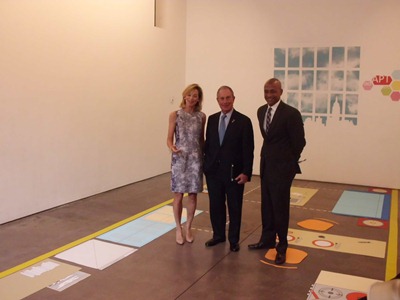
City Planning Commission Chair Amanda Burden, Hon. AIANY, NYC Mayor Michael R. Bloomberg, and Housing Preservation & Development Commissioner Mathew Wambua at the adAPT NYC press conference at the Center for Architecture.

Rick Bell

From Mayor Bloomberg to children participating in the Center for Architecture Foundation’s programming, everyone at the Center for Architecture was talking about the beauty of small spaces.

Rick Bell

The City’s new micro-unit housing competition, adapt NYC was announced at the Center for Architecture on Monday, July 9, by Mayor Michael R. Bloomberg, accompanied by City Planning Commission Chair Amanda Burden, Hon. AIANY, and Housing Preservation & Development Commissioner Mathew Wambua. (Click here to watch the video.)

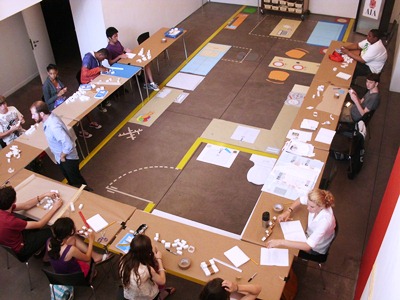
To demonstrate the potential of a change in the minimum housing unit size, a 300-square-foot apartment was delineated by bright yellow tape on the floor of the Center for Architecture’s Tafel Hall. Colorful furniture, fixtures, and fittings designed in-house by municipal architects led by Alexandros Washburn, AIA, were added in to give a sense of scale to the demonstration. Coming up on July 31, HPD will host a technical session at the Center to answer questions about the new initiative and the accompanying Request for Proposals.

The discussion to date has centered, in part, on how a smaller apartment might attract and retain recent graduates and those just entering the city’s job market. The AIANY’s Committee on Design for Aging, has also suggested the value of micro-units to an aging population for which the micro-unit may be right-sized. Whether for the young or less-young, the advantages of smaller units in a growing, high-density city were reflected in the many articles and blog entries appearing after the announcement. And students attending the Center for Architecture Foundation’s summer design camp also got into the mix, pondering design interventions while sitting at tables ringing this most adaptable apartment. Come see it at the Center, and hear or read about the city’s RFP.

Deputy Mayor Steel Girds for the Future

Deputy Mayor for Economic Development Robert K. Steel (left) with Tony Schirripa, FAIA, IIDA, 2010 AIANY President.

Rick Bell.

In a speech at Google’s space on Ninth Avenue in Chelsea on 12.16.10, Robert K. Steel, the Deputy Mayor for Economic Development, outlined four themes for NYC’s future, concentrating on what the Bloomberg Administration could do during its remaining 1,111 days. The broad concepts were cost savings, business assistance, physical infrastructure, and new industry.

Steel was introduced by documentary filmmaker Ric Burns, known particularly for his New York: A Documentary Film. Burns noted that these were “not the easiest of times in our city, in our country, or in our world,” but praised Mayor Bloomberg for bringing together “the greatest body of talent ever assembled to run a city — anywhere, anytime.” He stated that New York’s entrepreneurial spirit is “inscribed in, and emerges from, its very geography” and the “soaring wonder of the buildings.” Harking back to our city’s founding as a commercial outpost he spoke of NYC’s “unique culture of transformation — always open to the future”; a place that was adept at “pioneering the problems, pioneering the possibilities, pioneering the solutions — pioneering the future itself.” With a comparison to the unparalleled foresight of the 1780s economic planning — “a blueprint for America’s future” — done in NYC by Alexander Hamilton, he brought Deputy Mayor Steel to the lectern.

Of the four interconnected ideas for the future that were at the heart of Steel’s remarks, the architects in the audience, including 2010 Chapter President Tony Schirripa, FAIA, IIDA, and 2011 AIANY President Margaret O’Donoghue Castillo, AIA, LEED AP, were particularly enthusiastic about the description of the impact of public investment on the city’s infrastructure. Municipal stimulation of private investment included projects from Hunters Point South and its 5,000 housing units in Queens, to Hudson Yards in Manhattan, and Staten Island’s Stapleton. Steel noted that the New Housing Marketplace Plan’s goal of 165,000 units, announced in 2003, is two-thirds of the way to completion and vowed that the goal would be achieved.

Equally important was his mention of upcoming publicly-supported projects, including new work at the Hub in the Bronx, and the expansion of the New York Container Terminal. “From the harbor to the Hudson to the Erie Canal,” Steel noted, “the history of our city is inextricably linked to the water — with over 500 miles of shoreline, we have more waterfront than any other American city.” He said that the administration would soon announce a series of initiatives to further revitalize the waterfront, augment waterborne transportation, and reinforce waterfront parks.

Steel stated that “we are at an important juncture in the city’s history,” and he referred to Mayor Bloomberg’s recent speech in which he said that the issues impacting New York are almost always national issues. “At a time of fiscal challenges,” Steel noted, “we will not lose track of the investments that position us for the future.”

City of Delight

Buffalo-Century-Central

Century Grille and Central Park Grill in Buffalo.

Rick Bell, FAIA

The AIA New York State/ American Society of Landscape Architects Convention took place, this year, in Buffalo, the Queen City, as it is called by Lauren Belfer in City of Light. In her novel, published in 1999 by the Dial Press, issues of infrastructure, energy, urban dynamism, and passion come together in a metropolis defined by its architecture, urbanity, and extraordinary civic intelligence. That was the impression that visitors from downstate, and elsewhere, came away with after the most successful state convention in history.

Thanks are due to AIA New York State President-Elect David Businelli, AIA, and AIA New York State Past-President, Burt Roslyn, AIA, as well as AIANYS staff led by Executive Director Ed Farrell, along with Georgi Ann Bailly and Marthanne Gershman, for keeping the convention animated and exciting. Many service and design awards were conferred, as can be seen from the AIA Buffalo/ Western New York website. These included, among many others, the Educator’s Award to Kenneth Frampton, Assoc. AIA, of Columbia University, the Kideney Medal to Leevi Kiil, FAIA, and Honorary AIANYS status to Suzanne Howell Mecs, the Membership Director of AIA New York. Burt Roslyn, FAIA, received the Matthew W. DelGaudio Award; Stanley Stark, FAIA, received the President’s Award; and Mark Behm, Assoc. AIA, received the Associates Award. Firm of the Year honors went to FXFOWLE Architects.

Apart from these awards, and those received for superlative designs from firms statewide, the convention was given character and substance by the presence of the city of Buffalo itself. Many got to see the Richardson Asylum, Burnham’s Ellicott Square Building — site of the host chapter party, Wright’s Martin House, and the new Eleanor and Wilson Greathatch Pavilion, adjacent to it, by Toshiko Mori, FAIA. Others appreciated the enduring charms of the nightlife of Chippewa Street (“Been There” t-shirts abounded), and the home-style culinary delights of the Century Grill, Taste of Soul, Washington Square Bar, and Central Park Grille. Buffalo architects Ron Battaglia FAIA, Dennis Andrejko FAIA, Kelly Hayes McAlonie, AIA, and Robert Traynham Coles, FAIA, also made all convention-goers feel right at home. The City of Light was lit up for the AIA.

Leave the West Behind

Zodchestvo

Thirty of the 200 projects that are part of the “MADE IN NEW YORK” exhibition in the West 4th Street subway station in NYC are currently exhibited at the Zodchestvo 2010 Architectural Festival in Moscow, under the banner “NEW YORK NOW: The Architecture of Social Responsibility.” Pictured: Zuccotti Park by Cooper Robertson; Frank Sinatra School of the Arts by Ennead Architects; Flushing Meadows Natatorium & Rink by Handel Architects/ Hom & Goldman; St. Agnes Branch Library by Helpern Architects; and St. Hilda & St. Hughes School by Murphy Burnham & Buttrick Architects.

Anya Bokov

In Moscow, at the Manejh conference center in the former Tsarist cavalry training pavilion, 30 architectural projects from NYC (See Names in the News) were displayed during the Zodchestvo 2010 Architectural Festival of the Union of Architects of Russia (UAR). The exhibition, organized by AIANY, was a result of an invitation from UAR President Andrey Bokov to the AIA to be part of the annual design gathering, the Russian equivalent of the annual AIA Convention. Many recall that Bokov was a speaker at the AIA Convention in Miami this past June, and an exhibition of recent Russian design work, organized by Brian Spencer, FAIA, hung in the convention center’s halls. Here, then, was a chance to reciprocate, and the exhibition, called “NEW YORK NOW: The Architecture of Social Responsibility,” was culled from the 200 projects currently on display in the south passageways at the West 4th Street Subway Station a kilometer from the Center for Architecture on LaGuardia Place.

Projects in the show included a recycling barge transfer station by Annabelle Selldorf, FAIA, and the NYPL library renovation at St. Agnes Branch Library by Helpern Architects. A recreation center by Belmont Freeman, FAIA, accompanied the Frank Sinatra School of the Arts by Ennead Architects, and a courthouse in Allentown, PA, by Ricci Greene Architects.

The exhibition was facilitated by overall festival director Yuri Avvakumov and festival designer Egor Sopolov, and benefited from the strategic advice of Moscow-based architect Anya Bokov, who has worked in New York and Boston. Curators-of-record were Vladimir Belogolovsky and this writer, with major assistance from AIANY staff members Rosamond Fletcher, Suchi Paul, Jeremy Chance, and Cynthia Kracauer, AIA. Concurrent with the AIANY “MADE IN NEW YORK” subway show, the Zodchestvo installation shows that the Chapter promotes the value of architecture and of the work of AIANY members worldwide. As they say in Moscow, Architecture Matters!

Ward’s Words

Chris-Ward-090810-003

Christopher O. Ward.

Rick Bell

Christopher O. Ward, executive director of the Port Authority of NY and NJ, spoke about New York, Lower Manhattan, and the World Trade Center site at a breakfast of the Association for a Better New York (ABNY) on 09.08.10. After an introduction by ABNY Chairman Bill Rudin, who noted that, “Lower Manhattan’s commercial base has been expanding outside of its traditional financial service focus,” Ward complimented ABNY saying that “a better New York is a clarion call, simple and elegant.”

With the ninth anniversary of the 9/11 attacks on the minds of the more than 500 people attending at Cipriani Wall Street, Ward spoke of the importance of infrastructure, prior politicization of the design process, and current progress at the site. Anecdotes about stumbling blocks and the “fantastic” collaboration between the Port Authority and Silverstein Properties enlivened Ward’s presentation. He described the memorial by Michael Arad, AIA, (“a memorial of incredible emotional and engineering complexity”) to be open by the 10th anniversary next year, and equally detailed the Memorial Pavilion by Snøhetta, the Memorial Museum by Davis Brody Bond Aedas, the transit hub by Santiago Calatrava, FAIA, and the rising office towers by Skidmore, Owings & Merrill and Fumihiko Maki, Hon. FAIA. “We have turned those renderings into a construction site,” Ward declared, “defined by 2,000 workers, memorial waterfalls clad in black granite, the first of the trees being planted, by underground infrastructure, and the arches of the transit hub.”

BIM modeling allowed for both the integration of concurrent project components and anticipated potential coordination problems. “At the end of the day,” Ward stated, “this is a construction project, and has to be thought of this way.” The effort to depoliticize the discourse was aided by changing the name of the site’s tallest building from Freedom Tower to One World Trade Center, attempting to lose “the monumentalism and rancor that marked the early days after 9/11 — New Yorkers needed a new downtown, not a political message.”

Concluding his remarks, Ward stated, “Our work is far from over. But our vision for downtown is finally about something else, about renewing our conversation with downtown. It will be what we make of it, not a political agenda about a new structure a few blocks away. It will be quite simply about all of us being New Yorkers — that will be downtown.”

A Lunch to Save Energy

Schirripa-Israel

AIANY 2010 President Tony Schirripa, FAIA, IIDA (left), with Rep. Steve Israel of the 2nd Congressional District.

Rick Bell

The Alliance to Save Energy and ASE President Kateri Callahan hosted a lunch with Rep. Steve Israel (D-NY 2nd Congressional District) and Rep. Paul Tonko (D-NY 21st Congressional District) at which the lawmakers offered policy perspectives on comprehensive energy legislation. Introductory remarks by Francis J. Murray, Jr., President and CEO of the New York State Energy Research and Development Authority (NYSERDA), lauded the two Congressmen for “seeing beyond their own districts” to formulate a national approach that would augment “the many wonderful things we are trying to do in New York in regards to energy policy.” Those at the AIA New York table knew, for example, that NYSERDA provided significant funding for our Center for Architecture geothermal system and has selected AIANY and Urban Green to conduct energy code training statewide.

Rep. Israel noted that he didn’t need his allotted eight minutes to describe the failures of the last 30 years of national energy policy: “missteps, back-steps, and half-steps.” He criticized the doubling of Persian Gulf oil imports over that time period and the slashing of research on energy conservation by 87%. He described three ways to change our goals. First is top-down investment, such as the $16 billion stimulus funding for energy in the American Reinvestment & Recovery Act. Second is a bottom-up return on investments, including energy bonds for energy retrofits of existing buildings. Third is the initiative to use new technology to find clean energy in trash recycling. He called this a “Sputnik moment” when Americans should “not take no for an answer.”

On the same theme, Rep. Tonko spoke of the need for investment in what he called STEM, or Science, Technology, Engineering, and Mathematics to “embrace the American intellect.” He suggested that we encourage the “garage mentality” through support of a Sustainable Business Innovative Research Program (SBIRP) to more aggressively make “whiz kid ideas shelf ready.” He saw the big picture issues as being a new era of energy generation and distribution, a clean energy economy, and new concepts such as distributed technology wherein “energy efficiency is our fuel of choice.”

The interchange between the two distinguished members of Congress during the Q&A led Rep. Israel to conclude with a call for the political will to create $400 billion in new jobs, saying “the next generation of job growth is in energy efficiency — that’s the big issue.”

Goldsmith at Crain’s Breakfast

Goldsmith

Deputy Mayor Stephen Goldsmith.

Rick Bell

Deputy Mayor Stephen Goldsmith was appointed by Mayor Bloomberg on 04.30.10 to serve as Deputy Mayor for Operations, overseeing, among other municipal agencies, the NYC Department of Buildings, the NYC Department of Transportation, and the Mayor’s Office of Long-Term Planning & Sustainability — where PlaNYC is authored. Yesterday he gave the first major speech of his tenure at a breakfast hosted by Crain’s New York Business. After a glowing introduction by Kathyrn Wilde, president and CEO of the Partnership for New York City, who highlighted his prior career as Mayor of Indianapolis, Deputy Mayor Goldsmith started by saying, “I had been writing a book and the research for it always led me back to NYC and the things that are happening here: innovation combined with a set of methods to make things better.”

Goldsmith spoke about how leaders can cut through bureaucracy to serve constituents: “If you want to do transformational change, you have to elbow your way through to it — it’s not a question of doing more efficiently the things that we shouldn’t be doing at all.” In talking about unused desk space, redundant city garages, and the 80 municipal data centers, he said that “modernization is not just about cost savings, but improving the conditions of work. We need to transform how we do our work.” Responding to questions from Erik Enquist of Crain’s and Michael Scotto from NY1, the Deputy Mayor addressed how he had tried to reform the building permit process in Indianapolis, criticizing sequential review by multiple entities. “Near the end of the process someone can say, ‘change something,’ that requires you to start over.” After praising DOT Commissioner Janette Sadik-Khan and talking about how congestion pricing would have raised money while changing behavior, he concluded with: “change is what makes NYC a great place.”