Preservationists Ponder Continued Reuse

Event: Preserving 20th-Century Modernism
Location: Museum of the City of New York, 12.02.09
Speakers: Belmont Freeman, FAIA — Founder, Belmont Freeman Architects; Nina Rappaport — Chair, DOCOMOMO/New York-Tristate & Editor, Constructs; Frank Sanchis — Senior Vice President, Municipal Art Society; Theodore Prudon, FAIA — President, DOCOMOMO/US
Moderator: Andrew S. Dolkart — Urban Architectural Historian, Author, Guide to New York City Landmarks (Wiley & Sons, 1998)
Organizer: Museum of the City of New York

TWA

TWA Terminal, New York International (now John F. Kennedy International) Airport, New York, circa 1962.

Photography by Balthazar Korab, ©Balthazar Korab Ltd., courtesy Museum of the City of New York

“If you had the option,” asks Frank Sanchis, senior vice president of the Municipal Art Society, “wouldn’t you rather travel in and out of Grand Central Terminal, rather than Penn Station?” Sanchis, who passionately advocates for the preservation and re-use of the TWA Terminal for air travel, made his point. “Today,” he continued, airports are like bus stations.” There was no travel experience like flying in or out of the TWA Terminal at JFK.

Eero Saarinen’s TWA Terminal, a NYC designated landmark, could be called a poster child for the preservation of Modern masterpieces, and its situation is one of the most difficult to remedy. Jet Blue’s new Terminal 5 stands behind it and the iconic flight tubes join the two. Since the demise of TWA, the terminal suffered from benign neglect, until the Port Authority hired Beyer Blinder Belle Architects and Planners to make costly renovations, including repairs to the roof and drainage systems, removal of accretions, and asbestos abatement of the enormous ceilings over the lower and upper lobbies. It will also include restoration of the original flooring, seating areas, the flight information board, and information desk. The Port Authority says it “is expected to begin a process that ultimately will provide a vibrant new life for the structure by adapting it to new airport-related uses, which are yet to be determined.”

Saarinen, and the current exhibition “Eero Saarinen: Shaping the Future” at the Museum of the City of New York, is a perfect springboard to discuss preservation. He worked during an era when architecture was key to the identity of corporations. Due to corporate mergers and a down economy, Saarinen’s Bell Labs in Holmdel, NJ, is not the only modernist white elephant in an empty space. It is, however, high on the list for preservation and adaptive re-use for DoCoMoMo NY/Tri-State. The organization gathered a group of 38 design professionals and architects from NYC to Philadelphia to address the problems that surround the sustainable re-use of Saarinen’s buildings. Ideas such as re-use for healthcare, mixed-use, and education were presented to the building’s current owner, Somerset Development. Unable to secure the necessary approvals from the township, the development company sponsored its own community event to present its own mixed-use proposal to the public.

The panel was asked if adaptive re-use is the answer? Sanchis firmly believes that “it’s best use is its original use,” and that what you want to change a building into and the intensity of the design of the original are both factors. Theo Prudon, FAIA, feels that “9/11 changed the terminology,” especially in terms of the TWA Terminal. He feels adaptive re-use is a 1970s term and “continued re-use” is more appropriate today.

In this issue:

· Diana Center Opens on Broadway
· The Wright Stuff
· College Undergoes Fashionable Renovation
· New Theater Leaps to the Future
· Collaborative Design Studio Popped Up in the West Village
· Groundbreaking for a New Academy for New York’s Finest


Diana Center Opens on Broadway

DianaCenter

Diana Center.

Photo credit: Albert Vecerka/Esto

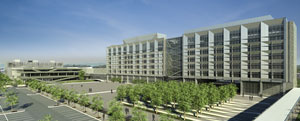
When Barnard students return next semester, they will have access to the new Diana Center, designed by WEISS/MANFREDI Architecture/Landscape/Urbanism. Located adjacent to Lehman Lawn, the 98,000-square-foot, multi-use building will serve as a new nexus for the campus and the community in Morningside Heights. The center’s wedge-shaped design frames a sightline from one end of the campus to the other, linking Barnard’s entrance gates to Milbank Hall. The seven-story building has an ascending, double-height glass atrium and a glazed staircase that brings in natural light and views through gradient patterns on the curtain wall. The building’s façade is composed of 1,154 clear and etched color glass panels of varying widths. LEED Silver certified, the center’s facilities include classrooms, studios, a library, and administrative and gallery spaces for Barnard’s architecture and art history departments. The building also houses dining rooms, a public café, a 100-seat black box theater, and a wood-paneled event space. The $70 million building is the capstone of the college’s multi-year master plan to increase spatial efficiency, improve infrastructures, and add academic and administrative space.


The Wright Stuff

TheWright

The Wright.

©2009 Philip Greenberg

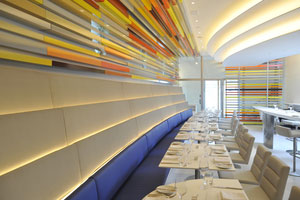
As part of the 50th anniversary celebration of the Solomon R. Guggenheim Museum, a new restaurant, called The Wright, in honor of the museum’s architect, has opened. The 1,600-square-foot space, designed by Andre Kikoski Architect, references the building’s architecture by featuring sculptural forms, including a curvilinear wall of walnut layered with illuminated fiber-optics; a torqued bar clad in a skin of custom metalwork and topped in seamless white Corian; an undulating banquette with blue leather seating backed by illuminated planes of a woven grey texture; and a layered ceiling canopy of a taut white membrane. A site-specific sculpture, The horizon produced by a factory once it had stopped producing, by British artist Liam Gillick, was commissioned for the space. The piece comprises a sequence of horizontal planks of powder-coated aluminum mounted to the walls and ceiling that creates a modular skin on the interior’s surface.


College Undergoes Fashionable Renovation

LIM

Multi-functional space and reception area at LIM.

Photos by Paul Warchol

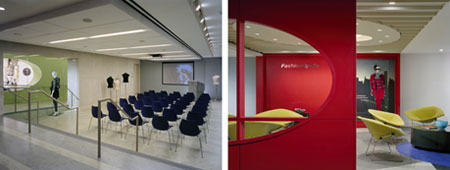
After a gut renovation of a circa 1880 six-story townhouse on East 53rd Street off Fifth Avenue, Butler Rogers Baskett (BRB) designed a new facility for LIM, the College of Business and Fashion. BRB sought to remedy the ad hoc architectural changes made throughout the school’s 30-year residence in the building. Given a modest budget, their goal was to refashion the cramped townhouse into a contemporary, creative environment. Renovations include new fashion studios, classrooms, computer labs, and offices. On the ground floor, BRB created a multi-functional public space that can seat 75 for lectures, fashion shows, and industry social events. A 20-foot-long, sliding, red lacquer millwork door with a clear glass, elliptical window is one of the key image-defining objects in the new design. This elliptical shape has evolved into the school’s newly branded logo and is used throughout the building to identify and reinforce areas of importance. C&G Partners was commissioned to create some of the signage.


New Theater Leaps to the Future

BAC

Jerome Robbins Theater at the Baryshnikov Arts Center.

WASA/Studio A

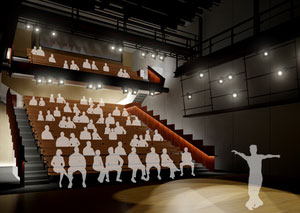
The newly renovated 238-seat Jerome Robbins Theatre at the Baryshnikov Arts Center (BAC) on West 37th Street, designed by WASA/Studio A, now accommodates dance, music, and theater. Designed to achieve LEED certification, the space juxtaposes new and old materials. Cor-Ten steel with a warm patina wraps around seating areas, sustainable wood panels are employed for acoustics, and glowing synthetic resin is used for stair handrails, and each seat has superior sightlines. A fully motorized rigging system allows for elaborate production capabilities with multiple set changes. Advanced variable acoustics were achieved using removable wall panels. The new theater, scheduled to open in early 2010, is an organic extension of the existing center.


Collaborative Design Studio Popped Up in the West Village

designstartshere

The Pop-Up Design Clinic was open from 12.05-13.-09.

re:design ARCHITECTURE + INTERIORS

As an antidote the slowdown in business, six professionals banded together to open a Pop-Up Design Clinic in the West Village. The storefront window advertised “FREE Design Consultation,” and during the nine days it was open, more than 170 “clients” came in to take advantage their architecture, interiors, and construction expertise. The projects ranged from gut renovations, new additions to existing homes, space planning, bathroom and kitchen renovations, and advice on furniture placement. Clients varied, too — a 13-year-old wanted help designing her bedroom, a woman with MS needed to design an accessible bathroom, and an 80-year-old woman about to move into an assisted care facility wanted her new home to be well designed and sensational. The Pop-Up Clinicians anticipate that some of the free consultations will translate into paying clients. Nevertheless, they are satisfied enough to already be making plans to resurrect the project next spring/summer. Called Design.Starts.Here., the collaborative design studio consisted of Brenda Bello, AIA, Jonathan Lundstrom, Basil Walter, AIA (Basil Walter Architect), Poonam Khanna, AIA (Re:Design Architecture + Interiors and Basil Water Architect), Ed Gavagan (PraxisNYC), and Jonathan Baker, AIA (Baker Works Architecture).


Groundbreaking for a New Academy for New York’s Finest

NYPDPoliceAcademy

NYPD Police Academy.

Perkins + Will

Construction is underway on the new NYPD Police Academy designed by Perkins + Will. Located on a 30-acre site (and former NYPD Auto Pound) in College Point, Queens, the new facility will consolidate training facilities for civilians, recruits, and active police officers that are currently scattered throughout the city. The first phase of the campus includes: an academic building; classrooms; tactical gyms that simulate street conditions; instructional offices; and administrative support spaces. This phase of construction is a joint venture of Turner Construction Company and STV Incorporated. Subsequent phases of the project will include a new firing range, a tactical training village, and a vehicle training course. Once completed, the new academy will be able to train approximately 2,000 recruits at any one time. The complex is being designed to achieve a LEED Silver rating. The total cost for the first phase of the new academy is estimated at $750 million and is scheduled to be completed in 2013. In 1989, Mayor Koch proposed that a new academy be built and finally, at the close of 2009, Mayor Bloomberg and Police Commissioner Kelly took part in the recent groundbreaking ceremony.

In this issue:

· 9/11 Casualty Breaks Ground in Lower Manhattan
· New Window to Complete Eldridge Street Synagogue’s Restoration
· Harlem Goes Green and Affordable for Retro-Fit
· NY Architects Redefine Las Vegas Strip
· New Super-Tall Responds to Sun in Seoul


9/11 Casualty Breaks Ground in Lower Manhattan

FitermanHall-COMBO

Fiterman Hall.

Pei Cobb Freed & Partners Architects

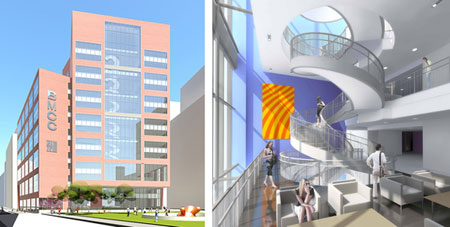
Ground was broken on the new Fiterman Hall for the Borough of Manhattan Community College. Located adjacent to the World Trade Center site, the building suffered structural damage and contamination during 9/11 and had been covered in black netting for years. The facility, designed by Pei Cobb Freed & Partners Architects, will be a 15-story vertical campus that weaves together public spaces and educational facilities. In addition to 96 classrooms, computer labs, a library, and assembly rooms, the facility will contain community gathering areas, a small conference center, two gallery spaces, and a café. It also features a large, multistory circulation atrium with circular stairs to alleviate elevator loads during class changes, and a planted roof. The total cost of the project is $325 million, which includes $66 million for the deconstruction and decontamination of the old building. $139 million is being provided by the city, with the balance coming from the Lower Manhattan Development Corporation. Construction is scheduled to be complete in 2012.


New Window to Complete Eldridge Street Synagogue’s Restoration

EldrigeStSynagogue

Before: Temporary window to be replaced by the Kiki Smith-Deborah Gans commission.

Kate Milford

Marking the final significant component of the 20-year restoration of the 1887 Eldridge Street Synagogue, a NYC Landmark and a National Historic Landmark on the Lower East Side, the Museum at Eldridge Street has commissioned artist Kiki Smith and architect Deborah Gans, AIA, to create a new east window. The window will parallel the original in its stained-glass medium, replacing a clear tablet-shaped glass-block design that was introduced in 1944-45 after the original window was damaged and removed. Sixteen feet in diameter, the window is the focal point of the sanctuary and occupies nearly the entire top half of the building’s eastern wall. The design, a galaxy of stars against a blue firmament, recreates in stained-glass the blue and gold star pattern painted on the walls immediately surrounding the new window. Using flash glass technology, it will be possible to etch yellow stars into a blue field without any outline or leading so that they will appear as more intense sources of light within the glow of the window. The new window is expected to be installed in spring 2010.


Harlem Goes Green and Affordable for Retro-Fit

WestHarlem

West Harlem retrofit apartment buildings.

Dattner Architects

Dattner Architects is set to retrofit a row of 10 circa 1905 apartment buildings in West Harlem. The buildings, containing a total of 198 apartments, are six stories plus a cellar, and are for the most part identical in design. The firm prepared a Green Retrofit Report to identify feasible opportunities to improve the environmental performance, consistent with the U.S. Department of Housing and Urban Development Green Retrofit Program and subsequently developed a scope of recommendations to address basic repairs and make sustainable improvements. Key green features include: the upgrade of energy systems; installation of a photovoltaic array; new street trees; thermally improved windows and doors; water conserving plumbing fixtures; energy-efficient lighting with motion detector controls; and sustainable materials and finishes in public spaces. This affordable and sustainable housing project is being developed by Jonathan Rose Companies.


NY Architects Redefine Las Vegas Strip

Vdara

CityCenter.

RV Architecture

The $8.5 billion CityCenter complex on the Strip in Las Vegas began opening its new buildings with Vdara Hotel & The Hotel and Spa, a non-gaming, 1,495-suite, 57-story building designed by RV Architecture, under the leadership of Rafael Viñoly, FAIA. The hotel’s crescent-shaped tower is distinguished by three parallel, offset arcs rising to varying heights. The second to open is Crystals, with 500,000 square feet of high-end retail and restaurants. Studio Daniel Libeskind designed the multi-faceted building and The Rockwell Group designed the interiors. Rising from Crystals is Veer Towers, twin glass 37-story towers that lean towards each other and contain loft-like residences.

The third to open this month is the 47-story the Mandarin Oriental Las Vegas, design by Kohn Pederson Fox, also a non-gaming hotel with 392 rooms and 225 branded condominium residences. The building draws inspiration from traditional Chinese motifs and features vertical panels of aluminum and glass that interlock with horizontal frit atop a podium made of zinc, titanium, granite and limestone. The fourth to open is the complex’s centerpiece — the 61-story ARIA Resort & Casino, designed by Pelli Clarke Pelli. Set to have its grand opening on December 16, the ARIA will have over 4,000 guest rooms, 150,000 square feet of gaming, and a 1,800-seat theater that will showcase Cirque du Soleil’s “Viva Elvis.” The final element in this ensemble is the Harmon, designed by Foster + Partners, a 400-room luxury boutique hotel, slated for late 2010.

CityCenter will be one of the world’s largest green developments. ARIA and Vdara are the first Las Vegas hotels to achieve LEED Gold certification and Crystals also has received LEED Gold. The remaining venues are expected to receive a combination of LEED Gold and Silver ratings. Located on 67 acres, CityCenter is a joint venture between MGM MIRAGE and Infinity World Development, a subsidiary of Dubai World. This project to build a city within a city began in 2004 with Ehrenkrantz, Eckstut and Kuhn Architects’s master plan. Gensler is executive architect overseeing the work.


New Super-Tall Responds to Sun in Seoul

DigitalMediaCity

Digital Media City Landmark Tower.

Skidmore, Owings and Merrill

The NY office of Skidmore, Owings & Merrill (SOM) celebrated the groundbreaking of the Digital Media City Landmark Tower. Located north of the Han River at the western edge of Seoul, the super-tall tower rises as a gateway to the city. Curved forms shape the 2,100-foot-tall building. Perimeter mega-columns reinforce the transforming mass and provide a natural break to a series of solar louvers. A pattern of both horizontal and vertical fins shield the interior from the sun, responding to the time of day. Together with a crown that collects and channels light and helps power the building through wind turbines, the architecture reinforces sustainability strategies at the core of the design. High-efficiency photovoltaic panels maximize solar energy and provide additional shade where needed. Radiant cooling through chilled beams, radiant floor heating, and drawing tempered air through green atriums add further efficiency. Additionally, atrium gardens and open-air green spaces throughout the building act as natural air filters. Upon completion in 2014, the project will be the tallest building in East Asia.

Ratensky Lecture Honors Legacy of Joan Goody, FAIA (1935-2009)

Event: 2009 Ratensky Lecture Honoring Joan Goody FAIA (1935-2009), with David Dixon FAIA
Location: Center for Architecture, 11.12.09
Joan
Speaker: David Dixon, FAIA — Principal-in-Charge of Planning and Urban Design, Goody Clancy
Moderator: Wids DeLaCour, AIA, Co-Chair, AIA New York Housing Committee
Introduction: Theodore Liebman, FAIA — Principal, Perkins Eastman
Organizer: AIANY Housing Committee
Sponsors: AIANY Planning & Urban Design Committee; with support by The George Lewis Fund

HarborPoint-BarkerCtr

Harbor Point (left) and the Barker Center for the Humanities at Harvard.

Courtesy Goody Clancy

David Dixon, FAIA, principal-in-charge of planning and urban design at Boston-based Goody Clancy, delivered the 2009 Ratensky Lecture — an annual series that honors individuals who have made significant lifetime contributions to the advancement of housing and community design — in honor of his long-time business partner, Joan Goody, FAIA, who passed away several months ago. He was among Goody’s friends, colleagues, and admirers who came to share their memories of her as a mentor, architect, planner, and public advocate. She was the former chair of the Boston Civic Design Commission, president of Boston’s Saturday Club, and recipient of the 2005 Boston Society of Architects Award of Honor for lifetime achievement. “She served the community as well as her profession,” said Dixon.

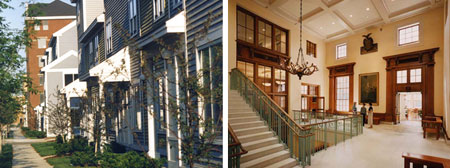
Goody was the senior member of a firm of more than 100 architects, preservationists, planners, and urban designers. She took the lead on many projects, but once told the Boston Globe in 1986, “There is no single genius in the firm. If someone has a better idea, we use it. We’re more collaborative than most. We try to bring up the next generation.” Her projects include the Barker Center for the Humanities at Harvard, which Dixon said was her “most controversial, but maybe her best.” The project restored and transformed McKim Mead & White’s 1901 Georgia-style Union Building, including a dining area and multi-level cluster of common spaces surrounding a skylit “great stair hall” at the heart of the building. The controversy sparked heated debates about historic preservation versus adaptive reuse, the latter winning out in the end.

What endeared her most to this audience was her belief that people are the building blocks for cities, more than the buildings she and others designed. This is particularly reflected in her urban housing projects. Some notable projects include Harbor Point, where she turned a Boston public housing project into a mixed-income neighborhood for 1,283 families living in new townhouses and mid-rises with renovated three- and seven-story existing buildings. Another project was born out of neighborhood activists protesting the loss of their homes to redevelopment in 1968. The firm worked closely with community groups to design a new mixed-income development for 1,200 people. The firm has been, and is currently, working on the recovery and revitalization of downtown New Orleans and other central neighborhoods covering approximately 20 square miles of the city. Plan elements include replacing public housing and parking lots with a mixed-income, mixed-use community of more than 5,000 people, roughly doubling the district’s pre-Katrina population.

In his introduction to the program, Theodore Leibman, FAIA, principal at Perkins Eastman, called her “an exemplary architect, tireless messenger, and a woman who crashed through the glass drawing table.” According to Dixon, she did not dwell on the fact she was a pioneer, but she certainly was. When she began her career, women practicing architecture was a rarity. In 1970, she helped found an advocacy group called WALAP — Women Architects, Landscape Architects, and Planners. Amie Gross, AIA, of Amie Gross Architects, who was in the audience, recalled vivid memories of interviewing Goody after architecture school in 1975. “I seriously doubted whether I could make it in the profession as a woman and if there would ever be opportunities to practice her firm’s type of architecture. The ease and pride she had as she showed me the work of the firm was my first professional exposure to the architecture of housing which has since been my passion.”

Three Buildings Make the Grade

Event: From Kindergarten to College: Three Recent Projects that Show the Way
Location: Center for Architecture, 11.03.09
Speakers: Daniel Heuberger, AIA, LEED AP — Partner, Dattner Architects; Susan T. Rodriguez, FAIA — Polshek Partnership Architects; Jean Oei — Project Designer, Morphosis
Introduction: Bruce Barrett — Vice President of Architecture and Engineering, NYC School Construction Authority
Organizer: AIANY Architecture for Education Committee

CooperUnion_2809

41 Cooper Square.

Jessica Sheridan

The NYC School Construction Authority (SCA) has the task of building new public schools and managing the design, construction, and renovation of capital projects in New York City’s more than 1,200 public schools. As the SCA’s vice president of architecture and engineering, Bruce Barrett has shepherded many projects, two of which, P.S./I.S. 276 in Battery Park City, currently under construction, and the recently completed Frank Sinatra School of the Arts in Astoria, Queens. The third project in the program, Cooper Union’s new academic building, hardly needs an introduction as it has been a source of wonderment since it began construction catty-corner to the school’s Foundation Building.

The steady influx of young families to lower Manhattan prompted the city and the Battery Park City Authority (BPCA) to fund a new school for approximately 950 pre-kindergarten through eighth-grade students. The eight-story, 125,000-square-foot building will occupy the last parcel of vacant land in Battery Park City. Designed by Dattner Architects, who co-authored the SCA’s Green Schools Guide in 2007 with the SCA’s architecture and engineering technical standards and support studio, the school will be one of the first in the city to be built under the green guidelines. It will also incorporate the goals of AIANY and NYC Department of Health’s Fit City program, while conforming to the BPCA’s design standards.

The high-rise’s curved profile and exterior will be clad in brick. A 10,000-square-foot outdoor playroof will be built on the third floor, and an outdoor multi-purpose room will be created on the eighth floor. To make the building more environmentally sound, all classrooms will be well lit with natural light to reduce the need for overhead lighting. Combined with extra insulation, solar panels, high-efficiency boilers, and other equipment, the school is anticipated to reduce its energy costs by more than 25%. Roof-mounted photovoltaic cells alone will generate 50 kilowatts of energy — roughly one-third of the energy needed to light the school. High-efficiency plumbing will also let the school use 40% less potable water, and 80% of the building’s construction waste will be recycled. According to Daniel Heuberger, AIA, LEED AP, a partner at Dattner, the design will also teach sustainability. For example, a planted green wall and a weather station will be adjacent to the science room. The school will also embark on a “My School, My Planet” signage campaign, based on LEED principles.

At the Frank Sinatra School of the Arts, “the building is doing a performance,” said its designer Susan T. Rodriguez, FAIA, of Polshek Partnership Architects. Another public/private initiative to create a model NYC public high school for the arts, developed by the SCA in partnership with Exploring the Arts, this new public high school is located in Astoria. Formally, spatially, and experientially, the design of the 147,000-square-foot building celebrates the visual and performing arts, creating opportunities for interdisciplinary interchange, and connecting the building with the surrounding film/TV production facilities, museums, and the community itself. The focal point of the school is the 800-seat Tony Bennett Concert Hall, whose curved form is visible from the street through a double-height lobby. Day-lit classrooms line the perimeter, and studios open onto the central atrium on each floor. The school also has two black box theaters, a roof terrace, and pianos on every floor. A list of influential artists in the city is engraved in a fret pattern on glass that can be read from the interior, reminding students that they, too, can follow in their footsteps.

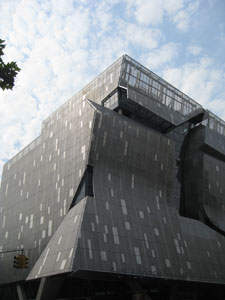
Morphosis, in collaboration with Gruzen Samton, were commissioned in 2003 to design 41 Cooper Square for the Cooper Union for the Advancement of Science and Art. Making up for 14,000 square feet lost when one of the school’s buildings was demolished, the building is home to the school of engineering and a support space for the art and architecture school. A vertical piazza forms the social and virtual heart of the new building. A full-height atrium enables unique circulation for building occupants, improves the airflow, and provides increased interior day lighting. Undulating latticework envelopes a 20-foot-wide grand stair. The lattice system is part of the guardrail system and gives shape to the space. A “skip-stop” circulation strategy allows for both increased physical activity and for more impromptu meeting opportunities. An operable building skin made of perforated stainless steel panels offsets from a glass-and-aluminum window wall. The panels reduce the impact of heat radiation during the summer and insulate interior spaces during the winter. Radiant heating and cooling ceiling panels will boost energy efficiency. The building also features a green roof and a cogeneration plant. Built to LEED Gold standards and likely to achieve a Platinum rating, 41 Cooper Square will be the first LEED-certified academic laboratory building in NYC.

In this issue:
· Lincoln Squared: Koch Theater Opens, David Rubenstein Atrium Awaits Debut
· Architects, Engineers Fight Rising Currents
· A New Light Fantastic Crowns Fifth Avenue
· Healthcare Gets an Upgrade in New Jersey
· Dallas Unveils Bush Presidential Center


Lincoln Squared: Koch Theater Opens, David Rubenstein Atrium Awaits Debut
LincolnCenter

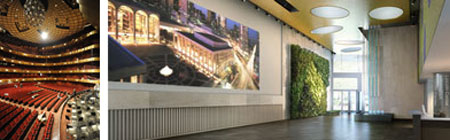
The David H. Koch Theater (left) by JCJ Architecture, and the David Rubenstein Atrium by Tod Williams Billie Tsien.

New York City Opera; dBox

The David H. Koch Theater, formerly known as the New York State Theater, the shared home of the New York City Ballet and the New York City Opera at Lincoln Center, has completed a $107 million renovation. Originally designed by Philip Johnson Associates in 1964, JCJ Architecture has now renovated the building to add comfort and accessibility. New side aisles were carved out of the orchestra maintaining the integrity of the theater’s original seating plan and retaining 40-inch legroom and unobstructed sightlines. Acoustical enhancements include the enlargement of the orchestra pit — now on a mechanical lift, and modification of the stage apron, allowing the pit to rest at any depth. Other acoustical interventions include the removal of carpet in the auditorium and the addition of new acoustic sidewalls near the proscenium. A complete onsite media suite captures and distributes high-definition images and digital sound. The theater itself is now outfitted with robotic remote-controlled cameras, as well as approximately 60 broadcast service plates. The renovated theater has a total capacity of 2,586, including new prime spaces for patrons with disabilities.

The David Rubenstein Atrium, a new gateway to the Lincoln Center campus at Broadway, between 62nd and 63rd Streets, designed by Tod Williams Billie Tsien, is still in previews. When it opens on December 17 it will offer a range of programs such as free weekly performances, a café, information and ticket desk, restrooms, and free Wi-Fi access. The new 7,000-square-foot space respects the materials used throughout Lincoln Center and achieves an open and accessible environment, an essential goal of the 16-acre campus redevelopment. Highlights include: two vertical gardens surrounded by stone benches and alcove seating; a floor-to-ceiling fountain incorporating streams of water surrounded by Pietra Luna stone benches; a media wall that displays performance information and a canvas for video presentations; a felt wall art installation of 114 panels by Dutch textile artist Claudy Jungsta; and 16 architecturally distinctive oculi lighting fixtures that bring natural light and state-of-the-art illumination into the atrium’s interior.


Architects, Engineers Fight Rising Currents

RisingCurrents-combo

(L-R): Zone 1 — subway car reefs, oyster farms, and wind turbines at Statues of Liberty Island; Zone 2 — wetlands near Staten Island; Zone 3 — slip in Sunset Park, Brooklyn; Zone 4 — offshore wind turbines among oyster racks.

Palisade Bay Team: Guy Nordenson and Associates, Catherine Seavitt Studio, Architecture Research Office

The Museum of Modern Art and P.S.1 Contemporary Art Center have initiated Rising Currents: Projects for New York’s Waterfront, an eight-month project bringing together teams of architects, engineers, and landscape designers to address and create infrastructure solutions in response to rising water levels. Organized by Barry Bergdoll, Philip Johnson Chief Curator of Architecture and Design at MoMA, the project is based largely on preliminary findings of the Latrobe Team, a multi-disciplinary Princeton University-affiliated group funded by the Fellows of the AIA and led by structural engineer Guy Nordenson.

Four team leaders were selected to focus on a specific geographic waterfront area. A team led by Paul Lewis, AIA, Marc Tsurumaki, AIA, and David Lewis of LTL Architects will work on the Northwest Palisade Bay/Hudson River area, which includes parts of New Jersey, Liberty Park/Ellis Island, and the Statue of Liberty and waters; Matthew Baird, AIA, of Matthew Baird Architects will focus his team on the Southwest Palisade Bay/Kill van Kull area, which includes Bayonne, NJ, Bayonne Piers, and northern Staten Island and waters; Eric Bunge, AIA, and Mimi Hoang of nARCHITECTS and their team are assigned the South Palisade Bay/Verrazano Narrows area, including eastern Staten Island, and Bay Ridge and Sunset Park in Brooklyn, and waters; and Kate Orff, ASLA, of SCAPE Studio, and team will concentrate on the Northeast Palisade Bay/Buttermilk Channel and Gowanus Canal area, including Governors Island, and the Red Hook area in Brooklyn. The brainstorming workshops will conclude in early January, and in March the second phase of the project, an exhibition of the proposed projects developed by the teams, will be exhibited at MoMA.


A New Light Fantastic Crowns Fifth Avenue

400Fifth

400 Fifth Avenue.

Gwathmey Siegel & Associates Architects

The Gwathmey Siegel & Associates Architects-designed 60-story tower at 400 Fifth Avenue recently topped out. The project will contain a five star hotel with 214 hotel rooms, including 157 guestrooms, and 57 hotel/suite apartments, in addition to 190 luxury residential condos and amenities including a restaurant, bar, spa, and ground level retail. The limestone-clad building consists of a tower set back from the street atop a 10-story podium, which, in terms of scale, rhythm, and materiality, relates to surrounding buildings such as Tiffany, Gorham, and 404 Fifth Avenue. The tower is composed of vertical masonry bands and windows capped by a metallic crown. Capping the tower are inclined planes of linen-finished stainless steel inserted between the masonry columns and designed to conceal mechanical equipment. When lit they act as large-scale reflectors to form a luminous crown. Developed by Bizzi & Partners Development, the project is expected to be completed in fall 2010.


Healthcare Gets an Upgrade in New Jersey
StJosephs

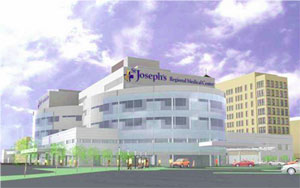
St. Joseph’s Healthcare System.

Francis Cauffman Architects

The St. Joseph’s Healthcare System recently broke ground on a new, $100-million, 230,000-square-foot critical care building, launching the expansion and renovation of its regional medical center in downtown Paterson, NJ. The master plan and the new building, both designed by Francis Cauffman Architects, will upgrade the hospital’s services and focus on revitalizing the city’s economic health. In contrast to the angular forms of the existing brick campus buildings, the facility is composed of two interlocking elliptical forms raised on a plinth clad in horizontal metal panels. The upper floors are comprised of glass of varying translucencies to provide patient privacy and form patterns intended to scale down the large volume of the building. When completed in 2012, the ground floor will house an expanded emergency room designed to accommodate 125,000 visits annually, with separate entrances for the pediatric and adult emergency departments, and a 50,000-square-foot addition to the level two regional trauma center. The upper level will have 12 operating rooms and two levels of cardiac, surgical, and critical and intensive care units.


Dallas Unveils Bush Presidential Center
BushLibrary

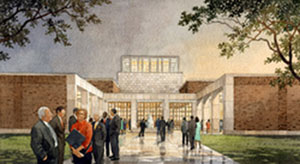
George W. Bush Presidential Center.

Robert A.M. Stern Architects

Robert A.M. Stern Architects recently unveiled the design for the George W. Bush Presidential Center located on the campus of Southern Methodist University in Dallas. The modern brick and limestone structure is designed to complement the American Georgian character of the campus and evoke both Texas and Washington, D.C. It will house an archive, museum, and policy institute. Visitors will enter through Freedom Hall, a large, light-filled open space that will tie the different aspects of the museum experience together. On one side of the hall, visitors will tour a replica of the Oval Office as it was during President Bush’s tenure, complete with an outdoor Texas Rose Garden that mimics the White House Rose Garden. The opposite side of the hall will contain a temporary exhibit space, ceremonial courtyard, and a café. The institute portion will include a conference center with a 364-seat auditorium with simultaneous translation and broadcast capabilities, offices for scholars, and a presidential suite for receptions.

The landscape, designed by Michael Van Valkenburgh Associates, will have large tree-shaded lawns, numerous gardens and courtyards, tall prairie grass with seasonal wildflowers, and savannah and woodland clearings that provide a range of native habitats for butterflies, birds, and other wildlife. In addition, the landscape will function as an urban park, providing numerous spaces for events and gatherings, including performances in the outdoor amphitheater and intramural sports on the west lawn.

The Environment Inspires Sacred Spaces

Event: God Comes to Earth: Designing Sacred Spaces for Environmentally Sensitive Times
Location: Center for Architecture, 10.26.09
Speakers: Michael J. Crosbie, Ph.D., AIA — Editor, Faith & Form; Rabbi Lea Cohen — Congregation B’Nai Chaim, Georgetown, CT; Alexander Gorlin, FAIA — Principal, Alexander Gorlin Architects; Victoria Meyers, AIA — Founding Partner, hanrahanMeyers architects; Henry Stolzman, FAIA — Partner, PKSB Architects
Organizer: PKSB Architects

StGabriels-Infinity

St. Gabriel’s Church by Larkin Architects (left); Infinity Church by hanrahanMeyers architects.

Larkin Architects (left); hanrahanMeyers architects (right

If you visit Congregation Rodeph Shalom on the Upper West Side, or any synagogue designed by Henry Stolzman, FAIA, of PKSB Architects, look for the memorial wall. Instead of illuminating the names of the deceased, you’ll see small stones. This not only replicates the Jewish custom of leaving a stone on a headstone to mark a visit to the gravesite, but it also brings nature into a house of worship. In his current project, Temple B’nai Chaim in Fairfield, CT, that tradition will be repeated. Clad in stone and glass, floor-to-ceiling windows in the sanctuary will also open to the wetlands beyond.

Sacred spaces were originally built like fortresses — places to escape from this world. They were soaring spaces with light pouring in from above. Today, the trend with sacred spaces is similar to that of other public and private places — to be socially responsible and sensitive to the environment. Michael J. Crosbie, Ph.D., AIA, editor of Faith & Form, cited St. Gabriel’s Church in Toronto, designed by Larkin Architects and completed in 2006, as a space that is intended to create a sense of the greater context of creation for worshippers. The church has a wall of greenery, it collects rainwater, the pews are made from recycled wood, and unadorned concrete serves as a canvas for colored skylights that illustrate the earth moving around the sun.

The Kabbalah and the notion of the tzimtzum, which in Hebrew means contraction, inspired Alexander Gorlin Architects’ design of the North Shore Synagogue in Kings Point, NY. According to Kabbalah teachings, God began the process of creation by contracting his infinite light, forming an empty space in which creation could begin. Natural light is used in the building’s design as a way to sculpt the space of the sanctuary.

Victoria Meyers, AIA, founding partner of hanrahanMeyers architects, was specifically commissioned by the 10th Church of Christ Scientist to create the Infinity Church in Greenwich Village because they appreciated the way her firm works with light. The chapel, currently under construction, features a cubic sanctuary “deformed” by light. The sacred geometries of squares, golden section rectangles, and “spheres of light” will surround worshippers. Three curving walls — from the south, north, and east — evoke the shape of a “Klein bottle” or Möbius strip, simple figures that suggest infinity with no beginning or end.

In this issue:
· New York’s Bravest Receive Design Excellence
· Museum of Jewish Heritage Expands View
· LEED Platinum Building Serves as Test Lab to Improve Respiratory Health
· Sponge Park & Eco Dock Are in Brooklyn’s Future
· Museum Hotel Fosters Arts, Urban Revival
· Crocker Art Museum Triples for 125th Anniversary


New York’s Bravest Receive Design Excellence

FDNY

Engine Company 201.

© Albert Vecerka / Esto, courtesy FDNY

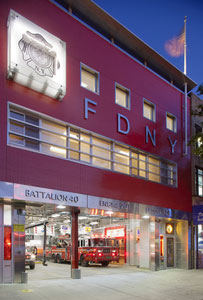
Engine Company 201 in Sunset Park, Brooklyn, designed by RKT&B Architecture and Urban Design, is the first completed firehouse as part of the NYC Department of Design and Construction’s Design Excellence Program. It is also the city’s first firehouse to be built with glass doors at ground level, expressing the importance the firehouse plays in the community by visually connecting firefighters with the neighborhood they serve. The design gives top priority to apparatus floor functions, response time, and operational efficiency of the shared spaces. The second floor contains offices, bunkrooms, bathrooms, lockers, and storage facilities, with horizontal and vertical circulation allowing fast access to the trucks on the ground floor. The third floor contains private spaces and includes a dormitory bunkroom, study facilities, and locker rooms. Design elements include a Maltese Cross, which is embossed on the street-level glass doors and expressed as an illuminated light box on the third floor façade. Brightly glazed red brick is used throughout, and a pre-existing ground floor memorial dedicated to fallen heroes has been preserved.


Museum of Jewish Heritage Expands View

KeepingHistory

Keeping History Center.

Melanie Einzig

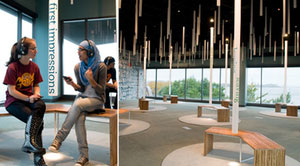
The recently opened 2,200-square-foot Keeping History Center is the first permanent addition to the Museum of Jewish Heritage since the Kevin Roche John Dinkeloo and Associates-designed Robert M. Morgenthau Wing opened in 2003. Designed by the interdisciplinary design firm C&G Partners, and Potion, a design and technology firm, the center is located at the end of a special exhibition hall that contains the Garden of Stones Timekeeper, a time-lapse showcase of Andy Goldsworthy’s sculptural installation. With panoramic views of New York Harbor, modular Plyboo chevron-shaped benches echo the room’s position in relation to the Statue of Liberty. They are located in circular listening stations that play “Voices of Liberty,” a soundscape of immigrant voices describing arriving in America for the first time accessed via an iPod Touch. One of the voices is Daniel Libeskind, AIA, who arrived in New York in 1959.


LEED Platinum Building Serves as Test Lab to Improve Respiratory Health

Eltona

The Eltona.

Danois Architects

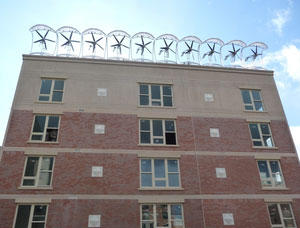
The Eltona, a five-story residential building in Melrose Commons in the South Bronx, is a standout with the 10 wind turbines mounted on its parapet to generate electricity for the building. The 70,566-square-foot, LEED Platinum project, designed by Danois Architects, contains 63 residential rental units ranging from one to three bedrooms, with a ground-floor community room, 6,800 square feet of landscaped recreation space, and an adjacent community garden. Located in an area known as the “Harlem-South Bronx Asthma Corridor,” residents will serve as subjects for the Mount Sinai School of Medicine, which will investigate and quantify what effects living in a green building may have on respiratory health of asthma sufferers. Not only is the building 100% smoke-free, each apartment will have a separate air ventilation system, and all public areas will be served by high-efficiency particulate air (HEPA) filter systems. Blue Sea Development, the building management company, constructed the $16.5 million Eltona in partnership with agencies including the Department of Housing Preservation and Development, the Housing Development Corporation, and the NYS Division of Housing and Community Renewal.


Sponge Park & Eco Dock Are in Brooklyn’s Future

EcoDock

Eco Dock Prototype.

Guardia Architects

The development of the Gowanus Canal Sponge Park, designed by dlandstudio, recently took a step forward when the fiscal year Interior and Environment Appropriations conference report was approved in the U.S. House of Representatives. The bill includes $300,000 for the project, which will incorporate greenery along the banks of the canal to manage excess runoff and help improve water quality. Still awaiting decision is whether the polluted canal will be declared a U.S. Superfund site.

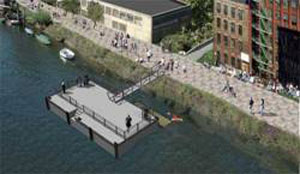
With funding in place, the first of several planned Eco Docks will be constructed by next summer. Designed by Guardia Architects and located at the 69th Street Pier in Bay Ridge, Brooklyn, the dock will be a flexible, lightweight, 20-by-40-foot barge. Cost-effective to build and easy to maintain, the project will become a prototype to extend up the Hudson River to Albany, with numerous Eco Docks ready for visitor drop-off and pick-up, community programs, and possibly, ferry service. The docks are a legacy project of the Hudson-Fulton-Champlain Quadricentennial Commission, spearheaded by the Metropolitan Waterfront Alliance in partnership with the NYC Department of Parks & Recreation.


Museum Hotel Fosters Arts, Urban Revival

21stCHotel

21c Museum Hotel in Cincinnati.

Deborah Berke & Partners Architects

Deborah Berke & Partners Architects, who served as design architect for the original 21c Museum Hotel in Louisville, KY, will repeat the role at the new 21c Museum Hotel in Cincinnati. The renovation will restore the 97-year-old former Metropole Hotel, recently listed on the National Register of Historic Places. Building on 21c Museum Hotel’s mission of engaging the public with contemporary art, the hotel will feature a contemporary art museum with more than 8,000 square feet of exhibition space. In addition, the facility will contain 160 guest rooms, a restaurant and bar, and meeting spaces. Located adjacent to the Contemporary Arts Center Cincinnati (by Zaha Hadid Architects) and across the street from the Aronoff Center for the Arts (by César Pelli, FAIA), the new museum/hotel is expected to help foster the ongoing revival of the city and strengthen its role as a cultural destination. The firm will collaborate with Pittsburgh-based Perfido Weiskopf Wagstaff + Goettel as executive architect, noted for its experience in historic preservation projects.


Crocker Art Museum Triples for 125th Anniversary

Crocker-combo

Crocker Art Museum.

Courtesy Crocker Art Museum

Next October, the Crocker Art Museum in Sacramento, CA, will open a new 125,000-square-foot expansion/addition, designed by Gwathmey Siegel & Associates Architects, which will more than triple the museum’s current size. The new building will complement the historic museum and expand its capacity for its growing collection, traveling exhibitions, and educational programs. Upon arriving at the new museum, visitors will enter a two-story, glass-walled court from a new 7,000-square-foot open-air courtyard. The indoor and outdoor spaces of the first floor will provide a community gathering place. The building will also include: expanded educational and art studio space; a teacher resource center; a space for participatory arts programming; an expanded library; student exhibition galleries; a 260-seat auditorium and meeting center; a café with indoor and outdoor seating; a redesigned store; space for onsite collections care and storage; and a new conservation lab. A Works on Paper Study Center will improve access for visiting scholars studying the Crocker’s master drawings collection.

Art and Architecture: A Marriage Made in Heaven

Location: Center for Architecture, 10.21.09
Speakers: Anita Glesta — Artist; Keith Sonnier — Artist; Craig Dykers, AIA — Senior Partner, Snøhetta; Roger Duffy, FAIA — Design Partner, Skidmore, Owings & Merrill
Moderator: Christian Bjone, AIA — Architect, SBLM Architects & author Art and Architecture: Strategies for Collaboration (Springer Verlag, 2009)
Organizer: AIANY Cultural Facilities Committee

OsloOperaHouse

Oslo Opera House, designed by Snøhetta.

Courtesy Oslo Opera House, www.oslooperahouse.com

While many artists are attracted to the spatial presence of architecture and its language and scale, contemporary architects also seek the inspiration of art in their designs. Great works have resulted from collaborations between artists and architects, and Christian Bjone, AIA, showcases some of the successes in the recently published Art and Architecture: Strategies for Collaboration (Springer Verlag, 2009). Bjone breaks down the collaborations into seven different themes: art as framed by architecture; art in contrast to architecture; art and architecture with common motif; architecture appropriates form from art; art duplicating the scale of architecture; art singular in its temple; and art in conflict with architecture. These themes were recently discussed at a panel moderated by Bjone.

For Craig Dykers, AIA, of Snøhetta, close collaboration with artists has always been an important part of his firm’s projects. He avoids using art as decoration for the architecture, preferring to allow an open dialogue among artists, artisans, and architects. As early as the competition stage for the Oslo Opera House, artists were invited to collaborate. Artists were involved in the design of the building’s stone roof, which consists of a non-repetitive pattern with integrated raised areas, special cuts, and various surface textures. Textile artists helped design metal cladding elements, which were derived from old weaving techniques. American artist Pae White worked with digital images of aluminum foil transferred on to a computer-driven loom to create a stage curtain for the auditorium. Artisans who make musical instruments were consulted for the design of the auditorium. And Olafur Eliasson designed an installation in the entry foyer.

Roger Duffy, FAIA, senior partner at Skidmore, Owings & Merrill, does not formalize the collaboration process with artists, yet his work with light artist James Turrell is central to the designs of the Greenwich Academy’s Upper School in Greenwich, CT, and the Koch Center for Science, Math & Technology at Deerfield Academy in Massachusetts. For the latter, he recruited an interdisciplinary team of scientists and artists, including Turrell, to offer input on the building’s design.

With a long list of successful partnerships, artist Keith Sonnier says, “It’s great to work with great architecture,” referring specifically to his lighting work in 1990-91 for the Neue Nationalgalerie (New National Gallery) in Berlin, designed by Mies van der Rohe in 1968. Other notable commissions include “Route Zenith,” a neon installation in the atrium of the Pei Cobb Freed-designed Ronald Reagan Building and International Trade Center in Washington, DC, and the permanent outdoor neon installation that simulates the movement of highways at the Cal Trans Building in Los Angeles, designed by Morphosis. According to Sonnier, “dialogue with the architect is the reason the installation got made.”

Artist Anita Glesta produced a body of work in the U.S. and Australia engaging the public sphere. She began as a painter and sculptor but as her pieces grew larger, she expanded her reach. “Census,” a seven-acre intervention at the Federal Census Bureau Building in Suitland, MD, commissioned by the GSA Art in Architecture Program, was a collaboration with Skidmore, Owings & Merrill and Turf Landscape Architects. It uses a variety of numerical systems imprinted on walls, benches, and sculptural mounds. According to Glesta, “for over 2,000 years artists have been working with architects. There exists artist envy and architect envy. They attract and repel, like a couple in a marriage.”

In this issue:

· Synagogue Sees the Light at the End of Construction Tunnel
· Philadelphia’s City Center Rises 33 Stories
· Arts Center Melds New Technologies with Industrial Aesthetics
· Allegheny College Advances the Arts
· Super Tower Will Scrape South Korean Sky
· W Hotel Opens in Santiago


Synagogue Sees the Light at the End of Construction Tunnel

LincolnSquare

Lincoln Square Synagogue.

CetraRuddy

Lincoln Square Synagogue on the Upper West Side recently topped out its new synagogue and community center, approximately 100 feet south of its current structure. The three-story, 50,000-square-foot building, designed by CetraRuddy, reinterprets historical spiritual forms and materials in a contemporary way. The façade incorporates five undulating glass ribbons that represent the five books of the Torah, bordered by stone panels that feature a pattern resembling a prayer shawl. The building will house a 450-seat sanctuary, a 75-person prayer space, 10,000 square feet of classrooms, a 500-seat ballroom, and administrative offices. This is the first new synagogue built on the west side of Manhattan since the construction of the original Lincoln Square Synagogue in 1970.


Philadelphia’s City Center Rises 33 Stories

Rittenhouse

10 Rittenhouse Square.

Robert A.M. Stern Architects

Rising 33 stories above the park, 10 Rittenhouse Square, a new 135-unit luxury building designed by Robert A.M. Stern Architects, is the last new building that will be built on the historic square. The building’s red brick and limestone façades recall early 20th-century Philadelphia buildings. The lobby has two entrances — one through the preserved façade of the adjoining Rittenhouse Building and another facing a garden courtyard. Nearly all of the residential units feature high ceilings, large bay windows, and balconies or terraces. Other amenities include a shared roof garden with adjacent pool, spa, and fitness center, business center, a marquee restaurant, guest suites, and valet parking; a Barney’s Coop has already moved into the new Rittenhouse Club.


Arts Center Melds New Technologies with Industrial Aesthetics

Dennison-1

Bryants Art Center.

Beyer Blinder Belle Architects & Planners

The art department at Denison University in Granville, OH, is now united under one roof with Beyer Blinder Belle Architects & Planners’ renovation and expansion of an existing neoclassical building. Originally built in 1904 as a gymnasium, the redesigned 45,000-square-foot Bryants Art Center includes expanded classrooms, studio and gallery space, faculty offices, and common areas, all specially-designed to support the department’s interdisciplinary pedagogy and culture. A 15,000-square-foot studio addition rises above an existing one-story base on the east wing; a north addition provides new space for offices, archives, and research facilities; and a small foundry rises from the hillside on the northeast corner. The scale and massing respects the original aesthetic, while a reinterpretation of traditional materials such as brick and zinc give the building contemporary character. The existing timber-frame interior was replaced with a steel structure, allowing upgrades to circulation, lighting, ventilation, and technology. A four-story central atrium is open to skylights above and directly connects the students and faculty working on different floors. At the center of the atrium, the wooden floor of the original painting studio was salvaged to create a colorful canvas.


Allegheny College Advances the Arts

Polshek

Vukovich Center for Communication Arts.

Polshek Partnership Architects

The new $23 million Vukovich Center for Communication Arts, designed by Polshek Partnership Architects, is a space dedicated to teaching theater, television, and related communication arts at Allegheny College, in Meadville, PA. The 40,000-square-foot facility completes a quadrangle creating an arts precinct on campus. The building’s scale and use of zinc, glass, and red and dark gray iron-spot brick respond to that of the surrounding older buildings and signal the school’s progressive arts program. The center contains a 250-seat black box theater, rehearsal and instructional spaces, technologically advanced video production facilities, scene and costume shops, dressing rooms, a green room, and faculty offices. A roof garden provides space for study and relaxation and also makes the building more energy efficient.


Super Tower Will Scrape South Korean Sky

KPF

Lotte Super Tower 123.

Kohn Pedersen Fox Associates

Kohn Pedersen Fox Associates (KPF) has completed the conceptual design for Lotte Super Tower 123, a mixed-use project in Seoul, South Korea. The firm was selected earlier this year after an international design competition organized by owner/developer Lotte Group for its corporate headquarters. The design for the light-toned glass structure, accented with a metal filigree, is a blend of modern aesthetic with historic Korean art forms, including ceramics, porcelain, and calligraphy. The building’s first six floors will contain retail; offices will occupy floors 7 through 60, followed by 25 floors of residential, and a 7-star hotel above. The top four stories have been earmarked for extensive public use and entertainment facilities including an observation deck. When completed in 2014, the 555-meter (1,821 feet), 123-story tower will be the world’s second tallest building after the Burj Dubai, and the tallest in Asia.


W Hotel Opens in Santiago

WSantiago

W Santiago.

Handel Architects

Starwood’s W Hotel brand is set to launch in South America with the opening of the W Santiago Hotel and Residences, part of the mixed-use project called Isidora 3000 designed by Handel Architects. The 31-story project makes it one of the city’s tallest buildings, containing 196 hotel rooms and suites with 46 condominiums above. In addition to the 243,000-square-foot five-star hotel and convention center and 86,000 square feet of residential condominiums, the project contains 93,000 square feet of retail and 134,000 square feet of office space. The project is located downtown on a half city block facing a major public square where the residential fabric of the city meets a shopping and business district.