In this issue:

· Moynihan Station Gets Green Light for Phase 1
· Neo-Moorish Mecca for Performing Arts Gets Modernized
· MLB Slides into New Home Base
· Grand Canal Theatre Debuts in Dublin
· Diagonal Mesh Bridges Past and Future
· Extreme Eco


Moynihan Station Gets Green Light for Phase 1

FarleyInterior

Farley Post Office.

Fordmadoxfraud

Skidmore, Owings & Merrill (SOM) has been given the green light by the Moynihan Station Development Corporation to start design work on Phase 1 of the transformation of the McKim, Mead & White-designed Farley Post Office into a new Moynihan Station. The initial phase is limited to underground infrastructure and platform expansion, thanks in part to an $83.3 million federal stimulus grant announced in February. The scope of work includes constructing two new entrances to Penn Station through the corners of the Farley Post Office Building. It will double the length and width of the West End Concourse, provide 13 new vertical access points to the platforms, and double the width of the 33rd Street Connector between Penn Station and the West End Concourse. Other critical infrastructure improvements include platform ventilation and catenary work. The late Senator Daniel Patrick Moynihan began advocating for the Penn Station expansion in the early 1990s. SOM has been involved almost as long, designing variations of the train hall in 2001 and again in 2007.


Neo-Moorish Mecca for Performing Arts Gets Modernized

55thStMarquee

View of Proposed 55th St Marquee.

Polshek Partnership Architects

New York City Center has unveiled plans by Polshek Partnership Architects to modernize the organization’s neo-Moorish Midtown building, a 1923 NYC landmark. Pending NYC Landmarks Preservation Commission approval, a new exterior canopy with lighting and signage on the façade is intended to create more street visibly and dramatically define the building within its urban context. The original box office and mezzanine lobbies will be faithfully restored and several new spaces will be introduced, including an expanded and redesigned street level lobby and patrons’ lounge that capitalizes on an existing alley space. The re-sloping of the auditorium floors will improve sightlines, and the reconfiguration and resizing of theater seating will improve comfort and accessibility. The renovation respects the original theater’s design motifs and the new design insertions are a result of a careful study and reinterpretation of the underlying geometric Islamic motifs. The performing arts complex contains a main stage, two smaller theaters, four studios, and 12-story office tower. The grand re-opening of the complex will take place in October 2011.


MLB Slides into New Home Base

MLB-combo

MLB Midtown headquarters.

Paul Warchol

Butler Rogers Baskett in collaboration with C&G Partners has completed the redesign of Major League Baseball’s Midtown headquarters. The project includes a new 24,000-square-foot executive conference center; a 1,500-square-foot sub-dividable multi-purpose room with advanced audio-visual and teleconferencing capabilities; and eight meeting rooms. Multiple references to baseball — its history and the experience of being at a game — are part of the design. Carpet-and-terrazzo flooring reference a grass and dirt baseball diamond; conference tables are made from ash, the favored wood for baseball bats; and baseball headlines appear on LED tickers throughout the facility. A glass screen depicting a monumental Jackie Robinson stealing home in the first game of the 1955 World Series defines the lounge/breakout area.


Grand Canal Theatre Debuts in Dublin

GrandCanalTheatre

Grand Canal Theatre.

©Ros Kavanagh

Designed by Studio Daniel Libeskind (SDL), the 2,000-seat Grand Canal Theatre in Dublin recently celebrated its grand opening. Located in the city’s Dockland’s section, the theater is sited prominently at the head of Grand Canal Dock in a large public piazza that has a five star hotel and residences on one side and an office building on the other. The concept for the angular glass-and-steel building is based on stages — the stage of the theater, the piazza, and the multiple-level lobby above the piazza. The theater becomes the main façade of the piazza, which will also serve as a stage for civic gatherings and as a grand outdoor lobby for the theater. SDL is also designing two galleria buildings for retail and commercial office space with courtyards that comprise the Grand Canal Square Theatre and Commercial Development project, expected to be complete in 2011.


Diagonal Mesh Bridges Past and Future

TGV

TGV railway tracks, La Roche-sur-Yon, France.

©Christian Richters

A new 67-meter footbridge designed by Bernard Tschumi Architects and Paris-based Hugh Dutton Associates was recently opened above high-speed TGV railway tracks in La Roche-sur-Yon, France. The diagonal mesh design is reminiscent of the circa 1890s bridge it replaced, but in a tubular form to create a cylindrical volume through which pedestrians pass. The basic design objective was to find a geometric composition that expresses the natural passage of forces. The volume provides a single solution that both spans between the available support points and provides structure for the required protective screens and canopy cover. The bridge design is an homage to the city’s native son Robert Le Ricolais, an innovator in architectural and engineering design known for research in the development of three-dimensional structures.


Extreme Eco

Ecorium

Ecorium Project.

Grimshaw Architects

Following a concept design competition, The Ministry of Environment in South Korea selected Grimshaw Architects, in association Seoul-based Samoo Architects & Engineers, to realize their scheme for the “Ecorium Project,” a 33,000-square-meter nature reserve and educational center. The proposal features arched biome enclosures optimized to maintain tropical plants during the winter by capturing as much low-angle sunlight as possible. A cable-supported glass envelope is suspended from parabolic steel compression arches, and the structures mimic a meandering river. Visitors will move through exhibitions, a 3-D theater, and restaurants, and re-emerge by way of a rooftop garden. The building and outdoor eco-park is intended to showcase global climate change and its impacts on ecosystems.

AIANY Design Awards Jury Announces 2010 Winners

Event: Design Awards Winners Announcement and Jury Symposium
Location: Center for Architecture, 03.01.10
Speakers: Design Awards Jurors: Architecture: Stanley Saitowitz; Gilles Saucier; Julie Snow, FAIA; Interiors: Brian MacKay Lyons, Hon. FAIA; Glenn Pushelberg; Brigitte Shim, Hon. FAIA; Unbuilt Work: Craig Hodgetts, FAIA; Quinyun Ma; Karen Van Lengen, FAIA; Urban Design: Maurice Cox; Teddy Cruz; Julie Eizenberg, AIA
Moderator: William Menking — Editor-in-Chief, The Architect’s Newspaper
Organizer: AIANY
Sponsors: Chair’s Circle: F+P Architects New York; Patrons: Mancini Duffy; Studio Daniel Libeskind; Trespa; Lead Sponsors: A.E. Greyson + Company; Dagher Engineering; FXFOWLE Architects; Gensler; Ingram Yuzek Gainen Carroll & Bertolotti; JFK&M Consulting Group; Kohn Pedersen Fox Associates; MechoShade Systems, Inc.; New York University; Port Authority of New York and New Jersey; Syska Hennessy Group; Toshiko Mori Architect PLLC; VJ Associates

DesignAwards

Courtesy AIANY

“We want the world to appreciate New York architecture and New York architects,” said 2010 AIANY President Anthony Schirripa, FAIA, IIDA, as he introduced the Design Awards Symposium. “The design that comes out of New York is important, and the Design Awards celebrate the great work of architects, planners, clients, and consultants who are inspired by and constantly inspiring our great city.”

As in previous years, the Design Awards received well over 400 entries in four categories — Architecture, Interiors, Urban Design, and Unbuilt Work, with Architecture receiving the lion’s share with close to 200 submissions.

There were two “firsts” in this year’s Design Awards Competition. For the first time submissions were filed online saving the jurors from sifting through boxes of paperwork. And, there were separate categories for Urban Design and Unbuilt Work, which in the past had been grouped together under the ubiquitous Projects category.

Despite the efficiency of working online, the jury for Unbuilt projects was the last to finish deliberations. Eleven projects won Merit Awards. Why the difficulty? The jurors explained that it is difficult to compare the projects because of the diversity of typologies and scale. Each winner received an award based on its own merits. According to Karen Van Lengen, FAIA, “what we’re looking for are projects that could influence the communities they’re in.”

After a full day of deliberations, the jurors’ symposium revealed some of the drama behind the decisions. What began as a discussion of various projects, turned into a more heated debate about the role of architects, particularly as they interact with community groups. Case in point: the High Line, which was the only project to garner an Honor Award in the Urban Design category. The project was called a “perfect storm of clients, architects, and politicians” by urban planner Maurice Cox, noting that the design itself was award-winning, but the story of community involvement in its creation heightened its success to the level of an Honor Award. Julie Eizenberg, AIA, countered that perhaps community activism “is a different award.”

More opportunities to learn about this year’s winners are on the calendar including: the Design Awards Luncheon on 04.14.10; the Design Awards Exhibition, which opens on 04.15.10; the Winners’ Symposia, scheduled for 04.27.10 and 06.17.10; and the Summer/Design Awards Issue of OCULUS.

For the full list of winners and projects, see Names in the News

In this issue:

· Pritzker Prize-Winning Team Debuts at the Met
· ESB to Become an Icon in Sustainability
· Long Island Homes Go Prefab
· New Quad Enhances Student Life
· Gagosian Takes to the Hills
· Taiwan Plans a Palace for Pop


Pritzker Prize-Winning Team Debuts at the Met

Attila

The set of Atilla.

Ken Howard/Metropolitan Opera

Herzog & de Meuron have designed the sets for the current production of Giuseppe Verdi’s Attila at the Metropolitan Opera House. Verdi’s ninth opera takes place in the mid-fifth century as the remnants of the Western Roman Empire crumble before the barbarian invasions and the attempts to spare Italy from Attila the Hun’s hordes. Herzog & de Meuron share production credits with designer Miuccia Prada, who previously collaborated to create the Prada Aoyama Epicenter in Tokyo. The architectural team made its theatrical design debut with a production of Tristan und Isolde for the Berlin State Opera in 2006. Performances of Attila run through March 27.


ESB to Become an Icon in Sustainability

ESB_slonecker

Empire State Building.

Michael Slonecker

The Empire State Building (ESB) is set to become energy efficient. Johnson Controls, a provider of energy efficient and sustainable products and services has selected Sunnyvale, California-based Serious Materials to super-insulate more than 6,500 windows for the ESB’s retrofit project, which could reduce energy costs by more than $400,000 per year. In a first-of-its-kind process, Serious Materials will re-use all existing glass to create super-insulating glass units (IGUs). The thermal performance of the windows is expected to be up to four times as efficient and solar heat gain will be reduced by more than 50%. Johnson Controls is overseeing the full Empire State Building retrofit project, with a team including the Clinton Climate Initiative, Jones Lang LaSalle, and Rocky Mountain Institute. The window upgrades is one of eight measures expected to reduce energy use by 38%, save $4.4 million per year in energy costs, and save 105,000 metric tons of carbon dioxide over the next 15 years. The more than $550 million rebuilding program will make the skyscraper eligible for a LEED Gold certification.


Long Island Homes Go Prefab

Res4

Lido Beach (left); Long Beach.

Resolution: 4 Architecture

Resolution: 4 Architecture is busy on the South Shore of Long Island with one prefab house completed in Lido Beach, and a second in pre-construction in Long Beach. The 2,735-square-foot, three-bedroom house in Lido is sited on the edge of the sand dunes and is composed of five modules. It features an upside-down spatial organization, which allows the main living space to be located on the second floor, affording views of the ocean. This floor contains a guest bedroom, bath, and playroom opposite from the open living, dining, and kitchen areas, while the downstairs contains the private spaces. Two cuts in the in the second floor mass open to private decks while inversely, a solid bulkhead element allows for roof access. Contained within the bulkhead is an office opening to a roof deck on both sides. The 1,700-square-foot, two-bedroom, oceanfront prefab in Long Beach is located on a compact site with little space between neighbors. Composed of three modules, the two-story house features a roof bulkhead that provides storage and access to the roof deck; a photovoltaic solar canopy stretches across half of the roof deck and doubles as a covered exterior space to escape the sun.


New Quad Enhances Student Life

DSU-2

Delaware State University Student Life Quad.

Photo by Christopher Lovi

The new 156,000-square-foot Delaware State University Student Life Quad in Dover, designed by Holzman Moss Bottino Architecture (HMBA), was recently dedicated. Composed of three separate buildings — a student center, an athletic strength and conditioning center, and a wellness center — that are tied together by an exterior intramural courtyard, the complex was designed to help the school shed its image as a commuter school. Each building incorporates locally manufactured brick featured throughout the campus, while a collective identity is established by the use of stone, blue horizontal metal siding, large entry canopies, and oversized columns. The $45.4 million project includes a waste management program for demolition of the original student center, use of regional and natural materials, a natural ventilation system for lounge and dining areas, large overhangs at the south and west sides to reduce heat gain, efficient circulation, and light-colored roofs to reduce solar gain.


Gagosian Takes to the Hills

Gagosian

Gagosian Gallery, Beverly Hills.

Photo by Joshua White

The expansion of the Beverly Hills branch of Gagosian Gallery recently celebrated its official opening. The expansion, designed by Richard Meier & Partners, which also designed the original gallery space in 1995, nearly doubles its size by adding 5,000 square feet to the existing building. The addition is anchored by a new 3,000-square-foot, street-level exhibition space. This adaptive reuse of adjoining retail space with its existing wood barrel vault ceiling, trusses, and steel beam, offer a distinctive counterpoint to the airfoil wing that scoops daylight into the existing gallery. Skylights balance daylight from the north and south sky to support a diversity of installations. A single, 225-square-foot glass-and-aluminum sliding door at the street allows oversized artwork to be unloaded directly into the gallery. New second level offices and a private skylit viewing gallery address the growing gallery’s administrative and exhibition needs. A sculpture terrace on the roof offers views of the city and the surrounding Hollywood Hills.


Taiwan Plans a Palace for Pop

TPMC-2

Taipei Pop Music Center.

Reiser + Umemoto RUR Architecture

Reiser + Umemoto RUR Architecture has won a competition sponsored by the Department of Cultural Affairs, Taipei City Government, to design the Taipei Pop Music Center (TPMC) in Taiwan. The TPMC will be a cultural hub dedicated to the production and performance of Taiwanese pop music, and will include shops, markets, cafés, and restaurants. An elevated pedestrian zone will bridge the complex’s two buildings containing three major zones. The indoor 3,000-seat Main Concert Hall features an approximately 20-story tower for support spaces, an audio/video recording studio, and offices. The Outdoor Amphitheater features a mobile stage that has four docking positions for events for audiences of up to 16,000 people. The Hall of Fame contains the main exhibition space, a digital media center, two lecture halls, and a Sky View Lounge. The New York office of ARUP is responsible for structural engineering, MEP, sustainability, theater acoustics, lighting, and façade. The complex is expected to be completed in 2014.

In this issue:

· African Burial Ground Interpretive Center Opens
· Historic Theater Goes From Ruins to Royalty
· LEED Platinum for Syracuse University’s Center of Excellence
· Holl Returns to Iowa
· Tower Will Rise Out of the BLU
· Blue Is the Word at Marc by Marc Jacobs in Milan


African Burial Ground Interpretive Center Opens

African

Visitor’s Interpretive Center for New York’s African Burial Ground.

Photograph by Lourdes Pena/John Samuels

The Visitor’s Interpretive Center for New York’s African Burial Ground, designed by Roberta Washington Architects, with exhibitions designed by Boston-based Amaze, opens this week in Lower Manhattan. Located on the ground floor of the Ted Weiss Federal Building, adjacent to African Burial Ground memorial designed by ARRIS Architects, the center is designed to give visitors a deeper understanding of the historical, archeological, and cultural background of the site, its history, and the science related to the re-internment of the remains of those buried there. The spaces feature rough, textured granite floors with muted “black liberation” colors. The curved entrance to the theater is decorated with African symbols. The ranger’s station evokes drums that were used to disseminate information during the Colonial era. The African Burial Ground National Monument is a multi-agency effort, combining the General Services Administration and the National Park Service. In 1993, the site was designated as a National Historic Landmark.


Historic Theater Goes From Ruins to Royalty

LoewsKingsTheatre

Loew’s Kings Theatre.

Jim Henderson

The 3,000-seat Loew’s Kings Theatre in the Flatbush section of Brooklyn, which has been vacant since 1978, will be rehabilitated, restored, and reopened as a premier performing arts venue by Houston-based ACE Theatrical Group. Designed by Rapp & Rapp in 1929, its architecture was influenced by the Palace of Versailles and the Paris Opera House, featuring high curved ceilings, ornate plaster walls, wood paneling, pink marble, and a glazed terra-cotta ornamental façade. The theater also features a stage that is approximately 70 feet wide by 30 feet deep, a fly gallery about 90 feet high, and a proscenium opening 60 feet wide by 50 feet high. Construction is expected to begin in two to three years and take approximately two years to complete.


LEED Platinum for Syracuse University’s Center of Excellence

Syracuse

Syracuse Center of Excellence.

Courtesy of Toshiko Mori Architect

The Syracuse Center of Excellence recently moved into its new headquarters, a five-story, metal-and-glass-clad building designed by Toshiko Mori Architect. The center is a joint effort by local colleges, businesses, and economic agencies led by Syracuse University with a mission to support research, development, and job creation in the fields of indoor environmental quality, renewable energy, and water resource management. The 60,000-square-foot, LEED Platinum building was designed as a green urban intervention anchoring the connective corridor between downtown Syracuse and the university. The project features a vegetative roof among other green features, including a geothermal heating and cooling system and a rainwater collection system. In addition, the Total Indoor Environmental Quality (TIEQ) lab factors, such as temperature, humidity, and air quality, can be manipulated in each workstation to increase productivity. The design team includes Ashley McGraw Architects, Arup for MEP and structural engineering, and landscape architects Hargreaves Associates. A dedication ceremony will take place on 03.05.10.


Holl Returns to Iowa

UI-Holl

University of Iowa (UI) Arts campus.

Steven Holl Architects

Steven Holl Architects (SHA), in collaboration with Midwest-based BNIM Architects, has won the commission for a new art studio facility for the University of Iowa (UI) Arts campus, to be located near the SHA-designed Art Building West (completed in 2006). The new building is to replace an original 1936 arts building heavily damaged during flooding of the Iowa River in June 2008. The flood left more than 20 buildings damaged, including the Art Building West. The selection process, which was to find an architect-led team and not to select a specific design, was organized by UI. The SHA/BNIM team was selected for its unique connection to the site, its sensitivity to an adjacent residential neighborhood, and an understanding of challenges related to FEMA-supported projects, among other reasons.


Tower Will Rise Out of the BLU

BLU

BLU.

Photo by Bruce Damonte

Handel Architects has completed a 205,000-square-foot residential tower situated at the gateway of the planned Folsom Street Corridor in San Francisco. Officially known as 631 Folsom Street, but dubbed BLU, the 21-story tower rises over a single-story podium with retail and a residential lobby along Folsom Street that is setback to align with the existing street wall. The tall, slender building was designed to maintain view corridors and provide sunlight and air for residents as well as pedestrians. The light-bluish colored glass and metal curtain wall is intended to create transparency. The tower contains six residences per floor, each with open spaces and floor-to-ceiling windows. Sky BLU, as the penthouses are called, feature three floors of living space plus a solarium and roof deck.


Blue Is the Word at Marc by Marc Jacobs in Milan

MarcJacobsMilan

Marc by Marc Jacobs in Milan.

Stephan Jaklitsch Architects

A new Marc by Marc Jacobs store with an accompanying café and bar, designed by Stephan Jaklitsch Architects (SJA), will open in early April in Milan’s historic Brera district. The 290-square-meter boutique was inserted into the ground floor of a 16th-century residential building. SJA’s design highlights the 12 arched bays. New frameless windows were inserted into each bay drawing attention to the existing architecture and allowing clear views into the store. From the interior, the arches create a deep cavity between the sales floor and façade, visually dissolving the interior and exterior. The store uses the brand’s signature “Marc” blue steel shelving; clear, blue, and mirrored glass; navy blue concrete floors; neon signage; and custom hanging and display fixtures. The café will connect to the store through a sliding blue glass door, and the aesthetics will be consistent with the Marc by Marc Jacobs brand using the same palate of colors and materials as the store.

PANYNJ Puts It All on the Table

Event: The Growth Catalyst: Reviving New York City’s Economy through Infrastructure, The Port Authority Lecture Series
Location: Theresa Lang Community & Student Center, 01.28.10
Remarks: Christopher O. Ward — Executive Director, Port Authority of New York and New Jersey (PANYNJ); Seth W. Pinsky — President, NYC Economic Development Corporation
Discussion: Joan Byron — Director of Sustainability and Environmental Justice Initiative, Pratt Center for Community Development; Robert D. Yaro — President, Regional Plan Association; Kathryn S. Wyle — President & CEO, Partnership for NYC
Moderator: Daniel Massey — Reporter, Crain’s New York Business
Organizer: Center for New York City Affairs, The New School

ARC

ARC Penn Station Expansion.

Courtesy of PANYNJ

“Visit any major city in the world, and you’ll see how far behind we are,” stated Seth Pinsky, president of the NYC Economic Development Corporation (NYCEDC). “We’re still paying for choices made [in the 1970s and 80s], and we’re still underinvested.” The laundry list of negatives far outweighed the positives at a recent discussion about reviving the city’s economy through infrastructure. Toll and fare increases will always be insufficient; LaGuardia Airport needs to be rebuilt; JFK’s poor cargo operations is leading to longer wait periods to get goods to users; trucks are choking the city; we need a better rail freight system; we need better ferry service.

Despite the pessimism, two transportation projects that excited panelists were the ARC (Access to the Region’s Core), a project of the Port Authority of NY and NJ (PANYNJ) and NJ Transit that will be the first new rail tunnel to be constructed under the Hudson River in 100 years, and the MTA’s East Side Access, which will make the east side of Manhattan more accessible to Long Island Rail Road commuters. PANYNJ is investing $6 billion in ARC, which has been on the drawing boards for decades. Ground was broken on the NJ side in June 2009 and, when completed by 2017, it is anticipated that the number of commuters from NJ to Manhattan will double since it will provide more frequent trains and express service. An expanded Penn Station will connect travelers directly to subway concourses at 7th and 8th Avenues, and for the first time, 6th Avenue and Herald Square.

Robert D. Yaro, president of the Regional Plan Association (RPA), concurred: “We need to continue to make investments.” He talked about “value recapture,” and finding ways to make money from the projects on the boards, such as an airport access fee, container fees, and congestion pricing, which he feels will be back on the table for discussion. “People think they can get something for nothing, but to get something, you have to pay for something.”

As for Moynihan Station, Christopher O. Ward, PANYNJ’s executive director, believes it will be built and believes it is not just a beautiful building, but it is a lynchpin to the Northeast Corridor.

And what about the Eero Saarinen’s TWA Terminal at JFK, which is being rehabilitated by Beyer Blinder Belle Architects & Planners? PANYNJ appreciates its architectural legacy and sees it as an asset. They hope it will monetize itself as a corporate center and a place to do business — once the economy picks up.

In this issue:

· Lincoln Center Tops the Vivian Beaumont
· Times Square Hearts Valentines
· A New Museum Lets Kids Learn About Kids
· Curtains Up on West 52nd Street
· Just Add Water
· Sun Shines on Cochin
· School Educates Kids in Malawi about Sustainability


Lincoln Center Tops the Vivian Beaumont

LincolnCtr

Claire Tow Theater.

H3 Hardy Collaboration Architecture

Lincoln Center Theater’s long held desire for a third theater will be realized on the roof of the Vivian Beaumont Theater with the addition of the Claire Tow Theater, designed by H3 Hardy Collaboration Architecture. The Tow will become the home of LCT3, Lincoln Center Theater’s programming initiative dedicated to producing the work of new artists and the development of new audiences. Construction will begin this spring on the 23,000-square-foot, two-story addition. Budgeted at $41 million, the project will house a 131-seat theater, dressing rooms, rehearsal and administrative space, and an outdoor terrace surrounded by a green roof. The new building, only partially visible from below, was designed to complement Eero Saarinen’s building, which also houses the Mitzi E. Newshouse Theater. The project is intended to achieve LEED Silver and completed in early 2012.


Times Square Hearts Valentines

Valentine

Ice Heart.

Moorhead & Moorhead

On the morning of 02.11.10, designers from the architecture and industrial studio Moorhead & Moorhead will lead a team of ice sculptors and engineers to create a large heart in Duffy Square. As a result of winning the second annual invited competition, the firm was commissioned by the Times Square Alliance to construct a 10-foot-tall heart made from masonry-scaled ice blocks. Kaleidoscopic in nature, “Ice Heart” will be activated by the constantly changing lights and colors of Times Square and will transform as it melts — though it will remain intact at least until Valentine’s Day. Okamoto Studio will construct the sculpture; Robert Silman Associates is the structural engineer; and Tillet Lighting Design will illuminate the public space.


A Museum Lets Kids Learn About Kids

DiMenna

DiMenna Children’s History Museum at the New York Historical Society.

Rendering by Lee H. Skolnick Architecture & Design Partnership

The New-York Historical Society has received a $5 million donation to create the DiMenna Children’s History Museum. Designed by Lee H. Skolnick Architecture + Design Partnership, the museum-within-a-museum will be located in a vaulted space on the lower level, and feature both permanent and special exhibitions for and about children, incorporating historical artifacts and replicas, objects and illustrations, three-dimensional pavilions, and interactive elements. The creation of the museum is part of the New-York Historical Society’s renovation, designed by Platt Byard Dovell White Architects, to bring a new level of openness to the building while improving the society’s ability to serve the public and showcase its collections and exhibitions. The new space is set to open in November 2011.


Curtains Up on West 52nd Street

52ndStProject

The 52nd Street Project.

Vanni Archives

The 52nd Street Project, a non-profit that matches kids from Hells Kitchen with professional theater artists (Cynthia Nixon, Billy Crudup, and Edie Falco to name a few) to create original works, has officially opened in its permanent home designed by BKSK Architects. After occupying various temporary spaces since it was founded 30 years ago, the group now has its own entrance and two floors in the new Archstone Clinton mixed-use development. The 17,000-square-foot space contains dressing rooms, studios, private and open offices, a workshop, and an after-school clubhouse with full kitchen, as well as tutoring and teaching spaces. At the heart of the space is a 156-seat black box theater, which also serves as a multi-purpose courtyard. A five-foot-wide catwalk with an open steel grating spans the length of the theater box and creates a shortcut between offices and a workshop and after school areas on either side. Windows in the street wall of the theater space were opened up, bringing in natural light. The project is expected to achieve LEED Gold.


Just Add Water

MaterialConnexion

Concrete Cloth.

Material ConneXion

The NY office of Material ConneXion held its first annual MEDIUM Award for Material of the Year, naming UK-based company Concrete Canvas’s Concrete Cloth as the winner. Concrete Cloth’s cement-impregnated flexible fabric technology allows it to be quickly and easily molded and set into shapes. When water is added it creates safe, durable, non-combustible structures for a wide range of commercial, military, and humanitarian uses. The award recognizes materials juried into the company’s Materials Library within the past year that demonstrate outstanding technological innovation and the potential to make a significant contribution to the advancement of design, industry, society, and economy. The winners will be on view through 02.19.10.


Sun Shines on Cochin

ChoiceMarina

Choice Marina.

CetraRuddy

Choice Marina, CetraRuddy’s first international commission, recently broke ground in Cochin, on the southwest coast of India. The 138,000-square-foot, 13-story residential resort condominium features three-bedroom homes, with two homes per floor. Rarely seen in Indian developments, the building will include private elevators and grand master bedroom suites with windowed master bathrooms, freestanding bathtubs, and dressing rooms. The design incorporates a rooftop lounge and pool, outdoor verandas, a private terraced garden that steps down to the waterfront, and two private yachts for use by the residents. Responding to the area’s tropical climate, the two towers are oriented to reduce solar heat gain and to minimize the impact of monsoons without compromising views. Each of the towers will bear an array of fixed and operable exterior screening and sun-shading devices to enhance the curtain wall performance and further improve energy efficiency. Occupancy is slated for July 2011.


School Educates Kids in Malawi about Sustainability

MalwaiAcademy

Raising Malawi Academy for Girls.

Adams Kara Taylor/Studio MDA

Work on the Raising Malawi Academy for Girls, designed by NYC-based Studio MDA, is underway. Located on a 100-acre site on the outskirts of Lilongwe, Malawi, the school will board 450 girls. The campus will contain a library and administration building, dining hall, gymnasium, wellness center, sports field, 30 classrooms, 12 dormitories, and 18 staff houses.

The design concept is sustainable throughout. Most construction materials are sourced locally, such as Hydraform bricks made from soil on site, avoiding the use of burned bricks that have been responsible for widespread deforestation in Malawi. A field of photovoltaic panels on the roof of the gymnasium and passive ventilation and natural light will help the school to be energy independent. Two constructed wetlands will process all the black and grey water to be used for irrigation in the playing field. Learning landscapes and educational agriculture areas will educate the students on the ecosystems in Malawi and help to develop sustainable agriculture in the country. Some of the other participants in Raising Malawi’s design team include the New York office of ARUP, Brooklyn-based landscape architects dlandstudio, London’s Adams Kara Taylor engineering, ePod Solar of British Columbia, and IM Designs of Malawi. The school, being funded by pop-star Madonna, is expected to open in 2012.

Exhibition Goes Beyond ABCs of Eero Saarinen

Event: Eero Saarinen: Shaping the Future — AIANY Member Night
Location: Museum of the City of New York (MCNY), 01.11.10
Speaker/Tour Guide: Donald Albrecht — Curator of Architecture and Design, MCNY; Wendy Evans Joseph, FAIA — Exhibition Designer
Organizer: AIANY; MCNY
Sponsor: Benjamin Moore

“‘Eero Saarinen: Shaping the Future’ at the Museum of the City of New York (MCNY) is remarkable because the impact of the work on NYC and its environs leaps off the walls,” said AIANY Executive Director Rick Bell, FAIA, at a special after-hours tour of the exhibition for AIANY members led by its curator, Donald Albrecht and exhibition designer, Wendy Evans Joseph, FAIA.

Called the “Architect of the American Century,” Eero Saarinen (1910-1961) was widely acknowledged as a leader of the second generation of Modernists who rose to prominence after World War II. “With Saarinen, it was all about ‘the search’ — the search for new ideas, the search for new building types,” according to Albrecht. “Saarinen said that architects of his generation had to go beyond the measly ABC’s of the first generation of Modernists, and his search was to add letters to the alphabet.”

Much of Saarinen’s most recognizable work — TWA Terminal at JFK, Dulles Airport, Vivian Beaumont Theater, F.B. Morse and Ezra Stiles College at Yale, CBS Headquarters (aka Blackrock), John Deere Headquarters, IBM Watson Research Labs, the Gateway National Arch, and Bell Labs — were completed after he died. As Saarinen was reaching the peak of his fame,” observed Stanley Stark, FAIA, “the consensus in support of strict, rigorous modernism was beginning to fracture. Architects like Paul Rudolph, John Johansen, and Philip Johnson, tiring of a style they found to be increasingly sterile and limiting, began to peel off in other directions and were soon to be followed by a new generation of post-war architects who turned their backs on the Bauhaus style with the same abruptness that an earlier generation had spurned the Beaux Arts. But Saarinen seemed to be among the first who embarked upon a new style or stylistic synthesis.”

According to Joseph, the exhibition is like a kit-of-parts, and her team created the environment for the parts in the museum. The core exhibition has been traveling in Europe and the U.S since 2006, and features sketches, working drawings, models, photographs, furnishings, films, and other ephemera from the architect’s career from the 1930s through the early 1960s. One feature distinct to the New York exhibition is the room-within-a-room for Saarinen’s residential projects — most notably, the Miller House in Columbus, IN. Due to its expansive budget, the project allowed Saarinen to work on a grand scale and collaborate with landscape architects and interior designers. While standing in the “room.” Joseph admitted her favorite Saarinen work is the Miller House and commented, “Saarinen reinforced that you have to think about things from concept to detail. It’s so obvious in his work. He wasn’t afraid to work with an interior designer. He wanted to invent something new for each project, whether it was a material or a thickness, to find that one thing everything else can work around.”

“Looking at the fantastic photos of TWA when it was newly open indicates not only what we have lost from daily use, but the expectation that we will soon see aviation-related activity — real activity — return to that wonderful space and see its cocoon-like hibernation spring forth, newly transformed,” concluded Bell. When the exhibition closes on 01.31.10, it will travel to Yale University from 02.19-05.02.10.

In this issue:

· Students to Till Soil in Brooklyn
· New Center Will Showcase Korean Culture
· Smart Medical Facility Has Heart
· More Art Pops Up on Construction Sites
· NYC Waterfront Revitalization Receives Funding
· NY-Based Landscape Architects Create New Destinations Nationwide


Students to Till Soil in Brooklyn

PS216

P.S. 216.

WORK Architecture Company

WORK Architecture Company has completed a design for the first Edible Schoolyard New York (ESYNY), founded by chef and organic food activist Alice Waters, which will be located at P.S. 216, in Gravesend, Brooklyn. The goal of the program is to create a space where schoolchildren plant, harvest, cook, and eat together, creating an interdisciplinary curriculum tied into regular academic subjects. At the heart of the project is the kitchen classroom, where up to 30 students can prepare and enjoy meals together. The design is a series of interlinking sustainable systems that produce energy and heat, collect rainwater, process compost, and sort waste with off-grid infrastructure. Part of P.S. 216’s existing asphalt-covered parking lot will be replaced by a quarter-acre organic farm, a kitchen classroom, and a mobile four-season greenhouse, all combined in a newly designed, self-sustaining educational building. The kitchen’s butterfly-shaped roof channels rain water for reclamation.


New Center Will Showcase Korean Culture

TheNYKoreaCtr-003

The New York Korea Center.

SAMOO Architecture

SAMOO Architecture, the NY studio of the Seoul-based firm, has won an international competition for the design of The New York Korea Center, a new home for the Korean Cultural Service. Located on 32nd Street between Park and Lexington Avenues, east of Manhattan’s Korea Town, the eight-story, 33,000-square-foot facility will offer spaces for exhibitions, performances, lectures, and administration. A multi-layered glass façade creates a screen wall that illuminates three sculptural figures within — composed of polished ceramic, rough terracotta, and milled wood, representing heaven, earth, and humanity. Layered behind the screen wall, display panels will convey a changing visual message to passers-by. At street level, exhibitions will focus on current popular trends in Korean culture, including music, movies, food, technology, and TV dramas. Construction is scheduled to begin at the end of the year and LEED accreditation will be pursued.


Smart Medical Facility Has Heart

Milstein

The Milstein Family Heart Center at New York-Presbyterian/Columbia.

Pei Cobb Freed & Partners

The six-story, 142,000-square-foot Milstein Family Heart Center at New York-Presbyterian/Columbia recently opened. Designed by Pei Cobb Freed & Partners, the $50 million LEED-Gold project features a curved glass curtain wall that acts as a counterpoint to the existing masonry buildings in the hospital complex. Called a “climate wall,” the energy-efficient, double-glazing construction offers views of the Hudson River and the Palisades beyond. Electronically-controlled vertical shades maintain a temperate internal environment and present a constantly changing façade. At night, strategically deployed lighting refracts through the glass envelope, which is suspended from the uppermost floor by a web of stainless-steel cables. The facility provides a full range of medical services including: diagnostics; ambulatory surgery; cardiac catheterization laboratories; medical practice suites; critical care units; and an education/conference center. The new building is connected to its neighbors by a series of inclined glass bridges that traverse the vertical space of the project.


More Art Pops Up on Construction Sites

WalkingMen99

“Walking Men 99.”

Maya Barkai/Courtesy ADA Art Consulting & Elinor Milchan

The Alliance for Downtown New York is installing five new works of public art this month at construction sites in Lower Manhattan as part of its “Re:Construction” program. The program, which began in 2007, helps mitigate the impact of construction sites by creating temporary artworks. The organization, with four arts consultants, identified artists to create installations at the sites. on a South Street construction fence, “Fence Embroidery with Embellishment,” by Katherine Daniels features ribbon-like stitches of green and white materials woven in geometric patterns to evoke stems and vines. At 99 Church Street, “Walking Men 99,” by Maya Barkai depicts 99 versions of the international “walk” symbol. Amy Wilson’s “It Takes Time to Turn a Space Around,” on a West Thames Park construction fence, is an ensemble of child-like characters in a storybook world. “The O2 Project,” by Elinor Milchan represents a garden of air bubbles at Fiterman Hall. And “Rendering Leonard,” by Helen Dennis tries to capture the city’s energy and flux at 56 Leonard Street. The Downtown Alliance received a $1.5 million grant in 2008 from the Lower Manhattan Development Corporation for about 30 projects over three years. Installation is expected to be completed by the end of this month.


NYC Waterfront Revitalization Receives Funding
The Metropolitan Waterfront Alliance reports that the New York State Department of State, via the Environmental Protection Fund, has granted $23.8 million for waterfront revitalization projects, $8.9 of which will be directed for projects in NYC. In addition to borough by borough projects, the funds will go to citywide projects, including: the NYC Comprehensive Waterfront Plan: Vision 2020; Urban Park Rangers: Adapting to Climate Change in NYC; Catalyst for Neighborhood Parks: Reclaiming the Waterfront; and Community Eco-Docks. Click here for a synopsis of all the projects.


NY-Based Landscape Architects Create New Destinations Nationwide

CurtisHixon

Curtis Hixon Waterfront Park BY Thomas Balsley Associates.

Image ©Sneary Architectural Illustration

NYC-based landscape architecture firm Thomas Balsley Associates, has completed the Curtis Hixon Waterfront Park in Tampa, FL. Formerly a lifeless riverfront site, the new urban park has performance lawns and gardens, water features and lighting displays, play areas, and a dog run. The park is framed by the new Tampa Museum of Art, designed by San Francisco-based Stanley Saitowitz | Natoma Architects, and the Glazer Children’s Museum, designed by John Curran, AIA.

Mathews Nielsen Landscape Architects is working on the master plan for Shoelace Park, a one-mile ribbon of parkland along the Bronx River, a project of the NYC Department of Parks and Recreation in partnership with the Bronx River Alliance. Work will include storm water and erosion control mitigation, streambank stabilization techniques, and control of invasive vegetation; the firm has already hosted a charrette with the local community.

Balmori Associates is working with H3 Hardy Collaboration Architecture on the Botanical Research Institute of Texas (BRIT), an international cultural and scientific center for conservation adjacent to the Fort Worth Botanic Garden. The firm is transforming a parking lot into more than an asphalt desert with spines of research files, rain gardens, and braided pathways that will operate as an open-air botanical lab.

In this issue:
· Recipe for New Design: The Robert at MAD
· What’s Cooking at the Freedom Tower
· Autohaus Shifts into Gear
· More Mixed-Use for Melrose Commons
· Louvre Expands LENS to Lille


Recipe for New Design: The Robert at MAD

TheRobert

The Robert.

Photo Credit: Andrea Malizia

The Robert, a 132-seat restaurant, recently opened on the ninth floor of the Museum of Arts and Design. Schefer Design created a flexible, open interior environment that maximizes views of Columbus Circle and Central Park. Materials such as metallic porcelain tiles, expanded metal ceiling panels, stainless-steel trim, tightly upholstered metallic fabric panels, decorative plaster, and strategically placed mirrored panels create a back-drop that reflects the museum’s architecture and provides a setting for selected art installations. London-based designer Philip Michael Wolfson created sculptural pieces including the restaurant’s two reception desks and a 15-foot-long steel communal table with a six-foot-tall “sound wave” element. Mobile-like LED-lit Lucite chandeliers and sconces were designed by San Francisco-based designer Johanna Grawunder, and Vladimir Kagan designed the upholstered furniture. A new video art piece, “Orbit 2” by artist Jennifer Steinkamp, is the first work to be displayed on the restaurant’s 103-inch plasma screen.


What’s Cooking at the Freedom Tower

WTC_Subway

The Subway restaurant is located in the Northwest Pod — containers NW31, NW32 AND NW33.

Courtesy PANYNJ; Courtesy DCM Erectors

A Subway restaurant has opened for Freedom Tower construction workers who want to stay in the tower during their half-hour lunch break (as the tower gets higher, it could take them 45 minutes to get to the street). The restaurant is like any other Subway, but the big difference is that it is housed in a series of shipping containers that will rise in tandem with the tower itself. A Subway franchisee was subcontracted by DCM Erectors, which fabricates and installs all of the tower’s structural steel. DCM Erectors was given the layout and they had the container fabricated to suit the constraints of the structure of the tower. The restaurant occupies three of nine top level containers. The remaining six containers in the pod are for dining areas and mechanical services.


Autohaus Shifts into Gear

Autohaus

Mercedes-Benz Autohaus.

The Spector Group

The Spector Group has been awarded the contract to design the new Mercedes-Benz Manhattan dealership in Clinton Park, a mixed-use development on 11th Avenue between 53rd and 54th Streets designed by TEN Arquitectos and currently under construction by Two Trees Management. The dealership will occupy parts of the first two floors of the complex for showrooms and offices, and three levels below ground for service facilities. This is the only company-owned dealership in the country, and the flagship of the Mercedes-Benz Autohaus initiative, a new set of design standards geared toward optimizing the customer’s experience. The new facility will combine brand and architectural design elements that are oriented toward creating more transparency, comfort, and convenience. It will feature state-of-the-art showroom technology and a service area. In addition to the dealership, the $700 million Clinton Park includes more than 900 mixed income rental apartments, retail space, a health club, and a NYPD equestrian facility.


More Mixed-Use for Melrose Commons

MelroseCommons-1

Melrose Commons North Urban Renewal Area.

Magnusson Architecture & Planning

One of the last large city-owned tracts of land in the Melrose Commons North Urban Renewal Area (URA) in the Bronx will be transformed into a mixed-use project designed by Magnusson Architecture & Planning (MAP). Three connected buildings will include 260 units of low- to moderate-income family housing, subsidized senior housing, studios, and 27,500 square feet of retail space. The project is designed for LEED Silver certification; green features include solar heating, roof gardens, and storm water management. Developed by CPC Resources, The Bridge, and The Briarwood Organization; the latter will also construct the project. Under the auspices of the City of New York Department of Housing Preservation and Development (HPD), 2,743 dwelling units have already been built or are currently under construction within the Melrose Commons URA, contributing to the city’s $7.5 billion New Housing Marketplace Plan (NHMP) to build and preserve 165,000 units of affordable housing.


Louvre Expands LENS to Lille

LENS

Louvre LENS.

SANAA/ImreyCulbert/Catherine Mosbach

Ground was recently broken on a former coalfield for the new Louvre LENS near the city of Lille in northern France. Co-designed by NY-based Imrey Culbert, Tokyo-based SANAA, and Paris-based Mosbach Paysagistes, the new branch of the Louvre will span 300,000 square feet and will house hundreds of artworks from the Louvre’s collection. Located on a 153-acre site, five one-story transparent and reflective pavilions will blend into the landscape. One of the pavilions, the Gallery of Time, will feature a semi-permanent exhibition of artworks regardless of styles and origins and arranged in chronological order — a departure from the way art is exhibited in Paris. A square-shaped pavilion in the center serves as the main reception area and will contain a large staircase that leads down to the first basement level. It will house a place where visitors can look down into the museum’s studios and see where artworks are prepared for display.

East Side Access Story

Event: East Side Access: Bringing the Long Island Rail Road to Grand Central Terminal
Location: Center for Architecture, 11.11.09
Speakers: Elton Elperin, AIA — Chief Architect, East Side Access; Maria Tarczynska, AIA — Senior Project Architect, East Side Access

EastSideAccess-cosssectn

Cross-section of the East Side Access.

Courtesy MTA

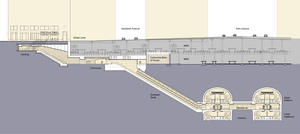
Good things come to those who wait. And wait. And wait. The Metropolitan Transit Authority (MTA) estimates that Long Island Rail Road (LIRR) commuters will save 40 minutes a day in travel time to Midtown and the East Side when the East Side Access (ESA), connecting the LIRR to Grand Central Terminal (GCT), is completed. The MTA projects that, by 2020, there will be a 50/50 split between ridership to Penn Station and GCT via the ESA.

The idea of linking the LIRR with GCT has been gestating for more than 40 years. The ESA is an enormous MTA capital project — the largest construction project ever undertaken by the authority. Seven miles of new tunnels are being built 100 feet below the surface and through the bedrock of Manhattan. The new tunnels, completely independent of those traveling to Penn Station, will eventually join the existing 63rd Street Tunnel and new tunnels originating in Sunnyside, Queens.

“GCT was designed as a complex,” said Elton Elperin, AIA, of AECOM, who has been working on the ESA since 2001, “and this project extends the GCT complex.” The AECOM team, which is being led by Elton and senior project architect Maria Tarczynska, AIA, is a member of the General Engineering Consultant (GEC) team that is designing the estimated $7.2-billion ESA, which will sit 90 feet below GCT and will include: new entrances; a 300,000-square-foot concourse’ eight tracks on four platforms that lie beneath the existing Metro-North lower level tracks; eight linked mezzanines; and ticketing and waiting areas, retail, and exhibit space. “Aesthetic features keep changing,” Elperin said, but the project is on track and the design of the ESA is expected to be complete by August 2010.

The most visible change to pedestrians will be a new open public space on 50th Street between Park and Madison Avenues. EDAW, a subsidiary of AECOM, is designing the public space that will feature a landscaped plaza with seating and a water feature designed by Waterline Studios of Fort Collins, CO.

Four townhouses had to be demolished to create a new ventilation building, but due to public input, the team reduced its height and relocated more of the functions underground. Another ventilation structure is being constructed on 44th Street. Its neighbor, the Yale Club, was adamantly against having a “ventilation monstrosity” nearby, so the team designed a low-rise structure to camouflage the system and it is illuminated to appear as if people are at work inside.

One of the greatest challenges, according to Elperin, is the weaving of the space through the numerous obstacles set by Metro North, the buildings, and infrastructure in the area. He admitted that the project has “suffered the loss of additional entrances to the street, but those can be phased in later — it’s simply a question of money.” When asked if there was any analysis done to connect the new tracks to the Second Avenue Subway, for which AECOM served as the prime consultant for the engineering and design, he said that he didn’t know, “but there’s got to be a feasibility of it somewhere.”

For more information on the ESA visit http://www.mta.info/capconstr.