In the News

In this issue:
• Bienvenido, Willkommen, Huan Ying to JFK
• Upscaling the Plaza District
• WXY Designs for WNYC Transmitter Park
• Designing for Social Innovation
• New Bridge Segues the Two Campuses of Lincoln Center
• An Aggressively Passive House


Bienvenido, Willkommen, Huan Ying to JFK

Courtesy Gensler
Courtesy Gensler

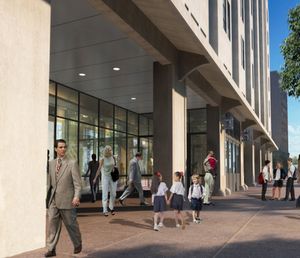
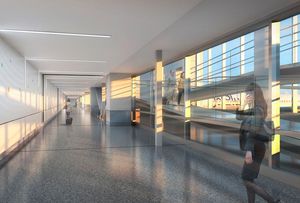
JetBlue recently broke ground on a 145,000-square-foot addition to Terminal 5 (T5) for international arrivals at JFK. Designed by Gensler, the space is a seamless extension to the firm’s existing T5, which opened in 2008, and designed to welcome travelers to the United States in a bright, clear environment that will streamline the travel experience. The extension includes the conversion of three existing gates to international swing gates and the addition of three new international swing gates. In addition, the terminal will include a new security checkpoint, an immigration hall, five new holdrooms, and two new baggage claims. Scheduled to open in 2015, the project is being built in collaboration with Arup, Turner Construction, and The Port Authority of New York and New Jersey.


Upscaling the Plaza District

dbox for Foster + Partners

Foster + Partners has been selected to redesign 425 Park Avenue. The conceptual design for the 650,000-square-foot, 687-foot-tall structure calls for a tapered steel-frame tower rising to meet illuminated sheer walls. The design also features a façade that seamlessly integrates with an internal arrangement that allows for three gradated tiers of column-free floors, defined by landscaped terraces. At street level, the design has the potential for a large civic plaza and a home for significant works of art. Project developers L&L Holding Company and Lehman Brothers Holdings say construction is expected to start in 2015 and be completed by the end of 2017. The building will replace the c. 1957, 380-foot-tall white brick International Style building designed by Kahn & Jacobs.


WXY Designs for WNYC Transmitter Park
Courtesy WXY Architecture + Urban Design
© Amy Barkow
© Ken Taranto

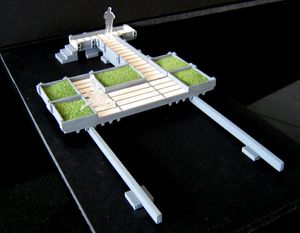
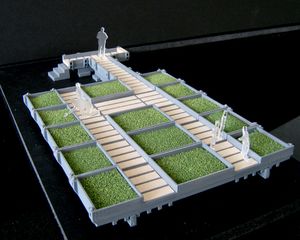
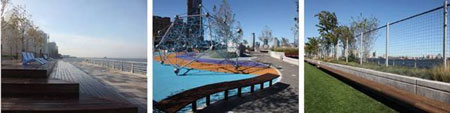
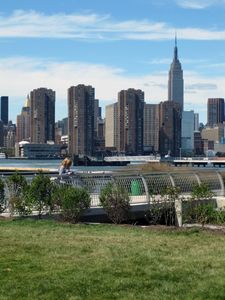
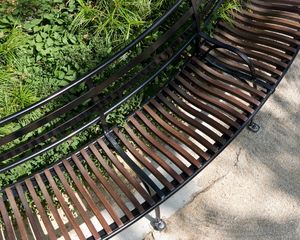
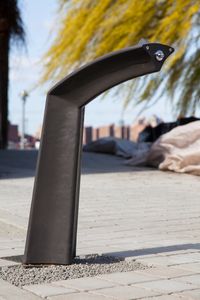
Set on the former location of two transmitter towers, the 1.6-acre WNYC Transmitter Park in the Greenpoint section of Brooklyn recently opened. Developed in partnership with the Department of Parks & Recreation, AECOM‘s Donna Walcavage, FASLA, planned and designed the park, and WXY Architecture + Urban Design collaborated on the design of park’s furnishings and structural elements. The design team uncovered an old boat slip and incorporated it into the design of a footbridge that provides access across the park as well as for viewing the tidal waters below. The park features WXY’s River Bench system, a durable and attractive curvilinear bench type with myriad possible configurations, the Z Rail, a modern steel railing installed for safety at the water’s edge along the esplanade and all along the pier, and the 2030 Drinking Fountain, which minimizes water waste by emphasizing the use of refillable bottles and by catching splash.


Designing for Social Innovation
© Kevin Chu
© Kevin Chu

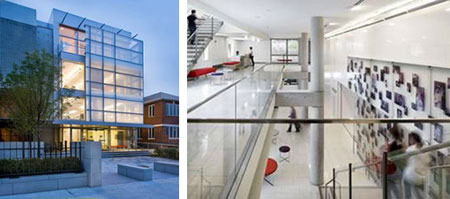
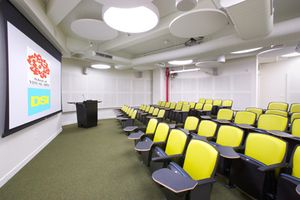
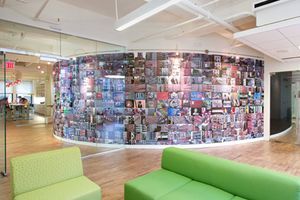
Spacesmith has completed the home for the School of Visual Arts’ (SVA) new program, “Design for Social Innovation” (DSI). At the heart of the 5,000-square-foot-space is a circular, 55-seat auditorium equipped with audio-visual capabilities for presentations, screenings, lectures, and symposiums. The interior of the curved wall is clad in perforated gypsum board panels; the outer walls are finished with magnetic paint that accommodates interchangeable graphics and also functions as white boards, chalkboards, and bulletin boards. The design includes the “playroom,” an open-plan multifunction area, that partially rings the auditorium and is equipped with movable desks, a quiet room for study, computer lab, sound booth for podcasts, and an eat-in pantry that doubles as an open teaching space. Light penetrates the space though generous interior glazing elements; splashes of vivid color are added through the use of brightly colored tile. The DSI is a two-year graduate program that provides students with the design tools and skills needed to become creative leaders in social innovation.


New Bridge Segues the Two Campuses of Lincoln Center

© Mark Bussell

© Mark Bussell

Lincoln Center marked the completion of its six-year, $1.2 billion redevelopment project with the dedication of the 83-foot-long, 10-foot-wide, President’s Bridge, designed by Diller Scofidio + Renfro, lead architects on the of the Lincoln Center Campus redevelopment project. Spanning 65thStreet near Amsterdam Avenue, the stressed-skin steel structure connects the upper level plaza of the Rose Building to the public spaces, concert halls, theaters, library, and eating establishments on the south side of Lincoln Center’s campus.


An Aggressively Passive House
© Evan Joseph/Aguayo Realty Group
© Evan Joseph/Aguayo Realty Group

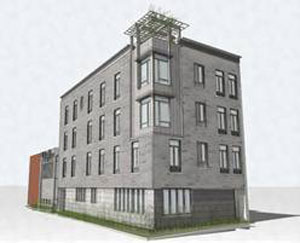
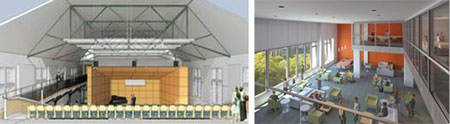
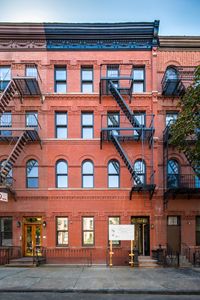
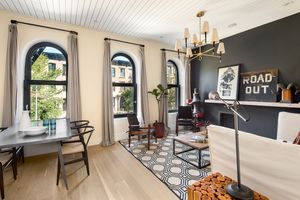
An 80-year-old townhouse in Prospect Heights, Brooklyn has been transformed into Haus 96, a four unit residential building that meets the Passive House EnerPHit standard. Designed by Ken Levenson Architect and developed by Brendan Aguayo, the approximately 4,000-square-foot project is billed as the first multi-family Passive House in the country. The building uses insulation materials that consist of dense-pack cellulose, a material with very high recycled content and low embodied energy. Windows are triple-glazed and gas filled, with air-tight gaskets providing acoustic separation from street noise, maximum interior day lighting and passive solar heat gains while eliminating convective currents typically associated with poorly insulated windows. Each apartment has its own dedicated ventilation system with high-efficiency heat recovery that provids filtered fresh air to living spaces and exhausts air from bathrooms and kitchen spaces. This maintaining high indoor air-quality by keeping pollutants such as soot, dust, pollen, CO2, and other typical toxins lower than in typical buildings.


This Just In
For SUITE New York’s the 3rd annual Pink Project, 20 architects, including Deborah Berke, FAIA, David Rockwell, AIA, Winka Dubbeldam, Assoc. AIA, interior designers, and style icons have each customized a Grete Jalk GJ chair to be auctioned from now through October 31 to benefit the Breast Cancer Research Foundation.

The proposals designed by firms shorted-listed in the competition for the new 425 Park Avenue – Foster + Partners, Rogers, Stirk, Harbour + Partners, OMA, and Zaha Hadid Architects – will be on view at the Municipal Art Society’s Summit for New York Summit for New York City (http://mas.org/summit-2012-schedule/) on October 19.

SHoP Architects is working on the initial designs for a major league soccer stadium in Flushing, Queens, as well as designing the 200-room hotel and a 350,000-square-foot outlet mall for The New York Wheel on the waterfront in the St. George section of Staten Island. Netherlands-based Starneth, which worked on the design the London Eye and the Singapore Flyer, and Perkins Eastman are architects, engineers, and designers of the wheel.

As part of its commitment to social responsibility, Perkins+Will has partnered with Infinite Family, a U.S.-based non-profit organization that helps children and teenagers from African communities connect virtually with mentors around the world. The firm has designed LaunchPad, a prototype computer lab where young Africans can communicate with mentors via face-to-face interaction thanks to high-speed and high-tech capabilities.

“Recharging Communities,” an exhibition of desigNYC’s 15 collaborations between nonprofits and designers, such as Bernheimer Architecture and d/b/A designbuild, is on view now through October 17 at CD Cucine in Chelsea. Public programs are scheduled during the run.

Hunts Point Landing, designed by Mathews Nielsen Landscape Architects, recently opened. Part of the firm’s South Bronx Greenway Master Plan, the 1.5-acre site offers water-based public recreation, such as a fishing pier and a kayak and canoe launch, and is linked to other bicycle and pedestrian improvements now underway.

The American Planning Association (APA) designated Fifth Avenue – from Marcus Garvey Park in Harlem to Washington Square – as one of 10 Great Streets for 2012 under the organization’s Great Places in America program. APA singled out Fifth Avenue for its wealth of historic buildings and districts, its vast array of commercial, retail, residential, religious, recreational, and cultural uses; and its reliance on planning and zoning to guide growth.

mag.net, a site-specific installation with dance performances that explores the interaction between architecture, dance, and magnetism, is taking place at White Gallery through October11. Designed by e + i studio in collaboration with human kinetics movement arts, a spider-like web of suspended metal and elastic is reconfigured by dancers with magnets embedded in their costumes.

Billed as the tallest stand-alone hotel in the Western hemisphere, 70-story Courtyard by Marriott and Residence Inn at 1717 Broadway at 54th Street, designed by Nobutaka Ashihara Associates, has topped out. The two Marriott “select service” hotels will be housed within the structure and will share public spaces and lobbies.

TPG Architecture has been commissioned to design a new 3,300-square-foot bakery and cafe for TLC’s hip owners of Carlo’s Bakery, stars of the TV show, “Cake Boss.” The new space, located in Ridgewood, NJ, will feature a “cake bar,” where guests can watch the decorators at work.

Philly field trip: This year’s DesignPhiladelphia festival offers a view into the city’s creative industries at work. Over 100 events take place city-wide with more than 400 participating designers; the vast majority of events such as open studios, exhibitions, lectures, runway shows, tours, workshops, and the like, are free and open to the public.
In this issue:
• Modern Modular Marvels
• The Future of Pharma
• Meier Island
• Hava Nagila Habitat


Modern Modular Marvels

Aerial view.

Courtesy Garrison Architects

Exploded axonometric view.

Courtesy Garrison Architects

Lobby view.

Courtesy Garrison Architects

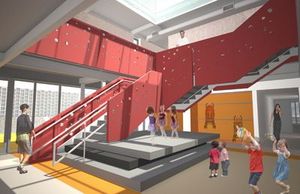
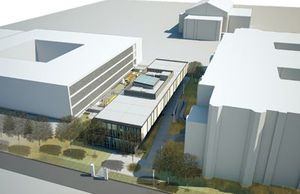
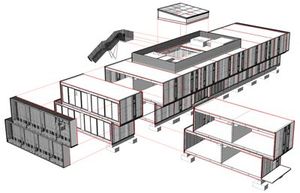
CUNY’s Lehman College, in the Bedford Park section of the Bronx, is currently undergoing a multi-day installation of its new 12,000-square-foot modular child care center. The units were pre-fabricated over the course of six months in a factory in Pennsylvania and shipped to the job site where set-up takes less than a week. Designed by Garrison Architects, the building utilizes a combination of natural and mechanical devices to maintain comfort, integrate nature, and conserve energy. For example, in spring and fall its mechanical systems can be turned off and the building can rely solely on its passive solar ventilation system. The natural ventilation system is an integral part of the design and expression of the building, and works in conjunction with the façade and garden trellises.

Classrooms are designed with floor-to-ceiling sliding glass panels that open onto balconies with integrated planting beds and trellises. These create vertical gardens for each classroom to cultivate. The openings provide natural ventilation, and the stainless-steel mesh trellises double as window guards. The large artificial surface platform outside the lobby includes “imagination playground” blocks and surface fountains to create multisensory, creative play experiences and cooling play in the summer. An embankment slide integrates with the topography to meet fall protection criteria; musical pipes promote multisensory play and understanding of acoustical properties of materials interacting with the environment; and planted “tepees” engender environmental stewardship through fruit and vegetable cultivation. Hauppauge-based Axis Construction is part of the project team.


The Future of Pharma

Courtesy Maya Lin Studio

Courtesy Toshiko Mori Architect

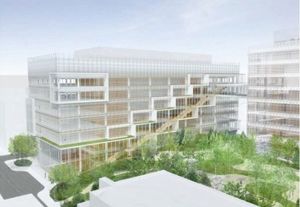
The pharmaceutical company Novartis is building a new worldwide operations complex located across from existing company facilities in Cambridge, MA. The new $600 million, 550,000-square-foot complex, will provide workspace for more than 1,000 employees currently spread across several buildings. Toshiko Mori Architect and Maya Lin Studio are each designing one of two new buildings, and landscape architect Michael Van Valkenburgh Associates is designing the surrounding landscape and 1.35-acre courtyard. Cannon Design’s Boston office of is architect-of-record and design engineer, and will employ the firm’s “New Scientific Workplace,” a design strategy focused on creating new opportunities for collaboration and cross-disciplinary communication. The complex will achieve this by pairing highly-flexible laboratory spaces that can accommodate multiple sciences now and in the future, along with conference and informal meeting spaces. The project is expected to be completed in 2015.


Meier Island

Courtesy Roland Halbe

Courtesy Roland Halbe

Courtesy Roland Halbe

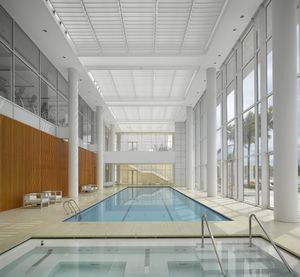
Richard Meier & Partners has completed the OCT (Overseas Chinese Town) Shenzhen Clubhouse, sited on an island in the middle of a lake within the 13 million-square-foot Harbour District. White metal panels and the firm’s mastery of natural light define the building. Shifting natural light throughout the day animates the interior, revealing different spaces and primarily white surfaces. The clubhouse’s geometry follows a precise focal point from which layers of distinct spaces radiate and terminate in a white glazed curve. Other features include a restaurant, private dining suites, a multi-purpose area, recreational facilities, and a small exhibition gallery. It is linked via an outdoor pathway and gardens to an indoor pool and fitness center. Various vistas, textures, plantings, and settings offer an opportunity for solitude, as well as platforms to admire the surrounding views of the water and the harbor entertainment complexes beyond.


Hava Nagila Habitat

Courtesy Situ Fabrication

Courtesy Situ Fabrication

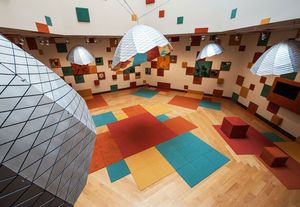
Situ Studio designed “Hava Nagila: A Song for the People,” an exhibition at the Museum of Jewish Heritage, which is on view through 05.13. The goal of the exhibit is to communicate the diversity of the song’s infinite embodiments; cultural complexity was accomplished by exploring how geometries and materials can focus, reflect, and absorb sound, and features giant parabolic reflectors that form isolated cones of sound that define space. Carpet tiles serve triple duty on floors, walls, and ceilings as containers for content that also absorb reverberations. Techniques were developed specifically for this show; these include text and signature images laser-engraved directly into the carpet piling. Similarly, the geometric properties of parabolic reflectors were studied in relation to acoustics and light. Graphic design firm MTWTF collaborated on the project.


This Just In

The ribbon’s been cut and Barclay’s Center officially opens on 09.28.12. The 675,000-square-foot area, designed by SHoP Architects and AECOM (Ellerbe Becket) contains 18,000 seats for basketball and up to 19,000 for concerts. Curbed has a selection of 43 photos of the new center.

A ceremonial groundbreaking (actually a “seed-throwing”) was recently held to mark the start of High Line at the Rail Yards, the project’s third and final section, designed by James Corner Field Operations, Diller Scofidio + Renfro, and Piet Oudolf. Though closed to visitors, as part of the 10th Annual OHNY the High Line is offering walking tours of the section while it’s still in its natural state.

Start counting…The Museum of Mathmatics (MoMath), designed by BKSK Architects, is scheduled to open 12.15.12 in the Flatiron District.

10.04-10.06.12, the Yale School of Architecture presents “The Sound of Architecture,” an interdisciplinary symposium that explores the audio dimension of architecture, and draws on experts from the fields of archaeology, media studies, musicology, philosophy, and the history of technology, as well as architects, acoustical engineers, composers, and artists. The event is free and open to the public. For a complete schedule and pre-registration information, visit www.architecture.yale.edu/symposia.
The fifth and final installment of the Guggenheim Museum’s “Stillspotting nyc” takes place in the South Bronx during the weekend of 10.13.-10.14.12 as a part of Archtober.

The 3rd annual Control This! Conference and Expo, organized by the IESNYC, explores innovations and product development in the rapidly growing fields of lighting controls and energy management systems; 11.07.12 at the Metropolitan Pavilion.

As part of its Six to Celebrate program, the Historic Districts Council (HDC), has created walking tour brochures for neighborhoods in Manhattan (the Bowery, Inwood, Mount Morris Park), Brooklyn (Bedford-Stuyvesant, Gowanus), and Queens (Jackson Heights). They are available for online viewing and purchase.

The inaugural edition of Frieze Masters, showing art from ancient to modern, 10.11-14.12 in Gloucester Green, Regent’s Park, London, is designed by Selldorf Architects.

H3 Hardy Collaboration Architecture has been selected to design the new $60 million Performing Art Center in downtown Greensboro, NC.

The schematic design for the $30 billion Yongsan International Business District (Yongsan IBD) in Seoul, designed by Studio Daniel Libeskind, was recently completed. The master plan for the over 5 million-square-foot, mixed-use development incorporates 66 buildings designed by 18 international firms, and includes office and commercial space, retail, residential, and hospitality. The US contingent includes Asymptote Architecture, 5+ Design, Gensler, Kohn Pedersen Fox (KPF), Murphy Jahn, REX Architecture, Adrian Smith & Gordon Gill, Skidmore, Owings & Merrill (SOM), and Studio Daniel Libeskind. Construction is expected to begin during the first half of 2013 and completed by 2016.

Recently posted on TED Talks, Julian Treasure, chair of the Sound Agency in London, asks architects to pay attention to the sounds that surround us. Want to listen? http://www.ted.com/speakers/julian_treasure.html

Mark Your Calendars for Archtober 1!

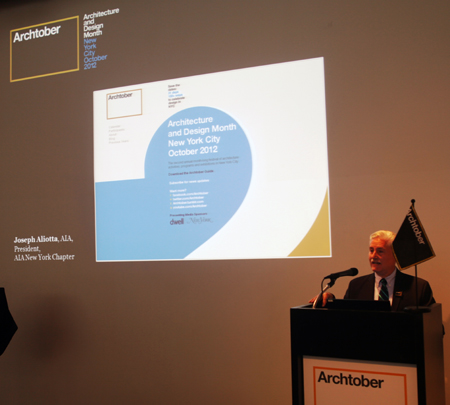
2012 AIANY President Joseph Aliotta, AIA, LEED AP, introduces the program.

Daniel Fox

Wendy Goodman, Design Editor, New York Magazine, and Roberto Guerra, Director (along with Kathy Brew) of “Design is One: Lella and Massimo Vignelli,” to be shown at the 2012 Architecture & Design Film Festival.

Daniel Fox

Gina Pollara, Executive Director, FDR Four Freedoms Park, with Abby Suckle, AIANY Board Member and President of cultureNOW, an Archtober participating organization.

Daniel Fox

Event: Archtober Press Preview
Location: Center for Architecture, 09.10.12

The Center for Architecture and AIA New York Chapter have a lot to wave their flags about. Now in its second year, Archtober (pronounced ARK-tober), is the month-long, city-wide festival involving more than 45 collaborating organizations (up from 33 last year), and an expanded menu of programming.

“This year Archtober is Architecture 101 – a 31-day course of architecture every day meant to illuminate the general public on the value of design, the values of our professionals, and the great wealth of design in New York City,” said AIANY Managing Director and Festival Director Cynthia Kracauer, AIA, LEED AP, at a press conference held at the Center on September 10.

Throughout the month of October, the Center for Architecture will turn into Archtober “central.” The Archtober Lounge will transform the Helfand Gallery with a giant calendar marking all of the more than 220 events taking place in and outside of the Center, such as the Architecture and Design Film Festival, Designers & Books Fair, the special opening of Louis Kahn’s Four Freedoms Park, the Bits and Mortar Conference with Frank Gehry, FAIA, and Nicholas Negroponte, among other leading technologists, and exhibition openings. On October 6, the Center is the place to celebrate Le Corbusier’s 124th birthday with a special one-day-only installation of his classic furniture.

The popular “Building of the Day,” a series of lunchtime tours of recent design award-winning projects led by architects and design professionals, is being reprised – starting on October 1, with a visit to Spruce Street School PS397, led by Joe Aliotta, AIA, LEED AP, Swanke Hayden Connell’s partner-in-charge and the Chapter’s 2012 president. All of these can be taken virtually, complete with podcasts delivered by architects, via CultureNow’s “Museum Without Walls” app at culturenow.org.

“New York City is home to nearly 40,000 architects and design professionals, which is the largest pool of design talent in the country,” says Aliotta. “Archtober continues to demonstrate this sector’s powerful impact, and draws global attend to one of New York’s leading exports.”

For more information about Archtober, visit www.archtober.com, or pick up an Archtober Guide inserted in Dwell’s October issue and New York Magazine’s September 26th issue…and, of course, at the Archtober Lounge.

Marketing & PR: Start with the Pitch

Berit Hoff

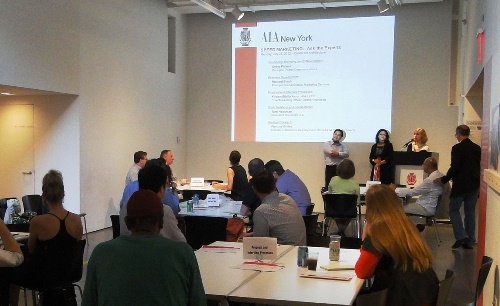
Event: Speed Marketing: Ask the Experts
Location: Center for Architecture, 07.23.12
Topics and leaders: Positioning, Branding, and Differentiation: Debra Pickrel, Principal, Pickrel Communications; Business Development: Richard Staub, Principal, Richard Staub Marketing Services; Proposal and Interview Processes: Kirsten Sibilia, Assoc. AIA, LEED AP, Chief Marketing Officer, Dattner Architects; Public Relations and Social Media: Tami Hausman, President, Hausman LLC; Strategic Outreach: Frances Gretes, Director of Business Development, Robert A.M. Stern Architects
At large: Ileana LaFontaine, Marketing & Design Consultant; Gretchen Bank, Assoc. AIA, Director of Business Development, Cosentini Associates & Co-chair, AIANY Marketing & PR Committee; John Fontillas, AIA, Partner, H3 Hardy Collaboration Architecture & Co-chair, AIANY Marketing & PR Committee
Organizer: AIANY Marketing & PR Committee

Marketing and public relations are essential to large and small practices. But not being an exact art or science, they are one of the least understood components of a successful firm. “Speed Marketing: Ask the Experts” drew participants ranging from architects – particularly those at start-ups – to marketing and PR practitioners who work in-house for AEC firms, and those who have firms as clients.

Attendees started at one of five tables led by a pro, each one representing the various elements of marketing and public relations, for a half-hour discussion. Participants then circulated to another topic table.

Since we can all glean something from the experts, listed below in the first section are what I consider to be the most important top tips from each topic leader. After that is a fuller set of tips from the participants.

My suggestion is to start conceptually at the Positioning, Branding, and Differentiation table, followed in order by Public Relations and Social Media, Business Development, the Proposal and Interview Process, and then Strategic Outreach. There is obviously overlap, but all of the experts agreed that the foundation of a firm’s marketing and PR effort is a strong “elevator pitch” and a solid understanding of “who you are and why you are different from other firms,” and being able to fluidly verbalize it. In fact, each of the experts included this tip in one form or another.

• Branding, Positioning, and Differentiation: The two hallmarks of a great brand are what make you unique and relevant. Know how to explain your firm’s expertise, its culture, values, and team members. Know what you want to say about your firm’s work and how it relates to the clients you are targeting.
• Public Relations and Social Media: Tell good stories. There’s no better way to engage people. Consider that every project has multiple stories and many audiences. Get creative.
• Business Development: The core of this area is relationship-building. There are three parts to the process: the initial contact and introduction;, developing the relationship and the trust that comes with it; and the sell. Everyone gets the first part. It’s the other two that tend to be neglected.
• Proposal and Interview Processes: If your firm does not win the competition or commission, try to get a debriefing to learn what you can improve. And have an honest conversation in-house about what you could have done differently in the proposal/interview process, focusing on the value of what you learned.
• Strategic Outreach: Maximize the use of your presentations. Repackage and disseminate your talk as a podcasts, webinars, white papers, or brochures, and post it on your website and distribute through social media.

And now for the more fulsome tips from the night’s topic leaders:

Positioning, Branding, and Differentiation – Debra Pickrel
• Write and practice your brand elevator speech over and over. It answers the ubiquitous question, “So, tell me about yourself/your firm,” and aim for no longer than a minute. In your answer include who you/your firm are, what makes you unique, and why is this relevant. Make sure you mention three recent successes.
• Study what your competition is doing and saying to shape your brand language differently and with more impact. Use short, succinct, powerful words, and remember we live in a 140-character world now. Use high-powered visuals and videos that portray you in the best light.
• Confront potential roadblocks head-on. This might elucidate a clearer understanding of where you actually want to go, the resistance to stating a position due to ego or other factors, or funding needed to update a website or create a new site entirely.
• Fish where your fish are, so to speak, and don’t try to be all things to all people.

Public Relations and Social Media – Tami Hausman
• Develop a good strategy before you start any outreach program. You need to be clear about why you’re doing it and what you want to accomplish.
• News gets old fast, so be timely and take advantage of good news, whether it’s about a project or a person. Seize opportunities that come your way and make the most of them.
• Social media has expanded the opportunities to promote your work, people, and ideas. Don’t let the medium overcome the message. Make sure your content is appealing and timely.
• Focus on your client’s needs. Think about the publications they read and what they want to hear. That way, your outreach is targeted and accurate.

Business Development – Richard Staub
• Before reaching out, be very clear regarding what your firm is about, what differentiates it, and how it provides value. Have that internalized so that it comes to mind easily in a conversation.
• Establish yourself and your firm as a value provider as you develop the relationship. Demonstrate that you understand the other person’s concerns and priorities.
• Build your comfort level with the process by doing research on the people and institutions you’re reaching out to. If you are calling someone for the first time, use LinkedIn to see if you have a friend in common who will recommend you or can tell you something about the person to whom you wish to contact.

Proposal and Interview Process – Kirsten Sibilia, Assoc. AIA, LEED AP
• Understand the differences between writing a proposal for the public and private sectors.
• Draft the cover letter of a proposal first; describe in a few paragraphs the expertise that your firm provides that is specifically relevant to the project, and your excitement about the assignment. That becomes a touchstone as you develop a compelling narrative to support it throughout your proposal.
• A proposal is a reflection of the quality of design your firm can deliver, so it’s imperative that it is thoughtful, well-designed, and free of typos.
• If appropriate, invite the potential client to visit your office so they can experience your office culture.

Strategic Outreach – Frances Gretes
• Be the only architect on the program. Propose to speak where you are featured as the only expert.
• Research and target venues where your expected audience is most likely to include prospective clients. Look at attendee lists, past programs, and publicity about past programs. Also speak “outside of the box” at associations or to groups that cross into a different field but have related interests.
• Direct your topic to a particular need or interest of your target audience rather than on self-promotion.

In this issue:
• SoHo Cafe Sparkles
• A Place for Student Urban Farmers to Flourish
• On the Avenues…
• Upper Manhattan Gets a New Restaurant and Cafe with Riverviews
• The Third Section of the High Line is on a Fast Track


SoHo Cafe Sparkles

Diller Scofio + Renfro’s “Light Sock.”

Adrian Wilson

Tom Dixon’s “Ball” chandelier.

Adrian Wilson

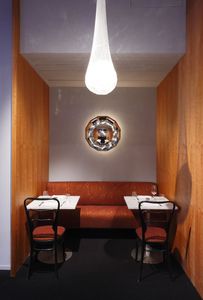
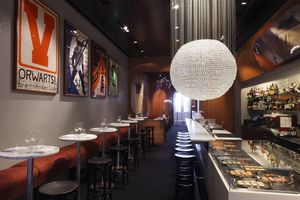
Café Kristall, adjacent to the Swarovski Crystallized store in SoHo, recently reopened after a redesign by Christian Wassmann, International Assoc. AIA (a 2012 New Practices New York winner). Cherry wood arches define the different areas of the Austrian-cuisine restaurant. The arches, as well as other elements that involve touch such as handrails and door handles, are a reference to the hexagonal shape of mountain crystals. Austrian touches include Thonet chairs originally designed by Adolf Loos for the legendary Café Museum in Vienna. All of the chandeliers are selected from the contemporary collection of Swarovski Crystal Palace, including two sphere-shaped ones designed by Tom Dixon. In front of an intimate dining niche with a mirror installation designed and custom-made by the studio, hangs a fixture designed by Diller Scofidio + Renfro. [An earlier version of this article reversed the photo captions. The above reflects the correct order.]


A Place for Student Urban Farmers to Flourish

Courtesy Handel Architects

Here and below, the green deck system is added in sections and sits directly on the columns below the roof.

Courtesy Handel Architects

Courtesy Handel Architects

Located atop the Robert Simon School complex on Manhattan’s Lower East Side, the 3,000-square-foot Fifth Street Farm Project, designed by Handel Architects, is about to take root. Due to the weight of the soil, the firm developed a design that perches a green deck directly onto the columns below the roof, similar to the way most rooftop mechanical equipment is handled. This required “stubbing-up” a select number of columns from below, as well as designing a pitch pocket waterproofing detail to wrap the base of these short columns, and building a steel framed deck to rest on the columns. The simple and standard deck construction that rests on these columns serves as a foundation for anything from planters to a greenhouse. The system can be easily replicated in other buildings where the roof slabs are not designed to carry the weight of a farmable green roof. The project also includes a kitchen with a solar oven, a greenhouse, free play lawn, large meeting space, compost area, and a weather station. In addition to providing the many benefits that green roofs offer – mitigating heat island effect, reducing storm water run-off and providing areas of refuge to increase natural bio-diversity – the retrofitting is also intended to allow teachers to weave cultivating plants into the curricula of different classes and areas of inquiry, ranging from science to art.


On the Avenues…

Courtesy Perkins Eastman and Bonetti/Kozerski

Courtesy Perkins Eastman and Bonetti/Kozerski

Courtesy Perkins Eastman and Bonetti/Kozerski

Perkins Eastman and the interior design firm Bonetti/Kozerski have collaborated with the in-house team at Avenues: The World School to create the school’s flagship 205,000-square-foot New York City campus opening this fall. Located in West Chelsea, the reinforced concrete building, designed by Cass Gilbert in 1928, has been transformed into a 10-story vertical campus organized with maximum space efficiencies and collaborative learning as programmatic priorities. The first floor includes a parents’ center, coffee shop, and the school’s major music support facilities. The second floor is dedicated to the Early Learning Center classrooms, while the third floor contains two dining halls and a studio workspace for the Upper School. This floor, directly adjacent to the High Line, features a high ceiling and light-filled space. The fourth, fifth, and sixth floors are the Lower School, the seventh and eighth floors are for the Middle School; and a portion of eighth floor plus the ninth and tenth floors are the Upper School. The ninth and tenth floors also house a 20,000-square-foot, state-of-the-art athletic and fitness space that includes locker rooms, weight and aerobic training spaces, and a full-sized gymnasium – plus access to a half-acre rooftop with play areas. STV is providing engineering and construction management services.


Upper Manhattan Gets a New Restaurant and Cafe with River Views

Courtesy Andrew Franz Architect

Courtesy Andrew Franz Architect

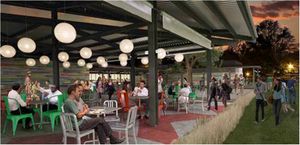
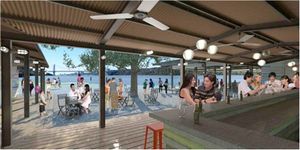
La Marina, a new café and restaurant designed by Andrew Franz Architect, recently opened. Covering 75,000 square feet of Hudson River waterfront just south of the Cloisters, the design is inspired by working maritime buildings. The project, a cluster of open, casual structures adjacent to a sandy beachfront, employs simple forms and materials such as roofs clad in corrugated COR-TEN steel, planted walls, reclaimed wood siding for the enclosed buildings and fencing, and native grasses. By separating the buildings, which include a full-service restaurant and several bars, and a casual waterfront lounge, patrons have more views of the river and beyond. Set to open next year is a marina and launch area with a 22-slip dock.


The Third Section of the High Line is on a Fast Track

11th Avenue Bridge: the primary pathway slowly ramps up, creating an elevated catwalk that will raise visitors approximately two feet above the level of the High Line. Display gardens on either side of the catwalk separate the primary pathway from the linear bench seating running along the railing on either side of the bridge. A new stair will bridge over the railing, providing visitors with sweeping east-west views as they enter and exit the High Line.

Image by James Corner Field Operations and Diller Scofidio + Renfro. Courtesy of the City of New York and Friends of the High Line

Beam Exploration Area: the railway’s concrete deck will be removed, revealing the framework of the High Line’s original beams and girders, covered with a thick rubber safety coating, and transformed into a unique feature for kids to explore the High Line in a new way.

Image by James Corner Field Operations and Diller Scofidio + Renfro. Courtesy of the City of New York and Friends of the High Line.

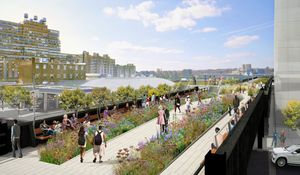
Rail Track Walk: the rail yards section contains planting beds featuring Piet Oudolf’s naturalistic landscapes that border a pathway embedded with the High Line’s original tracks.

Image by James Corner Field Operations and Diller Scofidio + Renfro. Courtesy of the City of New York and Friends of the High Line.

The City of New York has acquired the title to the third and final section of the High Line from CSX Transportation – bounded by West 30th and West 34th Streets to the south and north, and 10th and 12th Avenues to the east and west. The design process for the third section began in December when neighbors and supporters at a community input meeting shared ideas with the design team: James Corner Field Operations, Diller Scofidio + Renfro, and Piet Oudolf.

This Just In…

The Drama League announced it will open The Drama League Theater Center, located on the lobby level of the historic former AT &T Building in Tribeca. Designed by FXFOWLE, the project, scheduled to open later this year, incudes a new laboratory/development space, an administrative suite including computer workstations and conference space for artist use, flexible multipurpose space for educational programming and special events, a box office, design capability for sound/projection/video, and a variety of new programs.

The Design Trust for Public Space has released “Five Borough Farm: Seeding the Future of Urban Agriculture in New York.” It is a comprehensive survey of the city’s urban agriculture movement and provides a roadmap for public- and private-sector partners to leverage existing programs and expand urban agriculture citywide.

The Department of State’s Bureau of Overseas Buildings Operations (OBO) announced the selection of Tod Williams Billie Tsien Architects/Davis Brody Bond joint venture to design the new U.S. Embassy Compound in Mexico City. The project is the first solicited under OBO’s Design Excellence program. The team was selected from a shortlist of six firms that included: AECOM, Diller Scofidio + Renfro, Morphosis Architects, Skidmore, Owings & Merrill, and The Miller Hull Partnership.

cultureNOW (winner of the 2012 AIA Collaborative Achievement Award) has produced BostonNow for its Museum Without Walls App. It contains 600 sites of recent and historic buildings and public art collections in the area, over 100 podcasts recorded by Boston architects, artists, historians, and civic and cultural leaders, plus self-guided tours. An exhibit, “BostonNOW: Maps to Apps” opens August 9 at the BSA Space.

On view through October 21 at Socrates Sculpture Park is “Curtain,” the winner of Folly, a competition organized in collaboration with The Architectural League of New York that drew 115 submissions. Conceived by architects Jerome Haferd and K. Brandt Knapp, the winning project combines architectural structural framing with mutable plastic chain link partitions and enclosures. The competition was organized in collaboration with The Architectural League of New York.

The Yale School of Architecture Gallery presents “With Palladio Virtuel,” a new analysis of Renaissance architect Andrea Palladio. The exhibit is conceived and designed by Peter Eisenman, Charles Gwathmey Professor in Practice, and Yale School of Architecture critic Matthew Roman. It represents the culmination of Eisenman’s 10 years of study of Palladio’s villas. The exhibition is on view August 20 – October 27, 2012.

In this issue:
· Sustainability Brings Holiday Cheer to Convent
· Roosevelt House Undergoes Restoration and Adaptive Re-Use
· Haiti-Habitat Calls for Prototypes to Help Rebuild
· Colonial Planning Meets Natural Phenomena at University of Guadalajara
· First Prize in the Kaohsiung Port Terminal Competition Goes to RUR


Sustainability Brings Holiday Cheer to Convent

Convent for the Episcopal Sisters of the Community of the Holy Spirit.

BKSK Architects

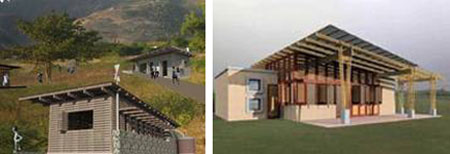
The Episcopal Sisters of the Community of the Holy Spirit have another reason to celebrate this Christmas — the completion of their new ground-up, 10,600-square-foot convent in the Sugar Hill section of Harlem, designed by BKSK Architects. The decision to build an eco-friendly convent came from the nuns’ desire to connect more profoundly with the natural world and live more sustainably. The four-story building features a chapel, community and silent dining rooms, kitchen, offices, conference room, library, sitting room, art room, 12 bedrooms, and two guest rooms. It also includes two types of green roofs — semi-intensive and extensive — that incorporate a pergola, sitting areas, and shallow-root plant landscaping. Solar power-heated water, rainwater collection, natural light and ventilation, and environmentally sensitive building materials are integral to the design.


Roosevelt House Undergoes Restoration and Adaptive Re-Use

Roosevelt House Public Policy Institute.

© Aislinn Weidele for Ennead Architects

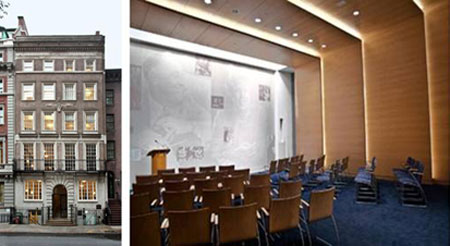
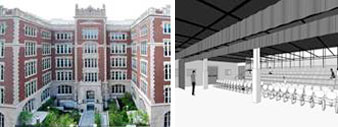
After years of deferred maintenance followed by nearly five years of preservation work under the direction of Ennead Architects (formerly Polshek Partnership), the landmarked Roosevelt House Public Policy Institute at Hunter College officially opened. Commissioned by FDR’s mother and designed by Charles Platt in 1907, the mirror-image townhouses behind a unified neo-Georgian façade have been historically restored. A new open stair leads to the basement-level lobby and lecture hall, which will host conferences and other programs. The former dining and drawing rooms have been combined into multi-functional spaces for meetings and receptions. FDR’s library has been restored as a museum and seminar space. Offices occupy the third, fourth, and fifth floors, and the top floor includes two apartments for visiting scholars with a roof terrace.


Haiti-Habitat Calls for Prototypes to Help Rebuild

Haiti-Habitat proposals by Keith Hayes (left); and Arthur Rabinovich, RA, LEED AP, Alberto Anastasio, Sabine Feil, Omid Balouch, and Paolo Puliga.

Keith Hayes (left); Arthur Rabinovich, RA, LEED AP, Alberto Anastasio, Sabine Feil, Omid Balouch, and Paolo Puliga

Haiti-Habitat, a new subcommittee of the AIANY Global Dialogues Committee, was formed shortly after the earthquake hit Haiti almost one year ago. With the subcommittee’s goal to help rebuild the country, it recently issued a call for collaborative designs for vernacular single-family houses that use local materials and are adaptable to Haiti’s varied geography. From 150 submissions, 12 were selected to continue to the next phase and have the potential to be part of a small community cluster of structures. The 12 participants are: the team of Estela Alvarado, Alexander Díaz, Gaspar Fernández; Timothy Bell; Joshua Doyle; Xiaoxi Feng; Keith Hayes; GCP Arquitetos; the team of Elena Guirao, Victor Brena Calvo, Carlos Torres Perez, and Sara Franco Restrepo; I-beam Design; Corentin Maury; Peerachet Pornsanoe; the team of Arthur Rabinovich, RA, LEED AP, Alberto Anastasio, Sabine Feil, Omid Balouch, and Paolo Puliga; and Tan Choonwah Wallace.

The second stage in the process is a charrette among the finalists and a panel of experts who will collectively review, combine the proposed designs, and select six original or modified designs. The final presentation will take place at the Center for Architecture on 01.12.11, which will include detailed design and construction information; potential sponsors/donors will be given an opportunity to fund any of the winning designs. For more info visit http://www.haiti-habitat.com/.


Colonial Planning Meets Natural Phenomena at University of Guadalajara

University of Guadalajara Museum of Environmental Sciences.

Snøhetta

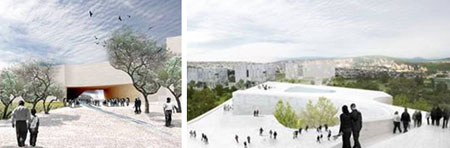
Snøhetta was selected by the University of Guadalajara as the winner of the competition to design a Museum of Environmental Sciences. The museum is part of the university’s Centro Cultural Universitario (CCU), a cultural district adjacent to the main campus and planned wilderness preserves. The building is compact and acts as a bridge over a central promenade that joins the library and auditorium buildings. Large courtyards and gardens punctuate the building and carve out space to allow natural light and fresh air to penetrate the interior. The courtyards are linked to allow for view and passage directly through the building. They are also unusually shaped, carved in eroded forms, and designed to integrate traditional methods of Spanish colonial planning with the natural phenomena found in the sunken pools and ravines of the surrounding area. The project is scheduled to begin in early 2011 and has a budget of $35 million. Snøhetta’s winning design was developed in collaboration with ARUP. Other firms shortlisted for this project were: Shigeru Ban (Japan), Diller Scofidio + Renfro (U.S.), Smiljan Radic (Chile), and Mauricio Rocha (Mexico).


First Prize in the Kaohsiung Port Terminal Competition Goes to RUR

Kaohsiung Port Terminal.

Reiser + Umemoto

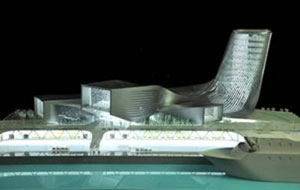
Reiser + Umemoto (RUR) has won first prize in the international competition for a new port and cruise service center in the city of Kaohsiung in southern Taiwan. Called the Kaohsiung Port Terminal, RUR proposed a “three-dimensional urbanism” that takes advantage of the site’s lateral position with respect to the city grid. A continuous elevated public boardwalk along the water’s edge will connect to the new Pop Music Center and the arts and shopping districts. Below will be the cruise and ferry functions, kept separate to maintain secure areas for passengers. The main hall splits into three zones, each related to a different travel itinerary, and the concourses are oriented parallel to the waterfront. The structure is a system of nested, long-span shells, which are composed of an underlying steel pipe space-frame sandwiched by cladding panels to create an inhabitable cavity space. RUR will partner with Taipei-based Fei and Cheng and Associates — with whom they are also working on the Taipei Pop Music Center project. The $85 million project is scheduled to start in 2012 and is expected to be in operation by 2014.

In this issue:
· PS90 Will Soon Dance for Joy
· Gateway Opens Doors to Harlem
· Hudson Square Selects Pedestrian Friendly Team
· Stairway Leads to Italian Kitchen Designs
· Stony Brook Aims for First LEED Certified Residence Halls
· Museum for Jewish History Opens Book on Independence Mall


PS90 Will Soon Dance for Joy

Center for Learning and the Arts at PS90.

Curtis + Ginsberg Architects

Curtis + Ginsberg Architects (C+GA) is transforming PS90 from a 20th-century abandoned school into 75 new condominiums, 20 of which are affordable. The cellar and first floor (18,000 square feet) will be occupied by the Center for Learning and the Arts, which will house programs by the National Dance Institute, a non-profit organization established to provide dance classes to public school children. The Center, designed by C+GA with design consultant H3 Hardy Collaboration Architecture, will include four dance studios, the largest of which will be a fully equipped performance space that seats 180. Visitors will be able to view rehearsals through ribbon windows that connect the studios to the lobby/gallery. This project is part of the city’s planned redevelopment of West 148th Street — the last large cluster of vacant city-owned buildings in Harlem.


Gateway Opens Doors to Harlem

Gateway II.

Michielli + Wyetzner Architects

Gateway II, a new six-story, 50,000-square-foot, mixed-use project in East Harlem, is home to a combination of commercial and not-for-profit tenants. Designed by Michielli + Wyetzner Architects, for ddm development and services, retail will occupy the ground floor, two floors are dedicated to office space, and three floors are for assisted living, each having its own entrance. The structure incorporates a Con Ed substation with thick concrete walls that isolate and protect it. To visually lighten the building’s mass, the firm divided the second through the fifth floors into two, two-story volumes clad with light and dark gray glazed brick. A narrow band of recessed windows on the third floor marks a break between the two volumes. The brick façade is articulated with a varied fenestration pattern to express programmatic divisions. The sixth floor includes a green roof on a setback that offers residents on the top floor a “lawn” view.


Hudson Square Selects Pedestrian Friendly Team

Hudson Square Connection, the Business Improvement District for the neighborhood bounded by W. Houston Street on the north, Canal Street on the south, Sixth Avenue on the east, and Greenwich Street on the west, has selected a team of seven firms led by Mathews Nielsen Landscape Architects to design pedestrian-friendly streetscapes. The area, known for its Art Deco buildings and once populated with publishers and printers, has now become a center for creative industries, including a number of architecture firms. Working closely with the NYC Department of Transportation, the team will have until the end of 2011 to draw up plans for socially, economically, and environmentally sustainable spaces. Team members include Rogers Marvel Architects (urban design), Billings Jackson Design (industrial design), and Arup (transportation planning and lighting design).


Stairway Leads to Italian Kitchen Designs

Scavolini SoHo Gallery.

Photo by Enrico Como

One of the stops on the Italian Design Street Walking Tour — part of the I Saloni Milano campaign to promote Italian Art and Culture — is the new flagship Scavolini SoHo Gallery, designed by SpaCe Architects. The design of the 10,000-square-foot space maintains the openness of the Nancy Hoffman Gallery, the previous occupant, to “exhibit” high-end kitchens manufactured by Scavolini. Existing cast iron columns draw visitors to a repositioned, re-sized glass staircase — the focal point of the space on axis with a new vestibule at the entrance. The stairway is enclosed by a lattice-like structure designed by Greneker Solutions. There is one fully operational kitchen designed by Karim Rashid, which will be used for cooking demonstrations. SpaCe is currently working in collaboration with Milan-based Brugi-Messi on a new store for fashion designer Etro, also located in SoHo.


Stony Brook Aims for First LEED Certified Residence Halls

SUNY Stony Brook Nobel Hall.

Photo by C. Taylor Crothers

Goshow Architects has completed Nobel Halls, a 175,000-square-foot complex on the campus of State University of New York at Stony Brook. The $56 million project is composed of two conjoined residences and a community center. Named after two Nobel laureates and former faculty members C. N. Yang and Paul C. Lauterbur, the residence halls combined contain 104 suite-style apartments. Each suite contains three double bedrooms centered around a common living room. Common spaces, such as lounges, small kitchens, and laundry rooms are located on the ground floor. The Center for Global Studies and Human Development serves as a community center with a café/lounge, seminar rooms, offices, and a 350-person meeting room. The project is on track to be certified LEED Gold. Sustainable features include insulated metal panels with high recycled content for the exterior cladding, and the use of rapidly renewable materials such as linoleum flooring and agrifiber door cores.


Museum for Jewish History Opens Book on Independence Mall

National Museum of American Jewish History.

Photos by Jeff Goldberg/ESTO

The new $150,000 million National Museum of American Jewish History, a Smithsonian affiliate, recently opened across the street from Independence Mall in Philadelphia. The 100,000-square-foot building, designed by Ennead Architects (formerly Polshek Partnership), is composed of two interlocking volumes — one opaque, the other translucent. The interior merges glass and masonry volumes and is arranged on six levels. Four floors feature interactive exhibition space, a changing exhibit gallery, a 200-seat auditorium, and an education center. An 85-foot-high atrium creates a spatial connection throughout the museum, allowing visitors to comprehend the organization of the building from any point. Two sculptural works are integral to the architectural concept — the 19th-century sculpture “Religious Liberty” was restored and relocated to the entry plaza, “Beacon,” a new LED sculpture by Ben Rubin, is located in the uppermost corner of the glass façade. Its undulating panels appear as pages in a book, such as the Talmud, one of the central texts of Judaism. Interlaced vertical and horizontal lines drawn freehand by the architects who designed the project define the pattern of the glass curtain wall and are intended as a metaphor for the interconnectedness of all.

In this issue:
· Design for Spring Street Salt Shed is Approved
· Times Square Bowls a Strike
· St. Ann’s Will Move into Historic Tobacco Warehouse
· Theater & Dance Perform Together Under One Roof at Kent State
· Jewels Adorn Hotel in India


Design for Spring Street Salt Shed is Approved

SaltShed

Spring Street Salt Shed (l-r): Manhattan 1/2/5 Garage, Salt Shed, Vent Shaft.

Dattner Architects

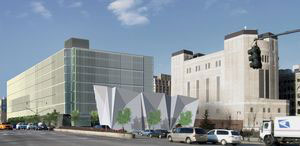
After more than two years of discussions among Dattner Architects, the NYC Department of Sanitation (DSNY), and the NYC Public Design Commission, the design for the Spring Street Salt Shed has won approval. Also called the Hudson Square Salt Shed, the structure, which can hold up to 5,000 tons of rock salt to use on the roads in winter, is a fully enclosed, mechanically ventilated wedge-shaped structure. The shed’s form is a series of crystalline, faceted planes, ranging from 43 to 67 feet tall, that taper at the bottom to lighten the perceived mass while expanding the sidewalk. The structure will be illuminated at night by a glowing glass moat beneath the sidewalk. Located on a 7,700-square-foot site at the terminus of Canal Street and the Hudson River, the shed adjoins the Art Deco Holland Tunnel Vent Shaft. To its north is the DSNY’s multi-story Manhattan 1/2/5 Garage, with its diaphanous, scrim-like façade designed by Dattner Architects with WXY Architecture. At the commission’s December meeting, it will review construction plans for the salt shed and issue a final decision on the project.


Times Square Bowls a Strike

Bowlmor-IMG

Bowlmor Lanes Art Deco Lanes.

Courtesy CMS Architecture & Design

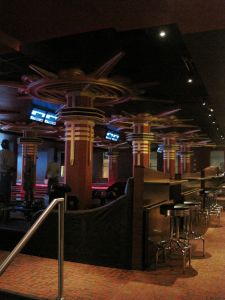
Bowlmor Lanes will open a 90,000-square-foot, multi-floor venue this week in the former New York Times Building on West 44th Street. Designed by CMS Architecture & Design, Bowlmor’s second NYC location features 50 lanes in seven NYC-themed bowling lounges: the mod Warhol Room; the Times Square Room recalling the pre-Disney era; the Central Park Room with Boathouse Bar and Tavern on the Green memorabilia; and “Subway” and “Prohibition” lanes inspired by historic speakeasies. The facility also contains the Stadium Grill Restaurant and Sports Bar, Tribeca Loft nightclub, and New York Salon, a private banquet room. The downtown and uptown floors are joined by a stair inspired by the Brooklyn Bridge. Blu3 Development collaborated on the project as theming consultant.


St. Ann’s Will Move into Historic Tobacco Warehouse

StAnn-extint

St. Ann’s Warehouse rehabilitation.

H3 Hardy Collaboration Architecture

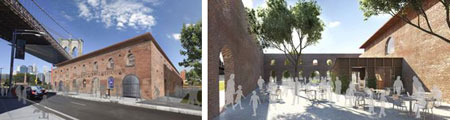
St. Ann’s Warehouse is designated to become the primary tenant of the Tobacco Warehouse, a Civil War-era structure located in the Empire Fulton Ferry section of Brooklyn Bridge Park. H3 Hardy Collaboration Architecture plans to rehabilitate and adaptively re-use the building as a year-round cultural facility, proposing to construct a flexible cultural space within the historic structure. For 30 years St. Ann’s Warehouse has commissioned, produced, and presented an eclectic body of events that meet at the intersection between theater and rock-and-roll. Since 2000, the organization has helped revitalize the Brooklyn Waterfront in DUMBO. The project features two performance spaces, including a 10,000-square-foot theater to accommodate 300 to 700 visitors, and a 2,100-square-foot space for a 125-set space. The remainder of the facility includes a 2,500-square-foot lobby, public restrooms, and performance support spaces. The firm will also create a walled public garden in an uncovered 7,600-square-foot triangular space.


Theater & Dance Perform Together Under One Roof at Kent State

KentState

Lobby (left) and dance studio at the Roe Green Center for the School or Theatre and Dance at Kent State University.

Photos by Tom Kessler

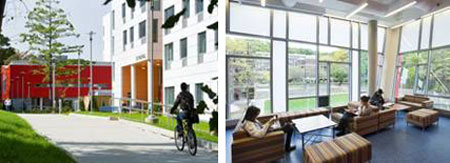
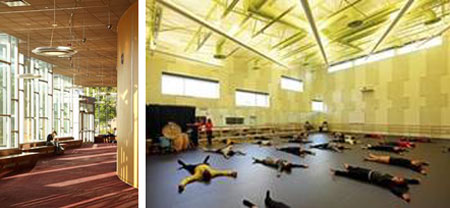
The $13 million, 73,500-square-foot Roe Green Center for the School of Theatre and Dance at Kent State University, in Kent, OH, was recently dedicated. Designed by Holzman Moss Bottino Architecture, the project incorporates both renovation and new construction of the 196- Music and Speech Building. It features a new glass lobby entrance, a 200-seat black box experimental theater, and three dance studios ranging in size from 1,900 to 2,400 square feet, accented by sloping 18- to 20-foot-tall ceilings. Located under a continuous canopy, the high-performance glass façade uses daylight harvesting to maximize natural light while providing views out to the surrounding campus. Connecting to existing circulation paths within the surrounding building, the lobby features a café, lounge, and an informal exhibition area. Among the sustainable materials incorporated throughout are low-E glazing, high efficiency lighting, carpet tiles made from rubber tires, recycled glass countertops, low VOC paints, and bamboo benches.


Jewels Adorn Hotel in India

ParkHotel-ext-facade

Park Hotel Hyderabad.

SOM ©Pallon Daruwala (left); ©Bharath Ramamrutham (right)

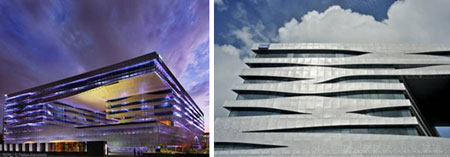
Skidmore, Owings & Merrill (SOM), has completed the nine-story, 270-room Park Hotel Hyderabad, the flagship hotel for The Park Hotel Group in Hyderabad, India. The 531,550-square-foot hotel infuses a Modern, sustainable design with local craft traditions, inspired by the region’s local gemstone and textile industries. Solar studies influenced the site orientation and building massing, with program spaces concentrated in the north and south sides, and service circulation on the west side to reduce heat gain. The guest rooms, situated on top of a podium of retail spaces, art galleries, and banquet halls are raised to allow expansive views. An elevated central courtyard features a private dining court and a swimming pool with moving patterns formed by light passing through the water. The façade provides a range of transparency relative to the interior spaces. The shape of the façade’s openings and three-dimensional patterns on its screens were inspired by the forms of the metalwork of the crown jewels of the city’s historic ruling dynasty. SOM designed the interiors to continue the jewelry concept, as well, using silver, gold, and gemstones throughout. The project is the first LEED Gold certification for a hotel in India.

In this issue:
· Pop-Up for Fashion
· Manhattan Expands Green Necklace to Tribeca
· Sephardic Community Center Doubles Its Space
· NYC Builds to Recycle
· Kliment Halsband Architects Designs for SUNY
· Marc Jacobs Opens Flagship in Hong Kong


Pop-Up for Fashion

BuildingFashion

Richard Chai’s fashions paired with Snarkitecture’s architectural design.

Photo by David B. Smith

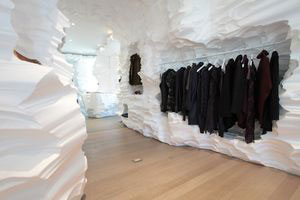
Building Fashion at HL23, a series of temporary installations that celebrates cutting-edge design under the High Line, has almost concluded. The works re-appropriate the HL23 Tin, a trailer converted and designed by Spilios Gianakopoulos with Richard Pandiscio that was used as the sales office for the Neil M. Denari Architects-designed HL23. Hosted by the non-profit arts group Boffo and Gianakopoulos, the project pairs architectural professionals with fashion designers, giving them the opportunity to showcase their work in a pop-up store environment. The line-up includes: Simon Spurr and Collective; Heather Huey and Urban A&O; House of Waris with Christian Wassmann; Richard Chai and Snarkitecture; and Siki Im and Leong Leong (one of this year’s New Practices New York winners). The teams were selected by Architizer via a national search; Supima, a provider of luxury cotton for fashion and home textiles, teamed up with konyk to design more than 4,000 square feet of outdoor space that serves as an event area for the program. The program ends on 11.15.10.


Manhattan Expands Green Necklace to Tribeca

Pier25

Pier 25 at Hudson River Park.

Signe Nielsen

Hudson River Park’s Pier 25 in Tribeca recently opened to the public. Designed by Mathews Nielsen Landscape Architects, which is responsible for the design for the entire Tribeca section of the park, the pier and adjacent area include moorings for small boats, an 18-hole miniature golf course, snack bar, beach volleyball, playground, artificial turf lawn for junior level sports, lounge seating, and a stargazing area. Almost five blocks long, Pier 25 is the longest pier in the park, which runs from Battery Place to E. 59th Street. Funding came from the Lower Manhattan Development Corp. (LMDC), along with 9/11 Community Development Grant funds. Representative Jerrold Nadler also provided funds that were used for the pedestrian parkway and a section along the esplanade. The Hudson River Park Trust continues to work on developing several other piers, including Pier 26, also in the Tribeca section, which will feature an estuarium — a river research and education center — and a boathouse that will double as a café by WXY architecture.

Sephardic Community Center Doubles Its Space

SephardicCC-extint

Sephardic Community Center.

Jonathan Wallen (left); Jeffrey Totaro

BKSK Architects has renovated and expanded Sephardic Community Center in Ocean Parkway, Brooklyn, doubling its size to 100,000 square feet. The facility serves as the educational, athletic, and social center for the surrounding community. The design features a gym, spa, childcare center, administrative offices, and meeting spaces. BKSK’s design also features subtle changes to the original façade, a layered glass and masonry composition for the new wing, and a continuous canopy that bands them together. In addition, the firm is working on the renovation of the neighboring Sephardic Synagogue. The project, which began in 2005, originally included three worship spaces, two social areas, classrooms, and offices, but the recession forced budget cuts that curtailed the project to a renovation of the existing interior.


NYC Builds to Recycle

Sims

Sims Municipal Recycling Facility.

Selldorf Architects

Ground was broken on the new Sims Municipal Recycling Facility in Sunset Park, Brooklyn. A public-private client partnership between Sims Metal Management and the City of New York, it will become the principal facility for all of the city’s metal, glass, and plastic recyclables. Designed by Selldorf Architects, the 125,000-square-foot facility, located near the entrance to the Gowanus Canal, is bounded by water on three sides and by the South Brooklyn Marine Terminal on the fourth side. It is conceived as a naturally vegetated peninsula with space carved out for the buildings and waterfront operations, including an enclosed barge unloading facility, and a materials-handling building for processing and storage of recyclables. A visitors’ center and administration building includes an exhibition space, classrooms, cafeteria, offices, and locker rooms, and is linked to observation areas in the recycling building via a pedestrian bridge. The design incorporates sustainable initiatives such as solar panels, stormwater collection, bioswales, and a wind-turbine. When completed in December 2011, the facility will minimize the distance that collection trucks travel between pick-up sites and receiving centers, allow Sims to expand its barge and rail-based transport systems, eliminate more than 260,000 vehicle miles traveled annually over city roadways, and create 100 new jobs.


Kliment Halsband Architects Designs for SUNY

SUNYGeneseo-Optometry

SUNY Geneseo’s Doty Building (left); SUNY College of Optometry.

Kliment Halsband Architects

Three projects designed by Kliment Halsband Architects for the State University of NY are currently underway. In design phase is the renovation of the SUNY College of Optometry, a vertical campus serving 300 students and more than 75,000 patients, making it one of the largest outpatient eye and vision care facilities in the country. Located across from Bryant Park, the ground floor lobby will be transformed into a passageway that traverses the entire first floor. The three floors above the lobby are being renovated for the new student life and learning center, which will include lounges, a lecture hall, seminar rooms, fitness and recreation rooms, and a methods lab.

Construction is also underway on two buildings expected to achieve LEED Gold certification. A new 146,000-square-foot academic building at SUNY College in Old Westbury will provide classrooms, faculty offices, computer labs, administrative offices, and shared instructional and support spaces for the schools of arts and sciences, education, and business. The adaptive re-use of the 69,000-square-foot Doty building at SUNY College at Geneseo will act as the “front door” to the college providing space for the admissions office and other administrative functions, as well as a new recital hall for the School of the Arts.


Marc Jacobs Opens Flagship in Hong Kong

MarcJacobs

Marc Jacobs, Hong Kong.

Stephan Jaklitsch Architects

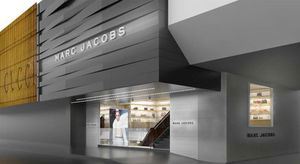
A new 1,500-square-foot Marc Jacobs flagship store designed by Stephan Jaklitsch Architects (SJA) — the seventh major Marc Jacobs project to be completed by SJA in 2010 — has recently opened on Canton Road in Hong Kong. The building has a custom black woven-like façade composed of concrete-fiber panels. A band of perforations extend across the façade, behind the custom Marc Jacobs signage, and emit LED lighting that bisects the solid mass. A frameless glass storefront provides clear views into store’s lower level; to the left of the entry a large state-of-the-art video wall sits above the stair to encourage circulation. The upper-level accessories floor sits above the threshold and features a central sycamore, glass, and stainless steel cashwrap and custom top-lit shelving displays that have become a signature of the brand.

In this issue:
· Moynihan Gains Momentum — Phase I Begins
· BPC Parks Conservancy Conserves Energy at its New Maintenance Facility
· Autobahn Alley Deals Volkswagens
· Curtain Wall Animates Science, Health, and Technology
· New England Lighthouse is Restored
· Austin Arthouse Reopens


Moynihan Gains Momentum — Phase I Begins

Moynihan

Moynihan Station.

Empire State Development

In honor of the 100th anniversary of the opening of the original Penn Station, a ceremonial ground breaking ceremony took place on the steps of the Farley Post Office building, the future home of Moynihan Station. The first phase of the project, “Moynihan Moving Forward,” will include the expansion and enhancement of the 33rd Street Connector between Penn Station and the West End Concourse, which lies under the grand staircase of the Farley building. The project will also extend and widen the West End Concourse to serve nine of Pennsylvania Station’s 11 platforms, and add new vertical access points, passenger circulation space, and entrances into the West End Concourse through the 31st and 33rd Street corners of the Farley building. The first phase of construction is expected to be complete by 2016. In March 2010, Skidmore, Owings & Merrill, which has been working on the new station since the 1990s, was contracted by the Moynihan Station Development Corporation to start design work on the first phase.


BPC Parks Conservancy Conserves Energy at its New Maintenance Facility

BPC

Battery Park City Maintenance Facility.

Dattner Architects

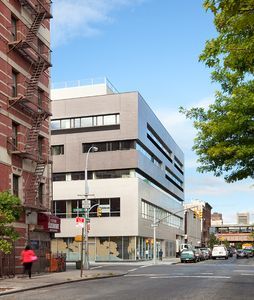
The Battery Park City Parks Conservancy now boasts a new high performance, 40,500-square-foot maintenance facility, designed by Dattner Architects, that consolidates its extensive maintenance activities, houses the organization’s educational and art workshops, and provides office and meeting spaces for the organization’s 100+ employees. The four-story facility, set in the base of the Visionaire, designed by Pelli Clarke Pelli Architects, is the only project Battery Park City (BPC) has built for its own use. It serves as an example of sustainable design integration, using a combination of low-tech, passive strategies and high-tech equipment to reduce the energy costs by 35% and water consumption by 47%. In addition to exceeding BPC’s sustainable guidelines, the project has also achieved a LEED Platinum rating for Commercial Interiors. A double-glazed exterior wall acts as a ventilated “circulation spine,” providing insulation in the summer and heat in the winter. The atrium is capped with louvered skylights to bring in natural light. In addition, the facility includes geothermal heating and cooling, radiant heating panels, recycled denim insulation, and bamboo millwork.


Autobahn Alley Deals Volkswagens

Volkswagen

Volkswagen Group of America dealership.

The Spector Group

The Spector Group has been named executive architect for the Volkswagen Group of America’s new, full-service dealership on 11th Avenue, aka Autobahn Alley. Located in a space formerly occupied by Potamkin General Motors, the design team, which includes Volkswagen’s design/brand architect Novi, MI-based Cityscape Architects, and Audi’s design/brand architect CR Studio, will transform the 260,000-square-foot facility to fit the national image of its dealerships. Volkswagen will occupy six floors, the roof, and a portion of the cellar. Plans call for blending the existing and a new façade with the interior design. Flexibility will be a key component of the design scheme. The project is now underway and is slated for completion in mid to late 2012.


Curtain Wall Animates Science, Health, and Technology

MedgarEvers

Medgar Evers College of the City University of New York School of Science, Health, and Technology.

©Aislinn Weidele/Ennead Architects

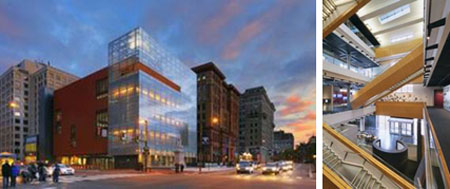
Medgar Evers College of the City University of New York, located in Crown Heights, Brooklyn, celebrated its 40th anniversary with the official opening of the five-story, 194,000-square-foot School of Science, Health, and Technology building, designed by Ennead Architects. The school occupies the top four floors of the facility and contains 16 flexibly designed teaching and research labs, 13 general classrooms, five computer labs, a 350-seat dining hall, faculty dining room, and kitchen. The glazed curtain wall provides natural light to the lobby and main corridor while open stairs animate the façade. In addition, wide corridors with seating alcoves encourage student and faculty interaction and the interdisciplinary mingling. This is the first new building of the college’s master plan, completed by Ennead Architects (formerly Polshek Partnership) in 1995. Roberta Washington Architects is the associate architect for both the master plan and the new building.


New England Lighthouse is Restored

BlockIsland

Block Island’s North Light.

Walter Sedovic Architects

After being dark in recent years, Block Island’s North Light on a bluff in Rhode Island has been restored by Walter Sedovic Architects. Recognized as an active aid to navigation by the U.S. Coast Guard, it was constructed in 1867 from local granite and cast iron. Exposure to salt-laden winds led to the deterioration of the lighthouse’s iron lantern. Restoration efforts involved intensive evaluations, logistics, and cooperative efforts to undertake this project within the confines of an environmentally sensitive site — shifting dunes, nesting habitat for migratory endangered birds, proximity to the sea, and fresh water ponds. The project also includes solar and wind clean-energy production, material salvage and recycling (the original corroded elements of cast iron were melted down at a foundry to be recast in new molded components), the use of local labor, and community education programs about sustainability.


Austin Arthouse Reopens

Arthouse

Arthouse.

Photo: © Michael Moran

Arthouse at the Jones Center, a contemporary art space in downtown Austin, TX, has reopened after an extensive $4.3 million renovation and expansion project designed by Lewis.Tsurumaki.Lewis Architects (LTL). Formerly a 1920s movie palace and a department store in the 1950s, the building now intertwines historical features with contemporary additions. The original Queen Theater’s large stucco murals, for example, are now visible, along with the original wooden ceiling; steel trusses and a sculptural plaster awning reference the former department store. The usable space of the building has been expanded from 7,000 to 20,830 square feet, as the previously inaccessible second floor now contains a large column-free gallery. In addition, the building has been reconfigured to house an entry lounge, galleries, a dedicated video/film gallery, a 90-seat community/screening room, two studios, a public mezzanine lounge, and a rooftop event space. The exterior skin of the building is perforated with 177 custom laminated glass units, which are clustered to selectively allow light into the building. Illuminated by LED lights at night, the blocks animate the public face of the building.