At the Center for Architecture

Current Exhibitions
Upcoming Exhibitions
Past Exhibitions

Join an Architalker for a Hosted Tour of Center for Architecture
Exhibitions

Join us for free Architalker-hosted tours of the Center for Architecture exhibitions Fridays at 4:00pm. To join one of these tours, meet in the Public Resource Area on the ground floor of the Center for Architecture.

Gallery Hours
Monday–Friday: 9:00am–8:00pm, Saturday: 11:00am–5:00pm, Sunday: CLOSED

CURRENT EXHIBITIONS

January 15 - March 24, 2007

School Buildings – The State of Affairs

Gallery: Kohn Pederson Fox Gallery, HLW Gallery, South Gallery


Falletsche School, Zurich-Leimbach, Switzerland
Gempeler

Related Events

Thursday, February 1, 2007, 6:00 — 8:00pm
Opening

Saturday, February 3, 2007, 1:00pm — 5:00pm
Symposium
A new architecture for a new education

CES credits available

Wednesday, February 7, 2007, 4:30 — 6:30pm
Educator’s Open House

Saturday, February 10, 2007, 1:00 — 4:00pm
FamilyDay@theCenter: Schools of the Future

Today’s educators require flexible spaces that can satisfy multiple functions and future demands and they are in need of spaces that enhance modern teaching as well as a student’s personal development. Communities request to share facilities and services, and changing social patterns require new services at schools. In response, architects design schools that feel, look and function differently, having become learning and community centers. It’s a new architecture for a new education. This exhibition illustrates this process and the schools that have been built in the course of it. It contains 31 examples of recently built or designed schools from Zurich Switzerland along with examples from Finland, Germany, the Netherlands, Scandinavia, and Austria. It facilitates a dialog among educators, architects, and the community, strikingly similar to the efforts than have been made in New York over the past few years. It will make for an interesting and fruitful dialog. Click here to see a complete list of all schools showcased in the exhibition.

The current exhibition is organized by:

AIA New York Chapter Committee on Architecture for Education, Umberto Dindo, AIA, Chairman ETH Zurich / Center
for Cultural Studies in Architecture (CCSA), Martin Schneider, scientific associate, dipl. arch. ETH Zurich

The exhibition is a site-specific presentation of a traveling exhibition originally organized by: ETH Zurich / Center for Cultural Studies in Architecture (CCSA), City of Zurich Building Authority, School and Sport Authority, and the Zurich University of Teacher Education.

Exhibition Underwriters:
Credit Suisse, City of Zurich, ETH Zurich, Department of Architecture


Credit Suisse
 

City of Zurich
 

ETH Zurich


March 22 to June 16, 2007

POWERHOUSE
New Housing New York

Galleries: Street Gallery, Public Resource Center, Judith and Walter Hunt Gallery, Mezzanine Gallery

Dattner_Grimshaw_LR
Winning proposal
Phipps Rose Dattner Grimshaw

Related Events

Thursday, March 22, 2007, 6:30 – 8:00pm
Opening

Monday, April 9, 2007, 6:00 – 8:00pm
Panel Discussion with Winning and Runner-up Teams

Monday, April 16, 2007, 6:00 – 8:00pm
Panel Discussion with Three Finalists

TBD
Green Design

Wednesday, May 16, 2007, 6:00 – 8:00pm
NHNY: Best Practices for Affordable Sustainable Housing – What worked, what didn’t?

Saturday, April 14, 2007, 1:00 – 4:00pm
FamilyDay@theCenter: House + Home

TBD
Family Day in the Bronx

Power House illuminates the people, projects, and public policies that fuel the affordable housing landscape in New York City.

As New York City’s first juried design competition for affordable, sustainable housing, the New Housing New York Legacy Project (NHNY) is generating creative, replicable approaches to urban development. The exhibition focuses on the NHNY competition and sets it within the context of the city’s efforts to preserve and development sustainable, financially viable residences for low- and middle-income New Yorkers. The show’s emphasis is on the future of housing in the city, as represented by the competition winner, Phipps Rose Dattner Grimshaw (Phipps Houses / Jonathan Rose Companies / Dattner Architects / Nicholas Grimshaw & Partners), the four finalists, and the development mechanisms put in place by Mayor Bloomberg’s 10-year New Housing Marketplace initiative and the Department of Housing Preservation and Development.

Building on the 2004 New Housing New York Ideas Competition, the 2006 two-stage contest will result in construction of the winning design on a 40,000 square-foot Bronx site, which is valued at $4.3 million and was donated by The City of New York.

For the full list of finalists click here

Curator: Abby Bussel
Exhibition and Graphic Design: Casey Maher

Organized by: AIA New York Chapter,
New Housing New York Steering Committee and the
City of New York Department of Housing Preservation and Development with the additional support of the Center for Architecture Foundation and the AIA New York Chapter Housing Committee

Exhibition Underwriters:


Exhibition Patron:


For more information on the New Housing New York Legacy Project click here

NHNY is a partnership between the American Institute of Architects New York Chapter, the City of New York Department of Housing Preservation and Development, and the New York State Energy Research and Development Authority. Additional support is provided by the Center for Architecture Foundation, and City University of New York.

The NHNY Legacy Project is sponsored by the New York State Energy Research and Development Authority, the National Endowment for the Arts, Enterprise Community Partners, Inc., an AIA National Blueprint Grant, JP Morgan Chase, and Citibank.


March 22 — June 2, 2007

Making Housing Home

Photographs with residents of New York City housing developments

Galleries: Library


Norma’s House
Gabrielle Bendiner-Viani

Related Events

Wednesday, March 28, 2007, 6:00 pm
Opening

Wednesday, May 30, 2007, 6:00 – 8:00 pm
Panel Discussion: Social Housing and the Social Contract

Saturday, April 14, 2007, 1:00 – 4:00pm
FamilyDay@theCenter: House + Home

This photographic exhibition explores how people inhabit housing to create homes in two of New York City’s affordable housing developments, each of which were developed to provide good homes for all. Because units of housing are in essence homes for families, this project takes an interior look at what architecture can allow and support, to afford the crucial process of making space for oneself within designed spaces and housing markets. If social housing reflects the social covenant of our society, what is it to which every citizen is entitled? What does it take for a life to flourish and can a building help or hinder this process? What becomes of designed spaces once they are inhabited?

An Installation by Gabrielle Bendiner-Viani

Exhibition underwriters: Related Apartment Preservation, 42nd Street Development Corporation, Barbara Stanton

Organized with: Center for Human Environments, Housing Environments Research Group, The Graduate Center, CUNY

03.06.07

03.06.07

Thank you for all of the positive feedback about the new eOCULUS design. I received many comments, coming from as far as Scotland! I am continuing to make adjustments as each issue is published (notice the larger font size!), so please send me an e-mail with any comments/ suggestions and I will do my best to address them.
– Jessica Sheridan, Assoc. AIA, LEED AP

Architect, Musician Battle for Resonating Frequency

Event: Resonating Frequencies
Location: Center for Architecture, 02.23.07
Speakers: David Byrne – former leader, Talking Heads & star, “Stop Making Sense”; Elizabeth Diller – partner, Diller Scofidio + Renfro
Moderator: Christopher Janney – artist, designer, author, Architecture of the Air: The Sound and Light Environments
Organizers: AIA New York Chapter
Sponsors: The Center for Architecture; Graham Foundation for Advanced Studies in the Fine Arts

Diller Scofidio + Renfro

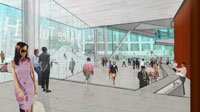
Conceptual rendering of Alice Tully Hall lobby, designed by Diller Scofidio + Renfro with FXFOWLE Architects. Bravo Lincoln Center Redevelopment.

Diller Scofidio + Renfro

“Does the venue shape the music or does the music shape the venue?” posed moderator Christopher Janney, designer and author of Architecture of the Air: The Sound and Light Environments. In a dialogue between musician David Byrne (arguing the former), and Elizabeth Diller, partner of Diller Scofidio + Renfro (arguing the latter), it was agreed that the question is cyclical.

To demonstrate how the venue shapes music, Byrne discussed how musicians often write music with a specific venue in mind. A punk band aiming to play at a club like CBGB’s, for example, would not write music that can be performed in an opera house. In the 1970s, composers Steve Reich and Meredith Monk began their careers performing at The Kitchen, which was a small loft space in Chelsea at that time. The repetition in their music reverberated off of the walls and tangibly washed over audiences, according to Byrne. This effect is not possible in larger concert halls.

The future of music is unpredictable, as the current venues of choice seem to exist in extremes, from arenas – where music is secondary to the communal mass experience – to the very individual iPod or automobiles. Since there have not been any venues designed specifically for popular music, Byrne wonders how the genre would change if there were.

Diller, on the other hand, argued that a venue is an extension of the performers and performances. Using the Diller Scofidio + Renfro with FXFOWLE Architects-designed Alice Tully Hall renovation as an example, she discussed the challenges of designing a music hall specifically aimed at becoming world-renowned for chamber music. Since there were strict rules – do not harm the acoustics, retain the structure of the existing hall, and keep all 1,100 seats – the project is 18 inches thick around the perimeter.

The guiding design theme addresses the psycho-musical experience, according to Diller, rather than acoustics. A high-performance wood veneer over a thin layer of resin sheathes the perimeter in a smooth, curving acoustic skin. Instead of using applied light fixtures, LED’s rest behind the resin creating a red/orange glow as lights are raised or lowered for the performance. The walls are isolated to reduce vibration from the subway. By eliminating visual and audio distractions, the listening experience becomes the focal point of the concert hall, and the music perceptually sounds better.

Both musician and architect agreed that ultimately both music and venue evolve from culture. A venue like Carnegie Hall was built for a specific type of music; it became a true destination for audiences; in turn, musicians began to play music that could be performed there. Patronage and audience determine the future of music and venue, and architects and musicians must please both.

WNYC’s Soundcheck recently invited Christopher Janney, David Byrne, and Ben Gilmartin (a prpject leader at Diller Scofidio + Renfro) to discuss the intersections of music and architecture. Click the link to listen to the show.

Proposed Pedicab Protocol Not So Appalling

This past week, a debate ignited regarding NYC Council’s proposed pedicab regulations, Intro. 75-A and Intro. 331-A. I may be in the minority, but after reading through the legislation, I feel that much of the regulation is reasonable and will provide a higher level of safety much-needed on busy NYC streets.

The first valid ruling is that drivers must own a license and attach a license plate to their pedicabs; licenses are to be renewed every two years. In order to obtain a license, drivers must complete a safety course, pass an exam administered by the Department of Cultural Affairs (DCA) with the Department of Transportation (DOT), be at least 18 years old, and pass any DCA-determined fitness requirements. Business owners must obtain a business license, renewed annually. Drivers must also have liability insurance that covers the “amount required by the vehicle and traffic law for vehicles carrying passengers.”

The local law also outlines a number of common-sense safety features to be incorporated into every pedicab vehicle. Included are: seating for up to three passengers; installation of water-resistant breaks; secondary or emergency breaks; battery-operated headlights and taillights; turn signals; seat belts; audible signaling devices; and reflectors on wheel spokes. To be integrated into pedicab designs (which must be motor-less and have maximum dimensions of 55-inches-wide by 10-feet-long) are timers that calculate ride rates, visible posting of pedicab business information, and visible rate-charge information. Pedicab operators can determine their own rates, but they must be posted. It is difficult to argue against any of the above decrees, in my opinion.

There are some debatable rulings included in the new law, however. Those who are opposed to the law target an item that gives the police the ability to restrict pedicabs from certain areas up to 14 days during “unusual heavy pedestrian or vehicular traffic.” In Midtown, from November 12 through January 7, there will be no limit to police restrictions due to the holidays. At first glance, this might seem unreasonable considering that the holidays are a time when pedicabs might profit the most, and the police may abuse this rule, but the text explains that unusual heavy traffic means during emergencies, fires, demonstrations, accidents, and parades. Of course I am against the misuse of the ruling, but the text itself does not pose a problem for me.

The one item of the legislation that I do disagree with, and is perhaps the most contentious, is the restriction of the number of pedicabs allowed in the city – 325, limiting the existing 500+. The pedicab business is new to the city. With time, it may prove to be a viable, more environmentally friendly alternative to taxicabs, car services, buses, and subways. I believe the city has a responsibility to legislate for people’s safety, and it is doing its job by instituting the new pedicab law, but it should not smother new forms of business that have the potential to thrive.

In this issue:
• SAVE THE DATES: 2007 AIA New York Chapter Design Awards Celebrations
• Students Converge for Day in the Field


SAVE THE DATES: 2007 AIA New York Chapter Design Awards Celebrations

2007 AIA New York Chapter Design Awards Celebrations

04.11.07 Design Awards Luncheon for Award Recipients and their clients
04.12.07 Design Awards Exhibition Opening at the Center for Architecture


Students Converge for Day in the Field

Event: AIAS Convergence Meet and Greet
Location: Center for Architecture, 02.24.07
Speakers: Winners of the New Practice Showcase, a competition sponsored by the AIA New Practice Roundtable Committee
Organizers: AIAS City College of New York; Cornell University; New York Institute of Technology
Sponsors: AIA NYS; AIANY; Cornell University; City College of New York

Onur Ekmecki

CCNY students celebrate AIAS Convergence: NYC. (l-r): Ruth Romero, Juan Gomez, Eric Scandlon, Yuriy Tkachenko, Mubeen Ahmad, Yuliya Ilizarov, Romell Gordillo, Carolina Cristancho, Johanna Prieto.

Onur Ekmecki

Lisa Wan

Participating in Convergence events, SHoP gives a firm tour.

Lisa Wan

With panel discussions, firm visits, and a party at Thor, students from Cornell University, City College of NY, NY Institute of Technology, Rensselaer Polytechnic Institute, and Syracuse University convened February 24 to socialize, network, and discover the field of architecture at this year’s Convergence: NYC.

Thirteen firms participated in this event by giving tours, opening doors to the future generation of architects. Firms included: Dattner Architects, REX, Mancini Duffy, Diller Scofidio+Renfro, Pei Cobb Freed & Partners, Perkins+Will, Beyer Blinder Belle Architects & Planners, Rafael Viñoly Architects, Grimshaw Architects, FLANK, HOK, SHoP, and FXFOWLE Architects. Representatives presented their firms’ works in detail, answering questions about projects, working environments, and employment.

The panel discussion, “Architecture: The New Practice,” moderated by Nino Hewitt of LEVEL Architecture, featured winners of the New Practices Showcase, a competition sponsored by the New Practice Roundtable. Matthew Bremer, AIA, of Architecture In Formation, Dan Wood, AIA, of Work Architecture Company, and Marc Clemenceau Bailly of Gage/Clemenceau Architects presented their work. Topics at the Q&A session ranged from how they started their practices (all of the panelists started their practices four years ago), and general challenges of their practices, to hiring processes. Questions addressed ideal firm size (all agreed between 15 and 40 employees), and the role of architect versus the developer (all agreed the two roles should remain separate).

The success of the event was not only in the fact that three times the number of students participated this year compared with last, but that students felt they had a new understanding of the field and their peers.

Open Architecture Network

Open Architecture Network

The Open Architecture Network.

Courtesy Architecture for Humanity

After receiving last year’s TED Prize, Architecture for Humanity is launching a beta version of the Open Architecture Network (OAN) on 03.08.07. The website will allow designers, community groups, and NGOs to browse, post projects, discuss relevant topics, contribute to shared resources, collaborate with each other, and access project management tools. The goal is to develop a site that will support innovative, sustainable, and collaborative design solutions for improving standards of living, according to the mission statement. To learn more, check out the website. An interview with Cameron Sinclair, Executive Director and co-founder of Architecture for Humanity, is also available on TreeHugger Radio.

Courtesy James Fischer

The Swiss Delegation visits the Center for Architecture. (l-r): Cathy Daskalakis – co-chair of the AIANY Education Committee; Gabriela Eigensatz – Cultural Attaché, The Consulate General of Switzerland in New York; Charles Kleiber – Swiss State Secretary for Education and Research; Gérard Escher – Assistant Director, Head of Analyses and Forecasts Division; James Fischer – chair of the AIANY International Committee.

Courtesy James Fischer

resonatingfrequencies.jpg

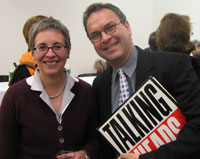
The talking heads of AIANY: Cynthia Kracauer, AIA, LEED AP, AIANY Managing Director, with Rick Bell, FAIA, AIANY Executive Director at the Resonating Frequencies event at the Center for Architecture.

Steve Friedman

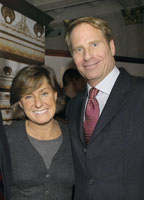
Swig Equities celebrated its latest project, The Exchange at 25 Broad Street. Kent Swig, President, is pictured above with wife, Liz.

Steve Friedman

Steve Friedman

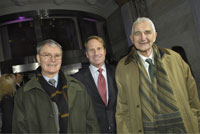
(l-r): Real Estate Agent Frank Arfmann of Brown Harris Stevens, Kent Swig, and MacRae Parker, Jr., Senior Vice President and Managing Director at Brown Harris Stevens at the Swig Equities event.

Steve Friedman

Gallery Hours
Monday–Friday: 9:00am–8:00pm, Saturday: 11:00am–5:00pm, Sunday: CLOSED


Falletsche School, Zurich-Leimbach, Switzerland
Gempeler

Related Events

Thursday, February 1, 2007, 6:00 — 8:00pm
Opening

Saturday, February 3, 2007, 1:00pm — 5:00pm
Symposium
A new architecture for a new education

CES credits available

Wednesday, February 7, 2007, 4:30 — 6:30pm
Educator’s Open House

Saturday, February 10, 2007, 1:00 — 4:00pm
FamilyDay@theCenter: Schools of the Future

January 15 - March 24, 2007

School Buildings – The State of Affairs

Gallery: Kohn Pederson Fox Gallery, HLW Gallery, South Gallery

Today’s educators require flexible spaces that can satisfy multiple functions and future demands and they are in need of spaces that enhance modern teaching as well as a student’s personal development. Communities request to share facilities and services, and changing social patterns require new services at schools. In response, architects design schools that feel, look and function differently, having become learning and community centers. It’s a new architecture for a new education. This exhibition illustrates this process and the schools that have been built in the course of it. It contains 31 examples of recently built or designed schools from Zurich Switzerland along with examples from Finland, Germany, the Netherlands, Scandinavia, and Austria. It facilitates a dialog among educators, architects, and the community, strikingly similar to the efforts than have been made in New York over the past few years. It will make for an interesting and fruitful dialog. Click here to see a complete list of all schools showcased in the exhibition.

The current exhibition is organized by:

AIA New York Chapter Committee on Architecture for Education, Umberto Dindo, AIA, Chairman ETH Zurich / Center
for Cultural Studies in Architecture (CCSA), Martin Schneider, scientific associate, dipl. arch. ETH Zurich

The exhibition is a site-specific presentation of a traveling exhibition originally organized by: ETH Zurich / Center for Cultural Studies in Architecture (CCSA), City of Zurich Building Authority, School and Sport Authority, and the Zurich University of Teacher Education.

Exhibition Underwriters:
Credit Suisse, City of Zurich, ETH Zurich, Department of Architecture


Credit Suisse
 

City of Zurich
 

ETH Zurich


South Bronx Charter School for the Arts, Hunts Point, NY, Weisz + Yoes Studio
Albert Vecerka/Esto

January 16 — March 17, 2007

Schools of the Future — US Case Studies

Gallery: Library

What is the relationship between pedagogical visions and spaces for children? This question is pivotal to understanding good school architecture. Currently there is widespread emphasis on innovative approaches to education that reflect a more personalized conception of learning than prevailed during the 20th century. This exhibition presents a selection of significant school designs from across the US.

Organized by:Ria Stein, Berlin; Texts by Mark Dudek, London; Design by Oliver Kleinschmidt, Berlin

The exhibition is based on the book Schools and Kindergartens — A Design Manual by Mark Dudek, published by Birkhauser Verlag AG

Exhibition sponsored by:
Skidmore, Owings and Merrill


Jason Bruges Studio

Related Events

Friday, January 12, 2007
Opening Party
Talk with designer Jason Bruges, 5:30 — 6:30pm
Party, 6:30 — 10:00pm

Wednesday, January 17, 2007, 5:30 — 8:00pm
LEDucation
A new architecture for a new education

CES credits available

Saturday, March 10, 2007, 1:00 — 4:00pm
Shadow Play — Family Day @ the Center

January 12 — March 10, 2007

Visual Echo

Gallery: Gerald D. Hines Gallery

This interactive light installation acts as a meandering ribbon of light by remembering the colors visitors wear. While also recording the rhythm and frequency of visitors, the ribbon transforms the viewer’s perception of space. Using cutting edge LED tiles, this work by Jason Bruges Studio demonstrates exciting new potentials and questions how light, space and color can interrelate in architectural space.

Organized by: The AIA New York Chapter in partnership with the Illuminating
Engineering Society, New York Section (IESNY), the International Committee
AIA New York Chapter, and the Royal Society of the Arts

Exhibition Underwriters:
Color Kinetics, SKYY 90


Kinetics


SKYY90


SKYY90

*Opening Party
presented as part
of the SKYY90
Diamond Design Series

To celebrate the 150th anniversary of the founding of the AIA, e-OCULUS is launching its new design. The website is more interactive and user-friendly, thanks to graphic designer Rachel Schauer and web technician Kevin Skoglund. New sections and features will be added throughout the year, so keep an eye out for more changes. Voice your opinion in The Measure section, or send me an e-mail.

– Jessica Sheridan, Assoc. AIA, LEED AP
02.23.07

America’s Favorite Brands Define Architectural History

“When you ask people to select their favorites… they choose buildings that hold a place in their hearts and minds,” said RK Stewart, FAIA, 2007 AIA President, of the recently released America’s Favorite Architecture list. The public poll compiled 150 “best works of architecture” in celebration of the sesquicentennial anniversary of the AIA’s founding. Many of the buildings are what you might expect – a garden variety of classical icons that speak of patriotism and democracy. Most of the buildings are accessible to the public, whether they are hotels, museums, transportation hubs, or memorials. Indicative of the types of buildings included, the Empire State Building tops the list. The list is generally uninteresting to me (as are most survey results), but the fact that only 21 buildings were constructed in the last 10 years does compel me to question why practicing architects are generally unsuccessful at tugging the heartstrings of the general public.

Perhaps it is a good sign that the largest percentage of those 21 recently constructed buildings are located in NY (six in NYC and one in Long Island). However, three are places where people go to shop: the city’s two Apple stores (#53 and #141) and the Time Warner Center (#105). We are a consumer-oriented society, and we spend more time interacting with retail architecture, maybe more than other types of architecture. So it could be good that people are considering the architectural experience rather than an image. Then again, the Hearst Tower (#71) is inaccessible to the public, and the New York Times Building (#68) is still under construction.

Ultimately, I think it all comes down to branding. Name recognition is at the forefront of the public’s and architects’ minds (after all, it was architects that came up with the initial 248 buildings). Currently, corporations are striking a chord more so than the buildings themselves – and that does not bode well for the future of architecture.