Gallery Hours
Monday–Friday: 9:00am–8:00pm, Saturday: 11:00am–5:00pm, Sunday: CLOSED

Join an Architalker for a Hosted Tour of Center for Architecture
Exhibitions

Join us for free Architalker-hosted tours of the Center for Architecture exhibitions Fridays at 4:00pm. To join one of these tours, meet in the Public Resource Area on the ground floor of the Center for Architecture.

CURRENT EXHIBITIONS


April 9-July 7, 2007

2007 AIA New York Chapter Design Awards

Galleries: Kohn Pedersen Fox Gallery, HLW Gallery, South Gallery, Edgar A. Tafel Hall

Related Events

Monday, February 12, 2007, 6:00–8:00pm
Symposium

Monday, April 9, 2007, 7:00–10:00pm
Opening

Wednesday, April 11, 2007, 11:30am–2:30pm
Luncheon

A showcase of the 2007 award-winning projects in three categories-Architecture, Interiors, and Projects. Selected from hundreds of international, national and local submissions, these projects spotlight the extraordinary achievements in architectural design excellence happening in New York City and around the world.

Exhibition and Graphic Design: Graham Hanson Design

Organized by: AIA New York Chapter and the AIA New York Chapter Design Awards Committee

Benefactor: DIRTT,
Oldcastle Glass


DIRTT

oldcastle
 

Patron:

HOK,
Microsol Resources,
F.J. Sciame Construction,
Laticrete International,
Trespa


HOK

Microsol Resources

Sciame


Laticrete International

Trespa

Lead Sponsor: Certified of New York, Inc., Columbia, KI, Langan, Mancini Duffy, Richter + Ratner, Syska & Hennessy

Cert Columbia KI Langan
Mancini Duffy Richter + Ratner Syska & Hennessy  

Sponsors:
Atkinson Koven Feinberg; Bauerschmidt & Sons, Inc.; Bentley Prince Street; Beyer Blinder Belle: Architects and Planners; Cosentini Associates; Costas Kondylis & Partners; Forest City Ratner Companies; FXFOWLE ARCHITECTS; Gensler; Gilsanz Murray Steficek; Haworth; Hopkins Foodservice Specialists, Inc.; The I. Grace Company, Inc.; Ingram, Yuzek, Gainen, Caroll & Bertolotti; Lutron; Mechoshade Systems; New York University School of Continuing and Professional Studies: The Real Estate Institute; Perkins + Will; Peter Marino Architect; Skidmore, Owings & Merrill; Steelcase, Inc.; Studio Daniel Libeskind; Swanke Hayden Connell Architects; Thornton-Tomasetti Group; Turner Construction


April 12–June 23, 2007

NY 150+: A Timeline
Ideas, Civic Institutions, and Futures

Galleries: Gerald D. Hines Gallery


AIA 150 Logo

Related Events

Thursday, April 12, 2007, 7:00–10:00pm
Opening

To commemorate the 150th anniversary of the founding of the American Institute of Architects in New York City, the AIA New York Chapter will feature an exhibition charting the transformation of the city and the profession from 1857 through the present and into the future. Genetic lines tracing the founding of the institute will intersect with various democratic and social movements and the architecture of New York’s civic structures.

Curator: Diane Lewis

Organized by: Organized by the AIA New York Chapter and the Center for Architecture Foundation

Exhibition Underwriters:


*opening presented by Ibex

The exhibition is supported in part by an Arnold W. Brunner grant from the AIA New York Chapter

Additional support is provided by: Peter Schubert, AIA; FXFOWLE ARCHITECTS


March 22 to June 16, 2007

POWERHOUSE
New Housing New York

Galleries: Street Gallery, Public Resource Center, Judith and Walter Hunt Gallery, Mezzanine Gallery

Dattner_Grimshaw_LR
Winning proposal
Phipps Rose Dattner Grimshaw

Related Events

Monday, April 9, 2007, 6:00 – 8:00pm,
CES 1.5, HSW
Panel Discussion with Winning Team
and Honorable Mention Team

Wednesday, April 11, 2007, 5:30 – 7:30pm
384 East 149th St., Bronx, NY, 3rd Floor
BX Community Board 1 Presentation

Saturday, April 14, 2007, 1:00 – 4:00pm
FamilyDay@theCenter: House + Home

Saturday, April 14, 2007, 12:00 – 2:00pm
1040 Grand Concourse at 165th St., Bronx, NY
FamilyDay@the Bronx Museum of the Arts
www.bronxmuseum.org

Monday, April 16, 2007, 6:00 – 8:00pm, CES 1.5, HSW
Panel Discussion with Three Finalists

Wednesday, May 16, 2007, 6:00 – 8:00pm, CES 1.5, HSW
NHNY: Best Practices for Affordable Sustainable Housing –
What worked, what didn’t?

Making Green Design More Accessible
TBD, CES 1.5, HSW

Power House illuminates the people, projects, and public policies that fuel the affordable housing landscape in New York City.

As New York City’s first juried design competition for affordable, sustainable housing, the New Housing New York Legacy Project (NHNY) is generating creative, replicable approaches to urban development. The exhibition focuses on the NHNY competition and sets it within the context of the city’s efforts to preserve and development sustainable, financially viable residences for low- and middle-income New Yorkers. The show’s emphasis is on the future of housing in the city, as represented by the competition winner, Phipps Rose Dattner Grimshaw (Phipps Houses / Jonathan Rose Companies / Dattner Architects / Nicholas Grimshaw & Partners), the four finalists, and the development mechanisms put in place by Mayor Bloomberg’s 10-year New Housing Marketplace initiative and the Department of Housing Preservation and Development.

Building on the 2004 New Housing New York Ideas Competition, the 2006 two-stage contest will result in construction of the winning design on a 40,000 square-foot Bronx site, which is valued at $4.3 million and was donated by The City of New York.

For the full list of finalists click here

Curator: Abby Bussel
Exhibition and Graphic Design: Casey Maher

Organized by: AIA New York Chapter,
New Housing New York Steering Committee and the
City of New York Department of Housing Preservation and Development with the additional support of the Center for Architecture Foundation and the AIA New York Chapter Housing Committee

Exhibition Underwriters:


Exhibition Patron:


For more information on the New Housing New York Legacy Project click here

NHNY is a partnership between the American Institute of Architects New York Chapter, the City of New York Department of Housing Preservation and Development, and the New York State Energy Research and Development Authority. Additional support is provided by the Center for Architecture Foundation, and City University of New York.

The NHNY Legacy Project is sponsored by the New York State Energy Research and Development Authority, the National Endowment for the Arts, Enterprise Community Partners, Inc., an AIA National Blueprint Grant, JP Morgan Chase, and Citibank.


March 22 — June 2, 2007

Making Housing Home

Photographs with residents of New York City housing developments

Galleries: Library


Norma’s House
Gabrielle Bendiner-Viani

Related Events

Saturday, April 14, 2007, 1:00 – 4:00pm
FamilyDay@theCenter: House + Home

This photographic exhibition explores how people inhabit housing to create homes in two of New York City’s affordable housing developments, each of which were developed to provide good homes for all. Because units of housing are in essence homes for families, this project takes an interior look at what architecture can allow and support, to afford the crucial process of making space for oneself within designed spaces and housing markets. If social housing reflects the social covenant of our society, what is it to which every citizen is entitled? What does it take for a life to flourish and can a building help or hinder this process? What becomes of designed spaces once they are inhabited?

An Installation by Gabrielle Bendiner-Viani

Exhibition underwriters: Related Apartment Preservation, 42nd Street Development Corporation, Barbara Stanton

Organized with: Center for Human Environments, Housing Environments Research Group, The Graduate Center, CUNY

04.03.07

04.03.07

Next week is Architecture Week! Included among the many celebratory events is a plaque unveiling at the site where the founding of the AIA took place — 111 Broadway (the Trinity Building) designed by Francis Hatch Kimball. Stop by at 6:00pm, Friday, April 13. And check out the AIA NY Chapter’s online calendar for more related events.
– Jessica Sheridan, Assoc. AIA, LEED AP

LDN vs. NYC: Only the Cleanest Will Survive

New plans to green cities, countries, and the world seem to be popping up everywhere. Similar to Mayor Bloomberg’s PlaNYC, the Mayor of London’s office recently announced its “London Plan.” Although it is difficult to tell how successful these initiatives will be — goals and objectives have only been laid out at this point — I believe a global discussion about reducing carbon emissions beyond the Kyoto Protocol is a step in the right direction.

The two plans were the subject of a recent discussion at the Center for Architecture, 03.27.07, organized by the Forum for Urban Design and sponsored by the AIA NY International Committee. Debbie McMullen, who is heading the planning team in London’s Mayor’s office, and Rohit Aggarwala, Director of the Mayor’s Office of Long Term Planning and Sustainability, agreed that both cities can and should learn from each other as each initiative progresses.

The London Plan — which was generated by 2007 Pritzker Prize-winning Richard Rogers — lays out a series of targeted goals rather than a prescriptive set of rules, allowing for the plan to adjust as the market requires, explained McMullen. In order to reach 30% carbon reduction by 2025, the Mayor’s approach is to educate residents to change their behavior, retrofit buildings to make them more energy efficient, and to design for zero carbon emissions in all future development. The plan incorporates the established congestion charging, and initiates new strategies such as developing radial mass-transit routes, expanding canal systems, constructing new sustainable buildings while allowing for appropriate historical preservation, and providing a range of “social housing” types (50% affordable housing is the current goal). Perhaps most important is that the Greater London Authority (GLA) is partnering with private organizations to help with funding and oversight.

PlaNYC has 10 goals that are divided into three categories. OpeNYC aims to improve travel times, create more affordable housing, and ensure all residents live within a 10-minute walk to a park. MaintaiNYC will provide cleaner water, reliable power, and a state of good repair throughout city infrastructure. Finally, greeNYC will reduce global warming emissions by more than 30%, achieve “the cleanest air of any big city in America” (according to the website), clean contaminated land, and reduce water pollution.

Both plans seem to have the same goals. Questions about their effectiveness remain. Which city will be more successful? Will the GLA’s involvement in the implementation of the London Plan be more effective than a lack of a designated oversight committee in NYC? Will the NY State government impede NYC’s progress — a level of bureaucracy that does not pertain to London? Will the fact that Mayor Bloomberg has a term limit help give NYC an extra push forward, or will a concern for his legacy hinder long-term planning? Will the 2012 Olympics aid or hamper London’s Plan? Only time will tell.

No Impact Man Steps it Up

In case you haven’t heard, there is a man with a family in NYC aiming to put us all to shame. Colin Beaven, or No Impact Man as he calls himself on his blog, is spending one year with his wife, two-year-old daughter, and dog, attempting to live without making a net impact on the environment. He is documenting his experiences daily, so check out the website often. In the future there will be a book and documentary film as well.

Feeling environmentally irresponsible? Well, Step It Up 2007 might help. Acting as an organizing hub for the National Day of Climate Action, 04.14.07, the website lists national gatherings, rallies, events, and a blog with frequent postings by Bill McKibben, author of The End of Nature and Enough: Staying Human in an Engineered Age. Throughout the day, links to the events will be posted. The aim is to “have the largest protest the country has ever seen, not in numbers but in extent.” To find a local activity, or list your own, click the link.

Edgar Tafel, FAIA

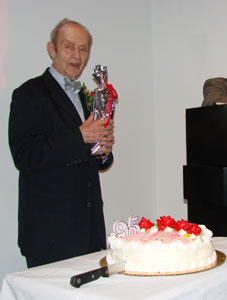
Edgar Tafel, FAIA, celebrates his 95th birthday at the Center for Architecture.

Annie Kurtin

photo by Kristen Richards

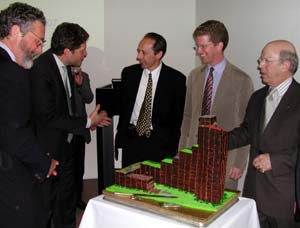
Let them eat cake: New Housing New York winning design as layer cake. (l-r): Jonathan Rose; Commissioner David Burney, AIA, NYC Dept. of Design + Construction; Commissioner Shaun Donovan, NYC Dept. of Housing Preservation and Development; and Lance Jay Brown, FAIA.

Kristen Richards

photo by Jessica Sheridan

Members of the AIANY Emerging NY Architects (ENYA) Committee met with Roman city planning officials, TEVERETERNO representatives, and NYC urban planners to discuss the benefits of international competitions. (l-r): Anna Maria Rosati, Executive Director of TEVERETERNO; Omar Mitchell, Assoc. AIA, ENYA co-chair; Gennaro Farina, Director of Historic Center, Department of City Planning, Rome; Joanne Fernando, AIA, ENYA; Nigel Ryan, architect, Rome; Sean Rasmussen, ENYA; Carolyn Sponza, AIA, ENYA; Michael Fishman, advisory board member, Metropolitan Waterfront Alliance. (see Reports from the Field).

Jessica Sheridan

photo by Kristen Richards

03.22.07: Lewis.Tsurumaki.Lewis (LTL) gang at opening of “New New York: Fast Forward” at the Urban Center (l-r): Marc Tsurumaki, AIA; Robert Kliment, FAIA; Paul Lewis, AIA; and David J. Lewis.

Kristen Richards

photo by Kristen Richards

03.21.07: John Newman, AIA, and Cat Lindsay of Lindsay Newman Architects threw a party at Cooper-Hewitt for clients and friends “just because.”

Kristen Richards

Gallery Hours
Monday–Friday: 9:00am–8:00pm, Saturday: 11:00am–5:00pm, Sunday: CLOSED

Join an Architalker for a Hosted Tour of Center for Architecture
Exhibitions

Join us for free Architalker-hosted tours of the Center for Architecture exhibitions Fridays at 4:00pm. To join one of these tours, meet in the Public Resource Area on the ground floor of the Center for Architecture.

CURRENT EXHIBITIONS


March 22 to June 16, 2007

POWERHOUSE
New Housing New York

Galleries: Street Gallery, Public Resource Center, Judith and Walter Hunt Gallery, Mezzanine Gallery

Dattner_Grimshaw_LR
Winning proposal
Phipps Rose Dattner Grimshaw

Related Events

Monday, April 9, 2007, 6:00 – 8:00pm,
CES 1.5, HSW
Panel Discussion with Winning Team
and Honorable Mention Team

Wednesday, April 11, 2007, 5:30 – 7:30pm
384 East 149th St., Bronx, NY, 3rd Floor
BX Community Board 1 Presentation

Saturday, April 14, 2007, 1:00 – 4:00pm
FamilyDay@theCenter: House + Home

Saturday, April 14, 2007, 12:00 – 2:00pm
1040 Grand Concourse at 165th St., Bronx, NY
FamilyDay@the Bronx Museum of the Arts
www.bronxmuseum.org

Monday, April 16, 2007, 6:00 – 8:00pm, CES 1.5, HSW
Panel Discussion with Three Finalists

Wednesday, May 16, 2007, 6:00 – 8:00pm, CES 1.5, HSW
NHNY: Best Practices for Affordable Sustainable Housing –
What worked, what didn’t?

Making Green Design More Accessible
TBD, CES 1.5, HSW

Power House illuminates the people, projects, and public policies that fuel the affordable housing landscape in New York City.

As New York City’s first juried design competition for affordable, sustainable housing, the New Housing New York Legacy Project (NHNY) is generating creative, replicable approaches to urban development. The exhibition focuses on the NHNY competition and sets it within the context of the city’s efforts to preserve and development sustainable, financially viable residences for low- and middle-income New Yorkers. The show’s emphasis is on the future of housing in the city, as represented by the competition winner, Phipps Rose Dattner Grimshaw (Phipps Houses / Jonathan Rose Companies / Dattner Architects / Nicholas Grimshaw & Partners), the four finalists, and the development mechanisms put in place by Mayor Bloomberg’s 10-year New Housing Marketplace initiative and the Department of Housing Preservation and Development.

Building on the 2004 New Housing New York Ideas Competition, the 2006 two-stage contest will result in construction of the winning design on a 40,000 square-foot Bronx site, which is valued at $4.3 million and was donated by The City of New York.

For the full list of finalists click here

Curator: Abby Bussel
Exhibition and Graphic Design: Casey Maher

Organized by: AIA New York Chapter,
New Housing New York Steering Committee and the
City of New York Department of Housing Preservation and Development with the additional support of the Center for Architecture Foundation and the AIA New York Chapter Housing Committee

Exhibition Underwriters:


Exhibition Patron:


For more information on the New Housing New York Legacy Project click here

NHNY is a partnership between the American Institute of Architects New York Chapter, the City of New York Department of Housing Preservation and Development, and the New York State Energy Research and Development Authority. Additional support is provided by the Center for Architecture Foundation, and City University of New York.

The NHNY Legacy Project is sponsored by the New York State Energy Research and Development Authority, the National Endowment for the Arts, Enterprise Community Partners, Inc., an AIA National Blueprint Grant, JP Morgan Chase, and Citibank.


March 22 — June 2, 2007

Making Housing Home

Photographs with residents of New York City housing developments

Galleries: Library


Norma’s House
Gabrielle Bendiner-Viani

Related Events

Saturday, April 14, 2007, 1:00 – 4:00pm
FamilyDay@theCenter: House + Home

This photographic exhibition explores how people inhabit housing to create homes in two of New York City’s affordable housing developments, each of which were developed to provide good homes for all. Because units of housing are in essence homes for families, this project takes an interior look at what architecture can allow and support, to afford the crucial process of making space for oneself within designed spaces and housing markets. If social housing reflects the social covenant of our society, what is it to which every citizen is entitled? What does it take for a life to flourish and can a building help or hinder this process? What becomes of designed spaces once they are inhabited?

An Installation by Gabrielle Bendiner-Viani

Exhibition underwriters: Related Apartment Preservation, 42nd Street Development Corporation, Barbara Stanton

Organized with: Center for Human Environments, Housing Environments Research Group, The Graduate Center, CUNY
Film Seduces Urban Planning Audiences

Event: Urban Design and Film Making
Location: Center for Architecture, 03.12.07
Speakers: Robert Nesson — documentary filmmaker & board member of Interlock Media; Ellin Reisner, PhD — President, Somerville Transportation Equity Partnership (STEP); David Katzive — President, Visual Technology Group at Ruder Finn; Illya Azaroff, Assoc. AIA — director of design & co-founder, Design Collective Studio; Ernest Hutton, AICP, Assoc. AIA — Vice-President for Outreach, 2007 AIANY Board of Directors & co-chair, AIANY Planning and Urban Design Committee (introduction)
Organizers: AIANY Planning and Urban Design Committee

Courtesy STEP

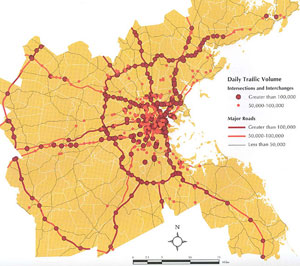
Daily traffic volume in the Boston metropolitan area.

Courtesy STEP

Rarely is filmmaking used to develop projects despite the array of new electronic tools architects regularly use. Documentary filmmakers Robert Nesson, a board member at Interlock Media, and David Katzive, President of the Visual Technology Group at Ruder Finn, believe this is a lost opportunity for architects, and used examples of their company’s films to describe film’s benefits. Although their current films approach the medium differently, the end result — helping facilitate a design process — is the same.

Giving an overview of how film has been used historically as a social activator, Nesson looks to pioneers like William Holly Whyte to influence his filmmaking. Whyte’s ’s “City Spaces Human Places” (1970) documented the successes and failures of New York City plazas to demonstrate good city planning. Nesson is working with the Somerville Transportation Equity Partnership (STEP) to help extend mass transportation throughout the Somerville section of Boston. His films document residents’ cumbersome commutes showing first-hand the failures of Boston mass transit.

In 1991, the local government ruled for a Green Line subway expansion. Development was stalled for 15 years, but now the project has been rejuvenated with the help of Ellin Reisner at STEP. She worries, however, that it has not addressed key community-oriented issues including: the site of maintenance facilities; where the trains will terminate; the location of new tracks and how the trains will travel through the neighborhood; and how the train will affect the community path commonly used by pedestrians and bicyclists. With Nesson’s films, Reisner hopes to get more community members involved with STEP, and show the government how important this project is to the health of Somerville’s residents.

Katzive, on the other hand, creates marketing videos for high-end developers and architects to sell projects to clients. He showed a DVD he made for Kohn Pedersen Fox Architects depicting the Victoria Station area in London. The film begins with showing the existing hectic atmosphere around the station and ends with the orderly, pedestrian-friendly design proposed by KPF. Katzive incorporated historic video, a British voice-over, good music (that changes from frenzied to calm), and design highlights with varied types images from sketches to renderings. The video aims to tease the client, and as the project changes the video does, too. Each viewing is fresh for the audience. The most important aspect of any film, according to Katzive, is the writing, and it is the text that ultimately will sell a project.

Film is appealing because of its visual nature, commented panel moderator, Ernest Hutton, AICP, Assoc. AIA. The media has existed for decades, and now it is possible to create movies with a desktop computer. As all architects and planners understand the power of visuals, film is an accessible tool that should be used more readily.

It’s great to read a favorable write-up on the pedicab regulations (See Editor’s Soapbox: Proposed Pedicab Protocol Not So Appalling). I also agree that the limited number within Manhattan may not be needed. I think the cost of the regulations will reduce the number in order to maintain profits. If the business is succeeding, then it should be allowed to grow.

Now we can only hope the licensing and insurance will limit the pedicab pot smoking breaks I regularly see along CPW.

– Nick Lawson, architectural designer

Note: Since the last issue was published, Mayor Bloomberg decided not to sign the pedicab bill, at least for now.

USGBC vs. NAHB – What Difference Does it Make?

“In an effort to bring uniformity to sustainable building practices, the International Code Council (ICC) and National Association of Home Builders (NAHB) have announced an agreement to develop and publish a residential green building standard.” This recent press release announces the upcoming launch of NAHB’s Green Home Building Guidelines. If NAHB is trying to unify sustainable practices, why is it developing these guidelines this year, the same year that the U.S. Green Building Council (USGBC) is releasing its LEED for Homes program?

NAHB’s guidelines are similar to LEED for Homes. There is a point system based in several categories: Lot Design, Preparation, and Development; Resource Efficiency; Energy Efficiency; Water Efficiency; Indoor Environmental Quality; Operation, Maintenance, and Homeowner Education; and Global Impact. A project can achieve Bronze, Silver, or Gold rating. Both the NAHB and USGBC websites even claim that their programs began in 2004. NAHB maintains that its guidelines are more geared toward local or regional jurisdictions, but after reading through the point system, I am unclear as to how its point qualifications are different from LEED.

One difference between the Green Home Building Guidelines and LEED for Homes is that NAHB is working with the ICC and the American National Standards Institute (ANSI) to develop its standards. This will make it easier on designers who comply with these building standards already, while in order to achieve LEED certification a designer has to go above and beyond the existing standards in order to achieve points.

Also, NAHB claims that its guidelines are more oriented to the economic needs of homeowners. It is difficult to convince a homeowner to apply for LEED certification because of filing costs, but nowhere does the website outline application costs for the Green Home Building Guidelines (at least that I could find).

Ultimately, this is another example of clashing organizations adding to the confusion about sustainability. At least NAHB acknowledges, “It should be noted that although many green building programs have been in existence for 10 years or more, the concept and practice of green building is not clearly defined and straightforward.” Also, NAHB’s website does include a link to the USGBC’s website (not vice versa). So maybe the USGBC is the only one who does not play well with others. I am not against multiple systems to rate sustainability, but why duplicate the efforts of other organizations? Why not deliver a clear and simple guide that anyone can understand and use?

Kristen Richards

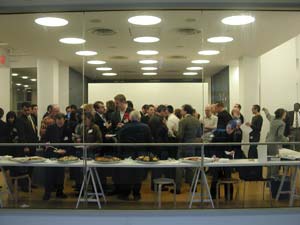
Crowds gathered at the AIA NY Chapter’s New Members Reception at the Center for Architecture 03.15.07.

Kristen Richards

Kristen Richards

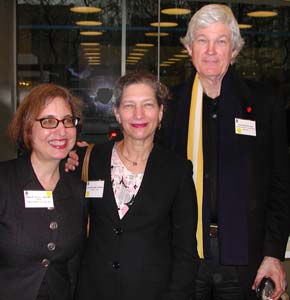
(l-r): Abby Suckle, FAIA, LEED AP, Secretary of the AIANY Chapter Board of Directors; 2007 AIANY President Joan Blumenfeld, FAIA, IIDA, LEED AP; and AIANY First Vice President/President Elect James McCullar, FAIA.

Kristen Richards

Craig Morton

Winners of the 2007 Illuminating Engineering Society of NY (IESNY) Student Design Competition were announced at the opening of the Immersive Lightscapes exhibtion at Lotus Space. The winning entry was submitted by Chung-Jung Liao, MFA Lighting, Parsons The New School for Design.

Craig Morton

Craig Morton

Another submission to the IESNY competition was this ball of light designed by Vincent Milner, AAS Interior Design, Parsons The New School for Design.

Craig Morton