Energy Efficiency Placed on the Back Burner Again

After a few weeks of excitement over Mayor Bloomberg’s ambitious proposal to require all buildings 50,000-square-feet or more to be audited for energy efficiency, I was disappointed to read that the plan has been tabled. The main reason cited for the delay was because of opposition from building owners. With difficult economic times, an unfunded plan such as this may fall to tenants, who would have to foot the bill for building owners unwilling to pay increased costs for required changes — even if the payback would occur within just five years (as was written in to the legislation).

While I understand why building owners are opposed to the plan, and I recognize the argument that this plan should be implemented when the city is in a better financial state, this plan could be an important element to economic recovery. With short-term paybacks, the city would also be on its way to reducing carbon emissions, along the lines of PlaNYC 2030.

The other downside to the postponed plan is that I saw a glimmer of hope for struggling architecture and construction fields. There are a number of large-scale buildings that would have needed architectural, engineering, and construction services if this plan had passed. Bloomberg estimated that it would have created 19,000 related jobs. It was not only a chance for the city to become more familiar with sustainability; it was also an opportunity for design and construction professionals to gain much-needed experience with green retrofitting. Hopefully, the plan will not stay on the back burner too long.

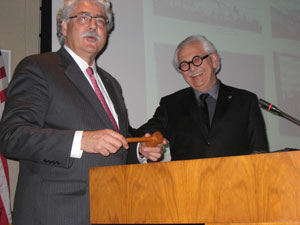
12.04.09: George Miller, FAIA, was inaugurated as 2010 President of the AIA in the Board Room of AIA Headquarters. He is the first NYC-based architect to head the AIA since 1971.

IMG_3022

2010 AIA President George Miller, FAIA, received the gavel from 2009 President Marvin Malecha, FAIA, at the official inaugural ceremony.

Dennis Andrejko, FAIA

IMG_3108

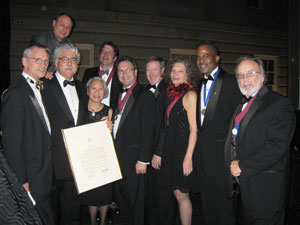
(L-R): Rep. Earl Blumenauer (D-Oregon); Mark Strauss, FAIA, AICP (AIANY Former President); George Miller, FAIA (2010 AIA President); Susan Chin, FAIA (AIANY Former President); Mark Ginsberg, FAIA (AIANY Former President); Rick Bell, FAIA (AIANY Executive Director); Ed Farrell (AIANYS Executive Director); Joan Blumenfeld, FAIA, IIDA, LEED AP (AIANY Former President); Terrence O’Neal, FAIA (AIANYS Former President); Dennis Andrejko, FAIA (AIANYS Regional Director).

Ashley E. Sullivan of Mattox Photography

AIA Inaugural 0012

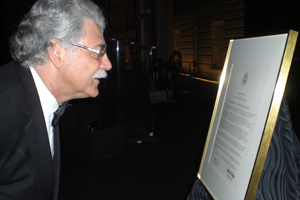
George Miller, FAIA, reading the Proclamation written by AIA New York former presidents, which was on view at the Inaugural Dinner at the National Portrait Gallery in Washington, DC, 12.04.09.

Rick Bell, FAIA

12.01.09: Commissioner Janette Sadik-Khan, Hon. AIANY, joined Storefront for Art and Architecture for a special gathering to unveil Pike Loop, the public art installation on Pike Street between Division and Broadway.

Pike_Loop

Cesar Cotta, producer, Storefront for Art and Architecture (left), and Janette Sadik-Khan, Hon. AIANY, Commissioner, New York City Department of Transportation.

NYC DOT

The AIA Guide to New York City: In Search of Green Places,” by Norval White, FAIA, and Fran Leadon, AIA, appeared in the 12.04.09 issue of AIArchitect. The article originally appeared in the Fall ’09 issue of OCULUS.


Why the Architecture Profession Needs the AAO,” by Rick Bell, FAIA, AIANY Executive Director, appeared in the 12.07.09 issue of Architectural Record‘s Daily News.

11.24.09

11.24.09 Editor’s Note: Did you attend “Energy Code Changes: What the design team needs to know” at the Center for Architecture? If so, let us know what you thought. Click here to add your comment.

Also, save the date for the following annual events:
12.03-05.09 Procrastinators’ Days
12.08.09 AIANY Board Inaugural

– Jessica Sheridan, Assoc. AIA, LEED AP

Note: Be sure to follow Tweets from e-Oculus and the Center for Architecture.


OCULUS Note: Corrections: In the Summer ’09 issue of Oculus, the names Rahul Mehrotra and Peter Chermayeff, FAIA, should be transposed in the caption under the Design Awards jury photo on page 9, and in the Projects jury caption on page 13. The Fall ’09 issue’s “Interior Motives,” on the development of Skanska USA Building’s new office in the Empire State Building, should have credited BBG/Brennan Beer Gorman’s graphics group, ThirdMark Studios, rather than the parent company.

OCULUS Editor’s Note: Specific questions about the Department of Buildings’ green roof program noted in the Fall ’09 issue’s “What’s Your Green Roof Worth?” can be addressed to: GreenRoofandSolar@buildings.nyc.gov.

Precautionary List Emphasizes Health Benefits of Sustinability

As firms make an effort to find new avenues in their work, some are making strides in research and development that is proving to be a valuable resource for the profession as a whole. Recently, Perkins + Will launched a Precautionary List of harmful building products that aims to be a “catalyst for marketplace change.” The firm is already a leader in green design, and with this database, one can see the evidence behind the harmful effects of certain materials. The argument for sustainable products becomes broader than environmentally-conscious building; it becomes a necessity for survival.

Chemicals are searchable by category, specification divisions and sections, alphabetical, and by health effects. When a product is selected, information includes: the origin and source of the chemical; a health impact summary; building products where the chemical is commonly found; alternative materials that can be used in its place; known and suspected health effects; regulatory jurisdiction; a rating according to the Green Building Rating System; and general reference links.

The research that went into the list is thorough, and I do not think there is a similar list out there that is so clear and created specifically for architects and professionals in the building industry. When selecting products, this is the website to consult before decisions are made.

11.10.09

11.10.09 Editor’s Note: According to the last e-Oculus poll, 53% of readers did not know we do podcasts. Click here to check them out.

As we are just launching podcasts, we want your feedback. Please e-mail me with comments, criticisms, and suggestions at eoculus@aiany.org.

– Jessica Sheridan, Assoc. AIA, LEED AP

Note: Be sure to follow Tweets from e-Oculus and the Center for Architecture.

Energy Code Mandates Response to Climate Change

Event: Energy Code Changes: What the Design Team Needs to Know (5-part series)
Location: Center for Architecture, 10.26-28, 11.03-04.09
Speakers: Session 1 — Overview of the Greening of the NYC and other Codes: Chris Garvin, AIA, LEED AP — Senior Associate, Cook+Fox Architects & Project Leader, Terrapin Bright Green; Session 2 — Lighting Design and the Energy Code: Hayden McKay, AIA, FIALD, FIESNA, LEED AP — Principal, Horton Lees Brogden Lighting Design; Shoshanna Segal, IALD — Associate, Horton Lees Brogden Lighting Design; Session 3 — Mechanical Systems and the Energy Code: John Rundell, LEED AP — Buro Happold; Session 4 — Building Enclosures and the Energy Code: Michael Waite, PE, LEED AP — Simpson Gumpertz & Heger; Session 5 — Energy Modeling and the Energy Code: Adrian Tuluca, RA, LEED AP — Principal, Viridian Energy and Environment
Organizers: AIA New York Chapter; AIANY Committee on the Environment; Building Enclosure Council; AIANY Building Codes Committee; ASHRAE; Urban Green

As of this past September, New York State instituted the latest update to its energy code. Currently, all projects in New York must comply with the Energy Conservation Construction Code of New York State (ECCCNYS) or ASHRAE 90.1-2004. With the city’s plans for all buildings to reduce energy consumption by 2030, the codes and regulations will become more stringent while greater enforcement will be put into place. The Greener Greater Buildings Plan, part of the Mayor’s PlaNYC, sets a goal of achieving a 30% reduction in NYC’s annual greenhouse gas emissions by 2030. In addition, there are rumors that once the Department of Buildings begins new mandatory auditing procedures, projects that do not meet the current energy code will lose their permits. Because of this, the AIANY Committee on the Environment teamed up with the Building Enclosure Council, AIANY Building Codes Committee, ASHRAE, and Urban Green to produce a five-part series on what architects need to know about the ever-changing energy codes.

Prescriptive vs. Performance-Based Methods
To calculate energy use in a building, architects have a choice to use either prescriptive or performance-based methods. The prescriptive method is the cheapest, fastest way, as COMcheck (for commercial buildings) and REScheck (for residential) are readily available online. These programs filter information provided by architects and engineers to determine code compliance. While all methods provide a choice to use ECCCNYS or ASHRAE 90.1-2004 (not to be confused with ASHRAE 90.1-2007, the code required for LEED), all of the speakers recommended using ASHRAE 90.1-2004.

Performance-based methods involve energy simulation, a process that takes longer, is more expensive, and often requires additional consultants. However, energy modeling is sometimes required, and, as codes become stricter, it may become inevitable for new projects.

Continues…

With LEED Becoming Even More Complicated, Is it Still Worth the Effort?

On 11.01, the Green Building Certification Institute (GBCI) launched its Credentialing Maintenance Program (CMP) for all LEED Accredited Professionals. As a LEED AP who wants to stay active, I signed on to the agreement that I will complete 30 continuing education hours biennially and pay the $50 maintenance fee. Since I attend events regularly at the Center for Architecture, which is now incorporating Sustainable Design credits for CEUs, I thought it would not be too difficult to maintain 15 CEs per year to continue my LEED accreditation.

Once I logged on to the CMP Report Summary page, however, I realized that the system is much more complicated than I thought. Not only do I have to complete 30 hours overall, I have to complete a minimum amount of hours related to each section of LEED: four CEs for Project Site Factors; three for Water Management; six for Project Systems and Energy Impacts; three for Acquisition, Installation, and Management of Project Materials; five for Improvement to the Indoor Environment; two for Stakeholder Involvement in Innovation; and one for Project Surrounding and Public Outreach. In addition, six of the 30 hours must go toward LEED-specific training. To enter my CE hours I had to submit the date, subcategory, the type of event, a brief description, details about the event hosts, and information about the speakers, along with the number of CE hours I am reporting. After all of this, which I did a week ago, I am still waiting for approval from GBCI.

In the end, not only is self reporting tedious, but it is also unclear whether AIA SD CEUs will count toward LEED CE’s. The only listed approved provider is the U.S. Green Building Council (USGBC), and it seems from the website as if there is an organization — called Education Reviewing Bodies, or ERBs — that makes the decision whether or not a credit is LEED-worthy. For architects who have to complete 18 CEUs per year of AIA credits, how are they supposed to complete 15 CEs in addition that are solely generated by USGBC programming?

I am an advocate for sustainable design, and I was a proponent for LEED when it first launched. What I do not understand, however, is why organizations that provide continuing education for architects and engineers are not collaborating with the GBCI to develop the standards and provide sufficient training. At a time when sustainability is being integrated more into the practice of architecture, many believe that LEED will eventually become obsolete. In my opinion, the GBCI certainly is speeding up this process.

Energy Code Mandates Response to Climate Change (continued)


Lighting Design and the Energy Code
Lighting is one of the ways architects will be most affected by the latest energy codes. However, rather than be limited by the code, architects can use it to design better lighting, claimed Hayden McKay, AIA, FIALD, FIESNA, LEED AP, principal at Horton Lees Brogden Lighting Design. Quality, not quantity, makes a well-lit space, she said. Daylighting, room finishes, natural colors, control of glare and contrast, and light fixtures all help maintain comfortable levels of illumination. Because people spend 85-90% of their lives indoors, McKay also believes a variety of light sources and incorporating daylight can help aid health and preserve circadian rhythms that humans need to stay productive at work. Each space is different and should be lit accordingly, and commissioning controls is key to saving energy.

Mechanical Systems and the Energy Code
While architects may depend on mechanical engineers, it is important they understand mechanical systems, since the majority of the developments in the energy code relate to them, according to John Rundell, LEED AP, of Buro Happold. By understanding how mechanical systems work, architects can develop a dialogue with the engineers from the start of a project. By incorporating more efficiency into their designs, mechanical systems will not have to work overtime to compensate for unnecessary heat exchange.

Building Enclosures and the Energy Code

One way to limit unnecessary heat exchange is with a well-designed envelope. The code relies on thermal resistance of materials (R-value), thermal transmittance of assemblies (U-factor), and solar heat gain (dependent on the Solar Heat Gain Coefficient, or SHGC). Creating air barriers, reducing thermal bridging, using daylighting and natural ventilation, and integrating with the mechanical systems are all strategies for energy-efficient envelope design.

Michael Waite, PE, LEED AP, of Simpson Gumpertz & Heger, suggested using the code as a guideline and reference as early as possible in design. He predicts that in the future the code will require: increased R-values; decreased U-factors and SHGC’s; more air barrier requirements; more restrictions on glazing area; provisions directly related to daylighting; and fleshed-out regulations for variable property materials such as dynamic glazing systems.

Energy Modeling and the Energy Code
While energy modeling may be the most complicated path to take when calculating a building’s performance, it is arguably the most precise way to measure if a building is code compliant, stated Adrian Tuluca, RA, LEED AP, principal at Viridian Energy and Environment. It is also required for buildings with fenestration covering more than 50% of the envelope, or any building that is having difficulty complying with COMcheck or REScheck. If an architect wants to use tradeoffs — a strategy used to offset non-compliant systems with the excess created by high performance systems — then modeling is the best method to use.

Conclusion
Ultimately, energy codes are changing to reflect global climate change and the need to reduce energy consumption. Complying with the latest energy codes will require major adjustments to the way architects currently put together drawings. The energy analysis is just one piece of the puzzle. Support documentation and more elaborate construction documents will become increasingly important as auditing is inevitable. Sustainability is not just important it is becoming a mandate, and the code is just one aspect guiding the way.

Give us feedback on the Energy Code Trainings
AIANY, Urban Green Council, and ASHRAE are gearing up for the second iteration of “Energy Code Changes: What the Design Team Needs to Know.” As the 12.02.09 workshop date approaches (register here), we’d like to hear from attendees to the October/November sessions so we can make the next session even better. Please post your comments to our blog.

Desai Tells Architects to “Go East” for Work

Event: 2009 Annual Arthur Rosenblatt, FAIA, Memorial Lecture with Vishakha Desai: “The Role of Museums in 21st-Century Asia”
Location: Center for Architecture, 10.15.09
Speaker: Vishakha Desai — President, Asia Society
Organizers: AIANY Cultural Facilities Committee
Sponsors: Kevin Roche John Dinkeloo & Associates Architects; Stone Source; Albieri Sebor Weber; Charles J. Rose; Devrouax & Pumell; Edison Price; Fisher Marantz Stone; Pilkington Glass; RKKG Architects; SPRINGBOARD Architecture Communication Design

AsiaSocietyHK

Asia Society Hong Kong, by Tod Williams Billie Tsien & Associates.

Courtesy AIANY

It is often said that the 21st century will be known as the Asia Pacific Century, stated Vishakha Desai, president of the Asia Society. While 20th-century museum culture may have focused on cross-Atlantic relationships, the 21st century will center on cross-Pacific connections, she believes. The role of museums in Asia is drastically changing with the explosion of new cultural facilities in countries like China and India. The context of museums, how they function, and what is the meaning of this development are points of dramatic debate among curatorial circles.

Culture is always related to economics and politics, Desai contends. Counter to the economic situation in the U.S., China is experiencing 8.5% economic growth and India is close behind at 7%. In the next decade, China will build 1,000 new museums. It is the world’s fastest growing market for museums. But what effect will the new role of museums have in a market that is “leapfrogging,” as Desai put it, achieving a market growth in 10 years what the U.S. has done in 100?

In the 20th century, most of the museums in Asia were designed in a colonial style that represented empirical power to those who controlled the governments in the various countries. Similar to the Louvre, expressing the height of the French Empire, or NYC’s Metropolitan Museum of Art, symbolizing an aspiration of U.S. power, museums like the National Museum of Singapore expressed an interest in Western notions of power through its design. Chang Kai Shek was one of the first to counter the trend, establishing a museum of national pride in the National Palace Museum in Taipei. With its vernacular Chinese form, the museum preserved Chinese culture and national treasures that were being destroyed by the Communist Party.

Now, in the 21st century, countries like China and India are grappling with their pasts in a way that is bringing local traditions into contemporary architectural practices. The Crafts Museum in New Delhi, designed by Charles Correa, celebrates the crafts tradition of India. The museum is a village housing practicing artisans, and it is comprised of re-adapted buildings preserved both with traditional and contemporary technologies. The Asia Society Hong Kong, designed by Tod Williams Billie Tsien & Associates, is located in a park in the center of Hong Kong in a building where the British once stored explosives. The goal of this museum is for Hong Kong to project an Asian connection beyond being a Chinese city, Desai stated. Hong Kong is “China’s gateway to Asia,” and the Asia Society hopes to help prove this.

While museums in Asia are beginning to express nationalistic pride in their designs, rather than western ideas of dominance and authority, Desai sees warning signs that point to a new source of empiricism — individual wealth. Since the 1980s, public/private ownership of museums has generally created a win-win situation: museums are privately funded for the benefit of the public. However, recently a handful of Asian tycoons, and wives of wealthy businessmen, have begun funding museums as public displays of their riches. Museums like the Devi Art Foundation in New Delhi or the Ullens Center for Contemporary Art in Beijing are examples of museums being developed with little collaboration among the museum network throughout their respective countries. Part of the reason 1,000 museums are being built in China is that wealthy people want to create their own imprint on society, regardless of a need for space to display artwork, Desai argues. There may not be enough art to go around.

Ultimately, Desai is optimistic. She sees governments deciding that museums are crucial as centers of social interaction, not just repositories of objects. They have the potential to put countries on the international cultural map. She is seeing a monetary commitment to art and cultural facilities being integrated as part of urban development strategies that she has not witnessed before. Once these museums are completed over the next century, all they need is people and artwork to give them the weight they deserve.