
Highlights from Cuba

Cuba is facing significant infrastructure, environmental and logistical challenges. A common theme is shortage; inextricably linked to this is the need for outside subsidies to close the gaps. Supply and demand of all types is a tug of war.

1-Cuba

Jeremy Edmunds

Aged housing stock is crumbling or approaching that state at a massive scale. An estimated 100,000 families are awaiting temporary shelter due to the dilapidated state of their current homes. Tenement housing is common with entire families living in a single room in old colonial mansions. Transportation is another key challenge. While 1,500 private buses serve 15% of the population, only 600 public buses serve the remaining 85%. Most of the railways are dedicated to moving cargo like sugar — not people.

2-Cuba

Jeremy Edmunds

On the other hand, urban farming is flourishing in Cuba. Although born out of necessity, the movement is growing. When tractors became scarce, livestock was used to till the land. When fertilizer became scarce, treated composted sewage was used instead. Amazingly, every Cuban city has agriculture. Havana alone has 2,000 acres of farms including yard gardens, green roofs, and planted vacant lots. The Antonio Núñez Jiménez Foundation for Nature and Humanity was formed in 1997 to promulgate design and management principles to deliver food sustainably. Urban farming produces an estimated 20-30% of the total produce consumed in Cuba.
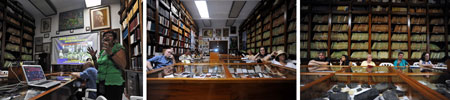
3-UrbanFarming

Pictured: the group met with Foundation Coordinator Maria Caridad Cruz, who presented the organization’s local sustainable farming efforts.

Jeremy Edmunds

Throughout the trip, the group also met with local planners, politicians, artists, and architects.
4-Farrar-Arrechea-Cordero

From left to right: Chief of Mission of the U.S. Interests Section Jonathan Farrar talking with Pedro Castillo; artist Alexandre Arrechea explains his series “Garden of Mistrust,” which plays off of issues of security, control, and paranoia with political irony; artist Raul Cordero is exceptional in his apolitical approach to art — his recent work incorporates the audio component of video projections though a coded series of dots that represent frequencies.

Jeremy Edmunds

The storied Escuelas Nacionales de Arte is undergoing renovation and completion after a hiatus since the project was halted in the 1960s.

5-EscuelasNacionales-1

One of three design architects, Roberto Gottardi (left), provided an extended tour. Some students were painting; others were engaged in a dance performance.

Jeremy Edmunds
World Leaders Take Up State of the Planet

Event: State of the Planet 08, Real People, Real Places, Real Solutions
Location: Columbia University Earth Institute, 03.27-28.08
Speakers: For full list of over 30 speakers, go to the State of the Planet 08 website.
Organizer: The Earth Institute at Columbia University

The poor population is expanding, human and environmental conflicts abound, clean energy seems elusive, and climate change is happening at an unpredictably quick pace. A new global mindset is required. In their own self-interest, the rich will need to help the poor. If developing countries go it alone, the environmental impacts from smokestacks will be felt across national borders. The polar ice cap is already 30-50 years ahead of projected melting due in part to the compounding effects of water seepage through cracks. The time to act is now and we will have to adapt to the irreversible damage already done.

And yet, “There is no clash between national and international interests.” — Kofi Annan, Former Secretary-General of the United Nations and President of the Global Humanitarian Forum told the gathering.

The State of Planet 08 conference addressed all of these issues, and more. Here are notable sound bites. To watch the full event online, click the link.

“The poor are the most motivated to eliminate poverty; all they lack are the tools.” — Asha-Rose Migiro, Deputy Secretary-General of the United Nations

“Beware of attempts by the security industry to reframe the climate change problem as a security problem. Hardening infrastructure and tightening immigration policies will not address root causes of instability.” — David Victor, Director, Program on Energy and Sustainable Development, Freeman Spogli Institute for International Studies

“A nation’s energy expenditure is relatively fixed. When costs rise by 20%, demand decreases by about 20%. There will be no macro-economic damage from fixing the energy carbon problem.” — Michael Grubb, Chief Economist, UK Carbon Trust

“It is a myth that biofuel crops destroy the Amazon — the soil conditions and proximity to processing centers rule this out. Ethanol from sugar cane is eco-friendly and makes for a good Sunday drink.” — Roberto Rodrigues, Coordinator, Getulio Vargas Foundation Agrobusiness Center; President, Superior Agriculture Council of Sao Paulo’s Federation of Industries; Co-Chairman, Interamerican Ethanol Commission, and Former Brazilian Minister of Agriculture

“Coal-fired power plants must be made more efficient for carbon capture to become economical. We should immediately construct demonstration projects to prove effectiveness of carbon capture technologies.” — Klaus S. Lackner, Murice Ewing and J. Lamar Worzel Professor of Geophysics, Earth and Environmental Engineering, and Director of the Lenfest Center for Sustainable Energy, Columbia University

“What happens in the Arctic does not stay in the Arctic. The growing season has doubled in some parts of Alaska.” — Daniel White, Director, Institute of Northern Engineering

“Some species win when climate change takes place. Cod, for example, grow larger in warmer waters, and invasive species like snake pipefish thrive as well.” — Ken Drinkwater, Senior Scientist, Bjerknes Centre for Climate Research, University of Bergen, Norway

“One potential solution that could help improve productivity by improving communications is the simple cell phone. This has been seen with female nut pickers who are coordinating and maximizing sale prices across their marketplace via telephony.” — Carl-Henric Svanberg, President & CEO, Telefonaktiebolaget LM Ericsson

“We don’t want a global government but we do want global governance.” — Jeffrey D. Sachs, Director, The Earth Institute, Quetelet Professor of Sustainable Development, and Professor of Health Policy and Management, Columbia University; Special Advisor to the United Nations Secretary-General Ban Ki-moon

Existing Buildings Must Go Green

Event: Retrofitting Green: Why It Makes (Dollars and) Sense!
Location: McGraw Hill Auditorium, 06.28.07
Speakers: Rohit Aggarwala, Ph.D. — Director, Mayor’s Office of Long Term Planning and Sustainability; Patrick Conti — Vice President of Facilities, New York Mercantile Exchange; Craig Kneeland — Senior Project Manager, Green Building Program, NY State Energy Research & Development Authority (NYSERDA); Joseph Olgiati — Director of Engineering, Cushman & Wakefield; Thomas Scarola — Director of Engineering, Tishman Speyer Properties; Sylvia Smith, AIA, LEED AP — Principal, FXFOWLE Architects; Russell Unger — Executive Director, U.S. Green Building Council, NY Chapter
Moderator: Michael K. De Chiara, Esq. — Partner, Zetlin & De Chiara
Introduction: John Parkinson — Executive Director, Urban Land Institute (ULI) NY District Council
Organizers: Zetlin & De Chiara; ULI; USGBC; New York Construction magazine

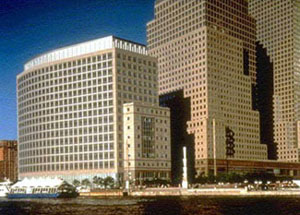
NYMEX

NYMEX retrofitted its headquarters to achieve LEED-EB certification.

Courtesy Forest City Ratner Companies (fcrc.com)

Approximately 85% of the buildings that will exist in NYC in 2030 exist today devouring over 70% of the total energy consumed, according to Rohit Aggarwala, Ph.D., director of the Mayor’s Office of Long Term Planning and Sustainability. Although LEED for Existing Buildings, LEED-EB, has not gained market traction the way LEED for new construction has, it warrants a larger share of attention, especially in highly-developed regions like NYC. Michael De Chiara, Esq., partner at Zetlin & De Chiara, moderated a discussion on the strategies and challenges attendant to greening existing buildings — a must if we are to meet the carbon targets set forth in Mayor Bloomberg’s PlaNYC 2030.

As the world’s largest energy futures marketplace, LEED certification was more of a corporate mandate than a money saver for the New York Mercantile Exchange (NYMEX) headquarters. Patrick Conti, vice president of facilities at NYMEX, and Joseph Olgiati, director of engineering at Cushman & Wakefield, highlighted the $600,000 retrofit of the building — NYC’s first LEED-EB certified project. Sustainable aspects included upgrading light fixtures, composting food waste from the cafeteria, and the use of non-toxic cleaning supplies.

Building maintenance subsequent to the retrofit is critical for sustaining its benefits, and re-commissioning the building systems periodically is required for certification, stated Sylvia Smith, AIA, LEED AP, principal at FXFOWLE Architects. As the lone architect on the panel, she aptly described her role in advancing green building as that of a salesperson and process facilitator. The majority of the tactics are engineering and maintenance based.

The New York government has begun to implement programs to encourage the greening existing buildings. NYC has proposed a $2.4 billion fund, raised through an increase to the System Benefits Charges already levied on consumers, to be administered by a yet-to-be-created intra-governmental authority. This fund will help finance the greening of existing buildings by partially offsetting the initial costs, thus reducing the building’s payback period to less than five years. The NY State Energy Research & Development Authority (NYSERDA) is currently assisting building owners in Con Edison service areas with revenue from the existing System Benefits Charges, largely in the form of design assistance programs, energy audit subsidies, and low interest loans.

The discussion closed with consensus that the way to achieve certification within a five-year payback period is to start with little things, like motion and carbon dioxide sensors, not flashy wind turbines and solar “gizmos.” To mainstream, retrofitting must make sense financially. With help from Albany, a wave of green retrofits seems like a welcome certainty for NYC.