Powerhouse Finalists Compare Notes

Event: Powerhouse: New Housing New York — Panel Discussion with Finalist Teams
Location: Center for Architecture, 04.16.07
Speakers: Richard Cook, AIA — Cook+Fox; Sam Marks — WHEDCO; Colin Cathcart, AIA — Kiss+Cathcart; Robert Rogers, AIA — Rogers Marvel; Alexander Taylor — BRP Development
Moderators: Holly Leicht & Lance Jay Brown, FAIA
Organizers: AIANY; New Housing New York Steering Committee; NYC Department of Housing Preservation and Development; additional support: AIANY Housing Committee
Sponsors: National Endowment for the Arts; Enterprise Community Partners; AIANY Housing Committee
New Housing New York Finalist Entries

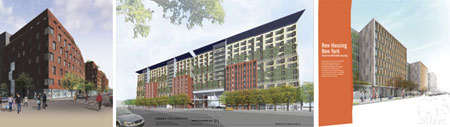
New Housing New York finalist teams (l-r): BRP Bluestone Rogers Marvel; The Legacy Collaborative; WHEDCo Durst Cook+Fox.

Courtesy AIANY

The New Housing New York (NHNY) Legacy competition asked architects and developers to push the limits of their design and practice modes. To what extent could interdisciplinary teams collaborate in greater depth, spend less, build greener, inspire the community, and set a replicable precedent at this 60,000-square-foot site in the Bronx? The fruits of the competition lie not only in the winning design by Phipps Rose Dattner Grimshaw, but in the plurality of sustainable, urban, affordable proposals generated by the five finalist teams.

Richard Cook, AIA, of Cook+Fox, discussed the undulating “oxbow” design his team devised in order to endow the long, narrow site with a sense of public/private circulation. He identified an inherent tension between an adaptable urban housing template and a response to the specific site conditions. The result draws upon his firm’s increasing use of sustainable design strategies to maximize natural light and ventilation while minimizing solar gain.

The 13-story slab proposed by Kiss + Cathcart with Magnusson Architecture and Planning expressed the concept of a “green building” with live vegetation growing on a planted façade. Articulated bands of “townhouses in the sky” would afford residents a clear view of the passing seasons, while a single-loaded corridor scheme would allow cross-ventilation and a more open feeling. Ground-level retail space would cluster near the northern side of the site, while health and recreation facilities would be grouped at the southern side.

Robert Rogers, AIA, of Rogers Marvel Architects, outlined the “thematic condition of health” that permeates his team’s proposal, from cultural enrichment to physical health and financial security. Together with Alexander Taylor of BRP Development, he articulated the desire to “land on the street with consequential community facilities” such as dance and exercise studios and a food co-op. Concave slabs clad in modular brick and masonry panels would create a complementary pattern of open and enclosed space. A co-generation plant, meandering gardens, and a carefully planned ventilation system would conserve resources and boost the quality of life.

Noting that the city possesses few remaining land parcels to offer for future new housing developments, Sam Marks, a director at the Women’s Housing and Economic Development Corporation (WHEDCO, which teamed with Cook+Fox), wondered whether a future competition could focus on retrofitting existing buildings. Lance Jay Brown, FAIA, defined the replicability of the NHNY exercise as a question of continued collaboration: “Can you replicate the act of will that it takes to bring this kind of event about?”

Powerhouse: New Housing New York is on view at the Center for Architecture through 06.16.07. See On View: At the Center for Architecture for more information.
Post-Modernism: R.I.P.

Event: Critical Modernism — Is It Possible?
Location: Columbia University Graduate School of Architecture, Planning & Preservation (GSAPP), 04.09.07
Speaker: Charles Jencks — author, Critical Modernism: Where is Post-Modernism Going? What is Post-Modernism? (Wiley)
Introduction: Mark Wigley — Dean, Columbia GSAPP
Organizer: Columbia University GSAPP

Critical Modernism: Where is Post-Modernism Going? What is Post-Modernism?

Courtesy Columbia University GSAPP

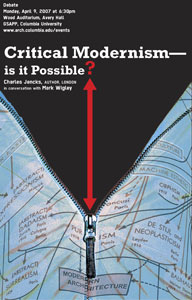
On the cover of Charles Jencks’s new edition of What is Post-Modernism? (the first new edition in 11 years), the first director of the Museum of Modern Art Alfred Barr’s chart of modern artistic movements comes apart, literally, in the image of a windbreaker emblazoned with Barr’s interconnected bubbles being unzipped. Revealed beneath is the work’s new title, Critical Modernism: Where Is Post-Modernism Going? The book’s title change reflects Jencks’s new attitude toward the movement: “Post-Modernism, like old soldiers, died slowly.” And he mourns its passing.

Author, critic, and landscape designer, Jencks was one of the earliest exponents of Post-Modernism. Critical Modernism surveys the culture and politics of the movement, and chronicles its demise. The beginning of the end was the appropriation of Post-Modern architecture by the entertainment industry in the mid-1980s. “For a moment at least it was an interesting avant-garde,” Jencks remarked.

Critical Modernism, on the other hand, attempts to “face reality” when “most Modernism is uncritical.” Art and architecture is grounded in the actuality that: arctic ice is retreating; the earth is warming, modern economics is globalizing; political culture is breeding skepticism; and fear of terrorism is growing.

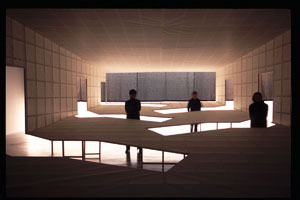
It is a movement of personal posturing (think Rem Koolhaas’s tough-guy persona), pluralism (James Stirling’s Neue Staatsgalerie), black humor (Damien Hirst), and noble though feeble gestures (green architecture), in Jencks’s view. Ultimately, Jencks praises the iconographic and iconologic possibilities of forms drawn from science and mathematics — the square deformations in the Pavilion at the Serpentine Gallery designed by Toyo Ito, FAIA, the images of DNA Jencks has incorporated in his own work, and the natural fractals in everything from pine cones to pineapples.

Infernal Affairs Bind Architecture, Cinema

Event: 3×3 A Perspective On China, Monthly Lecture Series: Part Eight — Conversation With Yung Ho Chang
Location: Center for Architecture, 03.19.07
Speaker: Yung Ho Chang — Principal Architect, Atelier Feichang Jianzhu (FCJZ) & Professor and Head, Department of Architecture at Massachusetts Institute of Technology (MIT)
Organizer: People’s Architecture
Sponsor: Center for Architecture

Atelier FCJZ

An installation of habitable cameras exemplifies Atelier FCJZ’s interest in creating framed and frameless perceptions of space and landscape.

Atelier FCJZ

Yung Ho Chang has hurdled conventional boundaries of place, culture, and professional specialization. Founder and principal partner of Beijing-based Atelier Feichang Jianzhu (FCJZ), he has also directed MIT’s architecture program since 2005. His trans-Pacific design career exemplifies an interdisciplinary ambition to complement history with modernity, landscape with buildings, and most recently, architectural rumination with popular film noir.

Chang presented a series of cinematic stills of his firm’s work superimposed with scenes from the Hong Kong film trilogy, Wu Jian Zao (Infernal Affairs, 2002-03), which inspired Martin Scorcese’s The Departed. FCJZ implanted stills from the original film with new objects and characters, such as a bicycle, a Van Gogh painting, or a mysterious hand and body. Simultaneously provocative and absurd, the vignettes mingle fiction with reality. Chang said he chose Infernal Affairs over the visually lush In the Mood for Love (dir. Wong Kar Wai, 2000) because he could tell the story with only a handful of images. He also cited the French New Wave movement and Alfred Hitchcock as cinematic inspirations.

This experiment represents Chang’s latest attempt to study and catalyze the act of perception. Long interested in Chinese scroll landscape painting as well as early Renaissance painting, photography, and film, he has designed exhibitions and buildings that challenge viewers to see their environs anew. For example, a landmark series of projects emerged from an enquiry into peepshow mechanics and Alfred Hitchcock’s classic take on urban voyeurism, Rear Window. In 2003, FCJZ worked with two video artists to create a series of giant, inhabitable sculptures modeled on Leica, Nikon, Polaroid, and Seagull rangefinder cameras.

This “Camera” exhibition helped fuel the design of the dramatic Villa Shizilin, a 45,000-square-foot home located in a rolling persimmon orchard outside Beijing. Chang conceived the house as an interlocking assembly of tapered, wedge-like volumes that function as focused lenses to frame views of the landscape. Drawing the viewer’s eyes horizontally along the landscape, the villa’s distinctly long, low window stripes recall the continuous, kinetic quality of scroll landscape paintings.

The work of Yung Ho Chang and FCJZ is the subject of the current exhibition “DEVELOP” on display at the MIT Wolk Gallery in Cambridge, MA, through 04.13.07.

TEVERETERNO Builds Bridge Between Rome, New York

Event: The Tiber Project: Rome; Rivers and Art as Catalysts for Urbanism: A Dialogue with New York
Location: Center for Architecture, 03.29.07
Speakers: Kristin Jones — President, Tevereterno; Gennaro Farina — Director of Historic Center, Department of City Planning, Rome; Patricia C. Philips — public art critic, Interim Director, Minetta Brooks; Meredith Johnson — Assistant Director, Minetta Brooks; Michael Fishman — advisory board member, Metropolitan Waterfront Alliance; Leni Schwendinger — Leni Schwendinger Light Projects; Moderator Ernest Hutton, AICP, Assoc. AIA — Hutton Associates & New York New Visions
Sponsors: AIA NY Planning and Urban Design Committee; AIA NY International Committee

Courtesy Google Earth

TEVERETERNO exists between two parallel bridges along the Tiber River in Rome.

Google Earth

The Italian Cultural Institute described TEVERETERNO in the following terms. “Motivated by the conviction that art is a powerful catalyst for environmental awareness and urban renewal, TEVERETERNO is a unique multi-disciplinary project that aims to contribute to the revitalization of Rome’s Tiber River by establishing a lively public gathering place — the Piazza Tevere — on a central section of the Tiber between Ponte Sisto and Ponte Mazzini.”

Each year international artists are invited to create innovative, site-specific art installations to stimulate a dialogue between nature and the city, between history and present day. It is with these environmental works that TEVERETERNO aspires to contribute to the revival of rivers worldwide, according to its website. Currently, the project is a cornerstone to the new city plan developed by Rome’s Department of City Planning.

Continuing to engage with architectural initiatives abroad, the AIA New York Chapter organized a dialogue as a follow-up to the initial presentation at the Italian Cultural Institute, on March 26. Kristin Jones, President of TEVERETERNO, and Gennaro Farina, Director of the Historic Center in Rome’s City Planning Office, presented the project and a summary of current planning efforts along the Tiber River. Indeed, this sequence settling development on the heels of temporary installations symbolized the aspirations of TEVERETERNO itself.

A highly-sensitive site-specific intervention, TEVERETERNO could not be simply transported to New York, panelists noted. Rather, the Tiber River project has pedagogic value for New York City designers in its attention to undervalued and discarded waterfront properties, stated Michael Fishman of the Metropolitan Waterfront Alliance. One would need completely new artistic and formal concepts to develop projects along these lines in any of the five boroughs, responded Leni Schwendinger, partner of Leni Schwendinger Light Projects. In any case, Farina stressed that the main objective in such development remains a desire to bring the city to the river, and the river to the city. Participants of the question and answer period noted that the combination of the arts with public/government development in so called discarded spaces serve to greatly enliven cityscapes.

Earlier in the day, Jones, Farina, Fishman, and Anna Maria Rosati, TEVERETERNO’s Executive Director, met with the AIANY Emerging NY Architects Committee to begin a dialogue about creating a bi-continental international competition. Finally, a conference is being planned for this fall to pursue opportunities further.

Can School Buildings Make Students Want to Learn?

Event: Schools of the Future — Claire Weisz and Roger Duffy discuss innovative school designs
Location: Center for Architecture, 03.12.07
Speakers: Claire Weisz, AIA — Pricipal, Weisz + Yoes Studio; Roger Duffy, FAIA — Partner, Skidmore, Owings and Merrill; Moderator Ria Stein — Senior Editor, Birkhäuser Publishers
Organizers: Center for Architecture

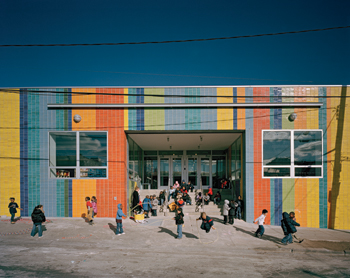
The Bronx Charter School for the Arts incorporates glazed-brick in nine VCT colors on the street front. The open-plan arts studios also have prime access to natural light.

The Bronx Charter School for the Arts incorporates glazed-brick in nine VCT colors on the street front. The open-plan arts studios also have prime access to natural light.

Courtesy Weisz + Yoes Studio

Courtesy SOM

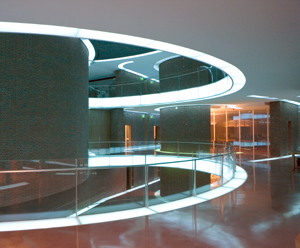
Curving paths of light designed in collaboration with James Turrell illuminate the atrium at SOM’s new Deerfield Academy building.

Courtesy SOM

Concrete evidence about the relationship between student performance and space and light is lacking, so architects and educators end up relying on intuition and externally imposed limits when conceiving visionary new schools. No one has yet proven, for example, whether heightened oxygen circulation improves students’ concentration, or the extent that internal public spaces spark constructive student dialogue. Nevertheless, there is a quickening movement to respond in architectural terms to the challenges of education. The newly released Schools and Kindergartens: A Design Manual, by Mark Dudek, Dip. Arch RIBA, highlights this trend.

Claire Weisz, AIA, of Weisz + Yoes Studio, and Roger Duffy, FAIA, of Skidmore, Owings & Merrill, believe in the power of design to shape and elevate the learning experience. Having recently completed primary and secondary schools, these two architects have transcended conventional formulas. Duffy recruited an interdisciplinary team of scientists and artists, including James Turrell, to help design the newly completed 78,000-squre-foot science, math, and technology building at Deerfield Academy in Massachusetts. “We wanted to test the boundaries of architecture to provoke unique human experiences,” he said. Inspired by spaces such as Turrell’s Roden Crater, Stonehenge, and Petra, Duffy and his team sought ways to “stimulate curiosity and thought, transcending the status quo.”

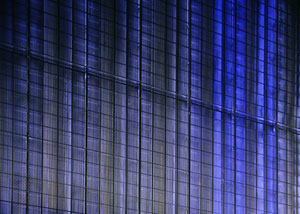
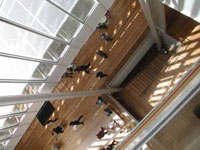
Curving brick ribbons and processional light stripes lend the Deerfield building a mysterious quality attuned to the wonder of scientific enquiry, according to Duffy. The classrooms function almost exclusively with natural light. However, perimeter light coves can be activated to emit uniform morning-like light, which is thought to boost human alertness by engaging natural circadian rhythms.

At the Bronx Charter School for the Arts, Weisz + Yoes also used environmental triggers to open students’ and teachers’ minds. A brilliantly colored glazed-brick street elevation, internal spatial continuity, and generous studio space define this former industrial building on a block that dead-ends at the Bruckner Expressway. In addition, an efficient air circulation system is meant to help everyone stay in the mood for learning. Weisz hopes the elementary school, which opened in 2004, will bring lasting change to the Hunts Point community. Its importance to the neighborhood is perhaps suggested by the fact that it has remained free of graffiti and vandalism while other nearby buildings have not.

The completely exposed ductwork and suspended fluorescent fixtures at Bronx Arts are the opposite of the seamlessly finished ceilings at Deerfield. Yet the markedly different challenges associated with working for a cash-strapped urban startup school and an elite private academy do not eclipse the shared, fundamental assumptions that good design matters in education, and education matters in society. As Weisz asked, “What does a school building say to those kids about how society feels about them and what they’re doing?”

Using Glass as a Spiritual Material

Event: James Carpenter Design Associates’ ‘Environmental Refractions’
Location: The Architectural League of New York, 03.13.07
Speakers: James Carpenter — James Carpenter Design Associates; Sandro Marpillero, AIA — Marpillero Pollak Architects; Kenneth Frampton — Ware Professor of Architecture, Columbia University GSAPP; Matthias Schuler — lecturer in architecture, Harvard Graduate School of Design; Detlef Mertins — Chair, Department of Architecture University of Pennsylvania; Linnaea Tillett, PhD, IESNA — Principal, Tillett Lighting Design Inc.
Organizers: The Architectural League of New York

Visual Processes

Visual Processes

Courtesy The Architectural League of New York

James Carpenter pushes the material boundaries of his projects, according to Sandro Marpillero, AIA, author of James Carpenter: Environmental Refractions. Glass, a common material, transforms into something spiritual and evocative. Kenneth Frampton, who contributed the afterword in the monograph, praised Carpenter’s ability to achieve technae, the ancient Greek ideal that lies “between craft and technology — linked to engineering but removed from its instrumentality.”

Sought after by designers, Carpenter often acts as a collaborative design consultant, a current trend in architectural practice. The James Carpenter Design Associates’ (JCDA) collaboration with Grimshaw Architects at the Fulton Street Transit Center is an example of how this collaboration can enhance a project, according to Detlef Mertins, Chair of the Department of Architecture at the University of Pennsylvania. The dynamic interplay of sunlight, glass, and reflections throughout the interior show an “interaction with phantasms.”

At the Tulane University Student Center, designed by Vincent James Associates, the two disciplines of glass and environmental design converge at the entrance. Climate engineer Transsolar and JCDA created a distinctly “non-glassy” solution involving motorized flat fans and excess chiller water to cool and dehumidify the space without conventional air-conditioning, explained Matthias Schuler, Diplom-Ingenieur at Transsolar.

Carpenter describes his work as “coming down to light and materiality.” Absorption and reflection are found in all materials, but he uses glass as a “substrate that can coalesce different bodies of information… compacting information, conscious and unconscious.”

Brand Defies Quality in Starchitecture

Event: Brandism Series: Icon as Brand
Location: Center for Architecture, 02.26.07
Speakers: Mustafa Abadan, FAIA – partner, Skidmore, Owings & Merrill; James Biber, FAIA – partner, Pentagram; Mario Natarelli – Chief Brand Experience Officer, FutureBrand; Frank Sciame – President & CEO, F.J. Sciame Construction Company
Moderator: Ned Cramer – Editor-in-Chief, Architect
Organizers: Anna Klingmann, Assoc. AIA; AIA New York Chapter

Kristen Richards

Foster + Partners’ Hearst Headquarters.

Kristen Richards

Kristen Richards

The interior of the Morgan Library & Museum, designed by Renzo Piano Building Workshop.

Kristen Richards

Architects today receive commissions from more clients who value good design, thanks in part to the efforts of ascendant branding experts. Developers have realized that some buyers and tenants will pay premium rates to occupy space designed by a “name-brand” architect, just as museum directors and city officials have tried to harness the caché of star architects to attract tourists. As a result, a super-crop of signature buildings is surfacing on the streets of major cities. New York’s recent and imminent icons include the Morgan Library & Museum designed by Renzo Piano Building Workshop (RPBW) with Beyer Blinder Belle Architects and Planners; Hearst Headquarters by Foster + Partners; RPBW/ FXFOWLE Architects’ New York Times Building; Gehry Partners’ IAC Center; the four new towers at the World Trade Center site; and One Bryant Park designed by Cook + Fox Architects. Is the drive to produce signature architecture healthy for the profession and the built environment, or does branding ultimately erase construction quality?

“Icon-branded buildings make connections between culture and commerce by combining design and real estate logic,” according to Anna Klingmann, Assoc. AIA, organizer of the Brandism series hosted by the Center for Architecture. Magazines such as Wallpaper – that fuse fashion, products, and architecture into a chic digest of contemporary visual culture – whet the public’s growing appetite for good design. While Ned Cramer, Editor-in-Chief of Architect, observed that contemporary architecture still lags behind classical and pre-modern design in mainstream popularity (see the AIA’s recent survey of America’s Favorite Architecture), several highly branded, recent projects, including the Apple Store Fifth Avenue by Bohlin Cywinski Jackson, made the list shortly following their completion.

If the branding-industrial field has discovered how to create interesting new buildings and travel destinations, it has not solved the problem of how to encourage consistent quality, nor how to preserve the distinct integrity of its successes. Can a designer focus on the programmatic, social, and formal challenges at the site while trying to produce a ready-made icon? Mustafa Abadan, FAIA, a partner at SOM currently working on the totemic Burj Dubai, says it’s not impossible. He described the development of the AOL Time Warner Center at Columbus Circle as an organic process of spatial problem-solving resulting in a striking final product. Yet he warns against a city resembling an overcrowded cosmetics store with opulent bottles jostling for attention.

James Biber, FAIA, an architect with the design and branding firm Pentagram, distinguished between architecture that revealed an “honest” brand identity, and superficial glitz amounting to an “advertising lie.” Mario Natarelli, whose firm FutureBrand is commissioned to strategically define cities, countries, and governments as well as companies and buildings, defines brand as a kind of relationship between seller and buyer. He agreed with an audience member that good branding is not synonymous with good architecture: “You can’t spin a building to be any better than it’s going to be.”

Architects Experiment with Ecology

Event: Experimental Urban Ecology
Location: Center for Architecture, 02.22.07
Speakers: David Ortiz – Project Manager, DMJM Harris/AECOM; Alex Felson – Director of Ecological Design, EDAW/AECOM; Anupama Sharma – Senior Project Architect & Planner, Metcalf & Eddy/AECOM; Amy Garrod – Sustainability Specialist, Faber Maunsell/AECOM
Organizer: AIA NY Committee on the Environment (COTE)

Photo by Jessica Sheridan

Architects are beginning to collaborate with ecologists to improve local ecosystems.

Jessica Sheridan

The study of ecological systems in urban environments is a relatively new area of research. The methodology used for ecological experiments in natural environments can be adapted for urban conditions – although with some difficulty. The heterogeneity of urban environments and social factors may compromise the scientific method when replicating experiments.

To aid the process, ecologists are forming new partnerships with design professionals to create architecture and urban designs that fuse ecology with design experimentation. Traditional collaborations between ecologists and designers often result in a design that directly mimics nature. In more recent designed experiments, however, the modular, functional, and geometric forms used to conduct the experiment become the basis for a new design expression.

According to statistics, the A/E/C industry invests only .05% of its total budget in research compared with the automotive industry’s 3% or biotech’s 14%. Convincing clients to incorporate design experiments into project budgets requires developing allies who can motivate constituents and mobilize resources. European sustainability metrics, such as the Building Research Establishment’s Environmental Assessment Method (BREEAM) and other regulatory measures, emphasize the impact of development on larger ecosystems and facilitate the participation of ecologists. The inclusion of ecologists on design teams is still rare in the U.S., however.

Architects are in a unique position to integrate ecological research into the built environment by insisting on working with ecologists throughout design development. Such a perspective will prove increasingly valuable as designers attempt to improve local ecosystems with the built realm.

LOT-EK Injects New Life Into Shipping Containers

Event: People and Buildings: Thinking Inside the Box
Location: Housing Works Bookstore Café, 01.30.07
Speakers: Giuseppe Lignano & Ada Tolla – Principals, LOT-EK; Marc Levinson, author, The Box: How the Shipping Container Made the World Smaller and the World Economy Bigger
Organizers: The Center for Urban Pedagogy (CUP); New York Council for the Humanities

Courtesy LOT-EK

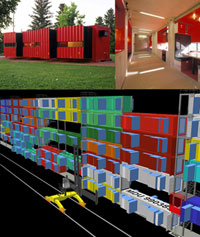
Mobile Dwelling Units (MDU) travel as standard-size containers, expand to reveal furnished interiors, and could be plugged into “vertical harbors” in any city.

Courtesy LOT-EK

Home, gallery, train station, vertical village, museum, portable retail hut, mega-billboard, recycling plant: these are among the novel alternative uses that Giuseppe Lignano and Ada Tolla, founding principals of LOT-EK, have conceived for the thousands of surplus 20- and 40-foot-long standard shipping containers that accumulate like empty shoeboxes in U.S. port cities. Interpreting the containers as adaptable architectural shells rather than inherently defined freight boxes, the partners envision a radically modular landscape as liquid as capital itself.

Their January 30th presentation – part of CUP’s People and Buildings event series – complemented a lecture delivered by the economist Marc Levinson recounting the evolution of the modern shipping container. According to Levinson, a former editor of The Economist and author of a new book on shipping container history, the adoption of standard shipping containers in the 1950s-70s fueled the industrial decline of formerly bustling ports such as Brooklyn. LOT-EK’s designs creatively invert this relationship; in its hands the very same shipping containers become post-industrial building blocks to revitalize the city. The firm is on a mission to discover how many different types of program can be dynamically planted in, around, and between the containers.

One case study is the Mobile Dwelling Unit (MDU), which not only functions as an independent, fully furnished home, but hypothetically plugs in to a vast “vertical harbor,” or high-rise steel rack, in any metropolis. Said Lignano, “Like pixels in a digital image, temporary patterns are generated by the presence or absence of MDUs in different locations along the rack, reflecting the ever-changing composition of these colonies scattered around the globe.” The completed Bohen Foundation gallery and offices on West 13th St. shows how shipping containers can be adapted to create flexible interior volumes. Accommodating an entirely different program, the train station and tower they have proposed for Turin, Italy, is a 1,800-foot-long “programmable billboard” animated by the constant movement of trains, cars, passengers, and shoppers, as well as a giant stream of travel information and advertisements.

Recycling is one of LOT-EK’s goals, but not only in the material sense. Responding to Levinson’s account of endless negotiations over the exact specifications of standard containers, Lignano said he and Tolla would like to “recycle the intelligence and all the effort” spent developing the 8.5-foot-tall, 8-foot-wide steel and aluminum boxes. They also see latent pop-art value in the multi-colored containers. Shipping containers could one day become as ubiquitous in the built environment as they are on the seas and highways.

Gideon Fink Shapiro is a writer and researcher at Gabellini Sheppard Associates, and contributes to several design publications.

Why Bronx Library Lures Customers

Event: Bronx Library – LEED Silver
Location: Center for Architecture, 02.07.07
Speakers: Daniel Heuberger, AIA, LEED AP – Principal, Dattner Architects; Robin Auchincloss, AIA, LEED AP – Senior Associate, Dattner Architects; James Kilkenny – Project Executive F. J. Sciame Construction Co., Inc.; Susan Kent – Director & CEO of The Branch Libraries, The New York Public Library
Moderator: William Stein, AIA – Principal, Dattner Architects
Organizer: AIA NY Committee on the Environment (COTE)

Jeff Goldberg/Esto

The Bronx Library Center’s sloping roof aids its green design.

Jeff Goldberg/Esto

The 78,000-square-foot Bronx Library Center at the New York Public Library, the largest public library in the Bronx, is the first publicly funded building in New York City to receive LEED Silver certification. Its open, light interior contrasts the dark 25,000-square-foot building it replaced creating a transparency that connects with the neighborhood. Since its opening in January 2006, numerous community groups began to use the building. If numbers can indicate success, 527,000 items were checked out and 15,400 library cards were issued last year, compared to a previous 154,000 items and 3,100 library cards.

The design of the Bronx Library Center is specific to the site conditions, particularly its eastern orientation and zoning envelope. The sloped metal roof maximizes the building’s area within the zoning constraints and allows light to penetrate the western side of the building. Cantilevered glass on the east façade also gives a sense of openness and maximum light penetration. The design includes an outdoor reading room on the roof that will be surrounded by a 10-foot hedge. Related energy conservation measures include thermally broken glass, light shelves, and mechanical blinds.

In addition to being an important lesson in sustainable design for the client, designers, and contractor, the library enjoys success as a public resource. The users of the building learn about sustainable architecture on a daily basis as they explore the Center’s new design.

Aaron Slodounik, LEED AP, is a freelance art and architecture writer.