
Awaken a New Yorker in the middle of the night and ask what the name Copenhagen brings to mind: the answer will probably be bikes. Yet its enthusiastic embrace of cycling is just one of many ways the Danish capital is a model for other cities’ efforts to increase sustainability and resilience. Continue reading “The Clean, Green Path to Urban Recovery”
Author: Bill Millard
Sandy, the game-changer: more than academic interest
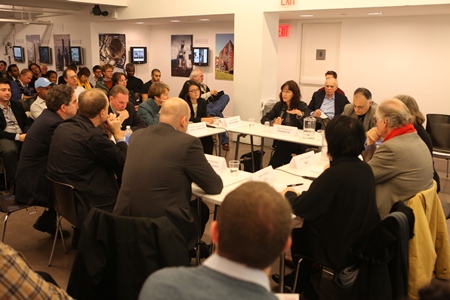
Nina Rappaport moderates the roundtable discussion.
Laura Trimble
Event: Arch Schools 2012 Exhibition Reception and Deans’ Roundtable
Location: Center for Architecture, 11.17.12
Speakers: George Ranalli, AIA, Dean, Bernard and Anne Spitzer School of Architecture, The City College of New York; Elizabeth O’Donnell, Associate Dean, The Cooper Union for the Advancement of Science and Art; Urs P. Gauchat, Hon. AIA, Dean, New Jersey Institute of Technology; Judith DiMaio, AIA, Dean, New York Institute of Technology; Andrew Bernheimer, AIA, NCARB, Director, Master of Architecture Program Parsons, The New School of Design; Tom Hanrahan, Dean, Pratt Institute; Evan Douglis, Dean, Rensselaer Polytechnic Institute (RPI); Robert Shibley, FAIA, Dean, University at Buffalo (SUNY); Marilyn Jordan Taylor, FAIA, Dean, University of Pennsylvania; Joyce Hsiang, Acting Assistant Dean, Yale University; Nina Rappaport (moderator), architectural critic, curator, and educator, and publications director at Yale School of Architecture; Jill N. Lerner, FAIA, Kohn Pedersen Fox Associates, and First Vice President / President-Elect, AIANY (introduction); Lance Jay Brown, FAIA, ACSA, Distinguished Professor, Bernard and Anne Spitzer School of Architecture, The City College of New York (closing remarks)
Organizers: AIANY in partnership with the Center for Architecture Foundation
Sponsors: Swanke Hayden Connell (patron); Beyer Blinder Belle, Forest City Ratner Companies, Mancini Duffy|TSC, NYC School Construction Authority, Perkins Eastman, STV Group, Thornton Tomasetti (sponsors); ASSA ABLOY, Cameron Engineering, Cosentini Associates, DeLaCour & Ferrara Architects, E-J Electric Installation, Ennead Architects, F.J. Sciame Construction, FXFOWLE, Ingersoll Rand Security Technologies, Ingram Yuzek Gainen Carroll & Bertolotti, Jack Resnick & Sons, JAM Consultants, JLS Industries, Knoll, Kohn Pedersen Fox Associates, Langan Engineering and Environmental Services, Lend Lease, Milrose Consultants, Pelli Clarke Pelli Architects, Syska Hennessy Group, Vanguard Construction & Development, Viridian Energy & Environmental / Israel Berger and Associates, World Trade Center Properties (supporters).
The eighth in the series of annual Deans’ Roundtables, held within three weeks of Superstorm Sandy and focused by that event on climatic effects on the built environment, offered chances for leaders of the region’s architecture schools to move, in the words of RPI’s Evan Douglis, “from marketing to messaging.” Representing one’s institution in its best light among colleagues under normal circumstances is one kind of communication; reimagining the wider relation between professional academies and societal needs for architectural expertise amid inexorable climate change is another entirely. As multiple commentators on resilience, ethics, and activism pointed out – and as the summation by Lance Jay Brown, FAIA, energetically and succinctly stressed – “anybody who thinks that we live in an era of unpredictability hasn’t been paying attention… there’s a lot of predictability,” involving both climate change itself and its linkages to economics, technology, and design. “This is the greatest time for architects there ever was,” Brown continued, outlining a new professional paradigm in which crisis and opportunity are fused.
Early institutional reactions to Sandy, noted AIANY President-elect Jill Lerner, FAIA, have been swift. The Design for Risk and Reconstruction Committee (DfRR), launched last year by co-chairs Brown and Illya Azaroff, AIA, received information from more than 300 architect-volunteers within 24 hours to help with building assessments, and an AIANY staff-led “members helping members” effort reached nearly 700 Chapter members in affected areas. (Please visit AIA New York’s Superstorm Sandy Recovery website for information on recovery efforts.) Beyond short-term responses, however, the institutions that shape rising generations of architects also have critical long-range responsibilities.
University of Pennsylvania’s Marilyn Jordan Taylor, FAIA, emphasized how architecture and design schools need to embrace a research mission to be “an equally respected player” with the other components of major universities, and to convince students (from the undergraduate “predisciplinary” state to the “disciplinary moment” and eventually a “postdisciplinary” point of thinking across barriers) that part of their mission, during the current crisis and perhaps over their whole careers, is “to show how design creates value.”
These observations set the stage for recurrent self-critiques of architecture schools’ embrace of interdisciplinary scholarship and analysis, reaching out to the physical sciences, environmental activism, and the realms of law, politics, and economics to take on increasingly hard questions: not just the technical details of how to rebuild after catastrophes, for example, but the variables affecting decisions on whether occupying certain sites is advisable at all.
Interdisciplinarity, some participants specified, needs purposeful definition: it’s a matter of appropriate engagements with multiple fields, not expansion of architecture’s concerns so far that it dilutes the discipline. The design fields, observed NJIT’s Urs Gauchat, Hon. AIA, can unite left-brain and right-brain modes of thinking, generating specific problem-solving approaches suitable to the hurricane as a “teaching moment.” Urging colleagues not to “forget everybody else [and] define the world in the way that is useful to us… [which] to me, makes us irrelevant,” Gauchat instead recommended collaborations with other fields’ existing approaches to problems. Since so much of education skews toward left-brain skills that are quantitative, measurable, and “quasi-scientific,” he added, the design disciplines have distinct strengths worth advocating. Engagements with science/technology/engineering/mathematics departments, added Robert Shibley, FAIA, AICP, of the University of Buffalo, face barriers of perception and communication: “We imagine ourselves to be ‘bilingual,’ [but] our STEM colleagues don’t…. What we need is a universal translator in the context of the university.”
Smaller institutions like Cooper Union, noted Elizabeth O’Donnell, have their own cultures, distinct from those of large research universities; their methods may encourage students to “not so much answer questions as to figure out what the right question is to ask.” Noting that in the same year as the hurricane, the Midwest had a summer hot and dry enough to lose 80% of its corn crop, O’Donnell identified these phenomena as “radically different expressions of the same condition,” and finds that architecture schools naturally educate students to address that whole condition rather than the disparate pieces. She also identified the Museum of Modern Art’s 2010 “Rising Currents” exhibition as a useful case of extramural research fostering public recognition of how design can help mitigate damage; that “the media is beginning to search outside the normal locations where they expect scientific research to happen” strikes her as grounds for optimism.
Thomas Hanrahan of Pratt was more guarded about the gap between “what we do pretty well” (ethical applications of multidisciplinary and multi-scalar analyses) and “how you leverage them up politically. How do you broaden the conversation… to get the world to acknowledge these really extraordinary skills?” One practical and overdue step, he suggested, would be to ensure that sustainability is a basic standard component of any curriculum.
Though Columbia’s GSAPP was conspicuous by its absence, one of its recent graduates sparked discussion late in the proceedings with a pointed question about schools’ responsibilities to their students and graduates, who “pay every month for the next 30 years for these institutions.” Comparing some of his peers to the “best minds of my generation destroyed by madness, starving hysterical naked” in Allen Ginsberg’s “Howl,” he contrasted the nuts-and-bolts knowledge he is now acquiring in practice with the intellectual “muscle that I flexed for seven years.”
Several deans recognized this question as an urgent one and attempted to answer it with honesty and nuance. CCNY’s George Ranalli, AIA, proposed a “significant realignment to the world of architecture, to the practical application of theory,” and acknowledged that the professional conditions his own generation faced – “you would get a job when you got out, and it would be good-paying, so you could spend your time in school, in which you were really pushing the exercises of your imagination, the exploration of tools and principles and so forth… and you were going to get paid to learn the rest of what you had to learn after two to five years in an architectural practice” – have vanished: “That’s just not what the trajectories of the market [are] offering, and frankly, it’s not the trajectories that our students are looking for.”
Though theory/practice disconnections and job-placement challenges are by no means unique to architectural study, restructuring the walls between the academy and its society to be more porous, synergetic, and open to “two-way traffic” will be a critical element of these institutions’ response to the global climate crisis, which increasingly looks like a permanent condition.
Edgeless/Best Schools in Depth: New Schools of Thought on Educational Edges
Center for Architecture
Center for Architecture

Center for Architecture
Center for Architecture

Thomas Mellins, curator, “The Edgeless School” and Juulia Kauste, director, Museum of Finnish Architecture, and project leader, “The Best School in the World,” in front of a panel from “The Best School.”
Sam Lahoz
Organizers, “The Edgeless School: Design for Learning”: AIANY in collaboration with the Committee on Architecture for Education and the Center for Architecture Foundation
Senior Research Consultant: Edith Ackermann, Ph.D., Visiting Scientist, MIT School of Architecture
Exhibition Design: Sage and Coombe Architects
Graphic Design: Hyperakt
Organizers, “The Best School in the World: Seven Finnish Examples from the 21st Century”: Museum of Finnish Architecture, as part of New Finnish Design CITY campaign, produced by the Consulate General of Finland and the Finnish Cultural Institute in New York
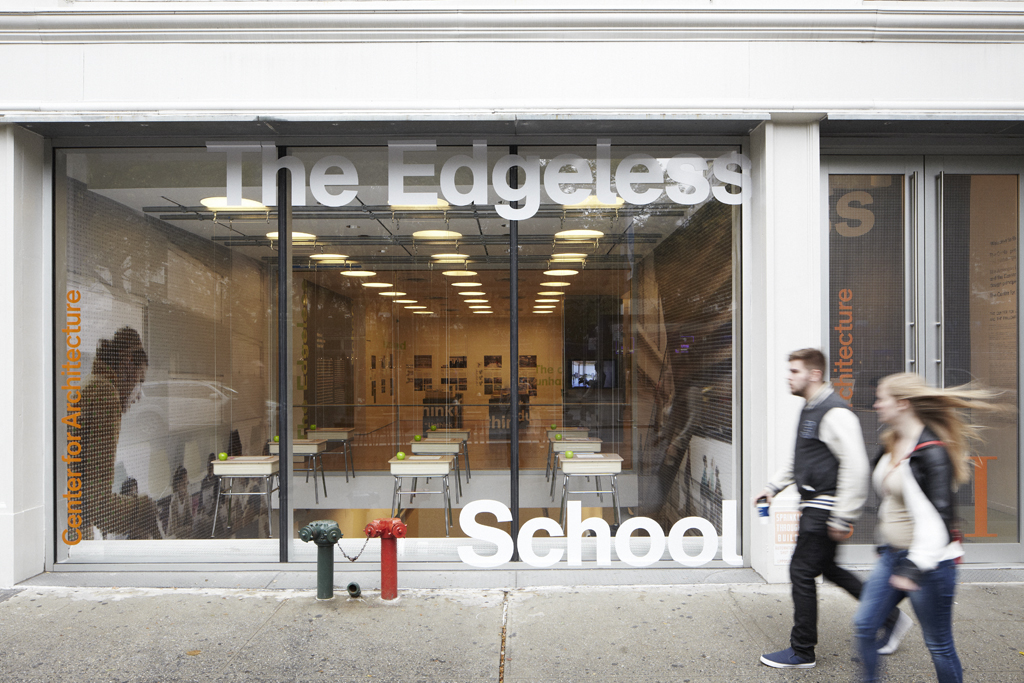
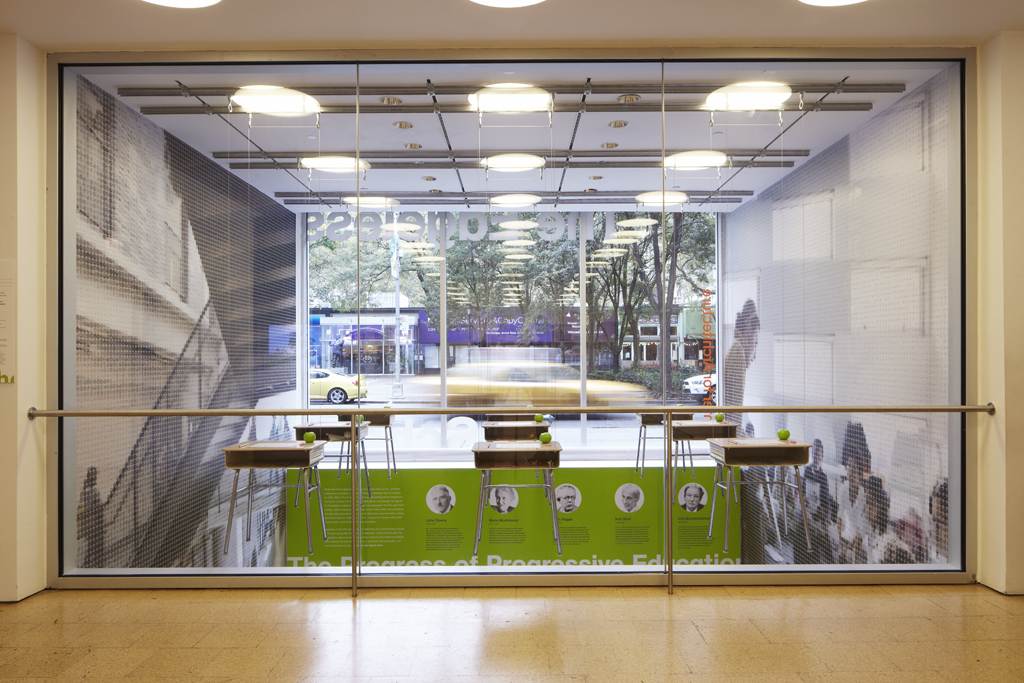
Eerily suspended rows of traditional school desks, aligned identically and equipped with sheets of ruled paper and uniformly positioned apples, are currently drawing the eyes of curious passers-by into the Center for Architecture’s Hines Gallery. The effect is both familiar and uncanny. Perhaps everyone’s recollections of grammar school, fond or otherwise, share certain qualities with dreams.
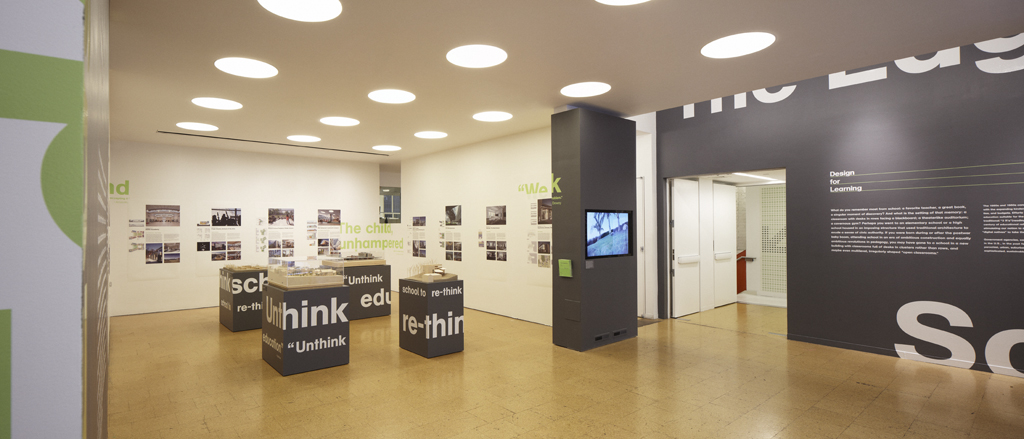
The new “The Edgeless School” exhibition, once one’s gaze moves past the disembodied desks and orderly geometries of yesteryear, offers variations on themes of fluidity, blurred borders, shifting roles for teachers and students, and altered relations between schooling and extracurricular life: forms and practices that the schools of the not-too-distant past were unprepared for.
Displays representing 19 architecturally distinguished K-12 schools nationwide (including urban, suburban, and rural settings; a mix of public, private, and special-needs institutions; and scales from the tight Manhattan sites of the East Harlem, Stephen Gaynor, and Rodeph Sholom schools to spacious campuses like Blue Valley Southwest High in Overland Park, KS) show how built forms express evolving teaching philosophies. These American examples share some features with the seven schools in a companion exhibition from Finland, where progressive design and policy have converged to yield impressive gains in student performance.
Schools’ built environments – like contemporary pedagogy itself – commented curator Thomas Mellins at the press preview, are abandoning the artificiality reflected in the Cartesian grid of airborne desks. “Everyone seems to agree that we’re at a watershed moment in terms of formal education in this country,” he said, noting that educating “digital natives,” students who have spent their whole lives in an information-rich environment, creates new expectations. If information and knowledge are now universally accessible, are traditional schools dinosaurs? Does introducing young people to the life of the mind require dedicated rooms or buildings at all? (One recalls President James Garfield’s legendary definition of the ideal college as [Williams president] “Mark Hopkins on one end of a log and a student on the other.”)
These questions aren’t easily answerable. Hence ”The Edgeless School” model, offering gray areas rather than sharp conceptual and physical demarcations between teachers’ roles as wise elders dispensing information or facilitators of students’ discoveries; separate and merged interior areas; purpose-built and ad hoc spaces; built environments and nature; town and gown; and the most basic borderline: formal schooling vs. informal, extramural, experiential processes of education. Parental expectations, adds Mellins, have evolved, and school design needs to consider them: “In the early 20th century, parents were very often expecting the schools to Americanize their children” and looked to school authorities for that role, while today’s parents, connected through constant electronic communication, not just annual parent-teacher conferences, are more directly involved and hold teachers “accountable to them,” altering the metaphoric meaning of transparency.
Despite all too many schools’ depressing atmosphere of carceral chain-link fencing, the best ones are organized for flexibility and surprise, not warehousing and discipline. Mellins described a “discovery that corporate America made quite some time ago: very often the best ideas don’t come out of the conference room or the board room, but… out of the chance encounters that happen at the water cooler.” The educational equivalent is to design for social interaction and collaboration, emphasizing open areas, multipurpose spaces (e.g., “a science lab that’s also an art room”), and scales appropriate to students’ needs. Children with autistic-spectrum conditions, for example, benefit from alcoves small enough for two or three kids and a teacher, plus extensive glazing to help them observe and mirror other kids’ interactions.
Mellins and colleagues look to a series of pathbreakers in progressive education for theoretical grounding, including John Dewey, Maria Montessori, Jean Piaget, Ivan Illich, Howard Gardner, John Seely Brown, and others whose ideas are presented in interior displays, among more up-to-date furniture: a Smart Board and an array of Steelcase rolling desk/chair/storage modules, which Mellins described as ideal for classrooms where teachers circulate freely, rearrange the students’ positions, and strive to keep floors uncluttered by ubiquitous backpacks. Such spaces support engagement with students’ diverse forms of intelligence and fit teachers’ evolving role: once the “Sage on the Stage,” now more often the “Guide on the Side.”
If media reports too often associate American schools with funding shortages, program cutbacks, declining scores, “teach to the test” narrowness, and metal detectors, what helps some schools perform better? Handsome facilities alone don’t create an atmosphere of professional dedication and imagination, but they can aid educators in developing one. Finland’s school system has earned global admiration among teachers and designers, as Finnish students recurrently earn high scores in the Organisation for Economic Co-operation and Development’s Programme for International Student Assessment (PISA) surveys, across the range of academic subjects and family socioeconomic backgrounds.
The Museum of Finnish Architecture’s Juulia Kauste answers recurrent questions about the key to this success in terms of Finland’s egalitarianism, providing free state-funded education to all as a national principle, as well as its lively tradition of architecture competitions (five of the seven schools shown here resulted from open competitions) and its dedication to upgrading learning environments, diversifying open communal spaces to help schools’ various age groups socialize safely or work privately without constant supervision. Local authorities, she reports, run 97% of the nation’s schools, which observe a national curriculum allowing for local variations. National guidelines consider building features as well as curricula.
“There’s a strong emphasis on this idea that everyone deserves to have the equal right to equal quality of education,” Kauste said, adding that schools provide healthcare and other services, with attention to nutrition and recreation as well as classroom work (the typical Finnish school day includes hourly recesses, she noted, aiding students’ alertness). The double-boomerang volumes by the young firm Verstas Architects for the Kirkkojärvi School in Espoo – perhaps the most striking of the seven sample schools – are both graceful and purposeful: each separate yard, as demarcated by the building’s wings, accommodates a different age group. Since communities also use the facilities after hours, Kauste added, “the school is the center of the community in other ways as well, not only for the students but for other activities,” defining “sustainability not only in terms of green and energy, but [as] cultural sustainability.” These schools treat their indoor and outdoor spaces not as neutral containers, but as environments designed to foster the development of the whole student and the whole community.
“The Edgeless School: Design for Learning” and “The Best School in the World: Seven Finnish Examples from the 21st Century” are on view through January 2013.
Putting the Pleasure Back in Americans’ Favorite Guilty Pleasure
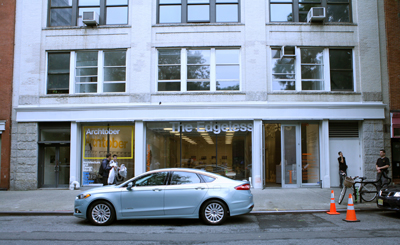
The 2013 Ford Fusion parked outside the Center for Architecture.
Daniel Fox
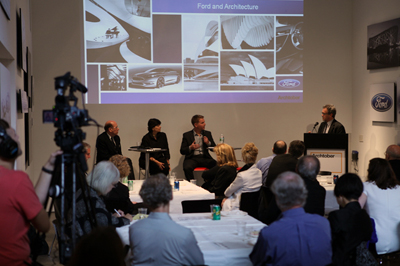
(l-r) Donald Albrecht, Jill Lerner, FAIA, Jeff Nield, and Rick Bell, FAIA
Daniel Fox
Event: Fords and Architecture
Location: Center for Architecture, 10.03.2012
Speakers: Rick Bell, FAIA, Executive Director, AIANY (moderator); Jeff Nield, Manager, Strategic Design Vision and Futuring, Ford Motor Company; Jill Lerner, FAIA, Principal, Kohn Pedersen Fox; Donald Albrecht, Curator of Architecture and Design, Museum of the City of New York; Cynthia Phifer Kracauer, AIA, LEED, Managing Director, AIANY (introduction)
Organizers: Ford Motor Company and AIANY
Sponsor: Ford Motor Company
We know what they do to the atmosphere, to cities, to human lungs and bones. The conundrum is that cars are still not only indispensable in most of the U.S. – both for individuals wanting full participation in civic life and for the economy in general – but, at their best, unavoidably cool. If the U.S. auto industry can adapt successfully to an era when buyers value sustainability and efficiency as well as horsepower, suggested a special Archtober panel, it’ll be in part because of design that revives the mojo of iconic ’65 Mustangs and ’57 Thunderbirds and confers it on advanced vehicles as well: hybrids, electrics, maybe even autonomous models.
Even in a city where the dominant mobility choice is pedestrian – and in an era of climate change, green urbanism, PlaNYC, and widespread awareness of the downsides of Robert Moses-era urban design – few of us are immune to the appeal of a well-designed car. Automotive design helped inspire Le Corbusier imagine his “machines for living”; the streamlined contours of buildings by Jørn Utzon, Ai Weiwei, Herzog & de Meuron, and others, as Ford’s photo installation in Tafel Hall for this event made clear, bear unmistakable resemblances to Detroit’s signature product.
As opening remarks by Rick Bell, FAIA, suggested, architectural and automotive design both strive for the Vitruvian virtues of firmness, commodity, and delight. Cars, he noted, help define national and personal images; “people still define themselves by what they drive,” expressing values from their first car onward. His unavoidable pun on cold fusion, a long-sought holy grail among physicists, generates the phrase “cool fusion,” a concept whose implications extend well beyond the name of an advanced model.
With an icy-green new Fusion parked tantalizingly in front of the Center for Architecture, implying that future hybrids can be not only as eco-responsible as a Prius but as sporty as an Aston Martin (this model definitely looked like it could accommodate the 007 twin-machine-gun option), three architects and a Ford designer offered an invited audience their insights into common ground between these realms.
Donald Albrecht, curator of the Museum of the City’s recent “Cars, Culture, and the City” exhibition, spoke of his first car (a 1969 Volvo) in terms of the minimalism of Eero Saarinen and Kevin Roche, along with outlining the linkages between Henry Ford’s assembly lines and modern office procedures.
Jill Lerner, FAIA (first car, a Ford Pinto), recalled working on Detroit’s Walter B. Ford College for Creative Studies, a design academy with a strong pipeline into the automotive field. She not only finds parallels between the two professions in the areas of aesthetics and emotional connection, but notes that technological advances commonly migrate between them (neoprene seals, for example, were developed by the auto industry, then applied to buildings’ fenestration). Comparing the energy-performance monitoring of a Prius to smart-building technologies that offer occupants informative feedback and control, she suggested a series of developments along multiple dimensions related to individual options (e.g., family-scale fleets of multiple cars for specific purposes). Mass customization, diversification, and precise information management, it seems, have thoroughly replaced the standardization embodied by Ford’s Model T.
Ford’s Jeff Nield also underscored parallel aims between architects and auto designers, noting that “in both cases, you want to put a person or a group of people in an environment that they’re comfortable in for a long period of time.” Responding to inquiries about cars’ adaptation to changing demographics, he described “how to get more out of less” as a high-priority aim at Ford; just as “a skyscraper is a brilliant solution to having a very small footprint,” automakers are maximizing efficiencies in spatial footprint, fuel use, and other variables.
A recurring theme, however, was that beauty trumps rationality in people’s relations to cars. “We’re differentiating ourselves,” Nield said, through “studying what makes a beautiful automobile timeless. We want our products to stand the test of time visually and aesthetically. Our goal right now at Ford is to design beautiful cars that customers fall in love with. And underneath that is a very impressive efficiency and power-train story, but that is really where our design director J Mays is taking the brand. We’re at a time where we can be responsible but also have the romantic and dramatic vehicle.”
There is much to say, and much being said elsewhere, about the auto’s history of crowding other mobility options out of public space; about externalities and subsidies; about urban driver behavior and accountability. Your humble reporter (full disclosure: first car, 1970 Ford Maverick; second car, ditto; current ride, antique Fuji 12-speed) found it refreshing, on this occasion, to step aside from those concerns and consider beauty for a while. It’s essential to nearly everyone’s experience of built space, whether that space stands still or rolls; though it’s an off-limits topic in some circles, it’s at the center of auto designers’ thinking. No serious consideration of transportation can ignore it.
Audience comments, particularly by Dale Cohen, Assoc. AIA, and Lance Jay Brown, FAIA, returned to factors that make people fall in or out of love with cars: no car of the last two decades, Cohen noted, inspires the love we gave up for classic T-birds, and Zipcars, Brown suggested, offer alternatives to the “psychological baggage” of auto ownership. The 2013 Fusion, Nield suggests, is the American hybrid with a chance to reintroduce romance.
On the other hand, the Zipcar system may make serial flings preferable to automotive monogamy altogether. Technologies like the Google Driverless Car are providing reasons to rethink whether the individual experience of driving is all that lovable anyway; perhaps it’s become dull enough to delegate to robots. At any rate, the most admirable vehicles, as with buildings, will be the ones that respond to a broad, complex definition of beauty.
From São Houses to Our House
Event: The Architecture of Social Investment
Location: Center for Architecture, 12.10.10
Speakers: Jörg Stollmann & Rainer Hehl — Founders, urbaninform (Zürich); Fabienne Hoelzel — Project Coordinator, SEHAB (Secretary of Habitat) (São Paulo)
Moderator: Andres Lepik — Curator, Museum of Modern Art
Introductions: Margaret O’Donoghue Castillo, AIA, LEED AP — 2011 AIANY President; Catherine Scharf — Consul, Head of the Cultural Department, Consulate General of Switzerland; Ann Marie Baranowski, AIA — Co-chair, AIANY Cultural Facilities Committee
Organizers: ThinkSwiss program, Swiss Confederation; Center for Architecture; AIANY Cultural Facilities Committee
Sponsors: Noah Foundation; Good Growth Fund; Global Exchange for Social Investment; Genisis Institute
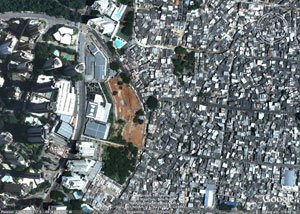
Morumbi district’s Paraisópolis favela.
Courtesy Google Earth
Urbaninform, a nonprofit sustainable-investment association, is one of three web-based projects included in MoMA’s current exhibition “Small Scale, Big Change: New Architectures of Social Engagement.” Curator Andres Lepik’s introduction to “The Architecture of Social Investment” panel emphasized how the social ideals that were integral to 1920s Modern architecture, but later became subordinated to formal, theoretical, and other considerations, are currently being rediscovered by a generation of younger architects.
A statistical milestone that’s been mentioned in numerous contexts lately — that the world’s population has just passed the threshold of being 50% urban, probably an irreversible tipping point — lent context and urgency to this discussion of the relations among housing design, economics, and governance. By 2030, noted Rainer Hehl, founder of Zürich-based urbaninform, that percentage is likely to reach 61% by leading estimates, with half the urban population living in slums. To create adequate housing conditions by then, the world needs to produce 4,000 new units each hour. Inadequate housing and infrastructure are not limited to distant places, Hehl added, quoting Rep. Marcy Kaptur (D-OH) on how the financial system’s cluster of failures (underwater mortgages, foreclosures, and evictions) make many Americans “squatters in [their] own homes.”
Considering the MoMA show’s subtitle, the shift in that final term is significant. An emphasis on investment in several senses (beginning but not ending with the financial) distinguishes “social business,” which returns the proceeds of investments locally, from either pro bono activities (i.e., traditional charitable work) or profit extraction to external corporate ownership. Hehl, co-founder Jörg Stollmann, and their colleagues view favelas (slums) as not only sites of informal construction, haphazard infrastructure, and concentrated poverty; they are a market that can develop and gain value over time through creatively structured enterprises, from the microfinance mechanisms of Nobel Peace Prize-winning economist Muhammad Yunus to a movable toilet that converts waste from a health hazard to a useful energy resource.
Swiss architect/urbanist Fabienne Hoelzel provided an overview of social housing and neighborhood regularization in São Paulo, where nearly a third of the population lives in “precarious circumstances” and luxury developments commonly bump elbows with improvised habitations (as in the Morumbi district’s Paraisópolis favela). Brazil’s largest city is “a tropical New York” marked by enormous diversity and a tendency for occupation to precede any form of planning. The municipal government is striving to reverse that sequence and supply badly needed sanitation and other services, but some of the social-housing forms replacing slums in massive, hasty urban-renewal endeavors — the “Brasilia blocks” or mid-rise “cingapuras” — struck Hehl as scarcely an improvement. The assumption that European-derived expertise is always appropriate, Lepik suggested, requires critique; Brazil’s unique Modernist tradition offers models that cities in China and Africa might usefully consider, and a cluster of approaching “mega-events” such as the 2014 World Cup and the 2016 Olympics will focus attention on a nation growing rapidly enough to be a global design and development laboratory.
Stark Realism from a Seasoned Troubleshooter
Event: 2010 Samuel Ratensky Lecture
Location: Center for Architecture, 11.15.10
Speakers: Richard Ravitch — Lt. Governor, State of New York
Introduction: Herbert Oppenheimer, FAIA — Past President, AIANY (1974)
Organizers: AIANY Housing Committee
Sponsor: Jonathan Rose Companies
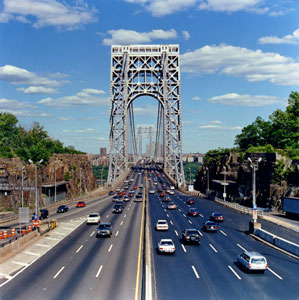
50,000 diesel trucks cross the George Washington Bridge every day — the equivalent of 34 trucks per minute.
Dave Frieder
Lt. Gov. Richard Ravitch minced no words in his sobering overview of the current state of housing and infrastructure, two components of the built environment that he treats as interdependent and inseparable. During the life of architect/city planner Samuel Ratensky (1910-1972), housing was a central political question and an unquestioned public responsibility. Now, Ravitch and his colleagues lamented, housing makes headlines only when toxic mortgages spread instability through the financial system. The prospect that state governments will invest adequately to accommodate the new Americans expected over the next half-century — at least 40 million, by conservative estimates — appears slim to none.
In the days when Ratensky worked with Ravitch’s HRH Construction and Davis Brody (precursor of today’s Davis Brody Bond Aedas) to strengthen the city’s affordable-housing stock by building Riverbend, Waterside, and other mixed-income developments, achievements against long odds were occasionally realistic. But today’s policy challenges, as he describes, them, are formidable.
“We have a society that’s broke,” he observed, rattling off disturbing facts and statistics: a $1.6 trillion federal deficit, a $10 billion state deficit, 12-14% unemployment, 41 million people on food stamps, more millions functioning below the poverty level, and “China and India beating our pants off” in productivity and global market share. Under these conditions, just catching up on minimal bridge and road maintenance seems beyond us, let alone forward-thinking investments, particularly in housing and transit. Freight infrastructure is particularly fragile: in 1900, he said, there was one rail crossing over the Hudson, at Selkirk, NY; 110 years later Selkirk’s is still the only functioning trans-Hudson rail bridge. Meanwhile, he said, “there are 50,000 diesel trucks that cross the George Washington Bridge every day,” bringing essential goods to the region but also giving the South Bronx the nation’s highest incidence of respiratory disease.
These and other physical manifestations of a crippled political will, Ravitch said, call for a revived public-service ethos like the one that motivated Ratensky, a Frank Lloyd Wright trainee with a lifelong respect for high-quality design. Most politicians respond to public opinion, and Ravitch believes architects, carrying more intellectual prestige than they might realize, have a special capacity for influencing that critical variable. The public needs a clearer understanding of how civic investment brings benefits in the future, and of how any serious approach to these problems begins with a mature understanding of taxation (it has to rise; the belief that “efficiencies” in public finance can overcome resource limits, he said, is a political myth). The architectural profession is a critical center of expertise; Ravitch called for a greater visibility for that expertise in public debates about what kind of society we intend to build.
Danish Architecture Dares to be Humble
Event: Five Keys to Interpret Contemporary Danish Architecture
Location: Center for Architecture, 10.27.10
Speakers: Marianne Ibler, Architect MA, Ph.D., RIBA — Founder & Director, Archipress M, & Vice Chair, Docomomo Denmark
Introductions: Ambassador Jarl Frijs-Madsen — Consul General, Denmark; Rick Bell, FAIA — Executive Director, AIA New York Chapter
Organizers: Center for Architecture
Sponsors: The Consulate General of Denmark in New York
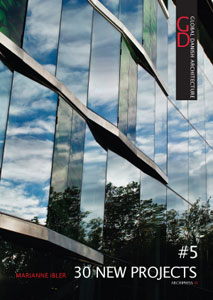
Cover of Marianne Ibler’s book, 30 New Projects.
Courtesy Center for Architecture
If the 1990s and early 2000s were marked by exuberance and risk-taking, the current post-crash period may be better suited to the humbler, understated work of the Danes. “We are a small country,” noted scholar/architect Marianne Ibler, Architect MA, Ph.D., RIBA, founder of Archipress M, and a country that has often looked beyond its borders for ideas. Denmark’s traditions of well-crafted materials and efficient, function-driven Modernism are clearly defined, as are its progressive social ideals, but most Danish architects have also incorporated external influences, adding up to a national design sensibility that is welcoming rather than nationalistic.
Ibler’s presentation connected contemporary Danish work with a set of distinctly Danish values that, including a commitment to social equality, an appropriate sense of scale, a strong bond with nature, and a reluctance to make dramatic formal gestures merely for their own sake. Ibler’s “five keys” are simple aspects of everyday living: dwelling, playing, schooling, caring for others, and learning. Many of the buildings she discusses, both in her recent talk and in the most recent volume in the Global Danish Architecture series (Tradition and Crisis [Aarhus: Archipress M, 2009], with essays by Ibler, Kenneth Frampton, Assoc. AIA, and J.M. Cava; see “Traditions Resilient Enough for Hard Times,” by Bill Millard, e-Oculus, 05.18.10) are schools, hospitals, kindergartens, senior housing, and other public-service facilities. “Denmark has long been known for its welfare system,” she said. “It’s been looked upon as a kind of fairytale country,” providing every citizen with levels of service and quality of life that other industrialized nations claim they can’t afford.
In the housing complexes and schools that attract Ibler’s strongest attention, green design comes naturally, connection to the earth is more important than skyscraping ambition, and the outdoors is never far away. Schools incorporate ample open spaces to encourage learning both in and outside of the classroom. Solhuset, a nursery in Hørsholm by Christensen & Co., was among Denmark’s first passive-house designs, with high-performance glass and precisely chosen roof angles ensuring energy efficiency without elaborate technology. Ambitious renovation projects have converted a rather regimented 1960s building with conventional double-loaded corridors at the Danish Technical University in Copenhagen to flexible open spaces; an abandoned water tower in Jaegersborg has become a striking multi-use student center.
Projects like these evince the Danish design community’s capacity for applying advanced strategies and daring geometries to quotidian problem solving. The quiet circumspection of the buildings Ibler discussed may represent a purposeful, service-oriented design culture that continues to earn an influence disproportionate to its size.
The Next Evolutionary Stage for NYU Med
Event: A New Standard of Design Care
Location: Center for Architecture, 10.04.10
Speakers: Vicki Match Suna, AIA — New York University Langone Medical Center; Duncan Hazard, AIA — Ennead Architects; Joan Saba, AIA — NBBJ
Organizers: Center for Architecture
Sponsor: Kramer Levin

NYU Langone Medical Center.
Courtesy NYU Langone Medical Center
After a discussion of NYU Langone Medical Center’s expansion plans, from a presentation of the site’s history to a blizzard of renderings, plans, and sections for the new Helen and Martin Kimmel Pavilion, Ennead’s Duncan Hazard, AIA, casually mentioned, “None of this is designed yet.” The 10-year plan to modernize the university’s East Side campus with a world-class acute-care facility, plus a renovation of the existing Tisch Hospital building, is just getting under way. The presentation by a team including Heritage Ball honoree Vicki Match Suna, AIA, and NBBJ’s Joan Saba, AIA, involved planning documents, not final designs; some components may change. But even at this early stage, the project promises to make NYU Langone a focal point in the specialized art of advancing the healing professions through design.
It’s a challenging site, complicated by Amtrak’s two Northeast Corridor tunnels, storm sewers, the nearby FDR Drive, and soil conditions precluding basements. There are also the existing buildings, which have appeared over multiple expansion stages since the Skidmore Owings & Merrill master plan for the campus first took shape in 1949. Now, the combination of medicine’s technical advances, new standards for outpatient and emergency care, and an increasing awareness of synergies between medical and environmental values (the green element in a campus not only improves its energy profile but enhances patients’ experience) have raised the stakes for architects working in this complex area.
With the institution’s integrated mission of patient care, teaching, and research requirements, architects are working closely with Design and Operational Strategic Teams comprising representatives of clinical departments. Evidence-based design, based on precise studies of how hospitals’ physical and operational features affect patient outcomes, is guiding many decisions. Modular same-handed room design can reduce staff errors; rethinking procedures along “lean management” principles incorporates strategies for infection control and minimizing patient handoffs between personnel.
State-of-the-art operation/procedure rooms, 12 to a floor, will accommodate broad ranges of surgical and other forms of care. Bed floors, delineated as a distinct volume atop a podium of procedural floors, use a floor plan resembling two open parallelograms, cracked at the center to offer patients a maximum of light and views. Connections between Kimmel and Tisch incorporate a central hallway spine to simplify patients’ wayfinding. The seventh floor will provide a roof terrace, one of Kimmel’s more prominent green features.
The campus transformation will take place within an active teaching-hospital environment; demolitions and relocations require multiple two-step processes to avoid disrupting operations. The East Side’s hospital district is about to endure some tricky transitional years, but Suna and her colleagues are giving NYU and the city an impressively coherent vision.
Not Yet Copenhagen? Give it a Few More Years
Event: Cities for People: A Talk with Author Jan Gehl
Location: Center for Architecture, 09.15.10
Speakers: Jan Gehl, Dr. Litt., Int. FRIBA, Hon. FAIA, Hon. FRAIC — Founding Partner, Gehl Architects
Introductions: Amanda Burden, FAICP, Hon. AIA — Chair, NYC Department of City Planning; Janette Sadik-Khan — Commissioner, NYC Department of Transportation
Organizers: AIANY; Island Press

Courtesy Island Press
With pedestrian plazas and bicycle lanes sprouting throughout the city, New York’s public spaces increasingly reflect the influence of architect/consultant Jan Gehl, Dr. Litt., Int. FRIBA, Hon. FAIA, Hon. FRAIC. In some respects NYC may still stand for Not Yet Copenhagen, but we’re getting there; Gehl’s recent presentation was part book launch, part victory lap.
Gehl’s discussion organized the details of modern urban history into a clear, intuitive argument. Corbusier’s revolutionary paradigm of urban form, he charged, overlooked human behavior and scale; architects “stopped building cities and started building buildings,” formally beautiful in isolation (especially when viewed from vehicles), but oblivious to “the interaction between form and life.” He conceded his own prior allegiance to Corbusian Modernism, but credited his marriage to a psychologist for convincing him that eye-level, walking-speed perspectives are essential for livable spaces. Gehl lambasted places like Brasilia, whose “eagle plan” is elegant from a helicopter perspective but devoid of street-level activity, and Dubai, where, he said, “I always get the feeling of being in an exhibition of perfume bottles.”
Instead of obsessing over large-scale forms and skylines, Gehl recommended, architects might better apply their energy to designing spaces that are inviting to pedestrians. Copenhagen’s “potato row” residential district doesn’t create an aerial spectacle, but citizens have pronounced it supremely livable as measured by both high prices per square meter and Denmark’s highest concentration of architects. Incremental adjustments in street design over 40 years succeeded in pedestrianizing the Strøget, bringing Danes into the streets despite the cold climate and extending the outdoor-comfort season from two months a year to 10. “A good city is like a good party,” he noted: people stay longer than expected.
The party metaphor also links infrastructure to quality of life. A city shaped for automobility invites more traffic and invariably gets it, but planners can issue citizens a different invitation and encourage walking and cycling, as New York, San Francisco, and other cities have done, by ranking non-automotive public space over arterials and parking. These cities are currently undergoing a paradigm shift as potentially far-reaching as the 20th century’s experiment with autocentric design. NYC Department of Transportation Commissioner Janette Sadik-Khan’s introduction noted that Cities for People is being initially published in Danish, English, and Chinese. “I think it’s essential that the entire planet learn from the lessons [in] Jan’s book,” she commented. Within Gehl’s expanding and well-earned sphere of influence, differences among local climates, scales, and styles are less important than the core principle he quoted from Ralph Erskine, Hon. FAIA: “To be a good architect, you must love people.”
Aviation Goes to the Mall
Event: Transportation Retail: Planning, Design and Construction
Location: Center for Architecture, 09.10.10
Speakers: Kate Coburn — Principal, AECOM; Carrol Bennett — General Manager, Real Estate Development, Port Authority of NY & NJ; Stephen L. Dwoskin, AIA — Design Principal, Callison Architecture; Ellery Plowman — Vice President, Business Development & Leasing, Westfield Concession Management; Steve Dumas — Senior Vice President, Retail Design & Tenant Coordination, Westfield Concession Management; Andy Frankl — President, IBEX Construction
Introduction: Robert Eisenstat, AIA, LEED AP — Assistant Chief Architect, Design Division, Engineering Department, Port Authority of NY & NJ
Moderator: Bill Fife — Principal, The Fife Group & Aviation Council Chair, Transportation & Development Institute, ASCE
Organizers: AIANY Transportation and Infrastructure Committee

JFK’s JetBlue terminal, designed by Gensler.
Photo by Prakash Patel
Air travel has changed drastically over recent decades, and not generally for the better. Rather than glamour, excitement, and optimism, flying today means delays and difficulties. Retailers and developers are adjusting to these conditions by turning airport concourses and similar spaces into multifunction malls where the traveler can find diversion and information as well as all manner of merchandise.
Rising fuel costs and other economic trends have driven airlines to cut back on once-routine amenities. “Aviation retail is just a small piece of it,” said moderator Bill Fife, an aviation consultant. But “it’s what’s keeping many airports alive.” This field has evolved beyond the days of “high-priced hot dogs [and] rip-off retail,” Fife noted. The sector is now huge — $4.8 billion in 2009 at airports alone, according to AECOM’s Kate Coburn — and involves global brands, diverse food options, and specialty services. Development, design, and operations need to take these scales and trends into account, along with post-9/11 security concerns. Since Transportation Security Administration procedures have changed passengers’ behavior, contemporary airport design places more retail on the air side of the security checkpoint; since no one lingers in the pre-security zone any more, and increasing flight delays mean passengers have more time on their hands once they’re between the scanners and the gate.
To fill that time and stimulate commerce, airports are including short-lease popup stores, sponsored entertainment, and locally specific attractions (fresh cheese and an airport library in Amsterdam; chic restaurants at JFK’s JetBlue terminal, where, as IBEX’s Andy Frankl said, “The idea was to change the need to go to the airport to [a] want to go to the airport.”). Cities and transit authorities increasingly rely on public-private partnership models to focus expertise. Facilities must balance commercial imperatives with practical concerns: wayfinding, neighborhood demographics, travel patterns. Some floor plans “create a meander” to maximize revenue, as Westfield’s Steve Dumas described in reference to O’Hare’s revamped Terminal 5. Callison’s Steve Dwoskin described “transportation-oriented food [as] a better mousetrap to be invented;” as inflight dining for most passengers is becoming extinct, London restaurateur Gordon Ramsay’s “plane food” in sturdy reusable carry-on pouches represents a match of opportunity and invention.
Perhaps the best news for the New York region is the Port Authority’s plan to upgrade both the midtown and George Washington Bridge bus terminals. For the former, said General Manager of Real Estate Development Carrol Bennett, the authority is close to signing a lease with Vornado Realty Trust for a north-wing expansion. For the latter, an interior renovation is now in the design stage, bringing much-needed improvements in lighting, signage, bus-traffic efficiency, and local employment. She expects this project to reach completion around 2013.