Hong Kong’s Lessons from NYC in Vertical Delirium

Event: Hong Kong | New York: Vertical Density | Sustainable Solutions
Location: Chase Manhattan Plaza, 10.16.08; Tishman Auditorium, New School, 10.17-18.08
Speakers: Learning from Hong Kong, 10.16.08: Thomas Wright — Executive Director, Regional Planning Association; Thomas Ho — Property Director, MTR Corporation, Hong Kong Special Administrative Region; Elliot Sander — Executive Director & CEO, MTA; Christopher O. Ward — Executive Director, Port Authority of NY & NJ; Paul Katz, FAIA — Partner & Principal, Kohn Pedersen Fox; David Scott — Principal, Arup & Chair, Council on Tall Buildings and Urban Habitat; Julia Lau — Sun Hung Kai Properties; Vishaan Chakrabarti, AIA — Executive Vice President, The Related Companies; Debating Density, 10.17.2008: Nicholas Brooke — Chairman, Professional Property Services Group, Hong Kong; Mark Willis — Visiting Scholar, The Ford Foundation; Peter Cookson Smith — Founding Director, Urbis, Hong Kong; Christine Loh — President & CEO, Civic-Exchange; Margaret Brooke — Heritage Hong Kong; Robert Tierney — Chair, NYC Landmark Preservation Commission; Carrie Lam — Secretary for Development, Hong Kong Special Administrative Region; Amanda Burden, Hon. AIANY — Chair, City Planning Commission & Director, Department of City Planning; Designing Density: Theory and Practice, 10.18.08: Brian McGrath — Associate Professor of Urban Design, Parsons School of Design; Paul Chu — Hong Kong Urban Design Alliance; Laurence Liauw — Architect & Associate Professor, Chinese University of Hong Kong; Ackbar Abbas — Professor of Comparative Literature, Hong Kong University & UC-Irvine; Alexandros E. Washburn, AIA — Chief Urban Designer, NYC Dept of City Planning; Eric Höweler, AIA — Principal, Höweler Yoon Architecture; Jim Robinson — Executive Director, Hong Kong Land
Moderator: Carol Willis — Director, The Skyscraper Museum;
Organizers: The Skyscraper Museum

NYC and Hong Kong share certain conditions, physical and cultural: excellent harbors, limited buildable land, a history as transit points for immigration and emigration, and a collective willingness to explore the “culture of congestion,” as coined in Rem Koolhaas’s Delirious New York. If NYC was the original test bed for the idea, Hong Kong has adapted it successfully and stretched its possibilities. Hong Kong now has the world’s highest concentration of skyscrapers. Its middle class and its developers have created a thick forest of high-rise housing to accommodate them. The buildable areas of Hong Kong Island and Kowloon Peninsula are so Manhattanized that the common description as Asia’s Manhattan has almost run its course and inverted itself, so that Vishaan Chakrabarti, AIA, executive vice president of the Related Companies, could refer to “New York [as] actually America’s Hong Kong.”

Carol Willis, director of the Skyscraper Museum, drew distinctions between forms of density produced by wealth and by poverty: affluent cities, like NYC and Hong Kong plus London, tend to embrace vertical development, while poorer cities like Mumbai and Cairo, though technically denser on a raw statistical basis, are predominantly low-rise. (If only the buildable 25% is considered, Hong Kong, like Manhattan, has about 70,000 people per square mile.) The early 20th-century Futurist vision, a rationalized city of high-tech multimodal transportation, takes literal shape in the elevated pedestrian bridges, large-scale harbor reclamation projects, and single-seat rail-to-airport connections of today’s Hong Kong.

A key part of this realized future is the MTR train system, a profitable private company that pursues an integrated rail/property development model. By coordinating all aspects of construction and management of mixed-use properties atop or adjacent to railway stations, MTR finances high-volume rail operations (some 3.4 million personal trips a day) without any government support. MTR also supports ambitious designs, including the eco-community LOHAS Park (“Lifestyle of Health and Sustainability”) near Tseung Kwan O station, a 50-tower complex that will segregate cars completely from pedestrian space in the interests of air quality, recreation, and healthy living. Local panelists, including the MTA’s Elliot Sander and the Port Authority’s Christopher Ward, expressed admiration for what Ho called a “win-win-win-win” for Hong Kong society, developers, government, and MTR. They wondered whether sprawlbound American culture is ready for such a radical departure into a post-automotive future.

The “Debating Density” discussion produced rigorous self-critiques of development’s erasure of building styles and street life. The panel’s fundamental question — does density pay, or does it cost? — becomes more urgent, said Kohn Pedersen Fox’s Paul Katz, FAIA, in the context of current financial collapses triggered by housing loans; financial, housing, and environmental crises are all consequences of sprawl, Katz finds, and density is the solution. Yet planning for density, incentivizing dense community formation in and around urban areas, and ensuring affordability have also exacted costs: the city is losing a degree of its authenticity, and air pollution undermines postcard views. Panelists stressed that an engineering-based approach to planning can strip away the idiosyncrasies that are inseparable from high-quality urban life. NYC’s street-level diversity is a positive model for Hong Kong and other cities.

Panelists emphasized the importance of bottom-up planning, looking at the city as a multidimensional organism rather than the 2-D zoning maps, photos, and renderings. Hong Kong Urban Design Alliance’s Paul Chu has his students examine sections rather than plans to acquire a sense of self-organizing urban textures and understand how superblocks destroy complexity. Ackbar Abbas, a professor of comparative literature and native Hongkonger, recalled Koolhaas’s idea that congestion is not so much a problem as the “forever insoluble problem that allowed Manhattan to be built.” If a “Hong Kong-ism” is arising, the city’s history as a site of migration, dependence, and recurrent threats give it a unique dynamic balance, forever converting its own crises into vitality.

The Future Arrives by Train

Event: Greening the Iron Ribbon: Redefining the Northeast Corridor
Location: NYU Kimmel Center, 09.16.08
Keynote: Eugenie Birch, FAICP — Co-Director, Penn Institute for Urban Research and Lawrence C. Nussdorf Professor of Urban Research, University of Pennsylvania
Introductions: James McCullar, FAIA — AIANY 2008 President; Allison C. de Cerreño, PhD — Director, NYU Rudin Center for Transportation Policy and Management; Robert D. Yaro — President, Regional Plan Association (RPA); Donald Burns, AICP — President-elect, American Planning Association (APA) New York Metro Chapter
Speakers: Along the Corridor: Center City Transit Oriented Development: Mark Kocent, AIA, AICP — Principal Planner, Office of University Architect, University of Pennsylvania; Daniel Baudouin, AICP — Executive Director, Providence Foundation; Along the Line: Between the Stops: Tom Suozzi — Nassau County Executive; Michael Kearney — Director of Design, JBG Properties; David Dixon, FAIA — Principal, Goody Clancy; The World View: Lessons Learned from Beyond: Donald Burns, AICP — President-elect, American Planning Association (APA) New York Metro Chapter; Mustafa Abadan, FAIA — Urban Design, Skidmore, Owings & Merrill; Craig Schwitter, PE — Buro Happold; Respondents Panel: Petra Todorovich — Director, America 2050, RPA; Martin Tillman — Associate, Steer Davies Gleave; Ernest Tollerson — Director for Policy and Media Relations, Metropolitan Transit Authority
Moderators: Ernest Hutton, FAICP, Assoc. AIA (moderator, Along the Corridor); Mark Strauss, FAIA, AICP, LEED AP (moderator, Along the Line); Lance Jay Brown, FAIA (moderator, The World View); Mark Ginsberg FAIA, LEED AP (moderator, Respondents Panel)
Organizers: AIANY; NYU Rudin Center for Transportation Policy & Management; Regional Plan Association (RPA)
Sponsors: AIANY; NYU Rudin Center for Transportation Policy & Management, and Wagner Institute for Civil Infrastructure Systems; RPA; APA Metro Chapter; ULI NY District Council; Boston Society of Architects; AIA Philadelphia Chapter; AIA Washington Chapter

Amtrak rail lines cut through the suburbs of Stamford, CT.

Courtesy Google Earth

Transit-oriented development (TOD) is not just a green solution; it is a logical answer to sprawl, and a well-timed response to recent fossil-fuel price shocks. Craig Schwitter, PE, of Buro Happold, articulated the symposium’s consensus: regardless of improvements in station design and efficiency, “getting more people to use mass transit will take a bigger chunk out of our carbon use than anything [else] we’ve talked about.” Presentations of urban-reanimation success stories in Philadelphia, Providence, metropolitan Washington, and overseas showed how appropriate incentives for developers are producing demonstrable results in the forms of mixed-use TOD and infrastructure improvements.

Mode shifting is under way: Petra Todorovich, the director of America 2050 at the Regional Plan Association (RPA), cited Amtrak data claiming that the rail-to-air split among NY-D.C. travelers has reached the highest rail percentage to date. The rising downsides of auto dependence could signal the resurgence of passenger rail, at least between Boston and D.C. However, there’s a gap between recognizing the economic and ecological strengths of the rail-ready northeast and convincing regional and federal policy makers to strengthen and integrate America’s rail system. With a capsule history of the region’s development-transit relationship, keynote speaker Eugenie Birch, FAICP, spotlighted a few notable victories in planning and restoration despite chronic underfunding for Amtrak. (The problem persists: Sen. Tom Coburn [R-OK] is currently procedurally withholding $11 billion in Amtrak support, obstructing majorities in congress as well as rail advocate groups.)

Nassau County Executive Tom Suozzi outlined various plans to build a “New Suburbia,” staving off the decline of low-density areas into “slumburbs” (as defined by Brookings Institution reporter Christopher Leinberger). Proposals include incentives for high-skill industries, arts- and entertainment-based “cool downtowns” aimed at attracting both young-adult and empty-nester populations, and strategically placed interventions such as greenways and light rails. But he also spoke starkly about the cultural factors that drove many Long Islanders there in the first place — they dislike cities and their residents. Many are untroubled by segregation and resist any development that urbanizes their space.

Recounting a conversation with NYU President John Sexton about how major cities are centered economically on particular industries, such as NYC’s massive FIRE sector (finance, insurance, and real estate), Suozzi asserted that the economic future belongs not to FIRE but to ICE: ideas, culture, and education. Still, he takes suburbanites’ anti-urbanism as an ideological immovable object, claiming that most of his constituents would view this conference as heresy. He also condemned the subsidies that redistribute wealth toward cheap and wasteful development approaches, thus locking many regions into transport monocultures. The tax system, he noted, is biased against the very regions with the best-developed transit networks. Until the northeast can stem this sprawlward cash flow, we are effectively “subsidizing our own demise,” he contended. In response, MTA’s Ernest Tollerson was more optimistic: “This region has the intellectual capital, the financial capital, and the social capital to do it on its own.”

The revival of rail and the spread of TOD are dependent on design solutions, political will, and ingrained beliefs on all scales. Ernest Hutton, FAICP, Assoc. AIA, considering the University of Pennsylvania’s efforts to foster transit habits among employees as it expands along the Schuylkill River, emphasized that mass walking-distance preferences are a function of the quality of pedestrians’ experience, and thus of design. British planner Martin Tillman noted that standard preferences remain just 400 yards to a bus and 800 yards to a rail station, and less in harsh climates. Panelists stressed that to catch up with France, China, the U.K., and other nations, America needs to change some of its core beliefs about transportation. The U.S. needs to integrate two governing factors: funding and organizational coordination (Istanbul’s new Bosporus Straits rail tunnel, described by SOM’s Mustafa Abadan, FAIA, may allow single-seat travel from Europe to Asia before riders can take a comparable trip from Long Island to New Jersey), and grassroots assumptions about different transit modes’ purposes and implications.

History offers grounds for hope, even amid financial collapse. AIANY 2008 President Jim McCullar, FAIA, mentioned infrastructure programs of the New Deal as a precedent — perhaps underscoring Governor David Paterson’s commitment, voiced at last week’s Building Congress forum, to completing Moynihan Station. As McCullar’s reminiscence of growing up in a small rail-connected Texas town implied, Americans’ view of the future would benefit from a look back at what railroads meant in the past.

The Gang's All There: Attention to Materials Pushes Limits of Design

Event: Experimental Architecture Series: Jeanne Gang
Location: Center for Architecture, 07.16.2008
Speaker: Jeanne Gang, AIA — Principal & Founder, Studio/Gang (Chicago)
Moderator: Saf Fahim, AIA — Design Principal, Archronica Architects, & Chair, Architecture Dialogue Committee
Organizers: The AIA New York Chapter and the AIANY Architectural Dialogue Committee

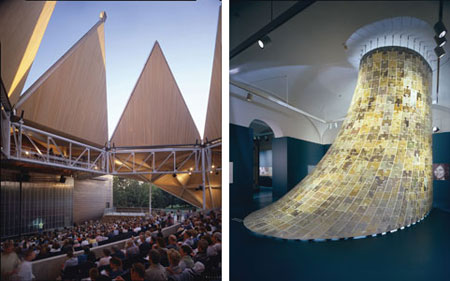
The Bengt Sjostrom Starlight Theater (left) and Marble Curtain (right).

Studio/Gang

Along with her own designs, Jeanne Gang, AIA, juxtaposed a seashell’s patterns with a computer-generated graph showing how the growing shell emits its pigments. This mathematically regular “relation to material and time,” she explained, was inexplicable until today’s technology allowed for precise analysis. Such close attention to the properties of natural materials and the power of ideas yields Studio/Gang’s approach to architectural processes that moderator Saf Fahim, AIA, identified as “the triad of materials, ideas, and process.”

Like Rem Koolhaas and other provocateurs at the Office for Metropolitan Architecture, where she worked before forming Studio/Gang in 1997, Gang devotes intense attention to analyzing program requirements in the early phases of a project, and she delights in proposing solutions that others may consider impossible. Her firm’s first independent project, the Bengt Sjostrom Starlight Theater at Rock Valley College in Rockford, IL, is an outdoor theater sporting an operable roof with six triangular panels that open like an origami flower, allowing open-air performances while remaining weatherproof. Backlit porthole windows help maximize the building’s profile on a small-college budget. For some viewers, the 12-minute sequential opening of its six overlapping “petals,” repeated at the beginning and intermission of each event, often upstages the performances.

Gang was one of four architects selected for the National Building Museum’s Masonry Variations Exhibition in 2003, and curator Stanley Tigerman, FAIA, assigned her the charge of working in stone. A floor with limited weight support complicated the structural requirements. Gang’s solution was to hang from the vaulted ceiling a network of catenary-curved chains of translucent, 3/8-inch-thick marble, cut by water jets into 660 different puzzle pieces designed to distribute stresses. Along with dissolving the conceptual border between rigidity and fluidity, the Marble Curtain tested how stone behaves in tension rather than compression, an area where data had been scarce.

Expanding into larger-scale projects, Studio/Gang has used baseball as a heuristic tool: investigations of Chicago’s stadiums, Wrigley Field, and U.S. Cellular Field (New Comiskey Park), led to both a study of urban density for the Art Institute of Chicago in 2004-05, and a new stadium plan for the U.S. Pavilion at the 2004 Venice Biennale. The design suggests informal rooftop viewing structures just beyond Wrigley’s outfield (a feature now sanctioned by Chicago’s building codes). The sporting facility would fragment its seating into separate angled-tier components distributed through an urban neighborhood.

Gang’s breakthrough project may be the hotel/residential tower Aqua, whose 82 individually sculpted floor plates will give occupants various views of Chicago while offering a topologically varied profile suggesting the Great Lakes region’s limestone outcroppings and its pools and eddies. Scheduled to open in 2009, Aqua aims to remind observers that “water and time are processes that act on the building,” as Gang noted, and that good design begins with close, thoughtful readings of the Earth.

Obesity Beware: Visualizing Healthy Urban Space is Half the Battle

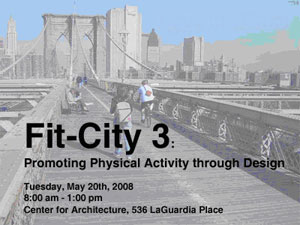
Event: Fit-City 3: Promoting Physical Activity through Design
Location: Center for Architecture, 05.20.08
Keynotes: James Sallis, PhD — Prof. of Psychology, San Diego State University and Program Director, Active Living Research; Jan Gehl, Hon. FAIA — architect, public space consultant, Copenhagen, Denmark
Speakers: Comm. Thomas Frieden, MD, MPH — NYC Dept. of Health and Mental Hygiene; Comm. David Burney, FAIA — NYC Dept. of Design and Construction; Rick Bell, FAIA — Executive Director, AIA-NY; Comm. Adrian Benepe, NYC Dept. of Parks and Recreation; Comm. Janette Sadik-Khan — NYC Dept. of Transportation; Alexandros Washburn, AIA — Chief Urban Designer, Dept. of City Planning; Brandon Mitchell — Full Spectrum NYC; Vishaan Chakrabarti, AIA — Related Companies; Stephanie Gelb, AIA — Battery Park City Authority; Robyne Kassen, Assoc. AIA — Pedestrian Studio
Moderators: Asst. Comm. Lynn Silver — NYC DoH; Joyce Lee, AIA — NYC Office of Management and Budget
Organizers: AIANY; NYC Department of Health

Courtesy AIANY

Convincing a roomful of urban architects and public-health personnel that too many Americans are unhealthy doesn’t require a raft of statistics. At the third annual Fit-City symposium, Health Commissioner Thomas Frieden, MD, MPH, provided research statistics anyway, as did “obesity warrior” James Sallis, PhD, program director of Active Living Research, and NYC Dept. of Health and Mental Hygiene (DoH) Assistant Commissioner Lynn Silver, whose national maps showed the alarming state-by-state rise of unhealthy body-mass indexes. The nation now has a proportion of overweight citizens once found only in isolated pockets of pudginess. Diabetes, an obesity-related condition, is rising even faster in NYC nationally. Human biology hasn’t changed, several speakers pointed out; people’s environment and diet have. Architects have some control over the former.

Design alone rarely induces sedentary people to exercise, but a coordinated, research-driven public-health effort that combines physical detailing and behavioral prompting — the new catchphrase is “active design” — is conducive to measurable results. One step promoted by Frieden and NYC Department of Design and Construction (DDC) Commissioner David Burney, FAIA, is to simply use stairs rather than elevators or escalators. Floor plans and attention to aesthetics can make staircases easy to find, welcoming, and visibly safe; on the behavioral side, Burney announced a new public education effort: a free poster by DDC’s graphic design division reading “Burn Calories, Not Electricity/Take the Stairs.” Janette Sadik-Khan, NYC Department of Transportation, presented the “Sustainable Streets” master plan, including measures such as car-free-street days, an idea pioneered in Bogotá, Colombia.

The blend of optimism and promotionalism wasn’t confined to the public sector: representatives of two private developers (Vishaan Chakrabarti, AIA, of the Related Companies, and Brandon Mitchell of Full Spectrum) presented their firms’ experience with sustainable, transit-oriented, and mixed-use urban residences whose locations and amenities advocate for improved health.

Because bodily de-conditioning is associated with car dependence, poor air quality, and a shortage of parks and recreational facilities, panelists believed that PlaNYC’s greening measures can produce positive health effects. NYC Department of Parks and Recreation Commissioner Adrian Benepe presented the plan’s components addressing the need to “program parks, not just build them.” Walking and cycling, in particular, enhance the quality of life for nearly the whole population, and keynote speaker Jan Gehl, Hon. FAIA, architect and public space consultant in Copenhagen, offered arguments for a steady effort to “reconquer” urban space for these and other human-scale activities. Gehl’s anecdote of cycling through Copenhagen with his wife on their 45th wedding anniversary, surveying the changes that several decades of public-space advocacy had brought to their home city, drove home the value of fighting this particular fight.

Ninth Avenue has a Copenhagen-style protected bike lane (at least as a seven-block proof-of-concept prototype), but for PlaNYC to move the city effectively toward Copenhagen’s level of civility, it must take on tougher battles. Overcoming the conundrum limiting bike commuting to the least risk-averse population, for example — cycling becomes safer when enough people ride, but most people won’t ride in city streets until they’re convinced it’s safe — requires a broad culture change: drivers have to learn instinctive respect for cyclists, and police must crack down on aggressive drivers. The Fit-City symposium indicates that officials and private players have a clear view of what a healthy built environment looks like, drawing on the world’s best examples and counselors. This vision, more than any single reform, is a major component of progress.

If you would like to learn more about the Fit-City program, AIANY has published pamphlets available at the Center for Architecture that detail symposium discussions.

Sadik-Khan Unveils NYC Model for Transport Reform

Event: Sustainable Streets: Highlights from the Strategic Plan for the New York City Department of Transportation 2008 and Beyond
Location: Municipal Art Society, 04.28.08
Speakers: Janette Sadik-Khan — Commissioner, New York City Department of Transportation; Edward Skyler — Deputy Mayor for Operations, Office of the Mayor (introduction)
Organizers: Municipal Art Society of New York

In the wake of the state legislature’s refusal to bring Mayor Bloomberg’s congestion pricing proposal to a vote in time to secure federal funds, the mood at the launch of the Department of Transportation’s (DoT) new strategic plan might have been subdued. However, Commissioner Janette Sadik-Khan energized the crowd by promoting local independence in transit policy. The congestion pricing program would have adapted a “London model,” Sadik-Khan noted, and debate has also drawn attention to ideas from other international cities, but she favors a “New York City model” building on local strengths like mass transit, pedestrianism, and democratic procedure.

Described by Deputy Mayor of Operations Edward Skyler as a “transportation visionary,” Sadik-Khan introduced the plan as a way to “treat streets as valuable public places rather than utilitarian corridors.” Citing safety statistics including last year’s lowest number of traffic fatalities since annual recordkeeping began in 1910, she outlined further traffic-calming measures focusing on schoolchildren, seniors, infrastructure inspections, and public education. The goal is to cut fatalities in half by 2030, which would win NYC the title of “safest city in the world” given PlaNYC’s projected population growth to nine million.

A Bus Rapid Transit (BRT) project on Fordham Road in the Bronx is the first segment of a plan to add new BRT lines and incorporate BRT-like features such as dedicated bus lanes into the existing system. Bicycle infrastructure expansion will extend some of the innovations tested in Chelsea’s Ninth Avenue cycling zone, aiming to double citywide bike commuting by 2015. New parking policies will strive to raise curbside vacancy rates and reduce space-hunting time. Selected sites such as the three-way intersection of Broadway, Fifth Avenue, and 23rd Street will see low-performing square footage reclaimed as destination plazas — in Sadik-Khan’s phrasing, “putting… the ‘square’ back into Madison Square.”

Like other PlaNYC green initiatives, the full Sustainable Streets publication is thorough and detailed, presenting the potential of public-sector activism. Instead of a single attention-getting plan like congestion pricing, Sustainable Streets offers a broad range of nuts-and-bolts reforms that may ultimately be more effective at restoring civility to vehicle-ravaged civic space. (The talk wasn’t just for the anti-auto faction, though: Sadik-Khan also hailed DoT’s road-resurfacing operation, a division that saves the annual equivalent of nearly a million barrels of oil by recycling used asphalt.)

Both Sadik-Khan and Skyler expressed long-range optimism about congestion pricing as an idea whose time has come: “We do believe that ideas, just like cities, can be sustainable,” Skyler said, “and that there’s going to be a coalition built around that.” The near miss may have galvanized a community’s resolve to take back the quality of its street life. Long timetables, though, put the enthusiasm of Sadik-Khan and her team to serious tests: how much of the DoT program can be realized during this administration’s remaining months, and how much of it will be upheld by its successor?

Firms Negotiate Chaos of Art

Event: Architecture: Designs for Living: Cultural Sustainability
Location: Center for Architecture, 04.14.08
Speakers: Robert M. Rogers, FAIA — Principal, Rogers Marvel Architects; Sara Caples, AIA — Principal, Caples Jefferson Architects; Mitchell Kurtz, AIA, LEED AP — Principal, Mitchell Kurtz Architect; Joseph Haberl — Project Designer, Leeser Architecture
Moderator: Kate D. Levin — Commissioner, NYC Department of Cultural Affairs
Organizers: AIANY Cultural Facilities Committee
Sponsors: Champion: Studio Daniel Libeskind; Supporters: Gensler; Humanscale; James McCullar & Associates; Friends: Costas Kondylis & Partners; Forest City Ratner Companies; Frank Williams & Associates; Hugo S. Subotovsky A.I.A. Architects; Mancini Duffy; Magnusson Architecture and Planning; Rawlings Architects; RicciGreene Associates; Skidmore, Owings & Merrill; Syska Hennessy Group; Trespa North America; Universal Contracting Group

QTiP

Queens Theatre in the Park is one of many cultural projects working with strict constraints.

Caples Jefferson Architects

New York City has some 1,400 nonprofit cultural organizations, noted NYC Cultural Affairs Commissioner Kate Levin; more than half are performing-arts groups. Her department, currently the nation’s largest arts funder, hears from 1,100 of these groups annually, half with budgets under $250,000 and 74% under $1 million. Small theater and dance companies (music wasn’t a focal point here) make enormous contributions to the city’s quality of life, she said, and consequently to its long-range economic health as well.

Many such challenges fall into the “little-D design” category, Levin said (borrowing a distinction from former AIANY Chapter president Susan Chin, FAIA); not every arts group’s problems call for real-estate-based solutions. Still, the financial and spatial limits of small and medium-sized venues can generate challenges for architects. Panelists presented four projects whose constraints became opportunities: a new building for a two-client, mixed-program partnership; a futuristic downtown space for an experimental theater; and two renovation projects with missions to preserve different components of the city’s history.

The Ballet Hispanico shares a new West 90th Street mid-rise tower with the Stephen Gaynor School for children with learning disabilities. In serving contrasting programs, balancing the needs of populations who use the building at different times of day, and making the most of a tight mid-block footprint, Rogers Marvel Architects allocated the readily accessible lower floors to the children and the large, daylit upper floors to the dancers, choosing a reinforced-concrete core to address the acoustic complexities of studios above classrooms.

At Queens Theatre in the Park (see “Queens Theater Offers Night on the Town,” e-OCULUS, 04.15.08), where performances will coexist with construction until the end of the year, Caples Jefferson Architects has created both a functional theater and a viewing space that respects the site’s distinct features (the landscape of Flushing Meadows/Corona Park and the World’s Fair “ruins”), with spiral forms continuing from two approach paths into the central cylinder and inverted-dome ceiling to create a dramatic sense of arrival.

Renovating the aging Cherry Lane Theatre and juxtaposing modern and older elements, Mitchell Kurtz, AIA, LEED AP, drew on his experience in stage design to help envision the specific needs of actors, directors, and theatergoers, such as an angled center aisle to optimize sightlines and an acoustically ideal placement of mechanical elements (“as far away as possible,” he said — preferably NJ; realistically, the rooftop).

For 3-Legged Dog, the first cultural organization to re-animate a downtown venue after 9/11, Leeser Architecture transformed a ground-floor site in an MTA garage into a high-tech, high-concept theater whose bent-glass front wall integrates performance space with street life, with an opaque white “urban jetway” for a lobby.

Arts groups are sometimes superb architectural clients, Robert Rogers, FAIA, said, with their combination of entrepreneurial spirit and creativity. Kurtz noted these clients’ similarities to architects themselves, highly adaptive in the face of adversity, “very simpatico… and also very poor.” Perhaps Sara Caples, AIA, pinpointed these clients’ defining quality when she observed that “a group that presents 300 different shows a year has enormous tolerance for chaos.”

D-Critters Dance with Assorted Devils

Event: D-Crit Reading Night: “Evil”
Location: KGB Bar, 03.27.08
Speakers: Steven Heller — Author, The Swastika: Symbol Beyond Redemption? & Co-Chair, MFA Design, School of Visual Arts; Philip Nobel — Author, Sixteen Acres: Architecture and the Outrageous Struggle for the Future of Ground Zero & Columnist, Metropolis; Andrea Codrington — Writer, Editor, & Brand Strategist, Brand Building Communications
Organizers: MFA program in Design Criticism (D-Crit), School of Visual Arts

D-Crit

The SVA D-Crit program takes on “Evil.”

Courtesy School of Visual Arts

The School of Visual Arts (SVA) launches its Design Criticism (D-Crit) program this fall, seeking to strengthen links among journalism, academic critique, and design. Several months before classes begin, D-Crit is already striking an informal, edgy profile with readings at the literary nightspot KGB. By taking on vast topics like Home, Music, and Evil, D-Crit’s organizers aim to show up the breadth and flexibility of this area of critical writing. The latest reading also showed how evil can elicit both gravity and wit.

Steven Heller, author and co-chair of the MFA Design program at SVA, argued that a symbol can be wrenched out of its history and converted to a visual weapon dangerous enough to ban. Fascinated from youth with the Nazis and the swastika, Heller expanded this interest into The Swastika: Symbol Beyond Redemption?, explicitly “a polemical history, not a linear or narrative one.” He has considered arguments for rehabilitating the symbol because of its long pre-Nazi history in Hindu and Native American cultures, among others; yet, he is against ever normalizing it, voicing special scorn for Sid Vicious-style transgressive displays. Because of the unique pathology of Nazism as “a paradigm of how terror became official policy for a civilized state,” Heller says, a suggestion that time could ever decontaminate it “begs the question, ‘What is enough time?'”

Author and columnist Philip Nobel read from a Metropolis column that nearly got him fired: an open letter to Philip Johnson connecting washed-out aesthetics to fascism. Nobel took the “Dean” to the woodshed for cynicism, collaborationism (in his period of admiration for Hitler — something Johnson’s admirers ignored until critic Michael Sorkin unearthed some early writings), and the tendency to revel in a position of power out of proportion to his architectural gifts. Though Johnson’s “acerbic wit, deracination of Modernism, and endless pimping” defined contemporary architecture for several generations, Nobel makes a case that Johnson’s influence also constricted and warped it. Nobel’s potshots add up to a distinction between taste making and the ethical seriousness that informs deeper talent.

Andrea Codrington, brand strategist for Brand Building Communications, observed how Hollywood directors use Modernist design to connote menace. Commercial cinema mythologizes American domesticity and the associated homey building styles; the flip side, Codrington finds, is a tendency to portray Europeans, and their clean-lined buildings, in terms of “villainy and vanity.” James Bond, she notes, becomes increasingly endangered the closer he gets to the geometric lairs of the Dr. Nos, Blofelds, Goldfingers, et al., all “monomaniacal scoundrels with exquisite modernist taste.” Hollywood’s habitual demonization of Modernism, she concluded, eventually ran counter to reality: when genuine terror hit Americans on 9/11, the culprits were not the elegant villains of Hitchcock or Kubrick. They lived in caves.

Paradigms on Trial

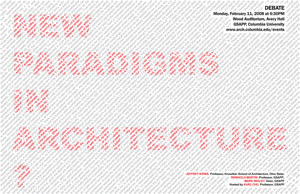
Event: New Paradigms in Architecture?
Location: Columbia University, 02.11.08
Speakers: Jeffrey Kipnis — Professor, Knowlton School of Architecture, Ohio State University; Reinhold Martin — Associate Professor, Mark Wigley — Dean, Columbia Graduate School of Architecture, Planning, and Preservation (GSAPP)
Host: Karl Chu — Adjunct Associate Professor, GSAPP
Organizers: Columbia GSAPP

New Paradigms in Architecture?

Courtesy Columbia University GSAPP

Sociologist Bruno Latour once told an interviewer, “Postmodern theorists are useful, like salt added to the academy… but a whole meal of salt?” The New Paradigms discussion was fast-paced and exceptionally salty (in Latour’s sense and others). Occasioned by Karl Chu’s invitation to two Columbia University Graduate School of Architecture, Planning, and Preservation (GSAPP) colleagues and one visitor to consider a brief manifesto about a new architectural paradigm based on computation, self-replicating structures, and engagement with biotechnology and artificial intelligence, the conversation spurred four thinkers to speculate about how the profession is evolving.

Jeffrey Kipnis, professor at the Knowlton School of Architecture, Ohio State University, ultimately agreed that Chu’s vision of “genetic architecture” as a quantitative, scientific discipline has the weight of history on its side. “I know for a fact… that architecture will become a science,” Kipnis said with more dismay than celebration, as other fields historically have done (e.g., alchemy becoming chemistry, or astrology yielding to astronomy). He finds architecture’s scientific ambitions unrealized as of yet, since a true science has formal mechanisms for recognizing when an experiment has failed. He compares current architectural discourse to poetry and emotions rather than quantitative analyses, quipping that architects still live “in a world of doxologies [an expression of praise, usually to a god], not demonstrations.” Loyal to architectural ideas arising from feelings, Kipnis is in no hurry to see this condition pass.

Mark Wigley, dean of Columbia GSAPP, noted an unbridgeable gap between users of buildings and architects, whose knowledge of professional and aesthetic codes places them outside users’ ordinary experience. Replacing routines with contemplation and uncertainty, he said, was a legitimate, even necessary activity for an architect; but to inhabitants, the paradigms may be as transparent as water to a fish.

Holl Outlines Guidepoints to Suit His Urbanisms

Event: Urbanisms: Working with Doubt
Location: Cooper Union for the Advancement of Science and Art, 02.21.08
Speakers: Steven Holl, AIA — Principal, Steven Holl Architects, & Associate Professor of Architecture, Columbia University Graduate School of Architecture, Planning and Preservation (GSAPP); Jeffrey Kipnis — Professor, Knowlton School of Architecture, Ohio State University;
Introduction: Craig Konyk, AIA — Principal, konyk, & Adjunct Assistant Professor of Architecture, Columbia University GSAPP
Organizers: The Architectural League of New York; The Irwin S. Chanin School of Architecture of The Cooper Union

Sliced Porosity Block

The Sliced Porosity Block represents Steven Holl’s 11 principles outlined in Urbanisms.

© Iwan Baan, courtesy Steven Holl Architects

In projects from Cambridge, MA, to China, Steven Holl, AIA, is bringing momentum to situations where few would be at ease. His first principle behind his forthcoming book Urbanisms: Working with Doubt (Princeton Architectural Press), “the geo-spatial,” explores environmental design in a context that is not just metropolitan but astronomical: he considers the 800-degree climate of Venus, which once had water before greenhouse effects made the planet inhospitable to life. Here on Earth, Holl blurs the borders between urban formations and landscapes so that “every work is an urban work.”

With the scale and the stakes thus raised, Holl proceeded through 10 more guidepoints — or Urbanisms — such as the new forms of space created by nighttime luminosity, the value of urban porosity to receive light and shadow, the downsides of ephemeral construction methods that lead to rationalized banality, the capacity for “working in the Z dimension, not just the X and Y dimensions,” and a new take on the Keatsian poetic concept of negative capability, emphasizing the importance of responding to potential uncertain occurrences (“negative capability is a modus operandi for the 21st century”).

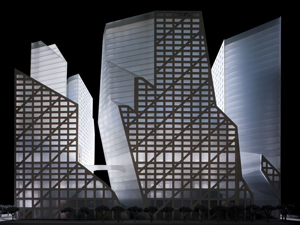
These principles are taking shape most dramatically in Holl’s projects in China. An elevated “city within the city” under construction in Beijing, the eight-tower Linked Hybrid housing complex organizes daily life around modular waffle forms, heated geothermically, and conjoined by skywalks to create “a cinematic space in the air.” Even more radical is the Sliced Porosity Block in Chengdu, a sun-sliced master plan that will incorporate pavilions by Lebbeus Woods and Ai Weiwei. The mixed-use Vanke Center in Shenzhen, is a nearly Empire State Building-sized “horizontal skyscraper” hovering on 9- to 14-meter legs to create shade and admit breezes while offering multiple perspectives on surrounding bodies of water.

Presenting the works and ideas behind Urbanisms, Holl was matter-of-fact, whether introducing abstract ideas or recalling the days when his practice occupied a small Sixth Avenue office, “where I slept on a plywood shelf over the entranceway and no one knew I lived there.” Urbanisms, the macro-scale companion to his previous volume, House: Black Swan Theory (2007), links six major projects with the 11 principles. “Today, working with doubt is unavoidable,” Holl asserted, proposing strategies that reckon with uncertain, intermittent, even ephemeral conditions as a necessary background for practice.

New View of Modernism: America the Irreducible

Event: Debate and Book Launch: USA: Modern Architectures in History (London: Reaktion Books, 2008)
Location: Columbia University, 02.18.08
Speakers: Gwendolyn Wright — Professor of Architecture, Planning and Preservation & Author, USA; Reinhold Martin — Associate Professor of Architecture, Director, Ph.D. Program in Architecture, Director, Master of Science Program in Advanced Architectural Design; Felicity Scott — Assistant Professor of Architecture; Joan Ockman — Adjunct Associate Professor of Architecture & Director, Temple Hoyne Buell Center for the Study of American Architecture; Andrew Dolkart — James Marston Fitch Professor of Historic Preservation, Columbia University Graduate School of Architecture, Planning and Preservation (GSAPP)
Moderator: Jorge Otero-Pailos — Assistant Professor of Historic Preservation, Columbia University GSAPP
Organizers: Columbia University GSAPP; Temple Hoyne Buell Center for the Study of American Architecture

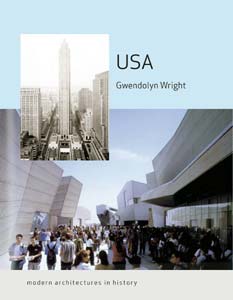
USA

In USA, a contribution to the British Modern Architectures in History series grounding the recent heritages of 14 nations in cultural and social perspectives, Gwendolyn Wright takes on the task of explaining American architectural history since the Civil War for an international audience. The argument she recounted before this panel of Columbia University colleagues takes a relatively familiar narrative — too often reduced to a major-figures parade, a greatest-hits collection chiefly based in three cities, and a set of formulas delivered by critical authorities — and expands it into a more nuanced palimpsest of forces. With an understanding of the ties between culture and the built environment, she reframes American Modernism as a broad-based, nationwide project of what she calls “radical incrementalism,” a more diffused, democratic form of progressive development rather than a top-down revolution by a select few, and much more than a simple translation of European Modernism.

Analyzing Modernism, modernization, and modernity (terms that Wright scrupulously defines in the book’s introduction) along national lines raises a contradiction for universalist theoreticians who saw Modernism in terms transcending national identities. Wright prefers a more inclusive view of actual building practices, influenced by distinct “national imaginaries,” or patterns of belief and self-awareness, as well as by each nation’s distinct material history.

America’s Modernism, as Wright sees it, combines broad cultural diversity with frank commercial influences, an active role for communications media shaping its public reception, and a longstanding environmental awareness. She tones down the conventional emphasis on supposedly pivotal events like the 1932 Museum of Modern Art exhibition, for example, finding that the social changes and specific programs ensuing from that same year’s election of President Franklin Roosevelt had greater effects on the public acceptance of modern architecture than the pronouncements of Philip Johnson and Henry-Russell Hitchcock. While not shortchanging major figures (Frank Lloyd Wright appears in every chapter until his death), she looks further afield to consider significant work by underappreciated architects, some female, many outside the Chicago-New York-Los Angeles metropolitan axis.

Her interlocutors, with few points of dissent (e.g., Felicity Scott’s objection that USA marginalizes Post-Modernism), provided opportunities for Wright to clarify her reasons for departing from received ideas, particularly ones assigning Modernism any decisive endpoint. Joan Ockman’s broad question — “What is modern, and when is modern? At the end of the book we’re back in modern, again, somehow” — challenged Wright to reposition the Modernist response as something more than momentary, beyond the implications of hyphenated styles. Wright’s book, sure to be incorporated into architecture school syllabi nationwide, indicates that she’s up to the challenge.