Margaret O’Donoghue Castillo, AIA, LEED AP, 2011 AIANY President was recently interviewed by NY1 about the new benchmarking law requiring owners of buildings larger than 50,000 square feet to record energy and water use. Click “New Benchmarking Law Has City Buildings Track Energy, Water Use” for the full article and video… Castillo was also featured in The Architect’s Newspaper: “New Hand at the Helm in New York,” and the New York Times: “Square Feet: The 30 Minute Interview/ Margaret O’Donoghue Castillo.”

David Rockwell, AIA, is the honoree of the 2011 Lawrence Israel Prize by the Interior Design Department at FIT/SUNY…

“Smart Grid Athletic Light” by Andrew Burdick, AIA, in association with Ennead Lab was selected as one of eight finalists for the Philips Livable Cities Award…

Even though the U.S. Department of Energy has chosen to continue siting the Solar Decathlon on the National Mall, the team from the City College of New York has posted a blog voicing its disappointment with the new, less central location. Read more here: “Back on the National Mall…?

2011 OCULUS Editorial Calendar
If you are an architect by training or see yourself as an astute observer of New York’s architectural and planning scene, note that OCULUS editors want to hear from you! Projects/topics may be anywhere, but architects must be New York-based. Please submit story ideas by the deadlines indicated below to Kristen Richards: kristen@ArchNewsNow.com.

2011 Themes:
Spring (President’s Theme): Design for a Change: Buildings, People, Energy

[Closed]

Summer: AIANY Design Awards 2011
[Closed]

Fall: Interior Activity
Architects as interior designers; Changes in corporate culture = transformation of the workplace; Architects designing products/Multi-disciplinary cross-overs; Rebranding hospitality, restaurants, retail to attract new audiences; Interiors as laboratories for small firms.
Submit story ideas by 04.22.11

Winter: Up, Down, and Sideways: Density and Transportation
Density enabled by transportation: mass transit, cycling; Moynihan Station; Regional connections; Housing Authority: former purposeful disconnect, now reintegrating back into neighborhoods; How a century of New York skyscrapers has/is/will affect the architecture, planning, and culture of the city and the world.
Submit story ideas by 08.19.11

For further information, contact OCULUS Editor Kristen Richards: kristen@ArchNewsNow.com.

03.21.11 Call for Entries: Kaiser Permanente Small Hospital, Big Idea Competition

03.31.11 Call for Entries: Weaving Love, Creating Hope Textile and Product Design Competitions

04.18.11 Call for Entries: The Air We Breathe: The Chicago Clean Air Design Challenge

04.28.11 Call for Entries: ThyssenKrupp Elevator Architecture Award

04.30.11 Call for Entries: ONE PRIZE 2011: Water as the Sixth Borough

05.31.11 Call for Entries: ECOSTRUCTURE’s Evergreen Awards

03.01.11: The winners of this year’s AIA New York Chapter Design Awards were announced at the Center for Architecture, followed by a moderated symposium discussion with the jurors.

(L-R): Monica Ponce De Leon and Neil Frankel, FAIA, FIIDA, choose winning designs within the Interiors category.

Center for Architecture

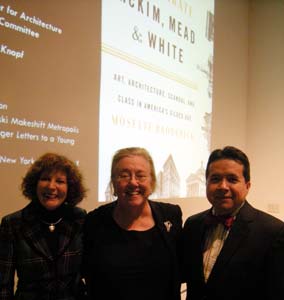
02.23.11: The Oculus Book Talk in February featured Mosette Broderick, who regaled a packed Tafel Hall with tales of the American Golden Age’s architectural triumvirate, McKim, Mead & White.

Mosette Broderick offered a most animated lecture about her new book, Triumvirate: McKim, Mead & White.

Kristen Richards

Spearheading the Oculus Book Talk series are Oculus Committee members Maxinne Leighton, Assoc. AIA (left), and Miguel Baltierra, Assoc. AIA, pictured here with author Mosette Broderick.

Kristen Richards

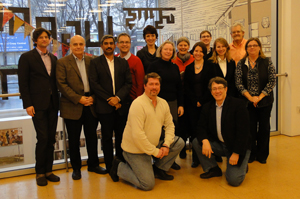
02.24-25.11: The Board of the Association of Architecture Organizations (AAO) met at the Center for Architecture.

Members of the AAO board at the Center.

Emily Nemens

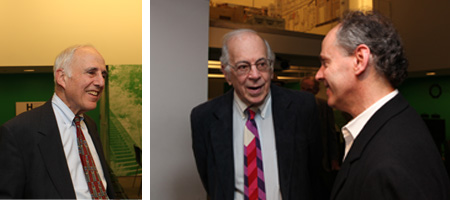
02.17.11: Guest gathered in Tafel Hall for a remembrance of the life of Edgar Tafel, FAIA, a generous supporter of the Center for Architecture

(L) Robert Silman, PE, Hon. AIANY, who organized the program. (R) Walter Blum, AIA, Tafel’s first employee, and Kent Kleinman, Dean of the Cornell University School of Architecture, where Tafel endowed the Edgar A. Tafel Professorship in Architecture.

Emily Nemens

Triumvirate Tells Storied Tale of McKim, Mead & White

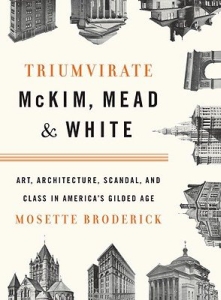
Event: Oculus Book Talk: Triumvirate: McKim, Mead & White Art, Architecture, Scandal, and Class In America’s Gilded Age by Mosette Broderick
Location: Center for Architecture, 02.23.11
Speaker: Mosette Broderick — Director of Urban Design and Architecture Studies & MA program in Historical and Sustainable Architecture, Department of Art History, NYU
Organizer: AIANY Oculus Committee
Sponsors: Reception sponsored by Alfred A. Knopf

Courtesy AIANY

A labor of love, years in the making, Triumvirate: McKim, Mead & White Art, Architecture, Scandal, and Class In America’s Gilded Age, by Mosette Broderick (Alfred A. Knopf, New York), is a lushly-layered scholarly work written with the ease and accessibility of a historical novel. In telling the story of Charles McKim, William Mead, and Stanford White’s world and times, and the buildings they built, Broderick delves into the storied lives of these named architects, the opulence and wealth of the Gilded Age, their clients, and the shifting dynamics of the world around them. She also gives focus to the voice of some of the other men in the firm, most notably the talented Joseph Wells. While the name McKim, Mead & White would become synonymous with great American architecture, Wells, chief designer, is given a voice in Triumvirate that provides a greater understanding into the design philosophy and management practice of the firm. Wells, who took on the design of the Villard Houses, not only opened new doors for the firm after the commission’s completion, but “the office had come to depend on him to make their designs coherent,” Broderick states when describing the impact of his death on the firm.

There are many other tangents of interest and the book does delve into the scandals. But the author makes clear from the beginning that she is in service of telling the story of their work, which is beautifully illustrated with some remarkable photographs throughout. I suggest that you consider reading this book with a bifocal lens — one focused on history and the other on the practice of architecture in 2011. The firm of McKim, Mead & White designed and built when the nation was going through a radical industrial and ideological transformation. There is much to be learned.

In this issue:
· BIG Introduces New Residential Typology to Manhattan’s Skyline
· Interboro Partners to Create Holding Pattern at MoMA P.S.1
· Mayor Unveils Plans for Hunters Point South
· Bamboo Tower Rises in Eco-City
· Foundation Finishes in Wood
· Rye Country Day School Renovates and Expands


BIG Introduces New Residential Typology to Manhattan’s Skyline

New residence at W.57th Street between 11th and 12th Avenues.

BIG-Bjarke Ingels Group

Durst Fetner Residential (DFR) has selected Copenhagen-based BIG-Bjarke Ingels Group to design an 870,000-square-foot residential building on West 57th Street between 11th and 12th Avenues. A hybrid between a European perimeter block and a traditional Manhattan high-rise, the building’s form shifts depending on the viewer’s vantage point — while appearing like a warped pyramid from the West Side Highway, it turns into a slender spire on West 58th Street. A courtyard opens views towards the Hudson River, bringing low western sun deep into the block, created by lifting up the northeast corner toward a 467-foot peak. The building’s slope allows for a transition in scale between the existing low-rise structures to the south and the high-rise towers to the north and west. The roof consists of a ruled surface perforated by unique south-facing terraces. More than 600 residential units of different scales will contain either a bay window or a balcony. Other design team members include SLCE Architects (architect-of-record), Starr Whitehouse (landscape architects), Thornton Tomasetti (structural engineering). This is BIG’s first project in North America and the firm recently opened a New York office.


Interboro Partners to Create Holding Pattern at MoMA P.S.1

Rendering of Holding Pattern.

Courtesy Interboro Partners

The Museum of Modern Art, MoMA P.S.1, selected Brooklyn-based Interboro Partners as the winner of the 12th annual Young Artists Program (YAP) from a group of five finalists. The project, called Holding Pattern, brings an eclectic collection of objects, including benches, mirrors, ping-pong tables, and floodlights, under a taut canopy of rope strung from the museum’s wall to the parapet across its courtyard. The unobstructed space under a single structure creates an environment focusing on both the visitors and the Warm Up concert series. Objects in the space will be donated to local community groups at the summer’s end.

In addition, MoMA P.S.1 partnered with the National Museum of XXI Century Arts (MAXXI) in Rome to establish an annual international edition of YAP. Out of five European finalists, Rome-based stARTT was selected for its project, WHATAMI. Both installations will open in June and an exhibition of all the finalists from both competitions will be on view at MoMA over the summer. Interboro Partners was an AIANY Chapter 2006 New Practices award winner.


Mayor Unveils Plans for Hunters Point South

Hunters Point South.

SHoP Architects

Mayor Bloomberg recently unveiled plans for Hunters Point South in Long Island City. It will be the city’s largest new affordable housing complex since the 1970s when Co-op City and Starrett City were completed. A development team, consisting of Phipps Houses, Related Companies, and Monadnock Construction, was selected through a competitive process to build the residential portion of the first phase of the complex. Two mixed-use buildings will contain more than 900 housing units and roughly 20,000 square feet of new retail space. At least 75% of the housing will be permanently targeted to low-, moderate-, and middle-income families. Designed by SHoP Architects with Ismael Leyva Architects, the team’s design for the two initial buildings features a tripartite building composition. Retail corridors will ultimately serve as a spine that connects all of the buildings in the complex. Phase 1, to be completed in 2014, also includes five acres of new waterfront parkland, a new intermediate and high school, new retail space, and parking. ARUP, Thomas Balsley Associates, and Weiss/Manfredi, completed the design plans for the project’s infrastructure, streetscapes, and waterfront park.


Bamboo Tower Rises in Eco-City

Tian Fang Tower.

Kevin Kennon Architect

Kevin Kennon Architect has recently unveiled the design for a 45-floor, mixed-use commercial tower in Eco-City, a joint project between China and Singapore that will showcase sustainable development in Tianjin, China. The 120,000-square-meter Tian Fang Tower incorporates sustainable and biophilic design strategies that include natural convection to heat and cool the building with filtered fresh air, an idea inspired by the form and growth of bamboo forests. The design is based on a 14-by-14 meter square module. Whereas a typical office building has four corners, Tian Fang has 18, providing an abundance of corner offices. The layout of the luxury retail space also follows this module and is composed of seventeen 14-by-14-meter volumes that rise into series of angled roofs shaped at various orientations to the sun. The project will generate 20% of its clean energy on site via a combination of hydrogen fuel cells, solar panels, and wind turbines while simultaneously conserving 20% of the energy used by a similar, fully occupied, mixed-use tower.


Foundation Finishes in Wood

Teagle Foundation.

Photos by Elliot Kaufman

Sydness Architects has designed the new offices for the Teagle Foundation, an organization devoted to promoting excellence in higher education, located on the 38th floor of the former General Electric building. The design takes advantage of citywide views and provides the staff optimum internal visibility and working adjacencies, as well as a place for the foundation’s extensive art collection. The reception area sets the tone for the space with Barcelona chairs, an oriental rug, and a wall paneled in Sapele wood. In the work area, glass-walled, open offices on the perimeter open onto a common area with a round conference table in the center for informal meetings. The president’s private office is paneled in natural figured Anigre with matching millwork, and the accountant’s office is paneled in deep mahogany and blond sycamore.


Rye Country Day School Renovates and Expands

Rye Country Day School.

Peter Gisolfi Associates

The renovation and expansion of the Rye Country Day School’s Pinkham Building, designed by Peter Gisolfi Associates, has been completed. Located on a 26-acre campus in Rye, NY, approximately half the 1963 building’s existing 35,000 square feet of space was renovated and a new student lounge overlooking the courtyard was added. New exterior stairs and terraces create a gradual transition from an existing athletic field, which is level with the top floor of the addition and descends down to the student lounge. The new three-story, 15,000-square-foot addition houses classrooms, science labs, informal student gathering spaces, a new college counseling center, and a 143-seat auditorium.

Ernest W. Hutton, Jr., FAICP, Assoc. AIA, was awarded an AIA Associates Award…

The 2011 Rudy Bruner Award for Urban Excellence committee has selected five finalists, including the Santa Fe Railyard Redevelopment by Ken Smith Landscape Architect, Frederic Schwartz Architects, Surroundings Studio, and public art by Mary Miss of New York; and the Brooklyn Bridge Park by Michael Van Valkenburgh Associates

Winners for the 58th Annual Progressive Architecture Awards presented by Architect magazine include the Hirshhorn Museum and Sculpture Garden Seasonal Expansion by Diller Scofidio + Renfro; and Taichung InfoBox by Stan Allen Architect

Winners of the Queens Chamber of Commerce Building Awards include Frank Briguglio, lifetime achievement award. In the category of New Construction: D’Angelo Center by Gensler; D’Amico Residence by Frank Petruso Architect; Moda by FXFOWLE Architects; New York Hospital Queens — West Building by Perkins Eastman; Arista 35 Condominiums by Grasso — Menziuso Architects; Stage K @Kaufman Astoria by Janson Design Group; Three-Seven Plaza Condominium by Gina O. Longo; Con Edison Newtown Substation by the Consolidated Edison Company of NY; 27-17 Crescent Street., Astoria by John Carusone Architect; Shinhan Bank America, Flushing Branch by Kyu Lee Architects; Marvin Residence by JLS Designs; Maspeth Gardens by Arnold S. Montag, Architect AM/PM Design & Consulting; 159-16 Union Turnpike by Gerald J. Caliendo; Kui Mei Ling Residence by John C. Chen Architect

… In the category of Rehab, Cafaro Residence by JLS Designs; Remsen Hall, Renovation and Addition by Mitchell Giurgola Architects; The Ransaw Building by Christopher Pappa Architect; Q-Care Affordable Medical Care by Laura Heim Architect; Kwok Po Lam Residence by John C. Chen Architect; The Summit School by Raymond Irrera & Associates Architects; Yu Art Studio And Gallery and Matsikas Residence by John Carusone Architect; Valentino’s on the Green by Jack L. Gordon Architects; Whitestone Community Library by Marpillero Pollak, Architects; Bay Terrace Country Club by Victor Familari Architect; and Harald Mission Center by Lin & Associates Architects

The 15th Annual SMPS-NY Honor Awards Dinner will recognize NYC Department of Transportation Commissioner Janette Sadik-Khan, Public Sector Award; Nos Quedamos Community Development Association, Melrose Associates Partner Petr Stand, APA, and President of MJM Construction Services Emanuel (Manny) Kanaris, Developer Award; and Architizer.com Managing Partner Marc Kushner, AIA, Media Award

ENR New York announced its “Top 20 Under 40” picks, including Tom Abraham, AIA; Babak Bryan, AIA; Virginia Castillo; Marcos Diaz-Gonzalez; David Malott; Brian Tolman, AIA; Monica Larsen Wetherll; and C. Scott Wood

Ralph Appelbaum Associates has been selected as exhibition designer for the National Museum of African American History and Culture in Washington, DC…

Jennifer Busch is resigning as Editor-in-Chief of Contract magazine to become Vice President of Marketing A&D for InterfaceFLOR…

The Board of Trustees of The Cooper Union for the Advancement of Science and Art elected Dr. Jamshed Bharucha, Provost and Senior Vice President of Tufts University, to serve as its 12th President, effective 07.01.11…

Stephan Jaklitsch, AIA, and Mark Gardner, AIA, announced that Stephan Jaklitsch Architects has become Jaklitsch / Gardner Architects

Callison announced the promotion of Steven Derwoed, David Kepron, AIA, LEED AP, and Kenneth Lill, AIA, as Principals…

2011 OCULUS Editorial Calendar
If you are an architect by training or see yourself as an astute observer of New York’s architectural and planning scene, note that OCULUS editors want to hear from you! Projects/topics may be anywhere, but architects must be New York-based. Please submit story ideas by the deadlines indicated below to Kristen Richards: kristen@ArchNewsNow.com.

2011 Themes:
Spring (President’s Theme): Design for a Change: Buildings, People, Energy
[Closed]

Summer: AIANY Design Awards 2011
[Closed]

Fall: Interior Activity
Architects as interior designers; Changes in corporate culture = transformation of the workplace; Architects designing products/Multi-disciplinary cross-overs; Rebranding hospitality, restaurants, retail to attract new audiences; Interiors as laboratories for small firms.
Submit story ideas by 04.22.11

Winter: Up, Down, and Sideways: Density and Transportation

Density enabled by transportation: mass transit, cycling; Moynihan Station; Regional connections; Housing Authority: former purposeful disconnect, now reintegrating back into neighborhoods; How a century of New York skyscrapers has/is/will affect the architecture, planning, and culture of the city and the world.
Submit story ideas by 08.19.11

For further information, contact OCULUS Editor Kristen Richards: kristen@ArchNewsNow.com.

03.11.11 Call for Entries: 2011 AIA UK Chapter Excellence in Design Awards Programme

03.15.11 Call for Nominations: Center for Architecture Foundation Design Scholarship

03.15.11 Call for Nominations: Women’s Auxiliary Eleanor Allwork Scholarship
03.21.11 Call for Submissions: CUP — Making Policy Public

03.21.11 Call for Entries: Copa Arquitectura

04.01.11 Call for Entries: The Gowanus Lowline

04.08.11 Call for Applications: 2011 Pettigrew Memorial ARE Scholarship

05.15.11 Call for Entries: Changing the Face — Moscow/Architizer

Risk Management Experts Advise Architects on Best Legal Practices

Event: Keep It Legal, Protected, and Profitable
Location: Center for Architecture, 01.27.11
Speakers: Cynthia Fischer — Partner, Schnader Harrison Segal & Lewis; Scott St. Marie — Partner, Schnader Harrison Segal & Lewis; Steve Whitehorn — Managing Principal, Whitehorn Financial Group
Organizers: AIANY New Practices Committee; RIBA-USA New York Chapter

In an increasingly litigious business climate, risk, liability, and exposure are integral aspects of practice. It is beneficial for architects at all levels of the profession to have an understanding of exposure, as well as the instruments in place to protect businesses from legal recourse.

Cynthia Fischer, Scott St. Marie, and Steve Whitehorn have decades of experience in architectural risk management, and each contributed a different facet to the subject of legal liability and exposure. Fischer, a business partner at the law firm of Schnader Harrison Segal & Lewis, as well as Secretary of RIBA-USA, explored the various legal structures and mechanisms available to architectural practices. She discussed the advantages and disadvantages of S-corporations, liability clauses in contract documents, and operating agreements between managing principals. She stressed the importance of proper asset valuation, whether that asset is employees, managing partners, or the company itself.

St. Marie, also a partner at Schnader Harrison Segal & Lewis, focused his talk on potential exposure during the design and construction process. He covered “changes” to the contract documents, as well as the manner in which changes resulted in “betterment” to the work and, therefore, decreased legal exposure. In addition, he outlined the function of mediation, arbitration, and litigation as methods of resolving disputes between architects and other aggrieved parties.

Whitehorn, managing principal of Whitehorn Financial Group, presented a brief overview of liability insurance. He spoke about practices excluded from insurance policies, recalibration of policies on a regular basis due to revenue changes, and the importance of working with consultants who maintain their own liability policies.

If there were a single concept uniting each of the three lectures, it would be the value of appropriate communication during the design and construction process. Clear dialogue is the most effective method of limiting liability and exposure, whether that communication is between client and architect, contractor and architect, principal and employee, or principal and principal.

Two Emerging Practices Value Attitude over Style

Event: New Practices 2010 Winner Presentations: MANIFOLD.ArchitectureStudio and SOFTlab
Location: Center for Architecture, 01.25.11 & 02.03.11
Speakers: Michael Szivos — Principal/Director, SOFTlab; Philipp von Dalwig, LEED AP — Co-Founder & Principal, MANIFOLD.ArchitectureStudio
Sponsors: Lead Sponsors: Dornbracht, MG & Company Construction Managers/General Contractors; Valiant Technology; Sponsors: Espasso, Hafele and Skidmore, Owings & Merrill; Media Sponsor: The Architect’s Newspaper

SOFTlab’s model of CHROMAesthesiae for the Devotion Gallery (left); MANIFOLD’s Cobble Hill Apartment.

Courtesy AIANY

SOFTlab and MANIFOLD.ArchitectureStudio (MAS) may be both emerging firms with capitalization-laden names, but their philosophies and portfolios appear to be polar opposites. However, principals from each firm agree that they strive to avoid labels associated with a particular design style.

“We are very concerned with the parts and pieces,” explained SOFTlab Principal Michael Szivos of the firm’s design approach, which is fueled by perpetual experimentation. SOFTlab designs many websites and logos, but is best known for creating installations that alter viewers’ perceptions of color and space. Szivos and his colleagues write customized computer scripts that instruct a CNC milling machine to cut complex pieces, which are then assembled into three-dimensional forms. SOFTlab recently designed and installed CHROMAtex.me, a colorful vortex that seemed to suck viewers from the street into a storefront gallery. “The beautiful part is on the inside,” according to Szivos. The sculpture was constructed of white laser-cut panels lined with photo inkjet paper, attached together via thousands of binder clips.

MAS, on the other hand, depends less on technology, creating simple diagrams at the outset of a project to offer clients multiple design options. Though the firm occasionally collaborates with branding and graphic designers, it primarily designs practical, clean interiors for NYC apartments. A theme throughout the firm’s work is the integration of custom, built-in millwork, or “living walls” as Co-founder and Principal Philipp von Dalwig calls them. These thick walls conserve space while accommodating several programmatic elements. For example, when MAS designed the conversion of a former synagogue into the Hirschkron/Camacho penthouse apartment, it created a white-paneled wall to conceal stairs, a wine cooler, media storage, and a powder room.

Von Dalwig believes that clients are drawn to his firm’s straightforward design approach, which he describes as “more European than American.” However, he admitted that he avoids a signature look for fear “of being labeled.” Szivos shares this sentiment, echoing that his firm “pushes back against having a certain style.” Instead, he insists that the work embodies an attitude.

Amanda’s Accent

Amanda Burden, Hon. AIANY, FAICP, Chair of the NYC City Planning Commission, at the Accent on Architecture gala.

Laura Trimble

Amanda Burden, Hon. AIANY, FAICP, Chair of the NYC City Planning Commission, won the Keystone Award at the Accent on Architecture gala of the American Architectural Foundation (AAF) on 02.04.11. Mayor Richard M. Daley of Chicago was the recipient, in absentia, of the Joseph Riley Award — record snows in Chicago made it impossible for him to attend the event, held at the Paul Mellon Auditorium in Washington, D.C. The AIA New York Chapter was well-represented by 2011 President Margaret Castillo, AIA, LEED AP, President-elect Joe Aliotta, AIA, Susan Chin, FAIA, Mary Burke, AIA, Mark Behm, Assoc. AIA, Venesa Alicea, AIA, Laura Trimble, Kate Rube, and Jay Bond.

The Keystone Award was presented by AAF President & CEO Ron Bogle after remarks by HUD Secretary Shaun Donovan, Hon. AIA, NEA Chairman Rocco Landesman, and Paul Goldberger of The New Yorker. Landesman praised Burden for her “design fanaticism,” saying that “she insists that architects do not only their best work, but that they go beyond themselves and do things that are new, that haven’t been done before.” In describing her as “exacerbating but irresistible, a visionary and a wonk,” he said that “the moral here is that good design leads not just to pleasure, but to real sustainability and economic utility as well.”

Despite travel problems that recalled last year’s Accent “Snowmageddon,” Goldberger arrived to deliver an oration praising Burden as the person who “understands the enormous importance of architectural quality in the public realm, and she has done this in the most visible city in the world. She is the city’s chief advocate for architecture, and recognizes that every work of architecture in the city, public or private, has a public role to play.” Goldberger noted that Burden “has become a symbol for architectural quality worldwide” and is someone who “reminds us never to forget that all design and planning decisions should be focused on making life easier and more pleasant. Design is not a thing apart, but a thing in service of the good life.” He spoke of her ability to see the big picture but also focus in on the detail, citing the neighborhood-by-neighborhood re-writing of the zoning code. “This is not planning as a bureaucrat, not planning as a technocrat, and certainly not planning as an autocrat,” he continued. “Amanda has been down on the ground. She has changed the zoning in a hundred neighborhoods.”

Burden concluded the evening by putting aside her prepared remarks and saying, simply, “I’m the luckiest person in the world. I love cities. To see something come alive, to see the High Line come alive, inspires me. Great design is not a solitary endeavor, it requires collaboration. It requires all of you.”