In this issue:
· City Unveils Vision 2020, a Blueprint for the Waterfront & Waterways
· Pier A Will Soon Wine & Dine New Yorkers
· MiMA Rises on 42nd Street
· Brooklyn Housing Goes Passive
· Perkins+Will Donates Work for GEMS
· Red and White Drapes the Armory


City Unveils Vision 2020, a Blueprint for the Waterfront & Waterways

(L-R) Mayor Michael R. Bloomberg introduced the Vision 2020: New York City Comprehensive Waterfront Plan; NYC City Planning Chair Amanda Burden, FAICP, Hon. AIANY

Rick Bell, FAIA

Vision 2020: New York City Comprehensive Waterfront Plan, a framework for the city’s 520 miles of shoreline for the next decade and beyond, will transform the waterfront with new parks, industrial activities, and housing, as well as capitalize on waterways to promote transportation, recreation, maritime activity, and natural habitats. A three-year action agenda comprised of 130 funded projects, includes the development of more than 50 acres of new waterfront parks, creation of 14 new waterfront esplanades, and the introduction of a new commuter ferry service. Led by the NYC Department of City Planning (DCP), and launched in April 2010, the waterfront planning effort included city, state, and federal agencies, as well as waterfront experts and advocates who served on a waterfront advisory committee (including AIANY Chapter Members Bonnie Harken, AIA, who also chairs the American Planning Association Waterfront Committee, and AIANY Executive Director Rick Bell, FAIA). After opening remarks by Mayor Michael R. Bloomberg, City Planning Chair Amanda Burden said, “For the first time we are recognizing the water itself. As the Mayor said, it is our sixth Borough. New York’s waterways and waterfronts are integral to our city’s identity, and this plan will make the water a part of the daily life of all New Yorkers.” The plan was formulated with input from residents at citywide public planning workshops and online. It is the first comprehensive plan for the city’s waterways.


Pier A Will Soon Wine & Dine New Yorkers
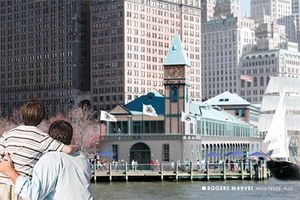
Pier A.

Rendering by Rogers Marvel Architects

The 124-year-old Pier A, currently undergoing a renovation and restoration by H3 Hardy Collaboration Architecture, has been leased to Harry and Peter Poulakakos, owners of several downtown eateries. When completed in the summer of 2012, it will mark the first time that the pier will be open to the public. Under an agreement with the Battery Park City Authority (BPCA), the restaurateurs’; development partner Dermot Company plans to create a casual dining restaurant and an oyster bar with outdoor seating, a coffee shop, and visitor center on the first floor, all designed by Rogers Marvel Architects. A fine dining restaurant and event venue will be located on the second floor, with a smaller event and entertainment venue on the partial third floor. There will be public seating on the plaza and promenade adjacent to the pier.

Pier A was originally built for harbor police and a headquarters for the NYC Department of Docks and Ferries. In 2008, the Economic Development Corporation, which owns the pier, allocated $30 million in capital funding to the BPCA to renovate and restore the core and shell of the dilapidated building, including replacing much of its crumbling underwater support structure. Last year, the Landmarks Preservation Commission (LPC) approved the restoration of the exterior to the way it looked in the 1920s and early 1930s. Stalco Construction serves as general contractor, and The LiRo Group serves as construction manager on the ongoing restoration of the building, which is on the National Historic Registry.


MiMA Rises on 42nd Street

MiMA.

Rendering courtesy of Related Companies

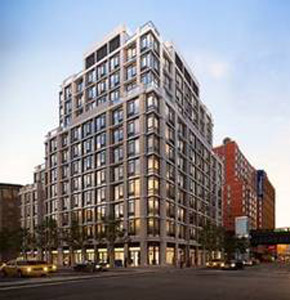
The 63-story mixed-use tower on 42nd Street, designed by Arquitectonica, with executive architect Ismael Leyva Architects and interiors designed by the Rockwell Group, has been completed. Named MiMA, after its location in the middle of Manhattan, the project contains 500 rental apartments, ranging from studios to two-bedrooms on floors seven through 50, and a “collection” of condominiums on floors 51 through 63. Amenities include more than 44,000 square feet of health and recreation facilities, including landscaped terraces, a basketball and volleyball court, an indoor lap pool, and an indoor and outdoor screening room. The project also features a Yotel, scheduled to open this spring, containing 669-170-square-foot cabins, also designed by the Rockwell Group in collaboration with Softroom of London. In addition, the Gehry Architects-designed Signature Center will open in early 2012 on the second floor and second-floor mezzanine levels, with three unique theaters, rehearsal spaces, a lobby with a café, and a bookstore. The project is developed by Related Companies.


Brooklyn Housing Goes Passive
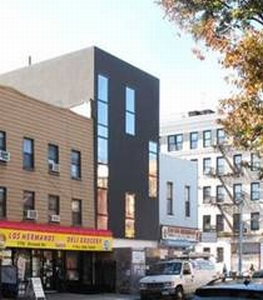
Brooklyn Passive House.

Photos by Loadingdock5 Architecture

Brooklyn-based Loadingdock5 Architecture has completed its first passive house in NYC. Located in Williamsburg, the 2,400-square-foot building contains ground-floor and basement retail space with a 1,500-square-foot, single-family, three-bedroom triplex above. The design for the residence, using the Passive Housing Planning Package (PHPP) software for designing and verifying projects, adheres to the German Passivhaus standards. Basic principles for a passive house include super-insulation, air-tightness, thermal bridge-free design, and ventilation with heat recovery. The house is heated by the inhabitants, their electrical equipment, and a split heat pump combined with an energy recovery ventilator located on the roof. The envelope consists of load-bearing, eight-inch concrete masonry units with seven-inch EPS exterior insulation, and frameless, triple-paned windows. The firm had to redesign the parapet on the roof with autoclave aerated concrete blocks to avoid thermal bridging. The firm has three other passive house projects in construction in Brooklyn.


Perkins+Will Donates Work for GEMS

Girls Educational and Mentoring Services.

Eduard Hueber, Arch Photo, Inc.

The renovated office for Girls Educational and Mentoring Services (GEMS), designed by Perkins+Will, recently reopened. Located on the ground floor of a residential building in Harlem, the 1,700-square-foot office space helps young women, ages 12-24, who have experienced commercial sexual exploitation and domestic trafficking to exit the sex industry, and provides counseling, crisis housing, life skills training, job training, and health care. As part of the Social Responsibility Initiative, the firm is part of the 1%, a firmwide program to contribute 1% of its profits to pro bono work. The NY office and its consultants donated more than 1,100 hours of pro bono services.


Red and White Drapes the Armory
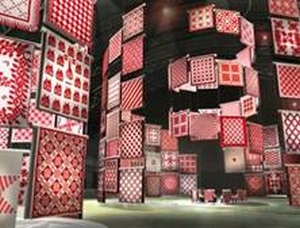
“Infinite Variety: Three Centuries of Red-and-White Quilts” at the Park Avenue Armory.

Renderings by Thinc Design

The American Folk Art Museum is transforming the Park Avenue Armory’s historic 55,000-square-foot Wade Thompson Drill Hall with “Infinite Variety: Three Centuries of Red-and-White Quilts,” an installation created by Thinc Design. With more than 600 red-and-white American quilts, the exhibition represents 300 years of American quilting. Inspired by the geometry of quilting circles, Thinc designed six towering cylinders that are made entirely with randomly-arranged quilts. The 30-foot-high forms are extrusions with the quilts hung over concealed cardboard tubes, so their intricate patterns can be viewed from both the exterior and interior of the cylinders. A 50-foot-high spiral enclosed by two ascending walls is the centerpiece. A circular arrangement of quilts draped on chairs under the spiral evokes the individual quilters. The exhibition is on view 03.25-03.30.11.


The recipients of the 2011 AIA Housing Awards include, in the category of One/Two Family Custom Housing, R-House by Della Valle Bernheimer and Architecture Research Office; and Special Housing, The Schermerhorn by Ennead Architects

The International Interior Design Association (IIDA) announced the winners of the 38th Annual Interior Design Competition, including the David Yurman Townhouse by Gabellini Sheppard Associates and the Andaz 5th Avenue Hotel by TonyChi and Associates

Winners of the 11th Annual NYC Section of the Illuminating Engineering Society’s Student Lighting Competition include: “Peace Bomb” by Kevin Lee of Pratt Institute, Industrial Design (Grand Prize); “Shadow Ripples in a Pond of Light” by Rebecca Bost, Parsons The New School for Design, MFA Lighting Design and Architecture (Second Prize); “Was It a Rat I Saw?” by Brandon Lenoir, Parsons The New School for Design, AAS Interior Design (Third Prize); and “Light Lunch” by Margaret Cabanis-Wicht, Pratt Institute, Master of Industrial Design; “The Heart of A Confident Man” by Shane Moan, Fordham University, BA Theater Design Production; and “Familiar Objects In a New Light” by Andrew Koudlai, Fordham University, Visual Arts (Honorable Mentions)…

Lance Jay Brown, FAIA, has been elected the inaugural Chancellor of the recently formed College of Distinguished Professors within the Association of Collegiate Schools of Architecture (ACSA)…

Nancy Aber Goshow, AIA, LEED AP,
will be honored as a 2011 Partner of the Year at the 24th Annual Partners for Progress Gala presented by the Queensborough Community College Fund…

Scott Lauer, former director of the Robin Hood Foundation L!brary Building Initiative and founder of openhousenewyork (OHNY), has been named vice president for programs at the American Architectural Foundation…

HOK New York announces that Juliette Lam will lead Strategic Initiatives for the firm’s worldwide Interiors practice, and Tom Polucci will lead the New York Interiors practice…

2011 OCULUS Editorial Calendar
If you are an architect by training or see yourself as an astute observer of New York’s architectural and planning scene, note that OCULUS editors want to hear from you! Projects/topics may be anywhere, but architects must be New York-based. Please submit story ideas by the deadlines indicated below to Kristen Richards: kristen@ArchNewsNow.com.

2011 Themes:
Spring (President’s Theme): Design for a Change: Buildings, People, Energy
[Closed]

Summer: AIANY Design Awards 2011
[Closed]

Fall: Interior Activity
Architects as interior designers; Changes in corporate culture = transformation of the workplace; Architects designing products/Multi-disciplinary cross-overs; Rebranding hospitality, restaurants, retail to attract new audiences; Interiors as laboratories for small firms.
Submit story ideas by 04.22.11

Winter: Up, Down, and Sideways: Density and Transportation
Density enabled by transportation: mass transit, cycling; Moynihan Station; Regional connections; Housing Authority: former purposeful disconnect, now reintegrating back into neighborhoods; How a century of New York skyscrapers has/is/will affect the architecture, planning, and culture of the city and the world.
Submit story ideas by 08.19.11

For further information, contact OCULUS Editor Kristen Richards: kristen@ArchNewsNow.com.

03.25.11 Registration Deadline: Save A Sample!

04.04.11 Call for Entries: suckerPUNCH International Ideas Competition for LIC Cinema

04.08.11 Call for Entries: EcoHome Design Awards

04.09.11 Call for Entries: Dekalb Market — Not Just A Container

04.26.11 Call for Entries: Think Space — Geopolitical Borders

05.03.11 Call for Entries: Douglas Haskell Award for Student Journals

07.15.11 Call for Entries: The Mid-Polis — 2011 Open Building Competition Challenge

10.07.11 Call for Entries: 2011 NOMA Student Design Competition

2011 AIANY Design Awards Announced

AIANY

The annual AIA New York Design Awards program recognizes local and international projects by NYC architects, as well as work designed in NYC by non-local firms. There were a total of 433 submissions this year, and juries comprised of internationally prominent designers chose Honor and Merit Award winners within four categories: Architecture, Interiors, Un-Built Work, and Urban Design.

Architecture, Honor Awards:
· Diller Scofidio + Renfro, FXFOWLE Architects (Associate Architect): Hypar Pavilion Lawn and Restaurant at Lincoln Center
· Steven Holl Architects, CCDI – China Construction Design International: Horizontal Skyscraper — Vanke Center
· LOT-EK: APAP Openschool
· Thomas Phifer and Partners, Pearce Brinkley Cease + Lee (Associate Architect): North Carolina Museum of Art
· Thomas Phifer and Partners: House in Midwest
· Tod Williams Billie Tsien Architects, Tom Eliot Fisch (Associate Architect): C.V. Starr East Asian Library

Architecture, Merit Awards:
· Diller Scofidio + Renfro: Granoff Center for the Creative Arts at Brown University
· Greeley-Hansen, Hazen & Sawyer, and Malcolm Pirnie in association with Ennead Architects: Newtown Creek Wastewater Treatment Plant
· Ennead Architects: Gateway Center, Westchester Community College
· Ennead Architects: The Standard
· Roger Ferris + Partners: Country Estate
· Foster + Partners, AAI Architects (Adamson) (Architect of Record): Sperone Westwater
· SAA / Stan Allen Architect, W.B. Huang Architects & Planners: Taichung Info-Box
· Rafael Viñoly Architects, SmithGroup (Architect of Record): UCSF Dolby Regeneration Medicine Building

Interiors, Honor Awards:
· Dean/Wolf Architects: Inverted Warehouse/Townhouse
· Michielli + Wyetzner Architects: EDAW Inc.
· Thomas Phifer and Partners: Fifth Avenue Apartment
· Tod Williams Billie Tsien Architects: David Rubenstein Atrium at Lincoln Center

Interiors, Merit Awards:
· Cook + Fox Architects: 641 Avenue of the Americas
· Dean/Wolf Architects: Implied Rotation Townhouse
· OBRA Architects, Terry Chance/ Site Assembly: Urbia Furniture System for Small Apartments in Big Cities
· SYSTEMarchitects: aA SHELTER
· WXY Architecture + Urban Design: NYC Information Center

Un-built Work, Honor Awards:
· LEVENBETTS: PhXcaseXcase: Cactus Flower Housing
· Morphosis Architects, SRA Architectes (Associate Architect): Phare Tower
· SO-IL: Kukje Art Center

Un-built Work, Merit Awards:
· CR Studio Architects: Marine Company 1 Firehouse
· EASTON+COMBS: Changing Room
· KNEstudio | University of Illinois: urbanCLOUD
· Philip Lee Workshop: Just Add Water: A Proposal for the NYC Shaft Sites
· NAMELESS: Playcloud
· Sage and Coombe Architects: Bronx River Art Center
· Joel Sanders Architect: LGBT Retirement Community

Urban Design, Honor Awards:
· Diller Scofidio + Renfro, FXFOWLE Architects, and Beyer Blinder Belle Architects & Planners: Lincoln Center Public Spaces
· dlandstudio, Architecture Research Office: Lower Manhattan: A New Urban Ground
· Michael Van Valkenburgh, Maryann Thompson Architects (Associate Architect): Brooklyn Bridge Park

Urban Design, Merit Awards:
· James Corner Field Operations: Qianhai Water City
· PPJ-Perkins Eastman, Posco E&C, Jina, and Vietnam Institute of Architecture: HANOI Master Plan to 2030 and Vision to 2050

AIANY Design Awards Jury Celebrates Diverse Design

Event: Design Awards Jury Symposium – Winners Announced
Location: Center for Architecture, 03.01.11
Jurors: Architecture: Minsuk Cho, — Principal, Mass Studies; Vincent James, FAIA — Principal, VJAA & Cass Gilbert Professor-in-Practice, University of Minnesota School of Architecture; Murat Tabanlioglu — Principal, Tabanlioglu Architects; Interiors: Neil Frankel, FAIA, FIIDA — Chair, University of Wisconsin/Milwaukee School of Architecture and Urban Planning; Monica Ponce De Leon — Principal, Office dA; Patricia Patkau, FRAIC, Hon. FAIA, Hon. FRIBA — Principal, Patkau Architects; Urban Design: Julia Czerniak — Principal, CLEAR & Associate Professor, Syracuse University School of Architecture; Marilyn Jordan Taylor, FAIA — Dean, University of Pennsylvania School of Design; Ray Gastil — Director, Gastilworks Planning & Design; Un-Built Work: Chris Genik, AIA — Principal, Daly Genick & Dean, Newschool of Architecture and Design, San Diego; Joe Rosa — Director, University of Michigan Museum of Art; Elias Torres Tur — Partner, Martinez Lapena — Torres Arquitectos
Moderator: William Menking — Editor-in-Chief, The Architect’s Newspaper
Sponsors: Patron: Trespa; Sponsors: Buro Happold; Ingram Yuzek Gainen Carroll & Bertolotti, LLP; Kohn Pedersen Fox Associates; MechoShade Systems, Inc.; New York University; Structure Tone Inc.; Studio Daniel Libeskind; Syska Hennessy Group; Swanke Hayden Connell Architects; Weidlinger Associates, Inc.

Jurors discuss winners in four categories, including Architecture, Interiors, Urban Design and Un-built work.

Courtesy Center for Architecture

Whether it’s site-specificity or small-scale intimacy, the AIANY Design Awards jurors rewarded 38 projects that are diverse with a variety of approaches — with Honor and Merit Awards.

The Architecture category winners included several projects built in Asia. Juror Minsuk Cho pointed out that it can be challenging designing modern architecture within the context of Asian building traditions, but he believes that entries such as Merit Award-winning Stan Allen Architect succeeded by creating a design that is “not only site-specific, but also time specific.” The temporary Taichung Info-Box is constructed with bamboo, a local material that can also be easily recycled. Another theme among winning projects was the play on topography. The Honor Award-winning Hypar Pavilion Lawn and Restaurant at Lincoln Center by Diller Scofidio + Renfro with FXFOWLE Architects was the “most simple and most successful” of these designs, stated Vincent James, FAIA, who noted that the changes in planes create a 3-D effect.

Chicago architect Neil Frankel, FAIA, FIIDA, found the entries in the Interiors category “ethereal” compared to work in his hometown, and believes that “NYC is rich with intimate spaces.” Monica Ponce De Leon noticed a “struggle for how to make architecture out of nothing” within small spaces. Thomas Phifer and Partners’ Fifth Avenue Apartment, which won an Honor Award, incorporated reflective surfaces in window frames, “a simple move that transforms the character of the space,” she said. Jurors agreed that there wasn’t a central idea among the winning projects, and those they selected exhibited distinct methodologies and ranges of scale, from private apartments to the very public NYC Information Center by WXY Architecture + Urban Design, which won a Merit Award.

“Urban design is creating opportunity,” said Ray Gastil. Jurors for the Urban Design category believed that Brooklyn Bridge Park by Michael Van Valkenburgh and Maryann Thompson Architects deserved an Honor Award for its “surface and creation of topography,” according to Marilyn Jordan Taylor, FAIA. She noted that many projects garnered awards by creating “urban junctions” that invite in the surrounding neighborhood. However, Julia Czerniak pointed out that there were aspects absent from submissions, including temporary, small-scale projects, and the policy component of how to actually get work built.

Projects within the ephemeral Un-built Work category ranged from those by well-known firms, including the Honor Award-winning Phare Tower by Morphosis Architects with SRA Architectes, which jurors praised for breaking away from the skyscraper ideal, as well as work by emerging firms. SO-IL’s Kukje Art Center, which received an Honor Award, features a “skin that is just unstable enough to suggest all types of uses,” which intrigued Chris Genik, AIA. Jurors gave a Merit Award to Playcloud by NAMELESS, part of the 2010 FIGMENT/ENYA/SEAoNY City of Dreams Pavilion competition on Governors Island, for its “optimism of confined space for adults to play,” according to Joe Rosa. Although, he admitted, there could be some structural issues with the design.

On 04.12.11, the winners will be honored at the Design Awards Luncheon at Cipriani Wall Street. The projects will be featured in an exhibition at the Center for Architecture (04.14-06.25.11) and in the summer issue of OCULUS. For more information about the AIANY Design Awards, click here.

"Salaam Bombay!" is as Relevant Today as it was 20 Years Ago


Event:
Jugaad Urbanism Film Series: Salaam Bombay!
Location: Center for Architecture, 02.25.11
Speakers: Mira Nair — Director, “Salaam Bombay!;” Aseem Chhabra — Director, Indo-American Arts Council
Introduction: Aroon Shivdasani — President & Executive Director, Indo-American Arts Council
Organizers: Center for Architecture; Indo-American Arts Council; The New School; Society of Indo-American Engineers and Architects
Sponsors: Grants: Graham Foundation for Advanced Studies in the Fine Arts; National Endowment for the Arts; Underwriter: Duggal Visual Solutions; Lead Sponsors: Hitachi; Robert A.M. Stern Architects; Sponsors: Grapevine Merchants; Society of Indo-American Engineers and Architects; Supporters: Bittersweet NYC; CetraRuddy; Kingfisher LGER; Friends: Arup; Benjamin Moore; IBEX Construction; Kohn Pedersen Fox Associates; Perkins Eastman; Skidmore, Owings & Merrill; Special Thanks: Umberto Dindo, AIA; Lutz Konermann; Catherine Scharf; Consulate General of Switzerland

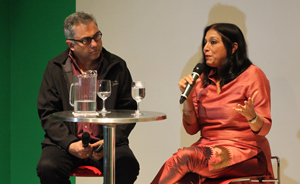
Director Mira Nair speaks with Aseem Chhabra, director of the IIAC Film Festival, after a screening of “Salaam Bombay!”

Caley Monahon-Ward

Before “Monsoon Wedding” put her in the international spotlight, Mira Nair’s 1988 directorial debut, “Salaam Bombay!” went on to win more than 25 international awards, including the Camera d’Or at the Cannes Film Festival. Shot on location in Bombay, she used real street kids as actors who received dramatic training at a workshop before production started.

Jugaad means “clever and resourceful” in Hindi, and a Jugaadu is a person who can get a job done by using easy-to-find materials without spending a lot of money. The current exhibition at the Center for Architecture, “Jugaad Urbanism,” shows solutions to big problems facing many people living in India’s cities. Clearly, the child actors in the film are jugaadus. They form small, close-knit groups and take on any menial task that comes their way to exist in the colorful, cacophonous, albeit slums, of Bombay.

In the film, the kids swagger like Bollywood stars to draw attention when in public, and they certainly have moments of desperation when alone, but they generally show no signs of self-pity. Their behavior, Nair said at the post-film screening Q&A, earned both her respect and concern for their welfare when filming.

Nair used the film’s profits to establish the Salaam Baalak Trust, which opened its first center in Bombay/Mumbai in 1989. The center provides a safety net of services for street kids, including all aspects of child development, from physical, medical, educational, and social, to vocational needs. To date, there are 25 centers serving 5,000 kids in Mumbai and Delhi. When asked “can art change the world?” her answer was simply “yes,” and it is evident in her body of work and her work with the trust.

“Salaam Bombay!” is part of the Jugaad Urbanism Film Series that screens films on Friday nights through 04.15.11.

SO-IL Springs into Design and Practice

Event: New Practices 2010 Winner Presentations: SO-IL
Location: Center for Architecture, 03.03.11
Speaker: Jing Liu — Principal, SO-IL
Organizer: AIANY New Practices Committee
Sponsors: Lead Sponsors: Dornbracht, MG & Company; Valiant Technology; Sponsors: Espasso; Hafele; Skidmore, Owings & Merrill; Media Sponsor: The Architect’s Newspaper

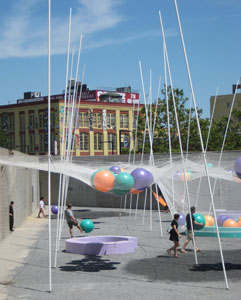
SO-IL’s “Pole Dance” as it was installed in the P.S. 1 Courtyard.

Jessica Sheridan

Solid Objectives — Idenburg Liu, or SO-IL, is a two-and-a-half year old architectural practice established by Florian Idenburg, Int’l Assoc. AIA, and Jing Liu. Their timing could have been better: they started the firm right before the recession hit, and though their first commission was commendable — a home for graphic artist Ivan Chermayeff — it fell through due to the financial crisis. “We have an elastic way of living,” Liu explained. This attitude has allowed the young firm to thrive, despite the economic situation, and is part of the reason they are a 2010 New Practices New York winner.

SO-IL’s “Pole Dance” was selected as the winner the 2010 MoMA/P.S.1 Young Architects Program. Idenburg and Liu positioned 80 fiberglass poles on a grid and wove them together with elastic bands and netting filled with large, colorful plastic balls. The poles moved via pivot connections attached to individual concrete foundations, creating a ripple effect. Throughout the courtyard, several “activators,” including hammocks and plants, were positioned to “contribute to the playfulness of the game,” Liu said. “The rules were invented by the users.”

The Kukje Gallery, sited within the old city fabric of Seoul, South Korea, received an Honor Award in the Un-Built category of the 2011 AIANY Design Awards program. Organized as a simple box with a skylight, the building’s circulation elements were pushed to the exterior. A fabric-like envelope wraps the entire form, stretching to accommodate the external elements. To translate their fabric-covered model into an architecturally feasible material, SO-IL worked with a manufacturer in China to create thousands of yards of chain mail.

Other projects by SO-IL reflect their fascination with surface and movement. They chose to turn a student housing complex 90 degrees within an infill lot in Athens, Greece, to create a side-yard for social activities and circulation. A “side façade” planted with greenery is intended to provide a calming view from each unit. The Flockr Pavilion for Beijing and Shanghai is clad in thousands of pink-tinted, mirrored panels. Though it wasn’t the designers’ original material of choice (stainless steel proved too expensive), the shiny panels move in the wind and create a shimmer effect. By remaining elastic in both their attitude and practice, SO-IL is succeeding despite the downturn.

Tony Hiss Travels In Motion

Event: Oculus Book Talk: Tony Hiss, In Motion
Location: Center for Architecture, 03.14.11
Speaker: Tony Hiss — Author, In Motion (Knopf, 2010)
Organizer: AIANY Oculus Committee

Courtesy Knopf

Geography, whether it is a street in Greenwich Village, or a mountain road in Dharmasala, have physical coordinates and characteristics we could all intellectually agree upon. Our individual experience and perception of these places would not be as predictable. Let’s take that seed of thought further, to where a walk around the block has as much a story curled inside of it as a trip to Gabon. This is where our adventure with Tony Hiss begins, in a place that is familiar, tucked within a world not previously experienced.

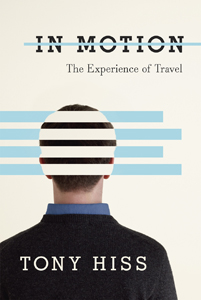
Written with the intellect and vision of a highly accomplished cartographer, Hiss’ In Motion: The Experience of Travel takes the reader on the journey of “Deep Travel, a wider awareness in which nothing is taken for granted and everything we encounter seems fresh and new and awaiting discovery. It is like waking up while we’re already awake,” Hiss writes. As for “Shallow Travel,” one can relate that to being perceptually disengaged while moving through a series of sequential events, which I can personally relate to as moving from deadline to deadline.

In Motion: The Experience of Travel is filled with insight, humor, and teachable moments on the study and practice of living, architecture, urban design, landscape design, and transportation planning — places where being visually alive and engaged is critical to making a rich contribution to the human experience within the built environment. Yes, this is also a book that is fun… it is, after all, about travel… and so the joy of the unexpected is very much in play.

Note about Oculus Book Talks: Each month, the AIANY Oculus Committee hosts a Book Talk at the Center for Architecture. Each talk highlights a recent publication on architecture, design, or the built environment — presented by the author. The Book Talks are a forum for dialogue and discussion, and copies of the publications are available for purchase and signing. This article is a preview for Tony Hiss’s upcoming talk on 03.14.11. Click here to RSVP.

Relative Resilience and the Coefficient of Friction

(L-R): Paul Bello, PE, 2012 Chair, ACEC New York; Deputy Mayor Stephen Goldsmith; Margaret O’Donoghue Castillo, AIA, LEED AP, 2011 AIANY President.

Rick Bell

Deputy Mayor Stephen Goldsmith addressed the membership breakfast of the American Council of Engineering Companies (ACEC) of New York on 03.03.11 at the Union League Club. After a glowing introduction by ACEC New York 2012 Chair Paul A. Bello, PE, of AKF Engineers, the Deputy Mayor for Operations spelled out NYC’s economic condition, and what Mayor Bloomberg, his deputies, and commissioners are doing about it. “It is true that because of the relative resilience of the city’s economy, revenues are higher than the Office and Management & Budget had expected,” was his opening line, followed quickly with: “But the expense side is something else.”

Much of the speech reviewed the reasons that “the cost of government is going up at a higher rate than revenues” with much attention focused on the pensions of former municipal workers and the need for lay-offs beyond those leaving city employ by attrition.

Of keen interest to the many engineers and two architects (including 2011 AIANY President Margaret O’Donoghue Castillo, AIA, LEED AP) in the room were the issues of procurement reform and review of regulatory processes. The former was noted in regard to the time it takes to issue, analyze, and award contracts through Request for Proposals. With Marla Simpson, director of the Mayor’s Office of Contract Services, at the head table, the Deputy Mayor joked about the administration’s remaining time in office perhaps being shorter than some consultant hiring decisions, adding that “how we do procurements is on the table.”

One of the recent hires was a consulting firm to analyze the operations of the NYC Department of Buildings as part of the Mayor’s “Simplicity” program “to reduce the friction of working with government.” Goldsmith noted, “There is a culture clash at the Buildings Department between two missions: policing safety and building buildings,” and that “mediating between those is the major issue of process change.”

The extent of capital expenditure reductions in the city’s proposed budget was also discussed, with particular mention of the difference between an across-the-boards cut of 10% or 20% on all projects versus the elimination of a set number of projects totaling that amount of the capital budget. The Deputy Mayor said that “there is a great variation between agencies on costs.” More radical was his mention that the city incurs costs by outsourcing all risk. He noted that it might be possible to change municipal contracts and the bonding process to cut costs by allowing for more risk.

Good news for the engineers present was the Deputy Mayor’s mention of the city’s green infrastructure program, creating “new opportunities in hydroelectric and sludge.” He noted “if we can take some of the gray infrastructure and make it green infrastructure and have more permeable surfaces and save some money while we do it, everyone will be happy.”

He invited those present to get involved in the issues of regulatory reform, including the problems of sequential and conflicting reviews, and concluded by saying, “In the end, we also have to get health costs under control, but we have to first figure out how to make city government more simple, more efficient, and less full of friction.”

In this issue:
· Prague 4- Pankrác Master Plan Underway with City Green Court
· New High Line Neighbor Grows Roof Gardens
· Affordable Housing Continues to Rise in Spring Valley
· Turkish Delight — Godiva Opens in Istanbul


Prague 4- Pankrác Master Plan Underway with City Green Court

City Green Court.

Renderings by Vize.com, courtesy of Richard Meier & Partners Architects

Construction is in progress on City Green Court, designed by Richard Meier & Partners Architects (RM&P). This is the third in a cluster of buildings designed by the firm in Prague, Czech Republic. The buildings are part of the Prague 4-Pankrác Master Plan, also designed by RM&P, which began almost a decade ago with the intent to transform a once neglected area into a revitalized business, commercial, and residential district filled with green public spaces and amenities. The eight-story building features a curtain wall composed of vertical solid panels with fins angled according to the sun’s orientation on the south and west sides, as well as balconies, clear vision glass, and shadow boxes. A grand canopy marks the formal entrance that leads into a single-height lobby that then opens into a multi-story atrium topped with a green roof. The building is organized around the central sky-lit space surrounded by office floors. The atrium contains a black olive tree, an ivy covered wall, and bridges that span the space, in addition to a freestanding stair that connects the first four floors. The project is expected to receive LEED Platinum certification.


New High Line Neighbor Grows Roof Gardens

500 West 23rd Street.

GKV Architects

500 West 23rd Street, a new 12-story, luxury rental, designed by Gerner Kronick + Valcarcel (GKV) Architects recently celebrated its topping off. The building, which is adjacent to the High Line in West Chelsea, contains 111 units from studios to three-bedrooms, some featuring private terraces. The building’s façade is composed of translucent glass set within an ornamental cast-in-place concrete frame. The building includes three common roof gardens with a lawn, outdoor furniture, and cabanas to create a visual link with the High Line. Developed by Equity Residential, the project is scheduled to be completed by November 2011.


Affordable Housing Continues to Rise in Spring Valley

Main Street Urban Renewal Plan.

Magnusson Architecture and Planning

The recent ground breaking on a new, mixed-use, multi-family housing development, designed by Magnusson Architecture and Planning (MAP), marked the start of the second phase of the downtown revitalization plan for Spring Valley, NY. Part of a comprehensive Main Street Urban Renewal Plan, the $16 million Spring Valley Family Apartments will provide 55 units of affordable housing for families earning 60% of the Rockland County AMI and will contain one-, two- and three-bedroom rental units, 7,000 square feet of street-front commercial space, a landscaped terrace, a community room, and parking. The project is located across the street from the Spring Valley Senior Housing project with 53 units of housing in addition to 11,000 square feet of commercial retail space. Future plans call for the construction of eight single-family affordable townhomes behind the senior housing. MAP is the project architect for all three phases being developed by the partnership of Community Preservation Resources (CPC), Rockland Housing Action Coalition, and the Village of Spring Valley.


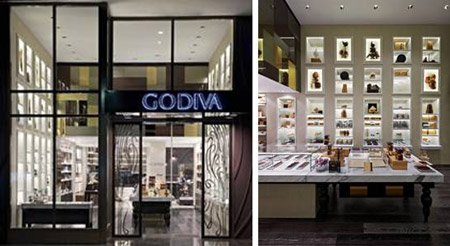
Turkish Delight — Godiva Opens in Istanbul

Godiva Istanbul.

Photo by Ali Bekman

Long Island City-based d-ash design has created the template for future Godiva Chocolatier retail locations with the recently opened, two-level, 3,000-square-foot flagship store in Istanbul’s Nisanti district. In collaboration with Linda Lombardi, Godiva’s vice president, global store design, and visual merchandising, the new design is inspired by Belgian Art Nouveau, a reference to the company’s birthplace. The “retail experience” includes a two-story vertical vitrine in place of the traditional chocolate display case, a 16-foot-long carrera marble-topped table where customers can create custom boxes, and a café that serves cocoa. Godiva has completed four other high-end locations — another in Turkey, two in Shanghai, and one in Hong Kong, with Atlanta opening this spring. A New York store will follow in the summer.