Not Your Typical Parking Garage: 1111 Lincoln Road

Event: AIANY New Practices: Development and Design
Location: Center for Architecture, 03.21.11
Speaker: Robert Wennet — Developer, 1111 Lincoln Road
Introduction: Farnaz Mansuri, Assoc. AIA — Lead Designer, De-Spec, & Member, AIANY New Practices Committee
Organizer: AIANY New Practices Committee

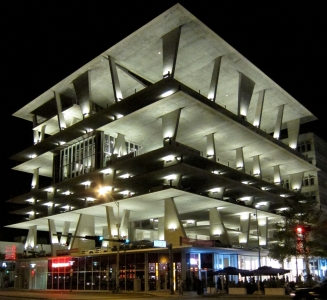
1111 Lincoln Road, by Herzog & de Meuron.

Cynthia Kracauer, AIA

Developer Robert Wennet is “passionate about learning to become a builder of a certain excellence,” stated Farnaz Mansuri, Assoc. AIA, lead designer at De-Spec, who assisted him in selecting the architect for 1111 Lincoln Road. For this new parking garage in Miami Beach, Wennet ultimately chose Herzog & de Meuron, and their design is far from a typical parking garage.

Wennet purchased the site, which was developed in the 1920s as a retail and entertainment district, to build a structure that would help to re-knit the urban fabric and literally tie in with an existing Brutalist building. Still, maximizing FAR was a priority, so he chose to center the program on parking.

The design creates a new model for the parking garage. Sprinklers and other systems are buried in the concrete slabs, which taper at the edges. Angled, irregular concrete columns support the perimeter of the structure, and a floating staircase turns egressing into an experience. Flat floor-plates, wide parking spaces and drive aisles, indirect lighting, and well-considered signage all contribute to a “pleasant parking experience.”

“1111 Lincoln Road is more civic in nature than a car park,” explained Wennet. “It is a public space.” Aside from parking, the structure accommodates high-end retail, and Wennet’s personal residence is carved beneath the roof. The developer created a public/private partnership with the City of Miami to install native landscaping, seating, and sculptures for the street-level pedestrian plaza in front.

Most of Wennet’s income is not actually generated through parking, but rather by renting the upper floor as event space. With sweeping views of Miami Beach, it has provided the backdrop for many weddings, fashion shows, media events, and films (not to mention 2010 AIA Convention parties).

Culture & Nature Dialogue in Seoul

Event: New Design in Seoul
Location: Center for Architecture, 03.22.11
Speakers: Jinsuk Park — Senior Associate Principal, Kohn Pedersen Fox Associates (KPF); Taeman Kim — Principal, Haeahn Architecture + H Associates; Du Nam Choi — Professor, Seoul National University; James von Klemperer, FAIA — Design Principal, KPF
Moderator: Clifford Pearson — Senior Editor, Architectural Record
Introduction: Rick Bell, FAIA — Executive Director, AIANY; Noushin Ehsan, AIA — Chair, AIANY Global Dialogues Committee
Organizer: AIANY Global Dialogues Committee
Sponsors: Kohn Pedersen Fox

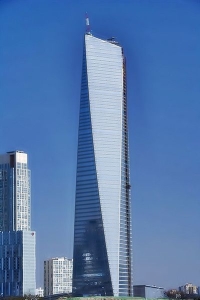
Northeast Asia Trade Tower by Kohn Pedersen Fox Associates.

Softjuice

With a strong economy and a proficiency in high-rise construction befitting peaking land values, the Republic of Korea has enjoyed a decades-long architectural boom despite recent decelerations. This AIANY Global Dialogues panel presented many of the distinctive projects and approaches drawing attention, investment, and talent to the southern half of the peninsula.

Seoul’s built environment, noted Moderator Clifford Pearson, like those of Rotterdam and other cities that have gone through cycles of wartime destruction and postwar rebuilding, is almost completely modern. It is largely the result of a post-Korean War building binge designed to serve the rapidly industrializing and urbanizing nation. Korea’s older culture continues to guide certain aspects of the nation’s development, imparting a connection to nature along with a practicality in accommodating social practices and norms. (There is a high prevalence of three-bedroom apartments, for example, in contemporary Korean buildings; this scale preference comes naturally in a society where several generations of a family often live together.)

Jinsuk Park, senior associate principal at Kohn Pedersen Fox Associates (KPF), provided historical background on the tendency of Korean cities to define themselves in relation to nearby mountains and water. The massive urban influx has developed Seoul into a megacity of 10 million comprising what Park’s colleague James von Klemperer, FAIA, identifies as interconnecting “separate subcities, not exactly villages but basins of built area and dense population, cradled between mountains.” Much early postwar construction — housing towers, megablocks, wide highways, ambitious landfill projects — emphasized regularity, replicability, economy, and speed over architectural distinction. More recent work, however, has blended global greening tendencies with local ideas, an approach that Taeman Kim, principal of Haeahn Architecture + H Associates, described as “Third Nature,” in which a new structure mimics natural features. Tradition and innovation engage in productive dialogue in projects like the Seongbuk district’s Gate Hills (a Haeahn design completed in 2008), 12 terraced, L-shaped private houses whose sedum-covered roofs create a pattern that frames and optimizes natural views, internally and externally, without compromising privacy.

Tomorrow’s Korea should have no shortage of arresting icons. The Northeastern Asian Tower, the nation’s tallest, is one of 10 planned “supertalls” marking separate communities on the skyline, von Klemperer commented, somewhat in the manner of the hill towns of Tuscany or 18th-century London’s church steeples. The Lotte Tower, a double-pointed “celery stalk” rising as a discrete “vertical city” 123 stories above a somewhat undefined area of repetitive slabs; its multiple green atriums and recurrent scalloped forms will be a welcome alternative. The Hyundai Global Business Tower, sited in a forest, cantilevers above the trees and uses a triangular geometry designed along the principles of pungsu (Korea’s version of feng shui).

New Songdo City near Incheon Airport has attracted wide interest as a large-scale green-urbanist venture, incorporating harmonious aesthetic features (e.g., artificial skylines resembling nearby mountains) as well as measures that strengthen its environmental performance, importing American LEED standards and advanced technologies such as pneumatic trash collection and graywater recycling. Like New York, New Songdo City is organized around a Central Park, focusing density and fostering higher levels of pedestrian activity than is seen in most of Korea’s sprawl-era development. KPF and the developers of this unique Korean/American joint venture have taken risks on a vast scale, planning from scratch a city for 300,000 residents, but it’s unlikely to be another Brasilia; its biophilic and cultural roots run deep.

Rybczynski Proposes Ideas About Cities

Event: Oculus Book Talk: Witold Rybczynski
Location: Center for Architecture, 04.11.11
Speaker: Witold Rybczynski, AIA — Author, Makeshift Metropolis: Ideas About Cities (Scribner, 2010)
Organizer: AIANY Oculus Committee

Courtesy AIANY

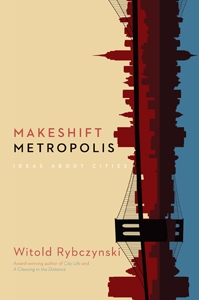
Makeshift — “a temporary or expedient substitute for something else.” Metropolis — “a large city or urban area.” Together these two words form the alchemical ingredients of a pragmatic and poetic work about urban design and the future of our cities, by author, critic, and professor Witold Rybczynski, AIA.

There are no villains or heroes in this story. This is a reflective examination of a century of ideas in urban planning that evolved from movements such as City Beautiful, the Garden City and the ideas of Le Corbusier, Frank Lloyd Wright, and Jane Jacobs. As the history unfolds it does so alongside the reshaping of our cities. This is a book that encourages the reader to think about the distinction between good ideas and implementation; as well as history, ideologies, and forward-thinking possibilities.

Rybczynski opens the book with Michael Van Valkenburgh’s Brooklyn Bridge Park and closes with Moshe Safdie’s new city of Modi’in, Israel — creative voices that clearly speak to the 2lst century. As for the pages between, all I can say is this: A planner walks into a bar… Charles Mulford Robinson, Le Corbusier, Frank Lloyd Wright, Jane Jacobs, Lewis Mumford, and Patrick Geddes are sitting there together, reading, and not saying much to each other until Patrick Geddes (who is on the final page of the book) breaks the silence, quoting the author: “History does not always have the answers — new problems do sometimes require new solutions — but it behooves us to keep one eye on the past as we venture into the future. This is not about nostalgia or summoning an imagined past, but freedom from history is no freedom at all. The next city will include much that is new, but to succeed it cannot ignore what came before. Linking the past with the present, and seeing the old anew, has always been part of our improvised urban condition.” With that the personages of history order a round and raise their glasses to the future. As for the how this has impacted the planner who walked into the bar and observed this moment in time — that part of history is yet to be written.

Note about Oculus Book Talks: Each month, the AIANY Oculus Committee hosts a Book Talk at the Center for Architecture. Each talk highlights a recent publication on architecture, design, or the built environment — presented by the author. The Book Talks are a forum for dialogue and discussion, and copies of the publications are available for purchase and signing. This article is a preview for Witold Rybczynski’s upcoming talk on 04.11.11. Click here to RSVP.

In this issue:
· Van Alen Books Fills Gap Left by Urban Center Books
· Installation Worms Its Way Down the Bowery
· Staten Island Museum Nestles in to Snug Harbor
· Luxury Hotel Reaches New Heights
· It Takes a Village, Condominium, and Hotel in Jesolo Lido


Van Alen Books Fills Gap Left by Urban Center Books

Book emporium at the Van Alen Institute.

LOT-EK

The Van Alen Institute will be opening a new architecture and design book emporium and gathering space later this month. The store will make available the remaining stock from the shuttered Urban Center Books, and will collaborate with publishers to offer a selection of new and noteworthy titles. Designed by LOT-EK, the storefront space at the institute’s headquarters features a 14-foot-tall staircase crafted from a stack of 70 recycled doors, which step up to create an amphitheater overlooking the street through glazed storefront windows. Sourced from Build It Green! NYC, a nonprofit supplier of salvaged building materials, the solid wood doors form a triangular platform evoking the steps of Times Square’s TKTS Booth, a project originated through the institute’s 1999 design competition. Beyond its role as a bookstore, multidisciplinary performances, debates, discussions, and storytelling sessions will be programmed. Van Alen Books is made possible through seed funding from Furthermore, a program of the J. M. Kaplan Fund, as well as the guidance of Joan K. Davidson and Margot Wellington.


Installation Worms Its Way Down the Bowery

The Worms planned for the Storefront for Art and Architecture’s StreetFest International.

Family and PlayLab

A team of emerging NYC-based designers, Family and PlayLab, has been selected as the winners of Storefront for Art and Architecture’s StreetFest International competition. The competition called for designs of street tents that not only serve as shelters, but also as active elements. “The Worms” are modular accordion forms, skinned in bright, lightweight, waterproof rip-stop nylon. Each modular unit is 10 feet high and 20 feet long, and can be combined in a number of configurations. Rolled galvanized steel ribs supported by steel forks resting on swivel casters create bays that can expand, turn, and contract to host a variety of programs. They will be on view near the New Museum on 05.07.11 as part of the Festival of Ideas for the New City. In addition, “The Worms” will be used at the NYC Department of Transportation’s summer events and other temporary street fairs this summer.


Staten Island Museum Nestles in to Snug Harbor

Staten Island Museum.

Gluckman Mayner Architects

The Staten Island Museum recently broke ground for its new home in Building A, a landmarked, long-vacant building on the Snug Harbor Cultural Center Campus. The reconstruction, designed by Gluckman Mayner Architects, will provide 18,000 square feet of usable space, including an auditorium/performance venue and a multipurpose room for community exhibitions. Upon completion, a full-scale Mastodon replica will greet visitors in the first floor lobby, which will also contain Hudson River School paintings placed in counterpoint with newly commissioned contemporary representations of the Staten Island landscape. The second floor will contain a mix of ancient art on loan. The ground level will be home to “The Green Museum: Keeping Our Cool” exhibition, where visitors can learn about the history of Snug Harbor’s architecture and the innovative engineering of the 19th century, as compared with today’s green technologies. The new facility, which is expected to achieve LEED Gold, will utilize a closed loop geothermal system. Staten Island Museum, which is currently located in St. George, is owned by the City of New York and benefits from public funds provided through the NYC Department of Cultural Affairs.


Luxury Hotel Reaches New Heights

The Ritz-Carlton Hong Kong.

Photo by Grischa Ruschendorf

The world’s highest hotel, The Ritz-Carlton Hong Kong, located on the uppermost floors of the International Commerce Center designed by Kohn Pedersen Fox Associates, recently opened. The hotel occupies floors 102 to 118 of the “vertical city” and contains 312 guest rooms and luxury amenities. The hotel also has the world’s highest bar, glass-enclosed on the rooftop with an outdoor terrace. The tower contains offices, residences, retail, restaurants, cafés, and a 360-degree observation deck situated above a transportation network that spans the Pearl River Delta. Hong Kong-based Wong & Ouyang served as the associate architect, and Singapore’s LTW Designworks was the interior designer for the hotel.


It Takes a Village, Condominium, and Hotel in Jesolo Lido

Jesolo Lido Condominiums.

Renderings by dbox

Jesolo Lido Condominiums, Phase 2 of an ongoing project along Italy’s Adriatic coast designed by Richard Meier & Partners Architects, is scheduled to open this summer. The 10-story building features open staircases and shaded terraces on all elevations with ocean views. The project contains 69 units, featuring six ground-floor apartments with private gardens and a spa, and are five duplex penthouses, each with its own outdoor pool. Phase 1, Jesolo Lido Village, completed in 2007, is a long rectangular residential building with 23 units and retail space on the ground floor. Phase 3, in the development stage, is a 30,000-square-foot, six-story hotel with 122 rooms above a two-story lobby. All three projects — village, condominiums, and hotel — are tied together along a spine running from north to south, which also acts as a viewing corridor and public access walkway to the beachfront.

The Center for Architecture Foundation‘s Learning by Design: New York (LBD:NY) program has been selected as one of four National Nominees for the inaugural International Union of Architects (UIA) Architecture & Children Golden Cubes Awards in the “Institution” category…

The winners of the 2011 Architectural League Prize for Young Architects and Designers include NY-based Ajmal Aqtash, Richard Sarrach, and Tamaki Uchikawa of form-ula, and Unchung Na, Assoc. AIA, and Sorae Yoo of NAMELESS

Jesse Reiser, AIA, and Nanako Umemoto of Reiser + Umemoto, RUR Architecture will be awarded The Cooper Union Irwing S. Chanin School of Architecture’s John Q. Hejduk Award for outstanding contributions to the theory, teaching, and practice of architecture…

The finalists competing for the 2011 European Union Prize for Contemporary Architecture — the Mies van der Rohe Award include the Acropolis Museum by Bernard Tschumi Architects

The National Council of Architectural Registration Boards (NCARB) has selected Michael Armstrong, currently a senior vice president at the International Code Council, as its next chief executive officer, effective 06.2011…

Deborah Marton has announced plans to step down from the position of executive director of the Design Trust for Public Space effective 04.08.11…

2011 OCULUS Editorial Calendar
If you are an architect by training or see yourself as an astute observer of New York’s architectural and planning scene, note that OCULUS editors want to hear from you! Projects/topics may be anywhere, but architects must be New York-based. Please submit story ideas by the deadlines indicated below to Kristen Richards: kristen@ArchNewsNow.com.

2011 Themes:
Spring (President’s Theme): Design for a Change: Buildings, People, Energy
[Closed]

Summer: AIANY Design Awards 2011
[Closed]

Fall: Interior Activity
— Sustainable interior architecture/design.
— Interiors as laboratories for small firms.
— Changes in Practice: Diversity out of necessity; multi-disciplinary cross-overs; architectural firms establishing quasi- or totally independent design studios for products, graphics, etc.
— Pro-bono policies: we’d like to hear from firms participating in established programs such as The 1%, Architecture for Humanity, etc. — and from firms who have an established in-house pro-bono program and/or policy.
Submit story ideas by 04.22.11

Winter: Up, Down, and Sideways: Density and Transportation
Density enabled by transportation: mass transit, cycling; Moynihan Station; Regional connections; Housing Authority: former purposeful disconnect, now reintegrating back into neighborhoods; How a century of New York skyscrapers has/is/will affect the architecture, planning, and culture of the city and the world.
Submit story ideas by 08.19.11

For further information, contact OCULUS Editor Kristen Richards: kristen@ArchNewsNow.com.

04.11.11 Call for Presentations: TRI State Design Conference

04.15.11 Call for Entries: AIANY Interiors Committee Speed Presentations: Not-for-Profit Projects

04.20.11 Call for Nominations: MASterworks Awards

04.25.11 Call for Submissions: 2011 Photo Urbanism Fellowship

04.25.11 Request for Proposals: Water Street Median — Feasibility Study

05.01.11 Call for Entries: The Generative Space Award

05.01.11 Call for Entries: The Gowanus Lowline — deadline extended

05.21.11 Call for Entries: Life at the Speed of Rail

06.01.11 Call for Entries: ACADIA 2011 Design + Fabrication Competition: Sponsored by FLATCUT_

06.15.11 Call for Papers: 49th International Making Cities Livable Conference on Planning Healthy Communities for All

03.25.11: As part of the Jugaad Urbanism Film Series, “Bombay Summer” was screened at the Center for Architecture.

“Bombay Summer” director Joseph Mathew.

Caley Monahon-Ward

(L-R): Rosamond Fletcher, Director of Exhibitions, Center for Architecture; Rick Bell, FAIA, Executive Director, Center for Architecture; Yumi Ito, Assistant Manager, Business Solutions Group, Hitachi; and Jen Apple, Development Manager, CFA.

Emily Nemens, Center for Architecture

03.31.11: As part of the Jugaad Urbanism program, speakers of “Contemporary Design Typologies in India: Housing, Airports and Mixed Use Developments” presented projects from the perspective of foreign firms and their interaction with local clients, contractors, and regulatory authorities.

Purnima Kapur, Director of the Brooklyn Office, NYC Department of City Planning, introduced the program.

Emily Nemens, Center for Architecture

(L-R): Rick Bell, FAIA, Mary Burke, AIA, and Laura Marlow, Program Director, Innovation & Business Development, Reed Construction Data.

Emily Nemens, Center for Architecture

03.30.11: Speakers at the “Energy Code and Lighting” presentation at the Center for Architecture discussed what conformance means in a practical sense.

(L-R): Jack Bailey, Partner, One Lux Studio; Patricia Di Maggio, LC, LEED AP, MIES Specifications Engineer for Osram Sylvania; and Deborah F. Taylor, AIA, LEED AP.

Caley Monahon-Ward

03.30.11: To mark the paperback release of Why Architecture Matters (Yale University Press), New Yorker Architecture Critic and Author Paul Goldberger, Hon. AIA, conversed with Oculus and ArchNewsNow.com Editor Kristen Richards, Hon. AIA, Hon. ASLA, at the Lower East Side Tenement Museum.

Debra Pickrel

03.25.11: A ceremony was held to commemorate the 100th Anniversary of the Triangle Shirtwaist Factory Fire.

Black and purple drapes were placed on the eighth floor windows where the fire originated in the building, located near Washington Square.

Frank Ritter, Ritterphoto.com

A ceremony was held at the Eldridge Street Synagogue, where 146 men and women wore black veils in honor of those who died in the fire.

Frank Ritter, Ritterphoto.com

Rebuilding Haiti? More Like Building it Anew

Event: Building a Future with Haiti: A Grassroots Forum for Sustainable Development
Location: Center for Architecture, 03.18.11
Speakers: Amy Stroud, ASLA — Founder and President, Building Foundations with Haiti; Wendy Jules — volunteer, Community2Community; Winston Ely, LEED-AP — WE Design; Avi Guter, LEED-AP — Desimone Consulting Engineers; David Obuchowski, RA, LEED AP — DO Architecture; Charles Newman — Project Manager/Architect, Community2Community; Myles Throop — Project Manager/Civil Engineer, Community2Community; Erik Madsen — Structural Engineer (Association des Ingenieurs Haitiens et Americains); Marie-Yolaine Eusebe — Founder & Firestarter, Community2Community
Moderator: Rick Bell, FAIA — AIANY Executive Director
Organizers: Building Foundations; Community2Community; Planetary1
Sponsors: AIANY; NYASLA; Haiti Outreach Ministries; National Organization of Minority Architects; Clean The World; Mayer Brown, LLP; Ronnette Riley, FAIA, LEED-AP; Kohn Pedersen Fox Associates; Scopello’s Restaurant & Bar, Brooklyn; Brown Sugar’s Delights, Bronx; Weaver Associates Printing, Cranford, NJ
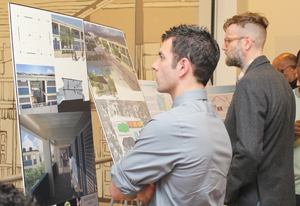
Community2Community and Build.Found displayed their projects to rebuild Haiti at the Center for Architecture.

Kvon Foto

The challenges of relief work in Haiti after the January 2010 earthquake go beyond the formidable difficulties associated with “ordinary” seismic cataclysms. The nation’s problems range from a cholera epidemic to predatory dockworker practices (thanks to a few powerful families’ control of the ports, getting materials off the docks can cost three times their shipping expense) to a dysfunctional government, according to many informed observers. Along with rebuilding damaged facilities, Haitians and outside volunteers need to institute credible building codes and construct basic infrastructure for the first time. Haiti’s misfortunes are many, but its strengths include an exceptionally dedicated populace; this presentation of projects by two nonprofit groups, Building Foundations (a.k.a. Build.Found) and Community2Community (C2C), demonstrated how much energy, imagination, and expertise (both volunteer and local) Haiti inspires.

Build.Found is applying volunteer professional services to a new community complex in the Port-au-Prince suburb of Repatriote, home of refugees from the impoverished Cité Soleil district and deportees from the Dominican Republic. The Repatriote project grew out of an ASLA-NY design charrette and focuses on a Haiti Outreach Ministries church, built on an old landfill site and mostly torn down after a near-total collapse in the quake. Rebuilding it, enlarging it, and improving it structurally (adapting American codes), the volunteer architects have created a master plan that adds classrooms, a clinic, community-accessible soccer fields, and other facilities, using a grid of 20-foot-by-20-foot modules for sturdy, adaptable CMU-based construction. The complex employs sustainable design principles, including rainwater collection and natural ventilation relying on the area’s west-to-east prevailing winds. As Winston Ely, LEED-AP, from WE Design, explained, the team selected a shear-wall structure over a moment-frame design, since the former is less susceptible to material quality problems in an area where expertise with concrete is limited and crushed-limestone aggregate can be unreliable.

The Repatriote project expands on earlier achievements by Build.Found and its clients constructing a hospital in Cité Soleil. “People needed to come and see what has been done, and what is being done, and be empowered by that,” adds Build.Found President Amy Stroud, ASLA. “A lot of the really unfortunate parts of the disaster, and what’s come from the disaster, is that people are consistently seeing on the news things that haven’t been done, and this was a really good opportunity for them to see things that have been done, and that will be done very soon.” Build.Found’s next project, a vocational school and its supporting infrastructure, expands the opportunities for New York-based architects, landscape architects, and engineers to join forces with organizations whose roots in Haiti run deep.

In the mountainous village of Piton Vallue in Petit-Goâve, some 40 miles southwest of Port-au-Prince, C2C is working to provide potable water, repair and extend a road, and build a schoolhouse for children who currently have makeshift facilities at best. The C2C team is experimenting with assorted innovations, including a retaining wall of reclaimed auto tires and rammed earth, as well as more familiar strategies such as compost toilets. The pivotal task for Piton Vallue is to create a local water system with a solar-powered pump feeding an expandable series of water kiosks, which could become a local economic engine as well as a relief from long walks hauling water by hand. Residents have been enthusiastic enough to express interest in paying small water fees to support the kiosk network, one of many ways in which these projects include community residents as active participants.

As in so many aspects of post-earthquake relief in Haiti, the water is “not a fix to a catastrophic earthquake,” said C2C Engineer Myles Throop; “this is actually a more long-term development project — not only construction but also economic development and empowerment.” Water is the first step toward thorough development of schools, housing, and other community features that most Westerners take for granted. These signs of hope require synergies between newcomers’ and residents’ expertise, earning the confidence of wary Haitians. “How are you going to include them in that process? Because they don’t really want a part of it if they’re not included, because they don’t trust it, and they don’t trust it because of their history. So people have to understand the history behind it,” says Stroud. “We work hand in hand with the Haitian people on ground, with the Haitian engineers… working next to each other to figure out the best practices for that project.” Collaborating with Haitian contractors and vendors and drawing on their local knowledge, these projects are helping to rewrite Haitian-American relations from a story of isolation and exploitation to one of inclusive partnership.

Architects Celebrate Improvisation in Contemporary Indian Construction

Event: Invention by Necessity: Construction Practice in India
Location: Center for Architecture, 03.10.11
Speakers: Aaron Schwarz, FAIA — Senior Principal & Executive Director, Perkins Eastman; Brinda Somaya — Architect & Founder, Somaya and Kalappa Consultants; Billie Tsien, AIA, & Tod Williams, FAIA — Partners, Tod Williams Billie Tsien Architects; Sanjeev Shankar — Architect, Artist, & Craftsman
Moderator: Kadambari Baxi — Partner, Martin/Baxi Architects; Principal, Imagemachine; Associate Professor of Professional Practice, Department of Architecture at Barnard College, Columbia University
Organizers: AIANY; Center for Architecture Foundation; India China Institute at The New School; Indo-American Arts Council (IAAC); Society of Indo-American Engineers and Architects (SIAEA)
Sponsors: Grants: Graham Foundation for Advanced Studies in the Fine Arts; National Endowment for the Arts; Underwriter: Duggal Visual Solutions; Lead Sponsors: Hitachi; Robert A.M. Stern Architects; Sponsors: Grapevine Merchants; Society of Indo-American Engineers and Architects; Supporters: Bittersweet NYC; CetraRuddy; Kingfisher Lager; Friends: Arup; Benjamin Moore; IBEX Construction; Kohn Pedersen Fox Associates; Perkins Eastman; Skidmore, Owings & Merrill; Special Thanks: Umberto Dindo, AIA; Lutz Konermann; Catherine Scharf

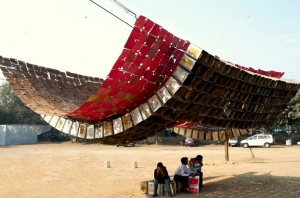
Jugaad Canopy by Sanjeev Shakar.

Sundeep Bali

In India, the contemporary construction industry, as well as the cultural and political landscape, tests architects’ abilities to employ “jugaad” — a Hindi noun alternately defined as creative improvisation and a frugal use of readily available resources. For U.S. firms working in India, architects must devise innovative approaches to craft, form, and construction to overcome many obstacles encountered during planning phases.

For example, the integration of handcrafted and high-tech construction caused problems on the TCS project, designed by Tod Williams Billie Tsien Architects. Stone shade screens, which were originally hand-carved, had to be reconfigured to accommodate CNC milling technology. In addition, mock-ups had to be employed so that workers would understand the level of construction quality required.

Perkins Eastman Senior Principal Aaron Schwarz, FAIA, explained how the Indian School of Business faced setbacks during planning by an entirely inaccurate survey furnished to the architects. However, the firm was able to overcome inaccuracies due to the flexibility built into the construction.

Brinda Somaya’s work embraces the adaptive re-use and unconventional construction practices that are more typical in India, so she found fewer conflicts with local practices. In one case, Somaya and her colleagues at Somaya and Kalappa Consultants redesigned the entire village of Bhadli following a devastating earthquake. The villagers provided the sweat equity required to re-build their houses and public buildings. The result was a community-wide re-investment in their home.

Perhaps the most direct application of jugaad to construction practice occurred in the aptly named Jugaad Canopy. This project, by Sanjeev Shankar, employed an entire community in the construction of a shared shade canopy from hundreds of repurposed oilcans.

The panelists agreed that Western designers have much to learn from Indian jugaad. The innovative use of local and re-used materials is an inspiration to those concerned with global resource and energy consumption. There is a positive attitude that embraces the creativity inherent in overcoming obstacles, and allows individuals to survive and work with dignity. As Somaya exclaimed, “The spirit of jugaad is present in every Indian, and we have the power of numbers — 1 billion.”

Design Competitions: Winning Isn't Everything

Event: Win, Lose, and Draw: How to Succeed at Design Competitions
Location: Center for Architecture, 03.17.11
Speakers: Olympia Kazi — Executive Director, Van Alen Institute; Illya Azaroff, AIA — Director of Design, +lab for experimentation; William Prince — Principal, PARK; Jeeyong An, AIA — Principal, Manifesto Architect
Moderator: Jessica Sheridan, Assoc. AIA, LEED AP — ENYA Committee Member
Organizer: AIANY Emerging New York Architects Committee (ENYA)

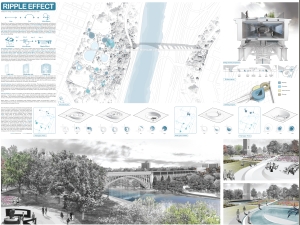
“Ripple Effect,” by PEG office of landscape + architecture, received the ENYA Prize for the HB:BX Building Cultural Infrastructure competition.

Courtesy AIANY ENYA Committee

“The best conversations are private,” occurring behind closed doors among members of a design awards jury, lamented Olympia Kazi, executive director of the Van Alen Institute. In association with the “High Bridge” exhibition currently on view at the Center, which features the AIANY Emerging New York Architects (ENYA) Committee’s HB:BX Building Cultural Infrastructure competition, experienced entrants and jurors revealed what goes on behind closed doors and offered valuable advice on succeeding in design competitions.

Illya Azaroff, AIA, director of design at +lab for experimentation, believes entrants should be honest with themselves about why they want to enter a competition. “Don’t do this for the jury,” he insisted. One common reason is to build a portfolio, while another is to generate ideas. Competitions provide “an opportunity to gauge public opinion and initiate a discourse on design and public space,” said Kazi, aside from the fact that they offer a release for those who miss the creative energy of architecture school. Before beginning to design, however, Azaroff advised potential entrants to “do your research” on jury members, as well as funds available.

What exactly do jurors look for? William Prince, principal of PARK and juror of the HB:BX competition, believes that “the rules are not always the rules,” but if entrants break them, he advised to “really break the rules and sell it hard.” He noted that over half of the entrants in the HB:BX competition presented the same parti, but entries that pushed the boundaries stood out to jurors. However, a strong concept is lost in the absence of a strong graphic presentation, and panelists agreed that visuals can make the difference between advancing through the first phase or not. As Azaroff explained, “the graphics should grab you from across the room.”

Jeeyong An, AIA, principal of Manifesto Architect, built his practice by entering competitions. Within the past two years, his firm has entered more than 50 competitions and received 20 awards. Though An has yet to win first place, his entries have impressed clients enough to lead to other work. “It helps us to build up our reputation and gain real projects,” he explained, proving that winning isn’t everything.