09.03.08

09.03.08

It’s been three years since Hurricane Katrina, and even though Hurricane Gustav did not do as much damage as initially predicted, now is the time to reflect on progress that is being made. For some inspiration, check out “Architecture School” on the Sundance Channel airing Wednesdays. See the Editor’s Soapbox to read my review.

– Jessica Sheridan, Assoc. AIA, LEED AP


CLICK ON BLOG CENTRAL: AIANY BLOG: The AIANY Chapter has launched a new blog. Blog Central features opinion pieces on architectural issues relevant to NY-based designers, firms, and projects, along with spotlights on debates and discussions at the Center for Architecture and AIANY, and is an informal discussion board. Be sure to check it out regularly and contribute to the dialogue.

Some of the recent debates include:
· 6 Month Rule. NCARB passed a rule that requires a six-month regulated reporting period for intern architects enrolled in the Intern Development Program. Read how this affects firms and schools as well as individuals.
· Buildings Commissioner Qualifications. City Council voted to pass Intro 755-A eliminating the requirement for the Buildings Commissioner to be a registered professional. Weigh in on the topic.
· AIANY Policy. Have you wondered how AIANY establishes its policy positions? Laura Manville, the AIANY Policy Coordinator explains all.

To become a regular contributor to Blog Central, please e-mail e-Oculus. Pen names are welcome.

Form Follows Fantasy at MoMA’s Dreamland

Exhibition: Dreamland: Architectural Experiments since the 1970s
Location: Museum of Modern Art, through 03.02.09

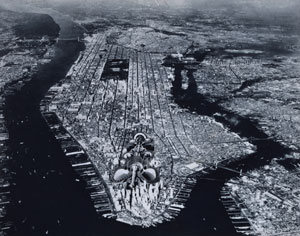
Urban Renewal in New York Project, New York, New York. Arial perspective, 1964. Cut-and-pasted gelatin silver photograph on gelatin silver photograph.

Hans Hollein, Hon. FAIA, courtesy Museum of Modern Art

New York City has always been a magnet for dreamers, and architects are no exception. In the 1960s and 1970s, a wave of young architects such as Raimund Abraham, Hans Hollein, Hon. FAIA, and Rem Koolhaas, took inspiration from the cityscape to form new utopian architectural visions. On the 30-year anniversary of Koolhaas’s book Delirious New York, the Museum of Modern Art’s show “Dreamland: Architectural Experiments since the 1970s” features more than 60 drawings, collages, paintings, and models dedicated to architectural experiments for New York and beyond, whether built or imagined.

Some works evoke the fantastical realms of science-fiction, such as Hollein’s collage “Urban Renewal in New York” (1964), which depicts part of Lower Manhattan transformed into a bug-like mechanical contraption — an ironic extension of Le Corbusier’s notion of the house as a machine for living in, explained curator Andres Lepik in an interview (in the absence of explanatory text in the exhibition, a frequent weakness in an otherwise engaging show). The somber “Church of Solitude” paintings (1974–77) by Gaetano Pesce depict a structure that reverses NYC’s usual inclination to build up by plunging into the earth, far from the noise and hubbub of the city, creating an underground sanctuary where visitors (animal-like and depraved) seclude themselves.

Whimsical imaginings from the then-young firm OMA include works from Delirious New York, such as Elia and Zoe Zenghelis’s painting “Hotel Sphinx” (1975–76), a Times Square hotel that straddles two blocks (a site condition lending to its sphinx shape). Koolhaas and Madelon Vriesendorp’s “The City of the Captive Globe” (1972) also celebrates Manhattan’s grid: each block houses another architectural or artistic idea, whose warmth helps to incubate the growth of the world at the center.

The City of the Captive Globe served as one source of inspiration for the show itself, said Lepik, with its assemblage of disparate concepts. A table at the center of the room serves as a platform for a dream city, dotted with models of eclectic projects from around the world. The curve of Diller + Scofidio’s Slow House rests near the angularity of Simon Unger’s T-House, both models encompassing idealist visions of what a country retreat can be. Surrounded with LED “leaves,” a high-tech model for a new Hotel Habitat in Barcelona (by Cloud 9, Acconci Studio, Ruy Ohtake, and Enric Ruiz-Geli) simulates an electronic tree house powered with solar energy. In some models, the utopian vision is obvious, in others, less so; again, more explanatory text would have made it an even stronger show.

Prairie Experiment Seeks to Impact City Life

Event: Public Ecologies at Midewin National Tallgrass Prairie
Location: Van Alen Institute, 08.06.08 & 08.14.08
Speakers: Dr. Clive G. Jones — Ecologist & Senior Scientist, Cary Institute for Ecosystem Studies; Michael Osman — Architectural Historian; Julia Czerniak — Co-founder, CLEAR & Associate Professor, Syracuse University; Edward Mitchell — Principal, Edward Mitchell Architects
Moderator: Ellen Grimes — Assistant Professor, University of Illinois at Chicago & Van Alen Institute New York Prize Fellow, Summer 2008
Organizer: Van Alen Institute

Photograph from Disarming the Prairie (Creating the North American Landscape), published by Johns Hopkins University Press, 1998, a survey of the Joliet Army Ammunition Plant, once the world’s largest TNT factory.

Photograph © Terry Evans

Just off Route 66 an ecological experiment is brewing under the auspices of Ellen Grimes, Van Alen Institute New York Prize Fellow, with the U.S. Forest Service (USFS) and the Center for Research in Urban Ecology at the University of Illinois Chicago (CRUE). The work focuses on restoring a 19,000-acre reserve in Illinois known as Midewin, the first official national tallgrass prairie. Described by Grimes as “an atypical design project,” restoring the brownfield to its original eco-state is a challenge since the site is located at the former Joliet Army Ammunition Plant and remains contaminated with toxic waste. Currently, Midewin consists of only 3% prairie and is largely comprised of abandoned farmland.

The rebirth of Midewin National Tallgrass Prairie will begin with a microcosmic, 2.5-mile strip of land that could take up to 25 years to complete, according to the USFS. The area will house a series of environmental experiments inviting public observation and interaction intended to reconnect people to nature. The experiments will include carbon sequestration analyses, investigations of nutrient and energy fluxes, and studies of the interactions among mammals, birds, and plant life. By redesigning human activities in the fields of forestry and agriculture, Grimes hopes that ecosystems may be used to more effectively impact design, the public realm, and even metropolitan life.

Rather than artificially simulating a prairie in a controlled environment, Midewin is a test bed to explore the relationships among economy, ecology, and design in a real environment. The USFS and CRUE seek to build regional and global audiences while educating local farmers in methods to restore and sustain the ecosystem.

James & Hayes Slade: NY Architects Discover Inner Mongolia

Entry perspective of Slade Architecture’s villa in Ordos, Inner Mongolia.

Slade Architecture

In 2002, architect James Slade, AIA, and wife Hayes Slade, an MBA with a background in engineering, launched a joint practice, Slade Architecture. Their work includes commercial, residential, and cultural projects, and now they’ve been selected by Herzog & de Meuron and artist Ai Weiwei as one of 100 international firms building 100 villas in the new town of Ordos, Inner Mongolia. E-Oculus contributor Ian Volner sat down with Slade Architecture to talk about Ordos, Ai Weiwei, and designing in the desert.

e-OCULUS: How did you first get involved with the Ordos project?

Hayes Slade: Herzog & de Meuron contacted us first about a year ago. We didn’t really understand the full scope of the project at the time, but the CC: list on the e-mail went on and on. “Dear all, we’ve put your name on a list of 100 young architects from around the world…”

James Slade, AIA: Then we started getting more information several months later, in December. Suddenly, we were told that the project was going forward and we were asked to come to Inner Mongolia either in January or in April. We went for the “Phase II” visit in spring. We met up with Ai Weiwei in Beijing at his restaurant, and found ourselves in the company of a lot of architects we already knew and others, especially from abroad, we didn’t. The next day, we all flew to Ordos, which is about a two-and-a-half hour flight from Beijing. Once we got to Inner Mongolia, we were constantly under police escort — a busload of architects and reporters.

e-O: What was the brief, exactly?

JS: All 100 houses in the development are 10,000 square feet with a lot of amenities: we had to provide for a pool, a wine cellar, study, and media room. The suggested footprint for each unit is set back into the lot and surrounded by paths, making the whole development a gallery for architecture. We were told that the construction of the house would have to be relatively low-cost concrete and brick. But other than that, there were so few limitations placed on the project that we had to grab on to the few restrictions there were. And, of course, there’s nothing there at the moment except desert, so we had to extrapolate on the master plan to find the context.

HS: There was no reason to jettison what little information we had about the site, and the lack of context became a kind of compelling context in and of itself. I mean, how often do you have a client giving you such vague instructions?

JS: So we took that gallery aspect as a given, as an objective of the master plan. We tried to make the house a sculptural object that would reward the viewer walking around it, but also allow for privacy inside. The private spaces have interior views, and the public spaces are put on display. We had three typologies in mind: Johnson’s glass house, an enclosed living space that’s an extension of the ground plane; a Chinese courtyard house, a traditional regional typology; and a freestanding, sculptural volume.

e-O: How did your design process differ from that of previous projects you’d worked on?

JS: We worked from the outside in on this one. It seemed like the sculptural possibilities of the house were very important, so we started by looking for a massing that we liked, since the building was going to be seen as a freestanding form on the site. Then we found an interior arrangement based on our foam core massing models, in coordination with Rhino.

HS: We also thought, working in China and with brick, that we had a unique opportunity because the labor there is so cheap. We realized we could do something unusual and inventive with the brick surfacing that we wouldn’t have been able to do in the States. The geometry of the bricks runs throughout the façade — the bricks rotate on their own axes as they wrap around the building, creating a ripple effect.

e-O: What’s it been like working with Ai Weiwei?

JS: I think one of Weiwei’s objectives with this project is to create a cross-cultural exchange. Part of the whole experience has been the social scene with the other architects, the mixing of practices.

HS: Weiwei put us up in a Holiday Inn in a town near Ordos. At the hotel, it was a little bit like waiting for an airplane that never arrived — there was a lot of lounging around, talking to other architects. It was a completely nondescript, ubiquitous tourist hotel in a nondescript tourist part of town, and the environment seemed to fit perfectly with Weiwei’s goal. The whole project is like a big social/art experiment, with us — the architects, as the subjects.

Students Bring “Real” Back to Reality Shows

Architecture School,” a six-part weekly documentary series on the Sundance Channel, premiered August 20. After the inundation of reality shows about design infiltrating television over the last couple of years, finally here is a show that brings out the best about those who study and practice architecture, and in a realistic way.

So far, two episodes have aired. A fourth- and fifth-year design studio at Tulane University, under the tutelage of Professor Byron Mouton, AIA, holds an in-studio competition to design a single-family house in a low-income neighborhood of New Orleans devastated by Hurricane Katrina. The first episode features the nine students and introduces the project, while the second episode takes viewers through the design process, a critique with the Neighborhood Housing Services of New Orleans (NHS) which is helping to fund the project, and a critique with noted architecture professors and critics around the country (including former-dean Reed Kroloff, Assoc. AIA, the harshest on the panel). Finally, the students vote on whose house will actually be built.

Watching this show brought back all of the mixed memories of late nights in the studio and architecture school critiques. Through desk crits that send some students in directions that are critiqued later, students trying to channel Modern architects like Adolf Loos and John Hejduk, and claims that most students will be pulling all-nighters to try to pull off the best designs they can, it comes down to the final crit that persuades the studio to select Adriana’s S-shaped, industrial-inspired design. It is easy to empathize with the students who are working so hard because they genuinely want to make a difference in the world and positively impact an ailing community. Subsequent episodes will follow the students as they build the house together, and I look forward to watching it happen.

In this issue:
· Work on Brooklyn Bridge Park Progresses
· Brooklyn Goes 80/20 on Housing
· Institute for the Study of the Ancient World Modernizes
· New School Goes Green by the Book
· Admiral’s Row In Jeopardy
· Long Island City Celebrates Industry
· Clinton Library Receives Conditions Report
· New Med School Breaks Ground in Scranton


Work on Brooklyn Bridge Park Progresses
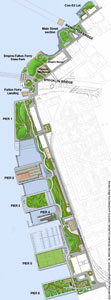
Brooklyn Bridge Park.

Courtesy brooklynbridgepark.org

The new park, designed by landscape architect Michael Van Valkenburgh Associates, will run 1.3 miles along the East River and will tie together the neighborhoods of DUMBO and Brooklyn Heights. The 85-acre park will be built on land now covered with asphalt, concrete, abandoned sheds, and rubble along the water’s edge. The NY office of Skanska is charged with turning the industrial remains into lawns, beaches, coves, restored habitats, playgrounds, sports facilities, and landscaped gardens. Structural steel and aluminum cladding from the old sheds, as well as concrete and asphalt, will be recycled. In addition, the waterfront will be reshaped with 180,000 cubic yards of material dredged by the Army Corps of Engineers from Fresh Kills channels in the harbor. Approximately 85% of the park will be complete by 2010, and the park is expected to be fully complete in 2012.


Brooklyn Goes 80/20 on Housing

80 DeKalb Avenue.

Costas Kondylis Partners

Forest City Ratner Companies (FCRC) has closed on financing for a 335,000-square-foot building designed by Costas Kondylis at 80 DeKalb Avenue in Downtown Brooklyn. The project is a 34-story tower that contains 73 affordable and 292 market rate rental units — making it the first 80/20 development in the borough to be financed with New York State Housing Finance Agency funds. The project consists of 123 studios, 188 one-bedroom, and 54 two-bedroom units, and aims for LEED certification. Green features include: the use of low- or no VOC-emitting materials; low-flow fixtures; recycling over 75% of construction waste; and using recycled materials with recycled content. As part of its ongoing commitment to strengthen minority- and women-owned businesses, FCRC has awarded 19% of the project’s contracts to such firms. In addition, FCRC projects that 30% of the construction workforce will be made up of minority workers and 10% of women workers. Major construction on the building began in July, which is expected to open during the summer of 2009.


Institute for the Study of the Ancient World Modernizes
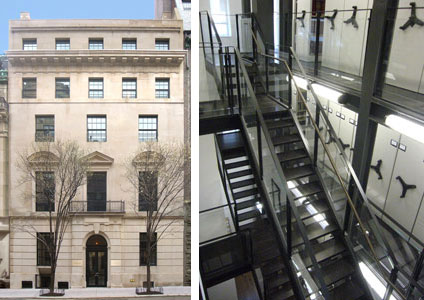
NYU Institute for the Study of the Ancient World.

Levien & Company

New York University’s Institute for the Study of the Ancient World, housed in an early 20th century mansion on the Upper East Side, has been completed. The 27,000-square-foot cultural and academic facility contains conference rooms, offices, and exhibition galleries. Major elements of the project included the restoration of the building’s grand staircase, installation of new elevators and interior and exterior staircases, and a four-story glass-and-metal library embedded in three stories of the grand building. Levien & Company managed the project team including Selldorf Architects and was funded by the Leon Levy Foundation.


New School Goes Green by the Book
P.S. 59.

Ehrenkrantz Eckstut & Kuhn Architects

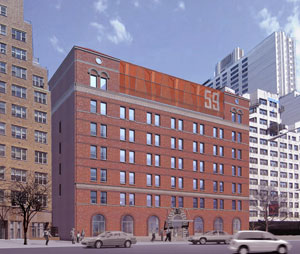
Through a public-private partnership between the Educational Construction Fund, an arm of the NYC Department of Education, and real estate developer The World-Wide Group, Manhattan’s first School Construction Authority (SCA)-certified green school located on 57th and 2nd Avenue opens this month. Designed by Ehrenkrantz Eckstut & Kuhn Architects, the school is the new temporary home for Public School 59 — also known as The Beekman Hill International School — for pre-kindergarten through fifth grade students. The project is the first school to comply with the Department of Education’s NYC Green Schools Rating system based on LEED certification requirements, which was adopted in 2008. With SCA standards calling for higher levels of fresh air, the project includes an ultra-efficient HVAC system, all of the windows were replaced with low-e-coated glass to help keep heat out and allow light in, and the building uses steam for heat, which emits no greenhouse gases. The new school includes a rooftop play area, a full-sized gymnasium, common learning areas, science laboratories, and classrooms.


Admiral’s Row In Jeopardy
Admiral’s Row rendering by Andrew Burdick.

Courtesy Municipal Art Society

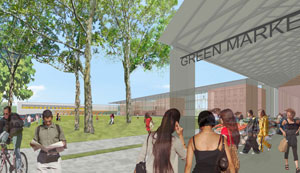
The Municipal Art Society (MAS) recently presented alternative plans to retain the 11 historic buildings on Admiral’s Row on the edge of the Brooklyn Navy Yard to the U.S. Army National Guard Bureau. Since the National Guard is in the process of selling the site to the City of New York, which intends to lease it to the Brooklyn Navy Yard Development Corporation (BNYDC), MAS instead proposes the development of a 65,000-square-foot grocery store, a large parking lot, and additional retail and industrial space on the site. The collection is composed of 10 houses for naval officers that were built between the mid-19th century and 1901, and a timber shed from the 1830s that is believed to be a rare survivor. Although the deteriorated buildings have been abandoned since the 1970s, MAS believes they are of architectural interest and most are structurally sound.

MAS held a public visioning session where participants developed several principles to guide the preparation of the alternatives, ranging from saving all of the buildings to losing only three or four of them; retaining green space; reducing substantially the number of surface parking spaces; and provide public access, serve the needs of the community, and help foster small businesses and new employment opportunities. Renderings produced by Andrew Burdick of the studio collaborative and Architecture for Humanity New York were created to illustrate the differences between the concept behind one of the MAS alternatives and the BNYDC’s proposal.


Long Island City Celebrates Industry
L haus.

Cetra/Ruddy

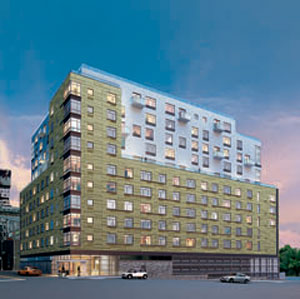
Cetra/Ruddy’s new residential condo project in Long Island City is starting to reveal its faç ade composed of a mix of green-hued cement fiber and corrugated metal panels, in deference to the neighborhood’s industrial character. Named the L haus because of its shape, the 11-story building will contain 122 one-, two-, and three-bedroom residences with 17,000 square feet of amenities. Outdoor spaces include a lawn with a water feature, and a roof terrace with both public areas and private cabanas with views of Manhattan. There will also be a club room, a relaxation space, catering pantry, fitness center, yoga space, and media room. L haus is expected to be completed in early 2009.


Clinton Library Receives Conditions Report
John F. Kennedy Presidential Library & Museum (left), and Franklin Delano Roosevelt Library.

Einhorn Yaffee Prescott Architecture & Engineering

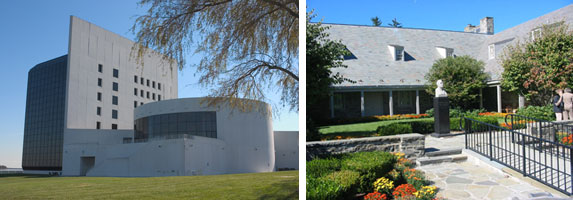
The National Archives and Records Administration recently selected Einhorn Yaffee Prescott Architecture & Engineering (EYP) to conduct a building conditions report at the William J. Clinton Presidential Library in Little Rock, designed by Polshek Partnership in 2005. Its archival and museum holdings are the largest within the Presidential Library system with approximately 76.8 million pages of paper documents, 1.85 million photographs, and over 84,600 artifacts. EYP has worked on all 12 presidential libraries in the country; work ranges from thorough building envelope studies and recommendations, to replacing roofs and systems, to renovation and addition of archival storage spaces.


New Med School Breaks Ground in Scranton
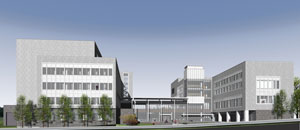
The Commonwealth Medical College.

HOK

The Commonwealth Medical College recently broke ground on its Medical Sciences Building in Scranton, PA. The NY office of HOK, in association with Highland Associates, shaped the physical planning of the educational program by pairing biomedical laboratories with other highly technical components, such as a gross anatomy lab, simulation rooms, and standardized patients’ rooms to achieve operational and mechanical efficiency. The west research wing and east educational wing will surround a shared courtyard to create a campus setting. The linkage between the two buildings will act as a gathering space with a porch, courtyard, and café. To the east, public ground-floor spaces include additional common areas, a bookstore, and lobby. Rainwater collection that will be used for the gardens and indigenous plantings, heat recovery, CO2 sensing, occupancy sensors, high-performance glazing, integrated daylight control through honeycombed transom glazing, and the use of local stone will contribute to the overall sustainability. The project is slated for completion by 2011.
The 2008 AIANYS Design Award Recipients include NYC-based firms in the following categories — Adaptive Reuse: New York Public Library, Mulberry Street Branch (Award of Excellence), Rogers Marvel Architects; Betances Community Center & Boxing Gym (Award of Merit), Stephen Yablon Architect; Bronx Lighthouse Charter School (Award of Merit), Gran Kriegel Associates

Commercial/Industrial, Small Projects: Fendi Flagship (Citation for Design), Peter Marino ArchitectHistoric Preservation: Rodin Studios (Award of Merit), Zaskorski & Notaro Architects International: Hong Kong International Airport, Terminal 2 and Skyplaza (Citation for Design), Skidmore, Owings & Merrill, Architect, Aedas Limited, Executive Architect…

Commercial/Industrial, Large Projects: The New York Times Building (Award of Excellence), Renzo Piano Building Workshop in association with FXFOWLE Architects and Gensler, Interior Architect; Hamptons Country Club (Award of Merit), Hart Howerton; The Plaza at PPL Center, Office Development for Liberty Property Trust (Award of Merit), Robert A.M. Stern Architects, Design Architect, Kendall/Heaton Associates, Associate Architect; Theory World Headquarters & Retail Flagship (Award of Merit), Rogers Marvel Architects

Institutional: The Queens Botanical Garden Visitor & Administration Center, (Award of Excellence), BKSK Architects; The Reece School (Award of Excellence), Platt Byard Dovell White Architects; Princeton School of Architecture (Award of Merit), Architecture Research Office; Bronx Library Center (Citation for Design), Dattner Architects; Flushing Meadows Corona Park Natatorium & Ice Rink (Citation for Design), Handel Architects in association with Kevin Hom & Andrew Goldman Architects; Glenstone Museum (Citation for Design), Gwathmey Siegel & Associates Architects; Joan and Joel Smilow Research Center, New York University School of Medicine (Citation for Design), Mitchell/Giurgola Architects

Interiors: Sheila C. Johnson Design Center (Award of Excellence), Lyn Rice Architects with Astrid Lipka; 23 Beekman Place (Award of Merit), Della Valle Bernheimer; Ermenegildo Zegna Flagship (Award of Merit), Peter Marino Architect; Interior for a Writer’s Studio (Award of Merit), Wendy Evans Joseph Architecture; Louis Vuitton Flagship (Award of Merit), Peter Marino Architect, Architect, Denton Corker Marshall, Associate Architect; Apple Store West 14th Street (Citation for Design), Bohlin Cywinski Jackson; Historic Central Park West Residence (Citation for Design), Shelton Mindel & Associates; IAC Headquarters (Citation for Design), STUDIOS architecture, Architect, Gehry Partners, Base Building Architect; NoVo Foundation Offices (Citation for Design), Ryall Porter Architects; The Core Club (Citation for Design), SPaN

Residential, Small Projects: Addition to House on the Gulf of Mexico (Award of Excellence), Toshiko Mori Architect; Studio for a Writer (Award of Excellence), Wendy Evans Joseph Architecture; Grand Street Residence & Gardens (Award of Merit), Andrew Berman Architect; Mesa’s Edge (Award of Merit), Bone/Levine Architects; Artist Studio (Citation for Design), Basil Walter Architects; Duane Street Live/Work Loft (Citation for Design), Marpillero Pollak Architects, Architect, John Furth Peachy Architect, Architect of Record…

Residential, Large Projects: 325 West Broadway Condominium (Award of Excellence), Beyhan Karahan & Associates, Architects; Private Residence (Award of Merit), Oliver Cope Architect; Upper West Side Townhouse (Citation for Design), Redtop Architects in association with Antonietta Schreiber; Watermill Houses (Citation for Design), 1100: Architect

Unbuilt: Decatur Modern Home (Citation for Design), Kimberlae Saul Architect; Urban Planning/Design: Hudson River Promontory (Award of Merit), Weisz + Yoes Architecture; Philadelphia Navy Yard, Liberty Property Trust and Philadelphia Industrial Development Corporation (Citation for Design), Robert A.M. Stern Architects, Architect, EDAW and Synterra Ltd., Landscape Architecture/Planning/Design…

The Society for Marketing Professional Services (SMPS) announced the 2008 recipients of the 31st Annual National Marketing Communications Awards (MCA), including Advertising, RAND Engineering & Architecture and Annual Report, Mancini Duffy

The National Building Museum will present the 2008 Henry C. Turner Prize for Innovation in Construction Technology to Charles H. Thornton, Hon. AIA, Ph.D., P.E., co-founder of Thornton Tomasetti, Inc., and founder of the Architecture, Construction, and Engineering (ACE) Mentor Program of America…

The American Society of Civil Engineers (ASCE) Board of Directors voted at its July meeting to merge with the Civil Engineering Forum for Innovation (CEFI)… The Board of HOK Group, Inc., and managers of HOK Sports Facilities have jointly agreed to transfer ownership of HOK Sport Venue Event to leaders of that practice, becoming and independent entity… Steven Rosenstein Associates (SRA) has merged into Perkins Eastman and Steven Rosenstein joins them as a Principal…

Kathryn Dean of Dean/Wolf has been appointed director of the Graduate School of Architecture & Urban Design in the Sam Fox School of Design & Visual Arts at Washington University in St. Louis… Magnusson Architecture and Planning announced the appointment of Fernando Villa, AIA, LEED AP, to senior associate…

09.05.08 Call for Entries: QUITO XVI PAN — American Architecture Biennale BAQ 2008
The BAQ, College of Architects of Ecuador — Provincial Pichincha, invites design professionals of the Americas to participate in the XVI Biennale, to strengthen the professional network, generate innovative discourses, compare work, and acknowledge the efforts, especially in Latin America, to create a better future through architectural and urban design. Participating projects will be published in the XVI Quito Pan-American Architecture Biennale catalogue, BAQ/2008: Feel the Latin American Architecture.

09.15.08 Call for Entries: Next American City Urban Leaders Fellowship Program
Next American City seeks writers to contribute about the development of the nation’s cities. The nine-month, part-time fellowship comes with a $10,000 stipend. Through substantial contribution to the print magazine and website, and presence in other national media outlets, fellows will conduct new research and in-depth reportage on the issues at the forefront of urban change. Candidates should have related published writing and be passionate urban thinkers, activists, and professionals working in city-related professions — law, urban planning, social work, real estate development, education, and others.

09.24.08 Call for Entries: Contract Interiors Awards
The Annual Interiors Awards honors innovative design teams in several different categories. Both established and emerging firms are welcome to submit. Held since 1979, the awards are presented at a breakfast gala along with the Designer of the Year and the Legend Award. Winners are featured in Contract‘s January issue and on Contractmagazine.com.

10.01.08 Call for Nominations: ASCE 2009 National Achievement Awards
The American Society of Civil Engineers (ASCE) is seeking nominations for the following awards: The Outstanding Projects and Leaders (OPAL) Awards, Henry L. Michel Award for Industry Advancement of Research, The Outstanding Civil Engineering Achievement (OCEA) Award, and the Charles Pankow Award for Innovation. The awards will be presented at ASCE’s OPAL Awards Gala in April 2009. The awards call attention to and celebrate leadership, creative spirit, and commitment to excellence within the engineering profession.

10.31.08 Call for Entries: Western Red Cedar Architectural Design Awards
The Western Red Cedar Lumber Association and the Cedar Shake & Shingle Bureau invite entries in this awards program honoring design excellence and architectural accomplishment using western red cedar. Projects must be completed no earlier than 01.01.05. The awards categories are: those featuring extensive use of cedar lumber, and those featuring extensive use of cedar shakes and shingles. New, restored and renovated buildings are eligible, and entries are not limited by geography.