Green Speaks for Itself in Workplace Design

Event: Architecture: Designs for Living Public Lecture Series: New Directions in Design of the Workplace
Location: Center for Architecture, 09.08.08
Speakers: Martha Hirst — Commissioner, NYC Department of Citywide Administrative Services (DCAS); Dina Frank, AIA, IIDA — President, Mancini-Duffy; Rick Focke — Senior Principal, HOK; Nathan Hoyt, FAIA — Principal, Davis Brody Bond Aedes; Guy Geier, FAIA, IIDA, LEED AP — Senior Partner, FXFOWLE Architects
Moderator: Rocco Giannetti, AIA, LEED AP — Chair, AIANY Interiors Committee
Organizer: AIANY Interiors Committee
Sponsors: Champion: Studio Daniel Libeskind; Supporters: Gensler; Humanscale; James McCullar & Associates; Friends: Costas Kondylis & Partners; Forest City Ratner Companies; Frank Williams & Associates; Hugo S. Subotovsky A.I.A. Architects; Mancini Duffy; Magnusson Architecture and Planning; Rawlings Architects; RicciGreene Associates; Skidmore, Owings & Merrill; Syska Hennessy Group; Trespa North America; Universal Contracting Group

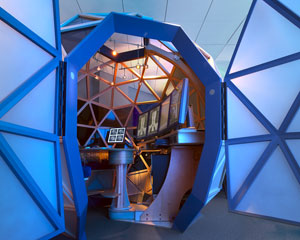
National Audubon Society Home Office, NYC.

Photo by David Sundberg/Esto, courtesy FXFOWLE Architects

The NYC Department of Citywide Administrative Services (DCAS) received a mayoral mandate to reduce city government’s carbon footprint by 30% over the next 20 years in accordance with PlaNYC. DCAS Commissioner Martha Hirst explained that “doing more with less” is no easy task as the Office of Energy Conservation handles the accounts for about 4,000 municipal buildings. Some efforts — more efficient lighting at the Police Academy, and quick roll-up doors for the Department of Sanitation — have presented technical challenges.

Interior designers are doing their part to live up to PlaNYC’s sustainability goals as well. Presenting an office renovation at the Empire State Building for the NGO Human Rights in China, Nathan Hoyt, FAIA, principal of Davis Brody Bond Aedes, spoke of the need to “elasticate” modest space to accommodate a growing staff. Installing floor track movable furniture was one of the decisions made, as well as creating spaces that could serve double, or even triple, uses. At the National Audubon Society offices, FXFOWLE Architects incorporated found furniture and streamlined heating and cooling into the interior design.

“We don’t try to convert the client,” said Mancini-Duffy President Dina Frank, AIA, IIDA; instead, she recommended a “soft sell,” letting the health and economic advantages of environmentally sensitive, LEED-oriented design speak for themselves. Images of Mancini-Duffy’s new interior for AOL’s New York headquarters addressed this: sensor-activated lighting, bamboo paneling, and an open floor plan all made for a seductive, yet practical, interior design solution.

As Baseball Season Ends for the Yankees, New Stadium Looms in Future

View from the Grand Concourse down 161st Street. On the left: the existing Yankee Stadium. On the right: the new Yankee Stadium under construction.

Jessica Sheridan

I have been spending some time doing research on the Grand Concourse, and have been struck by the presence of Yankee Stadium around 161st Street. From the Grand Concourse, one can see both the old and new stadiums, and even though the new mimics the old, there is a significant difference — the new turns its back on the community.

The South Bronx is transitioning. Parks are being improved, street plantings are being placed along the Grand Concourse, the Paradise Theater is being restored, and the Bronx Museum of the Arts opened a new addition by Arquitectonica in 2006. On a typical Saturday afternoon on the Concourse at 161st Street kids are skateboarding in Lou Gehrig Park and families are picnicking in Joyce Kilmer Park. Looking down 161st Street, the stadiums hover on either side.

Looking to the south, the old stadium opens up to the street. From the Concourse, one can see the seats and the building’s coliseum shape projects shouts from the fans up the hill. The excitement from the ballpark can be felt blocks away; the energy extends beyond the stadium walls. Looking to the north, however, the new stadium is oriented away from the street. No views, no noise, no excitement.

Even if the city replaces the old stadium with a park for the community (replacing the one it took away), what message does it send to the community when the new structure literally pulls away from the neighborhood? On top of it all, ticket prices are being raised, views from the subway are being eliminated, and the number of bleacher seats will be reduced to accommodate more corporate luxury boxes. Yes, the Bronx may be improving, but I believe building design should not take the form of elitism, excluding those impacted by it on a daily basis.

In this issue:
· 9/11 Memorial Museum Pavilion Plans Unveiled
· MCNY Overhauls for First Time in 76 Years
· Brooklyn Courthouse Gets a New Life — as Two Schools
· Affordable “Smart Housing” Grows in Brooklyn
· New Retail Center Completes Triangle Junction
· Reading Room Serves Radiology, 21st Century Style
· In the Heights — Shanghai Style


9/11 Memorial Museum Pavilion Plans Unveiled

The National September 11 Memorial & Museum.

Created by Squared Design Lab, provided by National September 11 Memorial & Museum

The National September 11 Memorial & Museum held a design briefing for the Memorial Museum Pavilion, designed by Snøhetta and located between the two memorial pools on the northeast quadrant of Memorial Plaza, designed by Michael Arad, AIA, and Peter Walker, FASLA. Modest in size compared to previous iterations, the building’s footprint is approximately 15,000 square feet and has a total area of approximately 40,000 square feet. Surrounded by a grove of oak trees, the glass and steel structure is intended to link the surrounding urban infrastructure with the Memorial Plaza park, and to bring natural light into the below-grade exhibition areas. One of the main features will be two saved “tridents” from the base of the original World Trade Center towers on display in the entry. In addition, it will provide visitors with information, general site orientation, ticketing services, security screening, 160-person auditorium space, café , rest areas, and a private room for use by 9/11 family members.


MCNY Overhauls for First Time in 76 Years

The Museum of the City of New York.

Polshek Partnership Architects

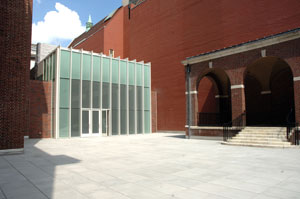
A ribbon cutting and open house marked the completion of the $28 million Phase I modernization project of the Museum of the City of New York, and the launch of Phase II and III. The museum’s circa 1929 Georgian Revival building has been largely unaltered since 1932, and the lifespan of its collections has been seriously compromised by the lack of appropriate environmental systems. Designed by Polshek Partnership Architects, the three-level addition includes: a new 3,000-square-foot gallery with translucent sunlight-diffusing glass; 6,000 square feet of terraces; restored vestibule and rotunda at the main entrance; redesigned and re-landscaped 4,700-square-foot Fifth Avenue terrace; and a below-grade curatorial center featuring cold rooms for the preservation of the museum’s extensive photo collection. The project is expected to be fully complete in 2011 at a cost of $ 97 million, $19.5 million of which came from the NYC Department of Cultural Affairs.


Brooklyn Courthouse Gets a New Life — as Two Schools

Transformed Brooklyn courthouse.

Gran Kriegel Associates

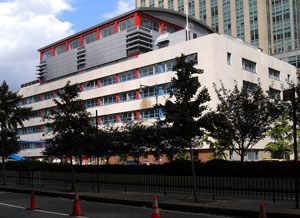
A project to convert a former 1951 courthouse in downtown Brooklyn into two high schools has been completed. Designed by Gran Kriegel Associates on behalf of the NYC School Construction Authority, the 140,000-square-foot space was gutted and reconfigured. To respect the surrounding character of Brooklyn’s civic center yet create a distinct identity for the schools, design solutions included re-cladding the building with lightweight limestone panels and adding a new double-height glass entry. The lobby features re-installed bas-relief stone panels salvaged from the original courthouse. The steel framed, long-span joist structure was separated from the existing roof by an interstitial space, which allows for efficient MEP distribution and optimum noise isolation. The building is now home to the Urban Assembly School for Law and Justice, and Urban Assembly School of Math and Science for Young Women.


Affordable “Smart Housing” Grows in Brooklyn

Smart Housing prototype.

RKT&B Architects

RKT&B Architects’ “Smart Housing” urban infill program is expanding with four new projects. Developed in conjunction with CPC Resources to address the need for affordable housing while making use of vacant space, the new designs are modeled on a prototype four-story, eight-family walk-up built by the firm in Park Slope, Brooklyn in 2003. At four stories, only one means of egress is required; other cost-efficient strategies include two-way visual access from the street and through ventilation. The projects are located in Bedford Stuyvesant, Brownsville, and Crown Heights on sites that are multiples of 20 to 25 feet and in neighborhoods with R6 zoning, which allow for medium-density housing of approximately 100 apartments per acre.


New Retail Center Completes Triangle Junction

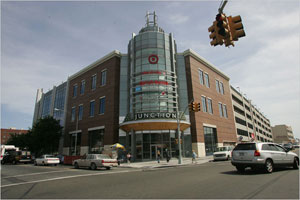
Triangle Junction.

Cooper Carry

Triangle Junction, the trapezoid-shaped new retail center in the Flatbush section of Brooklyn, officially opened in April. Currently, the building is undergoing interior fit-outs for seven retailers and restaurants that will occupy the 65,000-square-foot first floor. Developed by Triangle Equities and designed by Cooper Carry, the $150 million center was completed after six years of planning, design, and construction. The three-story building is designed to blend in with the neighborhood’s retail stores and walk-up residences. Textured faç ades — red brick, terra cotta, and glass — are separated by pre-cast cement piers with two cylindrical glass towers that serve as atria at the corners. Engineers had to develop a special platform over the Long Island Rail Road on top of which the retail center was constructed.


Reading Room Serves Radiology, 21st Century Style

UVA Radiology Reading Room.

Perkins Eastman/Photo: © Boris Feldblyum

Perkins Eastman recently completed a prototypical radiology reading area as the first step in a phased master plan for the University of Virginia Health System’s Radiology Department in Charlottesville, VA. The long-term vision for the plan efficiently organizes circulation, improves patient privacy, and provides increased flexible support areas for the department’s clinical activities. Due to digital imaging technology, the main reading area is now a concierge receptionist-served private space with ergonomically designed workstations, replacing the typical dark room with illuminated films. The three-year renovation frees up nearly 5,000 square feet of existing space while organizing operations around clusters of each clinical imaging type. Key elements of the project include a centralized waiting/reception area, a 15-bed patient preparation and recovery suite, and a new rounds room. There is also a multimedia conference space fitted with the latest display technology, a concierge station, flexible physician offices, and a new residents’ work area with staff support and educational components.


In the Heights — Shanghai Style

Sky Walk at the Shanghai World Financial Center.

Kohn Pedersen Fox Associates

Perched at 1,555 feet in the air, the Sky Walk recently opened on the 101st story of the Shanghai World Financial Center (SWFC), and has been declared the highest publicly accessible built space in the world. Designed by Kohn Pedersen Fox Associates, the Sky Walk is the pinnacle of the SWFC’s seven-level public observatory occupying the building’s 94th through 100th floors; a second Sky Walk on the 97th floor features a roof that opens when weather permits; and a Sky Arena on the 94th floor houses exhibition and event spaces. The Sky Walk extends 180 feet across a portal at the top of the tower and is designed with canted glass walls and a glass floor, affording city and river views. Shaped by the intersection of two sweeping arcs and a square prism — representing ancient Chinese symbols of heaven and earth, respectively — the tower’s tapering form optimizes programmatic efficiencies, from large floor plates at its base for offices, conference facilities, high-end retail, and dining establishments to rectilinear floors for the 174-room Park Hyatt Shanghai above.

In this issue:
· AIA Requires Green
· IDP/ARE Concurrency Authorized in NYS
· New Green Resource for Architects goes 50to50
· AIA Gets Political
· GSA Opposes Post 9/11 Building Code


AIA Requires Green
AIA Continuing Education System (CES) has changed the continuing education requirement to include 4 sustainable design hours as part of the total required 8 health, safety, and welfare (HSW) hours. Effective 01.01.09, the requirement will remain in place until 2012, when it will be re-evaluated. There are four thresholds by which courses are judged: eligible courses must address the AIA definition of sustainability; must be structured programs rather than self-study; must cover health, safety, and welfare in at least 75% of their content; and must address at least one of the Committee on the Environment’s (COTE) measures of sustainable design and performance.


IDP/ARE Concurrency Authorized in NYS
At a recent meeting of the New York State Board of Regents Professional Practice Committee, regulatory changes permitting architectural interns to take the Architectural Record Exams (ARE) concurrent with the Intern Development Program (IDP) were approved. Going into effect on 10.09.08, so long as an intern has a NAAB accredited degree (or a combination of education and experience equaling a NAAB accredited degree), and upon enrollment in the IDP with NCARB, and submission of a New York application and fee, he or she will be permitted to sit for the ARE. Check out the NCARB and NYS Education Department Office of the Professions for more information.


New Green Resource for Architects goes 50to50
As part of the AIA’s commitment to achieving a minimum 50% reduction of fossil fuel consumption in buildings by 2010 and carbon neutrality by 2030, 50to50 includes 50 strategies for architects to help achieve significant carbon reduction. Items span a spectrum from broad-based site and planning objectives to specific building-based concepts. Included are overviews of relevant topics, typical applications, emerging trends, links to information sources, and carbon reduction examples. 50to50 is a product of the AIA’s Sustainability Discussion Group (SDiG), a task group of the AIA Board of Directors. For more information, click the link.


AIA Gets Political
For the first time in its history, the AIA has become actively involved in both the political conventions and the presidential and congressional elections. DesignVote, an initiative to engage architects in the political process, educates members on pertinent issues, providing them with ways to participate in the campaigns. AIA members attended both the Democratic and Republican party conventions. In Denver, the AIA hosted a reception honoring the AIA’s sustainability successes on Capitol Hill with a “Walk the Walk” reception hosted by the firm RNL. During both conventions, AIA members contributed to The Angle, the government advocacy blog.

In addition, the DesignVote team is working on a “get out the vote” campaign with information on how, when, and where AIA members can register to vote. For more information on any election or campaign position, contact the DesignVote team at the links above.


GSA Opposes Post 9/11 Building Code
The General Services Administration (GSA) opposes changes made last year to the International Building Code regarding stronger safety requirements for skyscrapers. The GSA is concerned about the economic impacts of the more stringent codes. Though the federal government is technically exempt from local building codes, it generally requires that buildings it rents or buys honor them. The new provisions, which were based on recommendations of the National Institute of Standards and Technology in the wake of 9/11, state that any nonresidential skyscraper over 420 feet tall (about 40 stories) must have a third stairwell and fireproofing capable of staying in place even if hit with 1,000 pounds-per-square-foot of force.

Real estate industry experts estimate that the fireproofing and stairwell requirements alone could cost real estate developers $13 million for a 42-story office building, not to mention significantly decreased floor space. However, advocates of the code believe these figures are inflated. The matter will go to a vote next week at a meeting of the code council in Minneapolis.

Tri-State Area Schools Integrate 9/11 into Curriculums

High school juniors at Bergen County’s River Dell High, a NJ school that lost three students in the World Trade Center collapse, are piloting a 9/11 curriculum that the September 11 Education Trust has developed over three years with Queens College professors. The Trust hopes to roll out nationwide a curriculum this spring to be taught in history, sociology, or psychology courses.

Officials from the National September 11 Memorial & Museum launched a pilot program to be used in NY, NJ, and PA schools during anniversary remembrances. They aired the program’s eight-minute film to students at Millennium High School, the first new school to open in Lower Manhattan after 9/11.

The Rockefeller Foundation awarded the 2008 Jane Jacobs Medal for Lifetime Leadership to Peggy Shepard, executive director and co-founder of West Harlem Environmental Action, and the 2008 Medal for New Ideas and Activism to Alexie Torres-Fleming, founder of Youth Ministries for Peace and Justice…

Edith Hsu-Chen has been appointed as Director of City Planning’s Manhattan Office, succeeding Ray Gastil, who is now Seattle’s Planning Director… Frederick Bland, FAIA, a managing partner at Beyer Blinder Belle, has been appointed to the Landmarks Preservation Commission, replacing Jan Pokorny, the former commission chair who passed away in May… non-profit Architecture Omi has named Lee H. Skolnick, FAIA, as its first chairman of the board…

Zetlin & De Chiara was named the top regional construction law firm by Legal 500, and Michael De Chiara was selected as one of the five leading construction litigators in the country…

The Seagram’s Building is celebrating its 50th anniversary. Happy Birthday!

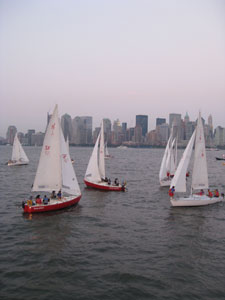
09.04.08: The annual Architect’s Regatta took place offshore from the World Financial Center. Nineteen teams competed in two races. Daniel Frisch Architects took the night’s greatest honor winning first place overall, followed by BKSK in second place and Richter + Ratner in third.

Boats circle around the starting line as the races begin.

Jessica Sheridan

The AIANY team, a.k.a. “The Flying Eagles,” came in ninth place overall. Skipper Wids DeLaCour, AIA, was aided by team members (l-r) Blake Middleton, FAIA, Mark Behm, Assoc. AIA, LEED AP, and Mark Ginsberg, FAIA, LEED AP.

Jessica Sheridan

As part of the festivities, each team gives prizes to the team that comes in behind it in the overall tally. Although they did not win, in a stroke of poetic justice, team AIANY beat Robert A.M. Stern Architect’s team — the team that beat them last year. Rick Bell, FAIA, AIANY Executive Director, presented RAMSA with a flying eagle trophy.

Megan Chusid

FXFOWLE Architects beat The Flying Eagles. Bruce Fowle, FAIA, presented AIANY with an inflatable pirate ship.

Megan Chusid

09.15.08 Request for Qualifications: From the Ground Up: Innovative Green Homes
This competition seeks to provide a new model for formerly vital, urban residential neighborhoods throughout the U.S. through the creation of sustainable, affordable housing. Selected teams will work on infill sites, proposing designs for a 1,100-1,500-square-foot single-family home to be built in the Near Westside neighborhood of Syracuse, NY. The goal is to create innovative designs for cost-efficient, green prototypes that are sensitive to the scale and composition of the existing conditions while providing a legible vision for an array of existing and potential residents.

09.26.08 Call for Proposals: AIA Emerging Professionals Component Grants
The deadline has been extended to apply for small grants provided by The College of Fellows to assist AIA components in the development of programs that foster the mission of Young Architects and Associates. Funds may be used to enhance the activities of an existing Emerging Professionals group or as seed money to help start a new one. All grants must be for a specific program or activity. The maximum available funding is $10,000, although grants may be subdivided.

11.03.08 Call for Entries: AIAS 2008 Library for the 21st Century Design Competition
Sponsored by Kawneer and administered by the American Institute of Architecture Students (AIAS), this program challenges students to learn about building materials — specifically architectural aluminum building products and systems and their assembly in the design of a library. While open to any student, the competition is designed for advanced students. Total prize money is $7,225, including $2,500 for the winning design.

11.14.08 Request for Proposals: 2009 Sustainable Design Assessment Team Program
This RFP solicits applications for inclusion in the Sustainable Design Assessment Team (SDAT) 2009 program. SDAT brings together multidisciplinary, architect-led teams to work with community stakeholders and decision-makers to develop a vision and framework for a sustainable future. Since its inception in 2005, the SDAT program has assisted over 25 communities with long-term sustainability plans addressing a range of local issues.

11.14.08 Call for Submissions: The Palladio Awards
The eighth annual competition recognizes outstanding work in traditional design for commercial, institutional, public, and residential projects. Co-produced by Traditional Building and Period Homes magazines, the awards are named in honor of Andrea Palladio, the Renaissance architect who created modern architecture for his time while drawing on past models for inspiration.

12.05.08 Call for Entries: Discarded Dreams: Used Mattress Design Competition
Every year in the U.S. 40 million mattresses are discarded. Architecture for Humanity and Rubicon National Social Innovations invite entrants to create innovative ways of converting used mattresses into useful products. Submissions should include instructions detailing how to make the product and a plan for production on a larger scale. First place is $1,000, and the winner/winners will be invited to collaborate with Rubicon to design and execute a method of collecting and converting the mattresses into their value-added product, potentially to be distributed for commercial use.

01.06.09 Call for Entries: TEA-OFF! Tea Kettle Design Competition
The competition invites original kettle designs using one of three materials: metal, glass, or ceramic. Three winners will be chosen with designs unveiled and exhibited at the World Kitchen booth at the 2009 International Housewares Show in Chicago in March 2009. Winning designers receive $5,000 cash prizes and two-day, expense-paid trips to Chicago for the show. If a winner is a design student, a $1,000 award will be given to a faculty advisor. The winning designs will also appear on the World Kitchen website.

02.13.09 Call for Entries: COD Ideas Competition
The AIA Committee on Design (COD) invites architects, students, and allied design professionals to submit sketches to the international COD Ideas Competition. Submitters are asked to design a new house to replace the recently demolished Raymond House (architect: Eleanor Raymond, FAIA). One of the earliest Modern homes in the United States, the Raymond House was a signature work of one of the most prominent American women architects of the 20th century. Award recipients will receive funding to attend the COD Spring Design Conference in Boston and have their work exhibited at the 2009 AIA National Convention in San Francisco.

Center for Architecture Gallery Hours
Monday-Friday: 9:00am-8:00pm, Saturday: 11:00am-5:00pm, Sunday: CLOSED

Join an Architalker for a Hosted Tour of Center for Architecture
Exhibitions

Join us for free Architalker-hosted tours of the Center for Architecture exhibitions Fridays at 4:00pm. To join one of these tours, meet in the Public Resource Area on the ground floor of the Center for Architecture.

CURRENT EXHIBITIONS

September 10 — October 4, 2008

Memorial Sites: New York to Nairobi

Memorial Sites: New York to Nairobi is an exhibition of photographs by Julie Dermansky which reflects on the meaning and history of memorials while addressing site specificity and the culture of place. “History belongs to all of us,” says Dermansky, “but it is the memorial site commemorating a particular historical moment and connecting it to the present that infiltrates our being and transcends history.” Dermansky has documented memorials in diverse locations, from the site of the destroyed US Embassy in Nairobi, Kenya, to the Valhalla, New York 9/11 memorial by Frederic Schwartz. Her global perspective explores the range of realized memorial design solutions. Memorial Sites: New York to Nairobi engages issues of injustice and genocide, while capturing the irony of sacred sites converted to tourist destinations.

Exhibition Curator: Tracey Hummer

Image caption: Oklahoma City National Memorial


September 5 — January 3, 2009

New Practices New York 2008

New Practices New York 2008 is the second juried portfolio competition and exhibition in a new biennial tradition sponsored by the New Practices Committee of the AIA New York Chapter. It serves as a platform for recognizing and promoting new, innovative and emerging architecture firms within New York City that have undertaken unique and commendable strategies – both in projects and practice.

From the 52 portfolios submitted, the New Practices Committee – consisting of Amale Andraos (Work AC), Jennifer Carpenter (TRUCK), Peter Eisenman (Eisenman Architects), William Menking (Architect’s Newspaper) and Charles Renfro (Diller Scofidio + Renfro) – was expected to choose the six most promising firms. The competition winners, all of whom will be participating in our exhibition are:

Baumann Architecture

Common Room

David Wallance Architect

Matter Practice

Openshop | Studio

Urban A&O

The exhibition will be accompanied by a series of programs organized by the AIA New York Chapter in collaboration with New Practices Committee

Exhibition organized by the AIA New York Chapter and the Center for Architecture Foundation

Exhibition Design: We Should Do It All

Media Partner: The Architects Newspaper

Underwriter: Häfele

Patron: ABC Imaging

Lead Sponsors: Ibex, MG & Company, Poliform, Thornton Tomasetti

Supporters: Fountainhead Construction, FXFOWLE Architects

Beverage Sponsor: SAAGA Vodka

Related Events

Wednesday, October 15, 2008, 6:00 — 8:00pm

Winner’s Symposium

Each firm will have a six-week exhibition and will be delivering a Hafele NY Showroom at 25 East 26th Street. For more information, visit Hafele’s New York showroom listing at www.hafele.com/us


July 17 — September 27, 2008

South Street Seaport – Re-envisioning the Urban Edge

The Emerging New York Architects Committee (ENYA) presents the Third Biennial Ideas Competition, South Street Seaport | Re-envisioning the Urban Edge. This competition encouraged participants to envision new connections, both material and metaphoric, between this richly historic neighborhood and Manhattan’s contemporary urban fabric.

South Street Seaport | Re-envisioning the Urban Edge provided an opportunity, uncommon for students and young professionals in the field of design and architecture, to engage the ongoing evolution of the South Street Seaport. More than 200 participants entered the competition, representing a broad spectrum of domestic and international architects, landscape architects, urban designers, and graphic artists. From over 100 entries, a jury selected four top prizes, five honorable mentions, and additional Jury Selections, all of which are presented in this exhibition.

ENYA partnered with the Seamen’s Church Institute (SCI), whose headquarters have been in the neighborhood since 1832. The principal element of the program is a community center for local residents and gallery space to house the SCI’s collection of maritime art and artifacts. In addition, competitors were encouraged to make community-building interventions in open spaces throughout the site in order to preserve the neighborhood’s intriguing history, while re-imagining its future edge condition on the downtown New York waterfront.

Exhibition organized by the AIA New York Chapter and Center for Architecture Foundation in collaboration with the Emerging New York Architects Committee (ENYA)

Exhibition organized by the AIA New York Chapter and Center for Architecture Foundation in collaboration with the Emerging New York Architects Committee (ENYA)

ENYA Co-Chairs:
Megan Chusid, Assoc. AIA

Harry Gaveras, AIA

Exhibition and Competition Developers:

Anne Leonhardt, Assoc. AIA

Heather Mangrum

Joel Melton, Assoc. AIA

Sean Rasmussen, Assoc. AIA

Exhibition Design:

Steven Mosier

South Street Seaport: Re-Envisioning the Urban Edge

Emerging New York Architects (ENYA)

Underwriter: F.J. Sciame Construction

Sponsor: Gensler; Propylaea Architecture; Richter+Ratner


Friends:

Service Point USA and A. Estéban & Company


Food Sponsor:
Acqua Restaurant
Beverage Sponsor: Barefoot Wine and Brooklyn Brewery

Through 09.18.08
Creative Hong Kong

“Stringless Pleasure,” by Chi-Wing Lo, is a stereo system atop an antique wood cabinet.

Courtesy Sotheby’s

From fashion and toys to environments and communication, designs and products on view show how Hong Kong has built a reputation for bringing added value and strategic solutions to businesses and brands. The highlight of the exhibition is a display of 10 unique products that are the results of collaborations among 10 internationally renowned brands and 10 well-known Hong Kong designers. The products, which range from a dining set to a distinctive stereo system, fuse elements from Hong Kong with the essence of brands such as Herman Miller, Alessi, Salvatore Ferragamo, and Royal Copenhagen.

Sotheby’s
1334 York Avenue


Through 10.13.08
Reinventing Grand Army Plaza

Reinventing Grand Army Plaza.

Courtesy Design Trust

This free, outdoor exhibition showcases 30 visionary plans for a new and improved Grand Army Plaza, selected from over 200 international submissions to the “Reinventing Grand Army Plaza” ideas competition. Designed by Pentagram, on view are ideas for making the plaza more beautiful, accessible, culturally vibrant, and safer for pedestrians, cyclists, and motorists. The first large-scale exhibition in the center of Grand Army Plaza allows visitors to imagine new designs while on site. The competition was co-sponsored by Design Trust for Public Space and the Grand Army Plaza Coalition; the competition winners were announced Friday, 09.12.08, and include Brooklyn-based Garrison Architects. All winning entries can be viewed at link below.

Center of Grand Army Plaza
Brooklyn, NYC


09.28.08 through 11.30.08
Panorama: The Mapping of Prediction

“Diagrams: Aerial Perspective,” by Steven Talasnik, 2008, graphite on paper.

Queens Museum of Art

This exhibition captures Steven Talasnik’s use of architectural forms, including 13 pieces from his Panorama series measuring up to 12 feet in length. Installed in the same space as the museum’s Panorama of the City of New York, the exhibition presents Talasnik’s own musings on architecture and design juxtaposed with the model that inspired his artistic career.

Queens Museum of Art, New York City Building
Flushing Meadows Corona Park, Queens, NYC