Queens Theater Offers Night on the Town

Event: Project Team Collaboration: Queens Theater in the Park; part of the Architects in Training 2008 series
Location: Center for Architecture, 04.09.08
Speakers: Sara Caples, AIA — Principal, Caples Jefferson Architects; Jeff Rosenstock — Executive Director, Queens Theatre in the Park; David Oldham — Construction Manager, Hill International; Sergio Silveira — Assistant Commissioner, NYC Department of Design & Construction
Organizer: AIANY Emerging NY Architects (ENYA) Committee

QTiP

The entrance to Queens Theatre in the Park brings visitors in along a spiral pathway leading to an inverted, golden dome.

Caples Jefferson Architects

After touring theaters nationwide, Jeff Rosenstock’s goals for QTiP were simple — provide for a shared and diverse community while creating a sense of awe and wonder. “Queens needs a theater where people can gather for a night on the town,” stated Queens Theatre in the Park (QTiP) executive director Rosenstock.

Currently, there is no place in Queens for a group to meet up, have dinner, see a show, and grab a drink afterwards. Sited next to the New York State Pavilion, originally designed by Philip Johnson for the 1964 World’s Fair in Flushing Meadows-Corona Park, “The Drum” houses the 464-seat main stage and 99-seat studio theater that comprise Queens Theatre. With the help of $20.45 million, Caples Jefferson Architects is adding a 75-seat cabaret performance space, full-service café and kitchen facility, new offices, and a 3,000-square-foot lobby in hopes that QTiP will become a cultural nexus for the borough.

With more than 300 performances annually, it was also important that the theater stay open during construction. Once the NYC Department of Design and Construction, Department of Parks and Recreation, and the Art Commission were on board, the goals expanded. Preserving and maximizing green space, cutting down as few trees as possible, and preserving a sense of history and nostalgia tied to the World’s Fair added to the project’s challenges. With construction manager (and former architect) David Oldham of Hill International, Caples Jefferson expects the project to be complete this year.

For Sara Caples, AIA, principal of Caples Jefferson, the design of QTiP centers on the project’s name: a theater, and the park. The firm did not want to overpower the existing building, so they added pieces that fan out around the central cylinder. The building is on axis with Johnson’s original building, and the two approaches bring visitors in on a spiral trajectory.

The lobby is a transparent cylinder with a ceiling in the shape of an inverted dome. This Nebula, as Caples calls it, is the major feature of the project as it acts as a point of entry, a gathering space, an observatory for the World’s Fair “ruins,” a place to view the park, grab a bite to eat, or even host public and private events. It is meant to enhance the life of the park and feed back into the cultural life of the theater, according to Caples. The golden yellow that coats the dome is a festive color in many cultures, reflecting both the diversity of the theater’s programs and the local community.

Semi-industrial materials that emulate the World’s Fair pavilions are used throughout. The glass façade allows views of the inverted dome, the park, and the ruins. The upper portion of glass around the building’s perimeter is tinted in a pattern that follows the sun’s path throughout the year to reduce heat and glare. Caples Jefferson worked with lighting designer Hervé Descottes to create movement with light; dappled light lines the entry and spirals up to the glowing inverted dome at night.

Ultimately, the project team — including the architects, contractors, clients, and government agencies — expects QTiP to help spur development of the entire Corona Park, making the area a performing arts center. Master planning is underway for the rest of the park, but the World’s Fair pavilions remain in ruins. Caples hopes QTiP will spur enthusiasm to preserve the respected structures.

Long Overdue, Modernized NYC Museum Evokes City's History

Event: The Museum of the City of New York: New Building Addition
Location: Center for Architecture, 03.24.08
Speakers: Susan Henshaw Jones — President and Director, Museum of the City of New York; James S. Polshek, FAIA — Senior Design Counsel, Timothy P. Hartung, FAIA — Partner, Joanne L. Sliker, AIA — Associate Partner, Polshek Partnership Architects
Moderator: Ann Marie Baranowski, AIA — Co-Chair, AIANY Cultural Facilities Committee
Organizers: AIANY Cultural Facilities Committee

MCNY

The new glazed gallery pavilion at the Museum of the City of New York.

©Polshek Partnership Architects

New York’s museum has languished without attention for much of its lifetime. Situated on Fifth Avenue across from Central Park, the Museum of the City of New York had to wait from its construction in 1929 as designed by Joseph J. Freedlander until 2005 for its first modernization. Today, it is set to open Phase One of its renovated and expanded gallery space.

Polshek Partnership Architects has worked in phases. First came the addition of HVAC and updating of the building’s infrastructure, then the gallery addition and other expansions. These next phases will redistribute spaces within the landmark building, bringing gallery, administrative, and storage spaces up to par with current design and technology. In the vacant plot east of the building, Polshek’s team, led by partner Timothy Hartung, FAIA, has created a new gallery space and expanded subterranean storage area to add 20,000 square feet to the museum’s original 90,000.

The new glazed gallery pavilion offers a double-height exhibition space open to an outdoor patio. Its sun-filled space can be darkened for presentations and lectures. A drop ceiling creates a light pocket around the top seam of the gallery.

Below the new gallery, a storage expansion will give the museum a new haven for its over 1.5 million objects and images. Relocation from the previously crowded attic levels will relieve the building’s space crunch and allow the curatorial and administrative staff to breathe in two newly opened floors of interconnected, sky-lit office space.

Central to the scheme within the existing building is a renovation of the entry court rotunda that previously connected the north and south wings and allowed access to the second floor “Marble Court” via a spiral stair. The rotunda and the stair will remain as designed, save for a new connection and window below the stair providing access to the new east pavilion. Hartung hopes the final decision to create two centrally oriented openings and preserve the original stair will integrate the new east pavilion to the circulation order. The rotunda will include a new bookshop and café. Galleries on the first three floors now offer unfettered spaces devoted exclusively to exhibitions.

Amanda Burden — Engine Driving Mayor's Redevelopment Frenzy

Event: City College School of Architecture Lecture Series: Amanda Burden
Location: City College School of Architecture, 03.27.08
Speaker: Amanda M. Burden, Hon. AIANY — Chair, NYC City Planning Commission & Commissioner, NYC Department of City Planning
Moderator: George Ranalli, AIA — Dean, City College of New York (CCNY) School of Architecture, Urban Design and Landscape Architecture
Organizer: CCNY School of Architecture, Urban Design and Landscape Architecture

LIC

Long Island City is one of the major development sites Amanda Burden, Hon. AIANY, has taken on as commissioner of the NYC Department of City Planning.

Jessica Sheridan

Under the leadership of Commissioner Amanda Burden, Hon, AIANY, the NYC Department of City Planning has worked at a frenetic pace over the last six years, including rezoning one-sixth of the city — more than combined actions of the past 40 years.

Burden’s role in reshaping NYC is significant in making Mayor Bloomberg’s aggressive redevelopment plans possible. A review of City Planning’s major initiatives during the Bloomberg administration include: the East River waterfront, World Trade Center site, West Side Rail Yards, Jamaica Business District, Long Island City, Greenpoint / Williamsburg waterfront, the South Bronx, 125th Street, and the High Line, to name a few. Each of these projects could take years of analysis, field observation, and community interaction, yet somehow they have all been implemented under one administration.

Embedded in Burden’s City College lecture were counterpunches to criticism of some of the proposals’ scale, affordability, and potential to restrict community access to neighborhood assets. For example, when discussing the Greenpoint / Williamsburg waterfront, Burden cited the FAR bonus for waterfront buildings that include at least 20% affordable housing. Burden also mentioned “get-downs” allowing direct water access that will be part of both the East River and the Greenpoint / Williamsburg waterfront projects, deflecting criticism that recent waterfront redevelopment projects tend to treat the water as something to be seen and not experienced. Burden also discussed the numerous down-zoning and preservation efforts made by the department in an effort to maintain the character of important neighborhoods like City Island, Park Slope, and Whitestone.

While the debate rages on as to whose needs these massive development projects address, there is no debating Burden’s sweeping impact on the shape of this city.

Buildings Commissioner Inspires Women Architects

Event: Breakfast Lecture
Location: Center for Architecture, 03.26.08
Speaker: Patricia J. Lancaster, FAIA — Commissioner, New York City Department of Buildings
Organizer: AIANY Women in Architecture (WIA) Committee
Moderator: Nancy Aber Goshow, AIA — Co-Chair, AIANY WIA Committee
Sponsor: Gensler

Patricia Lancaster, FAIA

NYC Department of Buildings Commissioner Patricia Lancaster, FAIA, speaks to the AIANY Women in Architecture Committee.

Jenny Huang

On becoming the NYC Department of Buildings commissioner in 2002, Patricia Lancaster, FAIA, was asked by Mayor Bloomberg to “fix the department” and restore its credibility. She has headed an agency that regulates NYC’s construction industry, and is responsible for enforcing the Building Code and Zoning Resolution for 975,000 buildings and properties. Under Lancaster, Buildings has been brought into the 21st century. She is implementing the International Building Code, come down on areas of the construction industry that needed improvement — from making sure all general contractors who build one-, two-, or three-family homes are registered to changing inspection protocol for tower cranes — and identified employees whose sole aim is to advance safety, transparency, and integrity. Kicking off this year’s AIANY Women in Architecture Committee (WIA) breakfast lecture series, Lancaster shared her story, experiences, and lessons learned with other women in the profession.

Asked to explain her success, Lancaster credited her architecture education, which prepared her to be a multi-tasking problem solver. While at the University of Washington, her thesis professor made students come up with at least 10 solutions for each design problem. Lancaster applies this method to her work, and manages to come up with an array of feasible solutions to each issue.

What drives Lancaster? It’s the need “to make a difference,” despite often having had to work harder and longer than her male colleagues throughout her career. “Success doesn’t happen overnight. Rather, each day counts.” Her advice to women in the profession: craft each day to be full and significant.

D-Critters Dance with Assorted Devils

Event: D-Crit Reading Night: “Evil”
Location: KGB Bar, 03.27.08
Speakers: Steven Heller — Author, The Swastika: Symbol Beyond Redemption? & Co-Chair, MFA Design, School of Visual Arts; Philip Nobel — Author, Sixteen Acres: Architecture and the Outrageous Struggle for the Future of Ground Zero & Columnist, Metropolis; Andrea Codrington — Writer, Editor, & Brand Strategist, Brand Building Communications
Organizers: MFA program in Design Criticism (D-Crit), School of Visual Arts

D-Crit

The SVA D-Crit program takes on “Evil.”

Courtesy School of Visual Arts

The School of Visual Arts (SVA) launches its Design Criticism (D-Crit) program this fall, seeking to strengthen links among journalism, academic critique, and design. Several months before classes begin, D-Crit is already striking an informal, edgy profile with readings at the literary nightspot KGB. By taking on vast topics like Home, Music, and Evil, D-Crit’s organizers aim to show up the breadth and flexibility of this area of critical writing. The latest reading also showed how evil can elicit both gravity and wit.

Steven Heller, author and co-chair of the MFA Design program at SVA, argued that a symbol can be wrenched out of its history and converted to a visual weapon dangerous enough to ban. Fascinated from youth with the Nazis and the swastika, Heller expanded this interest into The Swastika: Symbol Beyond Redemption?, explicitly “a polemical history, not a linear or narrative one.” He has considered arguments for rehabilitating the symbol because of its long pre-Nazi history in Hindu and Native American cultures, among others; yet, he is against ever normalizing it, voicing special scorn for Sid Vicious-style transgressive displays. Because of the unique pathology of Nazism as “a paradigm of how terror became official policy for a civilized state,” Heller says, a suggestion that time could ever decontaminate it “begs the question, ‘What is enough time?'”

Author and columnist Philip Nobel read from a Metropolis column that nearly got him fired: an open letter to Philip Johnson connecting washed-out aesthetics to fascism. Nobel took the “Dean” to the woodshed for cynicism, collaborationism (in his period of admiration for Hitler — something Johnson’s admirers ignored until critic Michael Sorkin unearthed some early writings), and the tendency to revel in a position of power out of proportion to his architectural gifts. Though Johnson’s “acerbic wit, deracination of Modernism, and endless pimping” defined contemporary architecture for several generations, Nobel makes a case that Johnson’s influence also constricted and warped it. Nobel’s potshots add up to a distinction between taste making and the ethical seriousness that informs deeper talent.

Andrea Codrington, brand strategist for Brand Building Communications, observed how Hollywood directors use Modernist design to connote menace. Commercial cinema mythologizes American domesticity and the associated homey building styles; the flip side, Codrington finds, is a tendency to portray Europeans, and their clean-lined buildings, in terms of “villainy and vanity.” James Bond, she notes, becomes increasingly endangered the closer he gets to the geometric lairs of the Dr. Nos, Blofelds, Goldfingers, et al., all “monomaniacal scoundrels with exquisite modernist taste.” Hollywood’s habitual demonization of Modernism, she concluded, eventually ran counter to reality: when genuine terror hit Americans on 9/11, the culprits were not the elegant villains of Hitchcock or Kubrick. They lived in caves.

Brad Pitt Narrates New York and Bogotá's Green Showing

Event: Green Screens: e2 design
Location: Center for Architecture, 03.29.08
Speakers: Elizabeth Levison — Senior Producer, e2; Serge Appel, AIA, LEED AP — Associate Partner, Cook + Fox Architects; Oswaldo Martinez — Architect under former mayor of Bogotá, Enrique Peñalosa
Organizer: AIANY Emerging NY Architects (ENYA) Committee
Sponsors: Herman Miller; Benhar Office Interiors

Bogota

The central arteries in Bogotá include extensive rapid transit bus lanes for the red TransMilenio buses.

Courtesy Google Earth

NYC and Bogotá differ greatly, but green urban planning in both cities is on a roll. The featured projects in “The Green Apple,” and “Bogotá: Building a Sustainable City,” episodes of the PBS e2 design documentary series, include: One Bryant Park designed by Cook + Fox Architects, Battery Park City’s Solaire designed by Cesar Pelli & Associates, Bogotá’s pedestrian-friendly Alameda walkway, and its TransMilenio public bus. The episodes, narrated by Brad Pitt, guide the viewer from NYC’s vertical, technologically based green design, to Bogotá’s horizontal view of sustainability in which a city’s health is measured by the well-being of its inhabitants.

NYC is seen as part-environmental nightmare of concrete, diesel, and garbage, and part-energy efficient nucleus, with its density and accessible mass transportation. “If NYC were the 51st state, it would be the most energy-efficient,” states “The Green Apple.” As One Bryant Park rises toward the sky, it will soon be the “greenest skyscraper in America,” filtering air and flushing the sinuses of midtown smog.

Bogotá comes across as a city emerging from mid-20th century poverty and despair to a continental hub of self-esteem through the enterprising work of former mayor Enrique Peñalosa. By concentrating on the pedestrian rather than the automobile, Peñalosa and city planners designed the Alameda pedestrian walkway and the TransMilenio computerized public transport system, creating new travel arteries that aid the city’s business, leisure, and social spaces. The wide pedestrian/bicycle lanes provide access for the three million residents at the city’s edge who live on less than $1 a day. Initially meant for mobility, the Alameda has also become a park space and a gathering spot. Peñalosa once personally patrolled the area to keep motor vehicles away.

The TransMilenio public bus system is a symbol of the city’s revitalization and renewed quality of life, stated Peñalosa. Main “trunk” lines service large busses that run on exclusive arteries throughout the city. Smaller tributary lines that reach out to the peripheral neighborhoods feed these lines. The busses are now federalized, after long being controlled by the mafia.

Cities that build better live better, and e2 puts it forth that “sustainable design” will eventually be called just “design.”

Reflecting Absence in the Details

Event: Reflecting Absence: Designing a Memorial at the World Trade Center
Speaker: Michael Arad, AIA — Partner, Handel Architects
Location: 7WTC, 03.20.08
Organizer: Downtown Alliance (part of the Downtown Third Thursday series)

WTC Memorial

Arial view from the southeast of “Reflecting Absence.”

dbox, courtesy wtcsitememorial.org

When it opens in 2011, the World Trade Center Site Memorial, whose theme is “Reflecting Absence,” will look somewhat different from its original concept. In addition to the bosque of trees that has been added surrounding the Memorial, the concept and progression of the underground Memorial Gallery has been altered. Michael Arad, AIA, winner of the memorial design competition, showed how the design has been refined over the past four years, presenting a palette of details currently under development with landscape architect Peter Walker, FASLA. Undergoing fine-tuning are the fountain design and the project’s name plaques, both of which are intended to ultimately reinforce the memorial’s underlying theme, “Reflecting Absence.”

The water delivery system designed for the project’s massive fountain centerpiece is vital, says Arad. Though initially intended to be a sheet of water “clinging to the surface” of the memorial, the fountain will ultimately feature individual streams of water canting more than six and a half feet from the face of the wall. The fountains take inspiration from Arad’s initial concept of providing two large fissures in the Hudson River. Now they will mirror the footprints of the towers on the memorial site.

After many mock-ups, Arad and his team are also close to finishing the design of the name plaques, including material and font. The plaques will now circle the top ring of the fountains (instead of the original location proposed circling the lower level of these openings) and may be partially engaged with the water. Viewing the names from the surface, rather than from inside the fountains, altered one of the project’s initial concepts – reflecting from within the void. According to Arad, this move “changed the entire meaning of the project’s edge,” making the ground-level perimeter of the fountains even more important.

State Risks Sidelining Art at WTC

The New York Times published an article about a proposal to move the Joyce Theater performing art center from the World Trade Center site to the Fulton Street Transit Center (See “Proposal Would Relocate Arts Center to Transit Hub,” by Robin Pogrebin, 04.10.08). While the proposal, put forth by Avi Schick, president and downstate COO of the Empire State Development Corporation and chairman of the Board of Directors at the Lower Manhattan Development Corporation, is not yet approved, I am concerned that the state will make rash, damaging decisions dictated by inadequate funding.

One of the biggest challenges facing planners of the WTC site is how to make it a destination for locals and tourists at all times of day and night. The commercial development, major transit hub, retail stores, and memorial should keep the site lively throughout the day. However, once work hours are over, I doubt a shopping mall will do the trick. It hasn’t worked in the past, and businesses in Lower Manhattan have enough trouble staying open once Wall Street executives limo home, outside the area. Instead, the Joyce Theater’s diverse performances and programs, that attract both young and old audiences, would create a magnet for evening activity. The WTC could become a downtown alternative to Lincoln Center.

The proposal to move the art center to Fulton Street would take away from both the Joyce Theater and the transit center projects. How will the state reconcile between the current transit hub, designed by Grimshaw Architects with James Carpenter Design Associates and Arup, and the Gehry Partners-designed art center? The proposal itself seems to assume that buildings can be used for anything, no matter what the initial design intent. It is a matter of misappropriation. The transit hub, designed for mass transit, cannot simply incorporate an art center; and by proceeding with this proposal, there is no guarantee it will save the city any money.

Ultimately, I feel that the state has not been able to see culture as a critical asset. It is often viewed at best as an enhancement to a place, or at worst an afterthought, but it is not perceived as a requisite to successful urban planning. For a city internationally renowned for its culture, it’s a shame new, high profile projects are being compromised.

World Leaders Take Up State of the Planet

Event: State of the Planet 08, Real People, Real Places, Real Solutions
Location: Columbia University Earth Institute, 03.27-28.08
Speakers: For full list of over 30 speakers, go to the State of the Planet 08 website.
Organizer: The Earth Institute at Columbia University

The poor population is expanding, human and environmental conflicts abound, clean energy seems elusive, and climate change is happening at an unpredictably quick pace. A new global mindset is required. In their own self-interest, the rich will need to help the poor. If developing countries go it alone, the environmental impacts from smokestacks will be felt across national borders. The polar ice cap is already 30-50 years ahead of projected melting due in part to the compounding effects of water seepage through cracks. The time to act is now and we will have to adapt to the irreversible damage already done.

And yet, “There is no clash between national and international interests.” — Kofi Annan, Former Secretary-General of the United Nations and President of the Global Humanitarian Forum told the gathering.

The State of Planet 08 conference addressed all of these issues, and more. Here are notable sound bites. To watch the full event online, click the link.

“The poor are the most motivated to eliminate poverty; all they lack are the tools.” — Asha-Rose Migiro, Deputy Secretary-General of the United Nations

“Beware of attempts by the security industry to reframe the climate change problem as a security problem. Hardening infrastructure and tightening immigration policies will not address root causes of instability.” — David Victor, Director, Program on Energy and Sustainable Development, Freeman Spogli Institute for International Studies

“A nation’s energy expenditure is relatively fixed. When costs rise by 20%, demand decreases by about 20%. There will be no macro-economic damage from fixing the energy carbon problem.” — Michael Grubb, Chief Economist, UK Carbon Trust

“It is a myth that biofuel crops destroy the Amazon — the soil conditions and proximity to processing centers rule this out. Ethanol from sugar cane is eco-friendly and makes for a good Sunday drink.” — Roberto Rodrigues, Coordinator, Getulio Vargas Foundation Agrobusiness Center; President, Superior Agriculture Council of Sao Paulo’s Federation of Industries; Co-Chairman, Interamerican Ethanol Commission, and Former Brazilian Minister of Agriculture

“Coal-fired power plants must be made more efficient for carbon capture to become economical. We should immediately construct demonstration projects to prove effectiveness of carbon capture technologies.” — Klaus S. Lackner, Murice Ewing and J. Lamar Worzel Professor of Geophysics, Earth and Environmental Engineering, and Director of the Lenfest Center for Sustainable Energy, Columbia University

“What happens in the Arctic does not stay in the Arctic. The growing season has doubled in some parts of Alaska.” — Daniel White, Director, Institute of Northern Engineering

“Some species win when climate change takes place. Cod, for example, grow larger in warmer waters, and invasive species like snake pipefish thrive as well.” — Ken Drinkwater, Senior Scientist, Bjerknes Centre for Climate Research, University of Bergen, Norway

“One potential solution that could help improve productivity by improving communications is the simple cell phone. This has been seen with female nut pickers who are coordinating and maximizing sale prices across their marketplace via telephony.” — Carl-Henric Svanberg, President & CEO, Telefonaktiebolaget LM Ericsson

“We don’t want a global government but we do want global governance.” — Jeffrey D. Sachs, Director, The Earth Institute, Quetelet Professor of Sustainable Development, and Professor of Health Policy and Management, Columbia University; Special Advisor to the United Nations Secretary-General Ban Ki-moon

In this issue:
· Affordable Green Housing Comes to Harlem
· New School Building Wins Gold
· A Barfly Lands in the East Village
· New Office Thinks It’s a Bar
· Office Expansion for a Private Jet Business


Affordable Green Housing Comes to Harlem

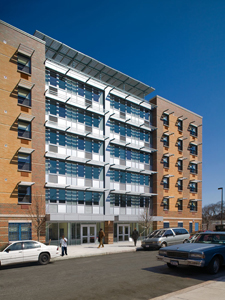
David and Joyce Dinkins Gardens

David and Joyce Dinkins Gardens.

Dattner Architects

Doors opened on the new David and Joyce Dinkins Gardens housing development in Harlem, designed by Dattner Architects. Built on city-owned property, the project is designed to meet the community’s social and environmental needs. The building includes 85 studio to two-bedroom apartments for low-income families and youths aging out of foster care, a first floor community center, and a landscaped community garden. The masonry bearing wall and pre-cast concrete plank building is organized into bays of contrasting brick colors. Two recessed, glazed window wall bays are inserted into the brick façade intended to mark the residence and community center entries and open the façade to the community.

Sustainable features include: a green roof with a solarium, rainwater harvesting system to irrigate the garden, sunshades, low-flow plumbing fixtures, recycled materials, and enhancement of indoor air quality through insulation and ventilation. The project was co-developed by Jonathan Rose Companies and Harlem Congregations for Community Improvement (HCCI).


New School Building Wins Gold

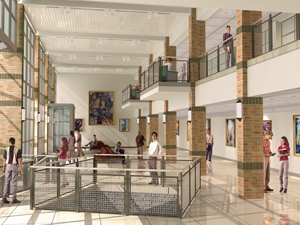
Manhattanville College

Student Center at Manhattanville College.

Peter Gisolfi Associates

A new 24/7 student center at Manhattanville College in Purchase, NY, designed by Peter Gisolfi Associates, recently opened. Sited near Reid Hall, a McKim Mead & White building, and adjacent to the existing dining hall, student post office, and college store, the new three-story, 31,000-square-foot building acts as a gateway to the campus, defining a new quadrangle that is part of the entry sequence to the center of the campus. New spaces include the student radio station, a multipurpose performance space, student lounge, campus art gallery, dance studio, graphic arts labs, and a recreational fitness center on most of the top level. The building has won LEED Gold certification.


A Barfly Lands in the East Village

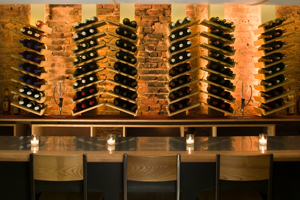
Bar Solex

Bar Solex.

OPUS Interdisciplinary Design Studio

The design for Bar Solex, a French wine bar in the East Village, was inspired by the fuselage of the Concorde, the caves of Lascaux, and a lightweight French moped that is its namesake. The entry to the 15-foot-wide storefront space, designed NY- and Rome-based OPUS Interdisciplinary Design Studio, is via an existing aluminum and glass façade. The transition to the inside is facilitated by an extension of the exterior storefront’s bronze brown color and exposed cast iron column and brick walls. Patrons are greeted by an engineered lightweight, vaulted, illuminated wing ceiling that forms the 55-foot-deep space. Travel themes abound — a stainless steel counter with solid birch bull nose adds to the wing metaphor, columns evoke the repetition of milestones along a highway, and the pattern of 60 tire treads are laser cut into masonite tiles, creating a high-tech mural.


New Office Thinks It’s a Bar

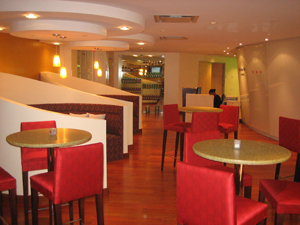
Northeast Regional Office of Heineken

Northeast Regional Office for Heineken USA.

MKDA

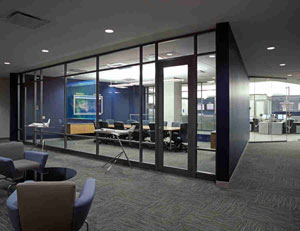
NYC and Stamford, CT-based MKDA has completed work on an 11,000-square-foot office for the Northeast Regional Office of Heineken in downtown Stamford. The new space for the light beer importer has a light green hue and is highlighted with Maplewood and brushed chrome accents. A curved and canted white glass partition divides the back office from the 1,500-square-foot bar and reception area, outfitted with wood flooring, high-top tables, banquettes, pendant lighting fixtures, sheetrock ceilings, and an illuminated glass bar. The office also includes a “think” room designed with amber-colored accents, soft illumination, and upholstered chairs with tablet arms to enhance creativity and camaraderie among employees.


Office Expansion for a Private Jet Business

CitationShares Offices

CitationShares Offices.

Photo by Adrian Wilson

The construction of new office space for CitationShares, a division of Cessna Aircraft Company specializing in fractional jet ownership and jet card membership, is underway. Gerner, Kronick + Valcarcel, Architects (GKV Architects), is responsible for space evaluation, programming, and full architectural services. The project expands existing office space, and incorporates open plan workspaces, and flexible training rooms. Construction is scheduled for completion this May.