Gallery Hours
Monday–Friday: 9:00am–8:00pm, Saturday: 11:00am–5:00pm, Sunday: CLOSED

Join an Architalker for a Hosted Tour of Center for Architecture
Exhibitions

Join us for free Architalker-hosted tours of the Center for Architecture exhibitions Fridays at 4:00pm. To join one of these tours, meet in the Public Resource Area on the ground floor of the Center for Architecture.

CURRENT EXHIBITIONS


April 9-July 7, 2007

2007 AIA New York Chapter Design Awards

Galleries: Kohn Pedersen Fox Gallery, HLW Gallery, South Gallery, Edgar A. Tafel Hall

Related Events

Monday, February 12, 2007, 6:00–8:00pm
Symposium

Monday, April 9, 2007, 7:00–10:00pm
Opening

Wednesday, April 11, 2007, 11:30am–2:30pm
Luncheon

A showcase of the 2007 award-winning projects in three categories-Architecture, Interiors, and Projects. Selected from hundreds of international, national and local submissions, these projects spotlight the extraordinary achievements in architectural design excellence happening in New York City and around the world.

Exhibition and Graphic Design: Graham Hanson Design

Organized by: AIA New York Chapter and the AIA New York Chapter Design Awards Committee

Benefactor: DIRTT,
Oldcastle Glass


DIRTT

oldcastle
 

Patron:

HOK,
Microsol Resources,
F.J. Sciame Construction,
Laticrete International,
Trespa


HOK

Microsol Resources

Sciame


Laticrete International

Trespa

Lead Sponsor: Certified of New York, Inc., Columbia, KI, Langan, Mancini Duffy, Richter + Ratner, Syska & Hennessy

Cert Columbia KI Langan
Mancini Duffy Richter + Ratner Syska & Hennessy  

Sponsors:
Atkinson Koven Feinberg; Bauerschmidt & Sons, Inc.; Bentley Prince Street; Beyer Blinder Belle: Architects and Planners; Cosentini Associates; Costas Kondylis & Partners; Forest City Ratner Companies; FXFOWLE ARCHITECTS; Gensler; Gilsanz Murray Steficek; Haworth; Hopkins Foodservice Specialists, Inc.; The I. Grace Company, Inc.; Ingram, Yuzek, Gainen, Caroll & Bertolotti; Lutron; Mechoshade Systems; New York University School of Continuing and Professional Studies: The Real Estate Institute; Perkins + Will; Peter Marino Architect; Skidmore, Owings & Merrill; Steelcase, Inc.; Studio Daniel Libeskind; Swanke Hayden Connell Architects; Thornton-Tomasetti Group; Turner Construction


April 12–June 23, 2007

NY 150+: A Timeline
Ideas, Civic Institutions, and Futures

Galleries: Gerald D. Hines Gallery


AIA 150 Logo

Related Events

Thursday, April 12, 2007, 7:00–10:00pm
Opening

To commemorate the 150th anniversary of the founding of the American Institute of Architects in New York City, the AIA New York Chapter will feature an exhibition charting the transformation of the city and the profession from 1857 through the present and into the future. Genetic lines tracing the founding of the institute will intersect with various democratic and social movements and the architecture of New York’s civic structures.

Curator: Diane Lewis

Organized by: Organized by the AIA New York Chapter and the Center for Architecture Foundation

Exhibition Underwriters:


*opening presented by Ibex

The exhibition is supported in part by an Arnold W. Brunner grant from the AIA New York Chapter

Additional support is provided by: Peter Schubert, AIA; FXFOWLE ARCHITECTS


March 22 to June 16, 2007

POWERHOUSE
New Housing New York

Galleries: Street Gallery, Public Resource Center, Judith and Walter Hunt Gallery, Mezzanine Gallery

Dattner_Grimshaw_LR
Winning proposal
Phipps Rose Dattner Grimshaw

Related Events

Monday, April 9, 2007, 6:00 – 8:00pm,
CES 1.5, HSW
Panel Discussion with Winning Team
and Honorable Mention Team

Wednesday, April 11, 2007, 5:30 – 7:30pm
384 East 149th St., Bronx, NY, 3rd Floor
BX Community Board 1 Presentation

Saturday, April 14, 2007, 1:00 – 4:00pm
FamilyDay@theCenter: House + Home

Saturday, April 14, 2007, 12:00 – 2:00pm
1040 Grand Concourse at 165th St., Bronx, NY
FamilyDay@the Bronx Museum of the Arts
www.bronxmuseum.org

Monday, April 16, 2007, 6:00 – 8:00pm, CES 1.5, HSW
Panel Discussion with Three Finalists

Wednesday, May 16, 2007, 6:00 – 8:00pm, CES 1.5, HSW
NHNY: Best Practices for Affordable Sustainable Housing –
What worked, what didn’t?

Making Green Design More Accessible
TBD, CES 1.5, HSW

Power House illuminates the people, projects, and public policies that fuel the affordable housing landscape in New York City.

As New York City’s first juried design competition for affordable, sustainable housing, the New Housing New York Legacy Project (NHNY) is generating creative, replicable approaches to urban development. The exhibition focuses on the NHNY competition and sets it within the context of the city’s efforts to preserve and development sustainable, financially viable residences for low- and middle-income New Yorkers. The show’s emphasis is on the future of housing in the city, as represented by the competition winner, Phipps Rose Dattner Grimshaw (Phipps Houses / Jonathan Rose Companies / Dattner Architects / Nicholas Grimshaw & Partners), the four finalists, and the development mechanisms put in place by Mayor Bloomberg’s 10-year New Housing Marketplace initiative and the Department of Housing Preservation and Development.

Building on the 2004 New Housing New York Ideas Competition, the 2006 two-stage contest will result in construction of the winning design on a 40,000 square-foot Bronx site, which is valued at $4.3 million and was donated by The City of New York.

For the full list of finalists click here

Curator: Abby Bussel
Exhibition and Graphic Design: Casey Maher

Organized by: AIA New York Chapter,
New Housing New York Steering Committee and the
City of New York Department of Housing Preservation and Development with the additional support of the Center for Architecture Foundation and the AIA New York Chapter Housing Committee

Exhibition Underwriters:


Exhibition Patron:


For more information on the New Housing New York Legacy Project click here

NHNY is a partnership between the American Institute of Architects New York Chapter, the City of New York Department of Housing Preservation and Development, and the New York State Energy Research and Development Authority. Additional support is provided by the Center for Architecture Foundation, and City University of New York.

The NHNY Legacy Project is sponsored by the New York State Energy Research and Development Authority, the National Endowment for the Arts, Enterprise Community Partners, Inc., an AIA National Blueprint Grant, JP Morgan Chase, and Citibank.


March 22 — June 2, 2007

Making Housing Home

Photographs with residents of New York City housing developments

Galleries: Library


Norma’s House
Gabrielle Bendiner-Viani

Related Events

Saturday, April 14, 2007, 1:00 – 4:00pm
FamilyDay@theCenter: House + Home

This photographic exhibition explores how people inhabit housing to create homes in two of New York City’s affordable housing developments, each of which were developed to provide good homes for all. Because units of housing are in essence homes for families, this project takes an interior look at what architecture can allow and support, to afford the crucial process of making space for oneself within designed spaces and housing markets. If social housing reflects the social covenant of our society, what is it to which every citizen is entitled? What does it take for a life to flourish and can a building help or hinder this process? What becomes of designed spaces once they are inhabited?

An Installation by Gabrielle Bendiner-Viani

Exhibition underwriters: Related Apartment Preservation, 42nd Street Development Corporation, Barbara Stanton

Organized with: Center for Human Environments, Housing Environments Research Group, The Graduate Center, CUNY

Exhibition Announcements

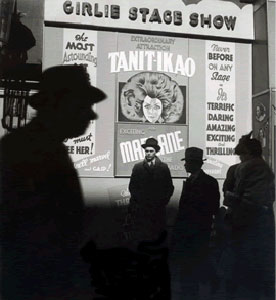
Burlesque House, 1942

Burlesque House, 1942.

Courtesy Times Square Alliance

Through 04.30.07
Times Square Through the Lens

This free exhibition includes more than 40 Times Square photographs culled from The New York Times archives, including teenagers screaming at the arrival of the Beatles; the USO serving doughnuts and coffee to WWII soldiers; crowds and cameras at the opening of the film, “The Sound of Music.”

Times Square Information Center
7th Avenue between 46th and 47th Streets


New New York: Fast Forward

Courtesy Architectural League of New York

Through 05.05.07
New New York: Fast Forward

The Architectural League of NY presents the fifth in ongoing series of exhibitions highlighting new architecture in NY. A snapshot of the changing city, this exhibition serves as an opportunity to evaluate and inform the current wave of redevelopment, and hopes to encourage more informed discussion. The centerpiece is a gallery-sized map, an aerial photograph of the five boroughs, featuring more than 500 projects, ranging from single buildings to neighborhood rezoning, now under construction or being planned. In addition, the exhibition looks at three areas that are undergoing particularly significant change: High Line District, Bronx River Greenway, and Spring Creek Housing. Included is a series of videotaped interviews with a cross-section of NY architects, ranging from emerging designers to internationally-recognized figures.

Urban Center
457 Madison Avenue


The Sims

Courtesy The Chelsea Art Museum

04.19.07 through 05.12.07
The Sims: In the Hands of Artists

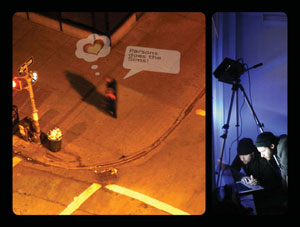
Using the world of the popular video game, “The Sims,” as inspiration, Parsons The New School for Design presents an exhibition of work by students in its Design and Technology, Communication Design, and Illustration programs. Works combine the art forms of “machinima” (using a game engine to produce animations or films), physical computing, interactive media, 3-dimensional printing, and traditional media.

The Chelsea Art Museum
556 West 22nd Street at 11th Avenue


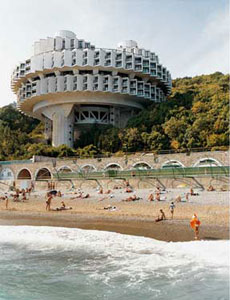
“Druzhba” holiday camp

“Druzhba” holiday camp (Yalta, Ukraine, 1985 — Architect Igor Vasilevsky).

Courtesy Storefront for Art and Architecture

04.24.07 through 05.26.07
CCCP — Cosmic Communist Constructions Photographed

During the course of his travels in the former Soviet Union over the past five years, French photographer Frederic Chaubin has documented architectural artifacts born during the last 20 years of the Cold War. Some architects in the peripheral regions of the Eastern Bloc countries, working on governmental commissions during the 1970s and 1980s, enjoyed a degree of creative freedom, drawing inspiration from expressionism, science fiction, early European modernism, and the Russian Suprematist legacy. As well as presenting the architecture itself, the exhibition traces the intellectual and political undercurrents.

Storefront for Art and Architecture
97 Kenmare Street, NYC


C&G Partners Green Exhibition

C&G Partners

Through 07.13.07
AIA America’s Favorite Architecture Green Exhibition

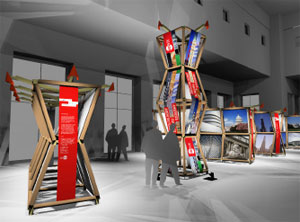
NY-based C&G Partners has designed a “green” exhibition system created for “America’s Favorite Architecture,” a traveling exhibition presented by the AIA. The lightweight, compact system incorporates sustainable materials and recyclable components. An interactive web site, also designed by C&G Partners, accessible at kiosks within the exhibition, allows visitors to vote for their own favorite architecture at each location.

AIA Washington DC Headquarters
1735 New York Ave., NW, Washington, D.C.
and at AIA’s National Convention
San Antonio, TX, from May 3-5, 2007.

04.03.07

04.03.07

Next week is Architecture Week! Included among the many celebratory events is a plaque unveiling at the site where the founding of the AIA took place — 111 Broadway (the Trinity Building) designed by Francis Hatch Kimball. Stop by at 6:00pm, Friday, April 13. And check out the AIA NY Chapter’s online calendar for more related events.
– Jessica Sheridan, Assoc. AIA, LEED AP

The Rise of Starchitecture: Who to Blame (or Credit)

Event: 2007 Temko Critics Panel: A Critical Situation: What to Make of Starchitecture, And Who To Blame For It
Location: Baruch College, 03.28.07
Speakers: Karrie Jacobs and Philip Nobel — Contributing Editors, Metropolis; Jeremy Melvin — Architectural Review, consultant to Royal Academy of Arts Architecture Program, London; Rowan Moore — Director, The Architecture Foundation, and critic for Evening Standard, London; Moderator: Joseph Grima — Director, Storefront For Art and Architecture
Sponsors: Forum for Urban Design and the Lincoln Institute of Land Policy; hosted by the Newman Institute for Real Estate Studies, Baruch College

photo by Kristen Richards

Temko Critics Panel (l-r): Jeremy Melvin, Philip Nobel, Rowan Moore, Joseph Grima, and Karrie Jacobs.

Kristen Richards

“I’ll jump into the deep end: starchitecture isn’t such a bad thing,” moderator Joseph Grima posited to the panel of design journalists and critics. “It’s good for your profession — it gives you something to write about.” Using Frank Gehry, FAIA, as an example of a global brand, he asked, “Are journalists to be blamed or credited?”

Jeremy Melvin, author of Isms: Understanding Architectural Styles (Universe 2006), commented that the conversation has been the same for the last 100 years, and will be the same for the next 100. The problem, as he sees it, is that in the last 15 to 20 years, there’s been more money to spend on architecture, causing “brand inflation.” He cited the Gazprom Tower competition as a “significant” example: “Invite all the same architects, and the winner is RMJM, a firm not that well known outside of the U.K. The design was not very good, but not worse than the others.” But it was a competition where “the quality of design dissolved.”

Philip Nobel asked if there is a connection between celebrity and quality. Melvin responded, wryly, that “celebrity can be achieved without doing anything,” yet there’s also the “irony” of those who reach “hyper-celebrity” because they have huge organizations behind them (he finds Norman Foster looking to sell his firm for £500 million “absurd”). Nobel pointed out that Zaha Hadid came to celebrity through her art and media buzz — which “is problematic — does that mean it’s good or just photogenic?”

Grima wondered if there’s complicity between architects and the press. Rowan Moore sees a “major shift in the scale of the phenomenon of starchitecture” where “clients and architects are controlling access to those they know will be positive; the balance of power has changed.” He said it boils down to “persuasion and charm, similar to the games fashion houses play.” Karrie Jacobs agreed, saying developers are buying into starchitecture in a big way, with “Broadway-style lists of credits in real estate ads. As architecture is recognized by popular culture, it becomes less the domain of a small group of experts and opinion makers.” She suggested someone should draw up a chart of how much a starchitect’s name adds to the square-foot value of a project.

To Grima’s question, “Has any building been killed by the press?” With a devilish grin, Melvin answered, “I’ve done quite a bit of slaughtering. Critics should be in the business of criticizing. Otherwise, what’s the point?” He later said that if the art world has experts who authenticate artworks, “why not have critics to authenticate good design?”

Grima then asked the panel if starchitecture has replaced what used to be “movements” or “isms.” Moore said, “I’d rather have starchitecture than isms or ideologies as style. Maybe it is progress. Or maybe I’m being too optimistic.” Nobel countered that in architectural education, “what might be good about isms is you’d have something to teach — not graphic chicanery. There are victims here — us — when these juniors start building.”

Audience Q&A: Is starchitecture a good thing? Moore: “I don’t think it’s fantastic; it’s open to abuse, but it doesn’t kill people.” Melvin: “You’re being too kind. It can hurt people.” Jacobs: “Ostentatious, over-the-top buildings used to show off nationalism. It beats the hell out of an arms race.”

How do you teach a client to think differently about architecture, to make better choices? Moore: “Call out bad buildings and bad shortlists.”

Would a global economic downturn affect starchitects? Nobel: “They’re trying to build practices that are recession-proof. You won’t kill starchitecture.”

Infernal Affairs Bind Architecture, Cinema

Event: 3×3 A Perspective On China, Monthly Lecture Series: Part Eight — Conversation With Yung Ho Chang
Location: Center for Architecture, 03.19.07
Speaker: Yung Ho Chang — Principal Architect, Atelier Feichang Jianzhu (FCJZ) & Professor and Head, Department of Architecture at Massachusetts Institute of Technology (MIT)
Organizer: People’s Architecture
Sponsor: Center for Architecture

Atelier FCJZ

An installation of habitable cameras exemplifies Atelier FCJZ’s interest in creating framed and frameless perceptions of space and landscape.

Atelier FCJZ

Yung Ho Chang has hurdled conventional boundaries of place, culture, and professional specialization. Founder and principal partner of Beijing-based Atelier Feichang Jianzhu (FCJZ), he has also directed MIT’s architecture program since 2005. His trans-Pacific design career exemplifies an interdisciplinary ambition to complement history with modernity, landscape with buildings, and most recently, architectural rumination with popular film noir.

Chang presented a series of cinematic stills of his firm’s work superimposed with scenes from the Hong Kong film trilogy, Wu Jian Zao (Infernal Affairs, 2002-03), which inspired Martin Scorcese’s The Departed. FCJZ implanted stills from the original film with new objects and characters, such as a bicycle, a Van Gogh painting, or a mysterious hand and body. Simultaneously provocative and absurd, the vignettes mingle fiction with reality. Chang said he chose Infernal Affairs over the visually lush In the Mood for Love (dir. Wong Kar Wai, 2000) because he could tell the story with only a handful of images. He also cited the French New Wave movement and Alfred Hitchcock as cinematic inspirations.

This experiment represents Chang’s latest attempt to study and catalyze the act of perception. Long interested in Chinese scroll landscape painting as well as early Renaissance painting, photography, and film, he has designed exhibitions and buildings that challenge viewers to see their environs anew. For example, a landmark series of projects emerged from an enquiry into peepshow mechanics and Alfred Hitchcock’s classic take on urban voyeurism, Rear Window. In 2003, FCJZ worked with two video artists to create a series of giant, inhabitable sculptures modeled on Leica, Nikon, Polaroid, and Seagull rangefinder cameras.

This “Camera” exhibition helped fuel the design of the dramatic Villa Shizilin, a 45,000-square-foot home located in a rolling persimmon orchard outside Beijing. Chang conceived the house as an interlocking assembly of tapered, wedge-like volumes that function as focused lenses to frame views of the landscape. Drawing the viewer’s eyes horizontally along the landscape, the villa’s distinctly long, low window stripes recall the continuous, kinetic quality of scroll landscape paintings.

The work of Yung Ho Chang and FCJZ is the subject of the current exhibition “DEVELOP” on display at the MIT Wolk Gallery in Cambridge, MA, through 04.13.07.

Architects Say, “I’ll Do It My Way”

Event: Emerging Voices Lecture Series
Location: Urban Center, 03.22.07
Speakers: An Te Liu — artist, associate professor & director, Faculty of Architecture, Landscape, and Design, University of Toronto; Jared Della Valle, AIA, Andrew Bernheimer, AIA — Principals, Della Valle Bernheimer
Organizers: The Architectural League of New York

245 Tenth Avenue

The steel-and-glass cladding of 245 10th Avenue was designed to reflect light in patterns that vary by day and by season.

qubdesign, courtesy Della Valle Bernheimer

“I hate it and I’ve almost rid my life of it,” proclaimed An Te Liu about IKEA furniture. Jared Della Valle, AIA, and Andrew Bernheimer, AIA, have no fondness for the mass-market designs either. For them, buying from IKEA and scavenging from the trash were equally distasteful methods for furnishing their office in their early days.

But Liu confessed to liking the designs better with a few not-so-minor alternations. Ignoring IKEA’s arcane instruction sheets, he assembled the parts for a desk into an angular hanging sculpture; he also reconstituted table panels to form a striped wall mural.

Like Andy Warhol, Liu, an artist and director of the Faculty of Architecture, Landscape, and Design at the University of Toronto, is known for using mundane objects as building blocks for new, unexpected forms. Drawn to the cheery colors of 3M sponges, he used them to create walls and pillars in his Soft series. In another project, he constructed totemic pillars out of air purifiers. He appropriated a photo of Levittown as source material for endlessly repeating ornamental wallpaper — an ironic critique of the myth of individual autonomy within a vast built network of sameness, he explained.

Bernheimer and Della Valle, principals of Della Valle Bernheimer, also delight in reinventing familiar forms, but with a highly utilitarian bent. When their firm needed new office furniture, they decided to sidestep stores like IKEA and buy a CNC milling machine to make their own ultra-customizable modular table. The duo’s love of individual variation characterizes their condominium at 245 10th Avenue, whose textured, reflective façade resembles an ever-shifting steam cloud, and a residence in Connecticut that appears to float in the treetops that surround it.

Perhaps the perfect complement to Liu’s Levittown wallpaper was Della Valle Bernheimer’s recent affordable housing project in East New York. The firm strove to break the mold of cookie-cutter design in the collaborative project, built for a mere $108 per square foot but offering a high level of architectural variation. Instead of “I live in the third house down the block on the left,” the owner can say, “I live there,” Bernheimer said.

Though a cynical police officer once challenged him, claiming the houses were “too nice for this neighborhood,” he holds on to the hope that the development may have a regenerative effect on the area. Certainly it’s been a positive step for the first-time homeowners who are beginning to move in, a group of people whose houses are as diverse as they are.

Power House Greens Way for New Housing in NY

Event: Power House, New Housing New York Exhibition Opening
Location: Center for Architecture, 03.12.07
Curator: Abby Bussel
Exhibition and Graphic Design: Casey Maher
Organizers: AIA New York Chapter; New Housing New York Steering Committee; City of New York Department of Housing Preservation and Development; with additional support from AIANY Housing Committee
Exhibition Underwriters: National Endowment for the Arts; Duggal Visual Solutions
Exhibition Patron: Enterprise

The New Housing New York winning proposal.

The New Housing New York winning proposal.

Phipps Rose Dattner Grimshaw, courtesy AIANY

“The New Housing New York exhibition showcases the future of affordable housing in NYC: green, mixed-use, near transit, and on a remediated brownfield site. The designs presented make living look easy, and housing eminently buildable. Production is brought into historical context by a must-see timeline billboard and hands-on wheatboard library,” said Rick Bell, FAIA, Executive Director of AIANY, about the winning entry at the Power House exhibition opening.

The winning proposal for the New Housing New York Legacy Project (NHNY) — NYC’s first juried design competition for affordable, sustainable housing in the Bronx — organizes residential and retail spaces around a multi-functional garden at street level that spirals upward through a series of programmed roof gardens to a sky terrace. The gardens will be used for fruit and vegetable cultivation, passive recreation, and will provide storm water control and enhanced insulation. Design team, Phipps Rose Dattner Grimshaw (Dattner Architects/Grimshaw Architects) refer to their project as “Green Way” or “Via Verde,” and the estimated value, at $4.3million, will be donated by the City of NY.

The NHNY competition evolved from Mayor Bloomberg’s 10-year New Housing Market Place Plan with the Department of Housing Preservation and Development calling for a 150-unit, environmentally sustainable development with open community space. A jury of architects, city commissioners, community representatives, and developers judged submissions using criteria that emphasize sustainable and healthy design principles.

An exhibition that highlights the future of housing featuring submissions to the New Housing New York Legacy Project (NHNY) can now be seen at the Center for Architecture through 06.09.07. Power House exhibits the winners as well as four finalists: Legacy Collaborative, comprised of The Dermot Company/Nos Quedamos/Melrose Associates (Architects: Magnusson Architecture and Planning (MAP)/Kiss + Cathcart (K+C); Women’s Housing and Economic Development Corporation (WHEDCo)/Durst Sunset (Architects: Cook+Fox Architects); BRP Development Corporation (Architects: Rogers Marvel Architects); and SEG + BEHNISCH + MDA (Architects: Behnisch Architekten/studioMDA). The Center is also hosting a number of panel discussions and events surrounding the exhibition. See On View at the Center for Architecture for more information.

Tsao & McKown Weave Designer Threads

Event: The Gil Oberfield Memorial Lecture
Location: Center for Architecture, 03.15.07
Speakers: Calvin Tsao, FAIA, Zack McKown, FAIA — partners,Tsao & McKown Architects
Organizer: AIA NY Interiors Committee

Tsao & McKown Architects relies on pragmatic solutions to guide each project’s style. With a portfolio of work ranging from custom furniture and retail installations to architecture and urban design, designs may seem theoretically and geographically scattered, but they ultimately find common ground. So with the ambitious opening “We want to dare to traverse…where we find the thread of connection to link all of our endeavors together,” co-founders Zack McKown and Calvin Tsao, FAIA, began a dizzying retrospective of their partnership. Though the duo identified upwards of a dozen concepts that influence their projects, the ideas that resonated most were the firm’s attention to interconnectivity and spirituality.

The firm is constantly investigating “the soul behind the style,” according to Tsao. For the master plan of Suntec City on the outskirts of Singapore, Tsao & McKown used the mandala as an organizing principle. While the circular form of the mandala has cosmological significance specific to Hindu and Buddhist religions, it also speaks to harmony among scales. In Suntec City, a central water element focuses and links five new buildings with interstitial commercial spaces tying together large and small elements into one system. At the River Lofts Condominium complex in Tribeca, the designers were challenged to provide a different type of linkage — tying together a new residential building with a renovated warehouse. The project provided deep windowsills to give residents “a sense of dimension beyond their domain” said Tsao.

Images of their interiors projects reveal a modern vocabulary tinged with Victorian extravagance. In one project, a series of fabric-draped chandeliers perch above a sculptural atomic sunburst. Another residence features a fluttering of appliquéd butterflies springing from a bedroom headboard to “help the client dream better.” Tsao & McKown has the insight to divine what is human and universal about the design experience, while elevating it to a higher level.

TEVERETERNO Builds Bridge Between Rome, New York

Event: The Tiber Project: Rome; Rivers and Art as Catalysts for Urbanism: A Dialogue with New York
Location: Center for Architecture, 03.29.07
Speakers: Kristin Jones — President, Tevereterno; Gennaro Farina — Director of Historic Center, Department of City Planning, Rome; Patricia C. Philips — public art critic, Interim Director, Minetta Brooks; Meredith Johnson — Assistant Director, Minetta Brooks; Michael Fishman — advisory board member, Metropolitan Waterfront Alliance; Leni Schwendinger — Leni Schwendinger Light Projects; Moderator Ernest Hutton, AICP, Assoc. AIA — Hutton Associates & New York New Visions
Sponsors: AIA NY Planning and Urban Design Committee; AIA NY International Committee

Courtesy Google Earth

TEVERETERNO exists between two parallel bridges along the Tiber River in Rome.

Google Earth

The Italian Cultural Institute described TEVERETERNO in the following terms. “Motivated by the conviction that art is a powerful catalyst for environmental awareness and urban renewal, TEVERETERNO is a unique multi-disciplinary project that aims to contribute to the revitalization of Rome’s Tiber River by establishing a lively public gathering place — the Piazza Tevere — on a central section of the Tiber between Ponte Sisto and Ponte Mazzini.”

Each year international artists are invited to create innovative, site-specific art installations to stimulate a dialogue between nature and the city, between history and present day. It is with these environmental works that TEVERETERNO aspires to contribute to the revival of rivers worldwide, according to its website. Currently, the project is a cornerstone to the new city plan developed by Rome’s Department of City Planning.

Continuing to engage with architectural initiatives abroad, the AIA New York Chapter organized a dialogue as a follow-up to the initial presentation at the Italian Cultural Institute, on March 26. Kristin Jones, President of TEVERETERNO, and Gennaro Farina, Director of the Historic Center in Rome’s City Planning Office, presented the project and a summary of current planning efforts along the Tiber River. Indeed, this sequence settling development on the heels of temporary installations symbolized the aspirations of TEVERETERNO itself.

A highly-sensitive site-specific intervention, TEVERETERNO could not be simply transported to New York, panelists noted. Rather, the Tiber River project has pedagogic value for New York City designers in its attention to undervalued and discarded waterfront properties, stated Michael Fishman of the Metropolitan Waterfront Alliance. One would need completely new artistic and formal concepts to develop projects along these lines in any of the five boroughs, responded Leni Schwendinger, partner of Leni Schwendinger Light Projects. In any case, Farina stressed that the main objective in such development remains a desire to bring the city to the river, and the river to the city. Participants of the question and answer period noted that the combination of the arts with public/government development in so called discarded spaces serve to greatly enliven cityscapes.

Earlier in the day, Jones, Farina, Fishman, and Anna Maria Rosati, TEVERETERNO’s Executive Director, met with the AIANY Emerging NY Architects Committee to begin a dialogue about creating a bi-continental international competition. Finally, a conference is being planned for this fall to pursue opportunities further.

Al Gore to Media: You’re Not Welcome; Media (somewhat) Amused

E-mail exchange between this writer and AIA National 03.23.07:

To: AIA National
Subject: Gore/AIA San Antonio

Hi AIA… I couldn’t find Gore keynote on schedule (or too bleary-eyed after pages of registration forms)…would you let me know when it is?

Fr: AIA National
RE: Gore/AIA San Antonio

He is speaking on May 5th at 3:30. But here’s the part that you’re not going to like. The agreement and contract…states that no members of the media will be admitted into the hall for Mr. Gore’s speech. I am not sure how His [sic] people or the management here at the AIA came to that agreement or more importantly WHY, but that’s what I have been told.

Apparently, the media is not allowed to attend any of Gore’s lectures. But that seemed beside the point, so I shared the above exchange with a number of design journalists across the U.S. Some of their responses are rather amusing (attribution has been omitted to protect both the innocent and not-so-innocent):

“Remember this the next time the AIA courts you for coverage!”

“Maybe he’s afraid of being Gored by the media???”

“Odd. What do you think he was going to talk about — state secrets revealed to the design profession? I personally think they should say no way, it’s open. His closing it does not reflect well on him, raises all sorts of issues.”

“Your e-mail has created a bit of a fuss around here. Either that or we’re all just really bored and want to go home! There’s also a huge, self-serving assumption here on the part of Gore’s people that the press would actually WANT to report anything he had to say. Kind of unintentionally hilarious, really.”

“I can’t believe that!! There’s a real lost opportunity on both sides.”

“A little birdy has told me that it’s Gore’s standard operating procedure these days. Don’t know if it’s because the content of his speeches are part and parcel of “An Inconvenient Truth” or not. Seems like a great way to annoy reporters, though, eh? You’d think that an old hand like Gore wouldn’t be afraid of the media at this point, wouldn’t you? I mean, he’s been through the most contentious election debacle in history, 8 years in the White House, etc. Strangeness.”

“He must be getting sensitive about his weight!”

“FYI this is standard @#$%-up practice by some at conventions. The directive to keep out the press would definitely come from Gore. Just goes to show you — he’s still a politician.”

“Why can’t they just show the movie?”

“I have no idea what’s up with Al, except he needs to go on a diet!”

“Keystroke slip — “His” with a cap letter might explain it all. The man IS surely running for president; he’s just waiting for Hillary and Obama to bore everyone to death. Having pesky press would destroy the neutral statesman/guru aura they’re working hard to inculcate.”

“Very strange. How enforceable is this?”

“This IS pretty strange. I guess the question is — are Gore’s comments off the record and cannot be reported? What in God’s name is he going to say that we haven’t heard already?????”

“Very strange indeed. A public and well-reported meeting between Gore and AIA members would have been terrific. I wonder whether the handlers around Gore are way too aggressive for his own good. I’m not close enough to the process to know whose interests are served by non-public events like these, but it looks too close to paranoia from here.”

“Interesting to compare this news with the big reach-out the AIA is doing to news media by conducting a Roper Poll on what we/media think of them.”