Architects Encouraged to Aid Poor at Awards Lunch

Event: 2007 AIA New York Chapter Design Awards Luncheon
Location: Gotham Hall, 04.11.07
Organizers: AIANY

Design Awards Luncheon

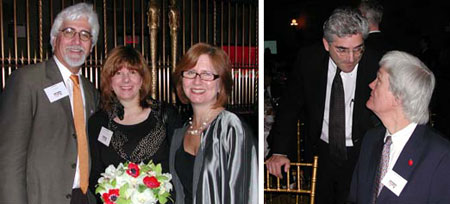
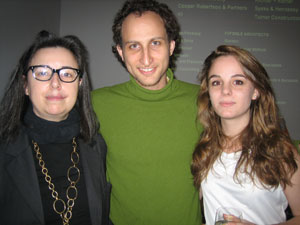
(Left) (l-r): R.K. Stewart, FAIA, Ronnette Riley, FAIA, and Elisabeth Martin, AIA at the Design Awards Luncheon.
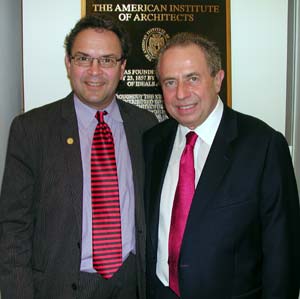
(Right) Ken Drucker, AIA, Design Awards Lunchen Chair with James McCullar, FAIA, AIANY First Vice President/President Elect.

Kristen Richards

As the 2007 AIANY Design Awards Luncheon Chair, Ken Drucker, AIA, welcomed more than 700 attendees to the second annual event held this year in the jewel-like setting of Gotham Hall. AIANY Chapter President Joan Blumenfeld, FAIA, IIDA, then introduced the celebrated graphic designer Milton Glaser, the keynote speaker who was both witty and profound.

Years ago, Glaser made a list of the hierarchy in the field of visual arts: “First painter, then architect, although I think this relationship may be reversed at this moment, with the architects at the very top.” Then, in descending order, city planner, industrial designer, graphic designer, book designer, editorial designer, art director, advertising designer, craftsman, and commercial artist. “It is unusual for you all to have invited me to speak at this occasion since; in general, speakers from the top of the list are conventionally selected to speak to those below.” The common thread he found is that “all of us engaged in the ‘applied arts’ play the game of reconciling utility and beauty.”

Glaser then explored, in words and with beautiful illustrations, how serious practitioners attempt to balance left brain/right brain, art/work, material/spiritual. “I’m often surprised how passively architects and designers react to the political situations that affect their lives,” he lamented. He speculated that it could be due in part to “a latent response to McCarthyism, a dark moment in our political history,” and that “our political timidity might be that our affluent clients are either uninterested or hostile to our social opinions.” He offered one small way to change the world that “is both transformative and risk-free”: Kiva, a microfinance organization that that matches micro-loans (as small as $25) with impoverished people working their way out of poverty.”We all can help create a benign revolution that will shape our collective future,” he concluded.

Meier’s Museums Bring Light to Communities

Event: Inaugural Arthur Rosenblatt Memorial Lecture for Excellence in Museum Design featuring Richard Meier, FAIA: On Museums
Location: National Academy Museum, 04.12.07
Speaker: Richard Meier, FAIA — Richard Meier & Partners, Architects
Additional Comments: Annette Blaugrund, Ph.D. — Director, National Academy Museum and School of Fine Arts; ; Gerald Gurland, FAIA; Nicholas Koutsomitis, AIA — principal, Koutsomitis, Architects; Stan Ries — photographer
Organizer: AIANY Cultural Facilities Committee
Sponsors: Kevin Roche John Dinkeloo and Associates; National Academy Museum; The Cantera Stone Source; Fisher Dachs Associates and Fisher Marantz Stone; RKK&G; AltieriSeborWieber Consulting Engineers; Devrouax + Purnell; Koutsomitis, Architects; Springboard; Edison Price Lighting; Pilkington; Charles J. Rose; Thornton Tomasetti; Paul Rosenblatt, AIA; The Luis A. Ferre Foundation; Mr. and Mrs. Luis A. Ferre; The Slovin Foundation; Pentagram

J. Paul Getty Museum

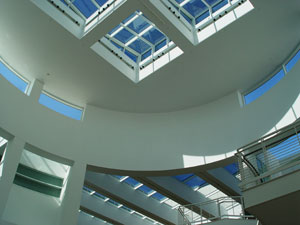
The J. Paul Getty Museum in Los Angeles — Richard Meier’s masterpiece.

Andrew Yip

“Every museum is different, and the life of every museum is different,” said Richard Meier, FAIA, whose Pritzker Prize-winning career designing international iconic museums began, ironically, with a project he did not win. Meier presented the inaugural presentation in a new annual lecture series honoring the late Arthur Rosenblatt, FAIA, founding chair of the AIANY Cultural Facilities Committee and man who interviewed with Meier for the failed project. Rosenblatt served under Metropolitan Museum of Art director Thomas Hoving as vice president for facilities during the heyday of the Museum’s modern expansion era.

The museum is more than a repository of art; it is a social center that integrates indoor and outdoor space, according to Meier. The Applied Art Museum in Frankfurt, for example, has become a hub for expectant mothers (although they tend to ignore the artworks). For Barcelona’s Museum of Contemporary Art, Meier picked the “worst place in the city,” and transformed the space. Echoing Paris’s Centre Pompidou, the adjacent plaza is now used by the whole community — from skateboarders to the elderly who watch them.

Natural light has always been very important to Meier, but it is something that must be negotiated to preserve artwork. One way is by separating exhibition and circulation spaces. He created a sense of propulsion in Atlanta’s High Museum of Art with a circular ramp around the atrium influenced by the Guggenheim Museum. The naturally lit core is separated from the art by the circulation ramp. The Beverly Hills Gagosian Gallery features rotating exhibitions; natural light is incorporated throughout, as the art is not exposed to sunlight for extended time periods.

Perhaps the apex of Meier’s outlook on natural light, social space, and circulation is the J. Paul Getty Museum in Los Angeles. The project had a controversial beginning because neighbors did not want to “see, smell, or hear it.” Meier’s solution was to build atop a hill, affording views of the ocean and the desert. With a “decompression zone” at the entrance, there is heavy emphasis on plaza space. Taking advantage of the California climate, the museum consists of clustered courtyards and buildings. The boundary between interior and exterior space blurs. The use of stone achieves a sense of permanence and solidity. Though initially dubious about travertine, Meier learned through trial and error how to achieve the desired texture. Of the Getty, Meier said, “There will never be another one like it.”

Museums have the potential to be both public and private spaces. Meier’s success lies in engaging the challenge to create both intimate viewing experiences and social spaces.

Portfolios Set Six Young Firms Apart

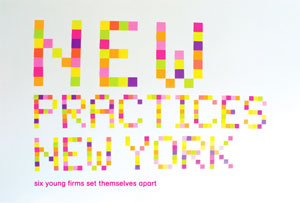
Event: New Practices New York: 06 Views/06 Positions
Location: Center for Architecture, 04.04.07
Speakers: Matthew Bremer, AIA — Architecture In Formation; Mark Foster Gage — Gage/Clemenceau Architects; Gordon Kipping, AIA — G Tects; Tobias Armborst — Interboro Partners; Amale Andraos — WORK AC; Marianne Hyde — Zakrzewski Hyde Architects
Moderator: William Menking — Founder & Editor, The Architect’s Newspaper & New Practices Showcase Jury Chair
Organizer: AIA NY New Practices Roundtable 2007; The Architect’s Newspaper
Sponsors: Häfele America; MG & Company; Fountainhead Construction; Microsol Resources

Courtesy Center for Architecture

Courtesy Center for Architecture

Much of winning the New Practices New York Showcase competition depended on how successful the submitted portfolio appeared to the judges. “It’s more important how it looks on the page,” explained jury chair William Menking, founder and editor of The Architect’s Newspaper. Some of the portfolios reviewed were “really bad.” So what do jurors look for in a good portfolio?

Firms could submit up to 10 projects, but most submitted fewer. Portfolios had to be in an 8 1/2″ x 11″ format, leaving limited space “to make someone fall in love with you,” said Mark Foster Gage of Gage/Clemenceau. Matthew Bremer, AIA, of Architecture In Formation approached the portfolio design process as a way to “say the most with the least.” Amale Andraos of Work AC looked for outside assistance — she and partner, Dan Wood, AIA, hired a graphic designer to “read” the firm and establish guidelines for their portfolio.

Emerging architects are often confronted with the issue of how to present their work, often choosing to collaborate with others or with a more established firm. Interboro Partners didn’t show any built work. They followed a strategy that “started out with a thesis and then tried to support it,” according to firm principal Tobias Armborst. Marianne Hyde of Zakrzewski Hyde Architects explained that she and her partner/husband, Stas Zwkrzewski, used a timeline at the beginning of their portfolio to clarify their professional careers.

The New Practices New York competition provides a forum and resource for recently established architecture firms. An exhibition was held at the Center for Architecture in March 2006, and each firm creates an installation at the Hafele Showroom. The next installation in May will be constructed by Work AC, and a discussion with the firm’s partners will occur at the Häfele Showroom May 10. Click the link for more information.

Calling All Designers: Get a Piece of Your PIE

The AIANY Chapter has finally taken the next step toward becoming a “Center for Architecture” with this week’s launch of the Public Information Exchange (PIE). Designed to create an archive of NYC projects, proposals, programs, and exhibitions, it aims to foster discussion among those in and outside of design professions. Many times I have longed for a resource that presents the latest building projects in the city, and PIE shows great potential — on the condition that architects, planners, and developers become actively involved in its maintenance, as described below.

PIE allows design professionals to post their projects. Each project page is interactive, complete with photographs, historic images, drawings, and plans. There are links to published articles, external resources, government documents, alternate submissions if the project was part of a competition, and sometimes fly-through animations. Google Maps show the location of each project, so anyone can compile a private walking tour of current projects throughout the city (something I can’t wait to do as the site grows). Most important is space for public comment. With an RSS feed, you can keep updated on the latest developments, responses, and upcoming events. This October, an information booth, designed by Grimshaw and housed at the Center for Architecture, will serve as a physical manifestation of PIE.

Dialogues will continue as the website expands and more information is added. Currently, the featured projects are Governors Island Redevelopment (Governors Island Preservation and Education Corporation), the winning entry of New Housing New York competition (Phipps Rose Dattner Grimshaw), and the New York Times Building (Renzo Piano/FX FOWLE Architects). These major projects are important, but I hope projects that are lesser known will soon be added. The only way the website will succeed is if design professionals take ownership of the site and become proactive in updating the site with their latest projects.

As the website expands, I anticipate additional features. At the moment, the only public interaction is through the comments. I hope that the site will soon allow anyone to upload images (I have some nice photographs of the New York Times Building that I would like to post), or link to articles (I could post a link to this issue’s article on the New Housing New York discussion). As much as the site depends on public contributions, it also must evolve to spur the level of participation. PIE could become as useful for the design profession as Flickr is for photography or the Lonely Planet is for tourists.

AIANY and Local Projects (of StoryCorps fame) developed PIE, with support from the National Endowment for the Arts, Carnegie Corporation, Graham Foundation for Advanced Studies in the Fine Arts, The City Council of New York, and the Center for Architecture Foundation.

In this issue:
·Historic Ellis Island Ferry Building Reopens
·Long Island: Tech Hub of the Future?
·From Horses to Humans: Historic Stables To Become Apartments
·Turn Courthouse Into Two Schools
·Casino Brings High Class Play to Atlantic City
·Stern About Town
·Sliver of Luxury on 48th and Eighth


Historic Ellis Island Ferry Building Reopens

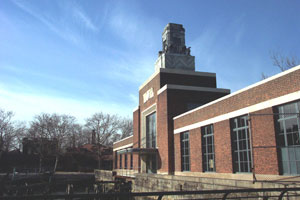
The restored Ellis Island Ferry Building.

The restored Ellis Island Ferry Building.

Photo by NPS/Kevin Daley

After 50 years of deterioration, and a $6.4 million restoration, the Ellis Island Ferry Building greeted its first visitors during a celebration earlier this month. The Art Deco-style building served as the departure point for immigrants traveling to new homes in New Jersey and lower Manhattan. The 5,500-square-foot terminal was built in 1934 to replace an earlier dilapidated wood structure. The exterior work involved extensive masonry repairs, a new roof, and the restoration of the steel windows and ornate lead-coated copper cupola. Interior work included detailed restoration of historic finishes and fixtures, such as the decorative plaster cornice, terracotta wainscot, terrazzo flooring, and a large bronze chandelier. In addition, new electrical, HVAC, and fire protection systems were installed.

The restoration is a project of the Albany office of Einhorn Yaffee Prescott for Save Ellis Island, Inc. and the National Park Service, and was executed to meet the Secretary of the Interior’s Standards for Historic Preservation.


Long Island: Tech Hub of the Future?

CEWIT

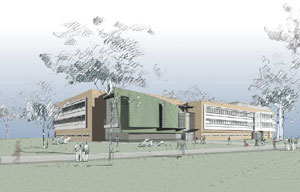
The Center of Excellence in Wireless and Information Technology at Stony Brook University.

Mitchell/Giurgola Architects

Construction is underway on the Mitchell/Giurgola Architects-designed Center of Excellence in Wireless and Information Technology (CEWIT) at Stony Brook University. The 100,000-square-foot facility will operate as a cutting-edge research center for both wireless and wired technology. Services will be available to companies seeking wireless or IT research and development, from industries such as healthcare, transportation and logistics, mobile commerce, financial services, and manufacturing. Construction of the CEWIT is part of a statewide economic strategy to make NY, and specifically the Long Island area, a global hub of the high-tech industry. CEWIT is intended to anchor a new research district where private/public partnerships can develop to aid the design and production of new concepts and products.


From Horses to Humans: Historic Stables To Become Apartments

The renovated American Express Stables

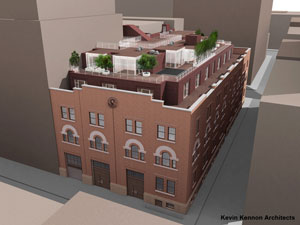
The renovated American Express Stables will incorporate a two-story addition with a 4,500-square-foot duplex penthouse.

Kevin Kennon Architect

Kevin Kennon Architect has received approval from the NYC Department of City Planning to renovate, enlarge, and convert the historic former American Express Stables built in 1866 into a luxury residential building. The existing three-story building will be transformed into a five-story, 75,000-square-foot, multi-family complex. As part of the renovation process, wooden joists dating back to 1898 will be restored and recycled into the flooring of new lofts, and found objects such as historic signs, stonework, and piping will be incorporated into the building’s design and artwork. Located in the North Tribeca Historic District, the project received approval from the New York City Landmarks Preservation Commission in 2005.


Turn Courthouse Into Two Schools

283 Adams Street

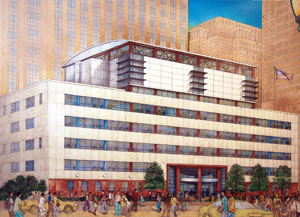
283 Adams Street in downtown Brooklyn will be converted into two schools.

Gran Kriegel Associates

Construction is under way to convert a 1951 former courthouse in downtown Brooklyn into two new 550-seat high schools, designed by Gran Kriegel Associates on behalf of the NYC Department of Education School Construction Authority. The specialized schools, one for law and justice (complete with wood-paneled courtroom), the other for math and science for young women, are for The Urban Assembly, a non-profit that creates small, public, college-prep high schools. The interior of the 140,000-square-foot building will be completely reconfigured. The deteriorating limestone exterior will be over-clad with a thin-stone façade system. A steel-framed, long-span joist rooftop addition, separated from the existing roof allowing for M/E/P distribution and noise isolation, will provide a multi-purpose room for sports and assembly. Construction on the $56 million project will be completed by the 2008-09 school year.


Casino Brings High Class Play to Atlantic City

Atlantic City’s latest casino design.

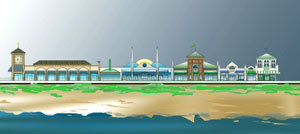
Atlantic City’s latest casino design.

Stantec

An entire block of the Atlantic City Boardwalk has been given to the New York office of Stantec (formerly Vollmer Associates) to design a casino contracted by the Casino Reinvestment Development Authority (CRDA). The design is intended to create a balance between fun and playfulness, elegance and sophistication, and takes cues from Eastern Seaboard pier architecture, Art Moderne, and the Mediterranean.


Stern About Town

The Brompton

The Brompton on the Upper East Side.

Courtesy Related Companies

On the heels of 15 Central Park West for Zeckendorf Development, Robert A.M. Stern Architects is designing the 22-story Brompton for Related Companies on the Upper East Side. Noted for its gothic-inspired red brick and limestone façade and dramatic arched entranceway with cherry wood paneling and marble floors that traverse two landscaped courtyards, the residences will range from studios to five bedrooms. Occupancy is to begin in fall of 2008.


Sliver of Luxury on 48th and Eighth

785 Eighth Avenue

785 Eighth Avenue.

Ismael Leyva Architects

An angular 43-story residential building, designed by Ismael Leyva Architects for 785 Partners with Esplanade Capital, will be rising on a thin slice of real estate on Eighth Avenue and 48th Street. The building will contain 122 condominium units, some with terraces, others with balconies. Outdoor rooftop terraces with hot tubs will adjoin the 43rd floor penthouse and 42nd floor apartments.

In this issue:
· New Mexico Ends Censorship of Interior Designers
· NYC Building Code Changes
· NCARB Surveys Architects for IDP and ARE
· Calling Associates! Post Picture, Win iPod Shuffle
· Students’ Structural Reality — in Marshmallow


New Mexico Ends Censorship of Interior Designers

New Mexico eliminated an unconstitutional restriction on the free speech of interior designers by amending legislation that prohibited designers from truthfully advertising their services. Senate Bill 535, signed by Governor Richardson on April 3, responded to a federal lawsuit brought on by the Institute for Justice in September 2006. Two NM-based interior designers were forbidden from accurately advertising their services because they did not hold a “free speech license” from the NM Interior Design Board.

The challenged law allowed anyone to work as an interior designer, but made it a crime for people not licensed by the board to use the terms “interior design,” and “interior designer.” The new legislation permits anyone who practices interior design to use the terms, and creates a new category called “licensed interior designer” for those who meet the credentials.

According to the Institute for Justice:

‘Title’ laws like New Mexico’s, which prevent people who lawfully perform interior design work from using that term to describe what they do, are the result of relentless lobbying campaigns by a small faction within the interior design community, as the Institute for Justice demonstrated in its study prepared by Director of Strategic Research Dick Carpenter, ‘Designing Cartels: How Industry Insiders Cut Out Competition.’ This small faction of industry insiders, unwilling to compete on a level playing field in a free market, pursues government overregulation in a naked attempt to demote their competitors to mere ‘decorators’ or ‘consultants’ by preventing them from using the term ‘interior designer’ without a license.


NYC Building Code Changes

The NYC Model Code Program is an effort undertaken by the NYC Department of Buildings to streamline and modernize the city’s building and electrical codes. Under the program, national model codes promulgated by leading technical organizations are reviewed. Working with local industry, labor, and real estate representatives, the model codes most appropriate for NYC are amended for use in the city and adopted as Local Law by the city council. After adoption, the Model Code Program and its Technical Committees review the codes every three years to ensure they remain up-to-date. The new code, drafted with the help of more than 400 industry figures — including architects, real estate developers, engineers, government officials, and union representatives — will be presented to the City Council later this month.

A recent article in the NY Sun (“Building Code Changes Could Increase Costs,” by Grace Rauh, 04.04.07) claims that these changes could end up increasing NYC’s already soaring construction costs.


NCARB Surveys Architects for IDP and ARE

Beginning April 9, National Council of Architectural Registration Boards (NCARB) certificate holders and American Institute of Architects (AIA) members may receive an e-mail invitation to participate in the 2007 Practice Analysis Survey. NCARB plans to collect data describing knowledge and skills necessary to practice architecture independently while safeguarding public health, safety, and welfare. The last study published in 2001 spurred the ongoing evolution of the Architect Registration Examination (ARE). Participation in this year’s survey will provide information for reviewing and updating the Intern Development Program (IDP) as well as the ARE.

Prometric, NCARB’s test development and psychometric consultant, will administer the survey. The results are anticipated to be distributed in early 2008. Those who do not receive the survey but would like to participate should contact Malia Stroble. Only registered architects may complete the survey and will need to provide proof of valid licensure in order to participate. The survey takes about 40 minutes to complete, according to one Chapter member who has done it.


Calling Associates! Post Picture, Win iPod Shuffle

New Associate members of the AIA out-number new AIA members five to one. To celebrate the future of the profession, the National Associates Committee (NAC) will display images of Associate members for the exhibition, AIA175, at the 2007 AIA National Convention in San Antonio.

Associates should post their images on the Flickr site and answer the following question: Who/What/Where will you be in 25 years when the AIA celebrates 175 years? The NAC will give away an iPod Shuffle to a randomly selected member on April 23. To post a picture, create a Flickr account and join the group, AIA175. Upload a 300-dpi image, enter name with all appropriate titles, and include a response to the question.


Students’ Structural Reality — in Marshmallow

Gravity-defying structures

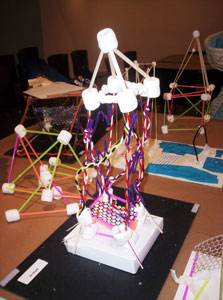
Results from the skyscraper design challenge.

Maggie Jacobstein

Students from the United Nations International School (UNIS) visited the Center for Architecture on April 5 to learn about skyscrapers and try their hand at building their own gravity-defying structures. The six-to-eight-year-old students have firsthand experience with skyscrapers — they live in them, visit their folks who work in them, and trek to observation decks. Visiting and appreciating tall buildings is one thing, but trying to build a structure that withstands the forces exerted by Center for Architecture Foundation’s Director Erin McCluskey is a tall order. McCluskey ran a strength test on a few of the models to see how well they stood up.

The skyscraper design challenge asked students to imagine a structure and bring their ideas into a 3-dimensional reality. Using straws, toothpicks, dowels, glue, tape, and even marshmallows as connectors, students experimented with a variety of shapes. Stacked frames tended to fall over until the students discovered the idea of cross bracing. Triangulated structural systems emerged to become tall buildings, castles, and other structures. Although McCluskey was careful not to push the designs to failure, the real test was whether the projects would sustain the bus ride back to school in one piece.

Design Podcasts Launched by SVA

The MFA Design Department at School of Visual Arts has launched a new podcast series. The “Designer as Author” features lectures by SVA faculty members like Milton Glaser and Paola Antonelli, along with guest speakers from the international design community, emerging designers, thesis projects, and student coursework. Topics range from book jackets to furniture trends. Click the link for more information, or subscribe to the RSS feed or iTunes.

Thirty-two design firms were pre-qualified in the second round of the Mayor’s Design + Construction Excellence Program (D+CEP). In the $10 million and under requirement contracts category, firms are: Andrew Berman Architect; Atelier Pagnamente Torriani; Caples Jefferson Architects; Charles Rose Architects; Christoff:Finio Architecture; CR Studio Architects; Garrison Architects; LARC Studio; Locascio Architect; Lyn Rice Architects; Marble Fairbanks; Marpillero Pollak Architects; Michielli + Wyetzner Architects; Narchitects; OBRA Architects; Pasanella + Klein Stolzman + Berg; Sage & Coombe Architects; Slade Architecture; Steven Harris Architects; Steven Yablon Architects; Toshiko Mori Architects; W Architecture and Landscape Architecture; Weisz + Yoes Architecture; and WORK Architecture Company

In the $10-$25 million category, firms are: 1100: Architect; Deborah Berke & Partners Architects; Grimshaw; Polshek Partnership Architects; Smith-Miller & Hawkinson Architects; Snøhetta; Steven Holl Architects; and Urbahn Architects

The AIA announced nine recipients of the 2007 AIA/ALA Library Building Awards including NY firms Gluckman Mayner Architects (Robin Hood Foundation Library for P.S. 192, NYC); and Polshek Partnership Architects (William J. Clinton Presidential Center for the William J. Clinton Foundation, Little Rock, AR)… The Science & Art Center designed by architects Peter Gisolfi Associates for the Agnes Irwin School has received a recognition of excellence from the National School Boards Association (NSBA)…

2007 MIPIM Architectural Review Future Project Awards were given to several NY-based firms, including Peter Marino Architect (105 W. 57th Street), “Tall Buildings” category and “Overall Winner”; Kohn Pedersen Fox Associates (122 Greenwich Avenue), “Residential” category; Grimshaw (Eco-Rainforest), commended for sustainability in the “Innovation” category; and Skidmore, Owings & Merrill (Chongming Island and Bahrain Bay), highly commended and commended respectively, in the “Regeneration and Masterplanning” category…

This past year’s New York City Canstruction Competition donated over 251,000 lbs. of canned food to City Harvest — the largest donation from a single event in City Harvest’s 25-year history… The eighth annual SpecSimple.com Box-A-Thon delivered over 200 boxes and raised over $10,000 for NY and NJ design schools. The winners are: Heather Kane, Perkins Eastman; Victoria Danesco, Ted Moudis Associates; Peter Carey, Butlers Rogers Baskett Architects; Maria Ortiz, GRAD Associates; and Eileen Ragsdale, TPG Architecture…

Roland Lewis, executive director of Habitat for Humanity New York City since 1997, has been named president and CEO of the Metropolitan Waterfront Alliance…

Celebrating Architecture Week, two exhibitions opened at the Center for Architecture on April 12: NY 150+: A Timeline – Ideas – Civic Institutions – Futures, and 2007 AIA New York Chapter Design Awards.

Timeline design team

The design team for the NY 150: Timeline – Ideas – Civic Institutions – Futures exhibition at the Center for Architecture celebrates at the opening. (l-r): Diane Lewis, AIA, FAAR (curator), Daniel Meridor, and Emma Fuller.

Jessica Sheridan

Rick Bell, FAIA, and Andy Frankl

Rick Bell, FAIA, AIANY Executive Director with Andy Frankl, President of Ibex Construction, underwriter of the opening reception.

Kristen Richards

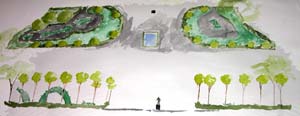
AIANY, ASLANY, and the Center for Architecture Foundation, along with Friends of LaGuardia Park, celebrated Architecture Week/Landscape Architecture Month with a reception at the Center exhibiting proposals by Columbia University Landscape Design students for a children’s garden in LaGuardia Park across the street from the Center (the winning design includes a dragon!).

Adrian Smith, ASLA, Anna Mather, and her daughter

(l-r): Adrian Smith, ASLA, President Elect, ASLANY, congratulates winning designer Anna Mather, a candidate for a Masters of Science in Landscape Design from Columbia, and her daughter, Wynn Maloney.

Kristen Richards

Winning entry for LaGuardia Park

Winning entry for LaGuardia Park, designed by Anna Mather.

Kristen Richards

architects of old…

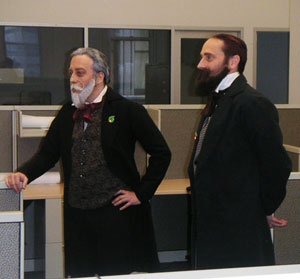
Architects go all-out to celebrate the AIA’s founding. Richard Morris Hunt and Richard Upjohn came back from the dead to tour modern interiors.

Michael Lischer, AIA

Michael Lischer, AIA, with Jeremy Edmunds, PE, Assoc. AIA, LEED AP

Michael Lischer, AIA, 2007 AIA International Director, with Jeremy Edmunds, PE, Assoc. AIA, LEED AP, AIANY Director of Programs and Strategic Planning celebrate Architecture Week at the Bohemian Beer Garden in Astoria.

Oculus 2007 Editorial Calendar
If you have ideas, projects, opinions — or perhaps a burning desire to write about a topic below — we’d like to hear from you! Deadlines for submitting suggestions are indicated; projects/topics may be anywhere, but architects must be New York-based. Send suggestions to Kristen Richards.
06.01.07 Fall 2007: Collaboration
09.07.07 Winter 2007-08: Power & Patronage

04.19.07 Call for Recommendations: AIANY College of Fellows
The AIA New York Chapter Fellows Committee is now accepting recommendations for those who will be nominated to fellowship from our chapter. Advancement to the AIA College of Fellows is granted for significant achievement in design, preservation, education, literature and service. Architects who have been members for 10 or more years are eligible for consideration.

05.01.07 Call for Submissions: Reinventing and Galvanizing Downtown
The Alliance for Downtown New York and the Lower Manhattan Cultural Council invite artists to creatively look at downtown construction sites. Projects should re-invent and transform community eyesores into places of attraction, curiosity, and anticipation. Proposals in all visual media — paint, collage, light, sculpture, architectural interventions — are encouraged. Projects will be evaluated in terms of effectiveness in ameliorating daily life in a construction zone and monetary feasibility.

05.04.07 Submission: Land Development Breakthroughs Visionary Award
This award recognizes projects with creativity, vision, and implementation of best practices in land development. Criteria for the award include effective leadership, team building, public relations successes, sustainable principles, community contributions, innovative solutions, and financial success, along with uniqueness and beauty. Finalists will be showcased at the upcoming Land Development Breakthroughs — Best Practices Conference, June 7-8 in New Orleans, LA. The winning project will be showcased in the Conference Review edition of Land Development Today magazine.

05.31.07 Submission: Urban Landscape Award 2007
This award sponsored by Eurohypo AG with Topos and Architektur&Wohnen seeks to raise the profile of projects that enhance inner-city open spaces, including residential blocks, mixed-use developments, and redesigned neighborhoods. Innovative sustainable development and economic and social integration will be expected. Public and private organizations, planners, and architects are invited to submit. Projects must have been completed between the years 2000 and 2006. The first-prize winner will receive EUR50,000 (appr. $67,000).

06.01.07 Submission: Schedium
The AIA NY Chapter’s Emerging New York Architects (ENYA) invites drawing portfolio submissions as part of its new program, Schedium, intended to celebrate the drawing abilities of emerging architects. Artists selected from the portfolio competition may be asked to participate in a live drawing series. International practitioners are welcome. Eligibility is limited to those with an architecture degree or international equivalent, who have received an architecture degree after 01.01.91 or received their architectural license after 01.01.97, whichever is less restrictive. Four winners will receive a $1,000 stipend plus additional benefits.

06.01.07 Submission: Challenge America: Reaching Every Community Fast-Track Review Grants
This grant category offers support primarily to small- and mid-sized organizations for projects that extend the reach of the arts to underserved populations — those whose opportunities to experience the arts are limited by geography, ethnicity, economics, or disability. Grants are available, in the amount of $10,000 each, for professional arts programming and for projects that emphasize the potential of the arts in community development. While not required, applicants are encouraged to consider partnerships among organizations, both in and outside of the arts, as appropriate to their project.

06.01.07 Competition: Walla Walla Market Station Design Competition
The Downtown Walla Walla Foundation and Valley Transit announce a competition to design a distinctive downtown transit station integrating various community needs. Walla Walla is an Eastern Washington city renowned for wine production and its picturesque and historic downtown. Three semi-finalists will win $5,000 each, and compete for a final $3,000 prize.

06.17.07 Submission: ShelterMe
ShelterMe calls for designs of temporary emergency shelters for deployment in a natural disaster. In the past two years, widespread catastrophic events have called forth large-scale international relief efforts throughout both urban and rural areas. Designers are challenged to present a cost-effective, short-term shelter that is affordable, lightweight, strong, and easily deployed. The competition is open to all registered members of the DESIGN 21: Social Design Network, who are at least 18 years old.

08.01.07 Competition: Connecting Market East: Student Design Competition
The Ed Bacon Foundation, a Philadelphia-based non-profit organization, launched its second annual national student design competition, open to architecture, planning, and design students across North America. Entrants must create design solutions for improving Market East in Center City Philadelphia focusing on re-connecting Market East and its destinations to the street, transit, and the city at-large.

12.31.07 Submission: Just Jerusalem
Just Jerusalem calls for innovative visions for Jerusalem and what it might be if justice and urban livability — rather than competing nationalist projects — were the principle points of departure. Sponsored by MIT’s Center for International Studies (CIS) and the Department of Urban Studies and Planning (DUSP), the project’s goal is to allow for the envisioning of Jerusalem, real and symbolic, as a just, peaceful, and sustainable urban locale by the year 2050. Entries are open to architects, urbanists, artists, historians, poets, political scientists, philosophers, economists, engineers, and all others who have ideas for the future of the city. Multi-disciplinary teams are encouraged.