Up From Anonymity: the Rise of New York’s Infrastructure

Event: Tour of New York Rises: Photographs by Eugene de Salignac
Location: Museum of the City of New York (MCNY), 08.15.07
Organizers: AIANY Member Services Committee; AIANY Emerging New York Architects Committee (ENYA); Museum of the City of New York

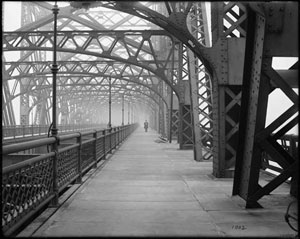
Queensboro Bridge

Queensboro Bridge, exposures made for experiment, February 9, 1910.

Photo by Eugene de Salignac, courtesy of the Museum of the City of New York and the New York City Municipal Archives

The current exhibition on view at the Museum of the City of New York (MCNY) helps celebrate an anonymous NYC by providing a glimpse into how the urban fabric and infrastructure we depend upon today was created. New York Rises: Photographs by Eugene de Salignac does portray known structures, but the workers and other folks gazing into the camera frequently steal the frame.

Eugene de Salignac, a civil servant who remained largely anonymous himself until a decade ago, is the eye behind the photographs in the exhibition. Beginning in 1903, de Salignac worked for the NYC Department of Bridges/Plant Structures for three decades, capturing thousands of ordinary and extraordinary views of the city. While his photos are overarching (construction shots of the Municipal Building construction in 1912 are archived alongside views of a Depression-era shelter), they are also detailed and poignant. Exhibition curator Tom Mellins stressed that the photographs were organized to impress de Salignac’s unique skills upon visitors, while the accompanying book (also New York Rises) pushes NYC’s massive infrastructure improvements to the forefront.

Mellins’ guided tour and special viewing of the exhibition marked the MCNY’s new reciprocal membership program for AIA members. Available through December, AIA members will receive a 30% discount when they join the MCNY.
AIANY Secretary Abby Suckle, FAIA, LEED AP, said that this event was the second in a “series of partnerships with museums and other cultural organizations that is a combination of joint programming and membership swaps.”

In this issue:
·Timeline Preserves American Women of Architecture
·Foundation Teaches Teachers How to Look at Architecture
·Passing: David Mandl, AIA
·NYC Housing Authority Lights Way in Brooklyn
·DOB Recruits Team to Monitor Construction
·OHNY Weekend 2007 Needs You
·Book Draws Line Between Computers and Pencils
·DVDs Highlight Trends in Senior Housing


Timeline Preserves American Women of Architecture
The Beverly Willis Architecture Foundation has launched the American Women of Architecture — Timeline and interactive archive. The foundation’s mission is to expand knowledge and recognition of women’s contributions to architecture broadly defined to include landscape design, interior design, and urban design. The timeline is the first stage of an overall attempt to celebrate the names, biographies, and work of women who have contributed to the development of American architecture in the 20th century.

This is an open, collaborative effort. Once users register, they are able to add or edit data about a particular individual, or submit entries to a general bibliography on women in architecture. To participate click the link.


Foundation Teaches Teachers How to Look at Architecture

LIC Summer Session

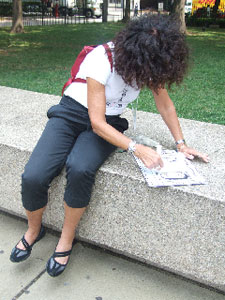
A participant investigates an historic map of SoHo.

Tim Hayduk

The Center for Architecture Foundation was host to Lincoln Center Institute’s (LCI) Summer Session workshop, Architecture: Faces of Urban Change. On July 19, 10 teachers gathered at the Center for Architecture to learn about using architecture as a way of exploring Aesthetic Education methodology.

Maggie Reilly, the LCI Education Partner helped develop a workshop using University Village (Silver Towers), designed by I.M. Pei, FAIA (1996), as the focus of the day-long study. Through the introduction to the concept of figure/ground, participants were asked to sculpt building massings out of modeling clay. From this, they were able to explore how the nearly identical towers were grouped to maximize views, and how they relate to Bleecker Street and La Guardia Place while intentionally turning their back to West Houston Street. With the close inspection of Pei’s refined use of concrete and attention to detail, participants also discovered the careful site planning that maintains the street grid through pedestrian rights of way, a complex procession from the public realm to private space. Many had walked by the buildings “thousands of times” without realizing the merits of the complex’s design.

The investigation led to inquiries about why the buildings of University Village were built at their particular location. Participants researched the historical context of the site by analyzing maps, photographs, and books. A walking tour of the South Village helped answer many questions relating to the growth and decline of the neighborhood, the impact of urban renewal, and the role Robert Moses had in shaping this diverse urban landscape.


Passing: David Mandl, AIA
It is with deep sorrow that Meltzer/Mandl Architects shares the loss of David Mandl, AIA. After a near two-year fight with pancreatic cancer, Mandl passed away on August 4. As a skilled negotiator, he challenged colleagues to dig deeper and to fortify the substance of their designs, arguments, and reasoning. Those who knew him observed that Mandl had a unique sense of humor, razor-sharp intellect, close attention to detail, and the ability to command a room with his knowledge. Above all, Mandl had the special ability to encourage and inspire as a mentor.

Mandl was a pioneer in the field of adaptive re-use. Through his hard work, historic and other types of buildings that had been neglected or misused received new life and were given a new role in the fabric of the city. Mandl was versed in the complex matrix of NYC Department of Buildings’ (DOB) regulatory processes. At 45 Wall Street, Mandl and partner Marvin Meltzer, AIA, were the first architects to convert a downtown office building to a residence employing “Professional Certification,” a flagship DOB design review process. As a member of the NYC Model Building Code Program, Mandl’s knowledge was used to assess the impact of integrating higher standards of safety for residential buildings throughout the city.

A memorial service will be held in early October. In lieu of flowers, the family requests that donations be made in his honor to: The Pratt Institute — School of Architecture (210 Willoughby St., Suite 219, Brooklyn, NY 11205) where a future scholarship will be established in his name.


NYC Housing Authority Lights Way in Brooklyn
Saving money and electricity while reducing the amount of carbon dioxide released into the air is as easy as substituting one light bulb for another. The New York City Housing Authority (NYCHA) is doing just that with a new pilot program recently launched at Boulevard and Linden Houses in the New Lots section of Brooklyn. As part of the Con Edison Electricity Demand Reduction Program, 12,000 standard light bulbs in the developments’ apartments, stairwells, and stairways are being replaced with Compact Fluorescent Lamps (CFLs). The new bulbs will cost NYCHA almost nothing — Con Ed is subsidizing the program. More to the point, they will reduce the demand for electricity during the hottest summer months, when the need for electricity is greatest.

Eventually, the program will expand to cover 75 developments in the borough. When that happens, NYCHA will be responsible for reducing the amount of electricity used by an estimated 15,700,000 kilowatt-hours per year, according to Public Energy Solutions Vice-President Jay Roemer. The Linden/Boulevard project alone will reduce carbon dioxide emissions by approximately 366,000 pounds a year.

Note: The program may seem progressive, but read or re-read Linda G. Miller’s article, “How Many Scientists Does it Take to Change a Light Bulb? Read On” in this issue.


DOB Recruits Team to Monitor Construction
NYC Department of Buildings (DOB) Commissioner Patricia J. Lancaster, FAIA, plans to recruit 67 new employees to serve on special operations teams and supplement existing units charged with raising the bar for construction safety standards citywide. Using multi-disciplinary enforcement tactics to stop repeat offenders and abuses of construction site regulations, the new special operations teams and staff expand the DOB’s enforcement presence in the field, enhance the quality of its services, and crack down on builders who flout the law. The DOB is now accepting applications from those interested in joining the agency as an architect, engineer, inspector, lawyer, analyst, or investigator, and working to carry out the DOB’s Special Enforcement Plan. To learn more about the positions, log onto the DOB website and follow the link to “Career Opportunities.”


OHNY Weekend 2007 Needs You
This year marks the fifth annual openhousenewyork (OHNY) weekend, presented by Target, an event that opens doors city-wide to buildings, memorials, and landmarks. Volunteers are needed to assist site and program coordinators and help facilitate the weekend. They must be at least 18-years-old and attend one two-hour training session. For more information about OHNY, visit the website. Contact Audrey to volunteer. If you are interested in opening a site to the public for the weekend, which will take place October 6 and 7, contact Jessica to be included in the online program guide.


Book Draws Line Between Computers and Pencils
Cinemetrics: Architecture Drawing Today, by Brian McGrath, associate professor, and Jean Gardner, senior faculty, Parsons The New School for Design, is the first guidebook for computer-generated architectural drawing based on understanding how digital drawing fundamentally differs from mechanical drawing.

Cinemetrics assumes digital imaging technologies are the everyday experience of today’s media-saturated public. Architectural drawing is reconceived as a multi-dimensional informational system. The book is a basic text for multiple disciplines, including digital drawing courses at all levels; architectural, interior, landscape and urban design studios; architectural history and theory classes; foundation courses in art, design, and architecture; and film and media studies. For more information on Cinemetrics click the link.


DVDs Highlight Trends in Senior Housing
A series of educational DVDs on new trends in nursing homes/retirement villages aimed at architects, designers, investors, industry executives, town planers, and government officials is now available. The series highlights the best designs and buildings from more than 20 countries in the following categories: Nursing Homes; Design for Assisted Living, World’s Best Practice; Dementia/Memory Support; Continuous Care Retirement Communities; Retirement Villages; Active Adult Communities; and Rental/Serviced Apartments for Seniors. For more information or to order, please click here.

05.07-07.07

The AIANY Chapter wants to extend a heartfelt “Thank you” to all who renewed membership this year. The chapter’s growth and long-term health is in your hands and we appreciate your support!

Those who are not currently members, we encourage you to consider the benefits. In addition to architects, we welcome the public, students, and professionals in related industries. Visit our membership page online for further information.

The AIA New York Chapter Membership Benefits Task Force has been meeting regularly and working to extend the benefits that are being offered. New programs include a resource collection of Architecture Firm Portfolios in the library, partnerships for member discounts with the Museum of the City of New York and the Solomon R. Guggenheim Museum, and a purchasing discount program with Kaplan AEC. We hope that you will take advantage of these new opportunities; suggest other ideas for the Chapter to puruse, or join the committee to help implement new perks for the future. Please contact Suzanne Mecs, Director of Membership, with any questions.

New Architect Members: Michael Jonah Altschuler, AIA, Michael J. Altschuler, Architect | Matthias R. Altwicker, AIA, AB Architekten | Paul C. Bailey, AIA, Perkins Eastman & Partners | Jeffrey Burke, AIA, Skidmore, Owings and Merrill, LLP | Ivan Chabra, AIA, Parsons The New School of Design | Natalie S.-W. Cheng, AIA, Alta Architecture P.C. | Jill S. Edelman, AIA, FXFOWLE Architects | Michael Even, AIA, Em Design Group | Mark G. Fiedler, AIA, Fiedler Marciano | Eugene Flotteron, AIA, Swig Equities. LLC | Robert Scott Franks, AIA, Stonehill & Taylor Architects and Planners | Mark Gage, AIA, Mark Foster Gage-Architecture & Design | Sara A. Grant, AIA, Murphy Burnham & Buttrick, LLP | Terence D. Hairston, AIA, Terence Hairston Architect | Anne-Sophie Hall, AIA, Skidmore, Owings and Merrill, LLP | Jian Hei, AIA, Pei Cobb Freed & Partners | Stephan Jaklitsch, AIA, Stephan Jaklitsch Architects PC | Harry Junger, AIA, Junger Architects | Brian Kaminsky, AIA, SBLM Architects | Wade H. Laing, AIA, Gensler | Jinseuk Lee, AIA, Kohn Pedersen Fox Associates, P.C. | William K.Y. Leung, AIA, Array | Steven B. Levine, AIA, LBS Associates | Eric Lifton, AIA, MESH Architecture | Stephen Matkovits, AIA, Handel Architects LLP | Thomas McKay, AIA, McKay Architecture & Design | Amanda McNally, AIA, Beyer Blinder Belle: Architects & Planners | Rick Migliorelli, AIA, Ann Taylor Inc. | Richard A. Miller, AIA, Beyer Blinder Belle: Architects & Planners | Nancie N. Min, AIA, Blue Pentagram NYC, LLC | Josef M. Prini, AIA, Josef Prini Associates LLC | Erich Schoenenberger, AIA, su11 Architecture & Design PLLC | Stephen M Starensier, AIA, Hope Community Corporate | Neal-James Stufano, AIA, MacAndrews and Forbes, Inc. | Trent Tesch, AIA, Kohn Pedersen Fox Associates, P.C. | William Tims, AIA, Corcoran Sunshine Marketing Group | Yung G. Wang, AIA, Y G Wang Architect | Lee J. Washesky, AIA, Rafael Vinoly Architects P.C. | Henry Weintraub, AIA, Howard B. Spivak Architect P.C. | Chia Hwei Yen, AIA, Robert A.M. Stern Architects | Kirsten Elaine Youngren, AIA, Tonetti Associates Architects, PC | Jinling Yu, AIA, Pei Cobb Freed & Partners

The following individuals have recently upgraded to Architect Level membership: Nicholas P. Colello, AIA, Curtis + Ginsberg Architects | Anne Rachel Goulet, AIA, Stephen B. Jacobs Group, PC | Delia Nevola, AIA, Goshow Architects | Ruangpong (Ron) Rodpracha, AIA, EDI Architecture, Inc.

New Associate Members: Kanan Ajmera, Assoc. AIA, Cooper Robertson & Partners | Ebraheem N. Alforaih, Assoc. AIA, Skidmore, Owings and Merrill, LLP | Lori A. Apfel, Assoc. AIA, Costas Kondylis and Partners | Joseph A. Auld, Assoc. AIA, Volunteers Of America Greater New York | Craig L. Bacheller, II, Assoc. AIA, Assemblages | Jimmy Barnes, Assoc. AIA, Hellmuth Obata & Kassabaum, P.C. | Matthew J. Beary, Assoc. AIA, Barbara Marks Architect | David E. Bench, Assoc. AIA, Richard Meier & Partners LLP | Marga Bergman, Assoc. AIA, A/R Architects LLP | Steven R. Butler, Assoc. AIA, Skidmore, Owings and Merrill, LLP | Breanna Alexia Carlson, Assoc. AIA, bStudio | Tsan Ming Simon Chan, Assoc. AIA, Ted Moudis Associates | Ting Chin, Assoc. AIA, TPG Architecture, LLP | Daeyoung Choi, Assoc. AIA, Cooper Robertson & Partners | Sergey Chudin, Assoc. AIA, Stantec | Naphtali Deutsch, Assoc. AIA | Xyrus John Nava Diego, Assoc. AIA | La’Quel Y. Edness, Assoc. AIA, Mancini Duffy | Bronwyn Hannah Evans, Assoc. AIA, New York City Transit Authority | Eric Fauerbach, Assoc. AIA, BLL, Inc. | Gudmunda Geirmundsdottir, Assoc. AIA, Platt Byard Dovell White Architects | Giovanni Gioia, Assoc. AIA, Ismael Leyva Architects, PC | Sally C. Greene, Assoc. AIA, Artemis Development | Shani Gurevich, Assoc. AIA, New York City Transit Authority | Daniel Hawes, Assoc. AIA, Mullman Seidman Architects | Kevin Patrick Homier, Assoc. AIA, SBLM Architects | Milenko Ivanovic, Assoc. AIA, Cannon Design | Mitchell W. Joachim, Assoc. AIA, Terreform | Kylie M. Kaiser, Assoc. AIA, Gensler | Adela Kalenja, Assoc. AIA, Rafael Vinoly Architects P.C. | Robyne S. Kassen, Assoc. AIA, Pedestrian Studio LLC | Kenneth M. Lake, Assoc. AIA, Andrew Bartle Architects, P.C. | Christopher Maurer, Assoc. AIA, StudioMDA | Wibowo Muljono, Assoc. AIA, Gensler | Alysa Nahmias, Assoc. AIA, RMJM Hillier | Buyachi Ndengu, Assoc. AIA, Hoffmann Architects | Cindy Ng, Assoc. AIA, BL Companies | Gregory Okshteyn, Assoc. AIA, Studios Go, Inc. | Vivian I. Okwuagwu, Assoc. AIA, The Louis Berger Group Inc. | Mikako Oshima, Assoc. AIA, Skidmore, Owings and Merrill, LLP | Albrecht Pichler, Assoc. AIA, Hart Howerton Architect | Ritu Saheb, Assoc. AIA | Monika Sarac, Assoc. AIA, FXFOWLE Architects | Michael F. Sargent, Assoc. AIA, Arquitectonica | Scott John Sassano, Assoc. AIA, SBLM Architects | Monica F. Schaffer, Assoc. AIA, Satellier | Hilary Kathryn Scruggs, Assoc. AIA, Atelier 1980 | Adam Semel, Assoc. AIA, Skidmore, Owings and Merrill, LLP | Natalie Marie Severson, Assoc. AIA, Ronnette Riley Architect | Marjorie Sobylak, Assoc. AIA, Mancini Duffy | Nina M. Stern, Assoc. AIA, Rockwell Group | Steven I. Super, Assoc. AIA, Steven I. Super, Counselor at Law | Shawn C. Walsh, Assoc. AIA, Lee H. Skolnick Architecture + Design

New International Associate Members: Olivio A. Capellan, Int’l Assoc. AIA, Gordon Kahn and Associates | Rosanne Dube, Int’l Assoc. AIA, Swanke Hayden Connell Architects | Stuart Jon Traynor, Int’l Assoc. AIA, Davis Brody Bond, LLP

Reinstated Members: Sara Agrest, AIA, FXFOWLE Architects | Anthony C. Baker, AIA, Anthony C. Baker, Architects & Planners, P.C. | Salvador Behar, AIA, Perkins Eastman & Partners | George Chin, AIA, Sydness Architects, P.C. | James Cockinos, AIA, Merritt & Harris, Inc. | Brian Joseph Connolly, AIA, Zivkovic Associates Architects | Craig G. Copeland, AIA, Pelli Clarke Pelli Architects | Christopher David Ernst, AIA, Cooper Carry Architecture | Bahaar F. Faquih, Int’l Assoc. AIA, Faquih and Associates | Kaif F. Faquih, Int’l Assoc. AIA, Faquih and Associates | Brian A. Ferrier, AIA, Butler Rogers Baskett Architects P.C. | Michael M. Fieldman, FAIA, Michael Fieldman, Architect | Thomas Fraehmke, AIA, American Continental Properties | Max Gordon, AIA, Marcus and Millichap | Robert F. Herrmann, Menaker & Herrmann, LLP | Yong Huang, AIA, Kohnke Architects, P.C. | Raymond Irrera, AIA, Gonchor Karlsberger | Stephen Kagel, AIA, Haks Engineers and Land Surveyors | Robert Alan Klein, AIA, Swanke Hayden Connell Architects | Wade H. Laing, AIA, Gensler | Diane Lewis, AIA, Diane Lewis Architects | Joel Martin Napach, AIA, GKN Architects | Michael A. Rodriguez, AIA, Rodriguez Architectural Studio PC | Joel Sanders, AIA, Joel Sanders Architect | Klaus Schmitt, Assoc. AIA, Ehrenkrantz, Eckstut & Kuhn, Architects | Ranabir Sengupta, AIA, Urbahn Associates, Inc | Abbas A. Shah, AIA, Empiretech Consulting Associates, Inc. | Anthony Sieverding, AIA, Davis Brody Bond, LLP | James P Simon, AIA, Gensler | Burt Stern, AIA, Burt L. Stern, AIA Architect | Michael Thoma, AIA, Hellmuth Obata & Kassabaum, P.C. | Charlotte Worthy, AIA, John B. Murray Architect, LLC | Svetislav Zivkovic, AIA, Zivkovic Associates Architects

Congratulations to these longtime members who have upgraded to Emeritus Status: Raymond Vasques Gomez, Jr., AIA, RGA Architects and Planners | J. Arvid Klein, FAIA | Kenneth H. Walker, FAIA, Walker Group Designs

New Steel Corporate Members: Architectural Grille: Anthony Giumenta, Jr., Stephen Giumenta | Bulthaup Corporation: Stephanie Badillo, Ute Mack | Microdesk: Luis Couto

New Aluminum Corporate Members: American Bluestone LLC: Deborah J. McDuffey, Robert M. McDuffey, Ryan McDuffey | Acme Architectural Walls: Marc Teich | Credit Suisse First Boston: Chantal Hintermann | Jerome S. Gillman Consulting: Larry Gillman | Swiss House for Advanced Research and Education — SHARE: Christoph A. von Arb | W. B. Engineering & Consulting PLLC: Julie Pampuch
Reinventing the Wheel Often Slows New Practices

New Practices NY

Courtesy Center for Architecture

Hoping for creative independence, new practices often face a dilemma. They want to reinvent the wheel too quickly when they might do better to understand and use wheels already in motion. Yet young practitioners can be equipped to produce compelling, unexpected models out of those existing wheel prototypes, and end up ‘rocking the boat’ of the establishment.

In the last issue of e-Oculus, Mark Strauss, FAIA, AICP, Immediate Past President of AIANY, and founding father/self-professed New Practices “Dad,” wrote about the accomplishments of the nascent New Practices Roundtable. (See “New Practices Grows Up,” 07.24.07). The original grassroots group provided a resource and forum for young upstart firms to swap ideas and learn survival skills for professional practices. It went on to promote six new practices from each side of the Atlantic — New Practices New York, and New Practices London (an exhibition, New Practices London, will open at the Center for Architecture August 23). Now called the New Practices Committee, AIANY’s youngest committee, we’ve turned focus on a simple, and perhaps more fundamental question, “What’s new?” in the practice of architecture in NYC, regionally, and globally.

The New Practices Committee, made up of a group of young professionals — most with their own emerging practices — meets bimonthly on issues relevant to a young start-up. Mired by the realities of rainmaking, bill paying, office management, and often building a career on small renovations and competition entries, young practices sometimes find they are expending more creative energy on their bookkeeping than creative architecture. The committee discussions serve to distill common problems and acts, as we often joke, as “group therapy” for young architects.

The 2006 New Practices Showcase proved a visible testament to emerging firms — highlighting six practices that perhaps differed more among themselves than they had in common. It showed that what makes a successful new practice today has little to do with type, quantity, or stylistic appearance of built or speculative projects. The New Practices Committee, Roundtable events, and Showcase will be most successful if they, like the new practitioners and practices, continue to be evolutionary, organic, and respond nimbly to new issues and opportunities in the marketplace, technology, and contemporary culture.

So join the New Practices Committee if you’re involved or even just interested in starting a new practice, or simply interested in the question: “What IS a new practice today, really?” Because the committee and the Chapter realize that many new practitioners cannot afford AIA membership dues, and that the evolving landscape of practice includes many engaged in architecture in non-traditional ways, the New Practices Committee is one of only two AIANY committees open to non-AIA members (the other being the Emerging NY Architects/ENYA committee). We look forward to seeing new faces at our next committee meeting in August. Contact Amanda Jones for more information.

Both authors want to thank the founders and advisors for their support of the New Practices program, and for giving our firms exposure and opportunities since proven invaluable: Joan Blumenfeld, FAIA, IIDA, LEED AP, 2007 AIANY President, Mark Strauss, FAIA, AICP, Immediate Past President AIANY, Rick Bell, FAIA, AIANY Executive Director, the AIANY staff, Diana Darling and William Menking of The Architect’s Newspaper, Häfele America, and all our program sponsors and participants.

In this issue:
·Ready About? Architect’s Regatta Heartily Returns
·Buildings Department Cracks Down on Illegal Ads… Again
·Counties Go Carbon Neutral


Ready About? Architect’s Regatta Heartily Returns
This year’s architect’s regatta, a charity race for Project City Kids, a free sailing program for children, is upon us. Only open to architecture firms, the 2007 ChallengeNY Architect’s Regatta will be held Thursday, September 6.

First prize will win the ChallengeNY perpetual trophy designed by Les Metalliers Champenois, a multi-disciplinary metalwork company. In addition, all teams are asked to find, fabricate, or otherwise furnish a small parting gift to bestow upon the boat immediately following theirs in the final standings. Gifts will be valued more dearly for their wit than wealth, so plan accordingly.

The suggested entry is a $1,000 donation to Project City Kids. For more information visit the website, or e-mail Gerry Dolezar.


Buildings Department Cracks Down on Illegal Ads… Again
Department of Buildings (DOB) Commissioner Patricia J. Lancaster, FAIA, announced phase two of the department’s enforcement campaign against illegal advertising. Expanding upon a crackdown on illegal advertising on sidewalk sheds, this new phase targets illegal advertising signs on buildings, which are generally large and mounted by anchors to the exterior wall of a building. The DOB is adopting a zero tolerance policy toward advertising signs posted on building walls and will issue violations to offending building owners and outdoor advertising companies.

“New York is certainly known for its busy landscape, but not every one of the city’s 950,000 buildings can be used as advertising space,” Lancaster says. “Some zoning districts allow advertising signs on building walls while others do not…. It is now time for these illegal signs to come down.”

Advertising posted on building walls is permitted in some commercial and manufacturing zoning districts, but, with the exception of some grandfathered signs, it is never permitted in residential districts. To install a wall sign, building owners must obtain an alteration permit and, in some cases, register with the DOB as an outdoor advertising company.

To report illegal signs on walls or sidewalk sheds, New Yorkers should call 311. For more information, visit the Department of Buildings’ website.


Counties Go Carbon Neutral
With local governments being in an ideal position to advance the green building movement, the National Association of Counties (NACo) has adopted a resolution supporting the AIA SustAIAnability 2030 Challenge calling for public buildings to be carbon neutral by 2030. U.S. buildings account for nearly the same amount of carbon emissions as the economies of Japan, France, and the United Kingdom combined, and if designed in an energy-efficient manner they can significantly reduce energy consumption, energy costs, greenhouse gas emissions, and slow the effects of climate change.

The Resolution Urging Counties to Adopt the “2030 Challenge” Goals for Public Buildings also asserts that NACo supports federal efforts to promote green buildings. The resolution highlights the many benefits of green buildings such as high performance school buildings and the need for greater emphasis to be placed on “life cycle costs.” To read the full resolution, click on the link.

Do You Have a Facebook Account Yet?

The world of social networking is expanding as the Center for Architecture now has a Facebook group. Find out about recent news and exhibition openings, post event photos and videos, connect with other members in the architecture community, and raise discussion topics on the Discussion Board. This is the second AIANY-based Facebook group, added to the Emerging NY Architects (ENYA) committee’s Schedium group, which provides up-to-date information on the upcoming international sketching competition.

New Practices Grows Up

Event: New Practices New York Showcase Series
Location: Häfele Showroom
Speakers: Winners of the 2006 New Practices New York competition
Organizer: AIANY New Practices Committee; The Architect’s Newspaper
Sponsor: Häfele America Co.

Zakrzewski Hyde Architects

Travelogue, an installation by Zakrzewski Hyde Architects, is currently on view at the Häfele Showroom. It is the final installation of the New Practices Showcase series.

Zakrzewski Hyde Architects

This month marked the end of the 2006/7 New Practices Showcase Series and the beginning of a new series of programs organized by the AIA New York Chapter’s youngest committee, the New Practices Committee. The program germinated two years ago at a new members reception at the Center for Architecture, when Nino Hewitt, AIA approached Susan Chin, FAIA, (2005 AIANY President) and myself and asked, “What kind of support does the AIA provide for new practices? I just started an architectural firm (LEVEL Architecture), and I need some help.”

Susan and I looked at each other and quickly realized that, although the Chapter has a professional practice committee, an emerging architect committee, and offers numerous forums for young professionals, we did not provide many programs that were specifically aimed at the needs of recently-developed practices. We decided to remedy the situation by partnering with The Architect’s Newspaper and launching “The New Practices Roundtable,” a series of programs reaching out to young practices offering resources in areas of business practice, technology, and marketing. At the roundtables, new practitioners shared ideas, discussed best practices, and vented frustrations. It was “group therapy for emerging practices.” The series was a major success and attracted over 500 attendees in four sessions.

One year later, we expanded the program to showcase emerging practices entitled “New Practices New York.” To launch the program, we announced a mini-portfolio review for practices founded after January 1, 2000. More than 50 practices submitted, and six architectural firms were selected: Architecture In Formation; G Tects; Gage/Clemenceau Architects; Interboro Partners; WORK AC; and Zakrzewski Hyde Architects.

The showcase highlighted the firms’ achievements in a group exhibition at the Center for Architecture last summer. (The show was re-exhibited at a gallery during the AIA Convention in San Antonio this past May, and is traveling to London this fall.) Following the initial showing, a bimonthly exhibit and reception was held for each of the practices at the Häfele Showroom. The final showcase, featuring Zakrzewski Hyde Architects, is on display through the end of August.

A new generation of young architects is now gaining recognition and becoming leaders in the professional community, thanks to the showcase program. In fact, a number of the participants have taken the reins and are turning the roundtables into a full-fledged committee at the chapter. The new committee’s first program, “Super-Models, MEGA_100+, Large-Scale Firms Revised,” was held at the Center on July 11, and examined how large practices are redefining themselves to emulate the passion and agility of young practices (See “Large Firms Struggle to Outbid Small Firms,” by Jessica Sheridan, Assoc. AIA, LEED AP, in this issue of e-Oculus). In the next issue of e-Oculus, Matthew Bremer, AIA, principal of Architecture In Formation, and Marc Clemenceau Bailly, AIA, principal of Gage/Clemenceau, will write about the objectives of this new committee. If you are interested in joining and/or participating in the committee, please contact Amanda Jones, AIANY Program Committee Coordinator.

In closing, I want to thank Susan Chin, FAIA, Joan Blumenfeld, FAIA, IIDA, AIANY President, James McCullar, FAIA, Rick Bell, FAIA, and the staff at the AIA NY Chapter, The Architect’s Newspaper, Häfele America, and all our program sponsors and participants. It’s been a great run, and we look forward to the next generation of programs for young practices.

Large Firms Struggle to Outbid Small Firms

Event: Super-Models, MEGA_100+, Large-Scale Firms Revised
Location: Center for Architecture, 07.11.07
Speakers: Aaron Schwarz, FAIA — Principal, Perkins Eastman; Christopher McCready, AIA — Associate Principal, Skidmore, Owings & Merrill; Christopher Lee — Principal, HOK Sport
Moderator: Julie Iovine — Executive Editor, The Architect’s Newspaper
Organizer: AIANY New Practices Roundtable Committee
Sponsors: The Architect’s Newspaper; Häfele America Co.; Skyy 90; Severud Associates; Fountainhead Construction; MG & Company; Microsol Resources

In the U.S., many large firms are beginning to compete with — and lose to — small firms for innovative projects. To remedy the situation, large firms are using the small firm model to shift the balance in their favor. By establishing smaller companies within the larger organization, big firms are finding they are able to take advantage of the flexibility and collaborative work environment offered by small firms while maintaining the vast resources and funds offered by the parent firm.

SOM Education Lab and HOK Sport are smaller, specialized firms operating within the large firms of Skidmore, Owings & Merrill and HOK, respectively. Since the profitability of small projects is the biggest issue for small firms, according to Christopher McCready, AIA, associate principal of SOM Education Lab, working as a firm within SOM helps alleviate monetary pressures. Focusing on campus planning and design, the firm can comfortably work on lower-budge projects in a small studio environment.

Although HOK Sport receives funding and office space from HOK, the independent practice struggled, as many small firms do at its start — entering competitions until it was able to build up a small client base. Christopher Lee, principal of HOK Sport, argues that the firm-within-a-firm model is successful because it creates long-term loyalty and employee satisfaction. Every employee is important to the continuing design process, and therefore, each project improves with his or her growing experience.

Perkins Eastman has not founded a small firm within its firm, but even though it has 700 international employees, principal Aaron Schwarz, FAIA, claims it is really “a small firm on steroids.” Large firms often have quality control problems and rely on bureaucracy to organize inevitable chaos. In doing this, firm structure can get in the way of the work. Large firms also tend to be run by individuals who are farther away from school, and forget the contributive nature of architecture school studios. Perkins Eastman avoids these pitfalls by breaking into smaller studios and encouraging principals to pick up teaching jobs on the side. The firm retains its flexibility and employees learn from their peers in an open environment.

Resources, money, security, and confidence are benefits of large firms; however, small firms are able to better maintain agility, a collaborative environment, and employee satisfaction. Although the two seem to be incompatible, large firms are starting to adapt and use small firm models to reinvigorate their work. By having the best of both worlds, large firms could become forces with which no other firm can compete. However, will the additive drawbacks smother their efforts? At this point, HOK Sport, SOM Education Lab, and Perkins Eastman do not think so.

In this issue:
·WIA Returns to Promote Women’s Leadership
·Property Portfolios Made Easy With New Toolkit


WIA Returns to Promote Women’s Leadership

The Women in Architecture Committee (WIA) of AIA New York Chapter has recently reorganized and is excited to announce its first event, Speed Mentoring. The primary mission of WIA is to be the leadership resource for women in the architecture profession. “We want to expand the dialogue regarding issues and challenges that affect women in the architecture profession,” explains Carolyn Sponza, AIA, member of the WIA Steering Committee. WIA seeks to enable, empower, and encourage women to succeed and advance in the profession. The Steering Committee is in the process of developing a vision statement as well as organizing a series of programs for the year ahead.

The first program, Speed Mentoring, to be held September 25, will provide a means of connecting women in the profession; each participant acts as both mentor and mentee to benefit from each other’s experiences. In a similar format to “speed dating,” women architecture professionals at various career stages will be paired together to exchange ideas. The event will provide immediate mentoring (“How do I handle this difficult client?”) as well as the opportunity for longer-term mentoring relationships among participants (“Let’s do lunch!”).

Diane Tien, AIA, committee co-chair, notes the timeliness of WIA’s mission. “The profession is growing. Because of a strong economy, the architecture job market is flourishing, providing numerous opportunities for women professionals at all levels to excel.” Women-focused and women-led leadership development programs can help women define and establish their future. “WIA will challenge women to know their leadership potential,” affirms co-chair Nancy Goshow, AIA.

Look for the Speed Mentoring announcement and details to come in the coming weeks. In the meantime, share your thoughts online at the WIA forum.


Property Portfolios Made Easy With New Toolkit
The National Asset Management Steering Group (NAMS) recently released
a toolkit, Asset Management Planning for Property Assets. The toolkit consists of three parts: a manual, an interactive website, and the demonstration asset management system. The manual includes the theory of managing a property portfolio offering case studies and examples. It also provides templates, data collection forms, and analytical models to use in planning and managing a portfolio. The interactive website offers downloads of analytical models, building component guidelines, health asset standards, and planning templates. The demonstration asset management system provides access to a full range of tactical functions and reports — users can enter their own data for renewals analysis, project planning, levels of service analysis, and depreciated replacement cost valuations.

Guggenheim Plans Architectural Haven in Abu Dhabi

Event: ENYA Networks | Guggenheim Young Collectors Council
Location: Center for Architecture, 06.27.07
Speakers: Min Jung Kim — Director of Strategic Development, Asia; Robert McGary — Project Manager, Guggenheim Museum
Organizers: AIANY Emerging New York Architects Committee; Guggenheim Young Collectors Council

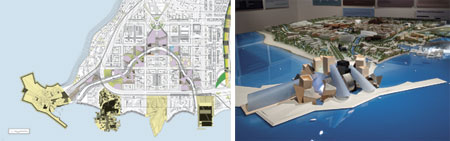
Saadiyat Island

A string of starchitect-designed musuems makes up the Cultural Master Plan of Saadiyat Island in Abu Dhabi

Courtesy Solomon R. Guggenheim Foundation

The Guggenheim Museum has not only reinvigorated Bilbao, Spain, creating a “Bilbao Effect” with its Frank Gehry Partners-designed museum, it has had an impact now sought after by arts organizations worldwide, including the Guggenheim itself. Saadiyat Island, Abu Dhabi, is the next target of cultural development for the museum, aiming to create a critical mass of art in a field of iconic architecture. By 2012, the Guggenheim expects completion of museums designed by Frank Gehry Partners, Zaha Hadid Architects, Ateliers Jean Nouvel, and Tadao Ando, Hon. FAIA, not to mention a biennale park and educational facilities as well.

Saadiyat Island is a natural island adjacent to Abu Dhabi City. Currently, there is nothing there but sand — a blank slate. Gensler is master planning the island comprising six districts. Skidmore, Owings & Merrill is working with the Guggenheim to master plan the Cultural District featuring the east-west coastline.

At 10,000 square meters, the smallest of the planned museums is the Maritime Museum designed by Ando. Inspired by the wind, boats, and sails, it celebrates the area’s pearling and fishing history by featuring a central reflective pool, hovering dhow boats, and a café under a waterfall. Moving east along the shore, the Performing Art Centre designed by Zaha Hadid Architects, sited at the center of the island, will be the island’s largest building. Its organic shape is formed by the intersection between the island’s central axis and the curve of the shoreline. Theaters are stacked to take advantage of city and sea views.

Ateliers Jean Nouvel will take advantage of the water by providing access to the Classical Museum (operated by the Louvre Museum) both by land and sea. A large protective dome will feature motifs that filter light and heat. Boxy volumes reference an archaeological excavation, apropos for a classical museum. At the eastern-most edge, Frank Gehry Partners’ Guggenheim Abu Dhabi juts into the Persian Gulf. With four levels of courtyards, galleries radiate inward from large to small, inspired by wind towers. With over 20,000 square meters of exhibition space, this Guggenheim is expected to be 40% larger than Guggenheim Bilbao.

For the biennale park, 19 pavilions designed by a range of firms from Asymptote to Greg Lynn Form will speckle the promenade among the large museums. The educational facilities, to be run by Yale University, are yet to be determined. A competition is currently underway for the Sheikh Zayed National Museum, which will be located at the center of the island, on axis with the Performing Art Centre. The shortlist comprises 13 firms including: Bernard Tschumi Architects and Eisenman Architects; Foster + Partners; Hans Hollein; Shigeru Ban; and Snohetta.

The AIANY Emerging NY Architects (ENYA) invited the Guggenheim’s Young Collectors Council (YCC) to the Center for Architecture to discuss the project which both groups follow closely. Presented by Min Jung Kim, director of strategic development, Asia, and Robert McGary, project manager at the Guggenheim, this event was the first ENYA Networks program, teaming up local emerging professionals to discuss common interests in an informal setting. A reciprocal program is being planned. This program also marked the first collaboration between the Solomon R. Guggenheim Foundation and AIANY since they announced the partnership to provide discounts to their members. AIANY members can redeem a 15% discount on membership to the Guggenheim. For more information, see “AIA Members Receive Discount off Guggenheim Memberships,” Around the AIA + Center for Architecture, e-Oculus, 05.15.07.