Arup Simplifies Complex Towers

Event: Thinking Outside The Box — Tapered, Tilted, Twisted Towers
Location: Center for Architecture, 03.19.09
Speakers: David Scott, PE, Hon. AIA — Chairman, Council of Tall Buildings and Urban Habitat & Principal, Arup
Organizers: Center for Architecture
Sponsors: Underwriters: The Center for Architecture Foundation; National Endowment for the Arts; Patron: Con Edison; Lead Sponsors: Arup; Buro Happold; Material ConneXion; Thornton Tomasetti; Supporters: The American Council of Engineering Companies; Josef Gartner USA/Permasteelisa Group; Weidlinger Associates; Friend: Grimshaw.

Strata Tower in Abu Dhabi, UAE.

Asymptote: Hani Rashid + Lise Anne Couture

“In terms of towers, the world has changed,” stated David Scott, PE, Hon. AIA, a principal at Arup. “Architects and engineers can now design almost anything –[but] should we?” Scott presented the firm’s latest engineering feats during a discussion of non-traditional towers that continue to dot global skylines.

Utilizing tools ranging from folded paper study models to parametric modeling, Arup is responsible for engineering complex structures such as Asymptote’s Strata Tower in Abu Dhabi and Moshe Safdie and Associates’ Marina Bay Sands in Singapore. Scott discussed these projects among others designed by HOK, KPF, Studio Daniel Libeskind, and Pelli Clarke Pelli to explain how conventional tower standards are modified to create untraditional forms. The complexities of Arup’s towers often mask a fairly simple structural model. Revealing the mystery behind daunting engineering, Scott explained that it is due to repetitive structural systems and central cores, which also can be found in the simplest towers. It is this suspicious truth that Scott communicates to clients to alleviate their budget-conscious fears.

A contemporary trend — tapered, tilted, twisted towers — and the structural gymnastics employed to build them, are accomplished with sparse precedent. With each commission Arup builds upon previous exercises to inform the development of the next iconic tower.

OMA’s New Tower Steps Out From the Crowd

Event: Helfand Spotlight Series: 23 E. 22nd Street by Office for Metropolitan Architecture (OMA)
Location: Center for Architecture, 03.06.09
Speaker: Shohei Shigematsu — Partner and Director, OMA NY
Organizer: Center for Architecture
Sponsor: Slazer Enterprises

23 E.22nd Street

Office for Metropolitan Architecture

In the 1978 book Delirious New York, a young Rem Koolhaas remarked that Manhattan “has fed, from its conception, on the splendors and miseries of the metropolitan condition — hyper-density — without once losing faith in it as the basis for a desirable modern culture. Manhattan’s architecture is a paradigm for the exploitation of congestion.” A new OMA tower epitomizes that impulse to exult in density and make the most of a congested air space, as a recent talk by Shohei Shigematsu and an accompanying exhibition about the building at the Center for Architecture showed.

Like a young kid peeking from behind a more straitlaced parent, a midrise tower at 23 E. 22nd Street will cantilever nearly 30 feet to the east to gain views of Madison Square Park, which otherwise would be blocked by the adjacent 60-story One Madison Park to the north. At the same time, the OMA-designed tower avoids blocking the light coming to the terrace of the next-door building, Shigematsu explained. The stair-like shapes of the new building also playfully allude to the traditional setbacks of the city’s architecture.

“Somehow, [in] New York we are a little bit either lucky or doomed to face a lot of interesting moments,” Shigematsu observed, citing past projects that never came to fruition, such as the hotel at Astor Place and the Whitney Museum extension. This latest project, though, seems on the luckier side: it’s nearly recession-proof, since it shares a base with One Madison Park, which is near completion, he added. The new tower — OMA’s first in the city — will include 18 residential units, a restaurant, and a Creative Artists Agency screening room, which will be prominently visible from the sidewalk.

Though the design received considerable publicity when it was unveiled last year, one of the joys of the talk and exhibition was getting a glimpse into OMA’s process. Some other potential designs, such as a tower shaped like a spiraling stairway, make the final choice look comparatively tame. In the end, the firm went with a design that’s largely guided by the limitations of the site and its zoning. Angling over to the east not only improves views, it also allows the tower to rise higher by skirting to the side of a 250-foot height limit, Shigematsu said. The strategy was made possible by obtaining air rights from neighboring buildings.

The tower gains the necessary structural strength through a form “like a corset that braces the building at the center,” he said. The middle of the building is denser, with smaller windows and lower ceilings, whereas the ceiling heights of the units towards the top and bottom of the tower are higher, creating loft-like spaces. In a move that somehow makes sense in the building’s topsy-turvy geometries, windows are placed on the floors of cantilevered spaces, creating a sense of connection to the bustling street life below. It’s a fitting flourish for a building that seems to defy gravity, in both meanings of the word.

Casa Malaparte’s Enigmatic Legacy Continues

Event: The Curious Case of Casa Malaparte: Literal Deconstruction and the Surrealist Building Enclosure
Location: Center for Architecture, 03.10.09
Speaker: Michael McDonough, AIA — Author, Casa Malaparte: A House Like Me (Clarkson-Potter)

Courtesy michaelmcdonough.com

“Who is this guy riding a bike around on a roof with no railing in a cliffside dwelling in the middle of the Bay of Naples,” asked Michael McDonough, AIA, pointing to a black-and-white photograph. McDonough is equally fascinated with Curzio Malaparte (1898-1957) — an Italian who was variously a journalist in London, a collaborator with the Surrealists in Paris, and a war correspondent on the Russian front during World War II — and Casa Malaparte, the fortress-like villa he designed for himself on the Isle of Capri. After 10 years studying the house and the man, and three years writing and editing, McDonough’s book Malaparte: A House Like Me was published in 1999.

“Casa come me,” or “house like me” is what Malaparte called his deep terracotta-colored masonry villa that was realized in 1939. Located on a promontory 32 meters above the sea, the house is surrounded by natural beauty on land steeped in Roman history. The outline of the building follows the course of the cliffs and is built on three levels. A large roof terrace stretching out towards the sea can be reached solely by a reverse pyramid staircase that fits in perfectly with the shape of the rocks. The idea for the steps comes from a church in Lipari, where Malaparte worshiped during his imprisonment. Access to the property is either by foot from the town of Capri or by boat and then a hike up a staircase cut into the cliff. “It’s inaccessibility,” says McDonough, “is extraordinary.”

One question that continues to mystify architects and historians is who really designed Casa Malaparte? Italian rationalist architect Adalberto Libera designed one scheme. Malaparte, who, according to McDonough, felt “architects are basically engineers,” worked with Libera’s plan, adapting it and building it with a local stonemason. The house has no steel components — rather, it is built of limestone, concrete, and stucco, materials found onsite. Terrific storms would cause windows to be blown out and the salty wind would blow completely through the house. In addition, the salt water in the in the two-foot-thick limestone walls migrated to the outside causing the stucco to fall off. An audience member questioned the color of the house. Yes, it was originally white, which was the color of the fascists, but after Malaparte became interested in communism, he painted it red. McDonough surmised that through time, even if people couldn’t read words, they could “read” materials and color.

The house was abandoned after Malaparte’s death in 1957 and became a victim of vandalism and neglect. Malaparte had willed the house to the People’s Republic of China — it is said he admired Chairman Mao — but his wish was contested and now the Casa Malaparte Foundation is its steward, making it available to architecture students. Malaparte’s great-nephew, Nicolo Rositani, is primarily responsible for restoring the house to a livable state. However, due to the building materials and the elements, Casa Malaparte is in a state of perpetual restoration.

The Value of Thinking Institutionally

Event: Architecture and Institutions
Location: Center for Architecture, 12.12.08
Speakers: Damon Rich — Founder & Chair, Center for Urban Pedagogy; Beth Stryker — Director of Programs, Center for Architecture; Gwendolyn Wright — Professor of Architecture, Planning and Preservation, Columbia University
Moderator: Olympia Kazi — Director, Institute for Urban Design
Organizer: common room

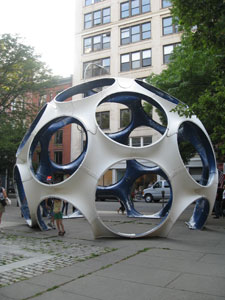
The Center for Architecture brought together a cross-disciplinary audience with Buckminster Fuller’s “Fly’s Eye Dome” installed at LaGuardia Park.

Jessica Sheridan

Big or little, independent or entrenched, New York’s radically different architectural institutions share some common traits. They initiate and propagate both abstract and creative research; leverage other arts as material for inspiration; and help bring discordant voices together in design. The educational collaborative Center for Urban Pedagogy (CUP) is one example of how design groups mediate among city dwellers, architects, and politicians. Like many fledgling architectural groups, CUP’s founder Damon Rich said that he wondered for a number of years how his group’s efforts could be made sustainable. “How can non-profits be more than beautiful bursts of energy?”

One key to the longevity of architectural institutions is the type and quality of the research they undertake. Moderator Olympia Kazi, of the Institute for Urban Design, questioned if the “hundreds” of design research labs practicing today actually generate valuable information, to which Professor Gwendolyn Wright responded that all research is valuable. Applied research, which reveals something new about a problem, is potentially more potent than solely intellectual, meta-scape research, however. Architects often use ex post facto research to “buttress” their designs, said Wright, but even these investigations are important if they reveal a new way of looking at things.

Beth Stryker, Director of Programs at the Center for Architecture, said that the beauty of larger architectural institutions, like the Center, is that they can bring together a range of cross-disciplinary perspectives. She cited Buckminster Fuller as one example of a designer who actively sought outside influences. This past summer, the Center put together a Fuller Study Center, which highlighted some of the many outside-design influences that the designer relied upon.

Though the panel praised institutions’ ability to spark creative thought and collaboration, the definition of what compromises an architectural institution was left fuzzy. How does an informal one- or two-person collaborative without physical space rank against groups with an established public presence, like the Center? Kazi posited a wide definition, saying, “Architectural institutions are places where compromises occur.”

Gilmartin Soars through Glass Ceilings, Torques Steel Façades

Event: An Evening with MaryAnne Gilmartin
Location: Center for Architecture, 10.27.08
Speakers: MaryAnne Gilmartin — Executive Vice President, Forest City Ratner Companies & 2008 AIA NY Chapter Award Recipient
Organizer: Center for Architecture
Sponsor: Kramer Levin

The Beekman Tower by Gehry Partners.

Artefactory

During her 15 years at Forest City Ratner (FCR), Executive Vice President MaryAnne Gilmartin has set a new standard for female leadership in the real estate community and is the reason she is this year’s AIANY Chapter Award recipient. With the 76-story Beekman Tower designed by Gehry Partners, she is proving her perseverance with the torqued stainless steel residence scheduled to open in 2010.

“To make a great building takes a great many people,” Gilmartin stated — collaboration is a theme that resonates throughout her portfolio, which includes development of Atlantic Yards, also by Gehry Partners, and the New York Times Building by Renzo Piano Buliding Workshop with FXFOWLE Architects. The Beekman is an exercise in public/private partnership, a regular mission of FCR’s endeavors, which fuses 100,000 square feet of public school programs with 903 luxury rental units. The site, located on Beekman and William Streets, is adjacent to New York Downstate Hospital and will provide the healthcare facility with an ambulatory care facility as well. Originally slated for a mix of condos and rental units, the final design contains only leasable units — a shift many properties are adopting in response to the 70/30 split between renters and owners in Manhattan. The final program also reflects a decrease in retail and parking areas, and a significant increase in housing units.

Gilmartin describes Gehry’s tower as a “serious departure from the norm,” and championed the property as unparalleled in its grandeur and views yet equal to its peers in rent costs. Regulating the budget for a building of “starchitect” quality is challenging; Gilmartin attributes the financial success of Beekman to the demystification of the undulating façade through mockups and precise manipulation of the curves. Like any good developer, she believes, FCR “introduced a certain amount of sanity” to the design process. And like any great developer, the result will be a dynamic addition to Manhattan’s skyline.

The Green Way Lays Path for the Future

Event: An Evening with the Department of Housing Preservation and Development and its Deputy Commissioner Holly Leicht
Speaker: Holly Leicht — Deputy Commissioner, NYC Department of Housing Preservation & Development; Adam Weinstein — President, Phipps Houses (Co-developer); Paul Freitag — Development Studio Director, Jonathan Rose Companies (co-developer); William Stein, FAIA — Principal, Dattner Architects (affordable housing studio); Robert Garneau, AIA — Grimshaw Architects
Organizer: Center for Architecture
Sponsor: Kramer Levin

Via Verde.

Phipps Rose Dattner Grimshaw, courtesy pieaia.org

Via Verde is entering its final working drawing phase. Since the competition-winning team of Phipps Rose Dattner Grimshaw was announced in January 2007 by competition hosts AIANY and the NYC Department of Housing Preservation & Development (HPD) with NYSERDA and the Enterprise Foundation, zoning changes have been approved, the design has developed, and it is now going for LEED Gold certification.

With a combination of sustainable and community oriented high-, mid-, and low-rise units (to be both owned and rented), the project may not be an exact prototype for future development, but it will hopefully be a model for smaller developments, said Paul Freitag, the development studio director for Jonathan Rose Companies. Sited near the NYC Housing Authority, Melrose Commons, the commercial center known as The Hub, and other retail development, the site presents distinct opportunities and challenges. According to William Stein, FAIA, principal at Dattner Architects, Via Verde can be described in organic terms. He compared it to tendrils that spiral from a high tower to the north, to the lower gardens to the south, and continue out to the neighborhood beyond.

The triangular site provides southern exposure, ideal for solar access. Terraced green roofs provide everything from orchards, vegetable gardens, and passive recreation, to non-accessible green areas to control storm water and mitigate the heat island effect on the horizontal fields. The vertical planes accommodate photovoltaic cells on panels that will produce 2.5% of the building’s total energy, or 160,000kw per year. Every apartment has large operable windows and through-ventilation.

Various materials on the façade distinguish private and public spaces, from warmer wood composite material facing the courtyard to cooler cement board panels facing the street. The rain screen system throughout is innovative, Robert Garneau, AIA, of Grimshaw Architects explained, and the prefabrication provides both cost efficiency and construction expediency. Balconies line the private inner courtyard as well, encouraging interaction among inhabitants, while sunshades protect apartments from overheating along the public street façade.

Overall, the team aims to encourage a healthier lifestyle with the design. In addition to cross ventilation and passive and active recreation areas, a food co-op is planned in one of the street-level retail spaces, along with an onsite health and fitness center. Signage will encourage the use of the stairs over the elevators, and FSC woods and low VOC paints will prevent harmful off-gassing. The onsite Montefiore Medical Center will also provide care.

At the end of the day, fine tuning existing tried-and-true systems will save the most money and offer the easiest solutions to environmental challenges, said Garneau. By correctly sizing units and by not oversupplying spaces, the savings will produce a regressive tax on low-income housing. With requirements for fixed percentages of affordable units and environmental regulations for all new city buildings, this project has honed the skills needed for future developments, according to Adam Weinstein, president of Phipps Houses.

Studio Libeskind Designs with Global Perspective

Event: An Evening with Studio Daniel Libeskind; 2008 President’s Award Recipient
Location: Center for Architecture, 10.29.08
Speakers: James McCullar, FAIA — 2008 AIANY President; Rick Bell, FAIA — AIANY Executive Director; Nina Libeskind & Daniel Libeskind, AIA — Studio Daniel Libeskind, President’s Award Winner 2008
Organizers: Center for Architecture
Sponsors: Kramer Levin

WTC site plan as of 01.29.08.

Image by Foster + Partners, courtesy of Silverstein Properties

Studio Daniel Libeskind received this year’s AIANY President’s Award for its significant contributions to the design of major international cultural buildings and urban projects. With this year’s Architecture Week theme in mind, “Architecture and Design: How to Create Sustainable Cities,” Nina and Daniel Libeskind, AIA, shared their thoughts on the development and importance of design across the globe.

With designs intended to expand the horizons of architecture and urbanism, the Libeskinds believe buildings and urban projects are crafted with human energy to speak to the larger cultural community. The public will see the symbolism of the WTC site once it is complete, he claimed. He regards the rebuilding of Lower Manhattan, and his role in it, as a grand success with its global vision.

In general, the clients the firm chooses to work with share their goals; therefore, Nina, who is chief operating officer and partner, prefers working with clients in democratic states. The office itself is “full of passionate designers and a fun place to work.” Married and working together, the Libeskinds “are like a yin and yang — we always disagree with each other, but this is essential to develop new inspirations and push boundaries,” they said.

Symbiosis: Poetry, Architecture

Event: Form and Function: The Intersection of Poetry and Architecture
Location: Center for Architecture, 09.27.08
Speakers: Latin American Confluenes: Poetry & Architecture at the Mid-Century: A.S. Bessa — Director of Programs, Bronx Museum of the Arts; Carlos Brillembourg, AIA — Principal, Carlos Brillemboug Architects; Rubén Gallo — Writer & Scholar; Mónica de la Torre — Poet & Conceptual Artist; Architexts: Louise Braverman, FAIA — Principal, Louise Braverman, Architect; Annie Finch — Poet; Jill Stoner — Poet & Author; A Conversation with Architect Lebbeus Woods & Poet Susan Stewart: Susan Stewart — Poet & Critic; Lebbeus Woods — Professor, The Cooper Union Irwin S. Chanin School of Architecture; Between Forms: A Poetry Reading: A.S. Bessa; Gregg Biglieri — Poet; Brenda Coultas — Poet; Patricia Spears Jones — Poet; Frances Richard — Poet; Marjorie Welish — Poet, Artist, Art Critic
Moderator: Stephen Motika — Program Coordinator, Poets House
Organizers: Poets House; Center for Architecture
Sponsors: Center for Architecture; New York Council for the Humanities, a state affiliate of the National Endowment for the Humanities; Graham Foundation

Poetry and architecture can be linked in many ways — design inspired by poetry; poetry inspired by design; through the lens of specific artists; and through the lens of history. A full-day symposium sought to highlight the contact between the two art forms.

The discussion, “Latin American Confluences: Poetry & Architecture at Mid-Century,” looked historically at Central and South America where 20th-century political turmoil was ancestor to both literature and design. Writer and editor A.S. Bessa presented Brazilian concrete poetry, a formal practice with a distinctly visual component as words themselves form pictures. Carlos Brillembourg, AIA, discussed poetry and the city, particularly the effect of the 1920s Parisian streetscape on Peruvian surrealists such as César Vallejo, whose poetry has a collage-like quality.

Rubén Gallo and Mónica de la Torre talked about engagé poets and architects emerging in the 1960s. Poets such as Octavio Paz were horrified by the violent suppression of student demonstrations in Mexico City in 1968; Gallo pointed out that the city’s New Brutalist architecture proved useful to the authorities in herding and controlling demonstrators. De la Torre spoke about radical poets following the riots, who took cue from Paz’s call for “reversible monuments” — suggesting both a literature of outsiders against society and a condition of impermanence in contrast to the stolid concrete architecture that was the backdrop for the riots.

Louise Braverman, FAIA, made distinct analogies between poetry and architecture when designing the Poets House headquarters in Battery Park City. Although she did not speak in detail about the project during the “Architexts” panel, she suggested that abstract problems of form, space, and movement are comparable in both disciplines.

During the “Conversation with Architect Lebbeus Woods & Poet Susan Stewart,” Lebbeus Woods, better known as a theorist than a builder, compared his own process-based design strategy to that of poet T.S. Eliot. Susan Stewart, winner of the National Book Critics Circle Award, was more reluctant to make a parallel between drawing and poetic composition. However, on the topic of historic influence, Stewart accepts the appropriation of poetic forms from any period in literature, while Woods objected to the direct borrowing from past architecture.

Artists Take to the Streets

Event: Conflux Festival
Location: Center for Architecture and other locations in NYC, 09.11-14.08
Artists, Speakers, Performers: For a full list of participants, go to the Conflux website
Organizers: Conflux Festival; Center for Architecture
Sponsors: Conflux Festival

Christine Foerster performs “Art.hro.poda: Cognigestation” (2008).

Pippa Connolly

Recently, you may have seen people walking down the sidewalk blindfolded, spinning wildly in “foga” (freak yoga) exercises in Washington Square Park, stealthily slicing up ads in SoHo, or imitating an insect in front of the Center for Architecture. All these mysterious shenanigans can be traced to Conflux, a five-year-old art and geography festival exploring NYC inhabitants’ relationship to their urban surroundings. Headquartered at the Center this year, the festival is loosely inspired by “psychogeography,” a Situationist term for the effects of the geographical environment upon people’s emotions and behavior.

Beginning with two days of talks at the Center, Conflux then burst into the city streets where festival-goers could sample urban games, walking tours, and other activities often defying easy definition. A game geek, an affordable-housing developer, and others led a walking tour/scavenger hunt called Kicking Over the Traces (2008), aimed at uncovering the gentrifying East Village and Lower East Side’s more radical past. Participants visited places and institutions that are rich in activist and cultural history, and watched video clips on iPods that helped bring bygone days back to life. In the low-tech but also engrossing walking tour Looking for… (2008), Columbia Urban Studies graduate Steve Duncan led a group to peer down manholes and explore the city’s hidden layer of subterranean waterways such as Minetta Brook, which once ran aboveground near where the Center now sits.

Collaborative mapmaking was the mission of some projects, such as artist o.blaat’s “Broadway Dreams” (2008), an electronic map complete with digital photos and tiny video and audio clips. The Urban Disorientation Game (2007) renounced maps; instead, its teams played the game blindfolded, taking inspiration from early psychogeographers’ technique of willfully disorienting themselves by exploring one city with the map of another.

Aside from such group activities, art performances and installations provided provocations. Blending architecture, fashion, and performance art was “Art.hro.poda: Cognigestation” (2008), in which El Paso, Texas-based artist Christine Foerster shed an outer layer of clothing (called “Shell-ter-ware”) to form a tent-like nesting pod for her insect character to inhabit. In a time when climate change and homelessness are pressing social issues, the adaptability of arthropods provides ample inspiration, according to the artist. London-based art collective CutUp’s sliced and remixed ad billboards created in SoHo provided an eye-catching antidote to the area’s brand-saturated visual landscape. To see images, go to the CutUp Ad Herennium blog.

The tension between marketing and art is playing out in the fate of the festival itself: Conflux has resisted corporate sponsorship, but lack of funding makes it difficult to sustain its huge popularity and corresponding growth, said co-founder Christina Ray in an opening speech. When it began, it was a small, spontaneous street-art party among friends; this year, it drew more than 100 artists from a dozen countries. Its fate next year is uncertain — Ray revealed that she is stepping down as director. But just as our city continually evolves, here’s hoping that if Conflux fades out, other events exploring the lively intersection of geography and art will emerge to take its place.

9/11 Remembered

6:46am (left); 6:55am (right).

© Frank Ritter 2008 www.RitterPhoto.com

9:04am (left); 9:07am (right).

© Frank Ritter 2008 www.RitterPhoto.com

11:06am (left); 6:14pm (right).

© Frank Ritter 2008 www.RitterPhoto.com

6:52pm (left); 6:58pm (right).

© Frank Ritter 2008 www.RitterPhoto.com

6:59pm (left); 7:42pm (right).

© Frank Ritter 2008 www.RitterPhoto.com

9:17pm (left); 11:24pm (right).

© Frank Ritter 2008 www.RitterPhoto.com