04.28.09
For those of you attending the 2009 AIA Convention in San Francisco, be sure to check out the AIA Convention Preview in the Around the AIA + Center for Architecture section.
– Jessica Sheridan, Assoc. AIA, LEED AP
04.28.09
For those of you attending the 2009 AIA Convention in San Francisco, be sure to check out the AIA Convention Preview in the Around the AIA + Center for Architecture section.
– Jessica Sheridan, Assoc. AIA, LEED AP
04.07.09
Because of the 2009 AIA Convention, the schedule for e-Oculus is shifting. The next issue will be published 04.28.09, in three weeks instead of two, and it will include a full listing of all NY-based speakers at the convention. Following that, issues will resume a bi-weekly schedule.
– Jessica Sheridan, Assoc. AIA, LEED AP
CLICK ON BLOG CENTRAL: AIANY BLOG: The AIANY Chapter’s Blog Central features opinion pieces on architectural issues relevant to NY-based designers, firms, and projects, along with spotlights on debates and discussions at the Center for Architecture and AIANY. It is an informal discussion board. To become a regular contributor to Blog Central, please e-mail e-Oculus. Pen names are welcome.
03.24.09
Tickets to San Francisco are just $250 round trip for the weekend of the 2009 AIA Convention (04.30-05.02.09). Be sure to purchase yours soon if you have not already!
– Jessica Sheridan, Assoc. AIA, LEED AP
CLICK ON BLOG CENTRAL: AIANY BLOG: The AIANY Chapter’s Blog Central features opinion pieces on architectural issues relevant to NY-based designers, firms, and projects, along with spotlights on debates and discussions at the Center for Architecture and AIANY. It is an informal discussion board. To become a regular contributor to Blog Central, please e-mail e-Oculus. Pen names are welcome.

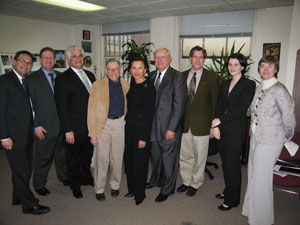
(L-R): Laura Manville; Rick Bell, FAIA; Tony Schirripa, AIA, IIDA; Sherida Paulsen, FAIA; Michael Cosentino, AIA (President-elect, AIA Queens); Congresswoman Carolyn Maloney; Mary Burke, AIA; Margery Perlmutter, AIA; Margaret Castillo, AIA, LEED AP; Venesa Alicea, Assoc. AIA, LEED AP: Terrence O’Neal, AIA; Burt Roslyn, AIA.
Orly Isaacson
The Grassroots Leadership and Legislative Conference of the American Institute of Architects brought more than 800 architects to Capitol Hill last week. Our Rebuild & Renew message called on Congress to prioritize economic recovery funding for projects that will stimulate the design and construction industries, creating jobs and assuring design quality. The AIA’s plan will enable architects and builders to create safe and modern infrastructure, energy efficient buildings, and sustainable communities.
The AIA New York delegation was led by Chapter President Sherida Paulsen, FAIA, and included President-elect Tony Schirripa, AIA, IIDA, Vice President for Public Outreach Margaret Castillo, AIA, LEED AP, Public Director Margery Perlmutter, AIA, Associate Director Venesa Alicea, Assoc. AIA, LEED AP, along with Policy Coordinator Laura Manville.
AIA National issued briefs that we discussed with NYC legislators calling for the promotion of healthy and safe communities through transportation funding, the elimination of federal fee retainage rules, and health care reform.
We also had conversations on the Hill about the impact of the economic crisis on the architecture and design community in New York, and how project funding and credit is needed to keep offices going. The Chapter’s Not Business as Usual advocacy efforts resonated with members of Congress and others present. Of particular interest to many was the idea of energy surveys of public buildings as a generator of work, and the expansion of AmeriCorps to include a DesignCorps component.
The VIA AIA theme of vision/influence/action was organized and led by AIA National President-elect George Miller, FAIA, a past-president of AIA New York.
A highlight was the Best Practice session spotlighting the AIA New York Chapter’s New Housing New York Legacy Project. Many affordable housing enthusiasts and housing specialists came to hear the presentation by Holly Leicht, Deputy Commissioner for Development of the NYC Department of Housing Preservation & Development, and Mark Ginsberg, FAIA, LEED AP, the Chapter’s AIA150 Champion.
With a spirit of change in DC, and a sense of urgency imparted by global economic conditions, this Grassroots conference was considered by those attending as the most important lobbying effort by the AIA in history.
Event: 2008 AIA National Convention
Location: Boston Convention and Exhibition Center, Boston, 05.15-17.08
Speakers: Go to the AIA Convention website for information on all speakers and events
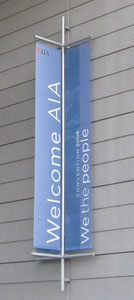
The Boston Convention and Exhibition Center.
Jessica Sheridan
“We the People,” this year’s theme at the AIA National Convention, urged architects to improve communities, locally and worldwide. Keynotes featured Ambassador Andrew Young, who stressed the need for the profession to diversify; Habitat for Humanity founder Millard Fuller, who encouraged architects to put up affordable housing; and a panel moderated by International Center for Urban Security founder Thomas Vonier, FAIA, who asked architects to focus on civic architecture despite a time of increased security and political turmoil. Sustainability, affordable housing, urban security, and diversity permeated many discussions at the Rafael Viñoly Architects-designed Boston Convention and Exhibition Center.
Focus on Civic Architecture
“It is deplorable that few architects get involved or are friends with politicians in the public realm,” stated Ambassador Richard Swett, FAIA, vice president and managing principal at Washington D.C.-based Leo A Daly during the Civic Architecture: Design and Identity in a Changing Society panel. Although this was a common sentiment at the convention, firms nationwide are addressing the issue by getting more involved in civic architecture. Until recently, government buildings were seen as limited to Classical design and political ruthlessness, Swett said. But Edward Feiner, FAIA, senior vice president and chief architect at Las Vegas Sands Corporation and former chief architect at the U.S. General Services Administration (GSA), believes that architects can be a catalyst for change in the public realm; public buildings can complete a “civic vision.”
After the Oklahoma City bombing and 9/11, the GSA began to readdress the security needs of public sector facilities by holding charrettes in most major cities. Structural hardening, blast-resistant glazing, a 50-foot standoff perimeter, increased lighting, and site surveillance are some of the measures introduced in the GSA Perimeter Security Guide (the AIA and American Society of Landscape Architects (ASLA) participated in putting together this document as well). As federal buildings bulked up to protect civilians, the GSA also began encouraging sustainable design. By designing buildings that incorporate natural light, hidden security, and the setback rule to create urban plazas, the hope is that civilians will want to visit new civic buildings and spend time in their open spaces, according to GSA chief architect, Les Shepherd, AIA.
In addition to developing new building codes, there are other steps possible to foster change. Swett stated that education is key — civic design should be integrated into architecture school curricula (possibly as studio projects), architects should educate their clients, and the GSA must educate government officials. For Shepherd, civic buildings must remain in city centers to encourage communities to trust that their governments are concerned with their safety.
Event: 2008 AIA National Convention
Location: Boston Convention and Exhibition Center, Boston, 05.15-17.08
Speakers: Go to the AIA Convention website for information on all speakers and events
There were a number of firsts for Associate members at this year’s AIA National Convention. The first AIA Associates Award, the highest award given to individual Associate members who “demonstrate an unparalleled commitment to their component or region’s membership,” went to Jonathan Taylor, Assoc. AIA, LEED AP, Regional Associate Director of the New England Region. Vasso Kampiti, Assoc. AIA, Regional Associate Director for the New York State Region, was the first New Yorker selected for the Jason Pettigrew Memorial ARE Scholarship that will pay for her ARE exams. The Associates Luncheon, proceeds of which went to her scholarship fund, featured keynote speaker Amy C. Edmondson, Novartis Professor of Leadership and Management, Harvard Business School, speaking on the value of good business practices.
This year’s convention also marked the debut of the Associates Lounge, sponsored by Kaplan AEC, a space for Associates to connect with each other, learn about the National Associates Committee (NAC), take practice ARE exams, and relax between sessions. Additionally, several workshops on preparation for the ARE were offered, book-ended by welcoming and closing receptions.
New Yorkers Design for the Public Realm
The GSA is not the only one urban centers with civic architecture. New York State, NYC, and NY-based firms moving to improve the public realm as well. Einhorn, Yaffee, Prescott A/E is doing much of that at the United Nations, as discussed during the The United Nations in the 21st Century panel. While trying to maintain the spirit of Le Corbusier’s design, the architecture/engineering team is also attempting to bring the building up to code, provide necessary health, safety, and welfare provisions, and introduce sustainable design. The renovations will reportedly reduce the building’s energy consumption by 30% by introducing an improved curtain wall, water re-use, and efficient mechanical systems. Ultimately, the goal is to imperceptibly surgically enhance the building, explained Anthony Cohn, AIA, of Einhorn, Yaffee, Prescott.
Although NYC is inherently green due to its density, extensive mass transit, strategically located parks such as Central Park, and community activism, Mayor’s PlaNYC brings sustainability to the forefront of civic planning. Thirty-two percent of NYC is covered with buildings and efficient development is costly, not to mention that developers often resist doing work for the public good, according to Jessica Strauss, AIA, LEED AP, NCARB, co-chair of the AIANY Committee on the Environment (COTE) at the Organizing Professional Response to the Mayor’s Plan NYC 2030 discussion. Robert Eisenstat, AIA, chief principal architect of the Port Authority of New York and New Jersey, stressed the importance of implementing PlaNYC initiatives after the mayor’s term ends this year. Outreach through education and advocacy, acting as a watchdog within the profession, and directly taking action to encourage sustainable design are architects’ responsibilities to achieve a reduced carbon footprint.
The New Housing New York Legacy Project panel discussed Via Verde, an affordable housing development that aims to improve a local community in the Bronx. Phipps Houses with architecture firms Dattner Architects and Grimshaw are bringing sustainable design and mixed-income housing to the forefront of its design. A community health center, exercise facility, food co-op, and roof gardens with linked paths aim to promote healthy living throughout the neighborhood.
Although private, The New York Times building, designed by FXFOWLE Architects/Renzo Piano Building Workshop with interiors by Gensler, takes up the public realm through its open lobby, as discussed during The New York Times Building: Vision, Collaboration, and Innovation. With an ongoing exhibition and central courtyard, passersby are encouraged to enter. The transparent design displays the activity within, mimicking the hustle-and-bustle of people on the street.
Even AIA chapters are improving the public realm by providing centers for architecture. By creating the Center for Architecture, AIANY, following Chicago’s lead, has developed a space for the architecture/landscape/planning/design community to gather, hold lectures and events, host exhibitions, and educate the public about the built environment. It has also become a center to advocate for good government practices. While each city to set up a center has a slightly different mission tailored to the needs of the local community, “design centers bring people together,” remarked Rick Bell, AIANY Executive Director, at The Value of Architecture Centers discussion. Other cities are seeing their value, and soon new centers will open in Dallas and San Francisco (one hopes in time for next year’s AIA Convention).
05.13.08
The 2008 AIA Convention is upon us this week. Still haven’t decided what events to attend? Check out the AIA Convention Preview in the Around the AIA + Center for Architecture section.
– Jessica Sheridan, Assoc. AIA, LEED AP
SAVE THE DATE: This year marks the 5th anniversary of OCULUS. Help us celebrate with a party following the Annual Meeting.
Location: Center for Architecture
Date: 06.03.08, 8:30-10:00pm
To RSVP, click the link. See you there!
Event: 2008 National Conference for the Intern Development Program (IDP)
Location: Albuquerque, NM, 04.11-12.08
Speakers: For a full list of speakers and presentations, go to the conference website
Organizer: AIA Emerging Professionals Committee
This year’s IDP conference introduced many changes to the process that may cause ripple effects throughout the profession. The Intern Development Program, hosted by the National Council of Architectural Registration Boards (NCARB), has been around for some 33 years, not long when compared to the 150-year-old AIA.
One major change to IDP involves the time period that interns have to report their Training Units. If approved during NCARB’s June 2008 Annual Meeting, Resolution 2008-G will require interns establishing a new IDP record on or after July 1, 2009, to report their Training Units in periods of no longer than six months. Beginning July 1, 2010, all interns enrolled in IDP will need to report their hours every six months. Upon implementation, retroactive reporting will become a thing of the past. This new policy is being introduced in conjunction with NCARB’s new online IDP reporting system, which itself is expected to be complete before July 1, 2009.
In addition to IDP reports, the New York State architectural licensure process will soon allow interns enrolled in IDP to concurrently take the Architectural Registration Exam (ARE). Other states have already adopted this practice, and upon approval by the New York State Board of Regents this fall or winter, candidates will be able to take the ARE at the same time they are completing their hours for IDP.
As more firms embrace IDP, AIA and NCARB have introduced two award programs: the IDP Firm Award and IDP Outstanding Firm Award. Recognizing firms that demonstrate exemplary efforts to support interns, the AIA hopes these awards will become a catalyst for IDP awareness. This year’s recipients of IDP Firm Awards include: BRR Architecture (Merriam, KS), Centerbrook Architects and Planners (Centerbrook, CT); Hendon + Huckestein Architects (Birmingham, AL); James Hundt Architecture (Clifton Park, NY); KTGY Group (Irvine, CA); Scott&Goble Architects (Tulsa, OK); Seay Seay, & Litchfield (Montgomery, AL); and Williams Blackstock Architects (Birmingham, AL). No NYC-based firms were given awards this year. The IDP Outstanding Firm Awards Program is still accepting submissions. The Summer 2008 cutoff deadline is July 15. Click here for more information.
Event: Advocacy Week
Date: 03.24-28.08
Organizers: AIA National; AIANY
Advocacy Week meeting at the District Office of Congresswoman Nydia Velàzquez included (l-r): Rick Bell, FAIA, AIANY Executive Director; Andrew Goldberg, Assoc. AIA, AIA National’s Senior Director for Federal Relations; AIANY Vice President Tony Schirripa, AIA; Don Weston, AIA Brooklyn; Rep. Velàzquez; Frank Lo Presto, AIA, AIA Brooklyn President; Marcus Marino, AIA, AIA Staten Island President; Laura Manville, AIANY Policy Coordinator; and Cynthia Kracauer, AIA, LEED AP, AIANY Managing Director.
Dan Wiley
AIA Advocacy Week 2008 was an effort to organize hundreds of meetings nationwide with members of Congress during the congressional recess, March 24-28. Since AIA members can bring expertise in the design field to the attention of elected leaders, hopefully key issues will be brought forth on a larger platform. Nearly 800 AIA volunteer leaders and executives laid the groundwork for Advocacy Week during the annual Grassroots Leadership and Legislative Conference in Washington, DC, February 20-23.
“Small businesses are the backbone of the American economy, and nowhere is that more clear than in NYC,” said Congresswoman Nydia M. Velàzquez, chairwoman of the House Committee on Small Business, who believes small businesses help make the city vibrant and diverse. A high point of 2008 Advocacy Week was a meeting on March 27 with Velàzquez during which AIA leaders exchanged ideas about the three key AIA National Legislative Priorities for 2008: Public Transportation Funding, Energy Efficient Buildings, and Eliminating Federal Contract Retainage Rules on Architects and Engineers. Representatives from three NYC AIA Components, including AIA Brooklyn President Frank Lo Presto, AIA, AIA Staten Island President Marcus Marino, AIA, and AIA New York Vice President Tony Schirripa, AIA, attended the meeting.
As NYC’s senior member on the House Subcommittee on Housing and Community Opportunity, Velàzquez was particularly interested in AIANY’s sesquicentennial blueprint initiative, Via Verde, a community-based public-private partnership that will result in the construction of over 200 units of sustainable, affordable housing in the South Bronx, designed by Phipps Rose Dattner Grimshaw. With her district spanning three boroughs and including neighborhoods as diverse as Red Hook, Bushwick, SoHo, and the Lower East Side, Velàzquez was also interested in AIANY’s dedication to cross-cultural interaction — such as the Berlin-New York Dialogues: Building in Context exhibition, currently on view at the German Architecture Center in Berlin.
Similar discussions took place throughout Advocacy Week in the 15th Congressional District, home to House Ways and Means Committee Chair Charles Rangel. AIANY President James McCullar, FAIA, shared thoughts with Michelle Sherwood, Rangel’s legislative counsel, on how to best incorporate energy saving features and incentives into affordable housing, noting that his firm designed a project nearing completion on West 123rd Street in the Congressman’s district.
Other events that highlighted the AIANY’s concerns about these three issues, as well as our 24/7 “everyday advocacy,” included programs at the Center for Architecture and testimony at City Council. Laura Manville, AIANY policy coordinator, attended a council hearing on congestion pricing, submitting the Chapter’s testimony in favor of the plan. New York New Visions and the Chapter’s Planning & Urban Design and Transportation & Infrastructure Committees hosted a presentation of the MTA’s Capital Plan, and its relation to the congestion pricing proposals. Participants included the MTA’s William Wheeler, AIA, director of special project development and planning, Gregory Kullberg, director of capital program budgets, and Nina Haiman of the Office of Planning and Sustainability of NYC Department of Transportation. McCullar introduced the panel by putting transportation-based planning in the context of Advocacy Week, PlaNYC, and AIANY “Designs for Living” annual theme.
Andrew Goldberg, Assoc. AIA, AIA National’s senior director for federal relations, joined local component leaders and staff for many of the Advocacy Week events, including the Velazquez and MTA meetings, as well as the City Council hearing on Governors Island convened by Councilmember Alan Gerson as chair of the Committee on Lower Manhattan Redevelopment.