Sewers Reveal Deep Topography Below

Event: Building Over the Past: The Hidden Layers of the City
Location: Center for Architecture, 01.27.09
Speaker: Steve Duncan — Urban Historian and photographer
Organizer: AIANY International Committee

Steve Duncan inside the Old Croton Aqueduct, which supplied NYC’s drinking water from 1842 until the late 19th century.

Steve Duncan

When most of us think of spending a nice day at a museum, we might think of hitting MoMA or the Met. But guerrilla historian Steve Duncan is more inclined to don a headlamp and explore a local NYC sewer, instead. The old subterranean infrastructure of cities is “one of the best ‘museums’ of old America that I’ve found,” he explained in a recent talk and slideshow. After all, underground spots tend to be protected from the elements and well preserved, so they provide a glimpse of architectural and cultural layers of times past.

Duncan’s obsession began in 1996, when he began exploring Columbia University’s subterranean tunnels while he was an undergrad there. These days, he travels around the world to practice “urban archaeology.” His slideshow gave the audience a whirlwind tour of Paris, London, Minneapolis-St. Paul, and other locales where he has snapped photos in spots both high above and far below the streets, in his never-ending quest to discover new angles on built environments.

Some of the underground images he showed have a strange beauty, such as the sculpted forms of sandstone tunnels forming the sewers of Minneapolis-St. Paul. His photos of NYC sewers and underground streams often showed a mélange of brick and concrete construction, much like the buildings above, though with occasional stalagmites or stalactites, as one might find in natural caves.

NYC’s underground watercourses bear testament to the city’s past incarnations, Duncan observed. Of course, NYC’s many waterways were one of the original draws for settlers. As the city, the sewer system developed along with it (rather chaotically), in multiple phases and methods of construction. The distinction between sewers and underground streams has often become blurred, Duncan added, because many streams became sewers once they were built over.

Though most of the city’s waterways are now hidden belowground, their memory lives on. Near the Center for Architecture, Minetta Street and Minetta Lane were named for Minetta Brook. The area’s underground waterways also make their continued presence known when local buildings such as the New School on West 13th Street occasionally flood, according to Duncan.

People in New York and beyond are searching for better ways to make underground watercourses more-well known and accessible. “Here are all these underground streams, these ancient watercourses, aqueducts, and I think it’s up to architects and builders and urban planners to try to celebrate that or open them up and reveal them,” Duncan said. But in NYC, the fact that the original watercourses are so intertwined with a labyrinthine sewer system makes such a task difficult. Some people advocate daylighting certain streams (though Duncan is too much of a fan of tunnels for that). Other efforts involve creating parks to celebrate the urban waterways, he said. Bounded by Canal, Varick, and Laight Streets, one park that’s under construction will feature a canal-like fountain (complete with a system of locks) inspired by the canal that once ran nearby. However, the project will use some water pumped in from the city’s water supply, instead of the nearby groundwater, Duncan said, challenging the architects in the audience to come up with better ideas about how best to celebrate and integrate the city’s groundwater in future projects.

MAD: A Slice of Life

Event: New Works: Brad Cloepfil and Allied Works Architecture
Location: Museum of Arts and Design, 01.22.09
Speaker: Brad Cloepfil, AIA — Principal, Allied Works Architecture
Organizer: Museum of Arts and Design

Installation view of the “Second Lives: Remixing the Ordinary” exhibition at the MAD Museum.

Photo Richard Barnes, courtesy MAD Museum

The Museum of Arts and Design’s new home at 2 Columbus Circle has been fraught with controversy. Preservationists decried the changes by Allied Works Architecture (AWA) to Edward Durell Stone’s Venetian-style building; some architecture critics looked at the new renovation as not going far enough toward making a bold design gesture.

In a recent talk, AWA principal Brad Cloepfil, AIA, revealed his perspective on the renovation of the museum, which opened in its new location last September. He showed no particular preoccupation with making a grand architectural statement — instead, his focus was on opening up the building to its surroundings and creating a space that feels vibrant, alive, and integrally connected with the fabric of the city.

One early scheme involved using art vitrines as “columns of light” that would penetrate vertically through the various levels and tempt visitors to explore. That idea proved impractical, Cloepfil said, but its spirit remains in a system of glassy slits that cut through the floors, allowing museumgoers to glimpse the shadows of artworks or visitors on other levels. The façade is also slitted, both horizontally and vertically, yielding views of the city to MAD visitors and allowing glimpses of the museum’s collection to people outside.

Other AWA museum projects reveal a similar concern with fostering a connection with the urban surroundings. The Contemporary Art Museum St. Louis features ribbons of concrete that intersect and overlap, creating “a bounded place” that is still “intimately connected with the city,” according to Cloepfil. At the University of Michigan Museum of Art, the firm designed a soon-to-open addition that’s elevated off the ground so that “people could move through the building physically, see into the building, see through the building, and it would become a kind of filter for the activity of the campus,” he said.

As attendees wandered about after the talk, the lights of cars and buildings glowed through the strategically placed slits and windows, demonstrating the way the museum welcomes its surroundings. The architects have given a nod to the art and the design of the city.

RPI Makes a Sound Investment

Event: Press Tour, Curtis R. Priem Experimental Media and Performing Arts Center (EMPAC)
Location: Rensselaer Polytechnic Institute, Troy, NY, 10.20.08
Speakers: Shirley Ann Jackson — President, Rensselaer Polytechnic Institute; Johannes Goebel — Director, EMPAC; Bill Horgan — Associate Principal, Grimshaw Architects; R. Lawrence Kirkegaard, Hon. AIA — President & Principal Acoustician, Kirkegaard Associates; Craig Michael Schwitter, P.E. — Partner & Regional Director, Buro Happold North America; Denzil Gallagher — Partner, MEP Regional Discipline Leader, Buro Happold North America; William Paxson, AIA — Partner, Davis Brody Bond Aedas, Ernesto Bachiller — Associate Partner, Davis Brody Bond Aedas; and others

EMPAC exterior (left); concert hall (right).

Kristen Richards

A recent tour of the new Grimshaw/Davis Brody Bond Aedas-designed Experimental Media and Performing Arts Center (EMPAC) at the Rensselaer Polytechnic Institute in Troy, NY, revealed a building so high-tech that sci-fi comparisons are inevitable. As visitors peered around one futuristic all-black theater, EMPAC director Johannes Goebel jokingly referred to it as “the Darth Vader space,” while project architect Bill Horgan of Grimshaw Architects compared it with “The Matrix.” One of two studios devoted to new-media performance and scientific data visualizations, the 3,500-square-foot Studio 1, is wrapped with pockmarked acoustic tiles. Hovering overhead are metal rings, providing a framework to hold a 360-degree panoramic screen and projectors for immersive virtual environments, aided by heavy-duty processing power (the building is connected to the university’s supercomputer). A computer-controlled rigging system can be used to fly people or objects through the space.

With the lights up, the futuristic decor is rather imposing, but the true function of the space, as well as the smaller Studio 2, is its ability to disappear and adapt to varying theatrical contexts, often infused with video or projections that provide an enveloping sensory experience. The studios and a larger theater with a fly tower were designed for “a sense of not knowing what one will find when one walks in,” Horgan said. In a building where various shows might happen at the same time, acoustic isolation was crucial, so Studio 1 was designed to be structurally separate. It floats independently within the larger building, supported by a series of springs, explained Craig Schwitter, P.E., of Buro Happold, one of many firms that contributed their expertise in the building design.

EMPAC’s cedar-clad concert hall.

Kristen Richards

Representing the analog side of the building’s program, a more traditional concert hall was inspired by the resonant chambers of stringed musical instruments. The hall’s red cedar-clad rounded exterior dominates the center of the building’s seven-story atrium. Unlike the curved exterior, the hall’s interior is basically shoebox-shaped, but it is slightly convex to improve acoustic diffusion. Supported by a web of steel cables, a ceiling made of thin fabric reflects high-frequency sounds, while an upper volume above it reflects low-frequency sounds, helping to perfect the acoustics. Vaguely visible from the outside through the glass façade, the rounded form of the concert hall is the building’s dominant visual icon, its curves providing a contrast with the surrounding linear geometries. In one of many eco-friendly touches, the façade carries a system of hollow mullions containing hot water to help heat the space in winter, explained Denzil Gallagher of Buro Happold. Visitors who touched the mullions could feel their warmth.

EMPAC concert hall interior (left); Studio 1 (right).

Kristen Richards

All in all, the tour revealed EMPAC to be a visually eclectic but highly functional space that is already helping to promote experimental endeavors in architecture, digital technology, and performance. New-media art collective Workspace Unlimited (founded by an architect and an artist) has already put Studio 1’s panoramic screen to use. The group’s EMPAC-commissioned multimedia art installation “They Watch” employs hacked video-game software and motion-tracking technology to let viewers walk around the studio to explore virtual architectural environments and interact with animated characters in real time. The tour’s one disappointment was the lack of a demonstration of such spaces’ prodigious audiovisual capabilities, leaving this visitor resolved to return one day to see them in action.

Snøhetta’s Ineffable Lightness of Being

Event: Current Work: Snøhetta
Location: The Cooper Union for the Advancement of Science and Art, 10.28.08
Speakers: Craig Dykers, AIA — Senior Partner/Director, Snøhetta; Calvin Tsao, FAIA — President, Architectural League & Partner, Tsao & McKown Architects (introduction)
Organizer: The Architectural League of New York

Snøhetta’s entry pavilion for the September 11 Memorial Hall and Memorial Museum.

Rendering by Squared Design Lab

Snøhetta is named for a craggy Norwegian mountain, but the firm’s inspiration comes as easily from water. From its Oslo office windows, ships can be seen drifting by on a fjord, said Senior Partner/Director Craig Dykers, AIA. “Three or four hundred tons of metal float effortlessly by, and there’s nothing more engaging to an architect [than] to see that much weight seemingly untouched by gravity. In a sense, that’s an important part of, I think, how we approach things — with a lightness,” he remarked.

The design for an airy glass-and-steel pavilion at the WTC tilts up toward the sky. Serving as an entry to the September 11 Memorial Hall and Memorial Museum, the pavilion has an angled roof that points down toward the underground museum and leads the eye up toward nearby buildings, reinforcing its role as a “link between the memorial and the commercial fabric of the city,” Dykers said.

The much-delayed project has, at times, been a tumultuous one. “Our building has been the only building on the memorial site, and therefore it gathers more criticism than the much larger buildings nearby,” he said. At one point, they had to redesign it and scale it down, yet in the end, Dykers thinks the change has been a good one. “In NYC, a small scale is a luxury,” he observed; the reduced size will bring a greater sense of intimacy for visitors.

The project led the firm to establish a second office in NYC in 2004, boosting its local presence. These days, it is planning to renovate a Williamsburg space for STREB, a highly athletic dance company whose gravity-defying feats match the firm’s kinetic sensibilities. “We began to review the methods of movement that occur with their dance company and integrate that into the motions of the façade,” Dykers said. Ripples in the brick will let dancers climb on the façade’s surface to perform acrobatic feats, and entire sections of the façade will be able to pivot open to the street.

Beyond presenting an array of projects, Dykers also discussed Snøhetta’s philosophies and progressive work policies, such as keeping an internal union. Principals are paid no more than twice an entry-level salary, and the firm’s experience-based salary ladder is common knowledge, taking the mystery out of the compensation process. And even in busy times, they eschew late nights at the office, proving that architects can take their work seriously without letting it weigh them down.

Artists Take to the Streets

Event: Conflux Festival
Location: Center for Architecture and other locations in NYC, 09.11-14.08
Artists, Speakers, Performers: For a full list of participants, go to the Conflux website
Organizers: Conflux Festival; Center for Architecture
Sponsors: Conflux Festival

Christine Foerster performs “Art.hro.poda: Cognigestation” (2008).

Pippa Connolly

Recently, you may have seen people walking down the sidewalk blindfolded, spinning wildly in “foga” (freak yoga) exercises in Washington Square Park, stealthily slicing up ads in SoHo, or imitating an insect in front of the Center for Architecture. All these mysterious shenanigans can be traced to Conflux, a five-year-old art and geography festival exploring NYC inhabitants’ relationship to their urban surroundings. Headquartered at the Center this year, the festival is loosely inspired by “psychogeography,” a Situationist term for the effects of the geographical environment upon people’s emotions and behavior.

Beginning with two days of talks at the Center, Conflux then burst into the city streets where festival-goers could sample urban games, walking tours, and other activities often defying easy definition. A game geek, an affordable-housing developer, and others led a walking tour/scavenger hunt called Kicking Over the Traces (2008), aimed at uncovering the gentrifying East Village and Lower East Side’s more radical past. Participants visited places and institutions that are rich in activist and cultural history, and watched video clips on iPods that helped bring bygone days back to life. In the low-tech but also engrossing walking tour Looking for… (2008), Columbia Urban Studies graduate Steve Duncan led a group to peer down manholes and explore the city’s hidden layer of subterranean waterways such as Minetta Brook, which once ran aboveground near where the Center now sits.

Collaborative mapmaking was the mission of some projects, such as artist o.blaat’s “Broadway Dreams” (2008), an electronic map complete with digital photos and tiny video and audio clips. The Urban Disorientation Game (2007) renounced maps; instead, its teams played the game blindfolded, taking inspiration from early psychogeographers’ technique of willfully disorienting themselves by exploring one city with the map of another.

Aside from such group activities, art performances and installations provided provocations. Blending architecture, fashion, and performance art was “Art.hro.poda: Cognigestation” (2008), in which El Paso, Texas-based artist Christine Foerster shed an outer layer of clothing (called “Shell-ter-ware”) to form a tent-like nesting pod for her insect character to inhabit. In a time when climate change and homelessness are pressing social issues, the adaptability of arthropods provides ample inspiration, according to the artist. London-based art collective CutUp’s sliced and remixed ad billboards created in SoHo provided an eye-catching antidote to the area’s brand-saturated visual landscape. To see images, go to the CutUp Ad Herennium blog.

The tension between marketing and art is playing out in the fate of the festival itself: Conflux has resisted corporate sponsorship, but lack of funding makes it difficult to sustain its huge popularity and corresponding growth, said co-founder Christina Ray in an opening speech. When it began, it was a small, spontaneous street-art party among friends; this year, it drew more than 100 artists from a dozen countries. Its fate next year is uncertain — Ray revealed that she is stepping down as director. But just as our city continually evolves, here’s hoping that if Conflux fades out, other events exploring the lively intersection of geography and art will emerge to take its place.

Symposium Spotlights Bucky’s Artistic Heirs

Events: Buckminster Fuller Symposium: On Architecture, Design and Science; On Influence and Contemporary Art
Location: The Cooper Union for the Advancement of Science and Art, 09.13.08
Speakers: On Architecture, Design and Science: Peter Galison — Joseph Pellegrino University Professor of the History of Science and of Physics, Harvard University; Chuck Hoberman — Founder & President, Hoberman Associates; Felicity Scott — Assistant Professor of Architecture, Columbia University Graduate School of Architecture, Planning and Preservation; Anthony Vidler — Dean & Professor, The Irwin S. Chanin School of Architecture of The Cooper Union; On Influence and Contemporary Art: Carol Bove — Artist; Elizabeth A. T. Smith — James W. Alsdorf Chief Curator and Deputy Director for Programs, Museum of Contemporary Art, Chicago; Victoria Vesna — Artist; Pedro Reyes — Artist
Moderators: On Architecture, Design and Science: K. Michael Hays — Eliot Noyes Professor of Architectural Theory, Harvard University Graduate School of Design & Adjunct Curator of Architecture, Whitney Museum of American Art; Margie Weinstein — Senior Coordinator of Public Programs and Academic Initiatives, Whitney Museum of American Art (introduction); On Influence and Contemporary Art: Dana Miller — Associate Curator, Whitney Museum of American Art; Margie Weinstein — Senior Coordinator of Public Programs and Academic Initiatives, Whitney Museum of American Art (introduction)
Organizer: The Cooper Union for the Advancement of Science and Art

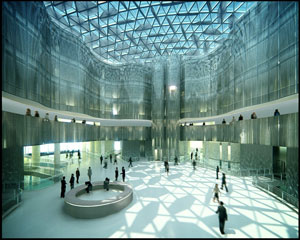
Hoberman Associates’ hexagonal shading system at the Foster + Partners-designed Audiencia Provincial channels Buckminster Fuller.

Foster + Partners

A quarter century after his death, Buckminster Fuller’s theories and inventions are still sending ripples of influence through the work of contemporary designers, architects, and artists. Therefore, a recent symposium aimed not only to historicize Fuller, but to explore his work’s ongoing relevance.

Chuck Hoberman of Hoberman Associates, an artist, inventor, engineer, and designer who often collaborates with architects, has been profoundly influenced by Fuller. Like Fuller, he shares a love of highly geometric and eco-friendly designs, as evidenced in his “transformable design” — structures and objects that can change in size, shape, form, and surface. In an era of global warming, devices such as Hoberman’s sun-responsive shades represent a form of adaptation, he said, offering a quote from structural designer Peter Rice: “When we get into trouble, we invent our way out of it.” For Madrid’s planned Audiencia Provincial (Appeals Court) by Foster + Partners, Hoberman designed such a system made from hexagonal shading cells that sense light levels and close as needed, creating leaf-like, dappled shadows inside the atria that minimize unwanted solar gain while maximizing natural light.

Aside from Hoberman’s discussion of his architectural collaborations, there wasn’t much talk about Fuller’s influence on architecture in the session titled “On Architecture, Design and Science.” Anthony Vidler made a case for the value of Fuller’s architectural work, despite Fuller’s autodidact status, but the bulk of his talk was on Fuller’s relationship with artist-writer John McHale.

One session was entirely devoted to Fuller’s influence in the realm of contemporary art. Artist Pedro Reyes presented his “Velotaxi” (2007), a human-powered vehicle reflecting a concern with aesthetics coupled with sustainability, along with several mathematically based sculptures recalling the familiar Fuller domes. Reyes also once took inspiration from Fuller’s geographical projects such as the World Game and the Dymaxion Map; his “Ideas for Iraq” (2008) is a table whose surface displays a digital map of Iraq and neighboring countries to help viewers visualize a war happening far away.

New-media artist Victoria Vesna discussed Fuller’s belief that art and science are closely aligned — the more advanced science gets, the closer it is to art, and vice versa. Both she and Carol Bove discussed some of their own artworks that use “tensegrity” structures, whether virtual or material. (The Fuller-coined term “tensegrity” refers to structures with a synergy between tension and compression components.) Elizabeth A.T. Smith of the Museum of Contemporary Art, Chicago, traced Fuller’s legacy in the work of several other artists, including Josiah McElheny, Andrea Zittel, and Olafur Eliasson.

While talks on Fuller at the Center for Architecture in June centered on personal anecdotes about him, featuring many of Fuller’s former associates (See “Bucky: Longtime Hero to a Few, at Last Comes into his Own,” by Lisa Delgado, 07.08.08), these talks complemented that earlier event, bringing an examination of Fuller’s work up to date.

Digital Fabrication Permeates Prefab

Event: Home Delivery: Fabricating the Modern Dwelling Panel
Location: Center for Architecture, 09.02.08
Speakers: Ali Rahim — Director, Contemporary Architecture Practice; Hina Jamelle — Director, Contemporary Architecture Practice; Neil Cook — Designer, Reiser + Umemoto; Michael Overby — Designer, Reiser + Umemoto; Scott Marble — Partner, Marble Fairbanks; Karen Fairbanks — Partner, Marble Fairbanks; Barry Bergdoll — The Philip Johnson Chief Curator of Architecture and Design, MoMA (introduction); James McCullar, FAIA — 2008 AIANY President & Principal, James McCullar & Associates (introduction)
Moderator: Peter Christensen — Curatorial Assistant, Department of Architecture and Design, MoMA
Organizers: Museum of Modern Art; Center for Architecture
Sponsors: Center for Architecture; AIANY Housing Committee

Contemporary Architecture Practice. “Migrating Formations, 2008.” Commissioned by MoMA for the Home Delivery exhibition. High-performance composite. This project supported in part by Z Corporation and ARUP.

Photograph by Richard Barnes, © 2008 The Museum of Modern Art

They are the only works that visitors to MoMA’s Home Delivery: Fabricating the Modern Dwelling exhibition inevitably see twice, remarked curator Barry Bergdoll. They’re at the heart of the show’s mission to explore evolving technological innovations in architecture fabrication and delivery. Yet the three digitally designed and manufactured walls in the vestibule have been overlooked in most press coverage, Bergdoll said, at a recent panel featuring the three NYC firms behind the creations. Calling them “among the most radical propositions in the show,” he said the museum commissioned the projects as “provocations to see where we are in the still-nascent revolution” of computer-aided design and manufacturing.

Ali Rahim and Hina Jamelle of Contemporary Architecture Practice (CAP) explored the design possibilities of rapid 3-D printing with “Migrating Formations,” a semi-opaque divider whose biomorphic forms resemble rows of bones. The printing was extremely fast, and the process obviated using molds or mechanical joints (the pieces were joined with epoxy resin). One day, similar technologies will be able to print entire homes in a day, Rahim said, which would be efficient, but not necessarily for good aesthetics. Home design is becoming easier for anyone with access to the technology — for better or worse. Therefore, CAP aimed for experimentation balanced with aesthetics. The patterns created by the wall’s curvy, bonelike pieces range between bulbous and angular forms to maximize the visual impact while adhering to the firm’s design sensibility.

The industrial looking “Flatform” by Marble Fairbanks was made, instead, of two laser-cut metal sheets that could be transported flat and then connected with foldout tabs. The result: a kind of “stainless steel Velcro,” as Scott Marble put it, where the intricate system of pinwheeling and opposing tabs provide the wall’s structure as well as its visual appeal. He was enthusiastic about how new digital fabrication techniques have inspired fresh architectural forms, seeing it as an opportunity to further architectural processes, not products, he said.

Reiser + Umemoto RUR Architecture used laser-cut steel to a different effect in “Vector Wall.” Undulating patterns of slits allowed the steel to be hammered into flowing curves, an easier installation than for Flatform, which required a squadron of students to help attach the tabs. The “Vector Wall” design process involved experimenting with variables such as the slits’ length, spacing, and patterning, said Neil Cook, one of the designers involved in the project. Like the other walls, Reiser + Umemoto is already exploring similar ideas and forms on a larger scale in projects such as the O-14 commercial tower in Dubai.

While the panels addressed technological and aesthetic concerns, the architects seemed less preoccupied with the practicality of their creations. Despite the three walls’ permeability, there was barely any talk about issues of visual or auditory privacy (apparently the designers all chose to envision their projects as decorative dividers). Bergdoll aptly observed that all three seemed more in the realm of materials research than an actual domestic program. Still, the panel justified the walls’ prominent placement, helping to elucidate some of digital design and fabrication’s advantages and pitfalls.

Form Follows Fantasy at MoMA’s Dreamland

Exhibition: Dreamland: Architectural Experiments since the 1970s
Location: Museum of Modern Art, through 03.02.09

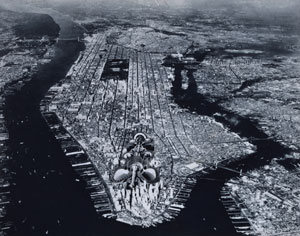
Urban Renewal in New York Project, New York, New York. Arial perspective, 1964. Cut-and-pasted gelatin silver photograph on gelatin silver photograph.

Hans Hollein, Hon. FAIA, courtesy Museum of Modern Art

New York City has always been a magnet for dreamers, and architects are no exception. In the 1960s and 1970s, a wave of young architects such as Raimund Abraham, Hans Hollein, Hon. FAIA, and Rem Koolhaas, took inspiration from the cityscape to form new utopian architectural visions. On the 30-year anniversary of Koolhaas’s book Delirious New York, the Museum of Modern Art’s show “Dreamland: Architectural Experiments since the 1970s” features more than 60 drawings, collages, paintings, and models dedicated to architectural experiments for New York and beyond, whether built or imagined.

Some works evoke the fantastical realms of science-fiction, such as Hollein’s collage “Urban Renewal in New York” (1964), which depicts part of Lower Manhattan transformed into a bug-like mechanical contraption — an ironic extension of Le Corbusier’s notion of the house as a machine for living in, explained curator Andres Lepik in an interview (in the absence of explanatory text in the exhibition, a frequent weakness in an otherwise engaging show). The somber “Church of Solitude” paintings (1974–77) by Gaetano Pesce depict a structure that reverses NYC’s usual inclination to build up by plunging into the earth, far from the noise and hubbub of the city, creating an underground sanctuary where visitors (animal-like and depraved) seclude themselves.

Whimsical imaginings from the then-young firm OMA include works from Delirious New York, such as Elia and Zoe Zenghelis’s painting “Hotel Sphinx” (1975–76), a Times Square hotel that straddles two blocks (a site condition lending to its sphinx shape). Koolhaas and Madelon Vriesendorp’s “The City of the Captive Globe” (1972) also celebrates Manhattan’s grid: each block houses another architectural or artistic idea, whose warmth helps to incubate the growth of the world at the center.

The City of the Captive Globe served as one source of inspiration for the show itself, said Lepik, with its assemblage of disparate concepts. A table at the center of the room serves as a platform for a dream city, dotted with models of eclectic projects from around the world. The curve of Diller + Scofidio’s Slow House rests near the angularity of Simon Unger’s T-House, both models encompassing idealist visions of what a country retreat can be. Surrounded with LED “leaves,” a high-tech model for a new Hotel Habitat in Barcelona (by Cloud 9, Acconci Studio, Ruy Ohtake, and Enric Ruiz-Geli) simulates an electronic tree house powered with solar energy. In some models, the utopian vision is obvious, in others, less so; again, more explanatory text would have made it an even stronger show.

Housing Acclimates to Waves of the Future

Event: Designs for Living: New Directions in Housing Design
Location: Center for Architecture, 08.11.08
Speakers: William Stein, FAIA — Principal, Dattner Architects; Coren Sharples — Partner, SHoP Architects; James McCullar, FAIA — Principal, James McCullar & Associates
Moderator: Andrew B. Knox, AIA — Partner, Edelman Sultan Knox Wood / Architects & Chair, AIANY Housing Committee
Organizer: AIANY Housing Committee
Sponsors: Champion: Studio Daniel Libeskind; Supporters: Gensler; HumanScale; James McCullar & Associates; Friends: Benjamin Moore & Co.; Costas Kondylis & Partners; Forest City Ratner Companies; Frank Williams & Associates; Hugo S. Subotovsky Architects; Ingram Yuzek Gainen Carroll & Bertolotti; Mancini Duffy; Magnusson Architecture and Planning; Rawlings Architects; Ricci Greene Associates; Skidmore, Owings & Merrill; Syska & Hennessy; Trespa North America; Universal Contracting Group

Custom molds shape brick curtain-wall panels at 290 Mulberry Street.

SHoP Architects

As our million new neighbors predicted by PlaNYC descend by 2030, housing will make up an ever-greater portion of the fabric of our city. So what are some of the most promising directions for its design? According to William Stein, FAIA, principal of Dattner Architects, and Andrew Knox, AIA, partner at Edelman Sultan Knox Wood / Architects, one trend is the confluence of green design and affordable housing, which are recently coming together in projects that are equally light on the environment as on the pocketbook.

At the David and Joyce Dinkins Gardens in Harlem, designed by Dattner Architects, the basic design might be considered “dead simple,” said Stein, but innovation lies in the many tweaks that make it highly sustainable. A unitized ventilation system (originally developed by Chris Benedict and Henry Gifford) keeps a constant flow of fresh air circulating through each apartment, without connecting to others, so no worries about a neighbor’s cigarette smoke. Sunshades on the south façade block summer sun while adding texture to the exterior. Similarly, at the Bronx’s Intervale Green, a traditional NYC Department of Housing Preservation & Development (HPD) housing design is enlivened with sustainable flourishes such as a green roof that’s being designed by Parsons the New School for Design architecture students, according to Knox.

With desirable housing sites dwindling, some improbable locations are being pressed into use. Case in point: James McCullar & Associates’ State Renaissance Court, a retail and mixed-income-housing building, is designed to hover above Brooklyn’s Hoyt-Schermerhorn subway station. Concerns about train noise and seismic safety guided its design, involving a system of spring isolators and pile foundations that help the building float above the subway (See “Renaissance Advances in Downtown Brooklyn,” In the News, e-Oculus, 02.19.08). While the trains’ rumbles can be felt on the nearby sidewalk, residents inside enjoy silence, James McCullar, FAIA, said.

Coren Sharples of SHoP Architects advocates getting involved at all levels of the design process, from the development phase through fabrication — otherwise, architects risk getting sidelined in a conservative speculative housing market. A new condo building under construction at 290 Mulberry Street is designed using tools such as Digital Project and Revit in the firm’s pilot BIM project. Canadian company Saramac used custom molds to fabricate the rippling brick curtain-wall panels. Contextual zoning called for masonry, and the uncommon forms pay homage to the Puck Building across the street, Sharples said. “We really wanted to do something with masonry that would be as modern and playful as the Puck Building was… in its day,” she explained.

Bucky: Longtime Hero to a Few, at Last Comes into his Own

Events: Dialogue 1: Fuller’s architectural partners; Dialogue 2: Fuller’s associates
Location: Center for Architecture, 06.25.08
Speakers: Dialogue 1: Shoji Sadao, AIA — President, Fuller and Sadao; Thomas Zung — Author & Editor, Buckminster Fuller: Anthology for a New Millennium; Amy C. Edmondson — Author, A Fuller Explanation. Dialogue 2: Edwin Schlossberg — Principal Designer, ESI Design; Michael Ben-Eli — Founder, Sustainability Laboratory
Moderators: Dialogue 1: Branden Joseph — Associate Professor, Modern and Contemporary Art, Columbia University; Tony Schirripa, AIA — Vice President, Public Outreach, AIANY (introduction), Dialogue 2: Paola Antonelli — Curator, Department of Architecture and Design, Museum of Modern Art; Jonathan Marvel, AIA — Principal, Rogers Marvel Architects (introduction)
Organizers: The Buckminster Fuller Institute; Center for Architecture
Sponsors: Underwriters: Center for Architecture Foundation; Friends of LaGuardia Place; NYC Department of Transportation’s Temporary Art Program; Lead Sponsor: Spring Scaffolding; Sponsor: Richter+Ratner; Supporters: New York University; Purchase College, State University of New York; Media Sponsor: Metropolis

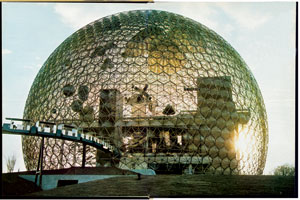
U.S. Pavilion for the 1967 International and Universal Exposition in Montreal, 1967.

Image courtesy the Estate of R. Buckminster Fuller, courtesy Whitney Museum of American Art

Because of Buckminster Fuller’s self-taught, interdisciplinary approach, the architecture community has been slow to give him his due, said Jonathan Marvel, AIA, of Rogers Marvel Architects. But Fuller’s prescient concerns with environmental issues means that now, 25 years after his death, architects are embracing him. “He’s always been a hero to many of us, but it’s only really been when sustainability came to the forefront of our architectural discussions — for economic and environmental purposes — that Bucky has found a placehold in our framework,” Marvel said as he introduced one of two recent panels.

Speakers included prominent associates of the architect-engineer-mathematician-inventor. Edwin Schlossberg discussed his work in running the Fuller-designed World Game in the 1960s. Designed as an alternative to war games, the World Game engaged players in optimizing the distribution of the world’s resources. Long before Google Earth, it was “a paper-and-pencil version of how to do a full-scale modeling environment,” he said. In a pre-Internet era, the research involved in compiling the data was an enormous undertaking, but “one of the qualities about Bucky was this absolute convinced optimism that problems could be solved,” Schlossberg said.

Shoji Sadao, AIA, discussed his collaboration on a 250-foot-diameter geodesic dome that served as the U.S. Pavilion at Expo 67 in Montreal. Made of small identical parts, the immense structure embodied Fuller’s ideal of using minimal materials for maximum results. “I think the lasting significance of the dome is that after Expo 67, it seemed to become an iconic image for all the rest of the fair,” Sadao said, adding that in the wider cultural realm, spherical structures also became popular in images of future cities.

Fuller’s former engineer, Amy Edmondson, best captured Fuller’s charisma and enthusiasm. She recalled one day when she completed a new miniature dome model. She was incredulous when he excitedly announced plans to change his next day’s lecture to a communal building session to create a full-size, 25-foot version. But next day, as she saw the attendees come together to build it, it was “as if people had been waiting their whole lives to put down their felt-tipped pens, stand outside in the sun, their backs aching, for hours, holding things up, instructions flying back and forth,” she recalled. Twenty-four hours later, a 25-foot dome stood before them. “It was a lesson for all of us… not just in geometry and structure and design, but in motivation and teamwork and empowerment.”

As to Fuller’s current significance, Edmondson said that while it’s “splendid” to have events such as the current Whitney Museum exhibition (See On View: About Town), his work truly carries on in each of us. “It’s in our own minds and our own talents to do integrative work in support of life, or ‘livingry’ — his term.”