09.05.07
The summer is winding down, and soon the city will be overwhelmed with architecture events. Brace yourselves and check out the AIANY online calendar to see what’s coming up.
– Jessica Sheridan, Assoc. AIA, LEED AP
09.05.07
The summer is winding down, and soon the city will be overwhelmed with architecture events. Brace yourselves and check out the AIANY online calendar to see what’s coming up.
– Jessica Sheridan, Assoc. AIA, LEED AP
Event: Sustainable Design Review
Organizers: Students at Parsons The New School for Design: Rishi Desai, Justine Abu-Haidar, Patricia Ormaza, Tanye Prive (Design and Management); Aritz Bermudez Monfort (Communication Design)
Winners: First Place: Caroline Pham (Integrated Design); Second Place: Hae Jeong Choi (Product Design)
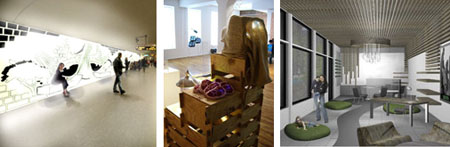
(l-r): “Subway Light Project” lights up commuters’ days; “Holon A.” is an interactive industrial agricultural information booth; “Why Sustain?” is a learning and information center made from sustainable materials maximizing natural light.
(l-r): Caroline Pham; Becky Stern; Amanda Gilbert
The first annual Sustainable Design Review, a student-led green initiative at Parsons The New School for Design, asked students to define sustainability. “Our mission is to foster an overall awareness and dialogue relating to social, environmental, and other forms of sustainability in school projects and consequently student perceptions,” according to founder and chairperson Rishi Desai, who conceived of the project with other Design and Management and Communication Design students at Parsons.
The winning entry, called the “Subway Light Project,” submitted by Caroline Pham of the Integrated Design Curriculum, introduces natural light into subway stations by incorporating fiber optic technology and sunlight collection panels. Windows and seating areas illustrating natural and urban landscapes are illuminated with full spectrum light to benefit sun-deprived city residents. “Terra Bites,” the second place entry by Product Design major Hae Jeong Choi, is a mobile cart that acts as a delivery and vending truck for local, fresh food.
Jury members, who sifted through more than 100 submissions and chose 10 finalists, included: Susan Szensay, editor-in-chief of Metropolis; Majora Carter, founder and executive director of Sustainable South Bronx; Kira Gould, Assoc. AIA, AIA Committee on the Environment (COTE) chair; Chelsea Holden Baker, assistant editor of DWELL; Douglas Diaz and Loretta Staples, professors at Parsons; Jackie Brookner, ecological artist; and students Ryan Wood and Tracy Chow.
“Word of mouth was the weapon to get this idea the support it needed. Now it is all about the dialogue,” the website background statement declares. After being in contact with some of the students who entered the competition, and in an effort to continue the discussion, they wrote to me about their experiences participating in the Sustainable Design Review:
[This competition] contributes to the argument that design should not only be about beauty and creativity, but should also be about responsibility. Winning this competition has taught me the importance of responsible design. I believe that the idea of sustainability can be beneficial to a new way of thinking, not as an alternative to normal life, but as a trigger for innovation.
[The Sustainable Design Review] initiative provides peer and industry review outside the classroom environment for projects with a nontraditional goal. Experiencing the process helped me put my project in a larger perspective.
By entering this competition, I wanted to increase the recognition of interior design as paramount to sustainability. I hope to focus my career on creating sustainable interior spaces and increase awareness that sustainability can be beautiful and effective on many levels.
I have been following the discussion about the Architect of the Capitol (AOC) vacancy in Washington D.C. The hiring process is as follows: Congress’s Architect of the Capitol Commission recommends three potential individuals from which the President may or may not choose one to be appointed for the 10-year position. Controversy has sprouted because these names have not been released to the public, and because of the spreading rumor that someone who is not a registered architect may fill the position.
According to the Architect of the Capitol website, the AOC is responsible for the maintenance, operation, development, and preservation of the U.S. Capitol Complex, which includes the Capitol, congressional offices, Library of Congress, Supreme Court, U.S. Botanic Garden, Capitol Power Plant, and other facilities. Duties include mechanical and structural maintenance, upkeep and improvement of the Capitol grounds, and arrangement of inaugural and other ceremonies. Current projects range from the replacement of worn Minton tile in the Senate corridors to the installation of security devices and the development of a Capitol Complex Master Plan. The AOC must also serve as a member of eight governing or advisory bodies including the D.C. Zoning Commission, Advisory Council on Historic Preservation, and the Capitol Police Board.
To be expected, the AIA has been voicing its collective opinion that the position must be filled by a licensed, registered architect — see The Architect of the Capitol Should be an Architect website. The website includes links to the AIA Board of Directors’ letter to the President, a letter supporting the AIA’s position from former AOC George M. White, FAIA, ongoing coverage in the Angle, and commentary on the AIA Archiblog. There is also a petition to Congress.
I agree that for a job called “Architect,” a registered architect must fill the position. This has been established by law. However, in reviewing the many responsibilities of the AOC, I see that it would be difficult to find one person who can successfully fill the vacancy. On the AIA Archiblog, Desiree Sheehan asks, “Wouldn’t appointing a design team be a better choice?” Collaboration and specialization is a trend in the architecture profession. Here is an opportunity to redefine the AOC, giving a team of individuals with diverse experiences the chance to successfully shape the future of the nation’s capital.

Artist Eve S. Mosher is marking the 10-foot flood line around the city.
Courtesy High Water Line
High Water Line is a public artwork conceived by artist Eve S. Mosher. Throughout the summer she has been marking the 10-foot-above-sea-level line by drawing a blue chalk line and installing illuminated beacons in parks. The line marks the extent of increased flood trends and is intended to create an immediate visual and local understanding of climate change. Mosher will be covering Red Hook to Williamsburg throughout September. Check out the website for updates and neighborhood locations.
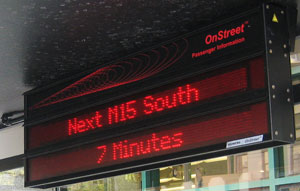
Real time electronic information boards are being tested on 15 bus lines throughout the city notifying riders when the next bus will be arriving. This one is on the M15 line on 2nd Avenue at 57th Street. Not much information about the initiative is available on the MTA’s website, but keep checking as more pop up around the city.
Jessica Sheridan
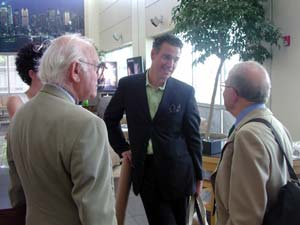
(l-r) Polshek Partnership’s James Polshek, FAIA, and Tomas Rossant, AIA, with Donald Newhouse ready to head to Syracuse University to tour Newhouse III.
Kristen Richards
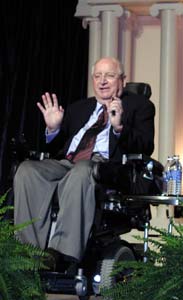
Amid columns and ferns, Michael Graves, FAIA, was animated and humorous during his keynote speech at “Build Business: Politics at Work;” Butler Rogers Baskett Architects was the only NYC firm to win 2007 Marketing Communications Award — in the category of Holiday Piece.
Kristen Richards
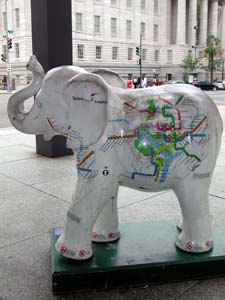
SMPS Conference: Wayfinding — D.C.-style (will it be donkeys if Democrats win?).
Kristen Richards
Center for Architecture Gallery Hours
Monday–Friday: 9:00am–8:00pm, Saturday: 11:00am–5:00pm, Sunday: CLOSED
Join an Architalker for a Hosted Tour of Center for Architecture
Exhibitions
Join us for free Architalker-hosted tours of the Center for Architecture exhibitions Fridays at 4:00pm. To join one of these tours, meet in the Public Resource Area on the ground floor of the Center for Architecture.

August 23 — October 27, 2007
Galleries: Judith and Walter Hunt Gallery, Mezzanine Gallery
The Future of the Architecture Profession in London. The exhibition features young firms whose work shows invention and promise. New Practices London is organized by the AIA New York Chapter’s Center for Architecture in collaboration with The Architecture Foundation in London.
6a Architects
AOC
Carmody Groarke
drdharchitects
Ullmayer Sylvester Architects
Witherford Watson Mann Architects
Exhibition Design:
Gage/Clemenceau Architects
Organized by:
AIA New York Chapter in collaboration with The Architecture Foundation in London.
Related Programming Organized by:
Center for Architecture in collaboration with the AIA New York Chapter’s New Practices Committee and the AIA New York Chapter’s International Committee and the Center for Architecture Foundation
Media Partners: The Architect’s Newspaper

Saturday, September 15, 2007, 1:00 — 4:00pm
FamilyDay@TheCenter: Design Your Own Exhibition
Organized by the Center for Architecture Foundation
Tuesday, October 16, 2007, 6:00 — 9:00pm
New Practices London Symposium
Super-Model Lecture Series
AIA New York Chapter’s New Practices Roundtable presents an exploration of innovative models of architectural and design practice.
Wednesday, September 5th, 2007, 6:00 — 8:00pm
MEDI_20—100, Medium Size Firms Compare
Tuesday November 6, 2007, 6:00 — 8:00pm
MINI_1-20, small firms means & methods
Thursday, December 6, 2007, 6:00 — 8:00pm
Exfoliation- RE-GENERATION
Exhibition Underwriter:


*Opening presented as part of the SKYY90 Diamond Design Series
Sponsors:


OS Fabrication & Design, The Conran Shop
Supporters:
Arup
bartcoLighting
Fountainhead Construction
FXFOWLE ARCHITECTS
MG & Company
Microsol Resources
Structural Enterprises
Friends:
Barefoot Wines
Cosentini Associates
DEGW
Delta Faucet Company
Perkins Eastman & Partners

July 19 – October 19, 2007
arch schools: r(each)ing out
Galleries: Kohn Pedersen Fox Gallery, HLW Gallery, South Gallery
Last September, leading New York area architecture schools participated in an exhibition that set out to foster a closer connection between the schools, students, and the profession.
This summer will feature our third annual architecture schools exhibition, arch schools: r[each]ing out, devoted exclusively to the work of students. The AIA New York Chapter’s annual architecture schools exhibition demonstrates exemplary student work representing the 9 New York area architecture schools, whose deans sit on the Board of the AIA New York Chapter, and 8 invited schools, including the four interiors design programs in New York City. The schools are asked to submit work related to the 2007 New York Chapter’s presidential theme “Architecture Inside/Out”.
Participating Schools:
The City College of New York (CUNY)
Columbia University
The Cooper Union for the Advancement of Science and Art
Cornell University
New Jersey Institute of Technology
New York Institute of Technology
New York School of Interior Design
Parsons the New School for Design
Pratt Institute
PrincetonUniversity
Rensselaer Polytechnic Institute
School of Visual Arts
Syracuse University
University at Buffalo (SUNY)
University of Pennsylvania
Yale University
Exhibition and related programming organized by the AIA New York Chapter and the Center for Architecture Foundation
Sponsors:


Supporters:
Pei Cobb Freed & Partners
Friends:
Beyer Binder Belle: Architects & Planners
Butler Rogers Baskett Architects
Francois de Menil Architect
Gabellini Sheppard Associates
Mancini Duffy
Terrence O’Neal Architect
Friday, September 14, 2007, 7:00 –– 9:00pm
AIAS Event
Monday, September 24, 2007, 6:00 –– 9:00pm
Deans Roundtable and Reception
Monday, October 1, 2007, 6:00 – 8:00pm
2007 Dean’s Forum
Thursday, October 11, 2007, 9:00pm – 2:00am
Party@theCenter!
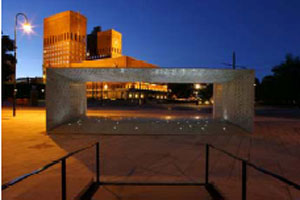
Canopy Nobel Peace Center, Oslo.
Photo by Adjaye/Associates, courtesy Austrian Cultural Forum
Through 10.28.07
David Adjaye: Making Public Buildings
In the first major museum exhibition of British architect David Adjaye’s work, emphasis is placed on the emotion and functionality behind his public buildings, both realized and in development. On display are models, sketches, photographs from his travels, and films of his projects in the realms of learning, community, contemporary art, and performing arts. Projects include the 2005 Venice Biennale pavilion, the Nobel Peace Center in Oslo, and the Museum of Contemporary Art in Denver.
The Studio Museum in Harlem
144 W.125th Street
Courtesy Austrian Cultural Forum
09.06.07-01.12.08
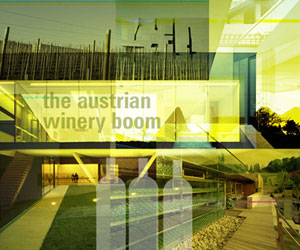
The Austrian Winery Boom
In addition to a nuanced survey of the cultural and economic situation in Austria since the 1980s, the exhibition offers a study, in 43 projects, of the development from the manor winery to the high-tech wine factory. Individual buildings and architectonic interventions are presented with a wide variety of materials such as blueprints, photographs, models, and sketches, but also individual vintners’ and wineries’ wine bottles.
Austrian Cultural Forum
11 E. 52nd Street
08.21.07
For this issue, we took advantage of August’s light event schedule to go to the museums and view the many architecture-related shows. Most of the exhibitions close at the end of the month, so be sure to check them out now.
– Jessica Sheridan, Assoc. AIA, LEED AP
Note: Unfortunately, in the last issue, one of the In the News items was misrepresented by its title. Please note that the title for item about the Medical University of South Carolina (MUSC) has been changed to “Medical University Breaks Ground With IBC.” MUSC has been nationally recognized for patient service and provides support to all patients — even those uninsured. We regret any misunderstanding that the old title might have caused.
Event: Frank Stella: Painting into Architecture; Frank Stella on the Roof
Location: Metropolitan Museum of Art, 05.01-07.29.07 and 05.01-10.28.07
Curator: Gary Tinterow — Engelhard Curator in Charge, and Anne L. Strauss — Associate Curator, Department of Nineteenth-Century, Modern, and Contemporary Art at the Metropolitan Museum of Art
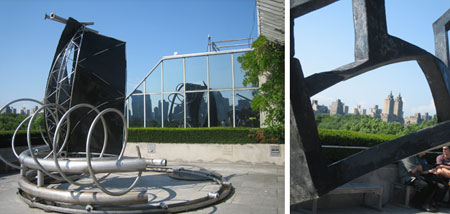
Highlighting the urban environment, adjoeman (2004), and Chinese Pavilion (2007) are two of Frank Stella’s sculptures on the roof of the Metropolitan Museum of Art.
Jessica Sheridan
Painting into Architecture is the second in a series at the Metropolitan to investigate contemporary artists working in the architectural realm. Here, Stella’s paintings are the backdrop to his architecture. Form-driven and pictorial in nature, the models range from his earliest plywood The Broken Jug band shell proposal (1998), to this year’s nylon and acrylic Guest House and Remembering Henry [Geldzahler] mausoleum. Although models display a progression of work, the development is limited to form. You cannot tell whether construction details have been explored and the reality of internal systems has been advanced.
“[Frank] Stella hopes to invigorate architecture with some of the freedom that he has learned to enjoy,” states the description of Frank Stella: Painting into Architecture. Two recent exhibitions at the Metropolitan Museum of Art highlight different aspects of Stella’s work — from paintings, wall-reliefs, and full-scale mock-ups to monumental sculpture — each exhibiting the artist’s passion for architecture. In fact, Gary Tinterow, Engelhard Curator in Charge, seems to imply that it is inevitable that Stella’s lifelong work has gradually grown in every direction to culminate in a yet-to-be-realized building.
The link between Painting into Architecture and Frank Stella on the Roof is in the former’s The Ship (2007) , and the latter’s Chinese Pavilion (2007). A proposal in 1989 for an addition to the Groninger Museum in the Netherlands, The Ship is still being developed even though it is no longer intended for the museum. Inspired by the veins in leaves, a full-size model made of fiberglass and carbon fiber is installed in the gallery. The carbon epoxy composite Chinese Pavilion, on the roof of the Metropolitan, is a very similar form to The Ship. Not claiming to be anything other than sculpture, the structure is more complete in an exterior setting where it can frame views and reflect the urban environment.
Frank Stella on the Roof consists of three recent monumental works in stainless steel and carbon fiber. Each sculpture takes advantage of its siting, featuring a different aspect of Stella’s admiration for architecture. While the sculptures are massive, they take a back seat to the museum, Upper East Side, and Central Park. As with Chinese Pavilion, adjoeman (2004) and memantra (2005) profit from their surroundings by framing views of the city and reflecting the surrounding architecture.
“Now I find I can’t stop thinking about architecture. I can only blame the pursuit of abstraction,” Stella is quoted in the exhibition. Although none of his building proposals have been constructed, these two exhibitions put forth the argument that the number of years Stella has pursued architecture, and the scale of the sculptures he creates, give him knowledge and expertise in the architecture field. Although Painting into Architecture has closed, a 40-page, illustrated publication with an essay by Paul Goldberger is available at the museum’s bookshops. Frank Stella on the Roof is on view, weather permitting, through October 28.
In the Winter 2005/06 issue of OCULUS magazine, the AIANY quarterly print magazine and sister publication to e-OCULUS, an article called “Epitaph for a Critic” by Sheri Olson, FAIA, described a dispute arising from a critical essay published in the Seattle Post-Intelligencer. The National AIA Ethics Committee has issued a response in an effort to clarify the ethics debate begun by the original article. Click National Ethics Committee to OCULUS to download the AIA’s letter. To read the original article, “On Architecture: Mediocre apartment-retail building misses an opportunity to be a star,” 04/12/04, click the article’s title.
