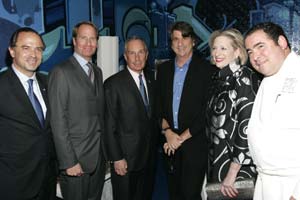
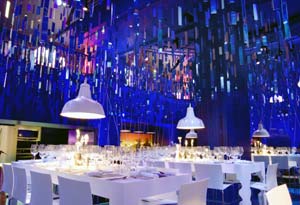
10.24.07: The stars came out to play at a fundraiser for David Rockwell’s Imagination Playground, which marked the opening night of the Rockwell Group-designed Bon Appetit Supper Club and Café, a pop-up restaurant in the former Hard Rock Café on West 57 Street (the event raised about $250,000!).

Bon Appetit Supper Club and Cafe

The eatery is open to the public only for lunch — lunch-time foods created by top chefs make definitely worth the trip (but hurry…it closes November 2).

Blandon Belushin

Bon Appetit Supper Club and Cafe

(l-r): NYC Parks Commissioner Adrian Benepe real estate mogul Kent Swig; Mayor Michael Bloomberg; David Rockwell; Barbara Fairchild, Editor-in-Chief, Bon Appetit; and master chef Emeril Lagasse.

Wire Image

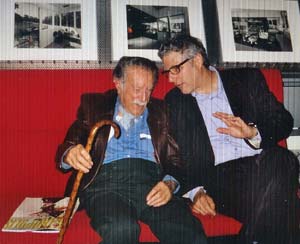
10.17.07: There was no question who the star of the show was at a Pentagram fete celebrating Julius Shulman’s 97th birthday and the publication of Pentagram Papers 38: The Russian Garbo.

Julius Shulman

(l-r): Julius Shulman with Pentagram partner James Biber.

Kristen Richards

Center for Architecture Gallery Hours
Monday-Friday: 9:00am-8:00pm, Saturday: 11:00am-5:00pm, Sunday: CLOSED

Join an Architalker for a Hosted Tour of Center for Architecture
Exhibitions

Join us for free Architalker-hosted tours of the Center for Architecture exhibitions Fridays at 4:00pm. To join one of these tours, meet in the Public Resource Area on the ground floor of the Center for Architecture.

CURRENT EXHIBITIONS

November 8 – January 26, 2008

Berlin — New York Dialogues: Building in Context

Galleries: Judith and Walter Hunt Gallery, Mezzanine Gallery, Kohn Pederson Fox Gallery, HLW Gallery, South Gallery

Two of the world’s most dynamic urban centers, Berlin and New York, are making radical transformations in their streets and skylines. Berlin — New York Dialogues investigates the changes in these two cities by looking at the contemporary built environment and mechanisms of urban regeneration: the social, political, economic, and cultural processes that affect building.

As the exhibition delineates, the sustainability of these cities’ neighborhoods is increasingly dependent on a critical mixture of identity, diversification, and infrastructure.

Against a background of data Berlin — New York Dialogues brackets three areas of each city. High-end projects and informal initiatives are featured and made comparable by a set of overarching topics: Culture as Catalyst, Community Activism, Gentrification, Open Space, and Governmental Intervention. Focus is given to the stories and forces behind the projects — the urban context.

Berlin — New York Dialogues is presented in partnership with Carnegie Hall as part of Berlin in Lights, a festival taking place November 2-18, 2007.

In partnership with Carnegie Hall’s Berlin in Lights, a festival taking place in November 2007 celebrating the cultural connectivity between Berlin and New York.

This exhibition is presented as part of the Center for Architecture’s Global City Dialogues series exploring differences and commonalities between distinctive international cultural centers and New York City.

Organized by:

Center for Architecture and the German Center for Architecture DAZ in Berlin

Curatorial Team: Lynnette Widder, Kristien Ring, Sophie Stigliano, Rosamond Fletcher, Lutz Knospe

Research Assistants: Anthony Acciavatti, Elizabeth Snow, Anna Vallye

In cooperation with:
Pratt Graduate Center for Planning and the Environment, Deutsches Haus at NYU,
and Akademie der Künste, Berlin

Exhibition Design & Graphics: Project Projects

Exhibition Architecture: MADE

Commissioned Photography: Noah Sheldon

Underwriter: RFR Holding, Digital Plus


Patrons: Eurohypo; IULA
  

Lead Sponsors:

Carnegie Corporation of New York; Tishman Speyer Properties

Supporter:

The German Consulate in New York
Friend: Getmapping


This program is supported, in part, by public funds from the New York City Department of Cultural Affairs.

Thanks to the generous support of the Alfred Herrhausen Society the exhibition will travel to the DAZ (LINK www.daz.de ) in Berlin in March 2008. The exhibition will open on March 7 and be on view through June 2008. An exhibition symposium will take place at the Akademie der Künste on March 8/ 9, 2008.

Related Events

Thursday, November 8, 2007
Exhibition Opening

November 5, 2007
Urban Design & Memorials, panel discussion

Saturday, November 10, 2007
Cultural Kapital / Capital Kultur: Exhibition Symposium

Sunday, November 11, 2007
FamilyDay@theCenter: Berlin/NY – My City Exchange


New York NOW

October 11 – December, 2008

Galleries: Edgar A. Tafel Hall

New York NOW celebrates the diversity of the AIA New York Chapter and Center for Architecture membership by displaying non-juried submissions of member projects. The exhibition will include works of all scales: small, large, commercial, residential, public, private, interiors, historic preservation, engineering, landscape, and urban design.

The exhibition presents the depth and breadth of professional activity and the variety of its impact. The resulting dialogue between different practitioners encourages a deeper understanding of what is happening in the New York architecture and design world now.

Exhibition Design: Illya Azaroff + the design collective studio

Underwriter:

Exhibition organized by the AIA New York Chapter


Architecture Inside/Out

September 19 – December 8, 2007

Galleries: Gerald D Hines Gallery, Street Gallery, Public Resource Center

Architecture Inside/Out demonstrates the unfolding of space by exposing architectural interiors through a range of typologies with an inward focus, including libraries, hotels, retail and work spaces. This exhibition challenges conventional categories and explores alternative typologies. The design of interiors has evolved into a complex and nuanced problem and addresses circulation patterns, use and adjacencies, sociologies of hierarchy and networks, and sustainability. The fully integrated interior considers light, color and materiality, but also new ways of programming space, the latest technological advances, innovative methods of construction and green practices.

Traditional representations such as section, plan and elevation, in addition to models and details will provide a lens to reveal inherent characteristics of featured interiors, exposing materials, structure and spatial relationships. Architecture Inside/Out takes the familiar architectural conventions and places them parallel to alternative ways of seeing and revealing. When these alternative methods of understanding space are applied to typologies, they provide views of the interior that shed new light on familiar places.

Curator:
Lois Weinthal, Director of Interior Design, Parsons

Exhibition Design: Freecell

Graphic Design: Language Arts

The exhibition and related programming are organized by the AIA New York Chapter in collaboration with the AIA New York Chapter’s Interiors Committee and the Center for Architecture Foundation.

Underwriter: AFD Contract Furniture

Patron: Certified of New York

Lead Sponsor: Zumtobel Lighting

Sponsor:: BBG-BBGM; Spartech Corporation; STUDIOS Architecture


Supporter:

Jack L. Gorden Architects; Perkins + Will

Supporters:

InterfaceFLOR
Knoll
Mancini Duffy
Perkins + Will
Steelcase
STUDIOS Architecture


10.16.07

10.16.07

I hope everyone has recovered from the 2007 AIANYS Convention and Heritage Ball/Party@theCenter! Because the convention only comes to town every 150 years or so, this issue features three articles about various issues discussed at the Grand Hyatt Hotel. It’s been a busy couple of weeks, and we have done our best to cover everything you may have missed.

– Jessica Sheridan, Assoc. AIA, LEED AP

Mission Impossible?

Event: 2007 AIANYS Convention: The Past As Prologue
Location: Grand Hyatt, NYC, 10.04-06.07
Speakers: Keynote Luncheon: Raymond Rhinehart, Ph.D., Hon. AIA — Senior Director, AIA
Organizers: AIA New York State
Keynote Sponsors: Design Insurance Agency; Victor O. Schinnerer & Company; Thornton Tomasetti, Inc.; Hohmann and Barnard, Inc.

2007 AIANYS Convention

Courtesy AIANYS

Ever since 13 architects decided to form the AIA in 1857, the role and perception of architects has fluctuated, from glorified genius to unnecessary niche artist. Now this year’s AIA New York State Convention theme, The Past As Prologue, inspired keynote luncheon speaker Raymond Rhinehart, Ph.D., Hon. AIA, senior director at AIA National, to title his speech, “Professional, City, World, or Mission Impossible?”

The world is in a state that requires architects to re-imagine and redefine their profession, Rhinehart argues. Referencing images of John Milton’s Paradise Lost’s earth hanging from heaven by a string and environmental activist David Suzuki’s earth as a basketball wrapped in Saran Wrap, Rhinehart calls architects “agents of life” in a time where social, environmental, and political climates are at a breaking point. To heal the world, architects must join together on a global scale. Architects need to design for human contact as well as to preserve the environment — seamlessly linking human life and nature. Sustainability has to go beyond “green.”

More Tours, Fewer Closed Doors!

I have volunteered at openhousenewyork (OHNY) since it began five years ago, and what continues to amaze me is the number of architectural enthusiasts who come out of the woodwork to participate. Many are not in the field; many fly in for the weekend from Europe; many are just curious New Yorkers who always wanted to know what goes on inside buildings that are not normally open to the public. This year I organized one of the tours as a member of the AIANY Emerging NY Architects (ENYA) Committee. After a full day of tours, I wonder why AIANY doesn’t offer similar architectural walking tours throughout the year.

Even though those of us who gave the tour (Carolyn Sponza, AIA, Darris James, Assoc. AIA, and myself) are not architectural historians, I felt that we were very qualified to discuss the past, present, and future of Southpoint Park having helped put together the 2006 Southpoint: from Ruin to Rejuvenation competition, which involved more than a year of research and interaction with Roosevelt Island residents, specifically the Roosevelt Island Visual Arts Association, Coler-Goldwater Specialty Hospital and Nursing Facility, and Roosevelt Island Historical Society.

We spoke of the architectural and planning history of the island and the Renwick Smallpox Hospital. We introduced our competition, which sought to bring ideas to local residents about what they could do with one of the few remaining undeveloped sites in NYC. And we discussed the reception we received on the island from the residents when we exhibited jury-selected entries. Most importantly, we talked about how our competition was able to have (even a small amount of) an impact on the park’s future because one of the entrants went on to work with the weisz + yoes architecture team currently planning the site with Wallace Roberts & Todd landscape architects. The team let us display their most recent material showing their plans for the park’s future (Thank you!).

We gave tours every hour on the hour throughout Sunday, 10.07, and crowds ranged from 10 people to over 45 at a time. Many Roosevelt Island and Long Island City residents were interested in learning more about “their back yard.” We met Columbia University students researching the site for a studio project. A local electrician had stories about sneaking behind the gate to explore the Renwick Smallpox Hospital Ruins. A nurse shared stories about a shipwreck that occurred off the island where those swimming to shore refused help from the smallpox patients.

The enthusiasm on both sides was invigorating, even though the fervor almost became overwhelming when we were unable to take a group on the last tour of the day (luckily, we were still able to give our presentation with the visual material we had). OHNY oddly feels like a release to pent-up frustration people have as more buildings close their doors “for security reasons” and costs for tourist attractions skyrocket. I think OHNY volunteers do a great job organizing an event with such broad and diverse locations (literally and metaphorically) — and I think they should stick to making that one weekend the best it can be. However, AIANY members have the expertise to create similar events on a more regular basis. When the city closes doors on the public, architects and planners should be opening them. I believe everyone would benefit from it.

This year’s sold-out Heritage Ball 2007 recognized Mayor Michael R. Bloomberg; George H. Miller, FAIA; Joan K. Davidson, Hon. AIA; and Architecture for Humanity. The party took place October 11 at Chelsea Piers, followed by the Party@theCenter at the Center for Architecture.

Heritage Ball

Joan Blumenfeld, FAIA, IIDA, LEED AP, 2007 AIANY president, with past Chapter presidents Mark Ginsberg, FAIA, and George Miller, FAIA, AIA vice president.

Kristen Richards

Heritage Ball

(l-r):Jim Sawyer, AIA; Abby Suckle, FAIA; Frank Sanchez; Beth Greenberg, AIA.

Kristen Richards

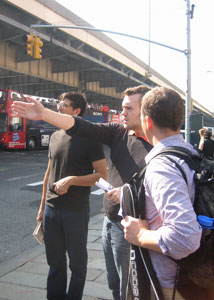
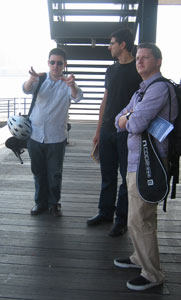
The fifth annual openhousenewyork took place October 6-7. The AIANY Emerging NY Architects Committee hosted two site tours to celebrate the launch of the third biennial international ideas competition, South Street Seaport: Re-envisioning the Urban Edge. One tour was of the current site at South Street, and the other was of Southpoint on Roosevelt Island, site of the 2006 competition Southpoint: from Ruin to Rejuvenation.

openhousenewyork

Joel Melton (center) points toward Pier 17, site of possible luxury high-rise condos in the future and adjacent to the site of the current ENYA competition.

Jessica Sheridan

openhousenewyork

Sean Rasmussen (left) indicates that the site of the old Fulton Fish Market, which may be incorporated into proposals for the competition.

Jessica Sheridan

openhousenewyork

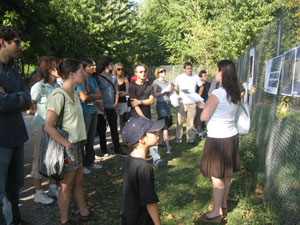
Carolyn Sponza, AIA, (white shirt, brown skirt) in front of the Renwick Smallpox Hospital. She presented competition boards as well as plans by Wallace Roberts & Todd with weisz + yoes architecture for Southpoint’s future.

Jessica Sheridan

Interior architects and architects celebrate together at the opening of Architecture Inside/Out at the Center for Architecture, September 19.

Architecture Inside/Out

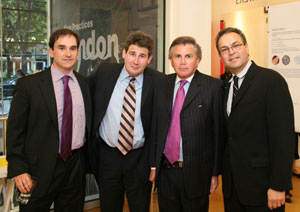
(l-r): David Kohn, David Aarons, and Richard Aarons of AFD Contract Furniture; Rick Bell, FAIA, AIANY Executive Director.

Sam Lahoz

Center for Architecture Gallery Hours
Monday–Friday: 9:00am–8:00pm, Saturday: 11:00am–5:00pm, Sunday: CLOSED

Join an Architalker for a Hosted Tour of Center for Architecture
Exhibitions

Join us for free Architalker-hosted tours of the Center for Architecture exhibitions Fridays at 4:00pm. To join one of these tours, meet in the Public Resource Area on the ground floor of the Center for Architecture.

CURRENT EXHIBITIONS

New York NOW

October 11 – December, 2008

Galleries: Edgar A. Tafel Hall

New York NOW celebrates the diversity of the AIA New York Chapter and Center for Architecture membership by displaying non-juried submissions of member projects. The exhibition will include works of all scales: small, large, commercial, residential, public, private, interiors, historic preservation, engineering, landscape, and urban design.

The exhibition presents the depth and breadth of professional activity and the variety of its impact. The resulting dialogue between different practitioners encourages a deeper understanding of what is happening in the New York architecture and design world now.

Exhibition Design: Illya Azaroff + the design collective studio

Underwriter:

Exhibition organized by the AIA New York Chapter


Architecture Inside/Out

September 19 — December 8, 2007

Galleries: Gerald D Hines Gallery, Street Gallery, Public Resource Center

Architecture Inside/Out demonstrates the unfolding of space by exposing architectural interiors through a range of typologies with an inward focus, including libraries, hotels, retail and work spaces. This exhibition challenges conventional categories and explores alternative typologies. The design of interiors has evolved into a complex and nuanced problem and addresses circulation patterns, use and adjacencies, sociologies of hierarchy and networks, and sustainability. The fully integrated interior considers light, color and materiality, but also new ways of programming space, the latest technological advances, innovative methods of construction and green practices.

Traditional representations such as section, plan and elevation, in addition to models and details will provide a lens to reveal inherent characteristics of featured interiors, exposing materials, structure and spatial relationships. Architecture Inside/Out takes the familiar architectural conventions and places them parallel to alternative ways of seeing and revealing. When these alternative methods of understanding space are applied to typologies, they provide views of the interior that shed new light on familiar places.

Curator:
Lois Weinthal, Director of Interior Design, Parsons

Exhibition Design: Freecell

Graphic Design: Language Arts

The exhibition and related programming are organized by the AIA New York Chapter in collaboration with the AIA New York Chapter’s Interiors Committee and the Center for Architecture Foundation.

Underwriter: AFD Contract Furniture

Patron: Certified of New York

Lead Sponsor: Zumtobel Lighting

Sponsor:: BBG-BBGM; Spartech Corporation; STUDIOS Architecture


Supporter:

Jack L. Gorden Architects; Perkins + Will

Supporters:

InterfaceFLOR
Knoll
Mancini Duffy
Perkins + Will
Steelcase
STUDIOS Architecture
Related Events

Saturday, October 20, 2007, 1:00 — 4:00pm
FamilyDay@theCenter:Architecture – Inside and Out!


August 23 — October 27, 2007

New Practices London

Galleries: Judith and Walter Hunt Gallery, Mezzanine Gallery

The Future of the Architecture Profession in London. The exhibition features young firms whose work shows invention and promise. New Practices London is organized by the AIA New York Chapter’s Center for Architecture in collaboration with The Architecture Foundation in London.

6a Architects
AOC
Carmody Groarke
drdharchitects
Ullmayer Sylvester Architects
Witherford Watson Mann Architects

Exhibition Design:
Gage/Clemenceau Architects

Organized by:
AIA New York Chapter in collaboration with The Architecture Foundation in London.

Related Programming Organized by:
Center for Architecture in collaboration with the AIA New York Chapter’s New Practices Committee and the AIA New York Chapter’s International Committee and the Center for Architecture Foundation

Media Partners: The Architect’s Newspaper


Related Events

Tuesday, October 16, 2007, 6:00 — 9:00pm
New Practices London Symposium

Super-Model Lecture Series
AIA New York Chapter’s New Practices Roundtable presents an exploration of innovative models of architectural and design practice.

Tuesday November 6, 2007, 6:00 — 8:00pm
MINI_1-20, small firms means & methods

Thursday, December 6, 2007, 6:00 — 8:00pm
Exfoliation- RE-GENERATION

Exhibition Underwriter:


*Opening presented as part of the SKYY90 Diamond Design Series

Sponsors:


OS Fabrication & Design, The Conran Shop

Supporters:
Arup
bartcoLighting
Fountainhead Construction
FXFOWLE ARCHITECTS
MG & Company
Microsol Resources
Structural Enterprises

Friends:
Barefoot Wines
Cosentini Associates
DEGW
Delta Faucet Company
Perkins Eastman & Partners


July 19 – October 19, 2007

arch schools: r(each)ing out

Galleries: Kohn Pedersen Fox Gallery, HLW Gallery, South Gallery

Last September, leading New York area architecture schools participated in an exhibition that set out to foster a closer connection between the schools, students, and the profession.

This summer will feature our third annual architecture schools exhibition, arch schools: r[each]ing out, devoted exclusively to the work of students. The AIA New York Chapter’s annual architecture schools exhibition demonstrates exemplary student work representing the 9 New York area architecture schools, whose deans sit on the Board of the AIA New York Chapter, and 8 invited schools, including the four interiors design programs in New York City. The schools are asked to submit work related to the 2007 New York Chapter’s presidential theme “Architecture Inside/Out”.

Participating Schools:

The City College of New York (CUNY)
Columbia University
The Cooper Union for the Advancement of Science and Art
Cornell University
New Jersey Institute of Technology
New York Institute of Technology
New York School of Interior Design
Parsons the New School for Design
Pratt Institute
PrincetonUniversity
Rensselaer Polytechnic Institute
School of Visual Arts
Syracuse University
University at Buffalo (SUNY)
University of Pennsylvania
Yale University

Exhibition and related programming organized by the AIA New York Chapter and the Center for Architecture Foundation

Sponsors:


Supporters:
Pei Cobb Freed & Partners

Friends:
Beyer Binder Belle: Architects & Planners
Butler Rogers Baskett Architects
Francois de Menil Architect
Gabellini Sheppard Associates
Mancini Duffy
Terrence O’Neal Architect

10.02.07

10.02.07

October should be renamed Architecture Month. The AIANYS Convention begins this Thursday; openhousenewyork is this coming weekend; Heritage Ball and the annual Party@theCenter are Thursday 10.11; ENYA is hosting two events — a Burning Man panel (10.13) and This Will Kill That? will bring author Saskia Sassen to the Center for Architecture (10.23); a New Practices London symposium (10.16), portfolio review (10.26), and Architecture Inside/Out symposium (10.27) will end the month with a bang — or a sigh of accomplishment. Check out the online Calendar of Events for more information.

– Jessica Sheridan, Assoc. AIA, LEED AP

Note: e-Oculus is looking for writers. If you’re interested, check out the Classifieds section for more information.

What NY Baseball Can Learn from Red Sox

Event: Take Me Out to the Brand-New Ballpark
Location: Museum of the City of New York, 09.27.07
Speakers: John Pastier — Architecture Critic & Author, Historic Ballparks (Chartwell Books, 2006); Janet Marie Smith — Senior Vice President of Planning and Development, Boston Red Sox; Andrew Zimbalist — Stadium Consultant, Author, In the Best Interests of Baseball? (Wiley, 2007), & Professor of Economics, Smith College
Moderator: Frank Deford — Sportswriter, Novelist, Correspondent, HBO & NPR
Organizers: Museum of the City of New York

Yankee Stadium

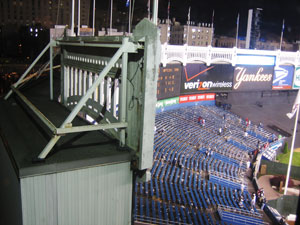
“The Façade” at Yankee Stadium is a replica of the original copper frieze that ran around the grandstand’s upper deck. The frieze will return to the upper deck roof in the new Yankee Stadium, designed by HOK Sport.

Photo credit goes here.

In association with The Glory Days: New York Baseball 1947-1957 exhibition at the Museum of the City of New York, experts in the field discussed what made old ballparks unique, how the suburbanization of America affected ballpark design, and why current trends in ballpark architecture take cues from the past.

Old ball fields began as urban parks; the size of the fields depended on the size of city blocks. As structures developed around the parks, they blended with the surrounding neighborhoods. Originally financed by city governments, at a time when team salaries were more reasonable, ball fields and players were an integral part of community life. And with cheap ticket prices, everone in the community could enjoy the games, meanwhile creating camaraderie across classes. Known as jewel box parks, Ebbets Field and Yankee Stadium represent this era.

In the 1960s and 70s, ballpark designs changed to accommodate car culture and became studies in parking lot planning and cookie-cutter construction. Shea Stadium, built in 1960, is an example of these types of arenas with its circular shape and ability to be converted into a football stadium. Multi-use was a priority, not intimacy. It wasn’t until 1992, when Oriole Park at Camden Yards in Baltimore was constructed, that designers began looking to the past to recapture what was lost. Sited downtown near the waterfront, it is accessible to all city dwellers. To make Camden Yards unique to Baltimore, an old warehouse was preserved in right field. While it helped revitalize the surrounding neighborhood, unfortunately its economic success is rare among new ballparks.

Oddly enough, new stadiums have not been found to bring prosperity to a neighborhood, says Andrew Zimbalist, stadium consultant, author, and economics professor at Smith College. Since there are only 81 home games per season, the areas surrounding stadiums tend to be blighted most of the year. Also, players can afford to live away from the cities in which they play. With high salaries, income goes to their hometowns and does not filter back into the city’s local economy. However, if new parks bring auxiliary development in addition to the stadium, such as housing and year-round amenities, the profit margin goes up.

The upcoming Yankees and Mets stadiums will be new construction, but planners are trying to preserve the nostalgia of old ballparks and include modern amenities to be economically viable. Both teams should use parks such as Boston’s Fenway Park as a model, claims Janet Marie Smith, senior vice president of planning and development for Boston Red Sox (who also helped plan and develop Camden Yards). Fenway, a jewel box constructed in 1912, has been able to endure all trends with a few minor modern-day improvements such as increasing aisle sizes and adding bleacher seats above the Green Monster. Despite being one of the smallest ballparks, it is able to be financially successful because of the adjacent Yawkey Way, which has year-round concessions, restaurants, and bars. With NY baseball fans as fervent as Boston’s, there is hope for success in future development.