NYC Sees Art in Aged Infrastructure

Event: High Bridge/High Line: Infrastructure as Culture
Location: Center for Architecture, 01.20.11
Speakers: Patricia Cruz — Executive Director, Harlem Stage/Aaron Davis Hall; Peter Mullan — Vice President for Planning & Design, Friends of the High Line; Jessica Sheridan, Assoc. AIA, LEED AP — 2009/10 AIANY ENYA Co-chair & Job Captain, Gensler; Keith VanDerSys — Principal, PEG office of landscape + architecture; Bryan Winter, RA — Executive Director, NYC Cement League
Moderator: Adrian Benepe — Commissioner, NYC Department of Parks & Recreation
Organizers: AIANY Emerging New York Architects Committee (ENYA); AIANY Cultural Facilities Committee
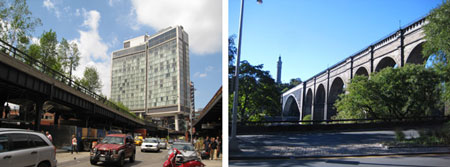
The High Line and the High Bridge.

Jessica Sheridan

“Parks represent the highest aspirations for a city,” stated Peter Mullan, vice president for planning and design at the Friends of the High Line. And whether they are generators for economic development or sites designed to bring a community together, he continued, parks are non-hierarchical, democratic levelers. A recent discussion brought together a panel to talk about the value of re-conceiving aged infrastructure to generate cultural activity in the city. Projects, such as the High Line by Field Operations and Diller Scofidio + Renfro and the Harlem Stage by Ohlhausen DuBois Architects with WASA/Studio A and Harvey Marshall Berling Associates, represent successful rehabilitation projects. The High Bridge, with $50 million from PlaNYC and the oversight of the NYC Department of Design + Construction, represents future potential for the oldest bridge in NYC.

The connection between infrastructure and culture is not new, stated Patricia Cruz, executive director of the Harlem Stage, which is housed in a former gatehouse to the Croton Aqueduct. In 1886, people traveled in horse-and-buggy to watch water being released from the gates. Now, since 2006, people gather to watch performances, attend events, and view exhibitions by artists of color — a program that answered the needs of the local community at the time of the renovation, according to Cruz.

The High Line represents the “ultimate repurposing,” according to NYC Department of Parks & Recreation Commissioner Adrian Benepe, who moderated the discussion. With rotating art exhibitions and impromptu performances (including a “renegade cabaret” performed on one local resident’s balcony), the High Line has drawn millions of visitors. With the rezoning of the meatpacking district, new economic development is flourishing.

The High Bridge was the subject of the AIANY Emerging New York Architects Committee’s (ENYA) most recent biennial design ideas competition. Connected to Highbridge Parks on either side of the Harlem River, the act of linking the Bronx to Manhattan through its parks is symbolic. Keith VanDerSys, principal of Philadelphia-based PEG office of landscape + architecture and winner of the ENYA Prize for his firm’s submission, used water to create a new connection between the community and the environment. His proposal integrated rainwater collection to generate a series of pools and waterfalls over and through the bridge. The health and welfare of the river and the local climate would be reflected, stated VanDerSys, and consequently the community would have a better understanding of climate conditions. The proposal incorporates a cloverleaf-shaped art center that transitions through the steep topography of the site over railroads and streets to give access to the waterfront.

Although VanDerSys’s proposal was an idea and not an actual proposal, ENYA’s goal for the competition was to inspire the local community to imagine the unconsidered possibilities for the High Bridge. VanDerSys suggested that by rebuilding the surrounding context (the parks) the potential of the bridge itself will be triggered. The parks will draw visitors and the local community will ultimately be improved. As was exemplified in the Harlem Stage and the High Line, the High Bridge has similar potential. “It is the ‘if you build it, they will come’ effect,” stated Mullan.

Note: The “High Bridge“exhibition featuring selected entries from the ENYA HB:BX competition is now on view at the Center through 03.26.11.

U.S. Department of Energy Sends Crushing Message to Architecture Students

Since 2002, the U.S. Department of Energy Solar Decathlon has challenged 20 teams of international college students biennially to design solar-powered houses. These houses have been exhibited on the National Mall, bringing public awareness to sustainability and the challenges facing future thought leaders in green design. A couple of weeks ago, just eight months before the launch of the showcase, the Solar Decathlon website posted an announcement that this year the venue will be changed and relocated to a yet-to-be-determined site. The post states that the reason for the site change is because of the historic effort to protect, improve, and restore the National Mall. This is creating quite a stir, especially among the teams of students who have been planning their designs for the Mall for almost two years now. Perhaps it is a harsh wake-up call to idealistic students that projects will not always turn out as expected, but it also sends a message to them that the government does not see the value in hosting the event on one of the most visible — and visited — center stages in the nation.

There is a petition posted by a student in protest to the relocation that, as of this publication date, 5,193 people have signed. It states, “In your inaugural address, President Obama, you stressed the importance of a national movement towards more sustainable practices…. You affirmed that our colleges and universities possess the ability to influence future generations to adopt more sustainable practices — this truth resonates with the mission of the U.S. Department of Energy’s Solar Decathlon.” I agree that, in a time when sustainability has gained momentum, and with the supposed support of the national government, relocating the event is making an antithetical point. Instead, the program requirements should be adjusted to either include a clause about minimally affecting the grounds or incorporate grounds rehabilitation. If plans for relocation prevail, however, I hope the new site will be just as accessible to the public as the Mall.

2011 OCULUS Editorial Calendar
If you are an architect by training or see yourself as an astute observer of New York’s architectural and planning scene, note that OCULUS editors want to hear from you! Projects/topics may be anywhere, but architects must be New York-based. Please submit story ideas by the deadlines indicated below to Kristen Richards: kristen@ArchNewsNow.com.

2011 Themes:
Spring (President’s Theme): Design for a Change: Buildings, People, Energy
[Closed]

Summer: AIANY Design Awards 2011
Recognition of outstanding architectural design by NYC architects and for work completed in NYC. There are four categories: Architecture, Interiors, Urban Design, and Un-built Work. Click here for details.
Register/Submit entries by 02.04.11

Fall: Interior Activity

Architects as interior designers; Changes in corporate culture = transformation of the workplace; Architects designing products/Multi-disciplinary cross-overs; Rebranding hospitality, restaurants, retail to attract new audiences; Interiors as laboratories for small firms.
Submit story ideas by 04.22.11

Winter: Up, Down, and Sideways: Density and Transportation
Density enabled by transportation: mass transit, cycling; Moynihan Station; Regional connections; Housing Authority: former purposeful disconnect, now reintegrating back into neighborhoods; How a century of New York skyscrapers has/is/will affect the architecture, planning, and culture of the city and the world.
Submit story ideas by 08.19.11

For further information, contact OCULUS Editor Kristen Richards: kristen@ArchNewsNow.com.

02.01.11 Call for Applications: 2011 Brunner Grant

02.04.11 Call for Entries: AIANY Design Awards 2011

03.01.11 Call for Entries: AIA National Photography Competition

03.01.11 Call for Entries: AZ Awards

03.14.11 Call for Entries: 2011 YAF/COD Ideas Competition

01.11.11

01.11.11 Editor’s Note: Happy New Year! In this issue, AIANY Policy Director Jay Bond outlines the 2010 advocacy efforts of AIANY. Be sure to read about everything from our work on streamlining the regulatory review process and our efforts on the NYC Energy Conservation Code, to our positions on Moynihan Station and The New Domino development in Around the AIA.

– Jessica Sheridan, Assoc. AIA, LEED AP

Note: Be sure to follow Tweets from e-Oculus and the Center for Architecture.

And check out the Center for Architecture’s Vimeo page!

Should We Plan for Architectural Recovery?

After two years of the recession, economists are predicting that this year we will see a turn-around. There are signs of hope in architecture as many projects that were put on hold are being revisited; new commissions are being won (outside of the government sector, too!); and firms are actually hiring again. While most of the action, as I have witnessed, is happening at the medium-to-large-sized firms, there is a revived sense of optimism in the profession.

As firms begin to get their feet on solid ground, and with so many unemployed professionals vying for open positions, the key to success will be finding and keeping the best staff for each project. Mentorship is one of the most important factors for individuals to make connections at all levels. Whether it is an emerging designer looking for guidance or help with his/her portfolio, or a firm principal trying to find the best prospect for a project, it is our responsibility as design professionals to do what we can to give back to the community to see it thrive.

AIANY is doing its part in several ways by continuing its “Not Business As Usual” luncheons, and hosting courses in current software and training sessions for the ARE exam. Building on the success of the Women in Architecture Committee’s Speed Mentoring program, the committee has joined forces with the Emerging New York Architects (ENYA) and the Professional Practice Committees to bring the Chapter’s first co-ed Speed Mentoring program. Held on 01.10.11, the event will hopefully be the first of many similar events that link the generations and encourage growth in the profession.

Associates Survey Shows Growing Interest in Licensure

This week AIANYS issued its first annual Associate Member Survey Report. After conducting the survey over the summer, the purpose was to help AIA components in New York understand the needs and demographics of Associates. From the results, it appears as if a majority joined the AIA to enrich their careers (45%) and are on the path to licensure (87% are Intern Architects and/or ARE Candidates, and 80% plan on achieving licensure), helping prove the point that, despite hard economic times, individuals are not leaving the profession — they are trying to get licensed.

This is encouraging, as the community of design professionals seems to have gained strength during the recession. Perhaps part of the reason is that the Center for Architecture has added a variety of classes geared toward technical training, including LEED courses, Revit classes, and the AIANY Emerging New York Architects (ENYA) committee’s ARE Boot Camp series. The AIANY Professional Practice Committee launched its Architects Fast-Track Leadership Series, aimed at training individuals to become leaders in their firms through discussions on various practice management topics.

The biggest problem, as is often the case with surveys, is that out of the 1,307 NY-based Associates, just 252 responded (19%). However, half of the respondents are AIANY Chapter members, so perhaps it is because of the programs offered at the Center that Associate Members offered up their time to fill out the survey. Hopefully, all of the New York State chapters will review the results and react to the needs of their Associate membership. Click these three links for the full summary and graphs: http://aianys.org/images/2010assocnumber2; http://aianys.org/images/2010assocresrate.pdf; http://aianys.org/images/2010assocsummary.pdf.

12.16.10: IBEX Construction Holiday Party held at the Center for Architecture.

Andy Frankl, President of IBEX Construction (left) with Rick Bell, FAIA, AIANY Executive Director.

Sam Lahoz

Margaret Castillo, AIA, LEED AP, 2011 AIANY President with Illya Azaroff, AIA, party designer.

Sam Lahoz

Henry Zachary, AIANY Finance Director (left) with Tony Schirripa, FAIA, IIDA, 2010 AIANY President.

Sam Lahoz

AIANY Staff (l-r): Suchi Paul, AIANY Exhibitions Coordinator; Christina Jung, AIANY Events & Marketing Coordinator; Jennifer Apple, AIANY Development Manager; Rosamond Fletcher, AIANY Director of Exhibitions; Jay Bond, AIANY Policy Director.

Sam Lahoz

12.15.10: New York Chapter of the American Society of Landscape Architects (NYASLA) Merry Mixer at the Center for Architecture included members of AIANY, the American Institute of Lighting Designers (IALD), American Planning Association (APA), and Society of Professional Engineers.

Charles McKinney, Affil. ASLA, NYC Parks & Recreation Chief of Design/Capital Projects, with NYASLA President-elect Denisha Williams, ASLA, of Abel Bainnson Butz Landscape Architects.

Kristen Richards

Kim Nielsen, RLA, ASLA; Bonnie Harken, AIA, President, Nautilus International Development Consulting; and bio-sculptor Jackie Brookner.

Kristen Richards

Michael Spitzer, RLA, LEED AP, Principal, LANDGARDEN; Signe Nielsen, FASLA, Mathews Nielsen Landscape Architects; and Adrian Smith, ASLA, LEED AP.

Kristen Richards

Nicholas Quennell, FASLA, Partner, Quennell Rothschild and Partners, and 2010 NYASLA President’s Award for Service to the Profession; Susannah Drake, ASLA, Principal, dlandstudio; and Charles McKinney, Affil. ASLA, NYC Parks & Recreation Chief of Design/Capital Projects.

Kristen Richards

12.07.10: An interdisciplinary team of 11 students from New York Institute of Technology’s architecture, engineering, and other academic programs won a competition to design an energy-efficient hangar for the historic U.S.S. Intrepid. Their design features five descending tiers representing the five kamikaze attacks the vessel sustained throughout World War II, and incorporates renewable energy through wind turbines and solar panels.

Rendering of the winning design.

Team Alphabet Soup

The members of the winning team, Alphabet Soup, include Ryan Metz, Antonella Verderosa, Samuel Franck, Nde Tene, Ben Alling, Zach Sanzo, Luke Ferland, Katerina Skiadas, Jobin George, Kevin Bruno, AIAS, Dominic Tetro, and Nicholas Zangiacomi.

Natasha Jahangir

12.07.10: The Architects for Animals Event benefited the NYC Feral Cat Initiative, a program of the Mayor’s Alliance for NYC’s Animals. Design firms were invited to create shelters for homeless, stray, and outdoor cat populations.

Tietz Baccon took home first place.

Courtesy Davis Brody Bond Aedas

12.07.10: New York Institute of Technology Students Propose Solutions for the Hudson Square District

NYIT’s fourth-year community design studio students investigated the Hudson Square neighborhood, identified opportunities and constraints, and developed programs for making a more sustainable community.

Courtesy Davis Brody Bond Aedas

12.08.10

12.08.10 Editor’s Note: Last night’s AIANY Board Inaugural celebrated the incoming 2011 Board of Directors, Nominating Committee, and Committee Co-chairs. Included in this issue are excerpts from speeches given by 2010 AIANY President Anthony Schirripa, FAIA, IIDA, and 2011 AIANY President Margaret O’Donoghue Castillo, AIA, LEED AP,

– Jessica Sheridan, Assoc. AIA, LEED AP

Note: Be sure to follow Tweets from e-Oculus and the Center for Architecture.

And check out the latest Podcasts produced by AIANY.

Film Looks Between the Cracks at Dharavi

Event: Dharavi Slum for Sale Premiere / “Jugaad Urbanism” Exhibition Preview
Location: SVA Silas Theatre, 11.19.10
Speaker: Lutz Konermann — Flimmaker, “Dharavi, Slum for Sale”
Moderator/Welcome: Sabine Ulmann Shaban — Deputy Consul General of Switzerland
Introductions: Kanu Agrawal — Curator, “Jugaad Urbanism”; Margaret Castillo, AIA, LEED AP — 2011 AIANY President; Aroon Shivdasani — Executive Director, Indo-American Arts Council
Organizer: Center for Architecture; Consulate General of Switzerland; Indo-American Arts Council; The New School; Society of Indo-American Engineers and Architects
Sponsors: Consulate General of Switzerland in New York.
Special Thanks: Umberto Dindo, AIA, AIANY Secretary

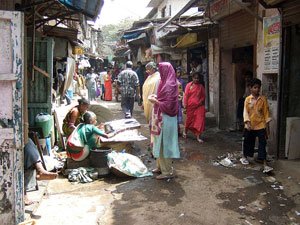
A street in Dharavi, Mumbai.

Kounusu

Dharavi, in Mumbai, is one of the three largest slums in the world. Approximately 100 million people live within one square mile, and up to 15 people live within 200-300 square feet of space, stated Aroon Shivdasani, the executive director of the Indo-American Arts Council. While vividly depicted in “Slumdog Millionaire,” the film “Dharavi, Slum for Sale” documents the struggle between the inhabitants and those who want to change the quality of life for those who live there. Directed by Lutz Konermann, a preview of the film was screened at the SVA Silas Theatre to raise funds for the upcoming “Jugaad Urbanism” exhibition coming to the Center for Architecture in February.

The film begins by tracing Mukesh Mehta, an architect who moved to India from NY. He is the mastermind behind a plan that would turn 35 acres of the slum into a mixed-use development with high-rise buildings and free housing for the current slum dwellers. As the camera follows him from his office to community meetings, Mehta says that he is trying to create a better life for the residents. If he is able to rid Mumbai of the slum, then he will have created not just a better way of life for the local community, but also a positive impact on the world.

However, Mehta is constantly faced with opposition, both by organized groups, including the Society for the Promotion of Area Research Centres (SPARC), and individuals on the streets. Naysayers are concerned that when the government decides who will receive free housing, many slum dwellers will be kicked out of the community. Also, despite the appearance of chaos, there is a complex network of businesses that are not only self-sustainable, but also assist the local government, as well. For example, many of the designer clothing knock-offs that are traded internationally are made within Dharavi by slum dwellers.

“People live between the cracks of city streets,” the film begins, and Konermann focuses on the pros and cons of both sides of the development war. Despite objective filmmaking, he did not mince words during the Q&A after the screening when discussing the necessity for the local inhabitants to maintain ownership of their way of life. Rather than razing the slum altogether, Konermann believes that enhanced infrastructure is what is needed to improve lifestyles. Instead of telling slum dwellers how they should live, he suggested that the government evaluate the reasons why the inhabitants — many of whom came to the city from small farming towns on the outskirts — moved there in the first place. New developments should begin in rural towns, not in the center of a bustling city, he said. It is trendy to discuss ways to “integrate” the city, but, in Konermann’s opinion, the city already is integrated.