The Space between Art and Architecture

Event: Toward ANARCHITECTURE: A Conversation between Architects and Artists
Location: Center for Architecture, 11.19.09
Speakers: Joseph Grima — Director, Storefront for Art & Architecture; Alanna Heiss — Founder, Art Radio WPS1.org; Katrin Sigurdardottir — Artist; Didier Faustino — Architect; Chris Perry — Partner, Servo; James Angus — Artist
Moderator: Farnaz Mansuri, Assoc. AIA — Principal, De-Spec
Organizer: AIANY New Practices Committee

Storefront

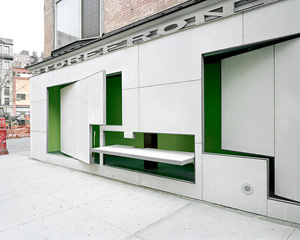
Storefront for Art and Architecture.

Courtesy Storefront for Art and Architecture

The synthesis of creative disciplines often results in an experience that defies tradition and probes curiosity. A growing collective of artists and architects are re-examining their mediums to invent a new hybrid discipline.

The Storefront for Art & Architecture continues to embody the spirit of cross-disciplinary intervention under the leadership of Joseph Grima, who views architecture as “a channel for political agency, a metaphor for society, and a platform for intervention.” This open ended view of architecture is literally present in Storefront’s façade — designed by Vito Acconci and Steven Holl in 1993 — which opens the length of the gallery to the street, blurring the boundary between indoor and outdoor space. Alanna Heiss, director of P.S.1 from 1976-2008, provided insight into the days of Gordon Matta-Clark, who parlayed his architectural background into art. Contemporary artist, Katrin Sigurdardottir continues to be inspired by Matta-Clark in her work, which resides between perceived and embodied space, encouraging a new participatory relationship between viewers and art.

Matta-Clark’s innovative perception of traditional disciplines has engendered a community of anarchitects who continue to mold and translate the creative box within which they design. The presence of public art in architecture is recognized as a vital complement to many contemporary buildings. Similarly, many artists are exploring 3-dimensional multi-media works that focus on creating objects and space rather than the interpretation of them.

Barcelona Opens Book to Cultural Landscapes

Event: A City of One’s Own: Architecture and Urbanism as Cultural Heritage in Barcelona
Location: Center for Architecture, 11.02.09
Speakers: Eulàlia Bosch — Curator & Program Designer, Education and the Arts
Organizer: AIANY; The Catalan Center at New York University, an affiliate of the Institut Ramon Llull

Barcelona

Image from www.lapedreraeducacio.org, a website dedicated to Antoni Gaudí’s Casa Milà.

Courtesy www.lapedreraeducacio.org

With an ardent aptitude for educational outreach, Eulàlia Bosch has centered her career as philosopher, curator, writer, and web designer on the integration of didactics in contemporary art, digital media, and urban studies. Comparing the process of education to bovine rumination, Bosch believes the collection of knowledge in the cultural “fields” of a city is best reflected upon in schools, equated with “barns,” and then transformed into academic nourishment through dialogue. Bosch’s work seeks to reinvent the traditional learning environment and blurs the boundaries of education, infusing urban life with the public exchange of information.

In collaboration with Ramon Espelt, Bosch is responsible for educational websites that look at cultural centers in Barcelona under multiple lenses. A website dedicated to Antoni Gaudí’s Casa Milà, www.lapedreraeducacio.org, explores the building from every angle, providing literary, film, and graphic references; perspectives of artists, inhabitants, and neighbors on the space; as well as history, architectural details, and visual metaphors. Most importantly, the website serves as an interactive platform to contribute, collect, and reflect on information. A multi-faceted resource unique to other institutional websites, the educational component of Bosch and Espelt’s creation is limitless and self-renewing.

According to Bosch, a city becomes a city of one’s own when it is recognizable in its details. Through her work, Bosch is achieving this for future generations by creating cultural grazing lands, both digital and physical, that embody Barcelona and open new public perspectives on its cultural landscape.

Social Media Is the New Strategy for Design Firms

Event: Why to Blog, Text + Tweet: Strategic Social Media for Design Firms
Location: Haworth Showroom, 10.14.09
Speakers: Dorian Benkoil — Founder, Teeming Media; Adam Lutz — Facilities Manager, Google, Inc.; Mike Plotnick — Media Relations Manager, HOK; Jessica Sheridan, Assoc. AIA, LEED AP — Editor-in-Chief, e-Oculus
Moderator: Judy Schriener — Former Managing Editor, McGraw-Hill Construction website
Organizer: AIANY Marketing + Public Relations Committee
Sponsors: Haworth; Hausman Communications; Stone Source; Dagher Engineering

As “social media” becomes a phrase that is heard more frequently in professional circles, the design industry has begun to explore this new age of corporate communications, one in which the traditional boundaries of marketing and public relations are transformed to encompass a broad range of staff and voices. Often cautious recruits to this ever evolving realm of digital media, the A/E/C industry has begun to populate Twitter, Facebook, LinkedIn, and blog sites with varying degrees of activity. Dorian Benkoil, founder of the strategic digital media business firm Teeming Media, believes that firms should ultimately be concerned with reaching their target audience and choosing an appropriate medium through which to do so, if possible directly applying the principles of marketing to social media.

Employing social media as a platform to share values — design, sustainability, public space, etc. — can help clients identify with the personality of design firms, fostering a long-term commitment and understanding. Mike Plotnick, media relations manager at HOK, has successfully led a social media campaign at his firm establishing it as a pioneer within the design community. Originally launched as a recruitment strategy, Life at HOK is a public blog authored by 35 designers at all experience levels in various offices within the practice. Celebrating its one-year anniversary with an average of 600 visitors per week, the platform has allowed HOK, according to Plotnick, “to live out our brand through our people in our own voice in our own time.” This evolution of communication and content delivery has given way to a raw, unedited style eradicating the corporate filter and vastly reducing editorial reviews. HOK’s bloggers are not censored and Plotnick admittedly has released control in what has become one of the most well known social media “experiments” in the design community.

The benefits of exposure are not limited to design firms, as evidenced by the many journalists that engage in Twitter and the like. Jessica Sheridan, editor-in-chief of e-Oculus, has established a professional presence on Twitter, which has given her access to individuals and firms serving as resources for news. While social media can be an outlet for editorial, the distinction remains between bloggers and journalists, the former being associated with frequency and subjectivity and the latter with research and objective reporting.

Although social media has yet to be linked to business development benefits, each panelist contributed an anecdote of sequential events that stemmed from their digital presence and indirectly resulted in a client connection, PR opportunity, or profile elevation. Many continue to understandably inquire: Is it worth sacrificing staff time and hourly rates to explore a new approach to marketing and business development without quantifiable results? Benkoil challenges that it is impossible to know what a tool can do for you unless you try it, and although clients may not be currently living in the world of social media, when they arrive wouldn’t we want to be there in full force?

A New Generation of Designers Speaks Up

Event: Archiculture Trailer Premiere Benefit
Location: Center for Architecture, 09.02.09
Speakers: Ted Landsmark, Assoc. AIA, Ph.D. — President, Boston Architectural College; Bill Moorish — Dean, School of Constructed Environments, Parsons The New School for Design; Gregg Pasquarelli, AIA — Co-founder, SHoP Architects; Billie Tsien, AIA — Co-Founder, Todd Williams Billie Tsien Architects; Giancarlo Tramontozzi — Architectural Professional, Profiled in Archiculture; Dionysios Neofitidis — Architectural Professional, Profiled in Archiculture
Moderator: Ian Harris, Co-Director, Archiculture
Organizers: Archiculture
Sponsors: HOK; Studios GO; Battle Tank Design Studio; MKI Realtors; Anyline; Brooklyn Brewery

archiculture-drafter

Archiculture Drafter.

Courtesy www.archiculturefilm.com

As the design industry continues to be transformed by technology and a demographic of young professionals enter the work force, Archiculture — a documentary directed by David Krantz and Ian Harris — presents a provocative view of the architectural profession and its impact on the lives of practitioners and the general public. Exposing the intense reality of matriculating through an architecture program, the film, currently in post-production, follows five students through the trajectory of their senior thesis projects.

During the trailer premiere at the Center for Architecture, Krantz and Harris fueled a conversation among academics and seasoned and young professionals to explore a growing disconnect between architectural education and professional practice. “Architecture schools are failing to prepare our graduates to be architects,” claimed Ted Landsmark, Assoc. AIA, Ph.D., president of Boston Architectural College. With a growing sense that architecture is a concept hinged on the virtual world of design, Landsmark inquired, “Can one be an architect without making anything?” The theoretical practice of design led many graduates of prior generations to pursue academia over the studio. With a majority of now tenured faculty espousing a limited view of a multi-faceted field, concern is rising about the ability of architecture curriculums to equip students with professional practice skills. Gregg Pasquarelli, AIA, principal of SHoP Architects, believes in engaging technology, production, and culture, and encouraging students to possess a greater understanding of finance and development to broaden their design freedom.

Krantz and Harris have tapped into a rising coup among architecture students, as the consensus calls for a syllabus emphasizing greater accountability to the general public and the environment. Architectural training needs to stress scale, according to Billie Tsein, AIA, of Tod Williams Billie Tsien Architects; understanding the relationship between the built environment and human beings is crucial to creating space. Landsmark encouraged architects to be more political and avoid working in isolation, stating, “Every time we design a public space we are engaging in a political act that affects people we don’t know — we can’t divorce ourselves from that.” Scheduled to premiere in 2010, Archiculture is a call for change, intrepidly exposing the shortcomings of architectural education today, and motivating design’s leaders to make their language more accessible to the public.

The Dutch Plan Cities for Climate Change

Event: HYBRID: Architecture and Planning Strategies for Renewable Cities
Location: Center for Architecture, 08.27.09
Speakers: Duzan Doepel — Principal, DSA-Doepel Strijkers Architects
Organizer: AIANY Global Dialogues Committee

As global warming continues to threaten urban communities, the Dutch are adapting their architectural and urban planning strategies to prevent crises threatening their cities. “We love to plan,” said Duzan Doepel, principal of Rotterdam-based Doepel Strijkers Architects. Climate-resistant architecture has become crucial to prevent the destruction of cities like Randstad, a flood-prone “edge city” with a population of 7.6 million. Architects and planners must re-think the way they design and build to avoid an environmental disaster.

Climate change, greenhouse gas emissions, energy consumption, and food shortages are all issues that The Netherlands is currently addressing with a blend of dynamic architecture and ecological solutions. The Dutch firm deUrbanisten has proposed rain water buffers, called “water squares,” comprised of absorbent surfaces for the collection and re-use of water. This technology would be integrated into public spaces, including parks.

The firm MVRDV has used The Netherlands, the chief exporter of pork in the European Union, as the subject of conceptual design proposals to establish biological pig farming methods in skyscrapers. By combining organic farming with concentrated production, there would be a reduction in animal disease and an opportunity to develop communal areas for feeding and slaughtering, thus reducing the enormous footprint required for present day pig farming.

Doepel helped create REAP (Rotterdam Energy Approach and Planning), targeting a return to 1990 levels of carbon dioxide emissions by 2025, and ultimately achieving energy neutrality through intelligent urban planning. REAP presents a building strategy that can be applied to neighborhoods, districts and cities. MVRDV states on its website, “We see the earth changing, we monitor its development, and we react.” Dutch designers and planners are proving this premise to be true.

Arup Explains the Bird’s Nest

Event: What Does This Button Do? Technology and the Bird’s Nest Olympic Stadium in Beijing
Location: Center for Architecture, 07.20.09
Speaker: Steve Burrows — Director, Arup Sport
Organizer: AIANY Technology Committee

Beijing-National-Stadium-2-

Bird’s Nest Olympic Stadium.

©Ben McMillan, Courtesy of Arup

Steve Burrows, director of Arup Sport, can attest to the crucial role changing technologies have played in design and construction. When he started his career at Arup in 1982, he programmed the firm’s sole computer. Most recently responsible for the engineering of the Bird’s Nest Olympic Stadium, designed by Herzog & de Meuron, Burrows has come a long way — and so has the technology that makes his work possible.

Terming the stadium “a heroic building,” Burrows attributed the ability to rationalize Herzog & de Meuron’s design to advancements in visualization and modeling technology. Through analysis and prototype testing, the latticework structure was designed for seismic efficiency and aesthetic appeal. While the structure measures 1,000 feet in diameter and is constructed of seemingly random strips of the translucent polymer ETFE supported by leaning columns, the Bird’s Nest embodies a very simple structural model. Due to the identical sizing of the primary, secondary, and tertiary structure of the stadium, the illusion of complexity is coupled with an arbitrary pattern. Construction of the stadium was no easy task, with 7,000 welders on site to erect what is now the world’s largest steel structure. Burrows recognized the impressive achievements of the Chinese construction industry and the “can do” attitude of the design team, as well as the ambition of all to make the project a success.

Burrows is excited by the challenge of finding the necessary means to harness today’s potential to improve the function and capabilities of the built environment. Interdisciplinary collaboration, carbon consciousness, behavioral analysis, and physical infrastructure are all on Burrows’ radar. If the Bird’s Nest is any sign of things to come, it looks like the future will be anything but boring.

Panel Questions Future of UAE

Event: Globalization and Local Essences of Modern Development in Dubai and Abu Dhabi
Location: Center for Architecture, 07.08.09
Speakers: Sudhir S. Jambhekar, FAIA — Senior Partner, FXFOWLE Architects; Frank Sabouri — President, Sustainable Architects, Urban Designers; Brian Kowalchuk, AIA — Director of Design, HDR/CUH2A; Jonathan Stark, AIA — Principal & Director, Perkins Eastman International
Moderator: Noushin Ehsan, AIA — Co-chair, AIANY Global Dialogues Committee & President, 2nd Opinion Design
Organizer: AIANY Global Dialogues Committee

UAE

Abu Dhabi and Dubai.

Courtesy Google Earth

With four times the land mass and one half the population of New Jersey, the United Arab Emirates is an architectural and urban planning conundrum. With the region’s plethora of extravagant developments, such as Skidmore, Owings & Merrill’s Burj Dubai, the world’s tallest building, and Atkins Architecture Design Studio’s Burj Al Arab hotel, which boasts a $28,000 price tag for one night in its Royal Suite, Dubai and Abu Dhabi leave most first-time visitors scratching their heads in awe.

Lacking a holistic strategy for urban planning, development in the two emirates is “object-centric not place-centric,” said Frank Sabouri, president of Sustainable Architects. Sabouri cites work by Ateliers Jean Nouvel and Snøhetta as signs of more meaningful cultural trends in the region. With a population comprised of 85% foreigners and 15% natives, it is debatable exactly which culture design in the UAE should reflect. Sudhir Jambhekar, FAIA, senior partner at FXFOWLE Architects, believes that international designers are reinterpreting Islamic ideas in the UAE. Just as western culture has been influenced by Islamic design and engineering — the use of water as a cooling element, for example — Jambhekar sees an opportunity for the west to adapt its concepts for developments in the UAE.

With such a sparse population density in Dubai and Abu Dhabi, moderator Noushin Ehsan, AIA, asked, “If we build it, will they come?” A similar construction boom in China, Ehsan observed, differs in that a swelling population demands development. The UAE, however, currently lacks a demographic to justify the employment of 25% of the world’s construction cranes. Perhaps foresight and optimism will prove beneficial in time. With an estimated $335 billion worth of UAE projects on hold or cancelled due to the economic downturn, the precocious business minds responsible for the rise of these instant global cities have their work cut out for them. Based on the achievements of what has become home to some of the most awe-inspiring architectural feats, we haven’t heard the last from the UAE.

Wright-ing a New History for Women in Architecture

Event: The Architecture of Writing: Wright, Women & Narrative, film premiere and discussion
Location: Solomon R. Guggenheim Museum, 06.10.09
Speakers: Wanda Bubriski — Director, The Beverly Willis Architecture Foundation; Lois Davidson Gottlieb, FAIA — Taliesin Fellow 1947-1948; Beverly Willis, FAIA — President, The Beverly Willis Architecture Foundation; Carol Gilligan — Psychologist & Author, New York University; Gwendolyn Wright — Historian & Author
Moderator: Suzannah Lessard — Author
Organizers: The Beverly Willis Architecture Foundation; Sackler Center for Arts Education

Courtesy www.bwaf.org

Urban myths and a number of literary works about Frank Lloyd Wright are often laced with tales of egoism, philandering, and an unbridled predilection for attention. A new film produced by The Beverly Willis Architecture Foundation (BWAF) entitled, “A Girl is A Fellow Here” — 100 Women Architects in the Studio of Frank Lloyd Wright,” may edit Wright’s story and radically change the view of women’s history in architecture. An interdisciplinary conversation about the untold legacy of 20th-century female architects followed a premiere screening of the film directed by Beverly Willis, a legacy in her own right.

The short film unearths the experience of more than 100 female fellows at Taliesin with a focus on six individuals who have carved a place for themselves in the legacy of women in architecture. Marion Mahoney, Isabel Roberts, Jane Duncombe, Eleanore Pettersen, Read Weber, and Lois Davidson Gottlieb all spent years studying and working under Wright at Taliesin, a place which, according to Gottlieb, “changed my life completely.”

The film’s inception lies in the discovery by Willis that Roberts, for decades documented as a Taliesin bookkeeper, was in fact an architect highly recommended by Wright to the AIA. This silent truth, glossed over in history, is one of many edited facts that comprise Wright’s unknown legacy and the record of women architects.

The film’s narrative, with first-person interviews, a scholarly investigation of the six women, and personal insight into life at Taliesin, unearths the equality with which Wright ran his studio. Founded in 1932, the Taliesin Fellowship required participants to not only work in the studio, but also fostered a communal living of crop raising, cooking, cleaning, house repairs, and manual labor. However, Wright did not assign these chores based on traditional gender roles. In fact, men did most of the domestic duties while the women fellows were out in the cornfields or making building repairs. Willis’s film subjects sing a chorus of praise to Wright as an inspiring, impartial, approachable, and provoking mentor. Gottlieb remembers him as a doer, not as a teacher. “I learned I could do almost anything.”

The confidence and passion with which Wright equipped his female fellows produced a roster of women who impacted his work and the tale of 20th-century architecture. Mahoney became the second female to graduate from MIT and one of the first licensed women architects in the world; Pettersen was the first female architect in New Jersey and also the first woman to open her own practice in the state; Gottlieb and Duncombe established a firm of their own years after Taliesin.

Wright welcomed the women to his studio, providing each with opportunities for professional and personal growth that society was not prepared to offer. So why haven’t we heard about these women in architectural history, nor about this side of Wright’s character? It is because of the innate exclusivity of writing and the disparity between the actual and edited truths, according to panelists after the film. Carol Gilligan, after recently publishing Kyra — a fictional work with a female architect as the protagonist — admits that she wasn’t aware that it was a novel endeavor to cast such a character and reflects that in her research there was a discernible lack of humanity and family life in the biographies of architects. Panelists agreed that the premise of the autonomous genius as a requisite for a successful design career perpetuates a limited view of both male and female architects, and does a disservice to the social and communal nature of the profession.

How Urban Strategies Apply in a Global Society

Event: Strategic Cities: Why some cities can build their visions, why most don’t
Location: Center for Architecture, 06.01.09
Speakers: Jeb Brugmann — Author, Welcome to the Urban Revolution: How Cities are Changing the World (Bloomsbury Press, 2009)
Organizer: Center for Architecture

Welcome to the Urban Revolution: How Cities are Changing the World (Bloomsbury Press, 2009), the latest book by urbanist Jeb Brugmann, explores the development of global urban strategies from local patterns of development. Brugmann counters traditional theories of globalization by arguing that the key to provoking change is linked to the growth of cities and their revolutionary processes. Globalization, as defined by the author, is the process by which people take economics of one city and implement similar strategies in cities around the world. The entrepreneurial premise of this idea is supported by the empowerment of the urban migrant and the anticipated two million people expected to move to urban areas over the next 25 years. As the phenomenon of urban migration progresses and the world’s population propagates, Welcome to the Urban Revolution challenges: how does that affect the way we plan and manage urban centers?

Touching upon key concepts of his book, Brugmann discussed the success of “strategic” global cities such as Barcelona, Curitiba, and Chicago in terms of their development and subsequent management. These cities represent unique and specific responses to the urban climate in which they were planned with the ultimate evaluation residing in the user communities. Curitiba, Brazil, has created an “ecology of solutions,” according to Brugmann, through density strategies and a diversification of bus transport availability in response to the city’s growth crisis.

These systematically generated responses to globalization — Brugmann’s “urban strategy”– are dependent upon strategic institutions, political patronage, and an agenda-driven user community. By transforming our cities into effective solutions, the array of global crises, including poverty, epidemic, recession, and global warming, are addressed by stable political, economical, and ecological mechanisms.

Amanda Burden Speaks on DCP’s Development Plans

Event: Shaping the City: A Strategic Blueprint for New York City’s Future
Location: Center for Architecture, 05.26.09
Speakers: Amanda Burden, FAICP, Hon. AIA — Commissioner, NYC Department of City Planning (DCP)
Organizer: AIANY Public Architecture Committee

Courtesy AIANY

Because of the recent economic downturn, we couldn’t be in a more exciting time for planning, says Amanda Burden, FAICP, Hon. AIA, commissioner of the NYC Department of City Planning (DCP). NYC’s future, in terms of master plans, neighborhood character, outdoor spaces, streetscapes, and general environmental quality of life are in the hands of Burden and her department. So what exactly are they up to?

Efforts range from widely publicized projects such as the rescue and restoration of Coney Island as a year-round destination, to smaller low-key projects like increasing the availability of neighborhood grocery stores through developer incentives. Burden’s esteem for street life and open spaces — inspired by her mentor, urbanist William “Holly” Whyte — resonates in her administration’s ventures. Vitality and sociability are enhanced by sidewalk cafés (legalized under Burden’s reign), privately owned public spaces, and re-zoning in all five boroughs to improve people’s lives. Burden espouses offering New Yorkers a variety of housing options and retail opportunities, waterfront access, cultural and entertainment destinations, and neighborhoods that are characterized by specific features to diminish anonymity in our city. Growth opportunities are anticipated by the subways, says Burden, and grow we must.

Termed by the commissioner, a “city of neighborhoods,” NYC has proven to be a global city of opportunity comparable to Shanghai or Tokyo, as opposed to Chicago or San Francisco. As our city’s population propagates, DCP is responding with initiatives that enhance the public realm, introduce innovative architecture, improve access to public transportation, and promote sustainable growth. And, according to Burden, a true New Yorker, “New York should demand nothing less.”