Nevelson as Architect?

Event: The Sculpture of Louise Nevelson: Constructing a Legend
Location: The Jewish Museum, through 09.16.07
Curator: Brooke Kamin Rapaport — Exhibition Curator, The Jewish Museum
Sky Cathedral Presence

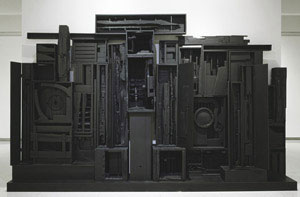
Louise Nevelson’s Sky Cathedral Presence (1951-64).

Courtesy The Jewish Museum

Louise Nevelson (1899-1988), best known for her large monochromatic relief-like sculptures composed of found scraps of wood, was in her heyday considered the “grande dame of contemporary sculpture.” Always ill at ease with the category of sculpture, however, Nevelson claimed, “I don’t want to make sculpture and I don’t want to make paintings; I’m not looking to make anything… It’s almost like you are an architect that’s building through shadow and light and dark.” Restricting herself to the arrangement of found objects, Nevelson avoids “‘making’ in a strict sense, and focuses on the construction of relationships in light, shadow, and above all — meaning.”

In pieces such as Sky Cathedral Presence (1951-64) and Dawn’s Wedding Feast (1959), wood fragments are arranged within an irregular grid of box-like frames and painted to highlight an abstract definition of space through light and form. The meaning of the original found objects is thus subsumed into an abstract topography and open to interpretation. This sublimation is never absolute, however, as traces of narrative rumble below the surface in an elusive and subliminal fashion. For example, in her self-portrait, Silent Music IV (1964), and her Holocaust Memorial, Homage to 6,000,000 (1964), a regular grid structure serves to contain and mediate a series of fragmentary compositions, each of which recede into shadowy spaces. The traces of meaning found within each compartment evoke a collection of memories: the stories of a community, or the multiple aspects of a singular persona.

Through her obsessive endeavors to collect and reassemble fragments, Nevelson strikes a dynamic equilibrium between the tensions of form and content, rational and irrational. Beyond her use of light and shadow to define abstract form, Nevelson’s intuitive sense for structuring and facilitating relationships further aligns her work to that of the architect — but on an the ethical and poetic level, by constructing the frames through which human existence can express meaning.
Cities to Develop New Landscapes

Event: Toward a Sustainable Urban Landscape
Location: The Morgan Library & Museum, 06.13.07
Speakers: Kenneth Frampton — Ware Professor of Architecture; Kate Orff, ASLA — Adjunct Assistant Professor of Architecture, Columbia University, Graduate School of Architecture Planning and Preservation (GSAPP)
Organizers & Sponsors: Columbia University Alumni Association

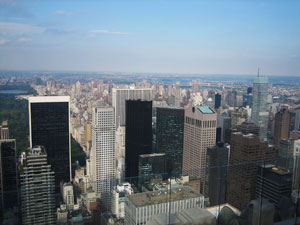
NYC from above

Frampton and Orff call for a re-conceptualization of urban landscapes.

Jessica Sheridan

The future of the urban landscape depends on collaboration between architects and landscape architects. “The megalopolis is new nature,” writes Kenneth Frampton, Ware Professor Architecture at Columbia University, Graduate School of Architecture Planning and Preservation (GSAPP), in his essay “Toward an Urban Landscape.” To Kate Orff, ASLA, principal of SCAPE and Assistant Professor of Architecture at Columbia University, GSAPP, new urban reality is fertile ground for exploration.

The use of design strategies associated with landscape architecture may be the most promising response to the “unprecedented scale of urbanization” underway internationally, according to Frampton. Urban form must be re-conceptualized as “urban landscape” to create continuity across multiple scales. As examples, Frampton cites the Diagonals Haus L’Illa building by Rafael Moneo and Manuel de Solá-Morales in Barcelona, where architecture merges with urban form to create new hybrids of public space, and the Yokohama International Port Terminal by Foreign Office Architects, where a landscape-like spatial experience is fused with architectonic form, alluding to a new poetics of construction. Above all, Frampton hopes the integration of landscape and architecture, with an emphasis on the public realm, will renew architecture’s role as a “social, cultural, and political act.”

To Kate Orff, designers must address the meaning of “new nature” posed by Frampton. Orff adds her own call to action for designers to think of “nature as a design issue” requiring cross-disciplinary methods that unite nature and engineering. While this is not a new concept (see Olmsted’s Central Park), it is particularly appropriate in response to contemporary issues of climate change, resource scarcity, and environmental degradation. With the Urban Landscape Lab at Columbia, Orff leads Urban Ecology studios focused on complex urban/natural environments such as the Gateway National Recreation Area and Flushing Meadows/Corona Park. She and her students find design inspiration in the pragmatic demands of environmental issues such a waste management. By blurring boundaries of design and science, Orff endeavors to “fabricate” these “new natures.”

Young Firms Take Risks for Architecture

Event: Young Architects Forum: Proof
Location: The Urban Center, 05.31.07
Speakers: Benjamin Aranda & Chris Lasch — Aranda/Lasch, NYC; Chaewon Kim & Beat Schenk, — uni, Cambridge, MA
Introduction: David Benjamin — Young Architects Committee
Organizers: The Architectural League of New York

Young Architects Forum

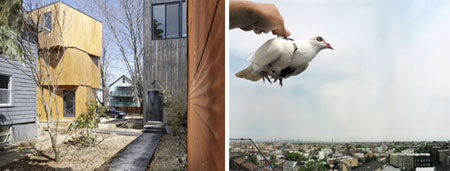
(left): uni’s XS, S, M, and L prototype houses; (right): Brooklyn Pigeon Project by Aranda/Lasch.

uni; Aranda/Lasch

“Risk is the territory of proof,” according to David Benjamin of the Young Architects Committee. Aranda/Lasch takes risks on a conceptual level through an engagement with open-ended explorations of pattern, while design/build firm uni engages risk on a pragmatic level balancing design with construction and development.

From explorations of “forbidden symmetries” found in molecular structure, woven baskets, and infrastructural proposals, Aranda/Lasch argues for an architecture situated within the patterns of natural and urban phenomena — to “get into the dynamic” is their goal, stated Benjamin Aranda. In the Brooklyn Pigeon Project, for example, the patterns of flocking pigeons are recorded through tracking devices and cameras to reframe our understanding of the city. In the Baskets Project, a collaboration with Native American basket weaver Terrol Dew Johnson, systems of pattern making (cultural and mathematical) are again taken as a starting point in an exploration of form. The study of pattern in their work is primarily about “looking at the world around us and breaking it down into phenomena,” claimed Chris Lasch, thus revealing new relationships, and perhaps new means of practicing architecture.

The risks taken by uni, on the other hand, deal with the realization of architecture as building. Taking command of their own destiny, Chaewon Kim and Beat Schenk did not simply open an office; they bought and renovated property until they completed the equivalent of a showroom of residential architecture. Four houses — categorized by size as XS, S, M, and L — function as a laboratory for exploration of domestic functions and materials. Through their design/build efforts they have made a compelling argument for the compatibility of design, real estate development, and straightforward construction.

Young Architects Test Their Boundaries

Event: Young Architects Forum: Proof
Location: The Urban Center, New York City, 05.17.07, 6:30
Speakers: Ivan Hernadez Quintela — ludens productions, Mexico City; Carlos Bedoya & Wonne Ickx & Victor Jaime & Abel Perles — PRODUCTORA, Mexico City
Introduction: Lisa Hseih — Young Architects Committee
Organizers: The Architectural League of New York

Museum of Contemporary Art in Lima

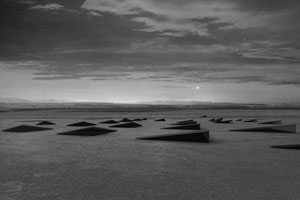
PRODUCTORA’s Museum of Contemporary Art in Lima, Peru, is buried under the desert sand.

PRODUCTORA

“Architectural practice is a process of persistently testing and reworking hypotheses continually moving toward ‘proof’,” posits Lisa Hsieh of The Architectural League of NY’s Young Architects Committee. Ludens and PRODUCTORA, two of this year’s selected architectural practices for the Young Architects Forum, both from Mexico City, embody this notion of testing through the exploration of boundary and representation in architecture.

Architecture is an “excuse for interaction” for Ivan Hernadez Quintela of ludens productions. Locating this interaction in a “space of friction,” Quintlela attempts to define the boundary between intimate space and the public realm and spur interaction among individuals. Demonstrating that architecture is incomplete without participation, the See-Saw Table alternates the positions of two participants between eating (lower and closer to the table) and talking (higher and away). Likewise, in some of his public furniture, such as a bench shaped like a spinning top, the interaction of multiple users is required to balance the shifts as each additional person gets involved. The result is equilibrium that is constantly recalibrated through a social and physical negotiation of space.

Boundary is more a question of representation than of social interaction in the work of PRODUCTORA. As inhabited and gradated thresholds, boundaries are experiential. In their proposal for the Tsunami Memorial Site in Oslo, Norway, a simple, abstract pathway that cuts into the land and hovers above the water represents the fragile relationship between culture and nature. In a proposal for the Museum of Contemporary Art in Lima, Peru, PRODUCTORA buries the project in its desert site. By organizing the museum as a hypostyle hall of various-sized columns that scale diagonally from one corner to the other — as thin columns to a series of “inhabitable columns,” their proposal re-presents the history of museums as dialogue of spatial typologies.

The testing of boundaries found in the work of both ludens and PRODUCTORA highlights the boundary as a fundamental condition for architecture while simultaneously questioning its very authority. The resultant “Proof” in the work of these practices then, is never final or determinant.

Gopnik Calls New York “Mono-Cultural Desert of Sameness”

Event: Gothamitis: Malcom Gladwell & Adam Gopnik in Conversation — The Inaugural Event of the Design Trust Council
Location: Museum of Modern Art, 05.02.07
Speakers: Adam Gopnik — author, Through the Children’s Gate, Paris to the Moon (Random House, 2000); Malcolm Gladwell — author, The Tipping Point, Blink; Deborah Berke, AIA — Co–Chair, Design Trust Council (Introduction)
Organizers: Design Trust for Public Space

Central Park

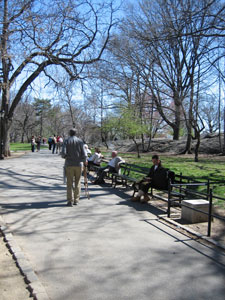
Central Park is necessary to preserve a unique sense of place in NYC, according to Adam Gopnik.

Jessica Sheridan

New York City has lost “a part of its identity,” bemoans Adam Gopnik in his article entitled “Gothamitis” (The New Yorker, 01.08.07). Although the city has drastically reduced crime, lowered unemployment, and cleaned up its streets since the 1970s, he describes the NYC of today as “an old lover who has gone for a facelift and come out looking like no one in particular.” Author Malcom Gladwell agrees that the city has changed drastically, but he believes the city has more subtle diversity than ever.

What NYC has maintained in density, it has lost in variety, according to Gopnik. The result is a “mono-cultural desert of sameness.” Gladwell, in contrast, posits that this loss of “physical diversity” has made way for “a more profound human diversity.” Conjuring an image of a coffee shop populated with young people working on laptops, he points out that these people are engaged in “highly varied pursuits, but the outward appearance of their production is the same.” Likewise, many of the city’s loft buildings that once housed the garment industry now support a variety of uses, from housing to commercial businesses. They may be “similar people with similar salaries,” Gladwell admits, but “they are doing very different things.”

While global economic trends have resulted in economic variety, Gopnik worries that, for the first time, Manhattan has no “Bohemian frontier.” While acknowledging the transfer of this activity to locations such a Williamsburg and Red Hook, NYC’s nature has changed from a compact and cosmopolitan place where varied socio-economic groups are in constant interface to a model of a city more akin to London, with far-flung and largely isolated neighborhoods of cultural generation.

Dismissing accusations of nostalgia, Gopnik sees the vernacular form of memory as defining “cultural values.” If global economic shifts affect NY, they cannot be left unquestioned. Looking to zoning codes, Central Park, and landmark preservation, Gopnik believes that similar interventions within the free market are necessary to maintain a desirable and valued city.

Balancing Great American Cities: Its Form AND Content

Event: Interpreting and MisInterpreting Jane Jacobs: New York and Beyond
Location: Museum of the City of New York, 03.07.07
Speakers: Ronald Shiffman, FAICP, Hon. AIA — Professor of Urban Planning, Pratt Institute; Michael Sorkin — Director, Graduate Urban Design Program, City College of New York; Margaret Zeidler — President, 401 Richmond, Toronto; Moderator Mary W. Rowe — Senior Urban Fellow, Blue Moon Fund; Roberta Brandes Gratz — Founder, The Center for the Living City at Purchase College (introduction)
Organizers: Museum of the City of New York

The Death and Life of Great American Cities

Jessica Sheridan

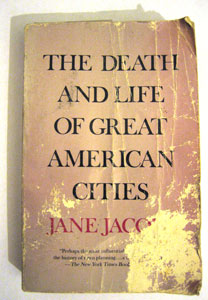
In The Death and Life of Great American Cities, Jane Jacobs praised the organized chaos of everyday urban life and articulates how a city’s aggregate form contributes to a vital life. She taught us how to listen to urban places, explains Roberta Brandes Gratz, founder of the Center for the Living City at Purchase College. In the neighborhoods she admired, Jacobs did not, however, see a model for but rather principles to guide urban development. In Greenwich Village, for example, Jacobs saw a healthy exchange between the public and private realms that should be replicated. But not all neighborhoods can or should be the Village.

According to Michael Sorkin, Director of the Urban Design Program at the City College of New York, the dual aspects of Jacobs thinking — the formal and the participatory — are interdependent. Often her ideas are misread because of the tendency to “divorce Jane Jacobs the activist from Jane Jacobs the gifted observer of urban morphologies.” Jacobs’s observations are increasingly lost as her ideas are appropriated “to sell large, top-down projects,” explained Ronald Shiffman, FAICP, Hon. AIA, Professor of Urban Planning at Pratt Institute. He cited the Atlantic Yards project in Brooklyn and Columbia University’s Manhattanville expansion as examples of this. As Sorkin summarized, “The form of the ‘good city’ and its culture are inseparable.”