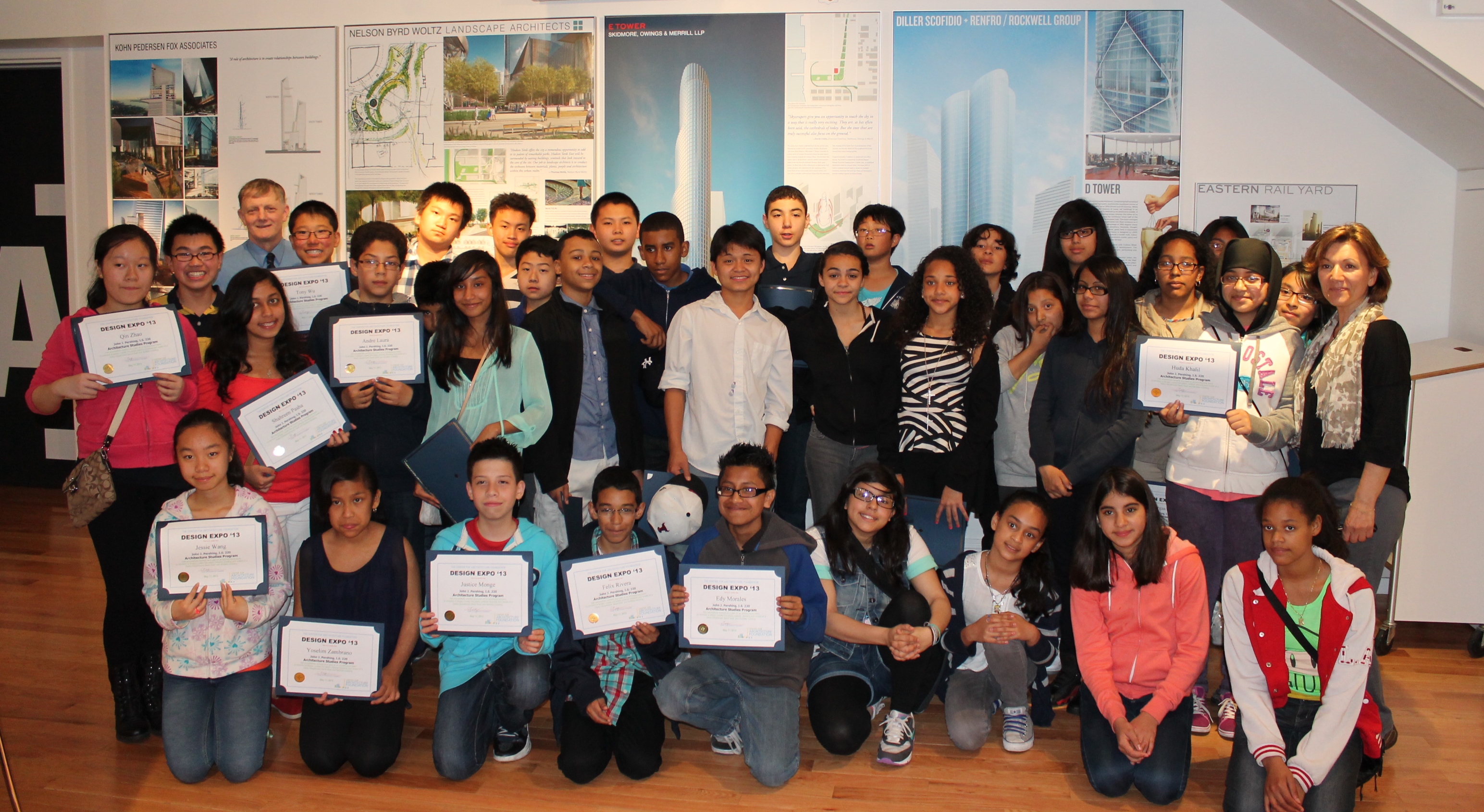
Each May, 7th-grade students from IS 220 in Sunset Park, Brooklyn, make their way to the Center for Architecture to present models and drawings they’ve created in a three-month school design program conducted in partnership with the Center for Architecture Foundation. For most students, these are the first architectural drawings and models they have ever made, and for all of them, their first visit to the Center. Having the opportunity to present their designs to a jury of professional architects in this setting elevates an ordinary school project into something with an extra sense of excitement and importance. Continue reading “Design Expo Returns to the Center”
Author: Catherine Teegarden
Landscape Design 101
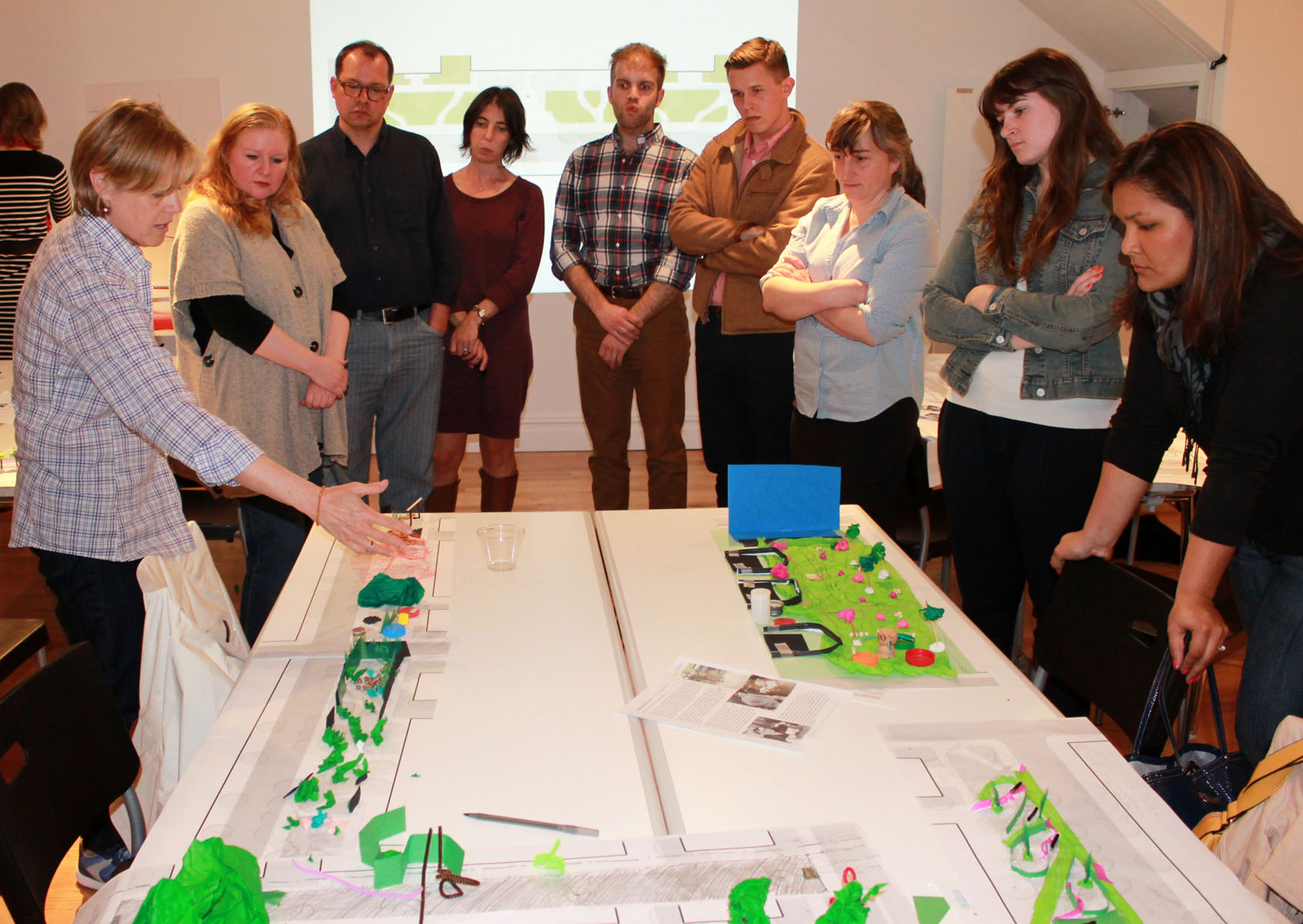
A diverse group gathered at the Center for Architecture on Wednesday 4.24.13 for a crash course on landscape architecture, culminating in their own designs for a new Memorial Park for Fiorella LaGuardia across the street from the Center. The program, Urban Parks & Plazas, was the first in a series of new public programs offered by the Center for Architecture Foundation. Called Design Insider, the series aims to nurture public understanding and appreciation of architecture and design in the city. Continue reading “Landscape Design 101”
Teachers Learn About Their School’s History
P.S. 1 staff on their first trip to the school’s roof.
Catherine Teegarden
Teachers at P.S. 1 enjoy learning about their school’s history.
Catherine Teegarden
Teachers and staff at P.S. 1 in Chinatown had a fascinating history lesson at a Center for Architecture Foundation workshop on 11.06.12. The focus of the program was the design of their own 1899 school building, one of 400 schools designed by Charles B.J. Snyder, Superintendent of School Buildings for New York City from 1891 – 1923.
C.B.J. Snyder expert Jean Arrington began the program with a slide talk familiarizing teachers with Snyder’s design ideas and the transformative effect his work had on the city’s school system. Snyder’s schools are typically elegant buildings with spacious, well-lit classrooms, good ventilation, and ample space for student recreation. He believed that students of every income level and background deserved dignified schools that would elevate the learning experience and improve the unhealthy conditions in which many New Yorkers lived. He developed innovative ways of fire proofing and maximizing the use of space through his signature “H-plan” layout, double stair halls, and rooftop playgrounds.
P.S. 1 teachers were amazed to see historic photographs of students using the rooftop play space and specialty classrooms on the building’s top floor. They lamented the boarding up of the once-operable transom windows that let light and air flow from classrooms to hallways, creating cooling breezes and brightening the school’s interior spaces. The teachers then took a tour of the building, starting at the roof and ending in the basement, identifying some of the design features they had just learned about. It was a fun way to kick off CFAF’s architecture program on local landmarks with P.S. 1’s second-graders, sponsored in part by the New York State Council on the Arts and the NYC Department of Cultural Affairs, and to give the staff a fresh perspective on their old school building.
Student design work from P.S. 1’s landmark program will be featured in CFAF’s annual “Building Connections” exhibit, opening Friday, 11.30.12, 4–7 pm at the Center. Historic schools will be the focus of the panel discussion “Adapting Historic Schools for 21st Century Learning” at the Center 01.17.13, 6–8 pm.
Students Design Resort Islands While on School Vacation at CFA

CFAF Lead Design Educator Tim Hayduk and students investigate tropical and ocean eco-systems at the American Museum of Natural History.
Claire Buckley

Twenty 3rd-5th-grade students spent their winter break creating their dream island resort.
Claire Buckley

Students worked with a variety of materials, developing their interests and skills in design through hands-on activities.
Claire Buckley

Design Your Own Island participants developed friendships while closely working together over the 3-day workshop.
Claire Buckley

Students proudly display and present their completed projects to parents and friends.
Claire Buckley

Detail of one of the many inventive deserted islands created during CFAF’s February Vacation Programs.
Claire Buckley
At first, the islands were deserted. Just bare ridges of brown earth forming hills and valleys, encircling ponds and reaching out like fingers into a still, turquoise sea. Then buildings began to appear on choice land at the higher elevations or marching down hillsides through bright green foliage to the sea. Eventually, these were joined by docks, walkways, activity centers, swimming pools, and beach umbrellas you’d expect to find at an eco-resort. An exciting new vacation destination was realized in this new tropical archipelago, improbably located at the Center for Architecture and created by a group of 8–11-year-olds at the Center for Architecture Foundation’s February Vacation Camp, Design Your Own Island.
Held during the public school winter break, this 3-day design program gave students who had stayed home for their holiday a chance to create their own tropical vacationlands under the guidance of CFAF Lead Design Educator Tim Hayduk. The students looked at examples of an environmentally-sensitive resort at Haystack Mountain School of Crafts where Hayduk had spent time last summer, to see how buildings might be designed to create a harmonious setting by the sea. The group also took a trip to the American Museum of Natural History to study tropical and ocean eco-systems, giving them ideas about the kind of flora and fauna they would find on their islands.
Each student drew a map of their island design, then learned how to transform this into a 3-D contour model that became the base for their resort design. Using colored cardboard, foamcore, toothpicks, wire, and other craft materials, they created the buildings and structures for their island resorts, and turned green tissue paper and “sushi grass” into shrubs, grasses, and tiny palm trees. As a final touch, the students created brochures describing their islands and resorts to potential visitors — their parents and friends who arrived at the end of Day 3 to be treated to tours of the 20 different islands by their designers.
The Center for Architecture Foundation’s upcoming Vacation Camps, March 27 – 29 and April 10 – 12, 2012, will focus on Skyscrapers for 3rd-5th graders and Digital Design for 6th-9th graders. For more information about these programs, or to register, visit www.cfafoundation.org/studio.
SketchUp@theCenter
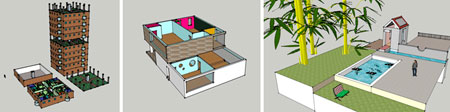
(L-R): Communicity; Green House; Personal Shelter
(L-R): Carin Queener; Jasmine Nadal-Chung; Jennifer Smith
The Center for Architecture Foundation (CFAF) welcomed two groups of students to the Center’s computer lab to learn the ins and outs of Google SketchUp. The afternoon class was for fifth- and sixth-graders who learned fundamental concepts in architectural design along with new computer skills. The evening group was for adults with a range of backgrounds, from professional architects to art teachers.
Once introduced to the basic tools in SketchUp by CFAF instructor Carol Gretter, both groups designed personal shelters. Adult participants found the project-based approach particularly helpful as they could practice their new skills in a real-life situation. Both groups also created short animations to walk viewers through their projects, which the kids shared with their parents at the last class.
The Foundation is offering two new SketchUp classes beginning in January. For adults, the eight-week Digital Design with Google SketchUp for Adults class runs Tuesdays, 6-7:30 pm, starting 01.10.12. Full participation in the class also earns 12 AIA CES Learning Units in Health, Safety, and Welfare.
Digital Design: From Books to Buildings will teach 5th-9th graders how to use SketchUp as they create a 3-D digital design for a building or place from a favorite book. Classes meet Tuesdays, 4-5:45 pm, beginning 01.03.12. For more information about either program or to register, click the links above or visit the CFAF website at http://www.cfafoundation.org.
(Buildings = Energy) + Kids = Creativity
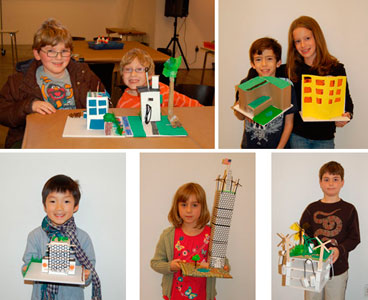
Eleanor Lygo
Energy ran high at the Center for Architecture Foundation’s Family Day on 11.12.11, as kids and their parents explored the Center for Architecture’s “Buildings = Energy” exhibition. They were excited to discover new technologies for trimming energy demand, such as elevators that recapture energy as they brake, and heating and cooling systems that tap into the earth’s steady temperature. Everyone loved the Solar Pod house designed by City College Architecture students and faculty to occupy empty rooftops in the city and create net-zero housing (and an entry in the 2011 Solar Decathlon). They were also impressed by the hi-tech gadgets in the exhibition’s Energy Lab, including the glowing Energy Orb, which changes color to indicate periods of peak energy demand and pricing to help consumers monitor and plan their energy use.
Creative juices really got flowing during the workshop portion of the program when families were challenged to take ideas from the exhibition and design their own energy-efficient buildings. These were as varied as the participants. Young designers proudly presented their buildings to the group and came away with new ideas of their own.
Families Envision NYC 2040
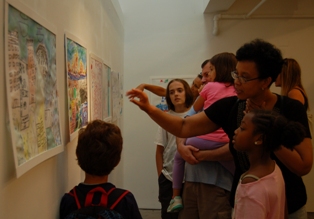
Students explore GLIMPSES.
Kristi Tremblay
Families gathered at the Center for Architecture on 07.09.11 to explore the Center’s summer exhibition, GLIMPSES: New York and Amsterdam in 2040. The exhibition, on display in both cities, presents architects’ and landscape architects’ visions for a sustainable urban future, developed by five Dutch and five New York design teams. Participating firms were asked to focus on five basic human needs — breathing, moving, eating, making, and dwelling — as they considered how to address issues related to global warming, including rising water levels, climate change, and population growth.
Using the Foundation’s Family Guide, children and their parents toured the exhibition and discussed the realistic and fanciful strategies shown for generating power, moving and making goods, housing people, and improving our urban environment. Kids especially enjoyed the projects that included futuristic ideas, such as robots manning recycling centers, as well as bucolic images of a greener view of the cities.
The workshop following the exhibition tour was an opportunity for participants to develop their own visions of what their city might look like in 30 years if they were able to redesign it to create a healthier urban environment. With mixed media such as watercolors, magazine cutouts, and drawing, families created large images modeled after those in the exhibition. They also created a simple cardboard frame and mounted their own “GLIMPSES” exhibition in the workshop space itself.
Although the kids’ exhibition was quickly dismounted, families are encouraged to come and do a self-guided tour using the Foundation’s printed Family Guide, which helps explain the exhibition to young visitors and gives them opportunities to respond to the work and create their own drawings and designs.
The Foundation offers Family Days once a month on Saturday at the Center for Architecture. The next program, Exploring Governors Island, will be held on Governors Island on 08.20.11. The Foundation also offers after-school, vacation, and summer programs for students in grades 3-12. For more information about Programs@theCenter, visit the website or contact Catherine Teegarden at cteegarden@cfafoundation.org.
Making the Most of a School Vacation
Event: Studio@theCenter
Location: Center for Architecture, 02.22-24.11
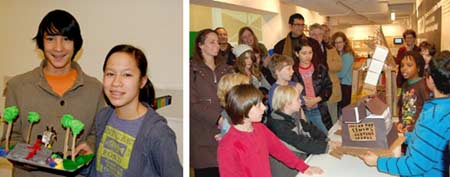
Two “Street Smart Designer” students (left); third-sixth graders participate in the “From Books to Building” program.
Catherine Teegarden
Public schools were closed last week, but learning didn’t stop for the 34 students who participated in Studio@theCenter, the Center for Architecture Foundation’s three-day school vacation program. Studio programs give 3rd- through 12th-grade students a chance to explore architecture and design through hands-on projects and field trips to local designers’ offices. Two programs were held this February: “From Books to Buildings” for 3rd-6th graders, and “Street Smart Designer” for 6th-12th graders.
Students in “From Books to Buildings” were given a photograph and asked to create a story for that setting. Going from buildings to books helped students identify the elements that give spaces a certain quality — learning how differences in scale, form, and materials can make a place feel spooky, dangerous, or cozy. Then, students crafted models of their spaces, down to minute details such as laundry lines and theater curtains, after which they gave presentations to their parents. The class also was given a tour of H3 Hardy Collaboration Architecture, where students learned about the work of an architect and how models and digital renderings are used to develop and present their designs.
In “Street Smart Designer,” students created digital and physical models of their own designs for multi-purpose street furniture using both Google Sketch-Up and cardboard and glue. Working in pairs to come up with designs that combined two or more functions, students created bench/bike racks and streetlight/garbage cans with emergency response phones. Students also paid a visit to Urban Movement Design, a firm dedicated to promoting healthy living and movement through innovative designs for the home and urban environment. The elements of accessibility, movement, and play were highlighted to give each student insight into how their designs could best serve the community. Even the professionals were wowed by the students’ Sketch-Up animations and carefully crafted models.
Special thanks to H3 Hardy Collaboration Architecture and Urban Movement Design for donating their time to the Center for Architecture Foundation. Additional Studio@theCenter programs, “Green NYC 2030” for 3rd-6th graders and “Digital Design with Google Sketch-Up” for 7th-12th graders, will be held 03.22-24.11 and 04.19-21.11. Registration is also open for the Foundation’s Summer@theCenter programs. Visit http://www.cfafoundation.org/summer for more information.
Students Explore the Middle Ages At the Center
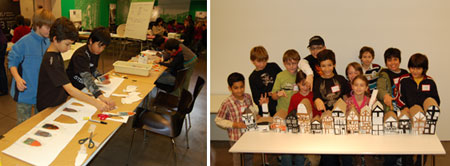
CFAF students built a model of a town from the Middle Ages.
Catherine Teegarden
This fall, 14 eight-to-10-year-old students were studying the Middle Ages as part of their home school program, and were looking to augment their studies with a hands-on project about the architecture of the time. Since the group does not have a shared classroom, the Center for Architecture served as the home base for an eight-week residency in which students built a scale model of a typical medieval European walled town.
The program began with an introduction to new architectural terms and important elements of medieval building design and structure, as well as an overview of the general layout and organization of a medieval town. Each student then chose trades from the Middle Ages that they adopted and created models of the related house/workshops. Together, the group also built a Gothic church for the town, exploring features such as Gothic arches and the use of buttresses. Through this residency, students learned about architecture, the jobs, and daily life of medieval people, as well as developing skills in scale measurement and model building.
While each member of the group is pursuing their own study of the Middle Ages independently, through the Center for Architecture Foundation they were able to come together. In January, the students will complete the town by building the castle and surrounding walls, adding scaled-to-size people and other appropriate accessories. This new residency program was such a success that plans are underway for a spring program focusing on early Native American life in the NY area.
ARCHITECTURE 101: Summer Architectural Design Studio

Students work on models of their designs (left); a high school student presents his final project.
Maggie Yolen
The Center for Architecture Foundation recently completed its first two-week Architectural Design Summer Studio program for high school students. The course was designed to give young people a taste of what architecture school might be like, to help them learn about what the practice of architecture entails, and to help them decide if they might enjoy the profession. According to one student, architecture is “more complicated than I imagined.”
The class was structured like a typical architecture school program with the major focus on the design studio, supplemented by scale drawing, model building and digital design, architectural history, and an introduction to professional practice. Thirteen students from as far away as Rockland County and Long Island participated, culminating in a final presentation at the Center on 07.09.10. Along the way, students visited the Irwin S. Chanin School of Architecture at the Cooper Union, toured offices of Thomas Phifer and Partners and Frederic Schwartz Architects and the Storefront for Art and Architecture. Photos from the program can be viewed on Facebook.
Course instructor Eric Ratkowski had students begin by designing a household object that then became the focal element for their studio projects — a 400-square-foot gallery and artist residence. Students were challenged to think about the interaction of private and public spaces, and develop a design concept that could tie together their object, their understanding of the site, and their ideas about architecture. Then, they worked together to build a site model of the project site on West 3rd Street and 6th Avenue. In reflecting on the program, one student summed it up: “I have a better understanding of what architecture is all about and even if I don’t end up studying it, I can appreciate it more.”
If you know a young person who is interested in learning more about architecture, there are a few spaces left in the Summer Studio programs Waterfront Parks for middle school students (07.26-30.10) and Playground Design for elementary students (08.09-13.10). For more information, visit the Center for Architecture Foundation’s website: www.cfafoundation.org. To join the mailing list for updates on future programs, e-mail info@cfafoundation.org.